
Judge, 1912-12-14 · page 11 of 26
Judge — December 14, 1912 — page 11: what you’re looking at
What you’re looking at
This satirical story mocks the absurdity of American football culture and parental pride in the early 1900s. A college football player arrives home battered and injured from a brutal game, yet his mother celebrates his toughness while fearing for his safety—a contradiction the narrative highlights. The joke deepens when the father claims credit for his son's strength, boasting about his own "leg" that the boy has been "pulling" harder since arriving at college. The innuendo—suggesting the father has been financially supporting (or being financially drained by) his son—culminates perfectly when the hero immediately asks for money ("an extra"), cutting off before he can finish. The satire targets both glorification of violent sports and the vanity of fathers who take undeserved credit for their sons' accomplishments while being exploited financially. The Hamlet quote emphasizes the questionable morality of the entire scenario.
📄 Transcribed text from this page (OCR, searchable)
Machine-transcribed from the original scan — historical spelling and the odd misread are preserved.
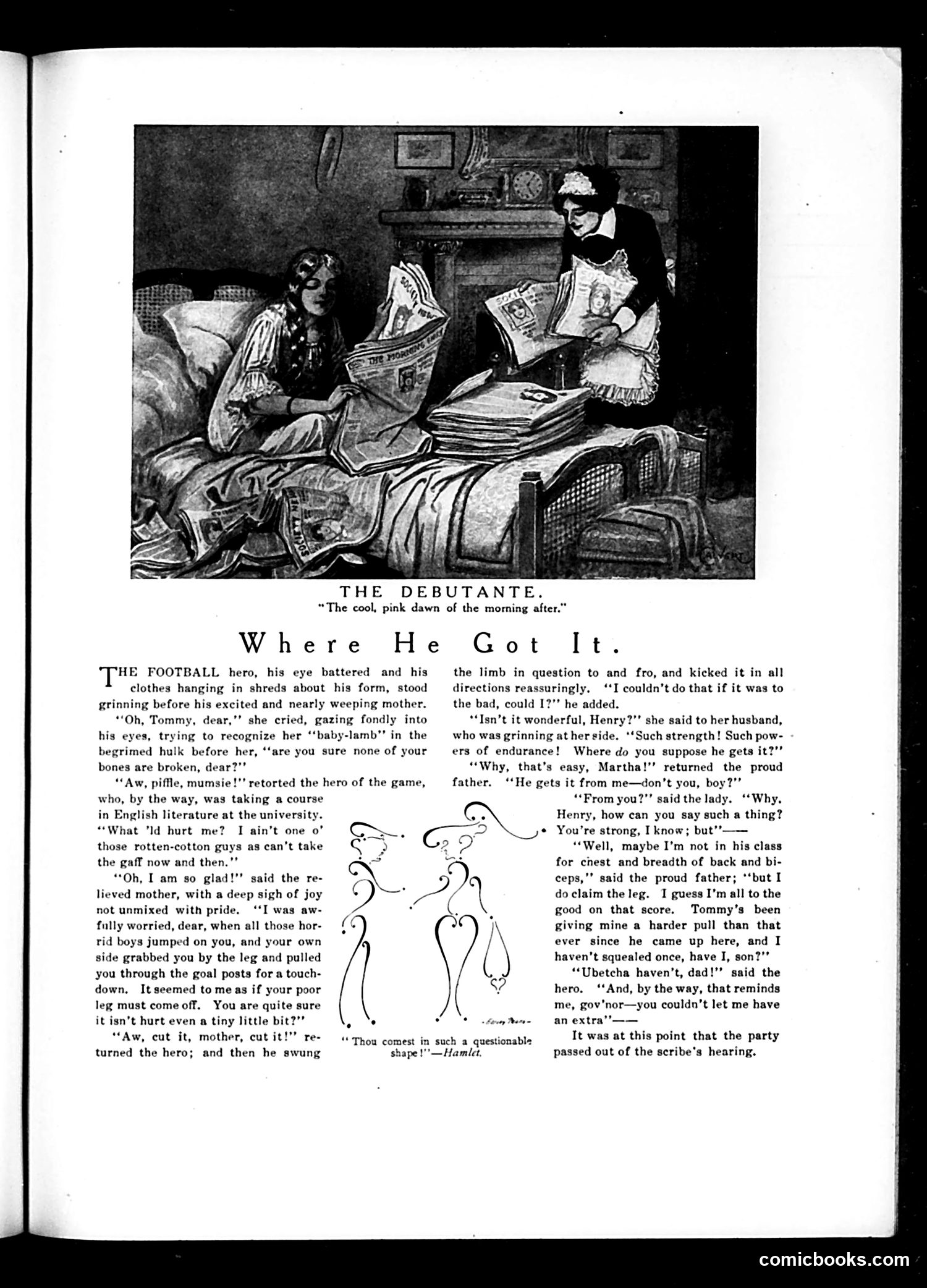
THE DEBUTANTE. “The cool, pink dawn of the morning after.” He HE FOOTBALL hero, his eye battered and his clothes hanging in shreds about his form, stood grinning before his excited and nearly weeping mother. “Oh, Tommy, dear,’’ she cried, gazing fondly into his eyes, trying to recognize her ‘‘baby-lamb’’ in the begrimed hulk before her, ‘‘are you sure none of your bones are broken, dear?"’ “Aw, piffle, mumsie!"' retorted the hero of the game, who, by the way, was taking a course in English literature at the university. “What ‘Id hurt me? I ain’t one o° those rotten-cotton guys as can’t take the gaff now and then.”” “Oh, I am so glad!’ said the re- lieved mother, with a deep sigh of joy not unmixed with pride. ‘I was aw- fully worried, dear, when all those hor- rid boys jumped on you, and your own side grabbed you by the leg and pulled you through the goal posts for a touch- down, Itseemed to meas if your poor leg must come off. You are quite sure it isn’t hurt even a tiny little bit?” oe “Aw, cut it, mother, cut it!" re- turned the hero; and then he swung Where “Thou comest in such a questionable shape !""—Hamlet, Got It. the limb in question to and fro, and kicked it in all directions reassuringly. ‘*I couldn’t do that if it was to the bad, could 1?’’ he added. “‘Isn’t it wonderful, Henry?"’ she said to her husband, who was grinning atherside. *‘Such strength! Such pow- ers of endurance! Where do you suppose he gets it?’’ “Why, that’s easy, Martha!’’ returned the proud father. ‘‘He gets it from me—don’t you, boy?’’ “From you?"’ said the lady. ‘‘Why,. Henry, how can you say such a thing? « You’re strong, I know; but””—— “*Well, maybe I’m not in his class for chest and breadth of back and bi- ceps,’’ said the proud father; *‘but I do claim the leg. I guess I'm all to the good on that score. Tommy's been giving mine a harder pull than that ever since he came up here, and I haven't squealed once, have I, son?”’ “Ubetcha haven’t, dad!’’ said the hero. ‘‘And, by the way, that reminds me, gov’nor—you couldn’t let me have an extra’’—— It was at this point that the party passed out of the scribe’s hearing. comicbooks.com