
Judge, 1912-12-14 · page 17 of 26
Judge — December 14, 1912 — page 17: what you’re looking at
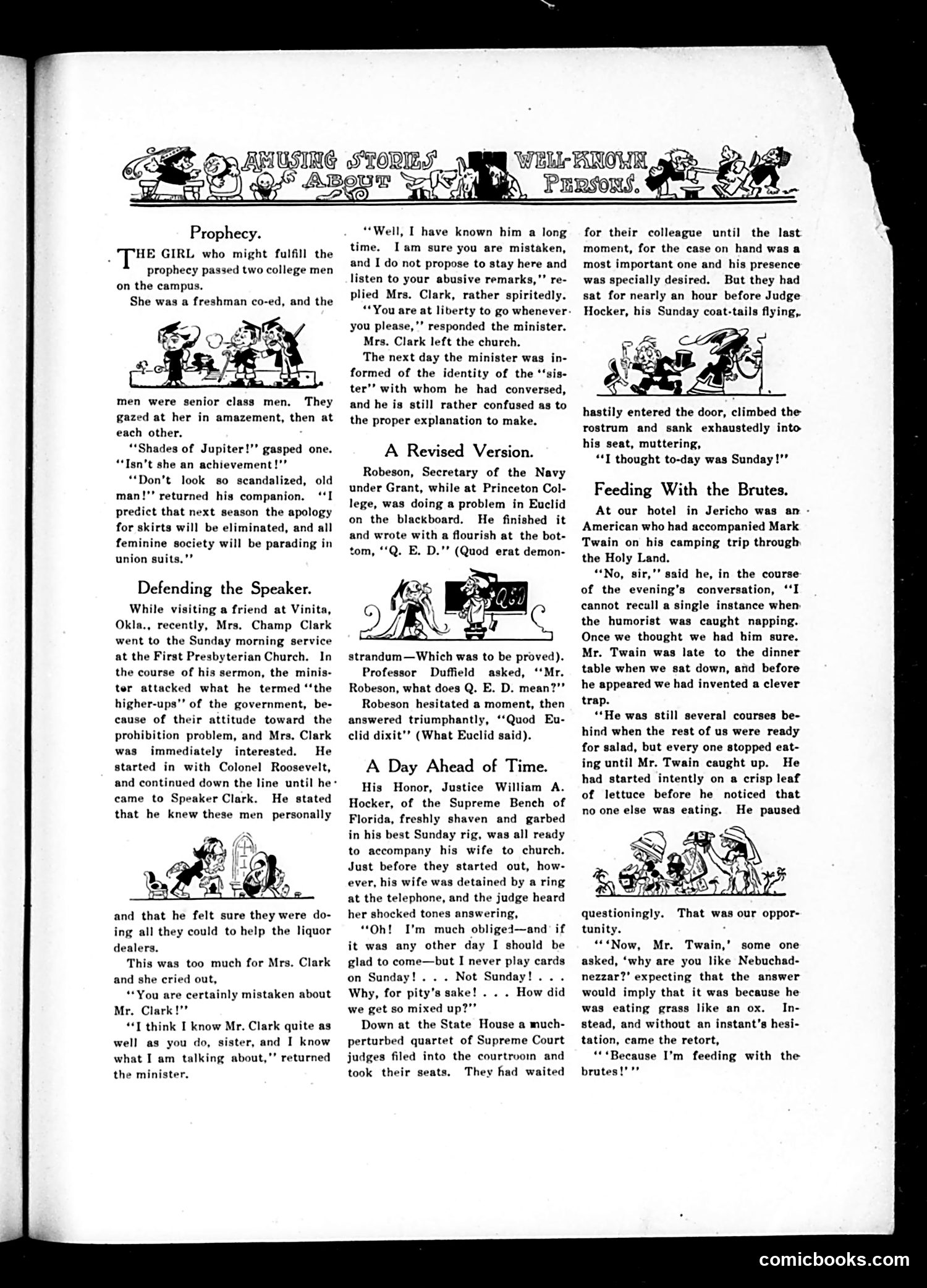
A restored page from Judge, 1912-12-14. Page through the whole issue in the reader above.
📄 Transcribed text from this page (OCR, searchable)
Machine-transcribed from the original scan — historical spelling and the odd misread are preserved.
RALUSIRE STORIES i « Prophecy. HE GIRL who might fulfill the prophecy passed two college men on the campus. She was a freshman co-ed, and the men were senjor class men. They gazed at her in amazement, then at each other. “Shades of Jupiter!’’ gasped one. “Isn't she an achievement!"’ “Don’t look so scandalized, old man!"’ returned his companion. ‘‘I predict that next season the apology for skirts will be eliminated, and all feminine society will be parading in union suits.’’ Defending the Speaker. While visiting a friend at Vinita, Okla., recently, Mrs. Champ Clark went to the Sunday morning service at the First Presbyterian Church. In the course of his sermon, the minis- ter attacked what he termed ‘‘the higher-ups"’ of the government, be- cause of their attitude toward the prohibition problem, and Mrs, Clark was immediately interested. He started in with Colonel Roosevelt, and continued down the line until he: came to Speaker Clark. He stated that he knew these men personally and that he felt sure they were do- ing all they could to help the liquor dealers. This was too much for Mrs. Clark and she cried out, **You are certainly mistaken about Mr. Clark!’’ “I think I know Mr. Clark quite as well as you do, sister, and I know what I am talking about,’’ returned the minister, ABOUT S ‘Well, I have known him a long time. Iam sure you are mistaken, and I do not propose to stay here and listen to your abusive remarks,”’ re- plied Mrs. Clark, rather spiritedly. “You are at liberty to go whenever: you please,’’ responded the minister. Mrs. Clark left the church. The next day the minister was in- formed of the identity of the ‘‘sis- ter’? with whom he had conversed, and he is still rather confused as to the proper explanation to make. A Revised Version. Robeson, Secretary of the Navy under Grant, while at Princeton Col- lege, was doing a problem in Euclid on the blackboard. He finished it and wrote with a flourish at the bot- tom, ‘‘Q. E. D."” (Quod erat demon- strandum—Which was to be proved). Professor Duffield asked, ‘Mr. Robeson, what does Q. E. D. mean?’”’ Robeson hesitated a moment, then answered triumphantly, ‘‘Quod Eu- clid dixit’? (What Euclid said). A Day Ahead of Time. His Honor, Justice William A. Hocker, of the Supreme Bench of Florida, freshly shaven and garbed in his best Sunday rig, was all ready to accompany his wife to church. Just before they started out, how- ever, his wife was detained by a ring at the telephone, and the judge heard her shocked tones answering, “Oh! I'm much obligei—and if it was any other day I should be glad to come—but I never play cards on Sunday! ... Not Sunday! ... Why, for pity’s sake! . . . How did we get so mixed up?” Down at the State House a much- perturbed quartet of Supreme Court judges filed into the courtrooin and took their seats, They had waited for their colleague until the last moment, for the case on hand was a most important one and his presence was specially desired. But they had sat for nearly an hour before Judge Hocker, his Sunday coat-tails flying, hastily entered the door, climbed the rostrum and sank exhaustedly into his seat, muttering, “I thought to-day was Sunday !’’ Feeding With the Brutes. At our hotel in Jericho was an - American who had accompanied Mark Twain on his camping trip through the Holy Land. “No, sir,’’ said he, in the course of the evening’s conversation, ‘‘I cannot recull a single instance when the humorist was caught napping. Once we thought we had him sure. Mr. Twain was late to the dinner table when we sat down, and before he appeared we had invented a clever trap. “He was still several courses be- hind when the rest of us were ready for salad, but every one stopped eat- ing until Mr. Twain caught up. He had started intently on a crisp leaf of lettuce before he noticed that no one else was eating. He paused questioningly. That was our oppor- tunity. “Now, Mr. Twain,’ some one asked, ‘why are you like Nebuchad- nezzar?’ expecting that the answer would imply that it was because he was eating grass like an ox. In- stead, and without an instant’s hesi- tation, came the retort, “*Because I’m feeding with the brutes!’"’ comicbooks.com