
A complete issue · 24 pages · 1912
Judge — September 28, 1912
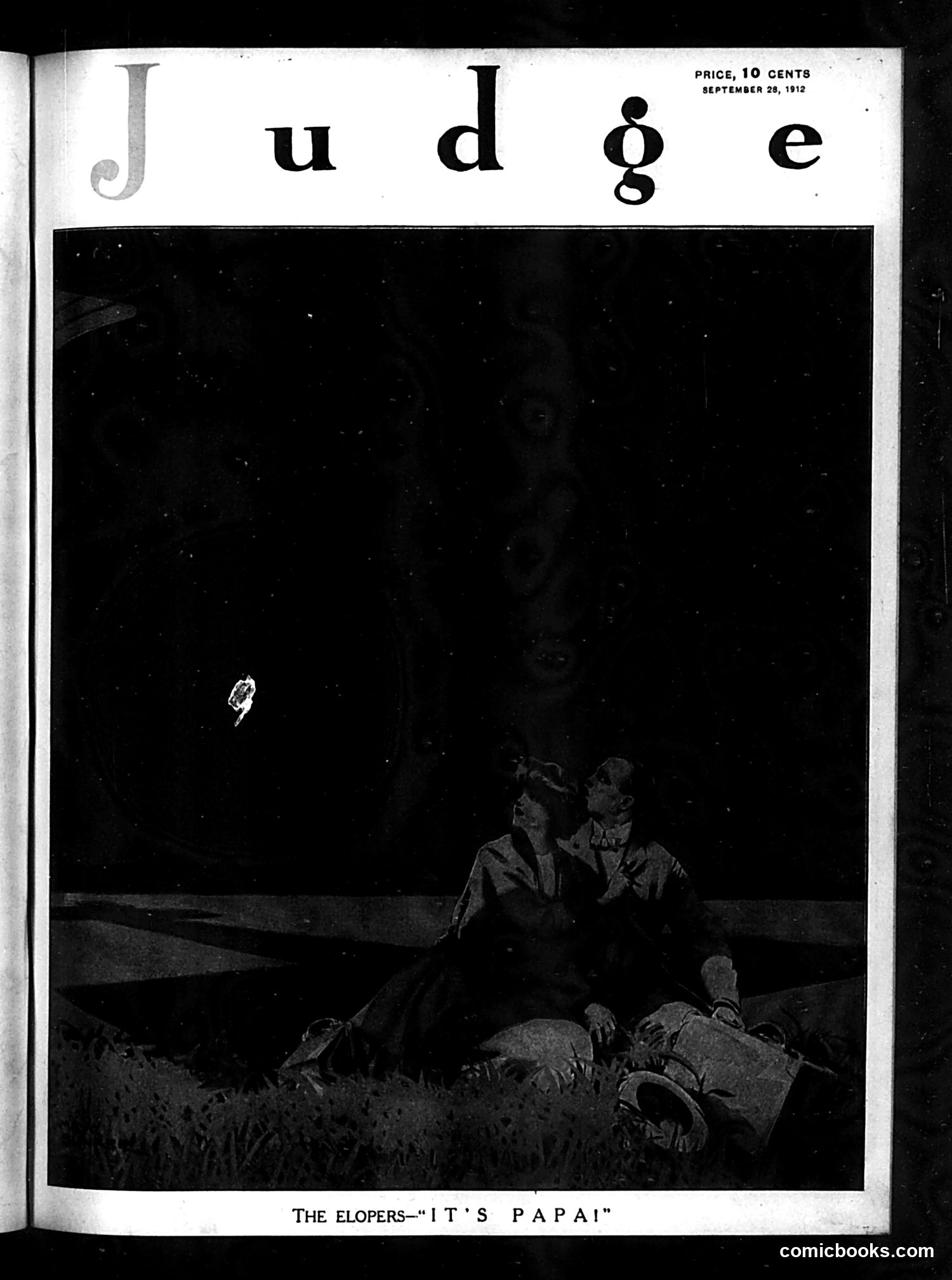
The caption reads "THE ELOPERS—'I T'S PAPAI'" This appears to be a dramatic scene depicting two figures (a couple) in what looks like a nighttime or dark setting, with a third figure visible below them. The image suggests a romantic elopement scenario—a young couple fleeing together, likely without parental consent. The joke relies on the woman apparently recognizing her father ("It's Papa!") in an awkward encounter during their escape. The satire targets the Victorian social convention of parental control over courtship and marriage, poking fun at the inevitable comedic confrontation when an elopement is discovered or interrupted. Without additional context identifying the specific figures, this appears to be a general satirical commentary on generational conflict and romance rather than a reference to particular public figures.
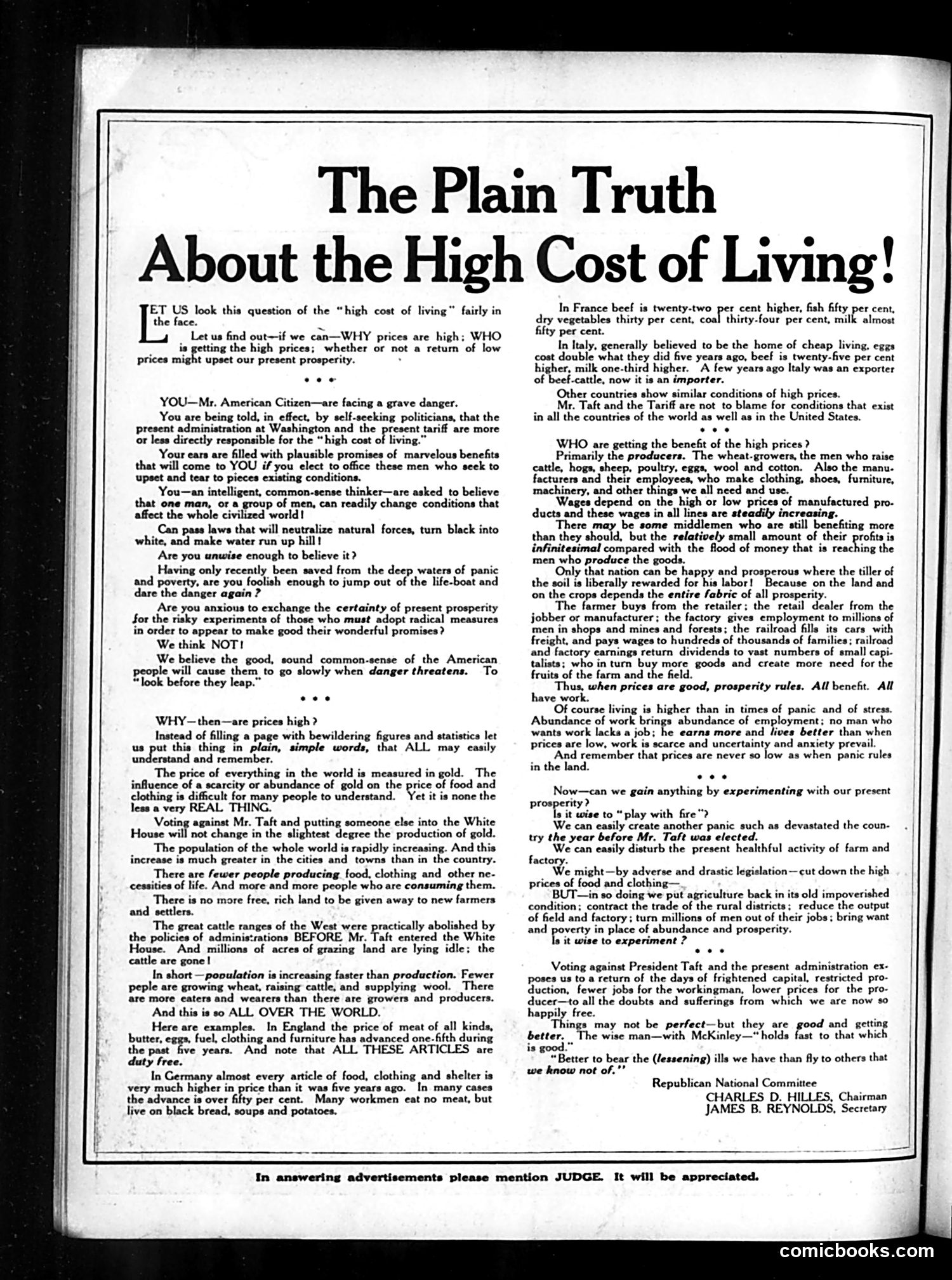
This appears to be a Republican National Committee advertisement from Judge magazine, authored by Charles D. Hillis and James B. Reynolds. The piece defends high living costs against criticism of the current (appears to be early 1900s) administration. The argument contends that rising prices benefit producers—farmers, manufacturers, and workers—more than they harm consumers. It attacks proposals to experiment with the economy, dismissing them as dangerous "playing with fire." The text advocates against voting for the opposing party's candidate (likely Taft based on references), arguing that radical economic measures would harm prosperity. Rather than satirical cartoon content, this is straightforward political propaganda using Judge's platform to influence readers toward Republican positions on economic policy and cost of living.
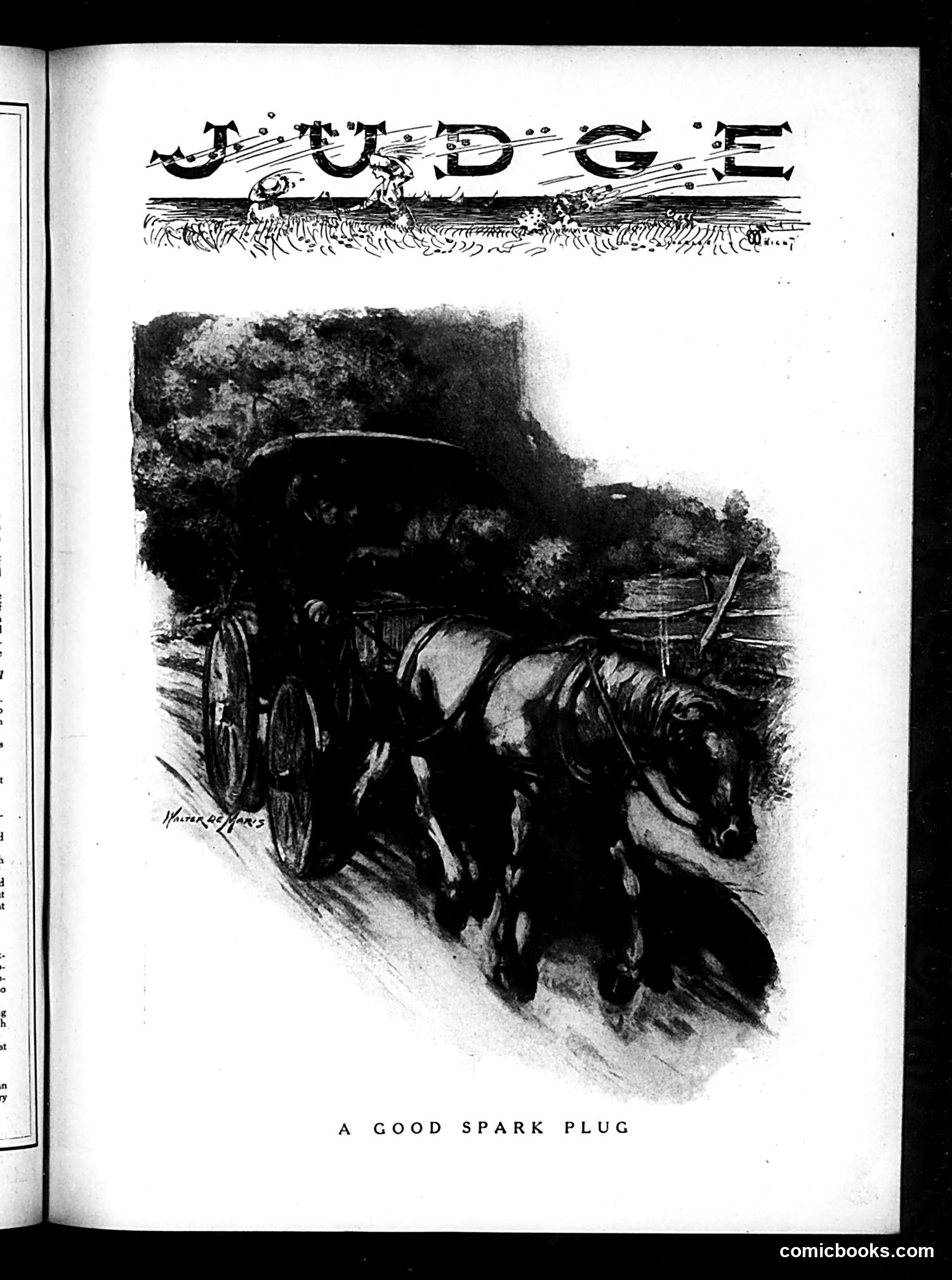
This page from *Judge* magazine features an illustration of a horse-drawn wagon with a driver, captioned "A Good Spark Plug." The "JUDGE" masthead sits above the image. The satire likely plays on the double meaning of "spark plug"—both the automotive engine component and the metaphorical term for an energetic, motivating person or force. Given the horse-drawn cart depicted, this appears to be early 20th-century humor about the transition from traditional transportation to automobiles. The joke probably contrasts horses (old technology) with the need for a "spark plug" (modern innovation), or satirizes someone/something driving progress forward. Without additional context about the magazine's date or political climate, the specific target remains unclear.
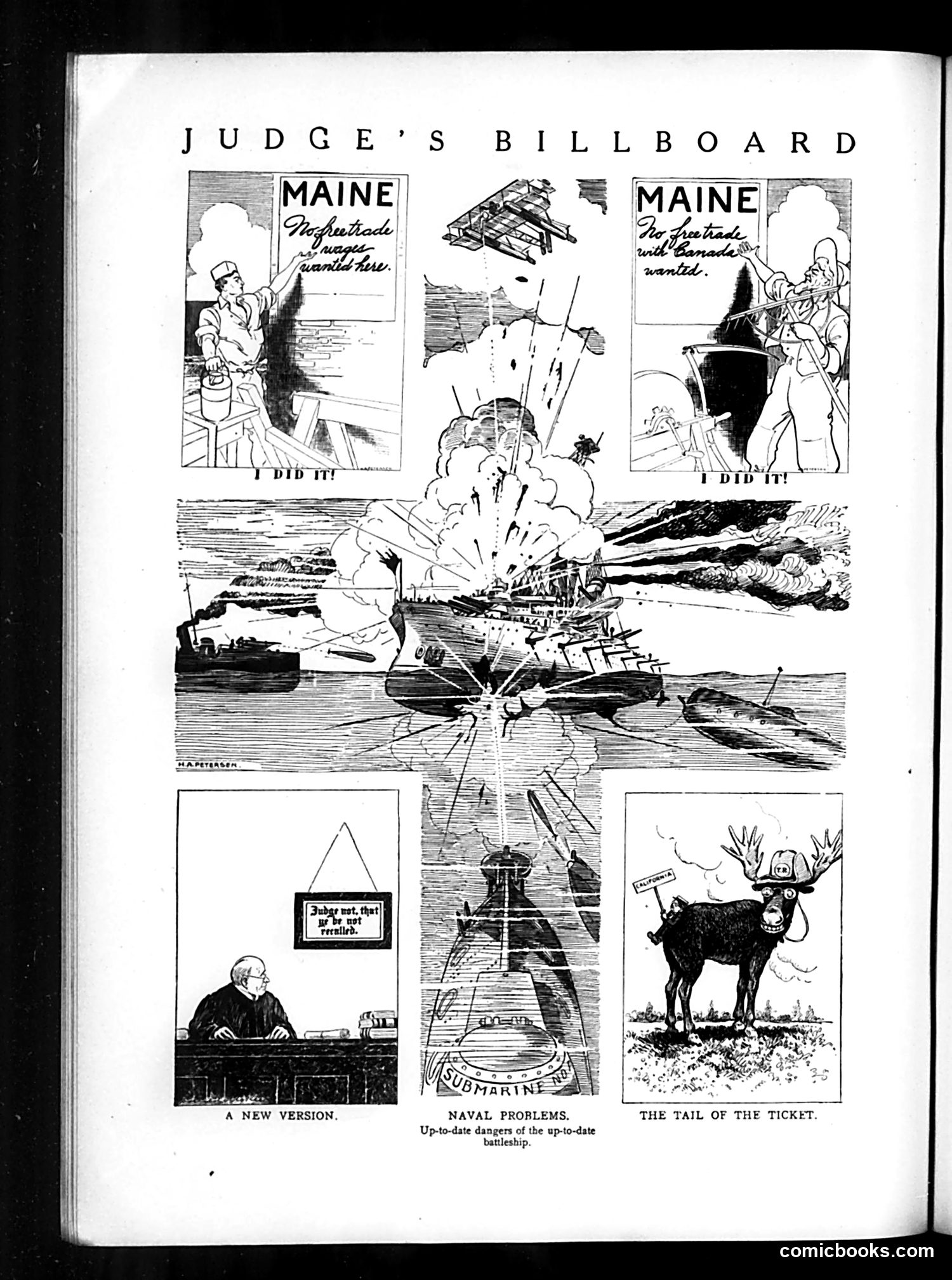
This page satirizes American naval power and Maine's role in military preparedness, likely from the early 1900s. The top panels show Maine officials proudly advertising the state's shipbuilding capacity ("I did it!"). The central image depicts a naval battle with a submarine—representing "up-to-date dangers" to modern battleships, a contemporary concern as submarine warfare was emerging as a strategic threat. The bottom section mocks judicial proceedings ("A New Version") and features "The Tail of the Ticket"—a moose wearing a Viking helmet, likely referencing Theodore Roosevelt's 1912 Progressive "Bull Moose" Party campaign. The overall message appears critical of Maine's military boasting while submarines render traditional battleships vulnerable.
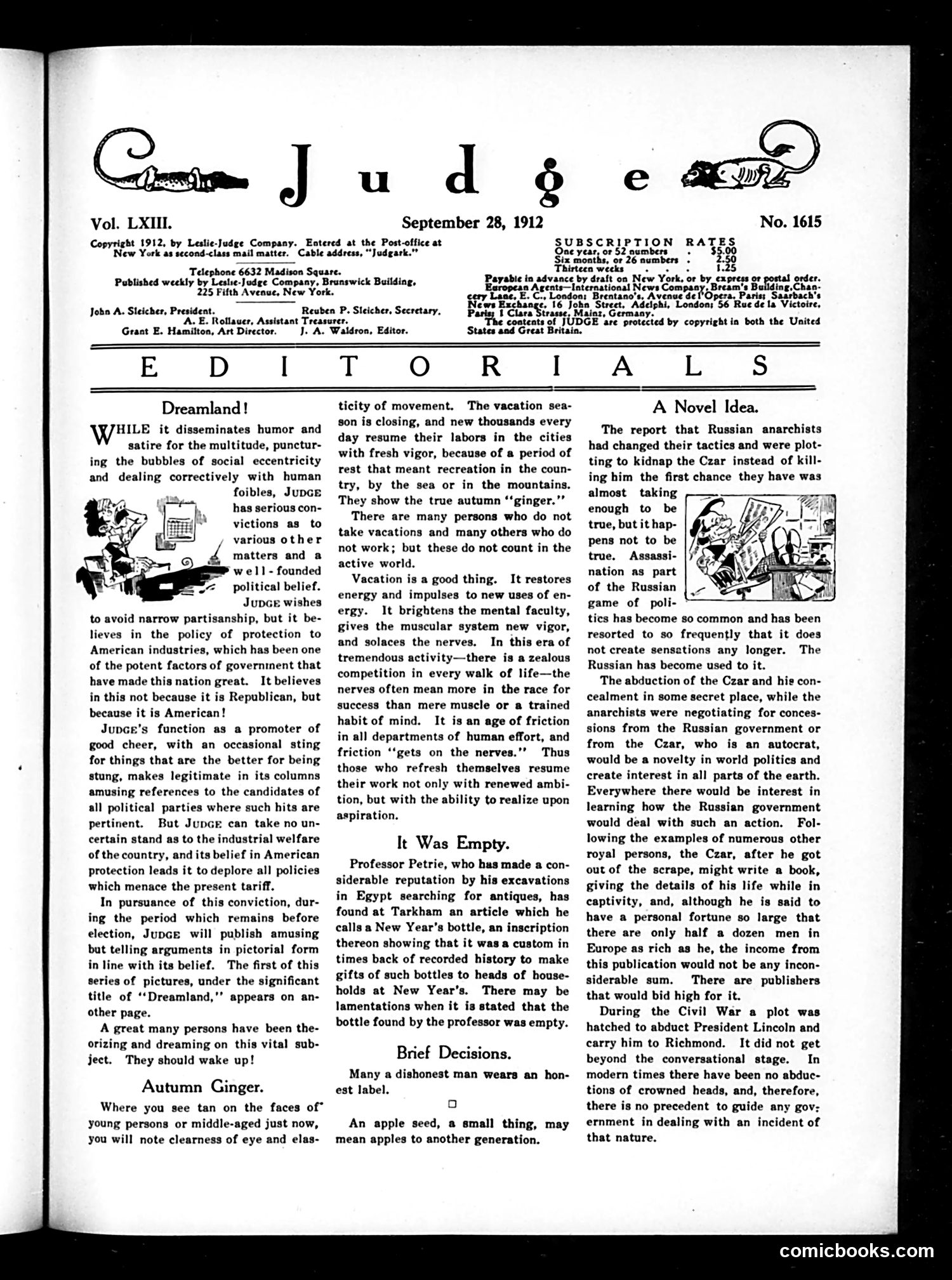
This editorial page contains three distinct sections: **"Dreamland!"** - A satirical piece praising vacations and rest as necessary for mental and physical vigor, advocating that workers deserve time away. The implicit criticism targets those who oppose labor protections. **"It Was Empty"** - References Professor Petrie's archaeological discovery in Egypt of a New Year's bottle with an inscription claiming it was a "custom in times back of recorded history." The joke: the bottle was empty—suggesting either the ancient practice was meaningless or Petrie's claim lacks substance. **"Brief Decisions"** - Short aphorisms, including cynical observations like "Many a dishonest man wears an honest label" and "An apple seed, a small thing, may mean apples to another generation." The page emphasizes Judge's satirical approach to social critique, labor issues, and human nature, with illustrations accompanying the main "Dreamland" editorial.
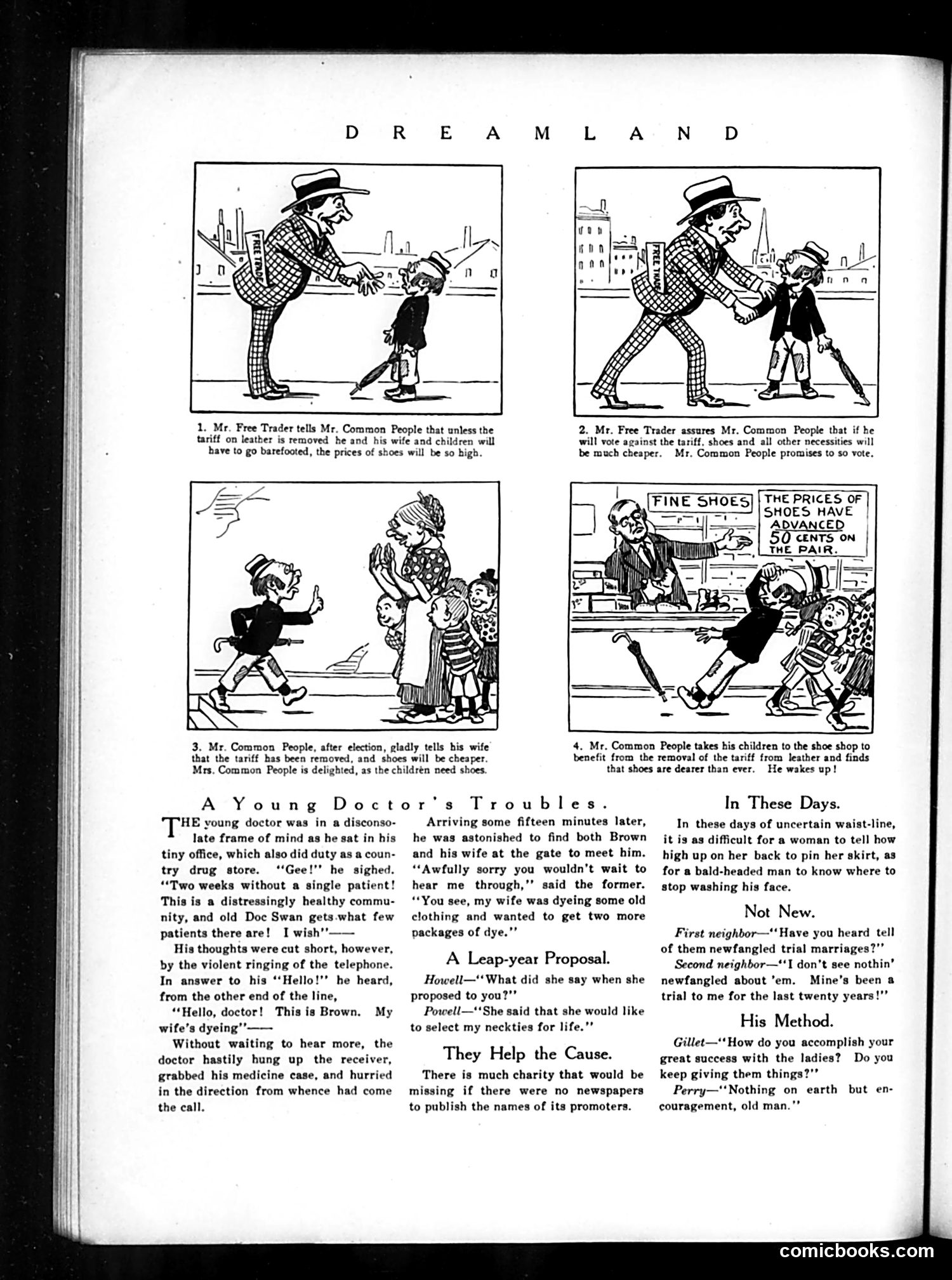
The four-panel cartoon "Dreamland" satirizes free-trade political rhetoric and its failure to deliver promised benefits. **Mr. Free Trader** (representing pro-free-trade politicians) persuades **Mr. Common People** (the working-class voter) that removing protective tariffs on leather will make shoes affordable. Mr. Common People votes accordingly, believing his family will benefit. Panel 4 reveals the con: shoe prices actually *rise* 50 cents per pair. When Mr. Common People takes his children to buy shoes, he discovers the tariff's removal benefited manufacturers, not consumers—he "wakes up" to the deception. This attacks the gap between campaign promises and economic reality, suggesting voters were duped by politicians' hollow assurances. The "dreamland" is the false promise of cheaper goods through free trade—a pointed critique of Gilded Age trade policy debates and political dishonesty toward ordinary workers.
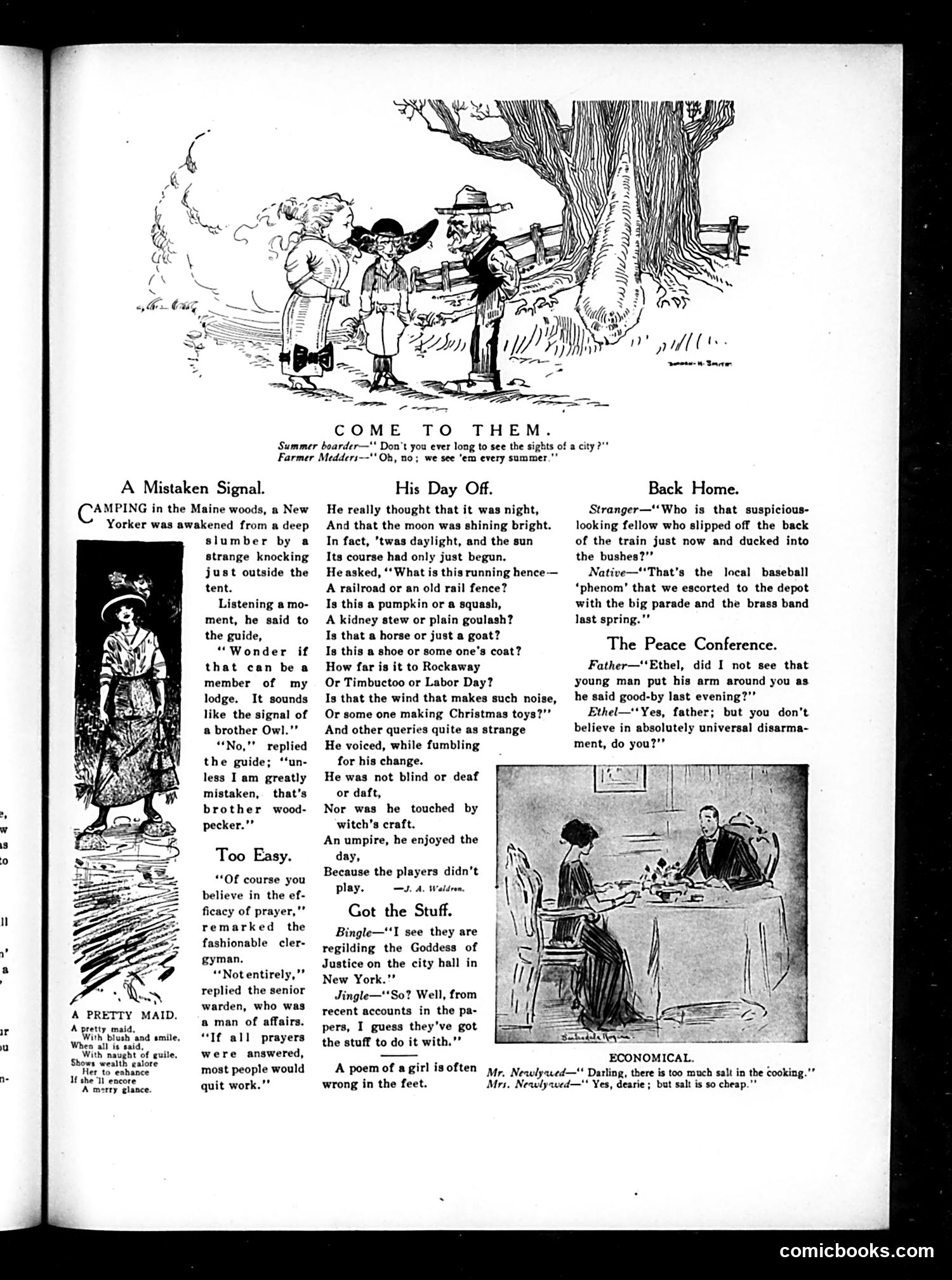
This page collects humorous anecdotes typical of early 20th-century American satirical humor. **Key content:** - **"Come to Them"** (top): A city visitor asks a farmer if he longs for urban sights; the farmer replies they see summer visitors every year—a gentle joke about rural life's predictability. - **"A Mistaken Signal"**: A camper mishears a woodpecker's knock for a Masonic lodge signal, mocking city people's unfamiliarity with nature. - **"His Day Off"**: An umpire, confused during daylight, asks absurd questions about everyday objects. The joke: without baseball to umpire, he's bewildered and useless. - **"Back Home"**: A local baseball star, celebrated with a parade, slinks back from the train—implying he failed professionally. - **"The Peace Conference"**: A daughter uses disarmament rhetoric to justify allowing her boyfriend to embrace her, cleverly deflecting her father's objection. **Overall tone**: Gentle satire mocking city/country contrasts, male confusion, and youthful romance—typical Judge fare emphasizing social observation over political commentary.
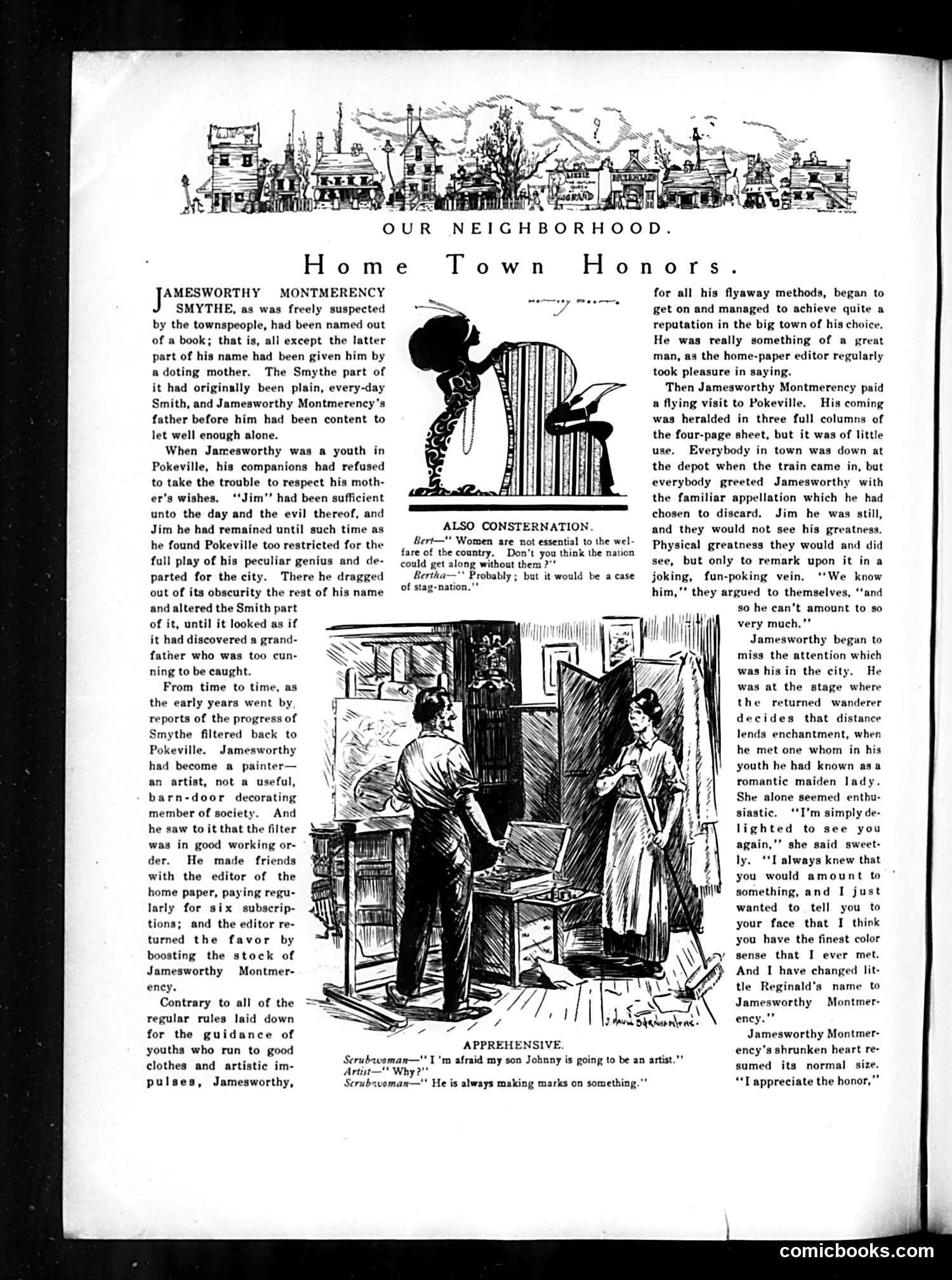
This story satirizes small-town pretension and the human need for recognition. Jamesworthy Montmerency Smythe—a name artificially elevated from plain "Smith"—escapes his hometown Pokeville to become a painter in the city, where he cultivates a reputation through careful self-promotion (bribing the local paper editor). When he returns as a celebrated artist, the townspeople frustrate him by refusing to acknowledge his transformation, calling him "Jim" as always. The satire targets how hometowns stubbornly deny their own children's achievements—"we know him" so he "can't amount to much." His spirits only revive when a former romantic interest validates him by naming her son after him, appealing to his vanity rather than his actual accomplishments. The accompanying jokes mock artistic pretension and gender roles ("stag-nation") in typical Judge fashion. The overall message critiques both small-town insularity and the artist's desperate hunger for recognition.
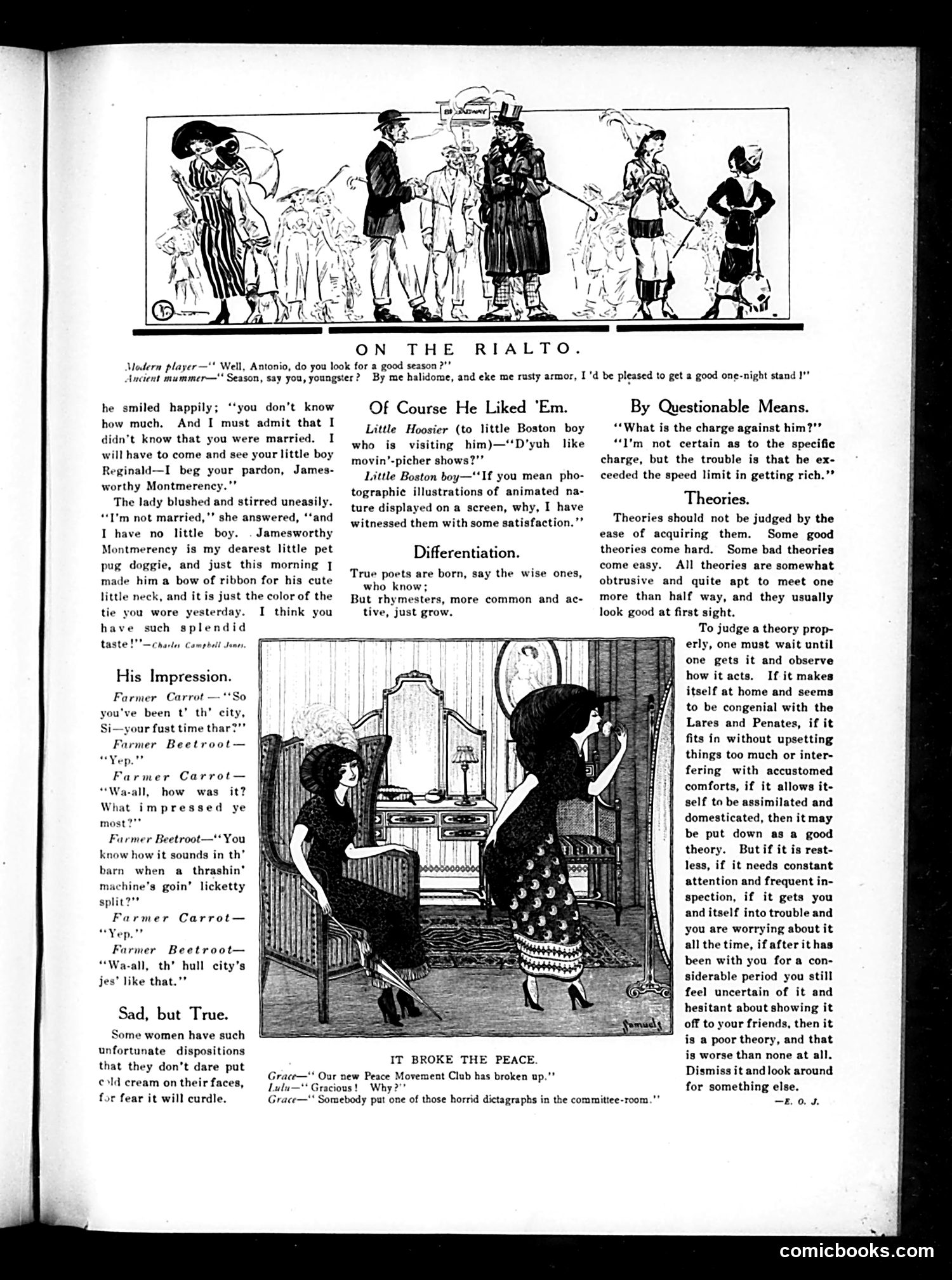
This page from *Judge* magazine contains several satirical sketches mocking early 20th-century society: **"On the Rialto"** pokes fun at theatrical pretension—an older actor mistakes a woman's pet pug dog for her child, embarrassing her. **"Of Course He Liked 'Em"** contrasts regional dialects: a Boston boy's verbose, pedantic description of movies versus a Hoosier's plain speech, satirizing East Coast affectation. **"By Questionable Means"** jokes about wealth-building: a man's crime is merely that he got rich *too fast*—exceeding the "speed limit" of acceptable enrichment. **"Differentiation"** dismisses the Romantic notion that poets are born, not made. **"It Broke the Peace"** satirizes pacifist movements: a "Peace Movement Club" dissolves after members secretly record each other with "dictagraphs" (early recording devices), suggesting activists can't practice what they preach. The humor targets pretension, hypocrisy, and the gap between ideals and behavior.
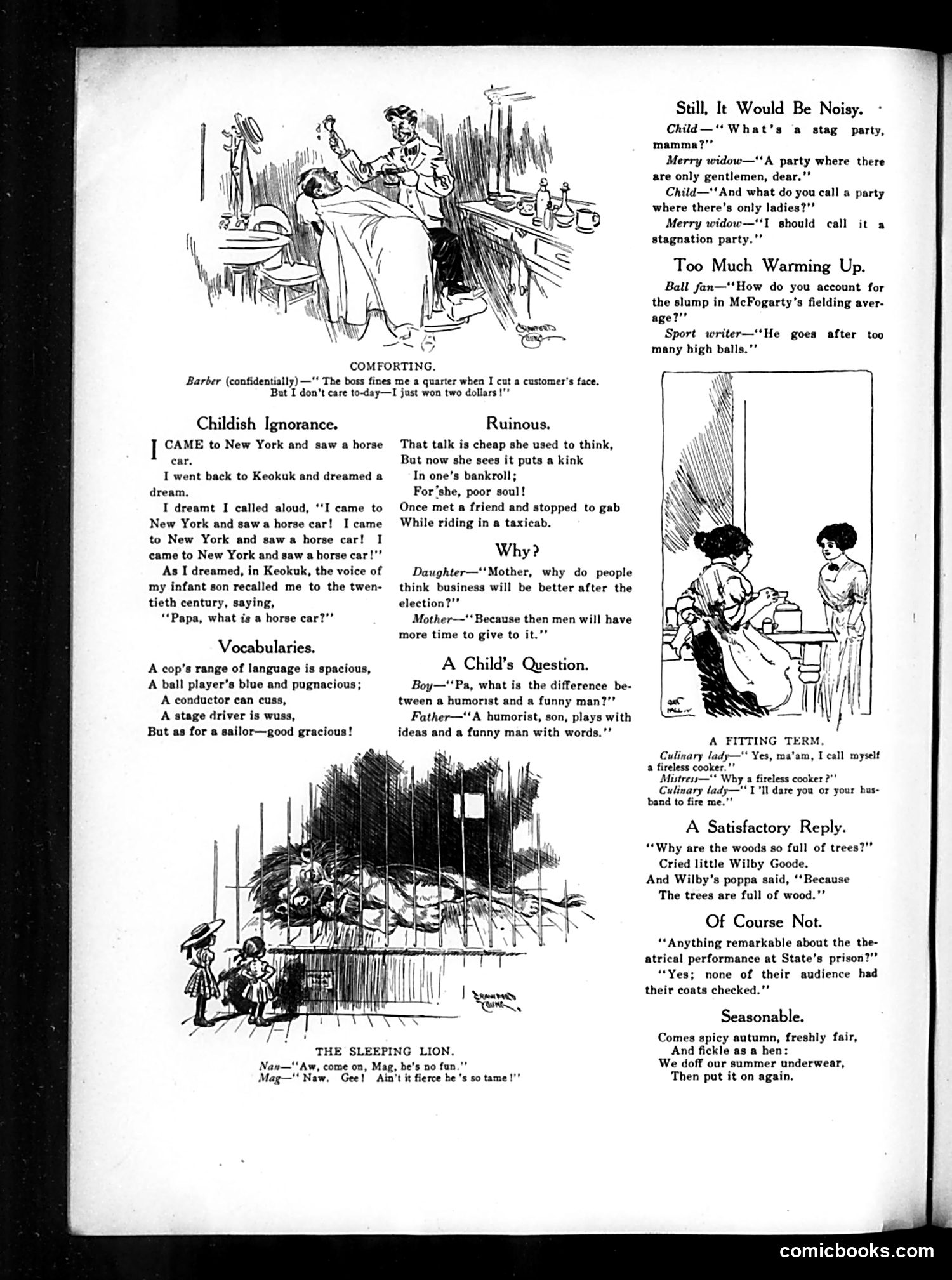
This page from *Judge* (a 19th/early 20th-century American humor magazine) contains multiple unrelated short jokes and cartoons reflecting contemporary social observations. **Key humor includes:** - **"Comforting"**: A barber's casual attitude toward workplace fines, having won money gambling—satire of working-class priorities - **"Childish Ignorance"**: A rural visitor to New York sees a "horse car" (streetcar), but his son doesn't know what one is—mocking changing urban technology and generational gaps - **"Ruinous"**: A woman's casual taxi ride conversation costs money—satirizing women's spending habits and the new expense of motorized transport - **"Too Much Warming Up"**: A baseball player's fielding decline blamed on chasing "high balls"—double entendre about excessive drinking - **"The Sleeping Lion"**: Children find a caged lion disappointing and tame The content reflects *Judge*'s typical format: satirizing modern conveniences, urban life, gender relations, and social changes of the era through brief, punchy jokes rather than continuous narratives.
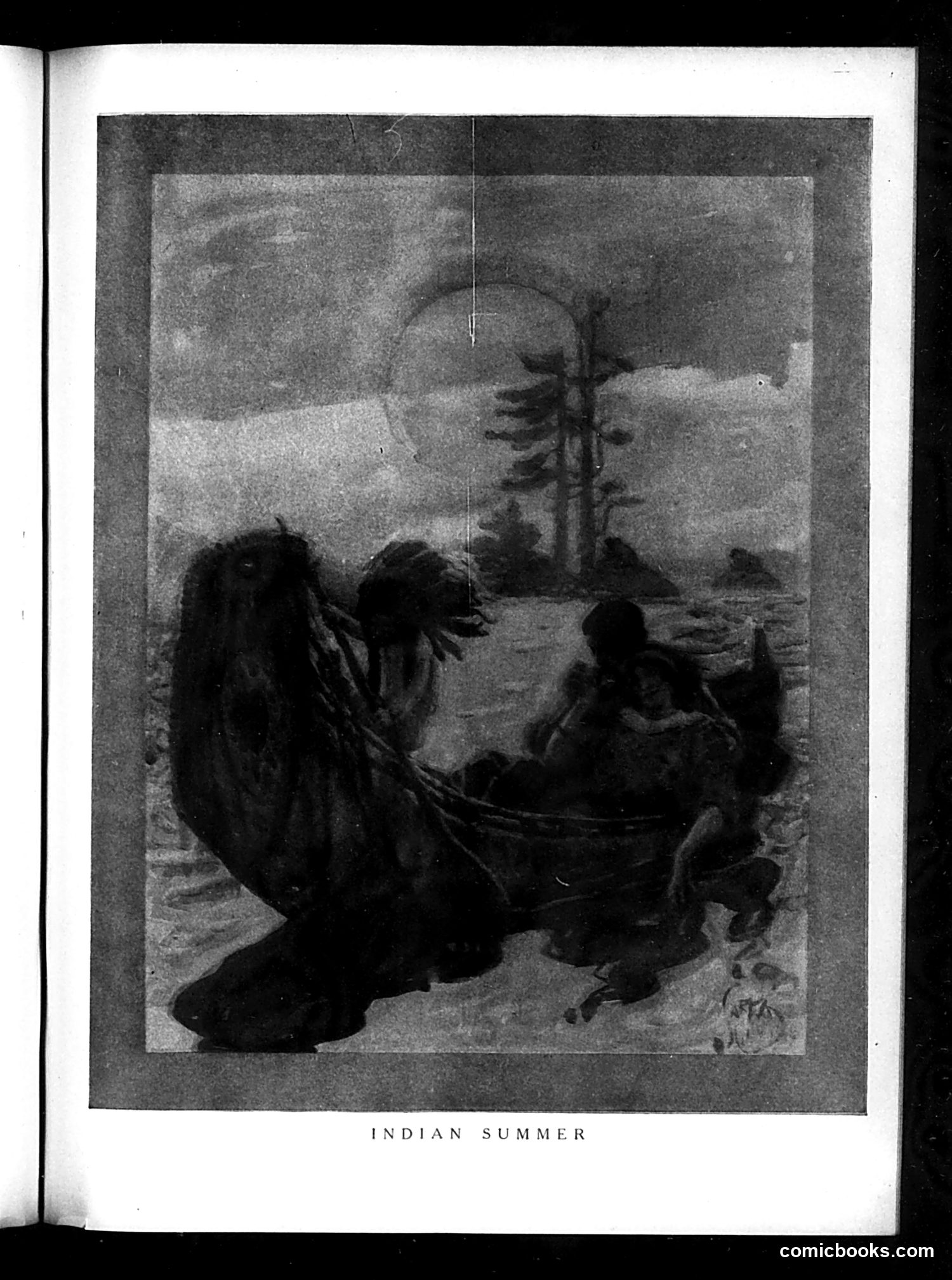
This appears to be an illustration rather than a political cartoon, titled "Indian Summer." The image depicts two figures in silhouette against a landscape with a cross visible in the background. The style and composition suggest this may be a literary or artistic illustration rather than satirical commentary. Without additional OCR text from the page or clearer context about the publication date and surrounding content, I cannot definitively explain the specific satirical point or identify the figures. The title "Indian Summer" could reference the meteorological phenomenon, or potentially carry period-specific connotations about Native Americans, but the image alone does not clearly establish the cartoon's intended message or social commentary that a contemporary Judge magazine reader would have understood.
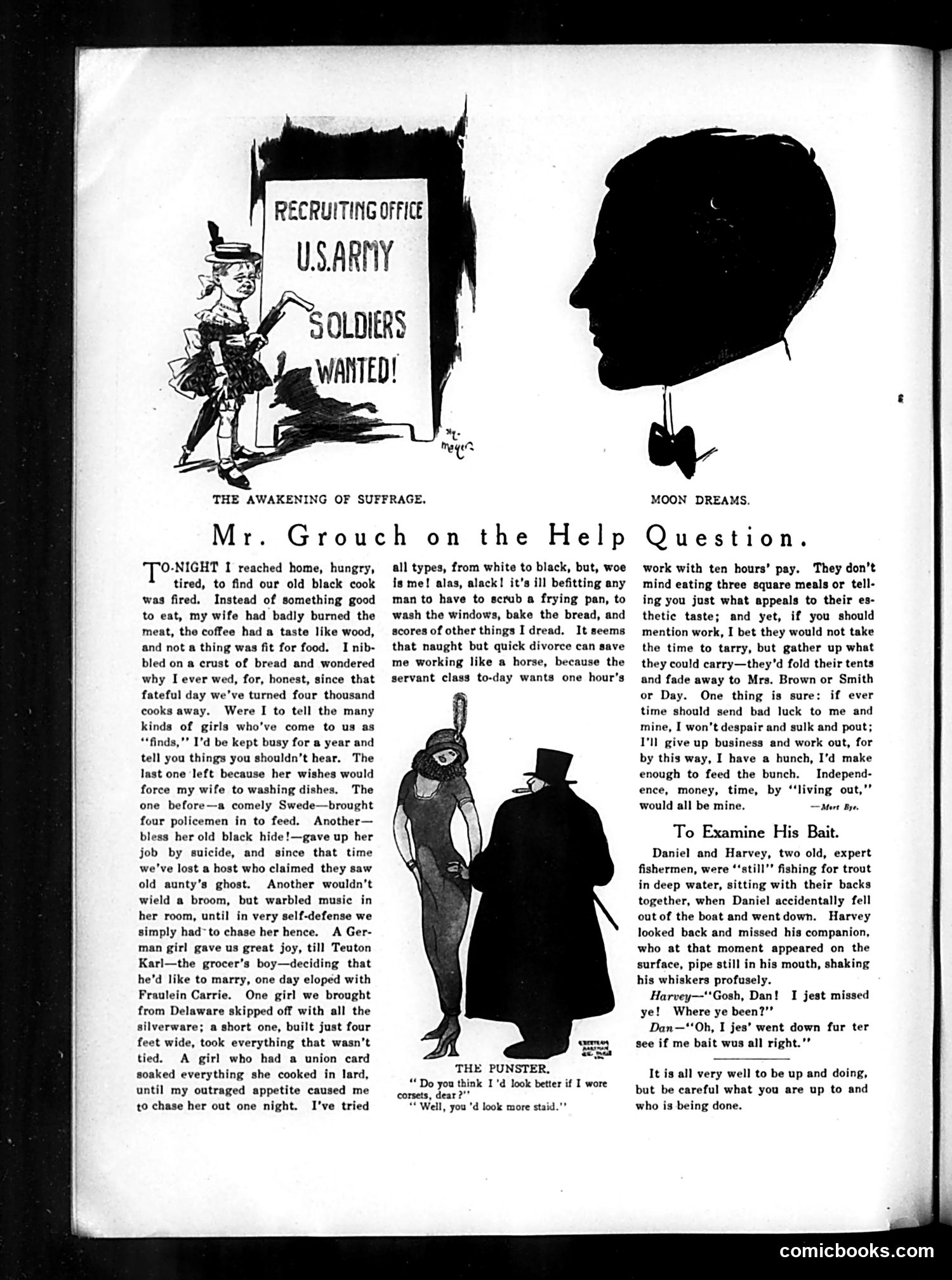
This page satirizes labor and domestic anxieties of the early 20th century, likely during or after WWI. **"The Awakening of Suffrage"** (left cartoon): A Uncle Sam figure at an army recruiting office points to suffragettes, sarcastically suggesting women demanding voting rights should instead be conscripted as soldiers—mocking the suffrage movement as disruptive. **"Mr. Grouch on the Help Question"** (main text): A wealthy man complains endlessly about the "servant problem"—domestic help (typically young women and immigrants) who demand better wages and working conditions, refuse degrading work, or leave employment. His bitter monologue reveals class anxiety: servants now want "one hour's work with ten hours' pay" and refuse to be exploited. The satire cuts both ways—mocking his entitled complaints while reflecting real anxieties about changing labor relations. **Minor cartoons**: "Moon Dreams" and "The Punster" are unrelated humor pieces. The page captures early 1900s tension between traditional hierarchies and emerging demands for workers' rights and women's equality.
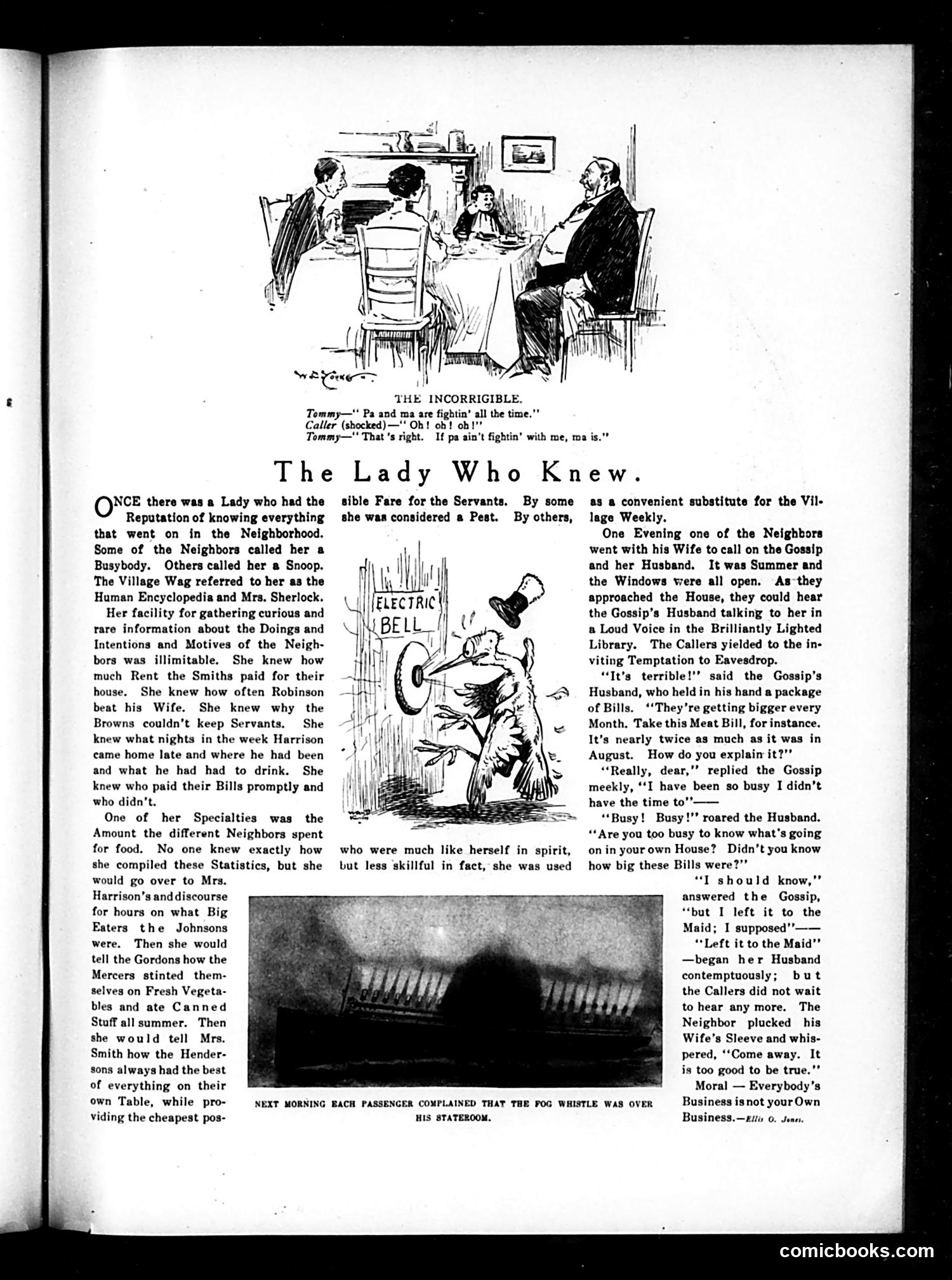
This page contains two separate pieces of humor satirizing domestic life and gossip culture in early 20th-century America. The top cartoon, "The Incorrigible," shows a family dinner where a child reveals his parents constantly fight with each other—a dark joke about marital discord presented through a child's innocent perspective. The main story, "The Lady Who Knew," mocks a busybody gossip who obsessively tracks her neighbors' private affairs (their rent, marital disputes, food spending). The satire's punchline: when visitors eavesdrop on this same woman's house, they discover her own husband angrily confronting her about rising household bills—revealing she knows everyone else's business but is ignorant of her own home's expenses. The moral explicitly states the hypocrisy: "Everybody's Business is not your Own Business." The satire targets the invasive gossip culture among middle-class women of the era, punishing the busybody through ironic comeuppance.
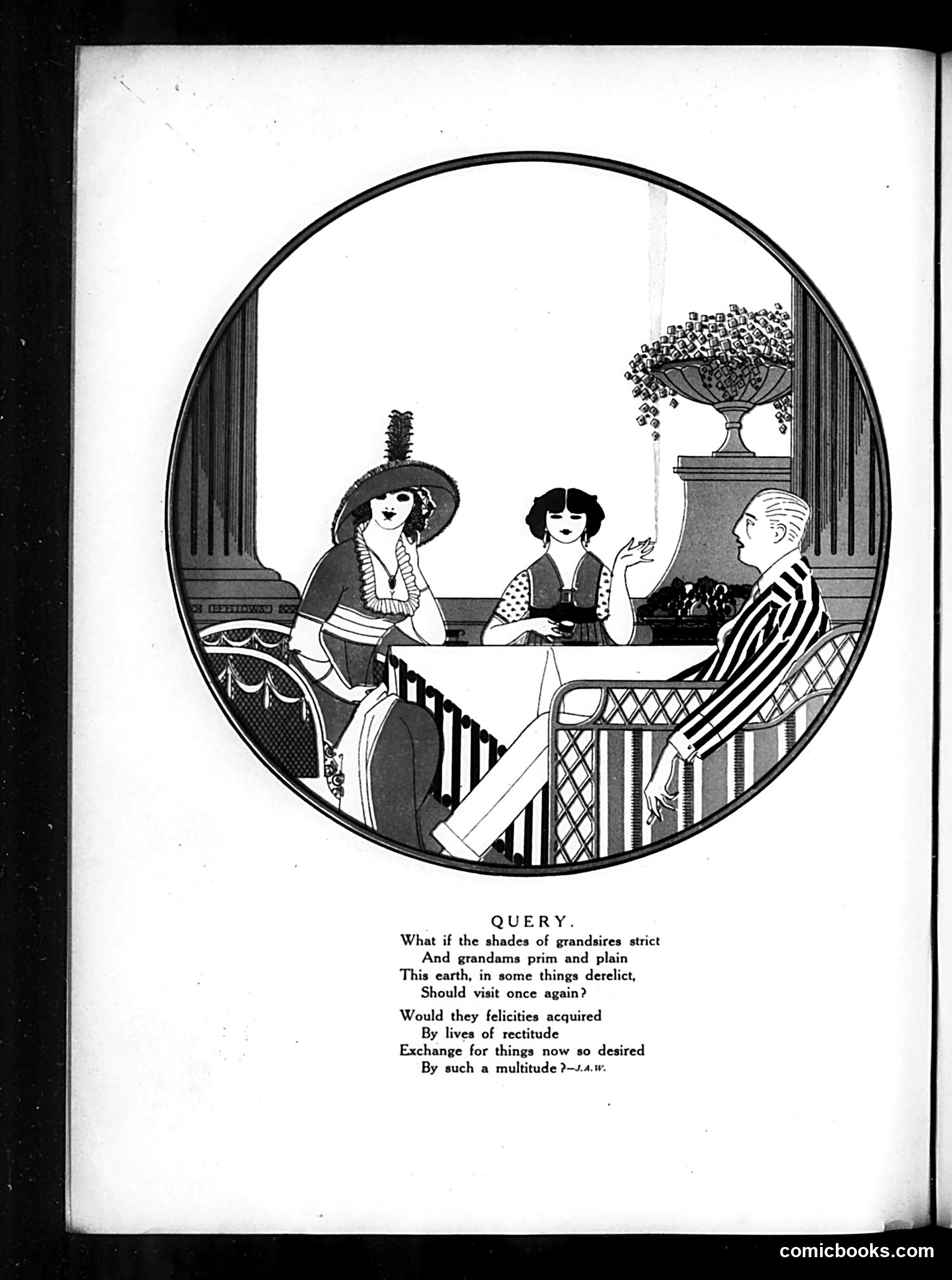
This is a poem titled "Query" rather than a political cartoon. It presents a moral thought experiment: if strict, proper ancestors returned to earth, would they trade their hard-won virtues for the modern pleasures their descendants now pursue? The accompanying illustration shows three fashionably dressed 1920s figures in an elegant interior setting, appearing to engage in leisure or entertainment. The visual juxtaposition supports the poem's implicit criticism—the contemporary scene represents the "things now so desired" by modern society that the poem questions. The satire targets the generational divide and moral decline the author perceives in Jazz Age society, contrasting it with Victorian-era rectitude and restraint. The poem's ironic tone suggests skepticism that moderns would willingly return to ancestral values.
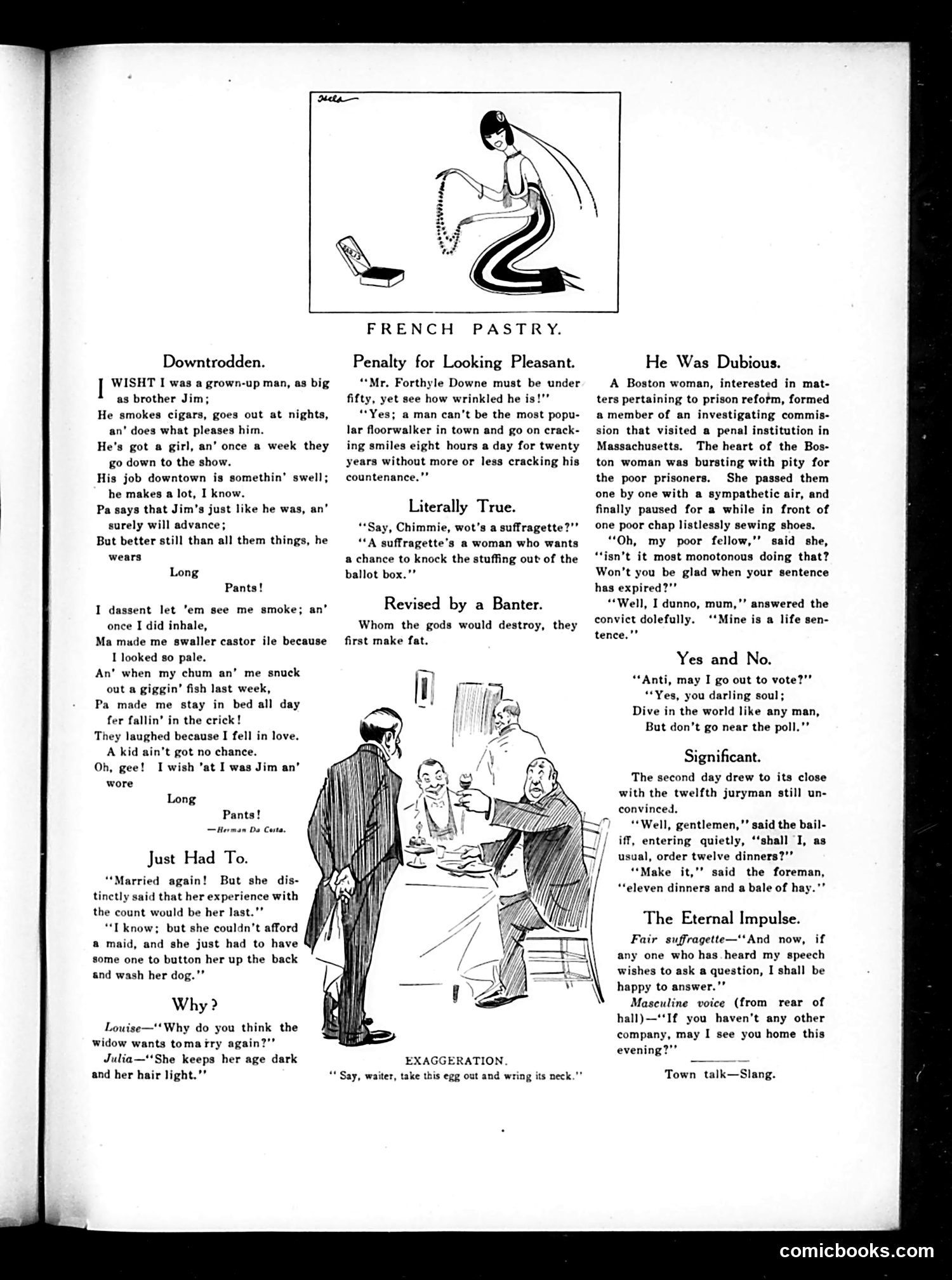
This page contains multiple short humorous pieces typical of early 20th-century American satire: **"Long Pants"** depicts a boy's envy of his older brother's adult privileges—smoking, dating, staying out late—symbolized by wearing long pants, a marker of manhood at the time. **The suffrage-related jokes** ("Literally True," "Yes and No," "The Eternal Impulse") mock the women's voting rights movement. They mock suffragettes as either violent ("knock the stuffing out of the ballot box") or as women whose real interests remain romantic rather than political. The "Yes and No" joke sardonically supports women voting while warning them away from actually voting. **Other jokes** target workplace dynamics (the department store floorwalker's forced smile causing wrinkles), widow remarriage, and jury deliberations. The **illustration** labeled "Exaggeration" shows a restaurant scene where a customer demands the waiter "wring" an egg's neck—suggesting it's poorly prepared. The page reflects early 1900s attitudes: skepticism toward women's suffrage, class consciousness, and conventional gender roles.
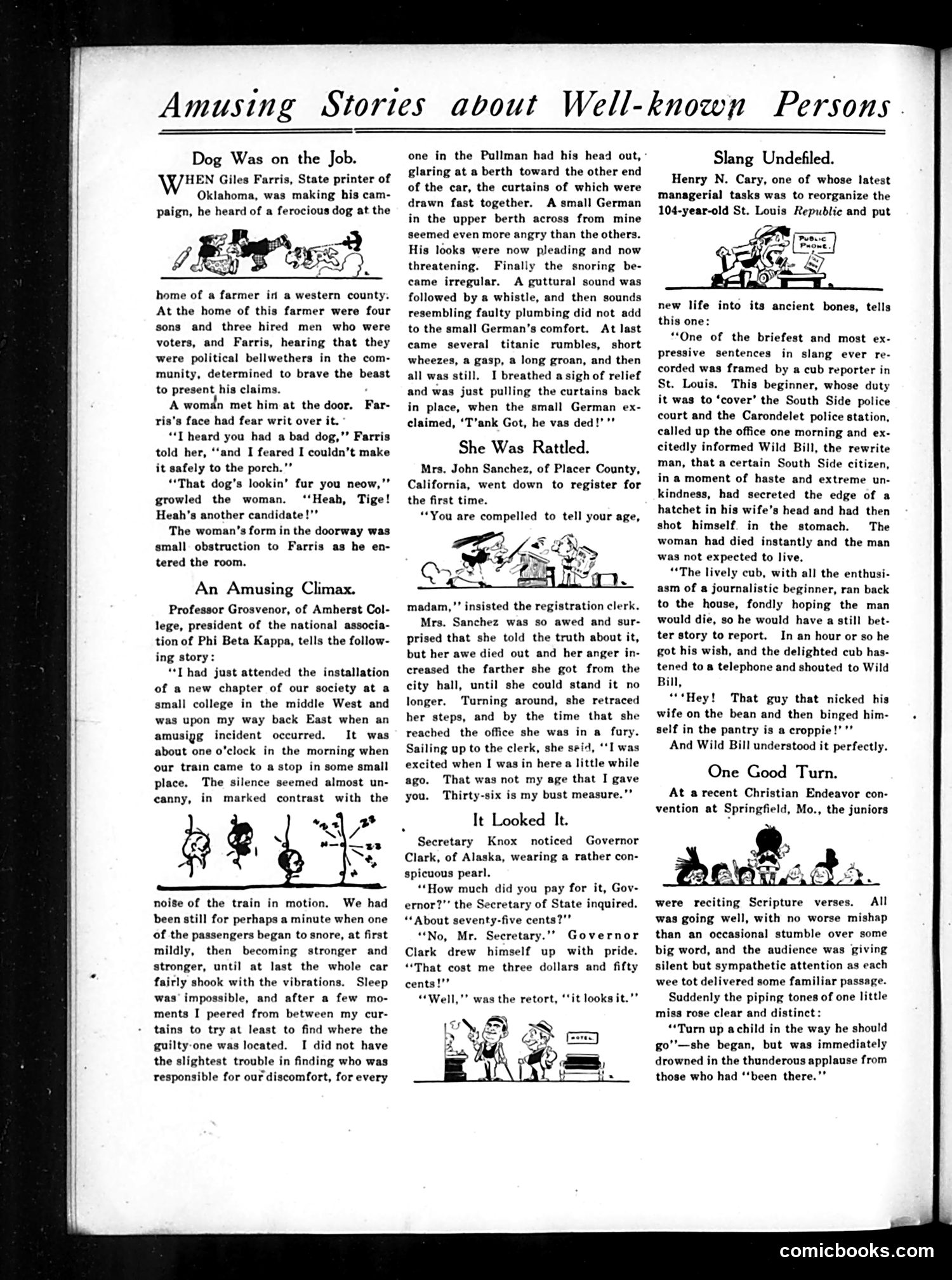
This page contains four humorous anecdotes about public figures, typical of Judge's "Amusing Stories about Well-known Persons" column. **"Dog Was on the Job"**: Giles Farris, Oklahoma's state printer campaigning for office, tries to court voters at a farm. The farmer's wife siccs her dog on him as a joke, but Farris enters anyway—the satire being that politicians will endure any indignity for votes. **"An Amusing Climax"**: Professor Grosvenor describes a train passenger snoring so violently that other travelers assume he's died. The small German passenger's relief when the noise stops is the joke's punchline. **"She Was Rattled"**: A California woman embarrassed at revealing her age to a registration clerk returns furiously to claim she meant her bust measurement (36 inches), not her actual age—poking fun at vanity and bureaucratic awkwardness. **"It Looked It"**: Secretary Knox teases Governor Clark about an obviously cheap pearl he claims cost $3.50, implying it looks worthless—a gentle jab at pretentiousness. These brief anecdotes mock politicians, vanity, and social discomfort through situations relatable to Judge's educated readership.
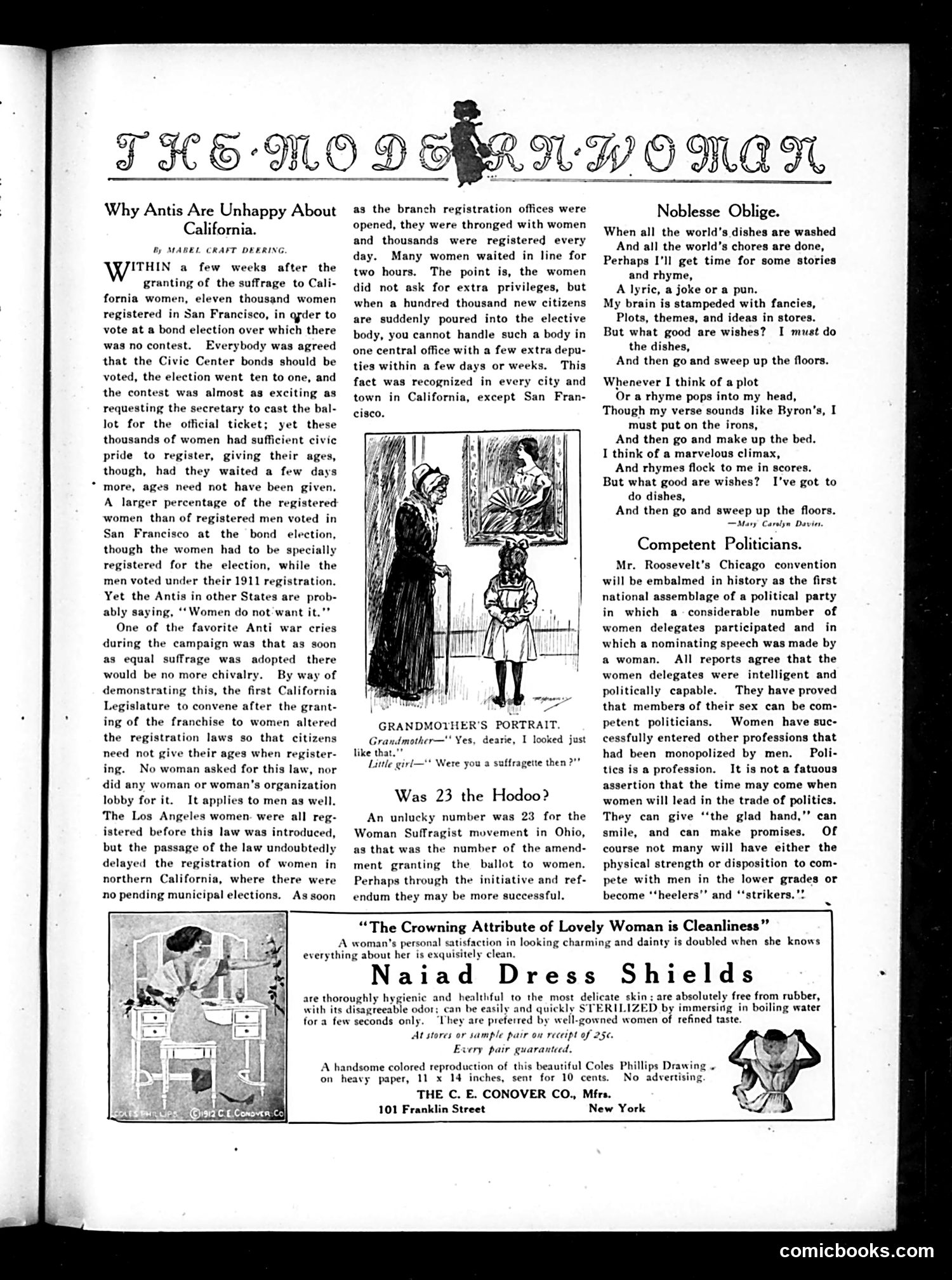
This page satirizes anti-suffrage arguments by highlighting women's demonstrated civic engagement after California granted women the vote. The main article mocks "Antis" (opponents of women's suffrage) who claimed women didn't want voting rights—yet 11,000 California women registered immediately and voted in higher percentages than men. The **cartoon** (center) depicts a grandmother telling her granddaughter she once looked identical to her, with the child asking if she was a suffragette. This mocks the notion that suffragists were unladylike or unfeminine. The article also notes anti-suffragists claimed granting women votes would eliminate male "chivalry," yet ironically it was *men* in the legislature who removed age-disclosure requirements from registration—not women requesting special treatment. The **"Noblesse Oblige" poem** sardonically reflects the period's real constraint: women's domestic duties preventing intellectual pursuits, highlighting the hypocrisy of excluding them from public participation.
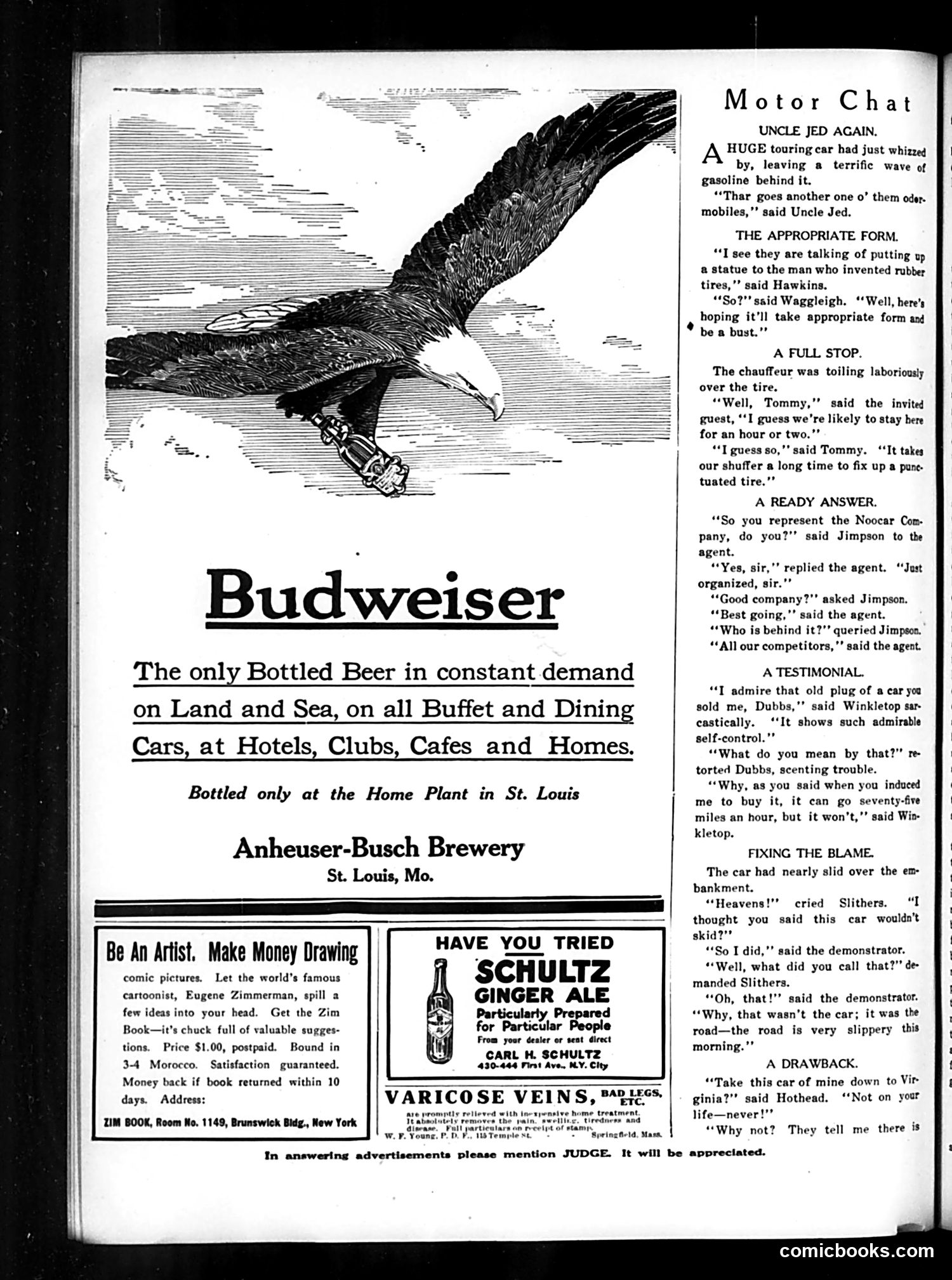
This page is primarily advertising with a sidebar of automotive humor anecdotes. The "Motor Chat" section contains six brief jokes about early automobiles and their owners/operators, reflecting 1910s-era motoring anxieties. The jokes satirize: - **Rural skepticism** ("Uncle Jed" dismisses automobiles as smelly nuisances) - **Mechanical unreliability** (flat tires, skidding, overheating—common period problems) - **Salesman deception** (dealers misleading buyers about performance; a car won't actually reach advertised speeds) - **Chauffeur incompetence** (servants struggling with tire repairs) The humor assumes readers' familiarity with automobiles' notorious mechanical failures and the social tensions surrounding this new technology. The jokes mock both naive car owners and dishonest dealers equally. The page's advertisements (Budweiser, Schultz Ginger Ale, and a cartooning instruction book) are unrelated to the automotive content.
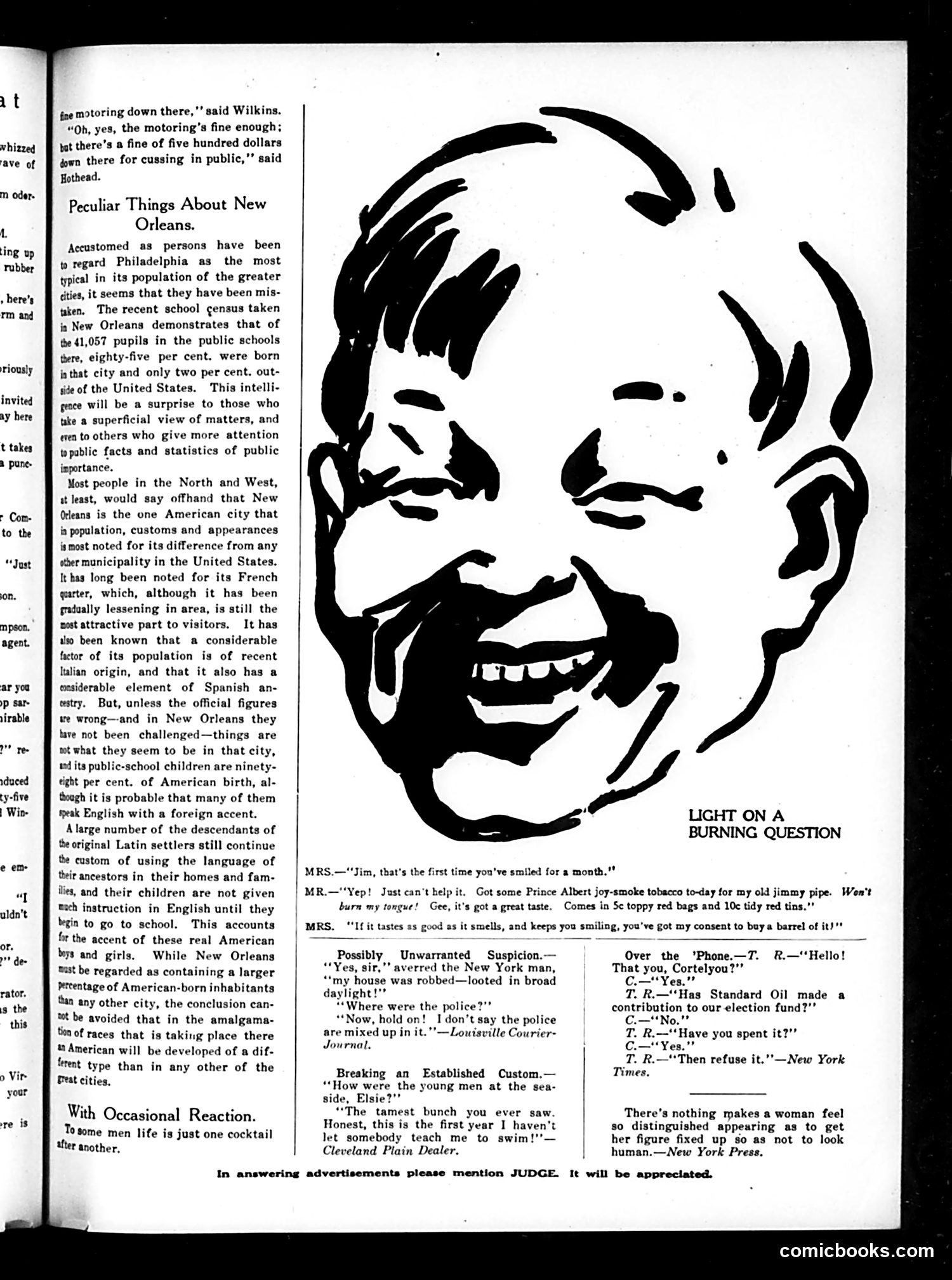
This page from *Judge* contains multiple satirical items typical of early 20th-century American humor: **Main Cartoon ("Light on a Burning Question"):** A Prince Albert tobacco advertisement disguised as editorial content, mocking the husband's sudden cheerfulness from smoking. The joke satirizes how advertising infiltrates supposedly objective journalism. **Political Dialogue ("Over the Phone"):** A conversation between "T.R." (Theodore Roosevelt) and "C." (likely Charles Cortelyou, his secretary) joking about Standard Oil's campaign contributions. The humor depends on understanding contemporary debates about corporate influence in politics and trust-busting efforts. **"Peculiar Things About New Orleans":** A lengthy article highlighting demographic statistics—that 85% of New Orleans schoolchildren were American-born, contradicting Northern assumptions about the city's "foreign" character due to its French Quarter and immigrant populations. The remaining short jokes and anecdotes reflect typical period humor about marriages, social customs, and regional differences—designed for middle-class readers interested in light satire rather than serious political commentary.
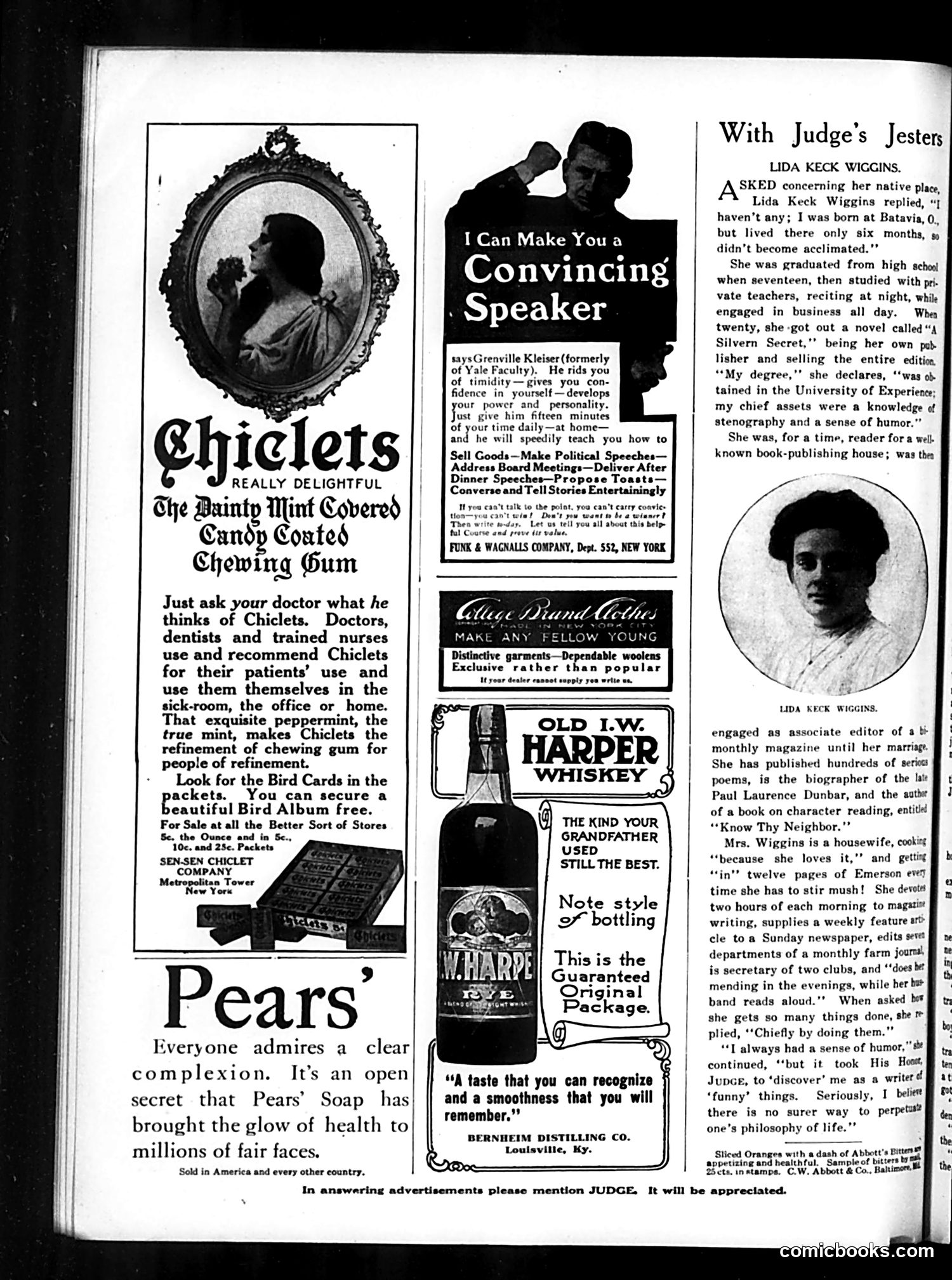
This page is primarily **advertising**, with a brief biographical profile. The main content includes ads for Chiclets gum, Pears' Soap, a public-speaking course by Grenville Kleiser, Harper Whiskey, and other products—typical of early 20th-century magazine pages. The notable editorial content is "With Judge's Jesters," a profile of **Lida Keck Wiggins**, an African American writer, editor, and poet. The piece celebrates her accomplishments: she published a novel, worked as a book editor, wrote extensively for magazines and newspapers, and authored works on character reading and biography (notably of Paul Laurence Dunbar). The humor derives from the contrast between her prodigious output and her self-deprecating claim of accomplishing tasks "chiefly by doing them"—a lighthearted play on productivity. The profile presents her as accomplished and witty, fitting Judge's "jesters" section format of celebrating clever personalities.
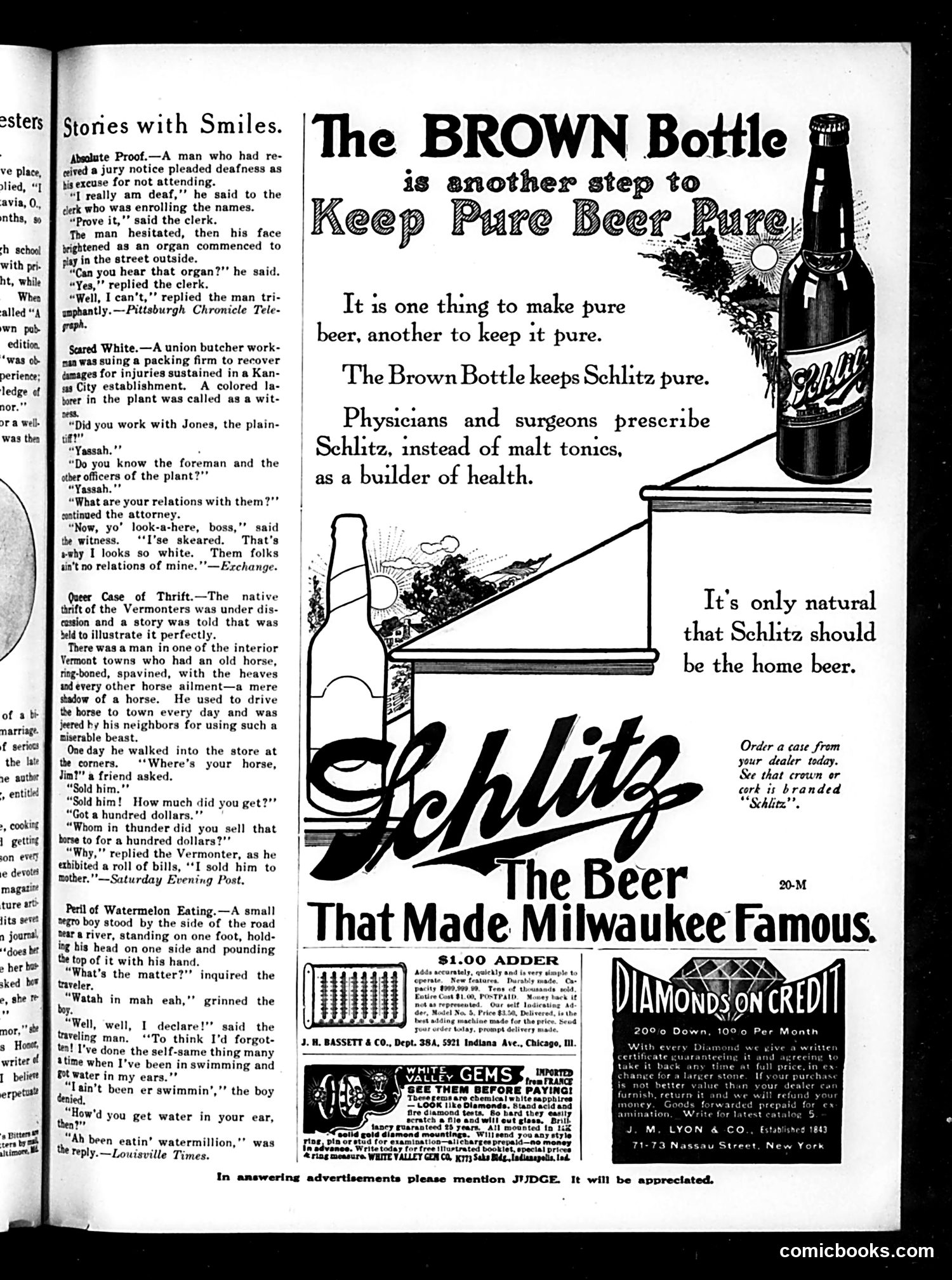
This page contains primarily **advertising** rather than political cartoons. The dominant feature is a large Schlitz beer advertisement occupying the right two-thirds of the page, claiming the brown bottle "keeps Schlitz pure" and that "physicians and surgeons prescribe Schlitz...as a builder of health." On the left side are brief humorous anecdotes titled "Stories with Smiles"—short joke pieces about a deaf man avoiding jury duty, a Black laborer's malapropism about "relations," a frugal Vermonter selling a worthless horse, and a child confusing watermelon with swimming water. These deploy period-typical racial stereotypes in their humor. The lower portion contains additional product advertisements for diamonds and gemstones. **Historical context**: This appears to be from the Prohibition era or just before, when beer companies still advertised openly. The claims that Schlitz had medicinal properties reflect early-20th-century marketing practices before modern pharmaceutical regulation.
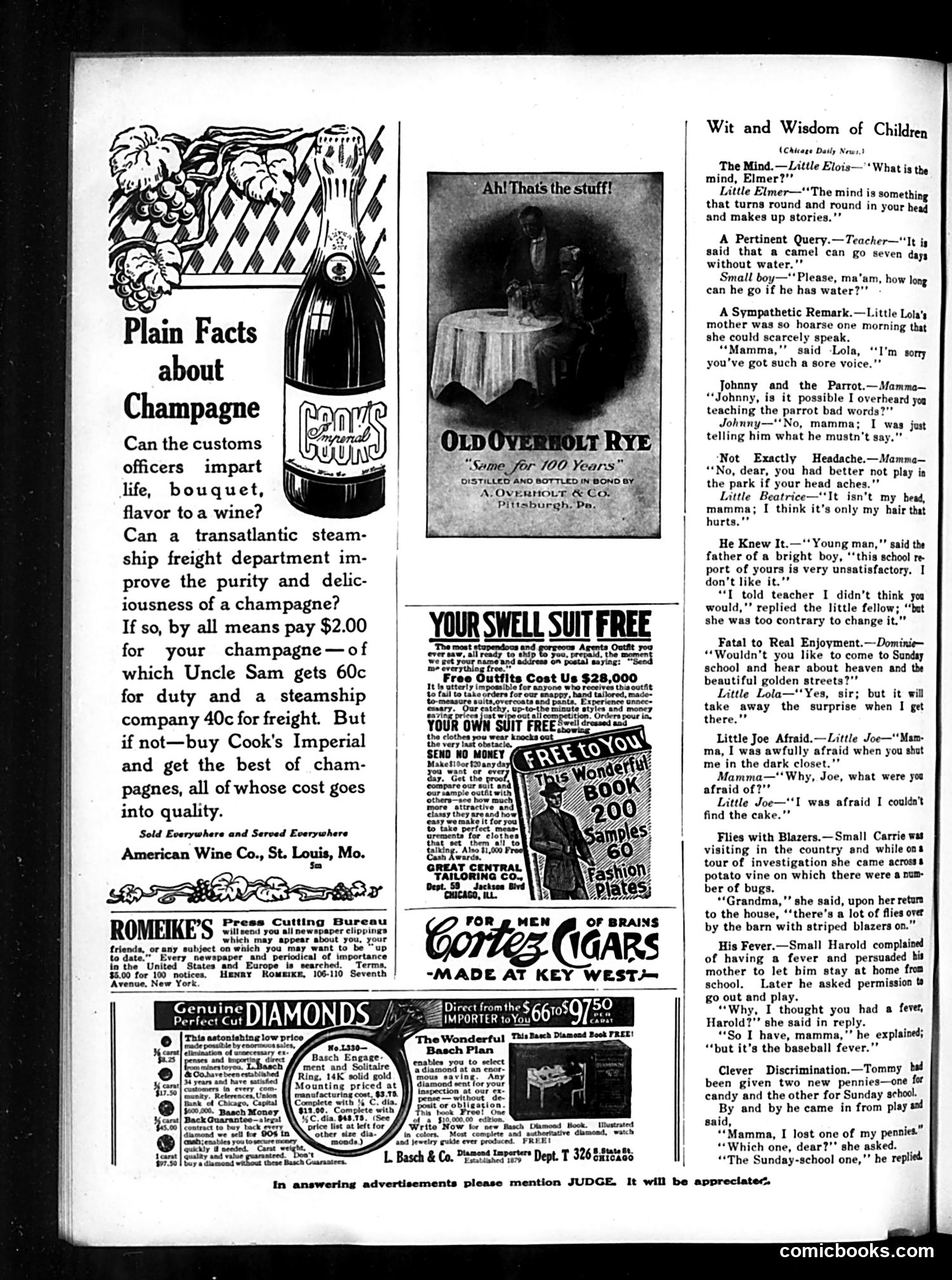
This page is primarily **advertisements and humor columns**, not political cartoons. The main satirical content is the **champagne advertisement** (top left), which mocks import tariffs and shipping costs. It argues that paying $2.00 for imported champagne—with 60¢ going to U.S. customs duty and 40¢ to steamship freight—is wasteful when domestic Cook's Imperial champagne offers better value. This reflects **turn-of-the-century American protectionist sentiment** and class anxieties about imported luxuries. The right column, **"Wit and Wisdom of Children,"** collects humorous observations from Chicago schoolchildren, a popular Judge feature. These jokes rely on children's literal-mindedness (a camel needing water to go further; "sore voice" misheard as physical pain; flies with "blazers" meaning striped patterns). The remaining space comprises ads for suits, cigars, diamonds, and a press-clipping bureau—typical magazine filler of the era. Nothing here references specific political figures or major events.
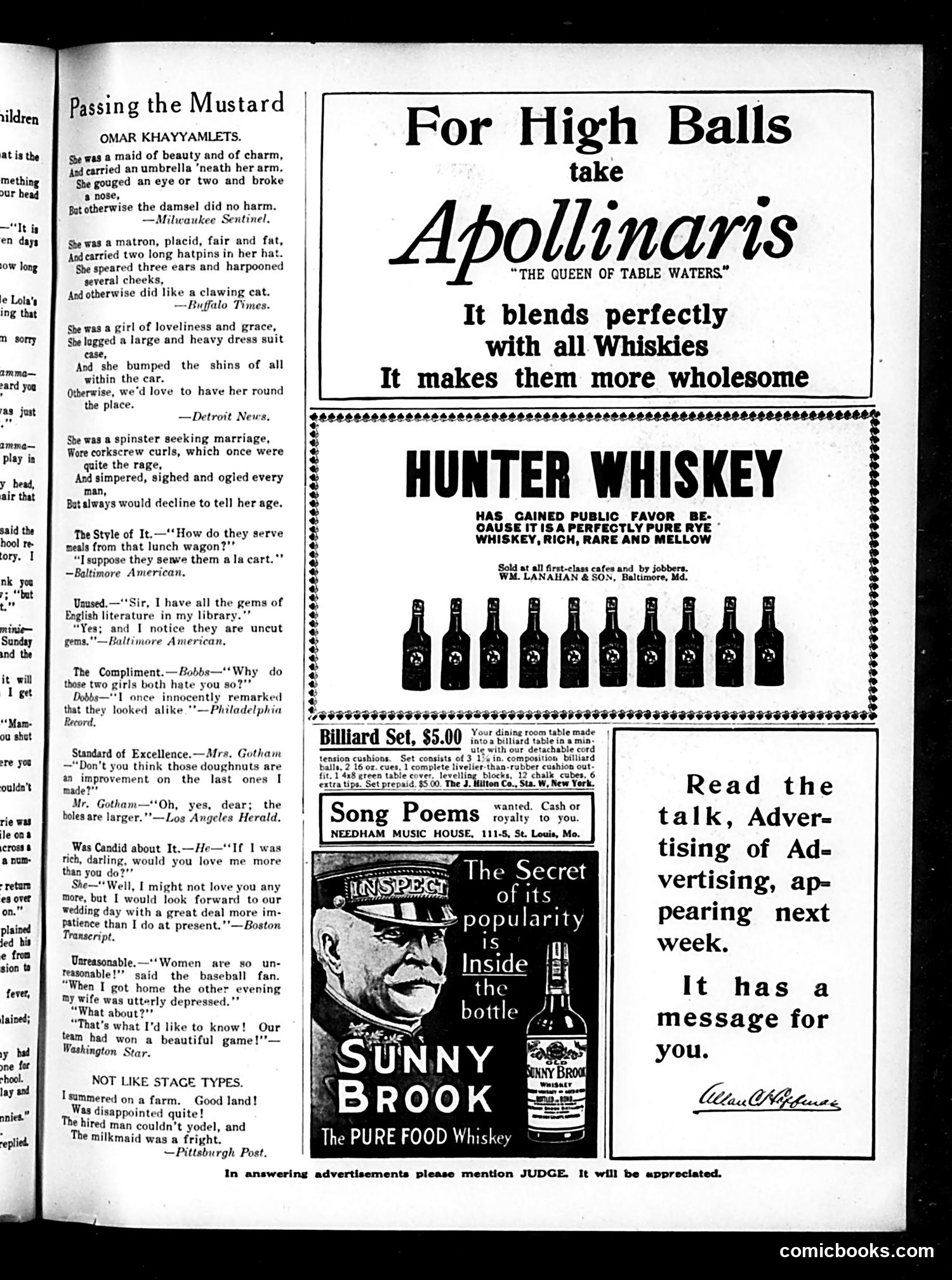
This is primarily an **advertising page** from Judge magazine, not a political cartoon. The page contains: **Main Content:** - Humorous short anecdotes in the left column (typical Judge filler material about women's appearance and behavior, reflecting early 20th-century social stereotypes) - Multiple whiskey advertisements: Apollinaris water, Hunter Whiskey, and Sunny Brook whiskey - A billiard set advertisement - Song poems advertisement **The Satire/Humor:** The left-column jokes reflect common Judge magazine tropes: women's fashion choices (hatpins, corsets, dress suits), marriage prospects, and physical appearance. The humor is based on period stereotypes—nothing political here. **Notable Context:** The whiskey ads are particularly interesting historically: they use claims like "makes them more wholesome" and "PURE FOOD"—language that would soon become illegal under pure food and drug regulations. These ads represent pre-1906 Food and Drug Act marketing. **Bottom Line:** This is a typical Judge magazine page mixing light humor with contemporary advertising, not a political commentary page. The content reflects early 1900s attitudes toward gender and consumer products.
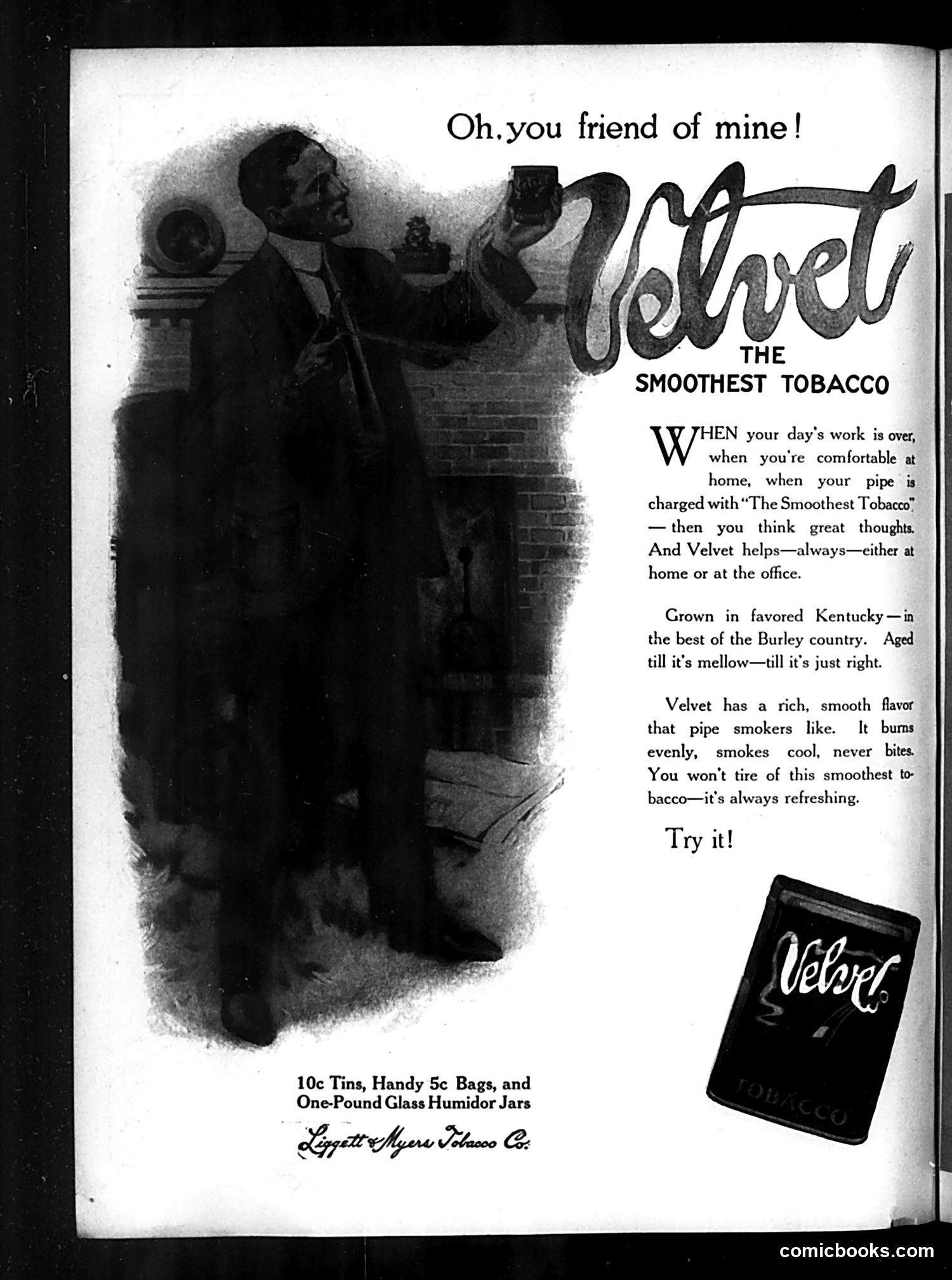
This is a **tobacco advertisement**, not political satire. It's a Velvet brand pipe tobacco ad from an early 20th-century issue of *Judge* magazine. The image shows a man in formal attire smoking a pipe while gazing thoughtfully upward—a common advertising trope suggesting that quality tobacco inspires intellectual contemplation. The ad copy emphasizes the product's smoothness, even burn, and Kentucky Burley origin. For modern readers: this represents an era when tobacco advertising was completely unrestricted and appeared in mainstream publications. The messaging—that smoking aids relaxation and clear thinking—was standard marketing that would be illegal today. The phrase "think great thoughts" exemplifies how tobacco was once marketed as enhancing mental activity rather than being acknowledged as addictive and harmful. The ad lists distribution formats (tins, bags, humidor jars) typical of early-1900s retail.