
Judge, 1912-09-28 · page 19 of 24
Judge — September 28, 1912 — page 19: what you’re looking at
What you’re looking at
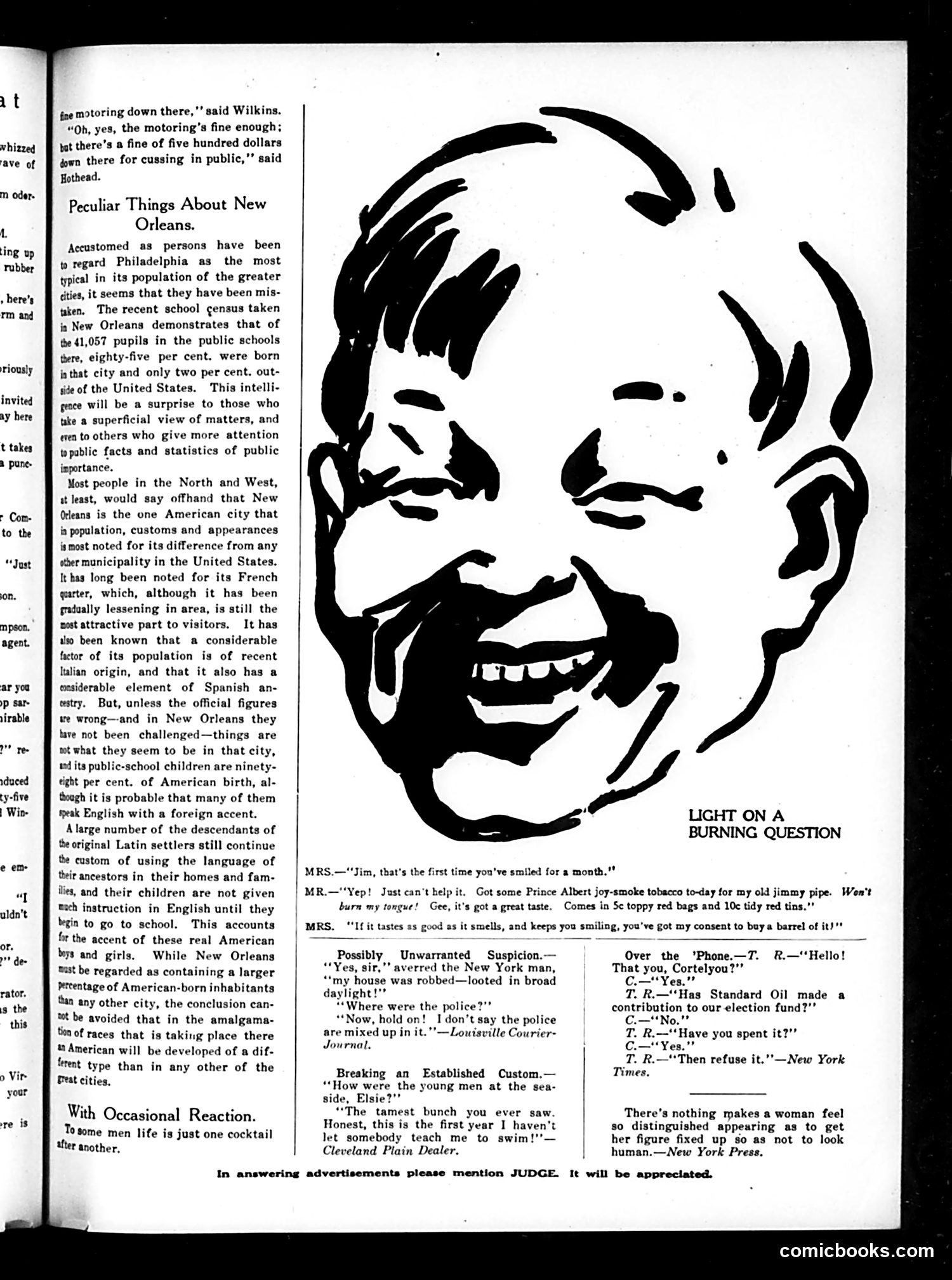
This page from *Judge* contains multiple satirical items typical of early 20th-century American humor: **Main Cartoon ("Light on a Burning Question"):** A Prince Albert tobacco advertisement disguised as editorial content, mocking the husband's sudden cheerfulness from smoking. The joke satirizes how advertising infiltrates supposedly objective journalism. **Political Dialogue ("Over the Phone"):** A conversation between "T.R." (Theodore Roosevelt) and "C." (likely Charles Cortelyou, his secretary) joking about Standard Oil's campaign contributions. The humor depends on understanding contemporary debates about corporate influence in politics and trust-busting efforts. **"Peculiar Things About New Orleans":** A lengthy article highlighting demographic statistics—that 85% of New Orleans schoolchildren were American-born, contradicting Northern assumptions about the city's "foreign" character due to its French Quarter and immigrant populations. The remaining short jokes and anecdotes reflect typical period humor about marriages, social customs, and regional differences—designed for middle-class readers interested in light satire rather than serious political commentary.
📄 Transcribed text from this page (OCR, searchable)
Machine-transcribed from the original scan — historical spelling and the odd misread are preserved.
A. ing up rubber » here's rm and riously invited ay here t takes a pune- fne motoring down there,'’ said Wilkins. “Oh, yes, the motoring’s fine enough; pot there’s a fine of five hundred dollars down there for cussing in public,’’ said Hothead. Peculiar Things About New Orleans. Accustomed as persons have been to regard Philadelphia as the most typical in its population of the greater cities, it seems that they have been mis- taken. The recent school census taken ia New Orleans demonstrates that of the 41,057 pupils in the public schools there, eighty-five per cent. were born inthat city and only two per cent. out- side of the United States. This intelli- gence will be a surprise to those who uke a superficial view of matters, and even to others who give more attention topablic facts and statistics of public importance. Most people in the North and West, at least, would say offhand that New Orleans is the one American city that in population, customs and appearances is most noted for its difference from any other municipality in the United States. Ithas long been noted for its French quarter, which, although it has been fdually lessening in area, is still the nest attractive part to visitors. It has tls been known that a considerable feetor of its population is of recent Italian origin, and that it also has a oxsiderable element of Spanish an- estry. But, unless the official figures ure wrong—and in New Orleans they lave not been challenged—things are mt what they seem to be in that city, tnd its public-school children are ninety- eight per cent. of American birth, al- though it is probable that many of them meak English with a foreign accent. A large number of the descendants of te original Latin settlers still continue the custom of using the language of LIGHT ON A BURNING QUESTION thelr ancestors in their homes and fam- MRS.—'‘Jim, that's the first time you've smiled for a month. ilies, and their children are not given tech instruction in English until they begin to go to school. This accounts for the accent of these real American MR.—''Yep! Just can't help it. Got some Prince Albert joy-smoke tobacco to-day for my old jimmy pipe. Wen't burn my tongue! Gee, it's got a great taste. Comes in Sc toppy red bags and 10c tidy red tins." “If it tastes as good as it smells, and keeps you smiling, you've got my consent to buy a barrel of it)” bys and girls. While New Orleans tast be regarded as containing a larger percentage of American-born inhabitants tan any other city, the conclusion can- tt be avoided that in the amalgama- tion of races that is taking place there "American will be developed of a dif- ferent type than in any other of the Brat cities, With Occasional Reaction. Tosome men life is just one cocktail tlter another. Possibly Unwarranted Suspicion.— “Yes, sir,’’ averred the New York man, “my house was robbed—looted in broad daylight!"" “Where were the police?’’ **Now, hold on! I don’t say the police are mixed up in it."’"—Louisville Courier- Journal. Breaking an Established Custom.— “*How were the young men at the sea- side, Elsie?” “The tamest bunch you ever saw. Honest, this is the first year I haven't let somebody teach me to swim!”’— Cleveland Plain Dealer. Over the 'Phone.—T7. &.—‘‘Hello! That you, Cortelyou?”’ C.—*Yes.’” T. R.—‘Has Standard Oil made a contribution to our election fund?’’ C.—"No.”” T. R.—‘‘Have you spent it?” C.—*Yes.”” T. R.—'*Then refuse it.""—New York Times. There’s nothing makes a woman feel so distinguished appearing as to get her figure fixed up so as not to look human.—New York Press. In answering advertisements please mention JUDGE. It will be appreciated. comicbooks.com