
Judge, 1912-09-28 · page 6 of 24
Judge — September 28, 1912 — page 6: what you’re looking at
What you’re looking at
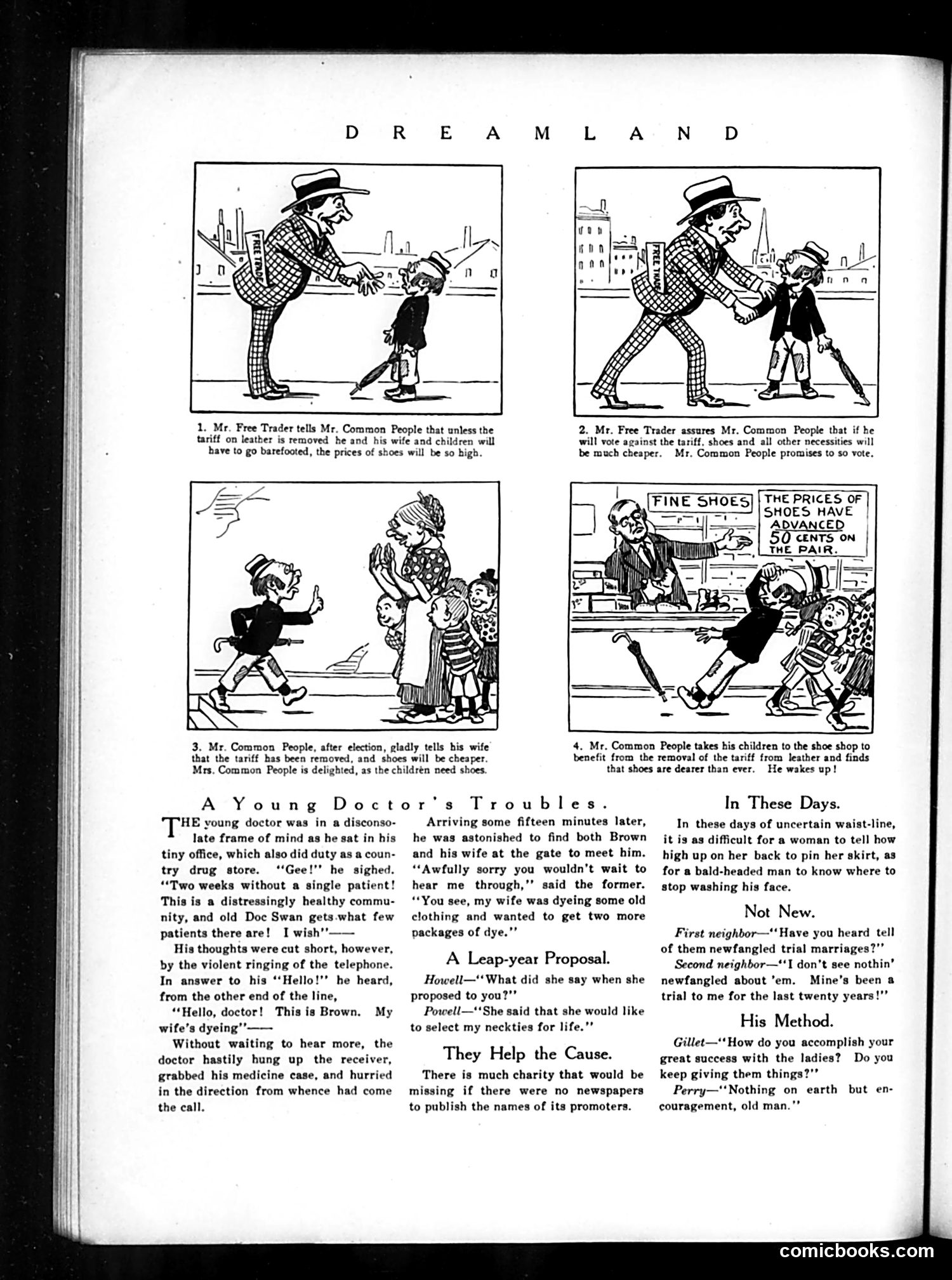
The four-panel cartoon "Dreamland" satirizes free-trade political rhetoric and its failure to deliver promised benefits. **Mr. Free Trader** (representing pro-free-trade politicians) persuades **Mr. Common People** (the working-class voter) that removing protective tariffs on leather will make shoes affordable. Mr. Common People votes accordingly, believing his family will benefit. Panel 4 reveals the con: shoe prices actually *rise* 50 cents per pair. When Mr. Common People takes his children to buy shoes, he discovers the tariff's removal benefited manufacturers, not consumers—he "wakes up" to the deception. This attacks the gap between campaign promises and economic reality, suggesting voters were duped by politicians' hollow assurances. The "dreamland" is the false promise of cheaper goods through free trade—a pointed critique of Gilded Age trade policy debates and political dishonesty toward ordinary workers.
📄 Transcribed text from this page (OCR, searchable)
Machine-transcribed from the original scan — historical spelling and the odd misread are preserved.
1. Mr. Free Trader tells Mr. Common People that unless the tariff on leather is removed he and his wife and children will have to go barefooted, the prices of shoes will be so high. 2. Mr. Free Trader assures Mr. Common People that if he will vote against the tariff, shoes and all other necessities will be much cheaper. Mr. Common People promises to so vote, THE PRICES OF SHOES HAVE ADVANCE 50 cenTs on THE PAIR. 3. Mr. Common People, after election, gladly tells his wife that the tariff has been removed, and shoes will be cheaper. Mrs. Common People is delighted, as the childrén need shoes. A Young Doctor's Troubles. 4. Mr. Common People takes his children to the shoe shop to benefit from the removal of the tariff from leather and finds that shoes are dearer than ever. He wakes up! In These Days. HE voung doctor was in a disconso- late frame of mind as he sat in his tiny office, which also did duty as a coun- try drug store. ‘‘Gee!'’ he sighed. “‘Two weeks without a single patient! This is a distressingly healthy commu- nity, and old Doc Swan gets.what few patients there are! I wish’’—— His thoughts were cut short, however, by the violent ringing of the telephone. In answer to his ‘‘Hello!’’ he heard, from the other end of the line, “Hello, doctor! This is Brown. My wife’s dyeing’’—— Without waiting to hear more, the doctor hastily hung up the receiver, grabbed his medicine case, and hurried in the direction from whence had come the call. Arriving some fifteen minutes later, he was astonished to find both Brown and his wife at the gate to meet him. “‘Awfully sorry you wouldn’t wait to hear me _ through said the former. “You see, my wife was dyeing some old clothing and wanted to get two more packages of dye.’’ A Leap-year Proposal. Howell—‘‘What did she say when she proposed to you?"’ Powell—‘‘She said that she would like to select my neckties for life.”” They Help the Cause. There is much charity that would be missing if there were no newspapers to publish the names of its promoters. In these days of uncertain waist-line, it is as difficult for a woman to tell how high up on her back to pin her skirt, as for a bald-headed man to know where to stop washing his face. Not New. First neighbor—‘‘ Have you heard tell of them newfangled trial marriages?"’ Second neighbor—‘‘I don’t see nothin’ newfangled about ’em. Mine’s been a trial to me for the last twenty years!"’ His Method. Gillet—‘‘ How do you accomplish your great success with the ladies? Do you keep giving them things?"’ Perry—'‘Nothing on earth but en- couragement, old man." comicbooks.com