
Judge, 1912-09-28 · page 7 of 24
Judge — September 28, 1912 — page 7: what you’re looking at
What you’re looking at
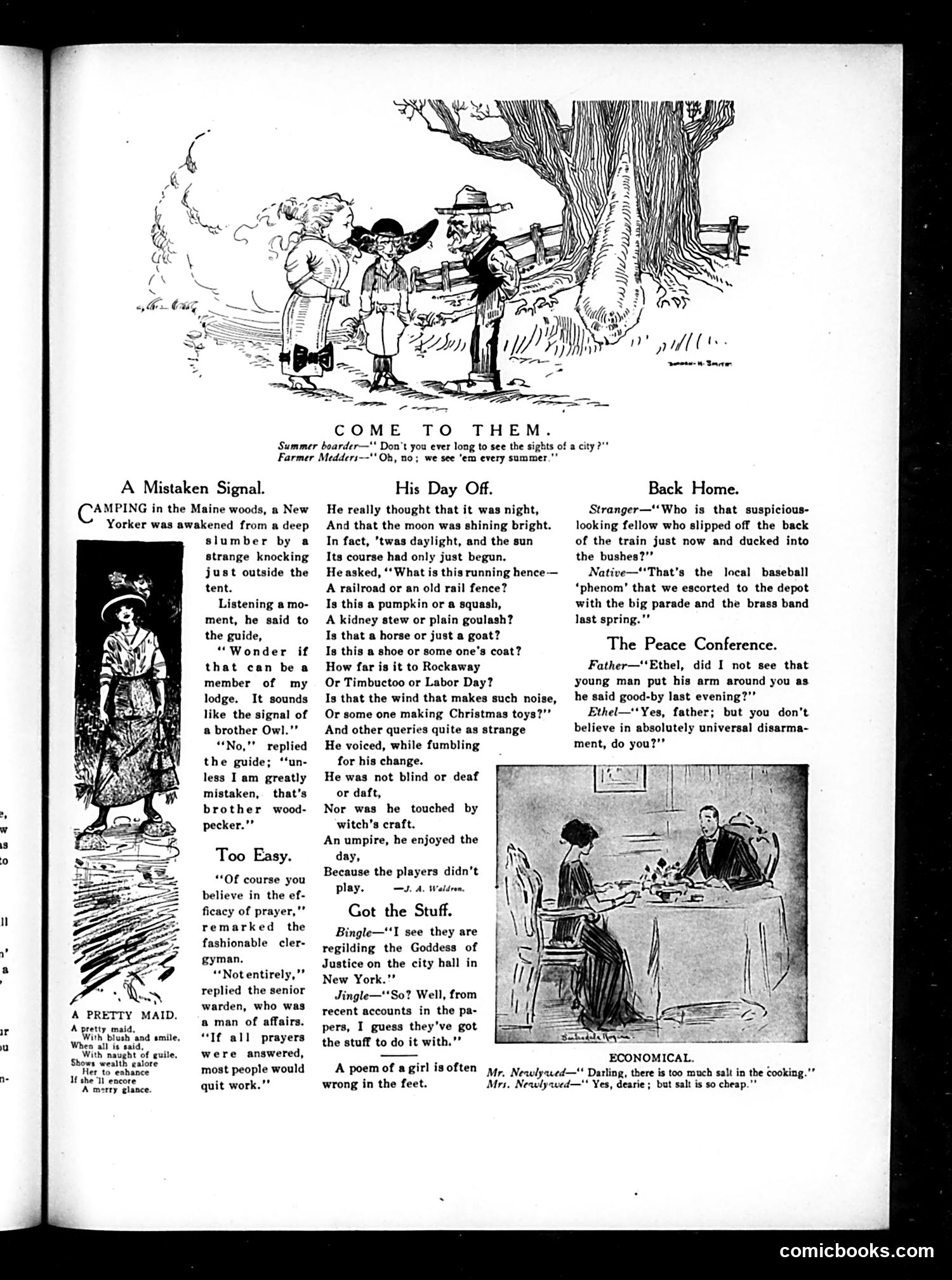
This page collects humorous anecdotes typical of early 20th-century American satirical humor. **Key content:** - **"Come to Them"** (top): A city visitor asks a farmer if he longs for urban sights; the farmer replies they see summer visitors every year—a gentle joke about rural life's predictability. - **"A Mistaken Signal"**: A camper mishears a woodpecker's knock for a Masonic lodge signal, mocking city people's unfamiliarity with nature. - **"His Day Off"**: An umpire, confused during daylight, asks absurd questions about everyday objects. The joke: without baseball to umpire, he's bewildered and useless. - **"Back Home"**: A local baseball star, celebrated with a parade, slinks back from the train—implying he failed professionally. - **"The Peace Conference"**: A daughter uses disarmament rhetoric to justify allowing her boyfriend to embrace her, cleverly deflecting her father's objection. **Overall tone**: Gentle satire mocking city/country contrasts, male confusion, and youthful romance—typical Judge fare emphasizing social observation over political commentary.
📄 Transcribed text from this page (OCR, searchable)
Machine-transcribed from the original scan — historical spelling and the odd misread are preserved.
COME TO THEM. Mm wan i) Summer boarder—"' Don't you ever long to see the sights of a city ?"" Farmer Medders—"' Oh, no; we see ‘em every summer."’ A Mistaken Signal. CAMPING in the Maine woods, a New Yorker was awakened from a deep slumber by a strange knocking just outside the tent. Listening a mo- ment, he said to the guide, “Wonder if that can be a member of my lodge. It sounds like the signal of a brother Owl.’” “No,’’ replied the guide; ‘‘un- less I am greatly mistaken, that’s brother wood- pecker.”’ Too Easy. “Of course you believe in the ef- ficacy of prayer,"’ remarked the fashionable cler- gyman. “‘Notentirely,”’ replied the senior warden, who was a man of affairs. “If all prayers were answered, most people would quit work.”” A PRETTY MAID. A pretty mai With naught of guile, Shows wealth galore Her to eabance If she ll encore A merry glance. His Day Off. He really thought that it was night, And that the moon was shining bright. In fact, *twas daylight, and the sun Its course had only just begun. He asked, ‘‘ What is this running hence— A railroad or an old rail fence? Is this a pumpkin or a squash, A kidney stew or plain goulash? Is that a horse or just a goat? Is this a shoe or some one’s coat? How far is it to Rockaway Or Timbuctoo or Labor Day? Is that the wind that makes such noise, Or some one making Christmas toys?’’ And other queries quite as strange He voiced, while fumbling for his change. He was not blind or deaf or daft, Nor was he touched by witch’s craft. An umpire, he enjoyed the day, Because the players didn’t play. J. A. Waldron, Got the Stuff. Bingle—‘'I see they are regilding the Goddess of Justice on the city hall in New York.”’ Jingle—‘*So? Well, from recent accounts in the pa- pers, I guess they've got the stuff to do it with.’’ wrong in the feet. Back Home. Stranger—‘Who is that suspicious- looking fellow who slipped off the back of the train just now and ducked into the bushes?’’ Native—‘That’s the local baseball ‘phenom’ that we escorted to the depot with the big parade and the brass band last spring."’ The Peace Conference. Father—‘Ethel, did I not see that young man put his arm around you as he said good-by last evening?” Ethel—'*Yes, father; but you don't believe in absolutely universal disarma- ment, do you?” aye -_ ECONOMICAL. A poem of agirl isoften yy, Neawlyared—'* Darling, there is too much salt in the Cooking." Mrs. Newlyrwed—'* Yes, dearie ; but salt is so cheap.”” comicbooks.com