
Judge, 1912-09-28 · page 8 of 24
Judge — September 28, 1912 — page 8: what you’re looking at
What you’re looking at
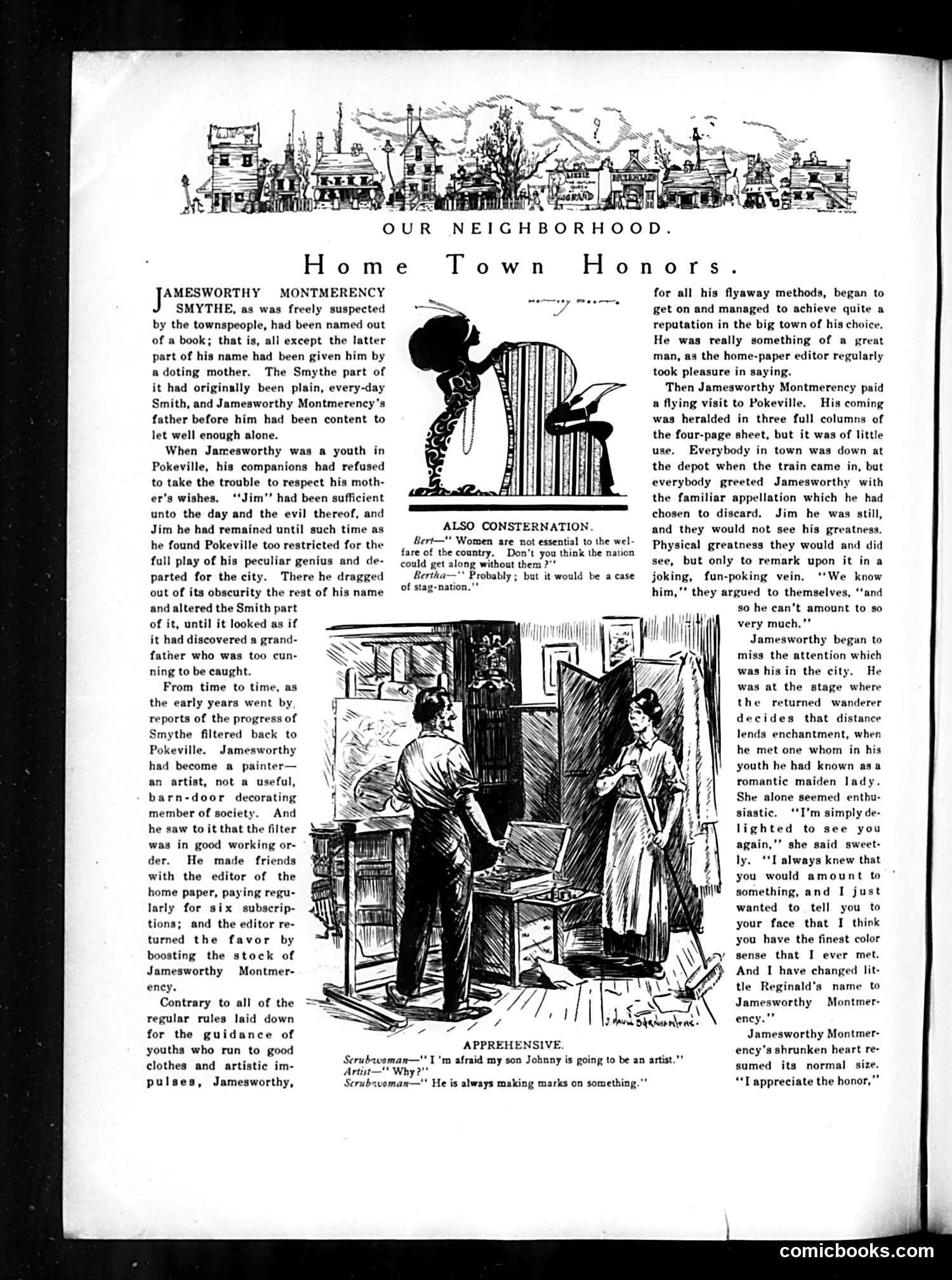
This story satirizes small-town pretension and the human need for recognition. Jamesworthy Montmerency Smythe—a name artificially elevated from plain "Smith"—escapes his hometown Pokeville to become a painter in the city, where he cultivates a reputation through careful self-promotion (bribing the local paper editor). When he returns as a celebrated artist, the townspeople frustrate him by refusing to acknowledge his transformation, calling him "Jim" as always. The satire targets how hometowns stubbornly deny their own children's achievements—"we know him" so he "can't amount to much." His spirits only revive when a former romantic interest validates him by naming her son after him, appealing to his vanity rather than his actual accomplishments. The accompanying jokes mock artistic pretension and gender roles ("stag-nation") in typical Judge fashion. The overall message critiques both small-town insularity and the artist's desperate hunger for recognition.
📄 Transcribed text from this page (OCR, searchable)
Machine-transcribed from the original scan — historical spelling and the odd misread are preserved.
OUR NEIGHBORHOOD. Home AMESWORTHY MONTMERENCY SMYTHE, as was freely suspected by the townspeople, had been named out of a book; that is, all except the latter part of his name had been given him by a doting mother. The Smythe part of it had originally been plain, every-day Smith, and Jamesworthy Montmerency’s father before him had been content to let well enough alone. When Jamesworthy was a youth in Pokeville, his companions had refused to take the trouble to respect his moth- er’s wishes. ‘‘Jim'’ had been sufficient unto the day and the evil thereof, and Jim he had remained until such time as he found Pokeville too restricted for the full play of his peculiar genius and de- parted for the city. There he dragged out of its obscurity the rest of his name and altered the Smith part of it, until it looked as if it had discovered a grand- father who was too cun- ning to be caught. From time to time, as the early years went by reports of the progress of Smythe filtered back to Pokeville. Jamesworthy had become a painter— an artist, not a useful, barn-door decorating member of society. And he saw to it that the filter was in good working or- der. He made friends with the editor of the home paper, paying regu- larly for six subscrip- tions; and the editor re- turned the favor by boosting the stock of Jamesworthy Montmer- ency. Contrary to all of the regular rules laid down for the guidance of youths who run to good clothes and artistic im- pulses, Jamesworthy, Town ALSO CONSTERNATION Bert—* Women are not essential to the wel- fare of the country. Don't you think the nation could get along without them ?"’ Bertha—** Probably; but it would be a case of stag-nation,"" \ ~~ < wie \ 1 WA Shedernlene- APPREHENSIVE. SS Scrubwoman—' 'm afraid my son Jobnny is going to be an artist."" Artist—"' Why?” Scrubwoman—" He is always making marks on something.” Honors. for all his flyaway methods, began to get on and managed to achieve quite a reputation in the big town of his choice. He was really something of a great man, as the home-paper editor regularly took pleasure in saying. Then Jamesworthy Montmerency paid a flying visit to Pokeville. His coming was heralded in three full columns of the four-page sheet, but it was of little use. Everybody in town was down at the depot when the train came in, but everybody greeted Jamesworthy with the familiar appellation which he had chosen to discard. Jim he was still, and they would not see his greatness. Physical greatness they would and did see, but only to remark upon it in a joking, fun-poking vein. ‘We know him,"’ they argued to themselves, ‘and so he can't amount to so very much.”’ Jamesworthy began to miss the attention which was his in the city. He was at the stage where the returned wanderer decides that distance lends enchantment, when he met one whom in his youth he had known asa romantic maiden lady. She alone seemed enthu- siastic. ‘‘I’m simply de- lighted to see you again,’’ she said sweet- ly. ‘*I always knew that you would amount to something, and I just wanted to tell you to your face that I think you have the finest color sense that I ever met. And I have changed lit tle Reginald'’s name to Jamesworthy Montmer- ency."’ Jamesworthy Montmer- ency’s shrunken heart re- sumed its normal size. “TL appreciate the honor,”” comicbooks.com