
A complete issue · 24 pages · 1912
Judge — September 21, 1912
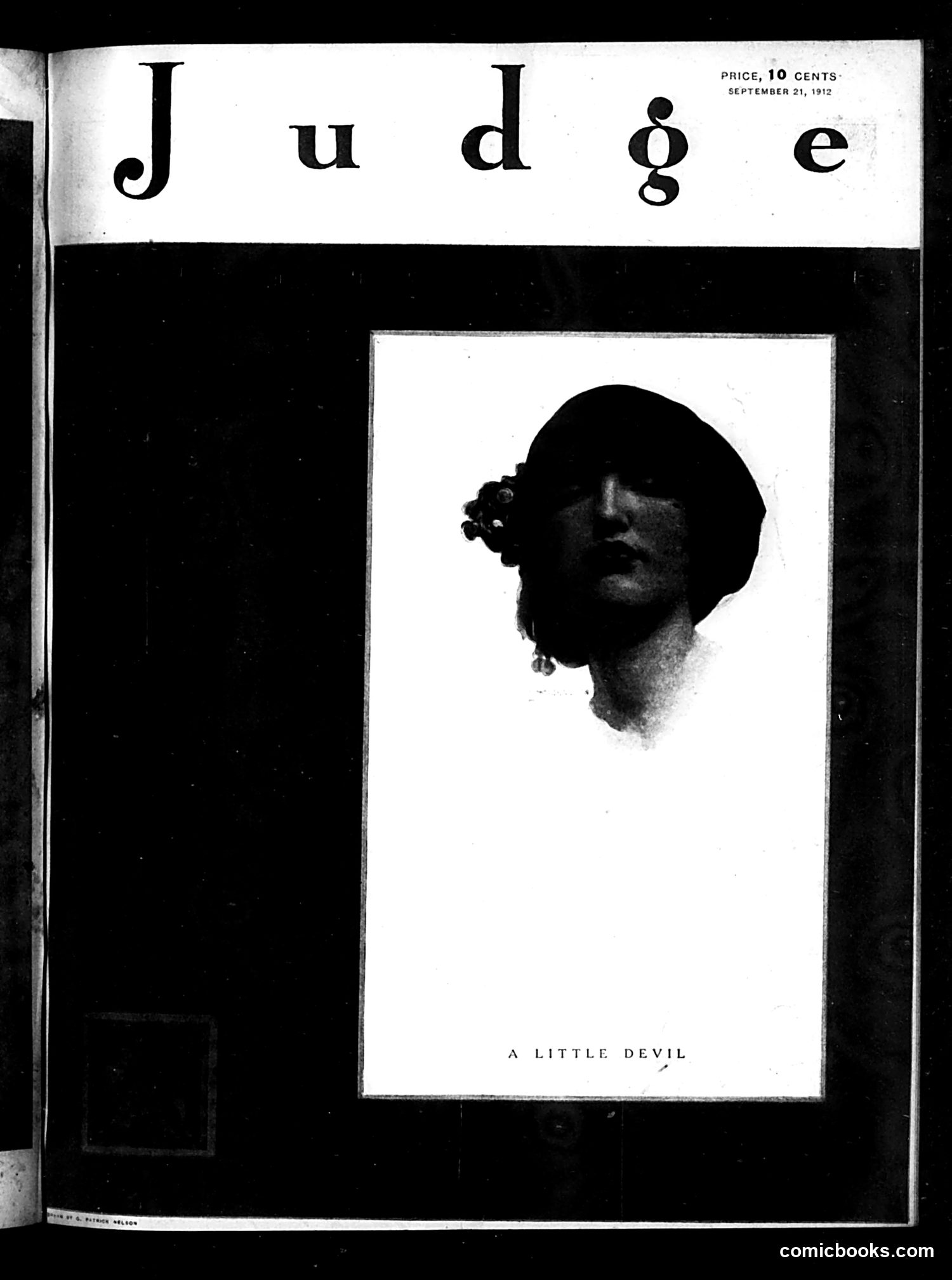
This is the cover of *Judge*, a satirical weekly magazine priced at 10 cents. The image shows a woman's profile in silhouette, wearing an elaborate hat decorated with flowers. The caption reads "A Little Devil." The photograph appears to be a portrait study rather than a political cartoon. Without additional context from the magazine's interior pages, the specific identity of the subject and the intended satire remain unclear. The title suggests criticism of the woman depicted—possibly a public figure, actress, or society personality—though the nature of the critique is not evident from the image alone. The elaborate hat styling may indicate commentary on fashion or women's vanity, common satirical targets in early 20th-century humor magazines.
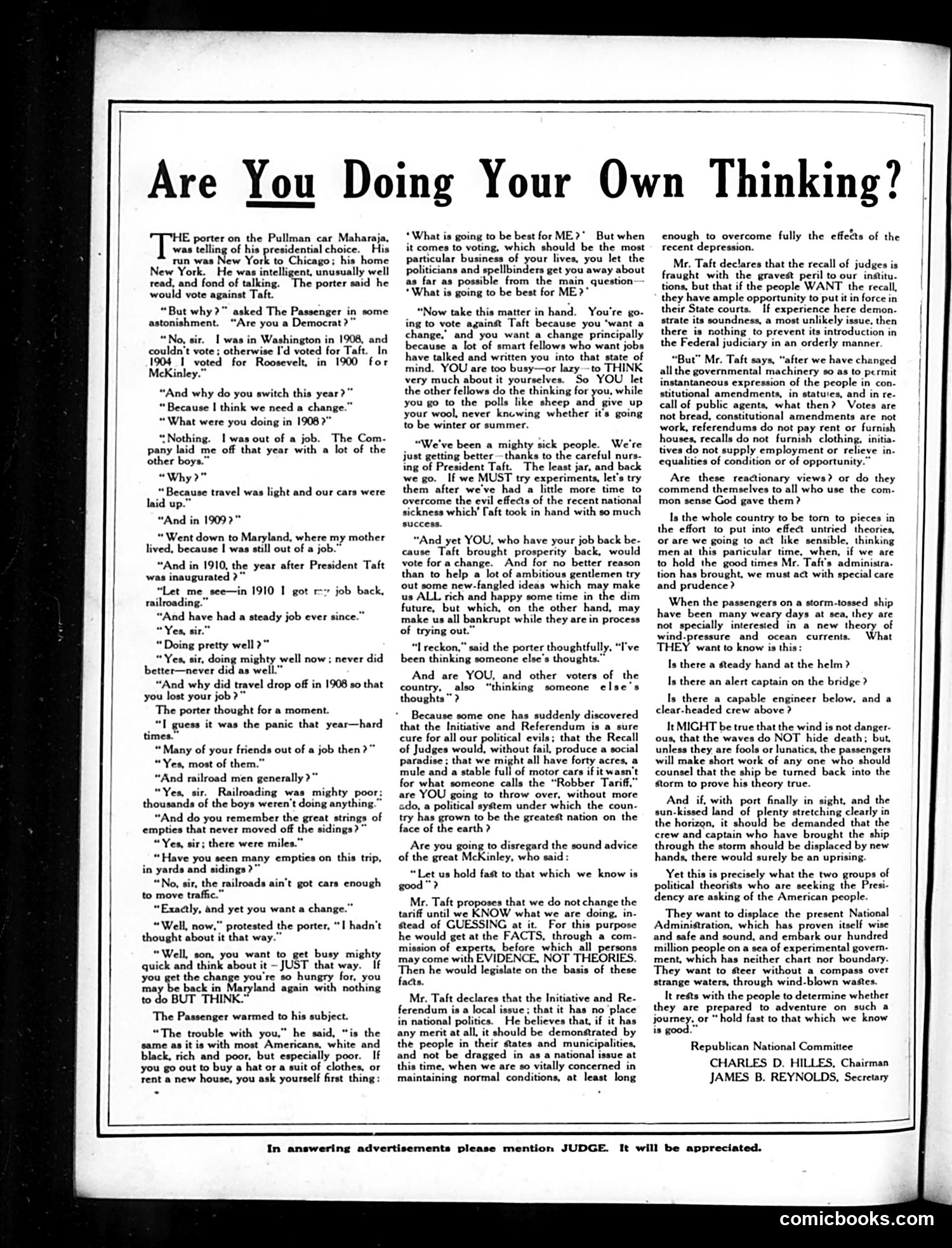
This Judge magazine piece is a dialogue between a Pullman car porter and a passenger debating political engagement during what appears to be the early 1910s. The satire targets voter apathy and blind party loyalty. The porter challenges the passenger—who switches political affiliation based on convenience rather than principle—to actually think independently about issues. The passage criticizes Americans for passively accepting politicians' and newspapers' talking points rather than examining facts themselves. References to President Taft, the Recall of judges, and the Initiative and Referendum suggest this addresses Progressive Era political reforms. The Republican National Committee credits (Charles D. Hilles, James B. Reynolds) indicate this is Republican propaganda promoting civic engagement and reasoned voting over mere party affiliation. The core message: voters should research issues independently rather than follow the crowd.
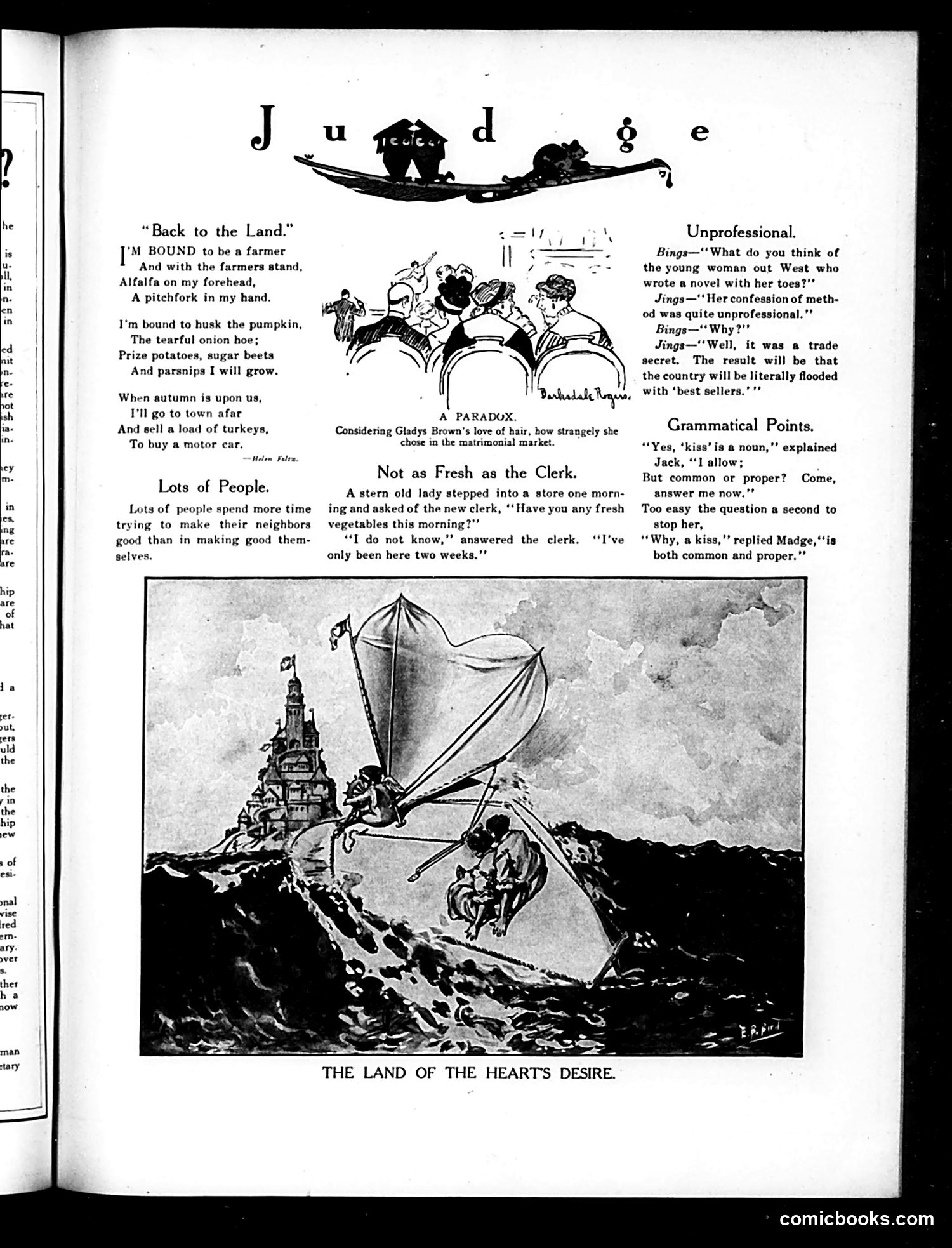
This page contains several distinct satirical pieces: **"Back to the Land"** is a poem mocking the "back-to-the-land" movement—a early-20th-century trend where urbanites romanticized farming. The satire undercuts this idealism by listing unglamorous farm realities: alfalfa, pumpkins, onions, and the hard work of selling produce. **"Lots of People"** briefly notes that people spend more time making excuses than improving themselves—social commentary on human nature rather than specific politics. **"Not as Fresh as the Clerk"** is a simple joke about a new store clerk unfamiliar with inventory. **The large illustration**, "The Land of the Heart's Desire," depicts an airship approaching a fantastical castle—likely satirizing escapist fantasies and the allure of unrealistic dreams, reinforcing the "back to the land" theme's disconnect from reality.
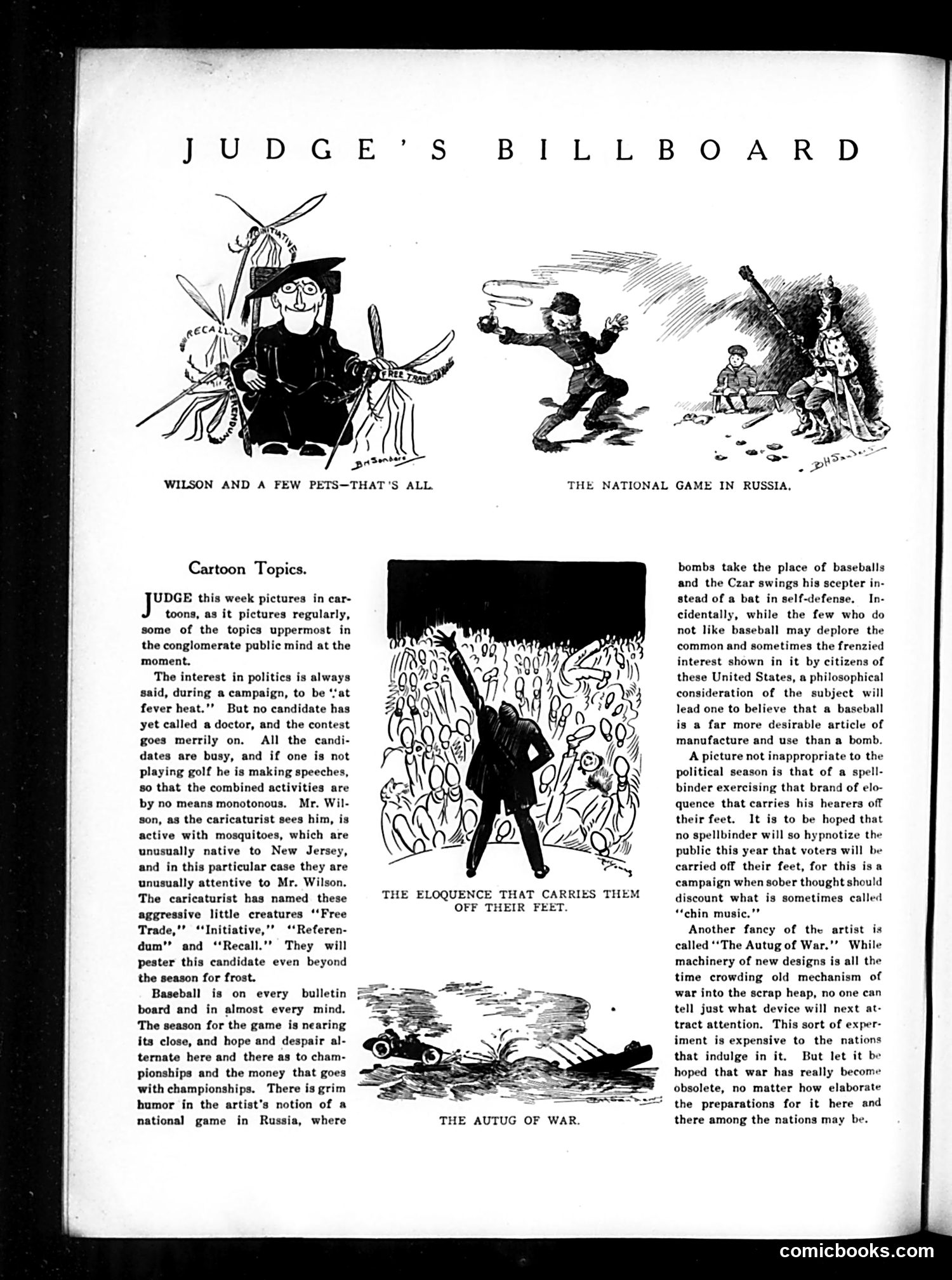
This page satirizes the 1916 U.S. presidential campaign, specifically targeting Woodrow Wilson. The cartoons employ baseball and war metaphors to mock Wilson's candidacy. **"Wilson and a Few Pets—That's All"** depicts Wilson surrounded by insects/pests, suggesting he's surrounded by ineffectual supporters or problematic policies. **"The National Game in Russia"** compares Russian warfare to baseball, with bombs replacing balls—dark satire on war's brutality contrasted with American pastimes. **"The Eloquence That Carries Them Off Their Feet"** shows a politician hypnotizing crowds with rhetoric, critiquing campaign speeches' manipulative power. **"The Autug of War"** remains unclear but likely mocks wartime mechanization. The article criticizes Wilson's campaign activities as distracting from serious governance, while satirizing Americans' obsession with baseball despite global conflict.
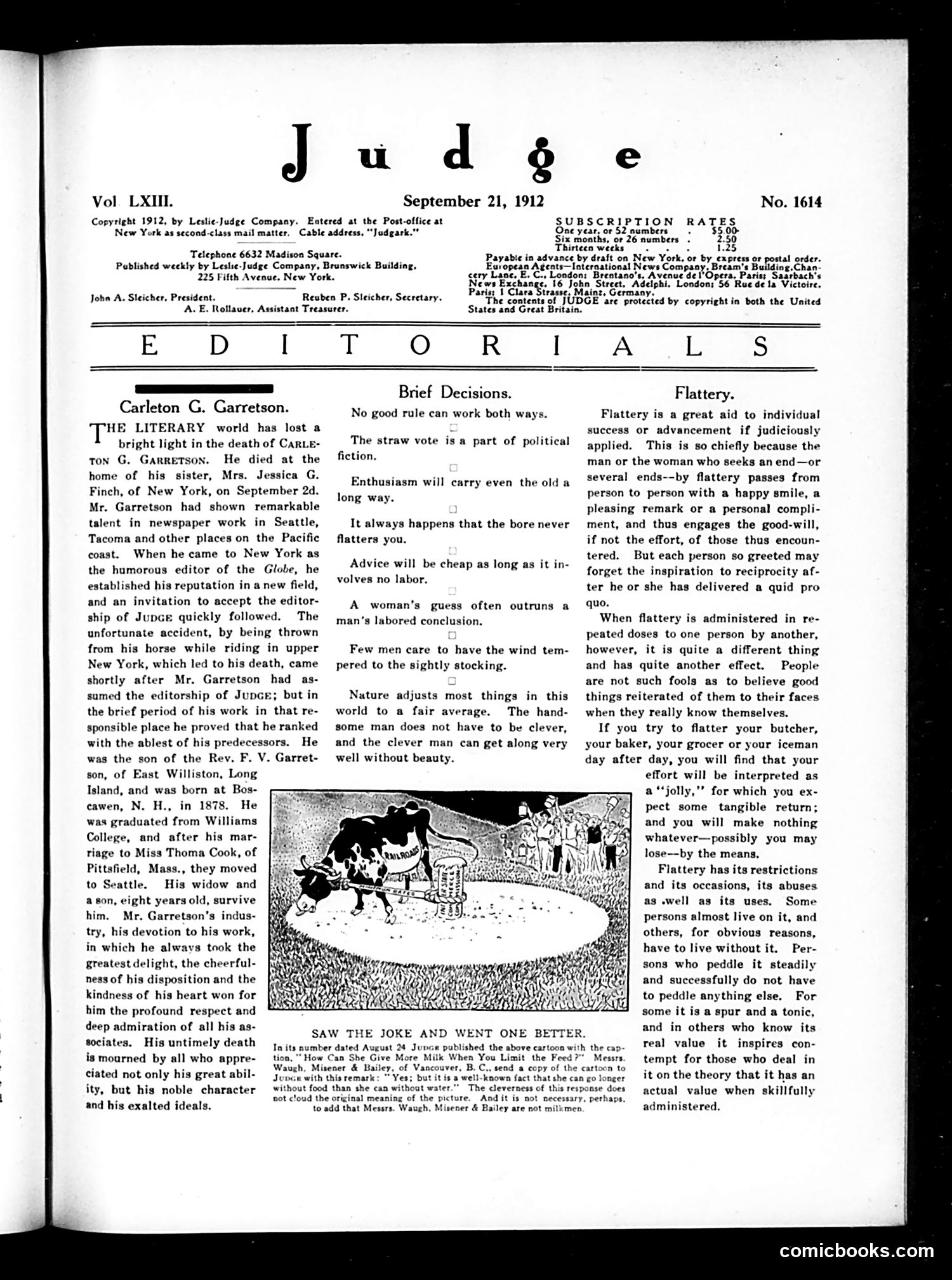
The main cartoon, titled "Saw the Joke and Went Busted," appears to reference a contemporary humorous article about limiting animal feed costs (based on the caption mentioning "How Can She Give More Milk When You Limit the Feed?"). The illustration shows a cow that has apparently collapsed or "gone busted" after understanding the joke—a visual pun on the economic absurdity of expecting increased milk production while reducing feed. This satirizes impractical business or agricultural advice common in 1912. The page also contains editorial commentary about flattery, straw-vote politics, and brief observations about human nature, typical of Judge's satirical content. The specific political or social context of the feed limitation debate remains unclear without additional historical documentation.
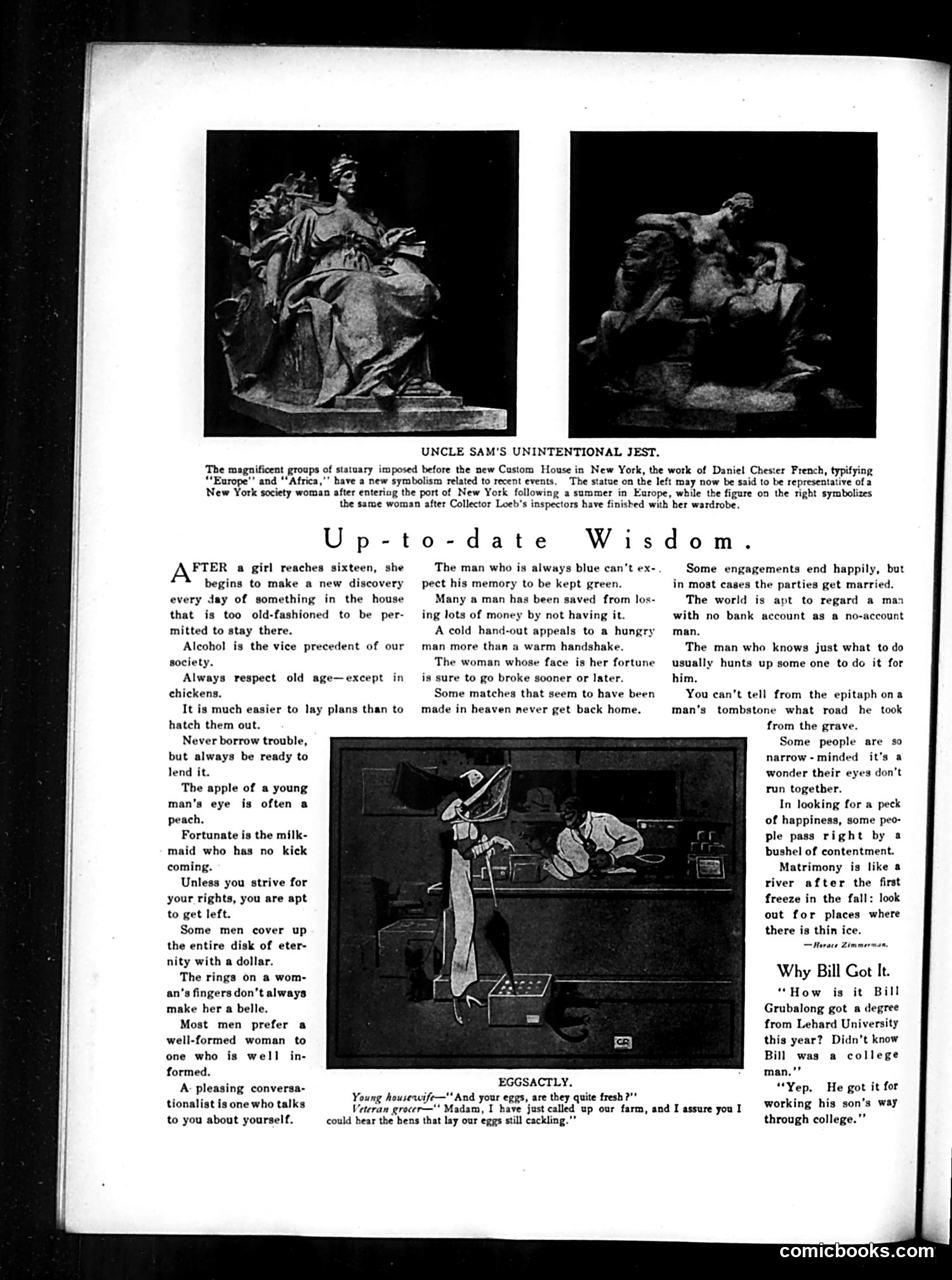
**Top Section - "Uncle Sam's Unintentional Jest":** This references statuary by sculptor Daniel Chester French newly installed at New York's Custom House. The satire equates the two female figures with a wealthy New York society woman: the left statue represents her after returning from a European summer; the right shows her after U.S. Customs inspectors examine her luggage and confiscate contraband goods (likely fashionable imported items subject to tariffs). The joke mocks both wealthy travelers' smuggling habits and aggressive customs enforcement under Collector Loeb. **Bottom Section - "Eggsactly":** A grocer humorously claims eggs are fresh because he just called the farm and could still hear hens cackling—absurd proof of freshness that actually proves nothing. **"Why Bill Got It":** A dry joke: Bill Grubalong earned his college degree by working to pay his son's tuition, not by attending himself. The humor stems from wordplay on "got a degree." The page also contains general aphoristic wisdom typical of Judge's satirical commentary.
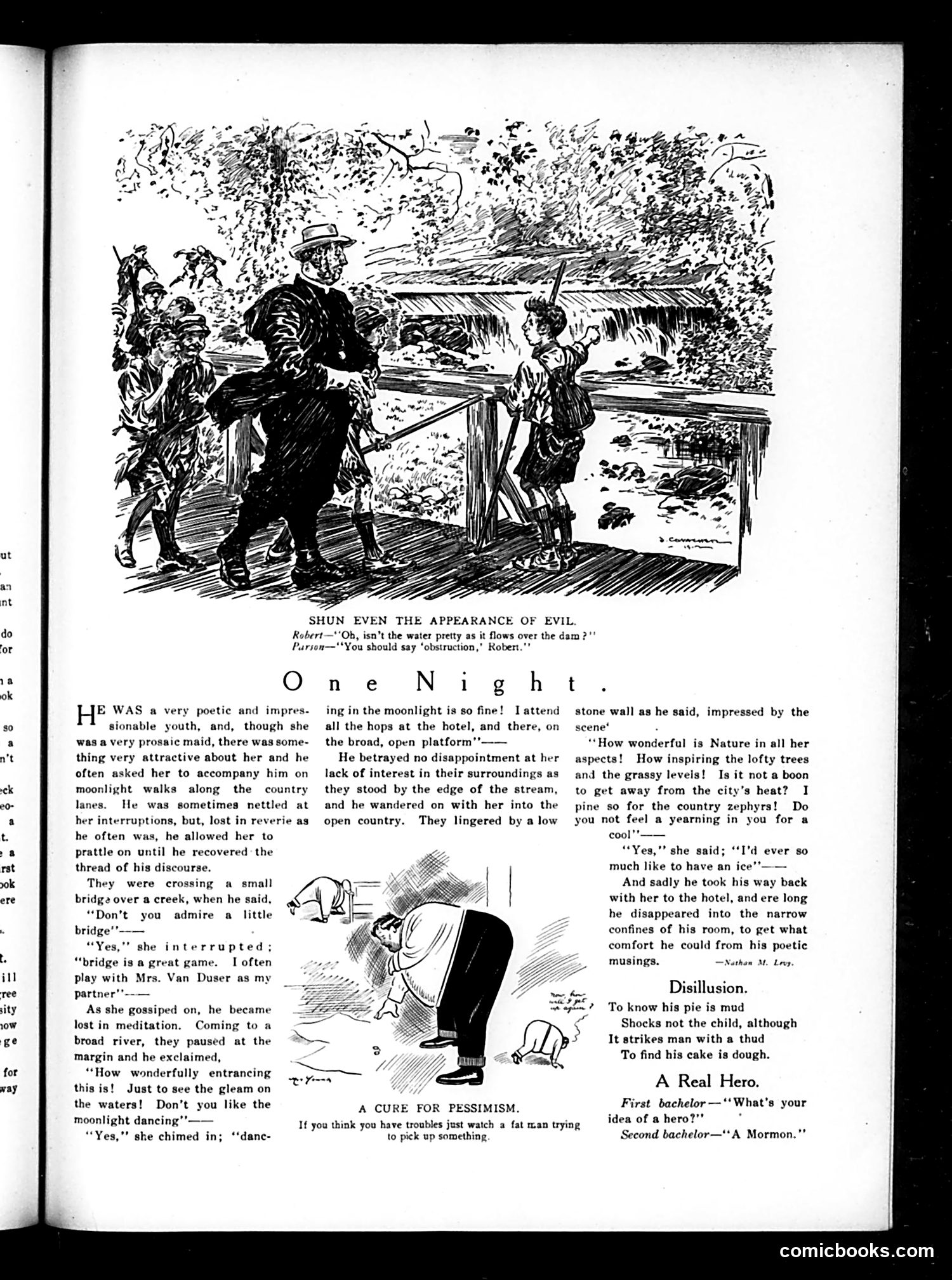
The top cartoon satirizes moral prudishness. A man and woman stand by a dam; when he romantically remarks on the water's beauty, she pedantically corrects him—the word "obstruction" sounds less suggestive than "flows." The joke: extreme propriety polices even innocent language to avoid *appearing* improper. The main story, "One Night," mocks romantic idealism meeting practical reality. A poetic young man takes a prosaic woman on moonlight walks, attempting to share appreciation for nature's beauty. She repeatedly misses his point, deflating each observation with mundane comments (about dancing at hotel hops, wanting ice cream instead of appreciating scenery). He retreats dejected to his room. The satire targets romantic sentimentalists and the gap between their lofty aspirations and ordinary human indifference. Both pieces critique excessive idealism—whether moral squeamishness or romantic fantasy—colliding with prosaic reality. Minor items include an unrelated joke about fat men and two one-liners about pessimism and Mormons.
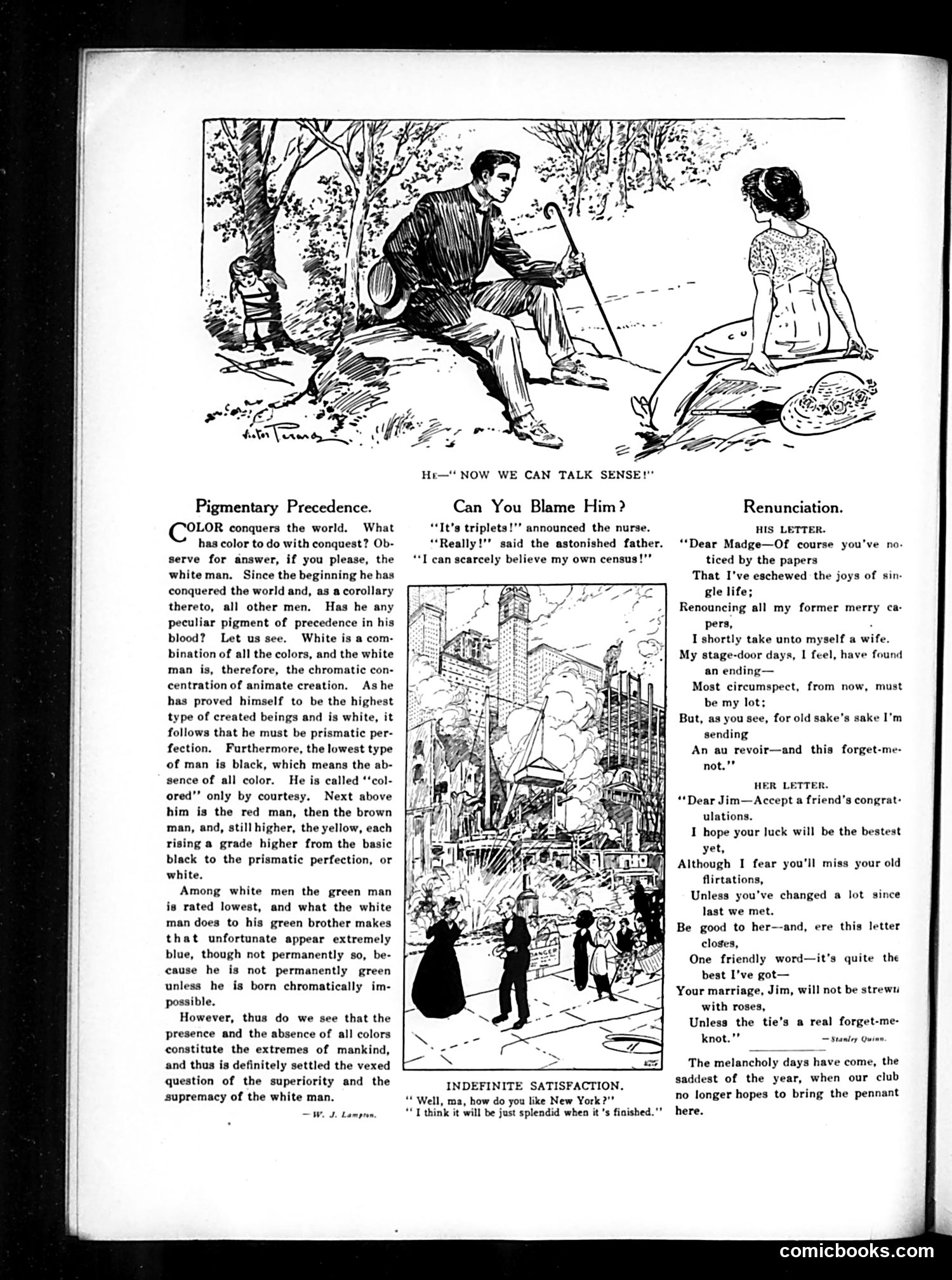
**Top Cartoon:** "Now We Can Talk Sense!" depicts a man and woman fishing together while a child plays nearby. The joke plays on the phrase "talk sense"—suggesting that fishing (a traditionally male leisure activity) finally allows the couple to communicate meaningfully. **"Pigmentary Precedence" Essay:** This is a racist pseudo-scientific satire attempting to justify white supremacy through color theory. It argues that white, being a combination of all colors, represents the "highest type" of mankind, while Black represents the "absence of color" and thus the lowest. The piece sardonically presents this hierarchy as logical fact. By modern standards, it's deeply offensive pseudoscience that exposes the absurd rationales used to legitimize racial prejudice. **"Can You Blame Him?"** plays on census/sensus wordplay—a father disbelieves his own "census" (count) upon hearing of triplets. **"Renunciation"** features two humorous letters between Jim and Madge about his upcoming marriage, with forget-me-knot puns.
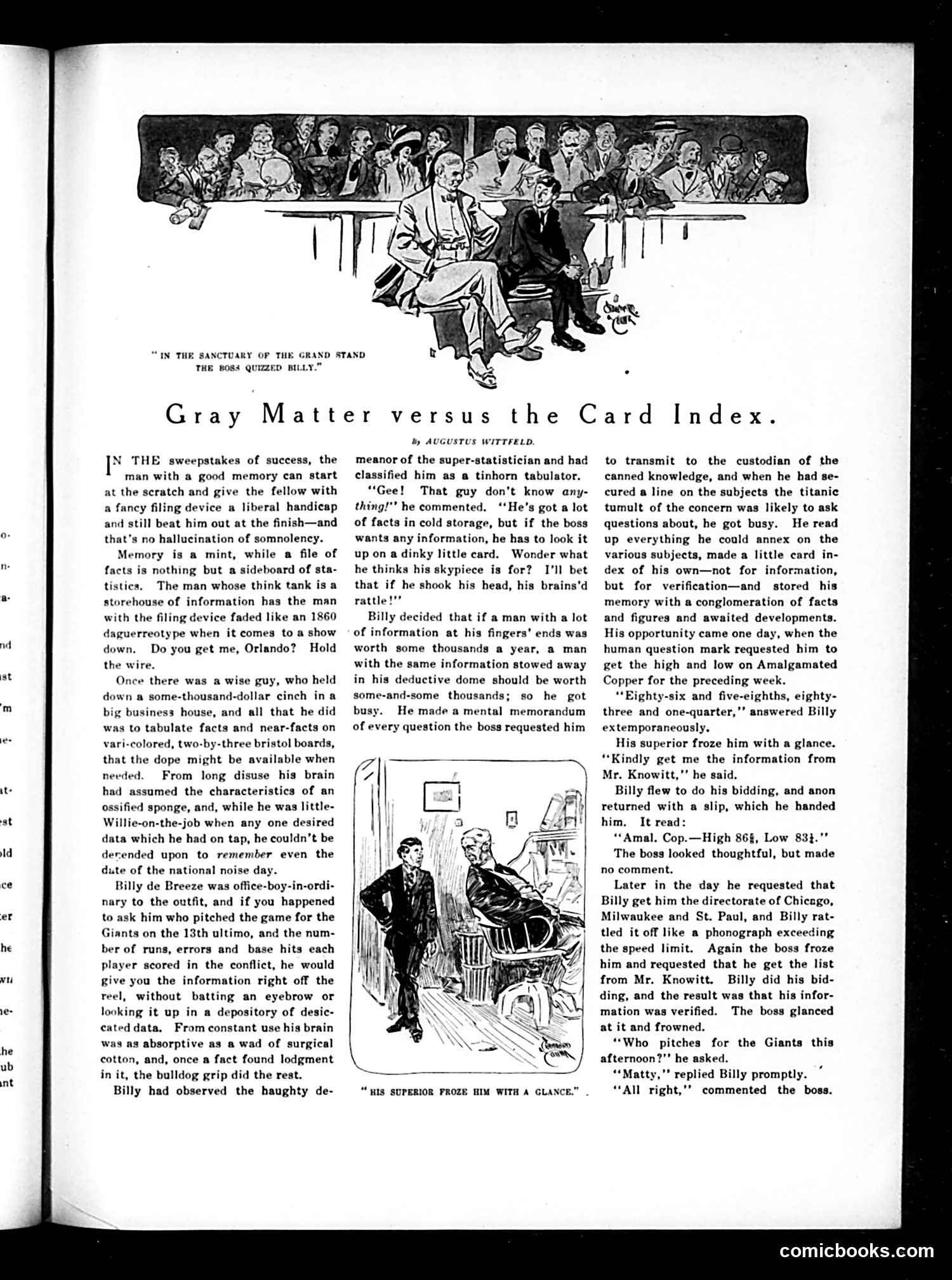
This story satirizes competing business management philosophies of the early 1900s. "Billy de Breeze," an office boy, challenges the established "super-statistician"—a senior employee who relies entirely on filing systems and written records to retrieve information for his boss. Billy proves that natural memory and mental preparation outperform mechanical filing. When the boss requests stock prices for Amalgamated Copper, Billy answers immediately from memory ("Eighty-six and five-eighths, eighty-three and one-quarter"). The boss's superior initially freezes him with disapproval, expecting Billy to consult written records. However, when the information matches Mr. Knowitt's official data exactly, the boss recognizes Billy's superior value. The satire mocks over-reliance on filing systems and celebrates human intellect and preparation—a timely concern as businesses increasingly adopted card-index and filing cabinet technology. The cartoon above shows the boss "quizzing Billy" in the grandstand, suggesting this is treated as public spectacle.
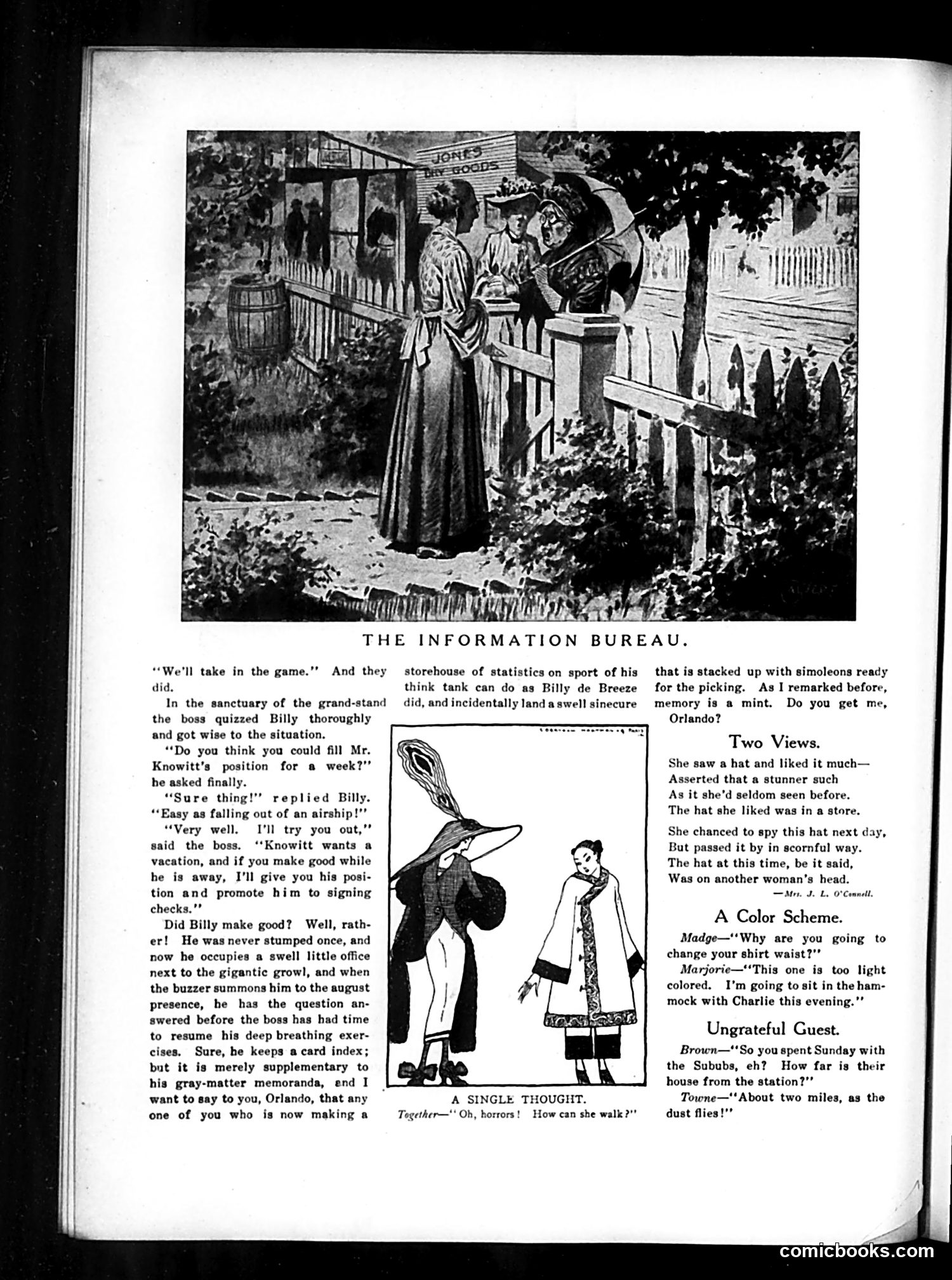
**Main Story - "The Information Bureau":** This narrative describes Billy, an office worker, successfully substituting for Mr. Knowitt during a vacation. Billy proves exceptionally competent by maintaining a detailed card-index system and memoranda, impressing his boss. The satire targets workplace efficiency and the "indispensable man" trope—Billy's systematic organization makes him invaluable, earning him promotion to a better office position. **Supporting Cartoons/Poems:** Three brief humorous pieces satirize social pretension and gender behavior: - "Two Views": A woman admires a fashionable hat in a store window but scorns it when seeing it worn by another woman - "A Color Scheme": A woman changes clothes to impress a man (Charlie) - "Ungrateful Guest": Visitors complain about distance to hosts' country home **Overall Theme:** The page mocks superficial social attitudes, vanity, and workplace ambition through comedic vignettes typical of early 20th-century satirical humor.
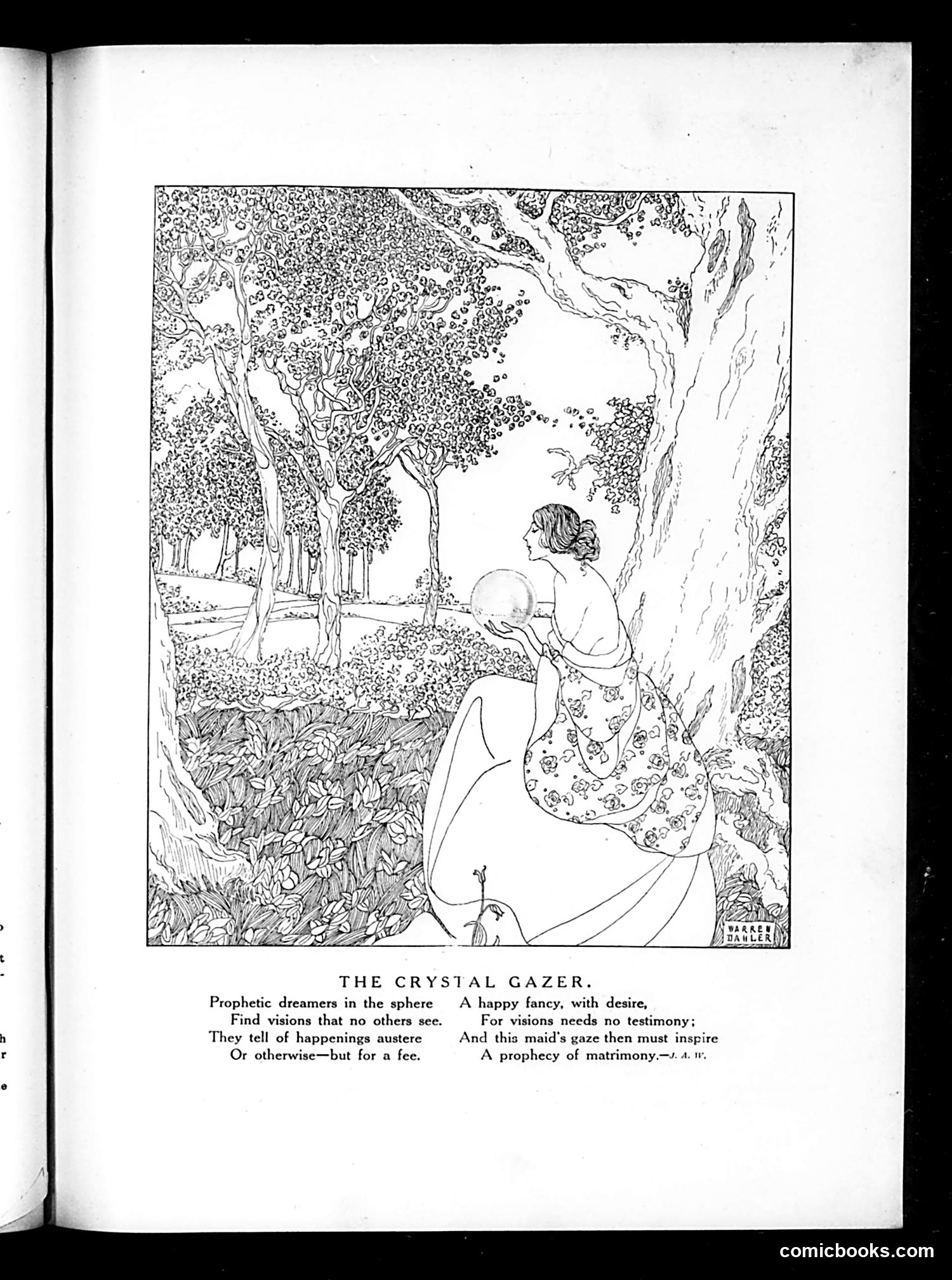
This is an illustration accompanying a poem satirizing fortune tellers and crystal gazers—popular con artists of the early 20th century who claimed supernatural powers to predict the future, particularly marriage prospects. The image shows a woman gazing into a crystal ball in a wooded setting, dressed in a patterned dress suggesting mystical affectation. The poem mocks the practice: fortune tellers claim "prophetic" visions that "no others see," tell stories of "austere" happenings (often ominous predictions), and charge fees for their supposed supernatural insight. The final lines—"For visions needs no testimony; / And this maid's gaze then must inspire / A prophecy of matrimony"—offer sarcastic commentary: since visions require no proof, these fraudsters exploit people's desires (especially young women's dreams of marriage) without accountability. The cartoon ridicules both the charlatans and their gullible clients.
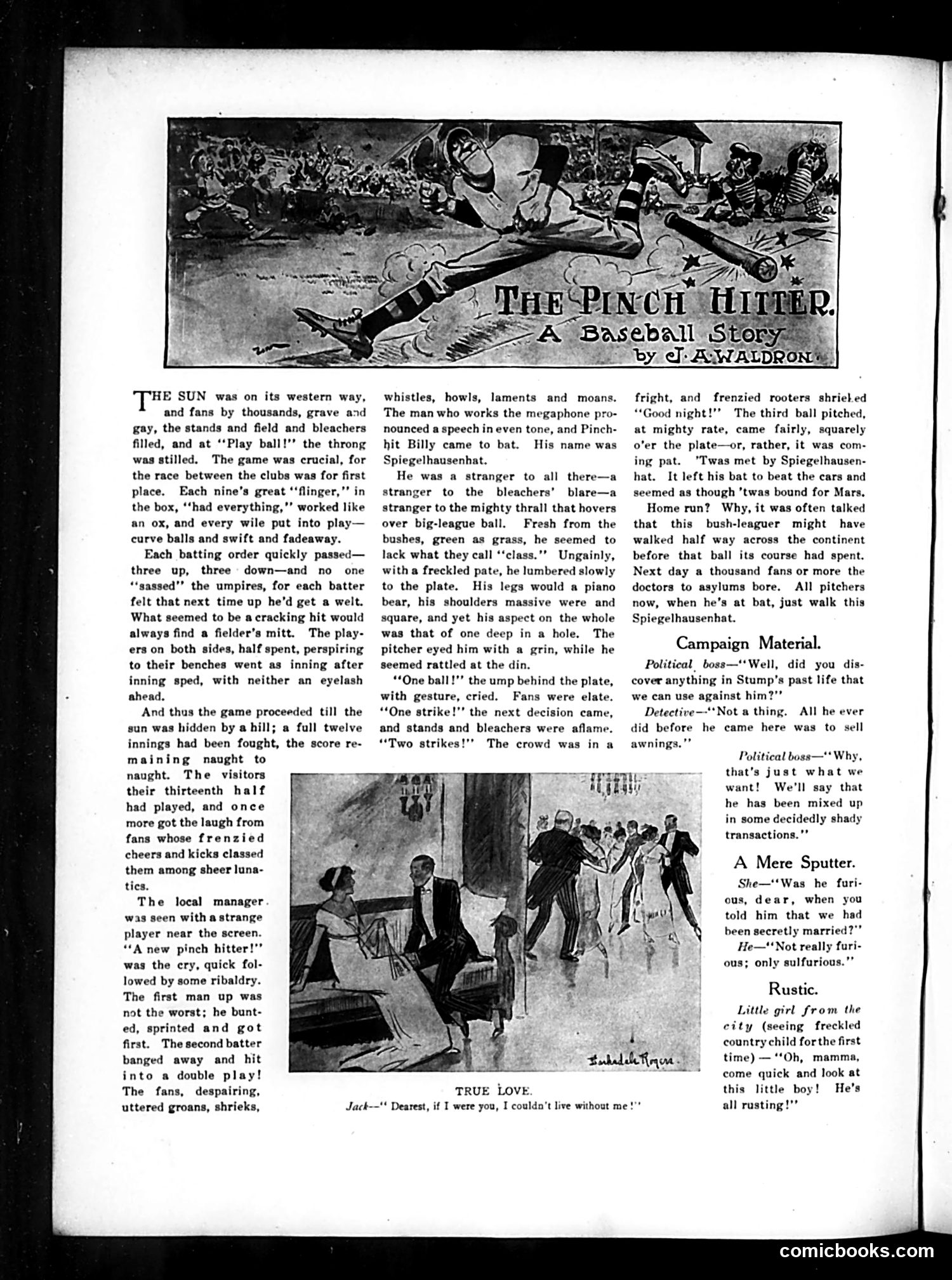
This is a humorous baseball narrative poem illustrated with a dramatic moment. The story follows an unlikely hero: Spiegelhausenhat, a green, ungainly "bush-leaguer" (minor league player) called in as a pinch hitter during a crucial tie game. Despite his awkward appearance and nervousness, he hits a massive home run, becoming an instant celebrity—so famous that opposing pitchers now refuse to pitch to him. The satire targets baseball's theatrical dramatics: the umpire's theatrical calls, the crowd's frenzied reactions, and how baseball transforms ordinary people into legends overnight. The accompanying vignettes mock political hypocrisy (inventing scandals) and offer light wordplay humor ("sulfurious" pun, rural child's misunderstanding of "rusting"). The page exemplifies *Judge* magazine's blend of sports satire and general social commentary circa early 1900s.
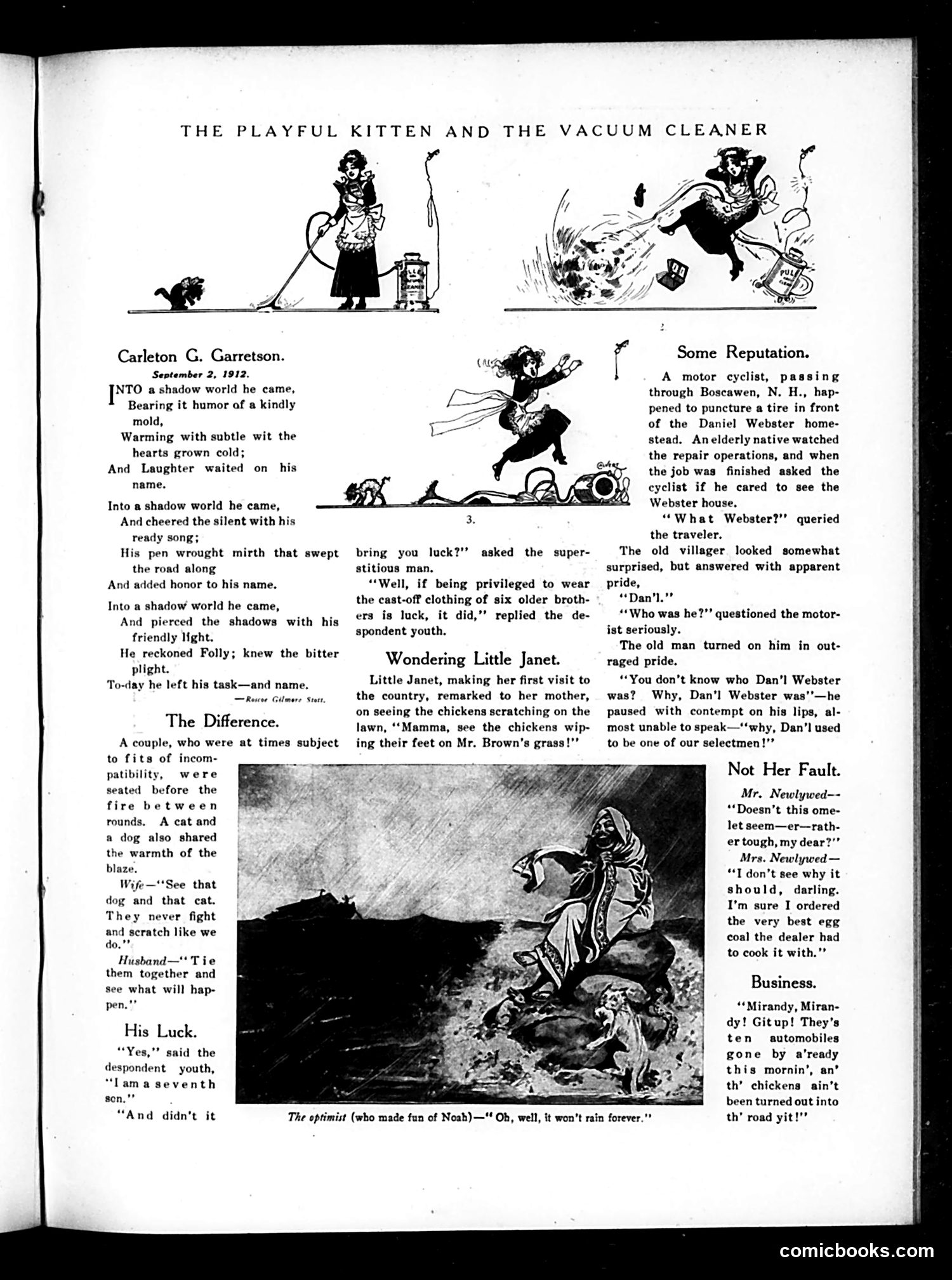
This is a humor page from *Judge* magazine (September 2, 1912) containing several unrelated comic sketches and anecdotes: **"The Playful Kitten and the Vacuum Cleaner"** shows three slapstick scenes of a woman being knocked around by a vacuum cleaner while a kitten causes chaos—visual humor about new household appliances. **Other sketches** include: - A poem memorializing cartoonist Carleton G. Garretson - "The Difference": a couple arguing while their tied-together pets fight, proving conflict requires active antagonism - "His Luck": a seventh son's "luck" is wearing hand-me-downs - "Wondering Little Janet": a country child's innocent malapropism about chickens "wiping their feet" - "Some Reputation": rural dismissal of Daniel Webster as merely a local selectman - "Not Her Fault": a newlywed's confusion between coal and eggs (implying women's incompetence in housekeeping) - "Business": a farmer complaining chickens haven't been let out to scratch on the road yet The humor reflects early 1900s class attitudes, gender stereotypes, and rural-urban contrasts typical of *Judge*'s satirical tradition.
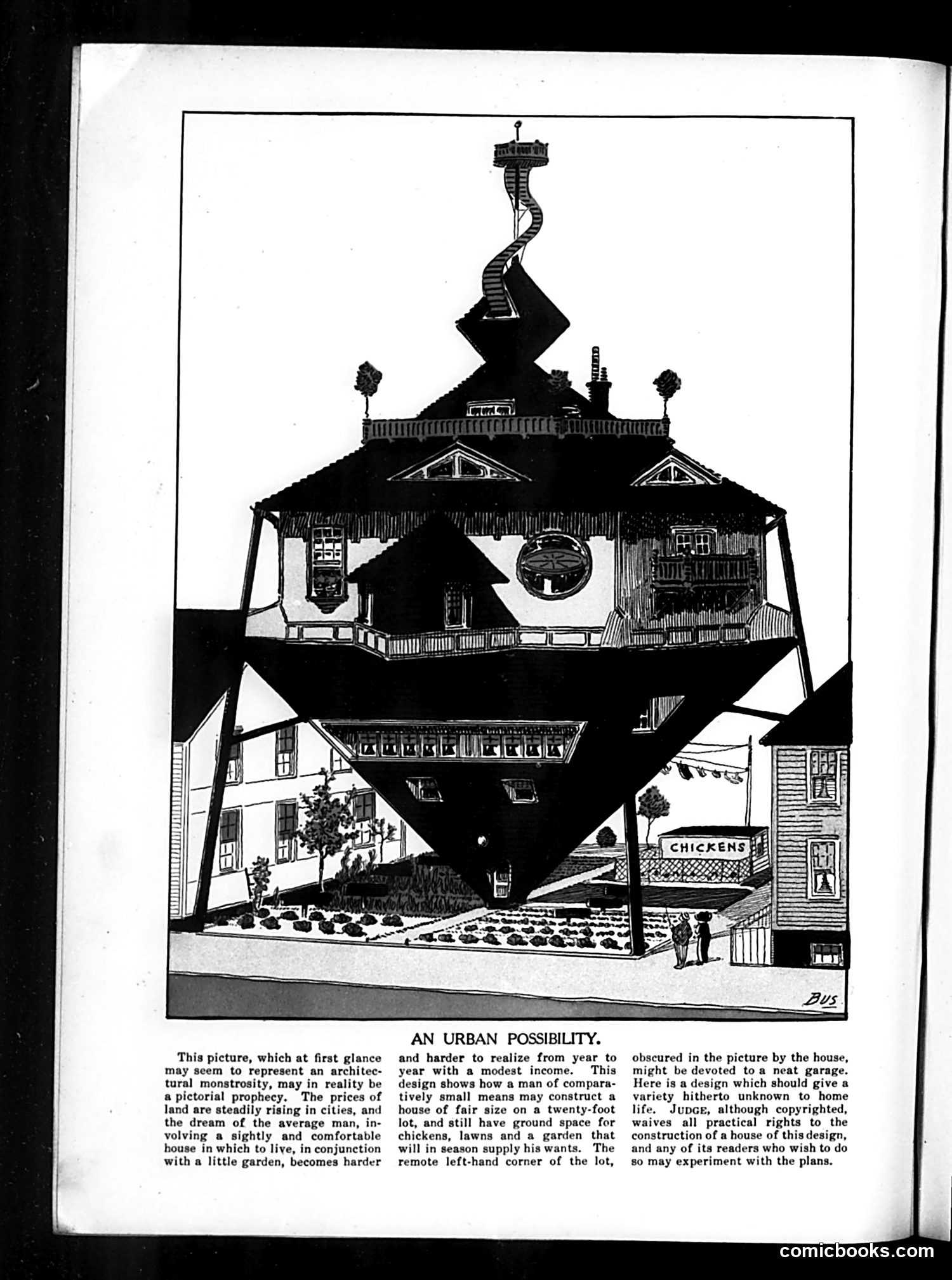
This is a satirical architectural proposal addressing housing affordability in early 20th-century cities. As land prices soared, average workers struggled to own homes with gardens. The cartoon proposes an absurd solution: a vertically-stacked house built upward on a tiny twenty-foot lot, resembling an inverted ship or fantastical structure, to maximize space for chickens, lawns, and gardens while fitting on minimal urban land. The satire works on two levels: it mocks both the desperation of working people priced out of homeownership AND the impractical architectural "solutions" proposed to solve housing crises. The elaborate, unwieldy design is obviously unlivable, exposing how ludicrous the situation has become—that such schemes must be imagined because normal housing remains unaffordable. Judge presents this ironically as practical advice while acknowledging its impossibility.
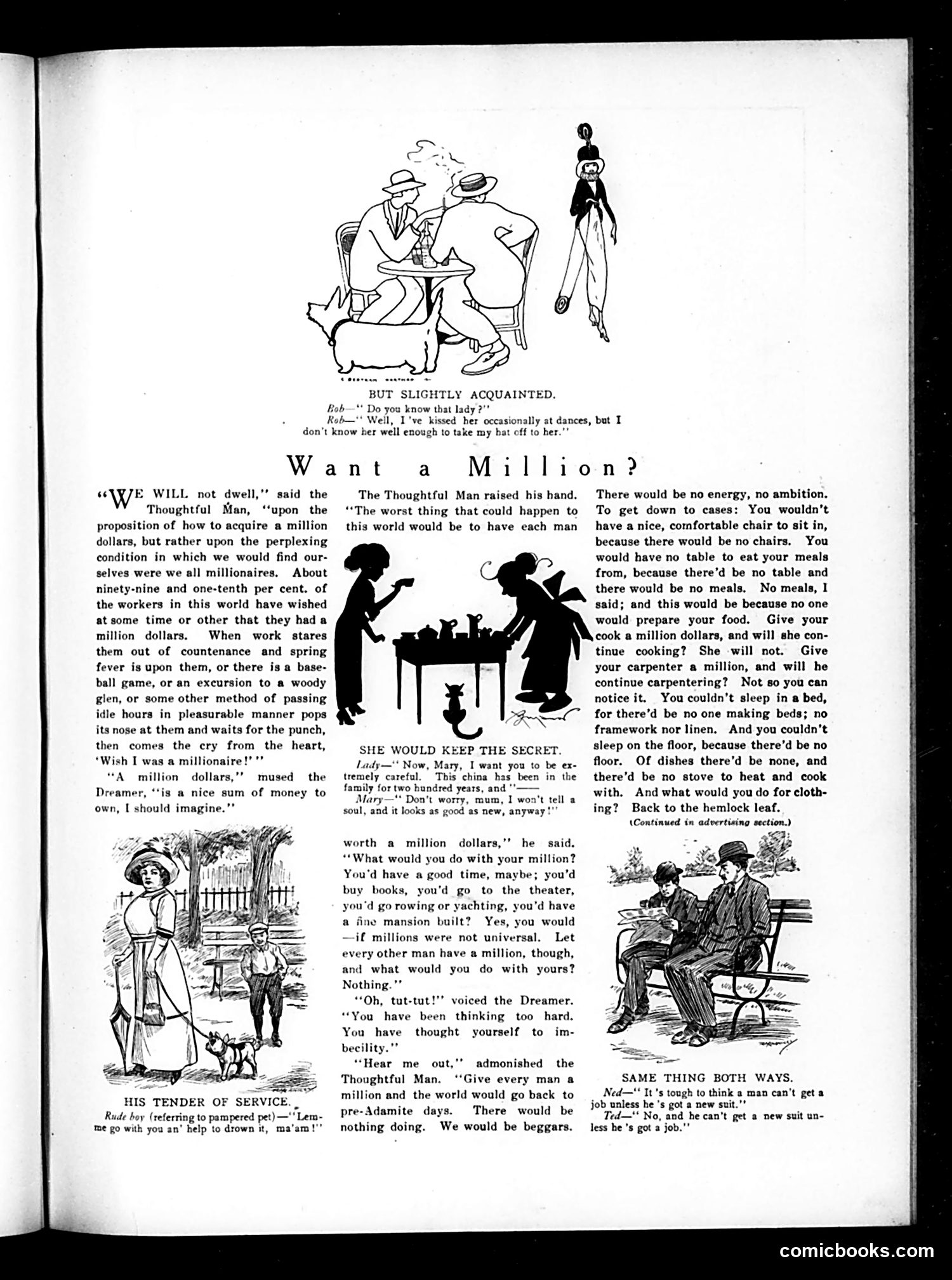
This page presents a philosophical argument against universal wealth redistribution, using the Thoughtful Man as a mouthpiece for economic realism. **The Main Satire**: The piece mocks the fantasy of giving everyone a million dollars. The Thoughtful Man argues this would destroy civilization—if everyone were wealthy, no one would work as servants, cooks, carpenters, or maids. Society would collapse into pre-civilization chaos because there'd be no chairs, beds, food, or clothing produced. The satire attacks both naive egalitarian dreams and the wealthy's dependence on cheap labor. **Supporting Jokes**: Side cartoons reinforce class themes: a servant offering to drown a pampered pet; a maid promising to keep fine china secret while clearly not understanding its value; and a commentary on employment catch-22s (can't get a job without new clothes; can't afford clothes without a job). **Historical Context**: This reflects early 20th-century anxieties about labor organizing and wealth redistribution, defending the existing class hierarchy as economically necessary rather than unjust.
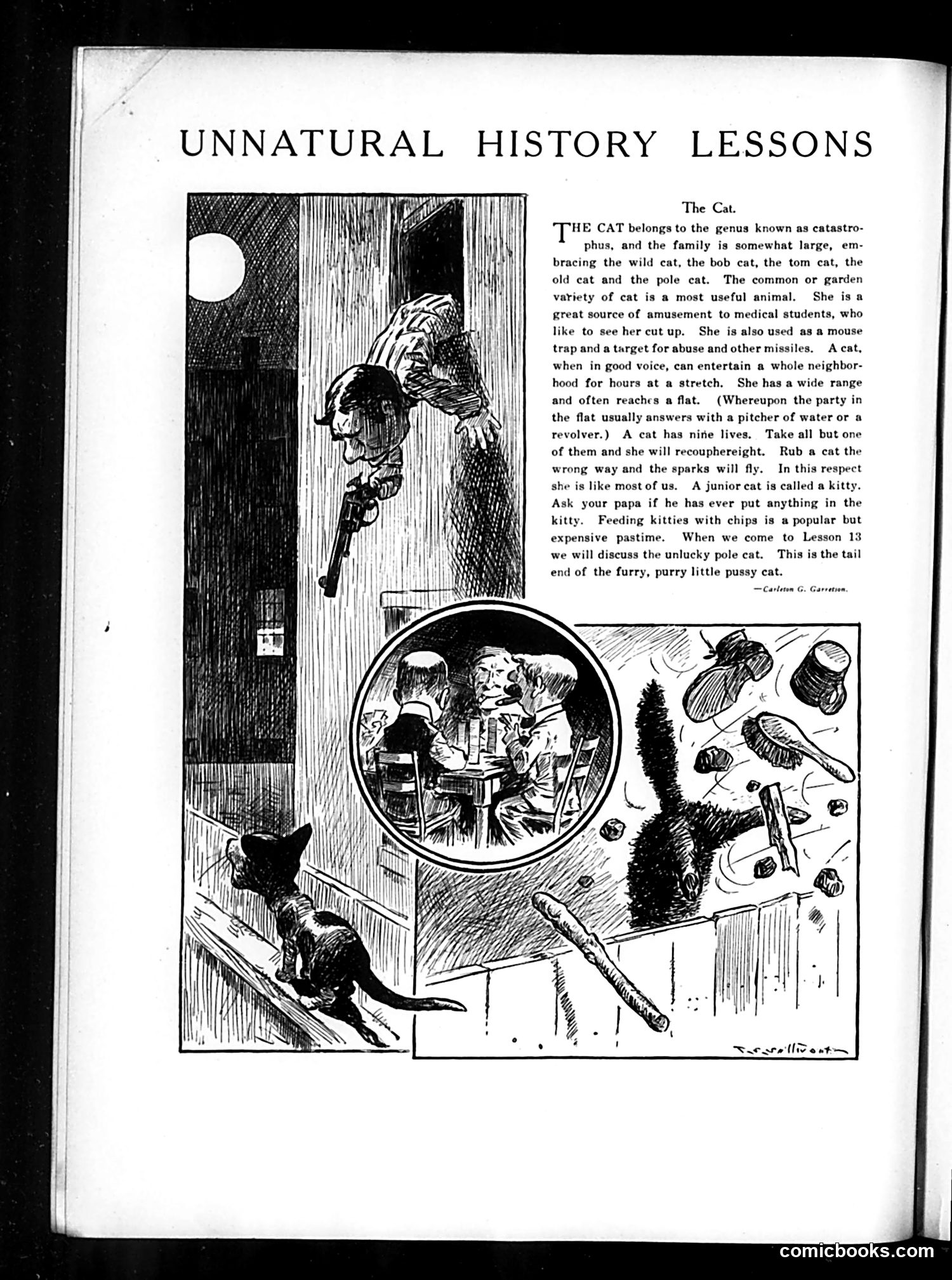
This page presents humorous pseudo-educational content about cats by Carlton G. Garrison. The satirical "lesson" mixes genuine cat facts with absurdist humor: cats have nine lives, can reach a flat when falling, and a junior cat is called a "kitty." The joke appears to be mocking serious natural history instruction by treating cats with exaggerated scientific gravity. The illustrations show a cat climbing a wall, people dining (possibly depicting the "flat" reference), and a cat surrounded by caught prey and domestic items. The cartoons seem to humorously illustrate the cat's predatory nature and unpredictable behavior, contrasting the dry instructional tone with comical visual chaos—a typical Judge magazine approach of satirizing earnest Victorian-era educational materials.
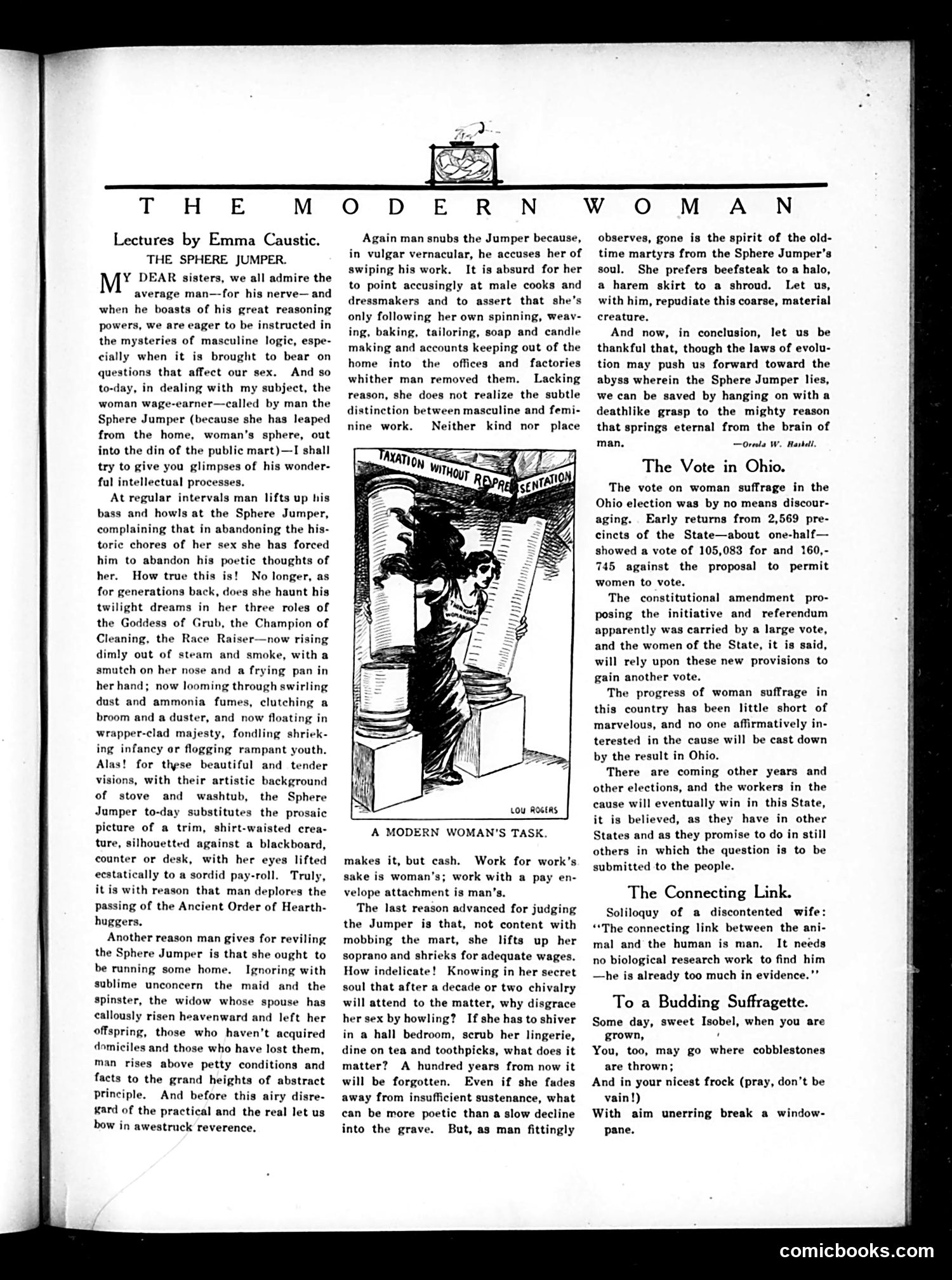
This 1912 Judge magazine piece satirizes male arguments *against* women entering the workforce. Emma Caustic (a pseudonymous female lecturer) mockingly catalogs men's hypocritical complaints about working women: **The targets of satire:** - Men claim women are "stealing" jobs while ignoring that men themselves moved traditionally female work (cooking, sewing, tailoring) into public factories - Men romanticize housewives as poetic muses but resent employed women's "sordid" appearance at desks and pay-rolls - Men invoke abstract "principle" while ignoring practical realities: widows, unmarried women, and the poor who *need* employment - Men find it "indelicate" for women to demand adequate wages, preferring they suffer nobly rather than demand "beefsteak" over "halos" **The cartoon** (by Lou Rogers) shows a woman juggling multiple household tasks—labeled "A MODERN WOMAN'S TASK"—illustrating the actual work women perform. The piece is progressive satire defending women's right to paid work and fair wages against paternalistic male objections.
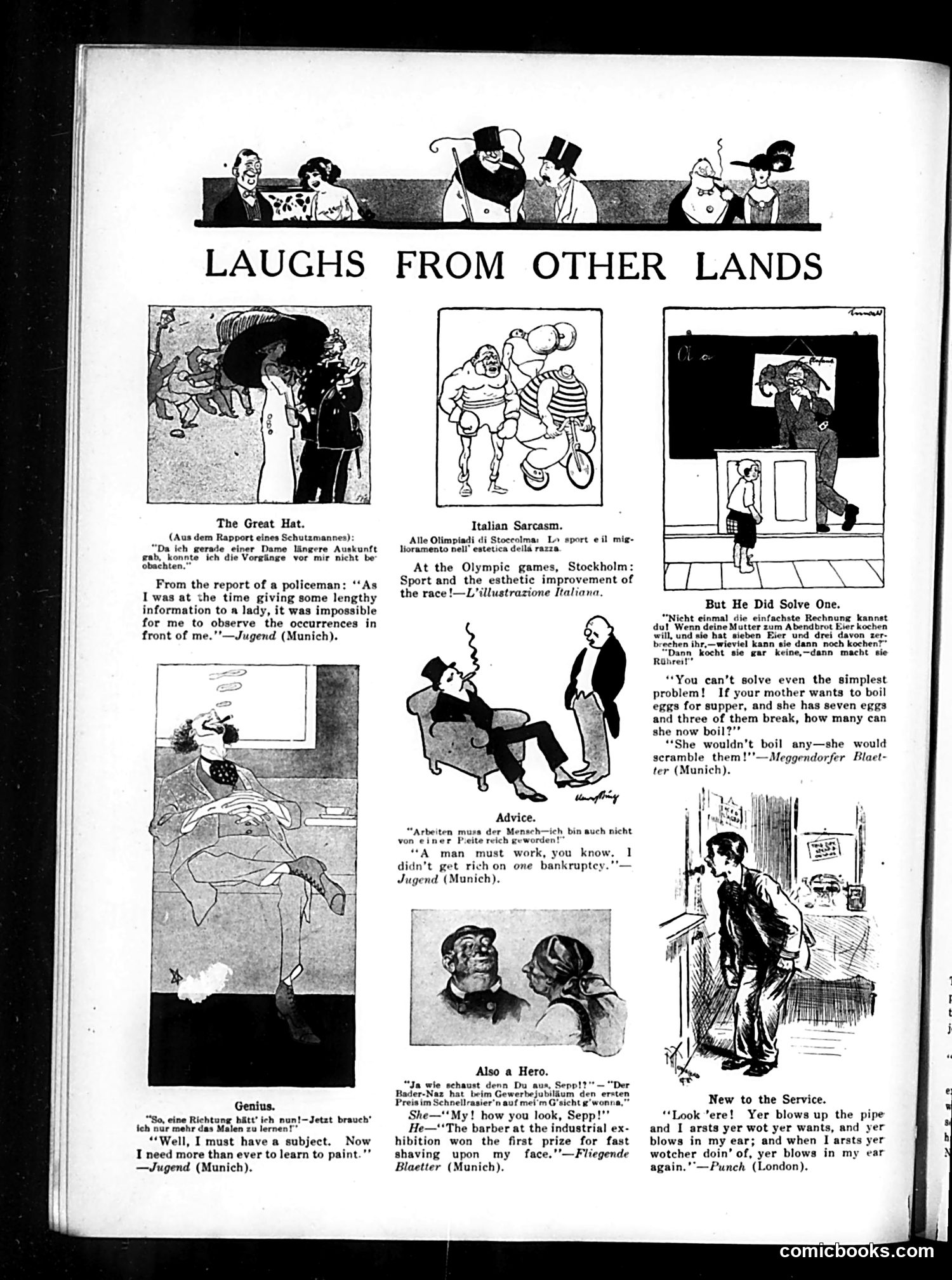
This page collects humorous cartoons and jokes translated from European satirical magazines (Jugend from Munich, L'illustrazione Italiana, Punch from London, and others), presenting them as cross-cultural entertainment. The jokes target familiar subjects: a distracted policeman blaming a lady for missing a crime, an artist seeking a painting subject, sarcasm about the Olympics promoting racial "improvement," working-class advice about bootstraps, a barber's industrial-age efficiency, and a child's practical logic (scrambling broken eggs rather than boiling them). "New to the Service" depicts telephone frustration—a common technology complaint of the era. The page demonstrates early 20th-century *Judge* magazine's practice of international content-sharing, treating humor as universal while celebrating European wit. The cartoons assume readers' familiarity with modern urban life, athletics, and emerging technologies.
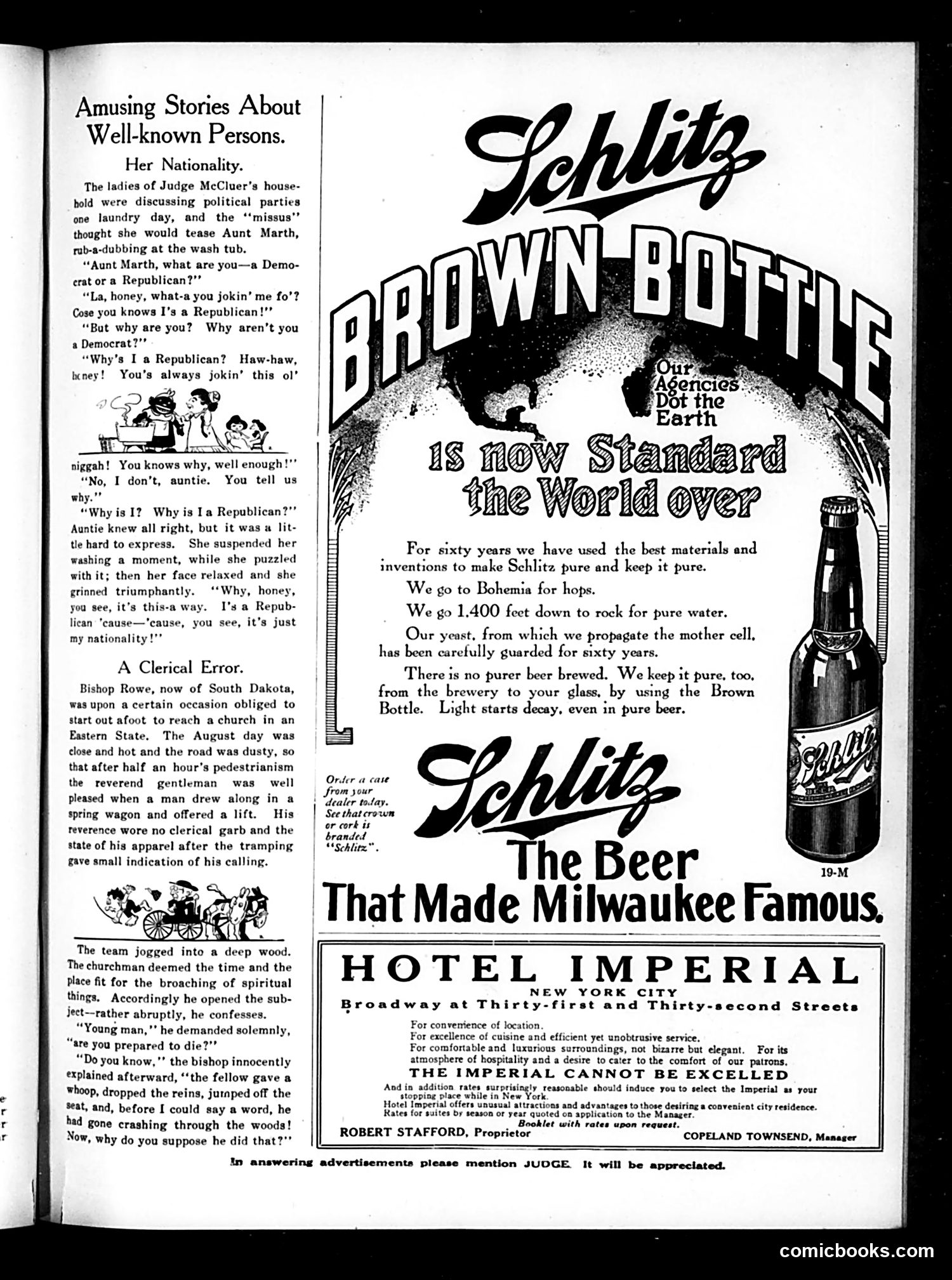
This page contains two satirical stories and period advertisements. **"Her Nationality"** presents a racist dialect joke. A white woman asks her Black servant "Aunt Marth" whether she's a Democrat or Republican. Marth replies she's Republican because "it's just my nationality"—the joke being that she identifies as Republican by race/nature rather than reasoned political choice. The humor relies on stereotypes of Black Americans as intellectually incapable of understanding politics, speaking in exaggerated dialect. **"A Clerical Error"** is a gentler anecdote: a bishop asks a wagon driver if he's "prepared to die," intending spiritual discussion. The driver, misunderstanding this as a threat, panics and flees into the woods. The advertisements promote Schlitz beer (emphasizing purity and brown-bottle protection from light decay) and the Hotel Imperial in New York City. The page reflects early 20th-century Judge magazine's content: mixing crude racial humor with mild situational comedy, alongside commercial advertisements. Modern readers should recognize the first story's offensive racial stereotyping as period-specific rather than representative of contemporary values.
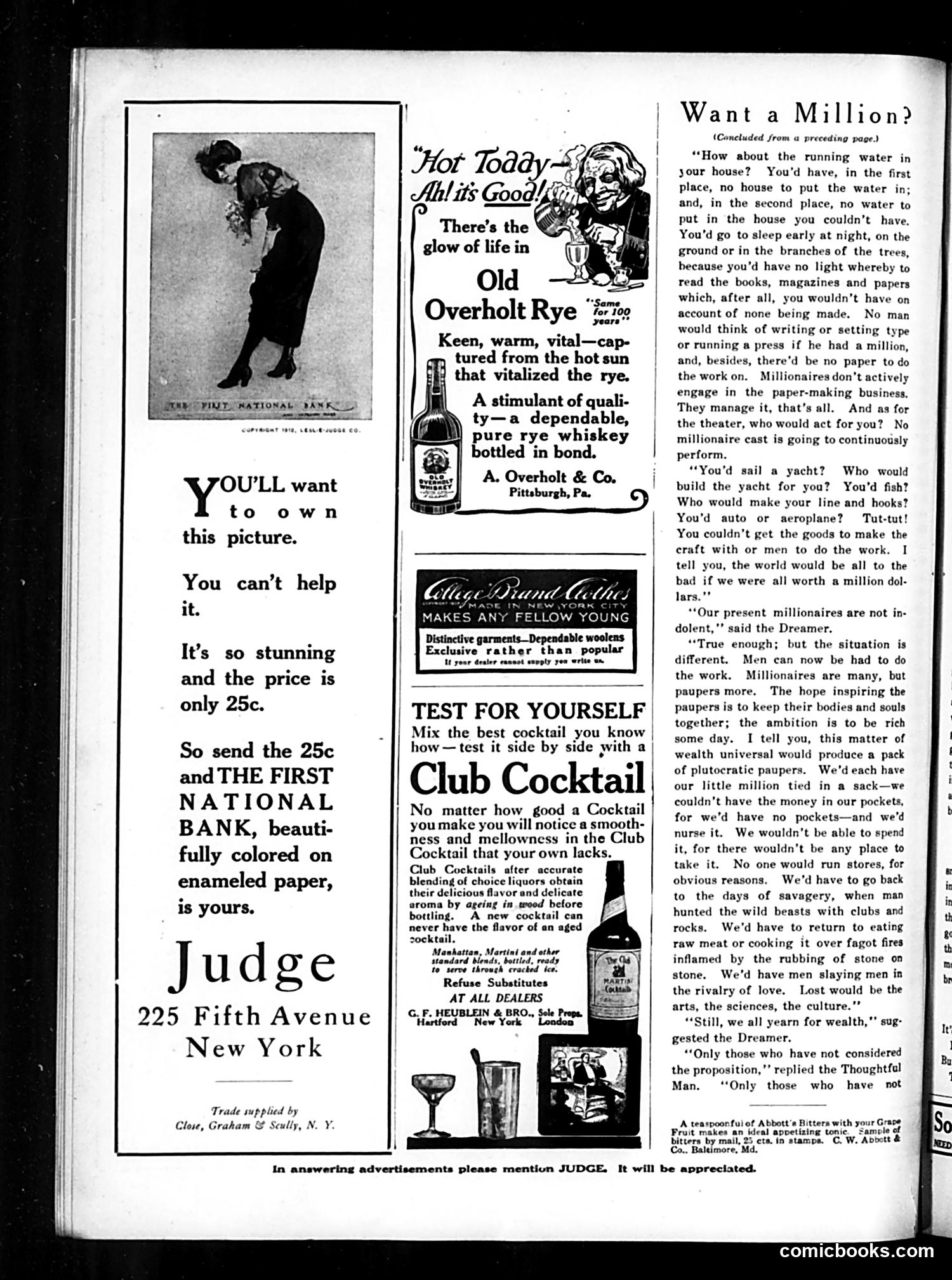
This page is primarily **advertisements** with a brief satirical dialogue at the top right. The main content is a philosophical debate ("Want a Million?") between two characters—the Dreamer and the Thoughtful Man—about universal wealth. The Thoughtful Man argues that if everyone had a million dollars, society would collapse: no one would work as laborers, builders, or performers; there'd be no goods to purchase; civilization would regress to savagery. The satire critiques naive utopianism by exposing the paradox that mass wealth requires inequality to function—someone must do the unglamorous work. It reflects early-20th-century anxieties about labor, class structure, and economic sustainability. The surrounding ads (Old Overholt Rye whiskey, clothing, cocktails) are period-typical Judge magazine content, unrelated to the main satire.
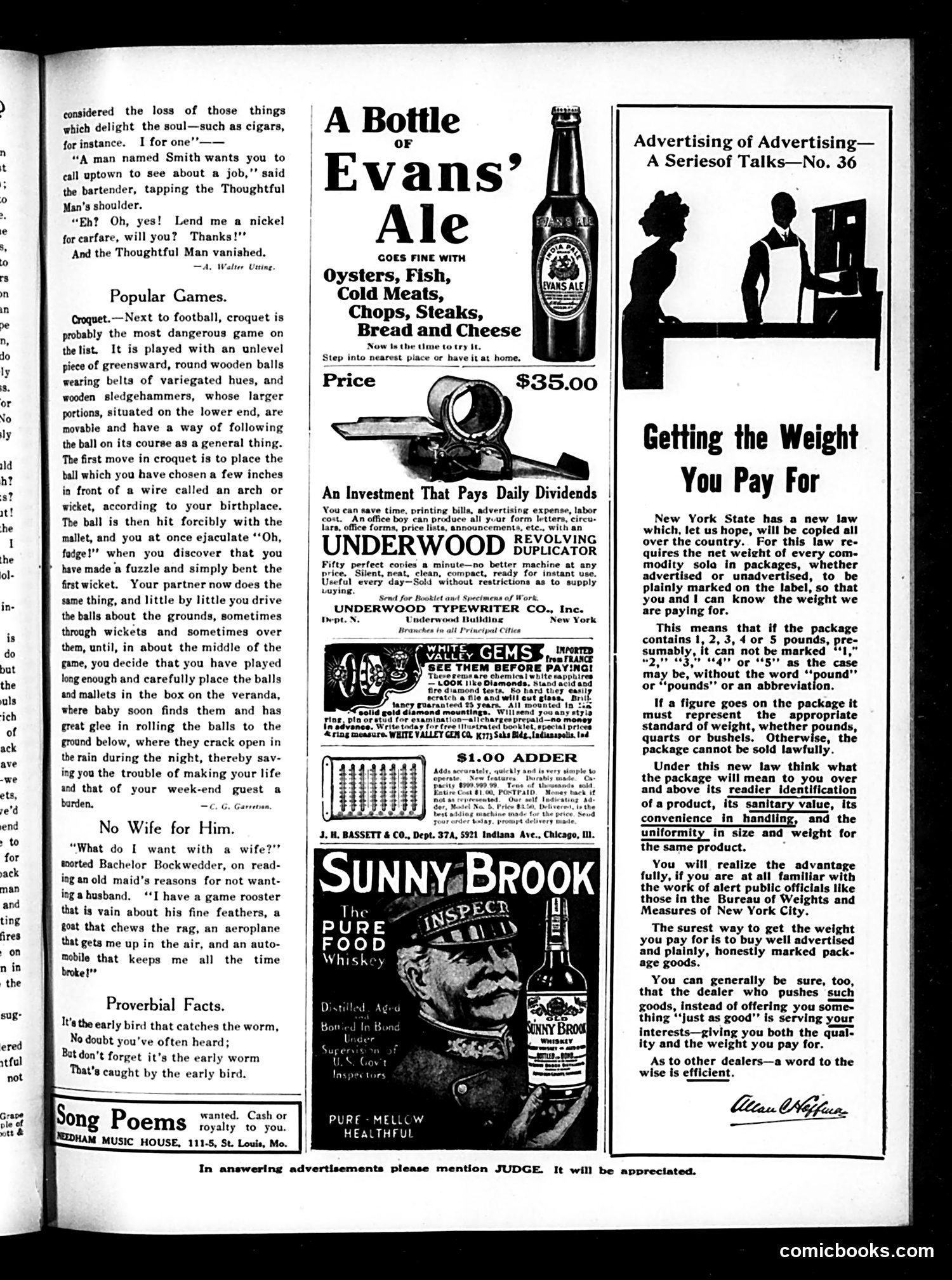
This page from Judge magazine (date unclear from image) contains several distinct elements: **Main Content:** Humorous essays ("Popular Games" on croquet, "No Wife for Him") satirizing bachelor life and recreational activities—typical Judge satirical fare mocking social conventions. **Advertisements:** The page is dominated by period product ads (Evans' Ale, Underwood typewriter duplicator, Valley Gems whiskey, Sunny Brook whiskey). **Notable Article:** "Getting the Weight You Pay For" by Allan Wulfohn—a consumer protection piece praising New York State's new labeling law requiring net weight clearly marked on commodity packages. This advocates for consumer transparency against deceptive packaging practices where weight markings could be ambiguous or misleading. The piece represents Progressive Era consumer advocacy, reflecting early 20th-century concerns about food and product fraud. It's essentially an advertisement promoting honest business practices—ironic given the whiskey ads surrounding it, products then often marketed with dubious health claims ("pure," "healthful").
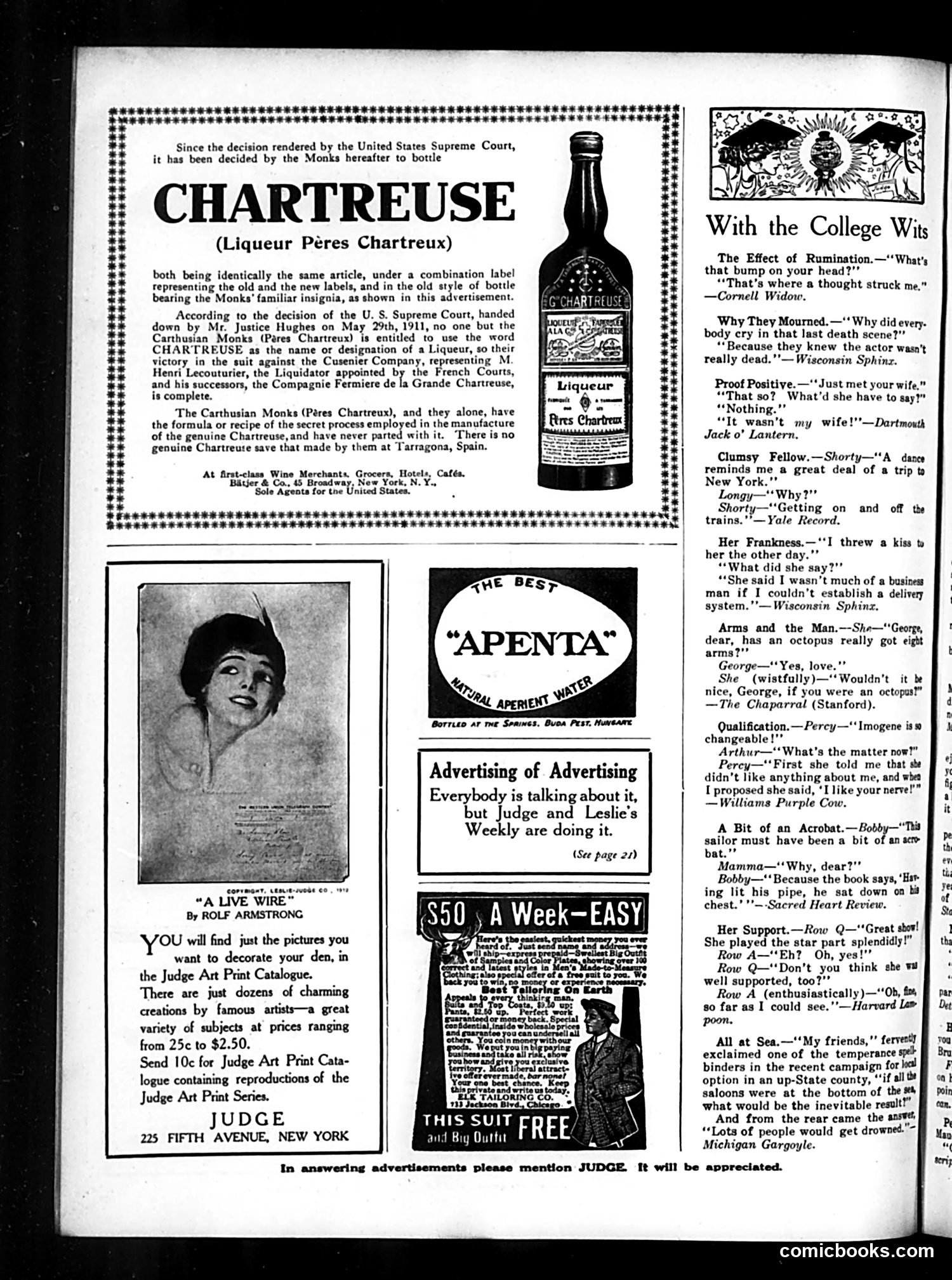
This page is primarily **advertising for Chartreuse liqueur**, framed around a 1911 U.S. Supreme Court decision. The legal context: the Carthusian Monks won a trademark suit against competitors (the Cusenier Company) for exclusive rights to the name "Chartreuse." The ad emphasizes that only the monks' version, made in Tarragona, Spain, is authentic—a legal victory that settled the matter. The right column contains unrelated **humorous one-liners** typical of Judge magazine's "College Wits" humor feature, offering brief jokes about dating, marriage, and social mishaps. These include wordplay and absurdist scenarios popular in early 1900s college publications. The remaining advertisements (art prints, a suit offer, Apenta water) are standard magazine filler. The page reflects **early 20th-century advertising strategy**: using legal authority and prestige (the Supreme Court decision) to market a luxury import while filling space with light collegiate humor to appeal to Judge's educated, urban male readership.
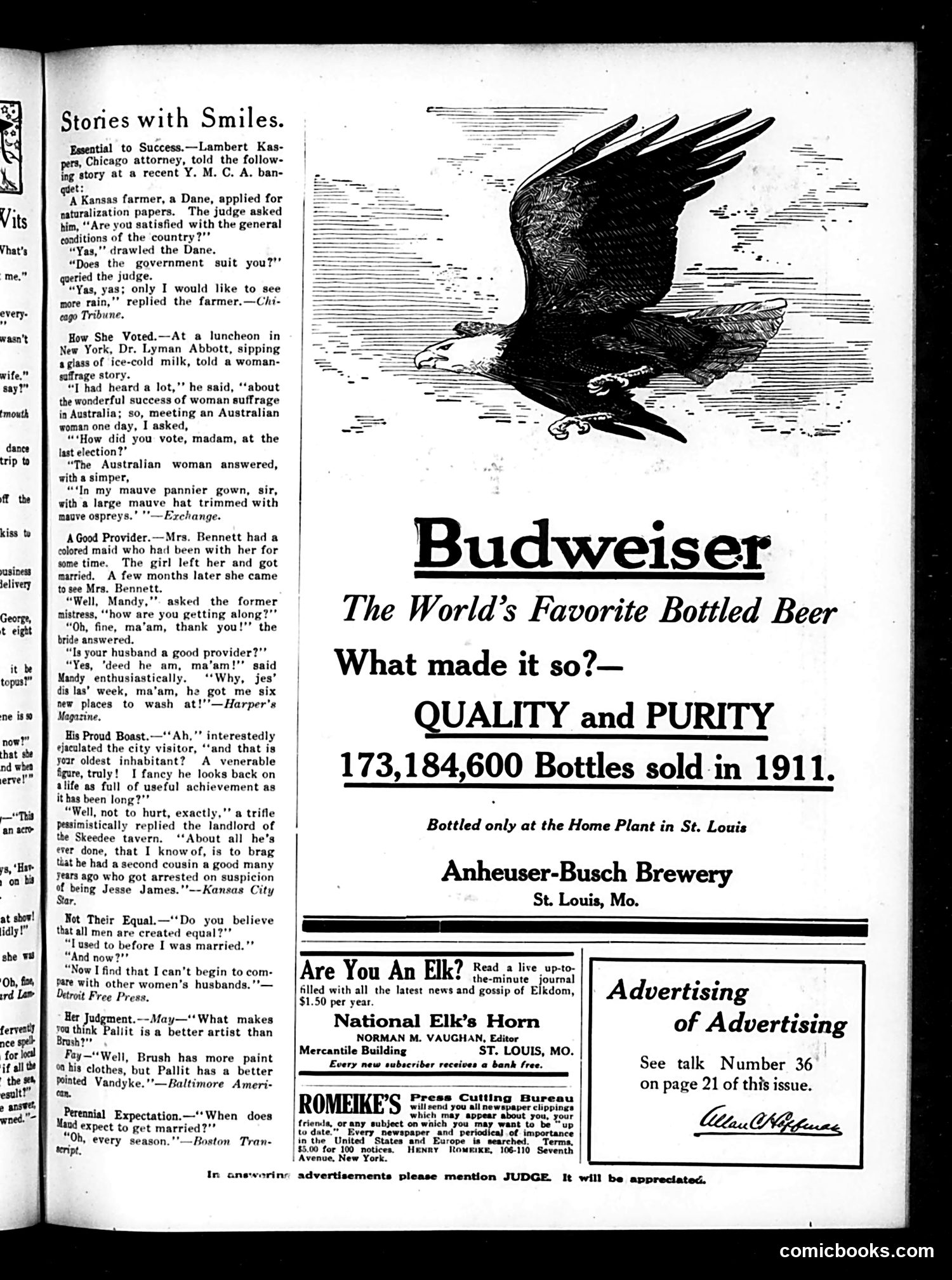
This page is primarily **advertising and humorous anecdotes** rather than political satire. The content consists of: **"Stories with Smiles"** section: Six brief jokes about contemporary social issues: - A Danish immigrant seeking naturalization - Woman suffrage in Australia (mocking women voters' focus on fashion over politics) - A Black maid whose "providing" husband gets her more washing work - A town's oldest resident's only claim to fame (a criminal relative) - A man claiming marriage proves men aren't equal - Artist comparison jokes **The dominant visual element** is a large **Budweiser advertisement** featuring an eagle logo, promoting 173 million bottles sold in 1911 through "quality and purity." **Historical context for modern readers:** The woman suffrage joke reflects early-20th-century anti-suffrage sentiment—ridiculing female voters as frivolous and concerned only with clothing. The maid joke uses period racial stereotypes typical of Judge's era. These anecdotes represent mainstream American humor of 1911, revealing attitudes toward women's rights, immigrants, and race that would be considered offensive today.
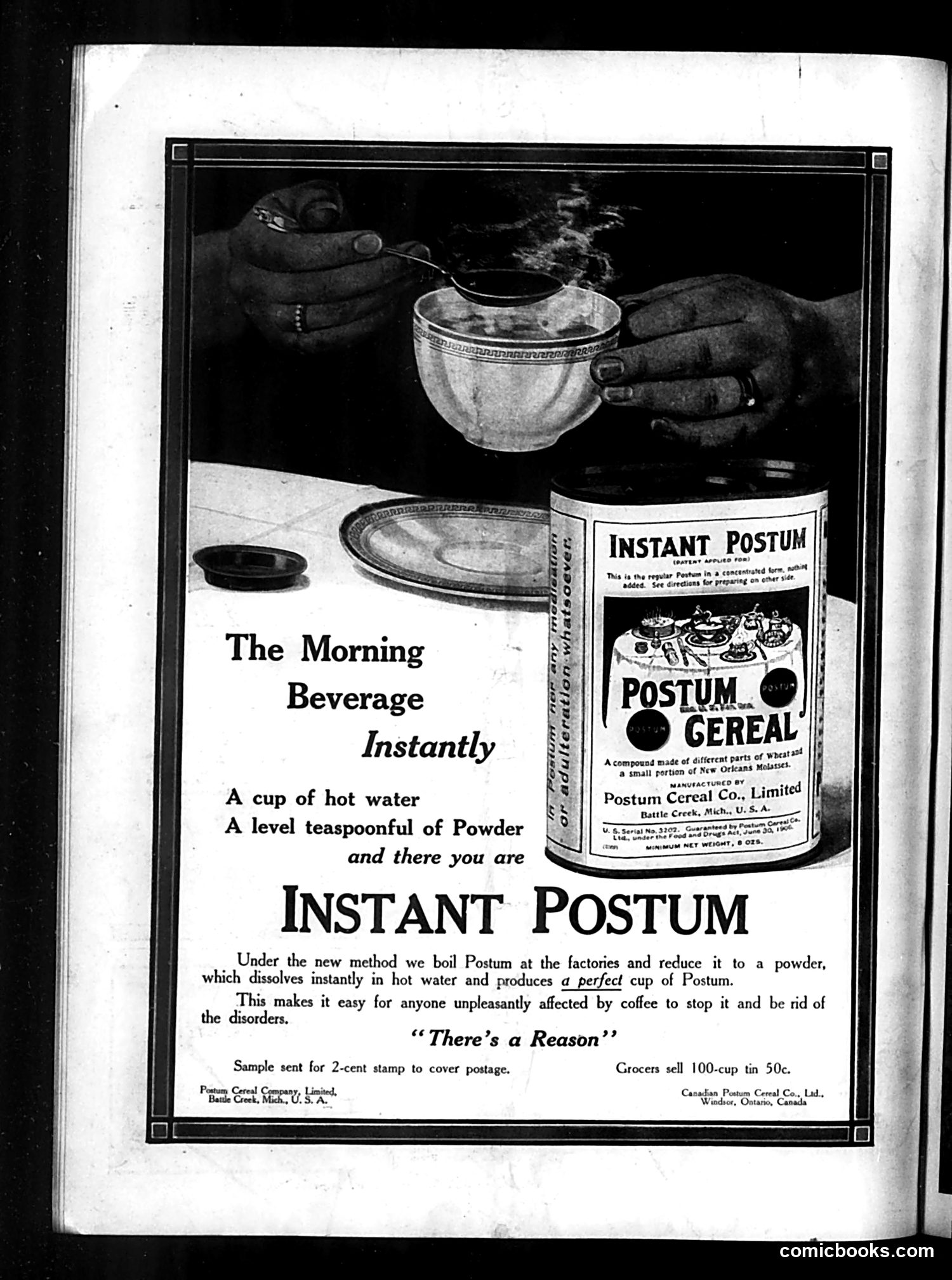
This is **not a cartoon or satire**, but rather a **straightforward advertisement** for Instant Postum, a coffee substitute manufactured by Postum Cereal Co. The page shows a product advertisement featuring hands demonstrating the preparation method: hot water plus a teaspoon of powder creates an instant beverage. The ad emphasizes convenience and health benefits, positioning Postum as ideal for those "unpleasantly affected by coffee" seeking to "stop it and be rid of the disorders." The phrase "There's a Reason" was Postum's actual advertising slogan, reflecting early 20th-century marketing that implied coffee caused health problems. This reflects period anxieties about caffeine and digestive complaints—common marketing angles of that era. The inclusion in *Judge* magazine (primarily known for satire and humor) indicates advertising revenue supplemented the publication's content. There is no evident political satire or cartoon present on this page.