
Judge, 1912-09-21 · page 12 of 24
Judge — September 21, 1912 — page 12: what you’re looking at
What you’re looking at
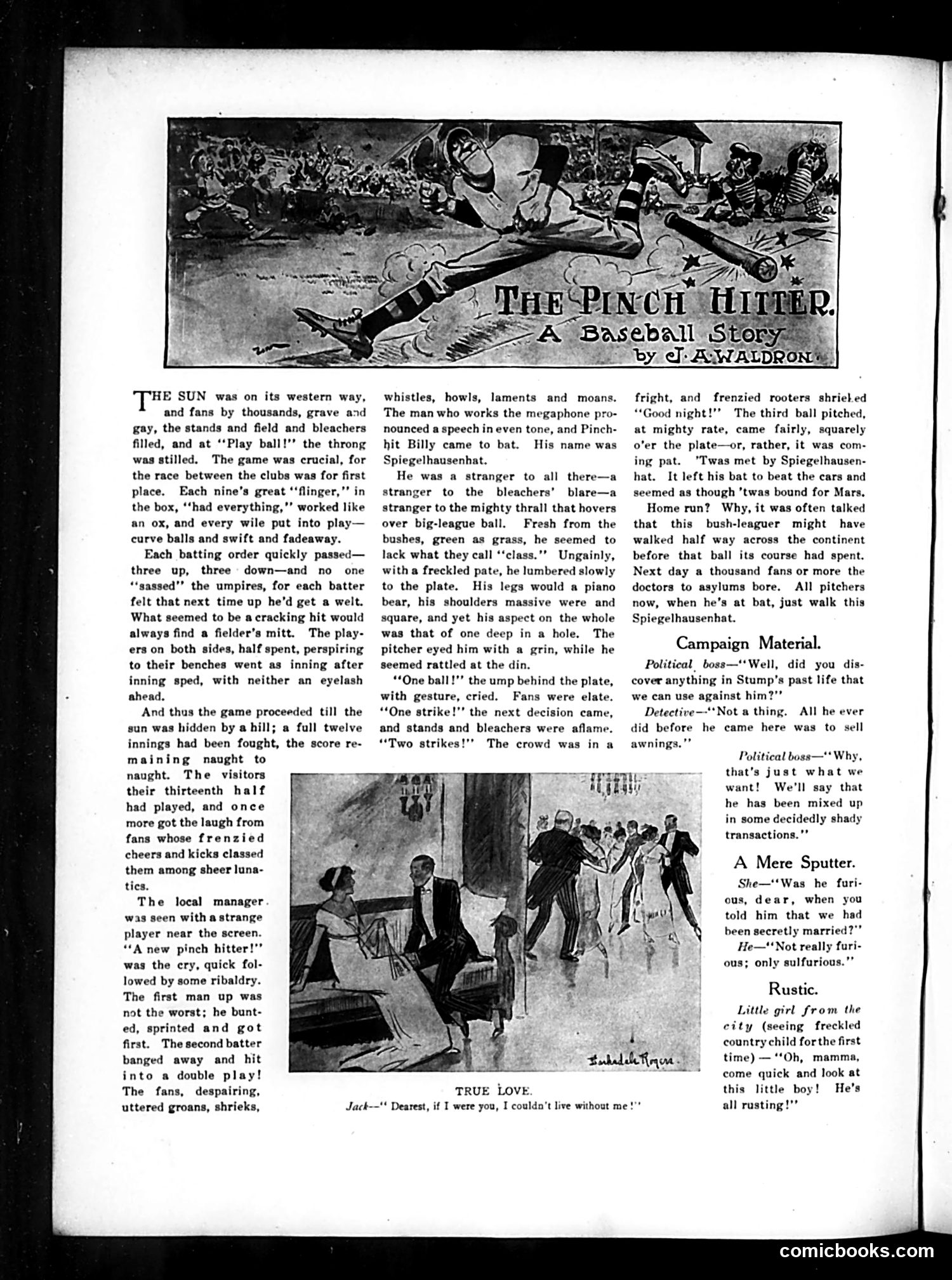
This is a humorous baseball narrative poem illustrated with a dramatic moment. The story follows an unlikely hero: Spiegelhausenhat, a green, ungainly "bush-leaguer" (minor league player) called in as a pinch hitter during a crucial tie game. Despite his awkward appearance and nervousness, he hits a massive home run, becoming an instant celebrity—so famous that opposing pitchers now refuse to pitch to him. The satire targets baseball's theatrical dramatics: the umpire's theatrical calls, the crowd's frenzied reactions, and how baseball transforms ordinary people into legends overnight. The accompanying vignettes mock political hypocrisy (inventing scandals) and offer light wordplay humor ("sulfurious" pun, rural child's misunderstanding of "rusting"). The page exemplifies *Judge* magazine's blend of sports satire and general social commentary circa early 1900s.
📄 Transcribed text from this page (OCR, searchable)
Machine-transcribed from the original scan — historical spelling and the odd misread are preserved.
HE SUN was on its western way, and fans by thousands, grave and gay, the stands and field and bleachers filled, and at ‘‘Play ball!’’ the throng was stilled. The game was crucial, for the race between the clubs was for first place. Each nine’s great ‘‘flinger,’’ in the box, ‘‘had everything,’ worked like an ox, and every wile put into play— curve balls and swift and fadeaway. Each batting order quickly passed— three up, three down—and no one ‘‘sassed"’ the umpires, for each batter felt that next time up he'd get a welt. What seemed to be a cracking hit would always find a fielder’s mitt. The play- ers on both sides, half spent, perspiring to their benches went as inning after inning sped, with neither an eyelash ahead. And thus the game proceeded till the sun was hidden by a hill; a full twelve innings had been fought, the score re- maining naught to naught. The visitors their thirteenth half had played, and once more got the laugh from fans whose frenzied cheers and kicks classed them among sheer luna- tics. The local manager was seen with astrange player near the screen. “A new pinch hitter!’ was the cry, quick fol- lowed by some ribaldry. The first man up was not the worst; he bunt- ed, sprinted and got first. The second batter banged away and hit into a double play! The fans, despairing, uttered groans, shrieks, whistles, howls, laments and moans. The man who works the megaphone pro- nounced a speech in even tone, and Pinch- hit Billy came to bat. His name was Spiegelhausenhat. He was a stranger to all there—a stranger to the bleachers’ blare—a stranger to the mighty thrall that hovers over big-league ball. Fresh from the bushes, green as grass, he seemed to lack what they call ‘‘class."” Ungainly, witha freckled pate, he lumbered slowly to the plate. His legs would a piano bear, his shoulders massive were and square, and yet his aspect on the whole was that of one deep in a hole. The pitcher eyed him with a grin, while he seemed rattled at the din. **One ball !"’ the ump behind the plate, with gesture, cried. Fans were elate. “One strike!’’ the next decision came, and stands and bleachers were aflame. “Two strikes!"’ The crowd was in a TRUE LOVE Jack--"* Dearest, if I were you, I couldn't live without me!’ fright, and frenzied rooters shriebed “Good night!’’ The third ball pitched, at mighty rate, came fairly, squarely o’er the plate—or, rather, was com- ing pat. 'Twas met by Spiegelhausen- hat. It left his bat to beat the cars and seemed as though ’twas bound for Mars, Home run? Why, it was often talked that this bush-leaguer might have walked half way across the continent before that ball its course had spent. Next day a thousand fans or more the doctors to asylums bore. All pitchers now, when he’s at bat, just walk this Spiegelhausenhat. Campaign Material. Political, boss—‘*Well, did you dis- cover anything in Stump's past life that we can use against him?”’ Detective—-** Not a thing. All he ever did before he came here was to sell awnings.”” Political boss—** Why, that’s just what we want! We'll say that he has been mixed up in some decidedly shady transactions." A Mere Sputter. She—‘‘Was he ous, dear, when you told him that we had been secretly married?”’ He—‘‘Not really furi- ous; only sulfurious.’’ furi- Rustic. Little girl from the city (seeing freckled country child forthe first time) — ‘Oh, mamma, come quick and look at this little boy! He's all rusting!"" comicbooks.com