
Judge, 1912-09-21 · page 9 of 24
Judge — September 21, 1912 — page 9: what you’re looking at
What you’re looking at
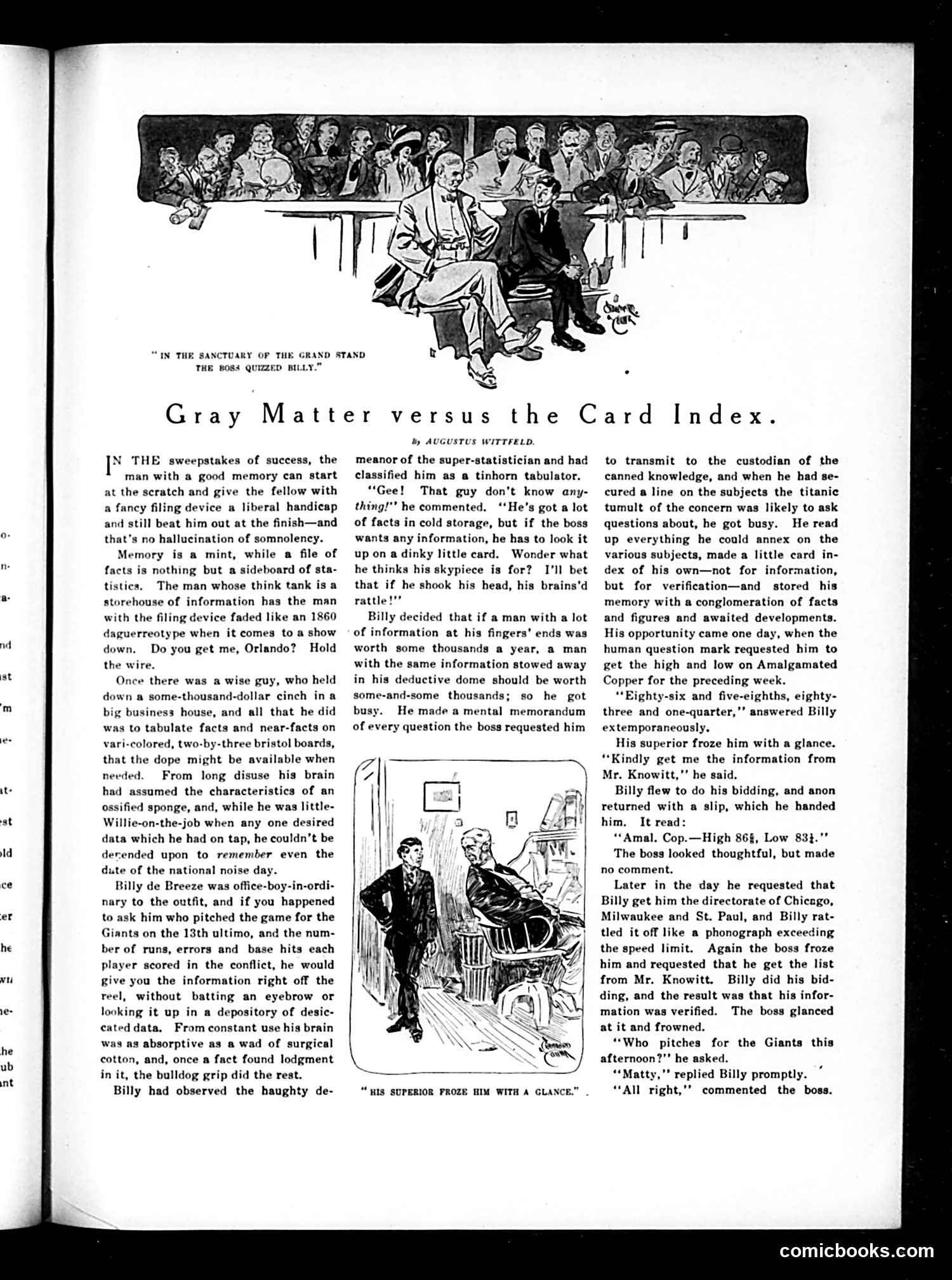
This story satirizes competing business management philosophies of the early 1900s. "Billy de Breeze," an office boy, challenges the established "super-statistician"—a senior employee who relies entirely on filing systems and written records to retrieve information for his boss. Billy proves that natural memory and mental preparation outperform mechanical filing. When the boss requests stock prices for Amalgamated Copper, Billy answers immediately from memory ("Eighty-six and five-eighths, eighty-three and one-quarter"). The boss's superior initially freezes him with disapproval, expecting Billy to consult written records. However, when the information matches Mr. Knowitt's official data exactly, the boss recognizes Billy's superior value. The satire mocks over-reliance on filing systems and celebrates human intellect and preparation—a timely concern as businesses increasingly adopted card-index and filing cabinet technology. The cartoon above shows the boss "quizzing Billy" in the grandstand, suggesting this is treated as public spectacle.
📄 Transcribed text from this page (OCR, searchable)
Machine-transcribed from the original scan — historical spelling and the odd misread are preserved.
“IN THR SANCTUARY OP THE GRAND STAND THE BOS% QUIZZED BILLY.” Gray Matter versus the C IX THE sweepstakes of success, the man with a good memory can start at the scratch and give the fellow with a fancy filing device a liberal handicap and still beat him out at the finish—and that’s no hallucination of somnolency. Memory is a mint, while a file of facts is nothing but a sideboard of sta- tistics, The man whose think tank is a storehouse of information has the man with the filing device faded like an 1860 daguerreotype when it comes to a show down. Do you get me, Orlando? Hold the wire. Once there was a wise guy, who held down a some-thousand-dollar cinch ina big business house, and all that he did was to tabulate facts and near-facts on vari-colored, two-by-three bristol boards, that the dope might be available when needed. From long disuse his brain had assumed the characteristics of an ossified sponge, and, while he was little- Willie-on-the-job when any one desired data which he had on tap, he couldn't be derended upon to remember even the dute of the national noise day. Billy de Breeze was office-boy-in-ordi- nary to the outfit, and if you happened to ask him who pitched the game for the Giants on the 13th ultimo, and the num- ber of runs, errors and base hits each player scored in the conflict, he would give you the information right off the reel, without batting an eyebrow or looking it up in a depository of desic- cated data, From constant use his brain was as absorptive as a wad of surgical cotton, and, once a fact found lodgment in it, the bulldog grip did the rest. Billy had observed the haughty de- By AUGUSTUS WITTFELD. meanor of the super-statistician and had classified him as a tinhorn tabulator. “Gee! That guy don’t know any- thing!"’ he commented. ‘‘He’s got a lot of facts in cold storage, but if the boss wants any information, he has to look it up on a dinky little card. Wonder what he thinks his skypiece is for? I'll bet that if he shook his head, his brains'’d rattle !"" Billy decided that if a man with a lot of information at his fingers’ ends was worth some thousands a year, a man with the same information stowed away in his deductive dome should be worth some-and-some thousands; so he got busy. He made a mental memorandum of every question the boss requested him “HIS SUPERIOR FROZE HIM WITH A GLANCE.” . ard Index. to transmit to the custodian of the canned knowledge, and when he had se- cured a line on the subjects the titanic tumult of the concern was likely to ask questions about, he got busy. He read up everything he could annex on the various subjects, made a little card in- dex of his own—not for information, but for verification—and stored his memory with a conglomeration of facts and figures and awaited developments. His opportunity came one day, when the human question mark requested him to get the high and low on Amalgamated Copper for the preceding week. “Eighty-six and five-eighths, eighty- three and one-quarter,” answered Billy extemporaneously. His superior froze him with a glance. “Kindly get me the information from Mr. Knowitt,’’ he said. Billy flew to do his bidding, and anon returned with a slip, which he handed him, It read: “Amal. Cop.—High 86, Low 833."" The boss looked thoughtful, but made no comment. Later in the day he requested that Billy get him the directorate of Chicago, Milwaukee and St. Paul, and Billy rat- tled it off like a phonograph exceeding the speed limit. Again the boss froze him and requested that he get the list from Mr. Knowitt. Billy did his bid- ding, and the result was that his infor- mation was verified. The boss glanced at it and frowned. “Who pitches for the Giants this afternoon?'’ he asked. “‘Matty,’’ replied Billy promptly. “All right,’’ commented the boss. comicbooks.com