
Judge, 1912-09-21 · page 15 of 24
Judge — September 21, 1912 — page 15: what you’re looking at
What you’re looking at
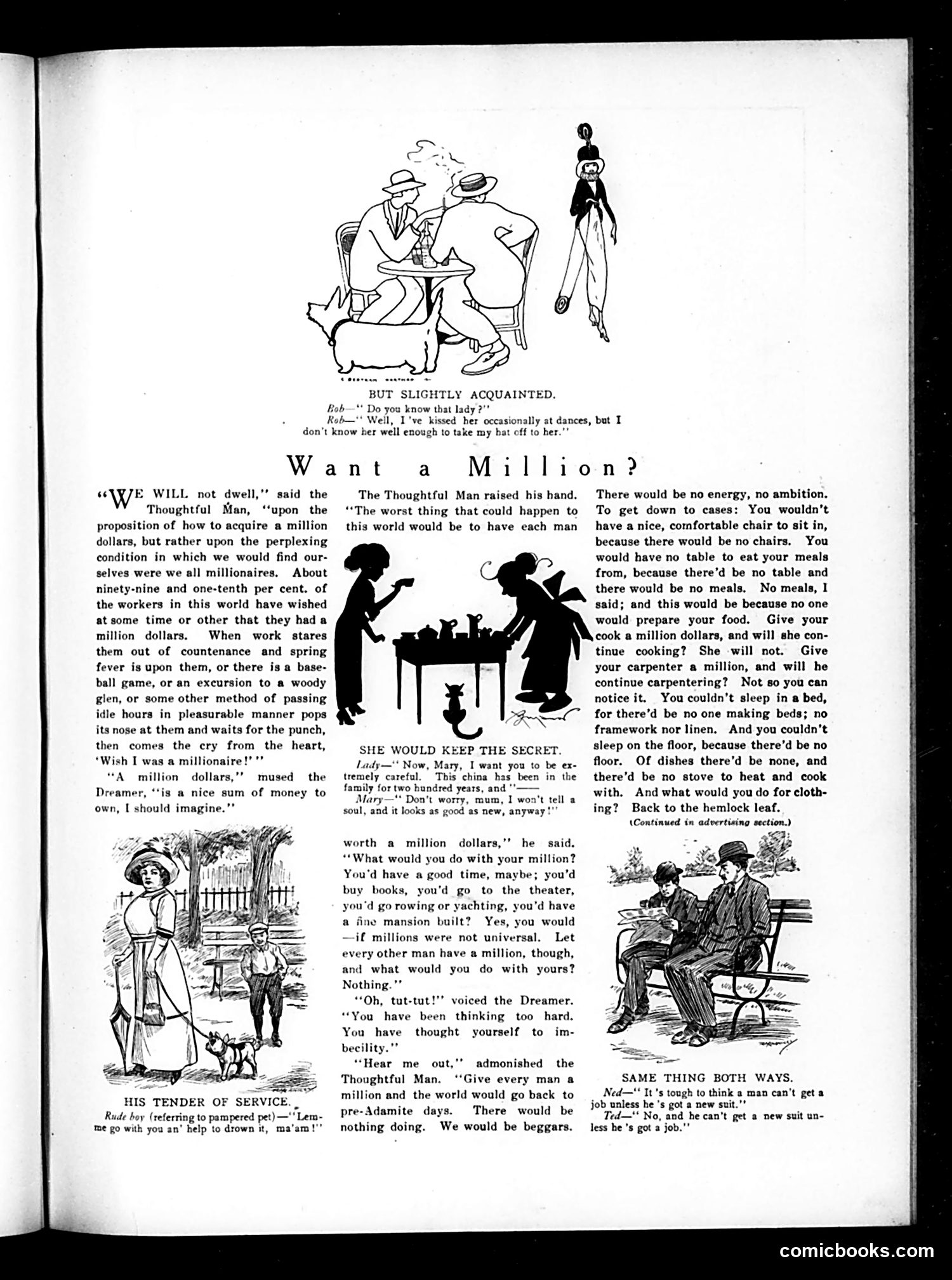
This page presents a philosophical argument against universal wealth redistribution, using the Thoughtful Man as a mouthpiece for economic realism. **The Main Satire**: The piece mocks the fantasy of giving everyone a million dollars. The Thoughtful Man argues this would destroy civilization—if everyone were wealthy, no one would work as servants, cooks, carpenters, or maids. Society would collapse into pre-civilization chaos because there'd be no chairs, beds, food, or clothing produced. The satire attacks both naive egalitarian dreams and the wealthy's dependence on cheap labor. **Supporting Jokes**: Side cartoons reinforce class themes: a servant offering to drown a pampered pet; a maid promising to keep fine china secret while clearly not understanding its value; and a commentary on employment catch-22s (can't get a job without new clothes; can't afford clothes without a job). **Historical Context**: This reflects early 20th-century anxieties about labor organizing and wealth redistribution, defending the existing class hierarchy as economically necessary rather than unjust.
📄 Transcribed text from this page (OCR, searchable)
Machine-transcribed from the original scan — historical spelling and the odd misread are preserved.
Bob BUT SLIGHTLY ACQUAINTED. “Do you know that lady ?”” Rob—** Well, I've kissed her occasionally at dances, but I don't kn Wa “Wwe WILL not dwell,”* said the Thoughtful Man, ‘‘upon the proposition of how to acquire a million dollars, but rather upon the perplexing condition in which we would find our- selves were we all millionaires, About ninety-nine and one-tenth per cent. of the workers in this world have wished at some time or other that they had a million dollars. When work stares them out of countenance and spring fever is upon them, or there is a base- ball game, or an excursion to a woody glen, or some other method of passing idle hours in pleasurable manner pops its nose at them and waits for the punch, then comes the cry from the heart, ‘Wish I was a millionaire!’ "’ “A million mused the Dreamer, ‘tis a nice sum of money to own, I should imagine.’" HIS TENDER OF SERVIC. Rude boy (referring to pampered pet me go with you an’ help to drown it, ma’am!"* ow ber well enough to take my hat cff to her.”” nt a The Thoughtful Man raised his hand. “The worst thing that could happen to this world would be to have each man ne SHE WOULD KEEP THE SECRET. Lady— Now, Mary, I want you to be ex- tremely careful. This ‘china has been in the family for two hundred years, and "” Mary—" Don't worry, mum, I won't tell a soul, and it looks as good as new, anyway!" worth a million dollars,’ he said. “*What would you do with your million? You'd have a good time, maybe; you’d buy books, you'd go to the theater, you'd go rowing or yachting, you'd have a fine mansion built? Yes, you would —if millions were not universal, Let every other man have a million, though, and what would you do with yours? Nothing.” “Oh, tut-tut!’’ voiced the Dreamer. “You have been thinking too hard. You have thought yourself to im- becility.”” ‘Hear me out,’’ admonished the Thoughtful Man. ive every man a million and the world would go back to pre-Adamite days. There would be nothing doing. We would be beggars. Million? > There would be no energy, no ambition. To get down to cases: You wouldn’t have a nice, comfortable chair to sit in, because there would be no chairs. You would have no table to eat your meals from, because there’d be no table and there would be no meals. No meals, 1 said; and this would be because no one would prepare your food. Give your cook a million dollars, and will she con- tinue cooking? She will not. Give your carpenter a million, and will he continue carpentering? Not so you can notice it. You couldn’t sleep in a bed, for there’d be no one making beds; no framework nor linen. And you couldn't sleep on the floor, because there’d be no floor. Of dishes there’d be none, and there’d be no stove to heat and cook with. And what would you do for cloth- ing? Back to the hemlock leaf. (Continued in advertising section.) SAME THING BOTH WAYS. Ned—'* It's tough to think a man can’t get @ job unless he's got a new suit."* Ted—* No, and he can't get a new suit un- less he 's got a job."” comicbooks.com