
Judge, 1912-09-21 · page 2 of 24
Judge — September 21, 1912 — page 2: what you’re looking at
What you’re looking at
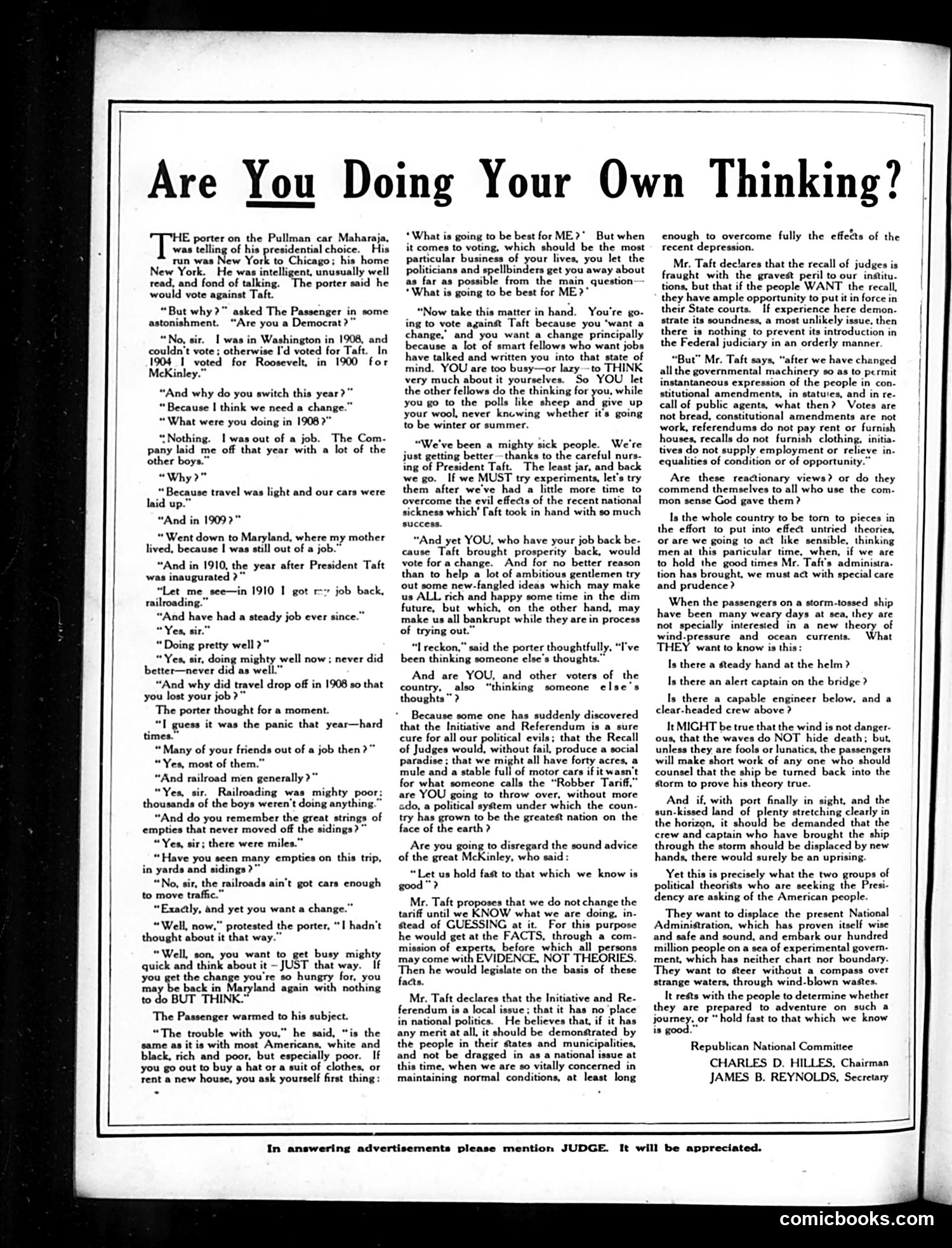
This Judge magazine piece is a dialogue between a Pullman car porter and a passenger debating political engagement during what appears to be the early 1910s. The satire targets voter apathy and blind party loyalty. The porter challenges the passenger—who switches political affiliation based on convenience rather than principle—to actually think independently about issues. The passage criticizes Americans for passively accepting politicians' and newspapers' talking points rather than examining facts themselves. References to President Taft, the Recall of judges, and the Initiative and Referendum suggest this addresses Progressive Era political reforms. The Republican National Committee credits (Charles D. Hilles, James B. Reynolds) indicate this is Republican propaganda promoting civic engagement and reasoned voting over mere party affiliation. The core message: voters should research issues independently rather than follow the crowd.
📄 Transcribed text from this page (OCR, searchable)
Machine-transcribed from the original scan — historical spelling and the odd misread are preserved.
Are You Doing Your Own Thinking? IE porter on the Pullman car Maharaja, was telling of his presidential chi run was New York to Chicago; his home New York. He was intelligent, unusually well read, and fond of talking. The porter said he would vote against Taft. “But why?” asked The Passenger in some astonishment. “Are you a Democrat?” “No, sir. I wa: Washington in 1908, and couldn't vote; otherwise I'd voted for Taft. In 1904 1 voted for Roosevelt, in 1900 for McKinley.” “And why do you switch this year?” “Because | think we need a change.” “What were you doing in 1908?” “Nothing. I was out of a job. The Com- pany laid me off that year with a lot of the other boys.” “Why?” “Because travel was light and our cars were laid up. “And in 1909?” * Went down to Maryland, where my mother lived, because | was still out of a job.” “And in 1910, the year after President Taft inaugurated >” Let_me_see—in 1910 I got m7 railroading.” “And have had a steady job ever since.” “Yes, sir.” job back, retty well?” “Yes, sir, doing mighty well now ; never did better—never did as well.” “And why did travel drop off in 1908 so that you lost your job?” The porter thought for a moment. “I guess it was the panic that year—hard times.” “Many of your friends out of a job then?” “Yes, most of them.” “And railroad men generally?” “Yes, Railroading was mighty poor; thousands of the boys weren't doing anything.” “And do you remember the great strings of empties that never moved off the sidings?” “Yes, sir; there were miles.” “Have you seen many empties on this trip, in yards and sidings?” “No, sir, the railroads ain't got cars enough to move traffic.” “Exactly, and yet you want a change.” “Well, now,” protested the porter, “I hadn't thought about it that way. “Well, son, you want to get busy mighty quick and think about it ~ JUST that way. If you get the change you're so hungry for, you be back in Maryland again with nothing to do BUT THINK.” The Passenger warmed to his subject. “The trouble with you,” he said, “is the same as it is with most Americans, white and black, rich and poor, but especially poor. If you go out to buy a hat or a suit of clothes, or rent a new house, you ask yourself first thing: * What is going to be best for ME?" But when it comes to voting, which should be the most particular business of your lives, you let the politicians and spellbinders get you away about as far as possible from the main question. * What is going to be best for ME?* “Now take this matter in hand. You're go- ing to vote against Taft because you ‘want a change,’ and you want a change principally because a lot of smart fellows who want jobs have talked and written you into that state of mind. YOU are too busy—or lazy —-to THINK very much about it yourselves. So YOU let the other fellows do the thinking for you, while you go to the polls like sheep and give up your wool, never knowing whether it's going to be winter or summer. “We've been a mighty sick people. We're just getting better thanks to the careful nurs- ing of President Taft. The least jar, and back we go. If we MUST try experiments, let's try them after we've had a little more time to overcome the evil effects of the recent national sickness which’ aft took in hand with so much success. “And yet YOU, who have your job back be- cause Taft brought prosperity back, would vote fora change. And for no better reason than to help a lot of ambitious gentlemen try out some new-fangled ideas which may make us ALL rich and happy some time in the dim future, but which, on the other hand, may I bankrupt while they are in process c “L reckon,” said the porter thoughtfully, “I've been thinking someone else's thoughts.” And are YOU, and other voters of the country, also “thinking someone else's thoughts”? Because some one has suddenly discovered that the Initiative and Referendum is a sure cure for all our political evils; that the Recall of Judges would, without fail, produce a social paradise ; that we might ave forty mule and a stable full of motor cars if it w for what someone calls the “Robber Tariff,” are YOU going to throw over, without more ado, a political system under which the coun- try has grown to be the greatest nation on the face of the earth? Are you going to disregard the sound advice of the great McKinley, who said “Let us hold fast to that which we know is sy Mr. Taft proposes that we do not change the tariff until we KNOW what we are doing, in- Stead of GUESSING at it. For this purpose he would get at the FACTS, through a com- mission of experts, before which all persons may come with EVIDENCE, NOT THEORIES. Heck he would legislate on the basis of these jacts. Mr. Taft declares that the Initiative and Re- ferendum i: I issue; that it no ‘place i He believes that, if it has should be demonstrated by municipalities, and not be dragged national issue at this time, when we are so vitally concerned in maintaining normal conditions, at least long enough to overcome fully the effects of the recent depression. Mr. Taft declares that the recall of judges is fraught with the gravest peril to our institu. tions, but that if the people WANT the recall, they have ample opportunity to put it in force in their State courts. If experience here demon. strate its soundness, a most unlikely issue, then there is nothing to prevent its introduction in the Federal judiciary in an orderly manner. “But” Mr. Taft says, “after we have changed all the governmental machinery so as to permit instantaneous expression of the peop! stitutional amendments, in statutes, a! call of public agents, what then? Vote: not bread, constitutional amendments are not work, referendums do not pay rent or furnish houses, recalls do not furnish clothing, initia. tives do not supply employment or relieve in. equalities of condition or of opportunity.” Are these reactionary views? or do they commend themselves to all who use the com. mon sense God gave them? Is the whole country to be torn to pieces in the effort to put into effect untried theories, or are we going to act like sensible, thinking men at this panicular time, when, if we are to hold the good times Mr. Taft's administra- tion has brought, we must act with special care and prudence? When the passengers on a storm-tossed ship have been many weary days at sea, they are not epecelly, inerened ina new theory. of wind-pressure and ocean currents. What THEY want to know is this: Is there a steady hand at the helm? Is there an alert captain on the bridge? Is there a capable engineer below, and a clear-headed crew above ? It MIGHT be true that the wind is not danger- ous, that the waves do NOT hide death; but unless they, are fools or lunatics, the passengers will make short work of any one who should counsel that the ship be turned back into the orm to prove his theory true. And if, with port finally in sight, and the sun-kissed land of plenty stretching clearly in the horizon, it should be demanded that the crew and captain who have brought the ship through the storm should be displaced by new handa there would surely be an uprising. Yet this is precisely what the two groups of political theorists who are seeking the Presi- dency are asking of the American people. They want to displace the present National Administration, which has proven itself wise and safe and sound, and embark our hundred million people on a sea of experimental govern- ment, which has neither chart nor boundary. They want to steer without a compass over strange waters, through wind-blown wastes. It rests with the people to determine whether they are prepared to adventure on such a journey, or “hold fast to that which we know is good.” Republican National Committee CHARLES D. HILLES, Chairman JAMES B. REYNOLDS, Secretary In answering advertisements please mention JUDGE. It will be appreciated. comicbooks.com