
A complete issue · 28 pages · 1912
Judge — June 15, 1912
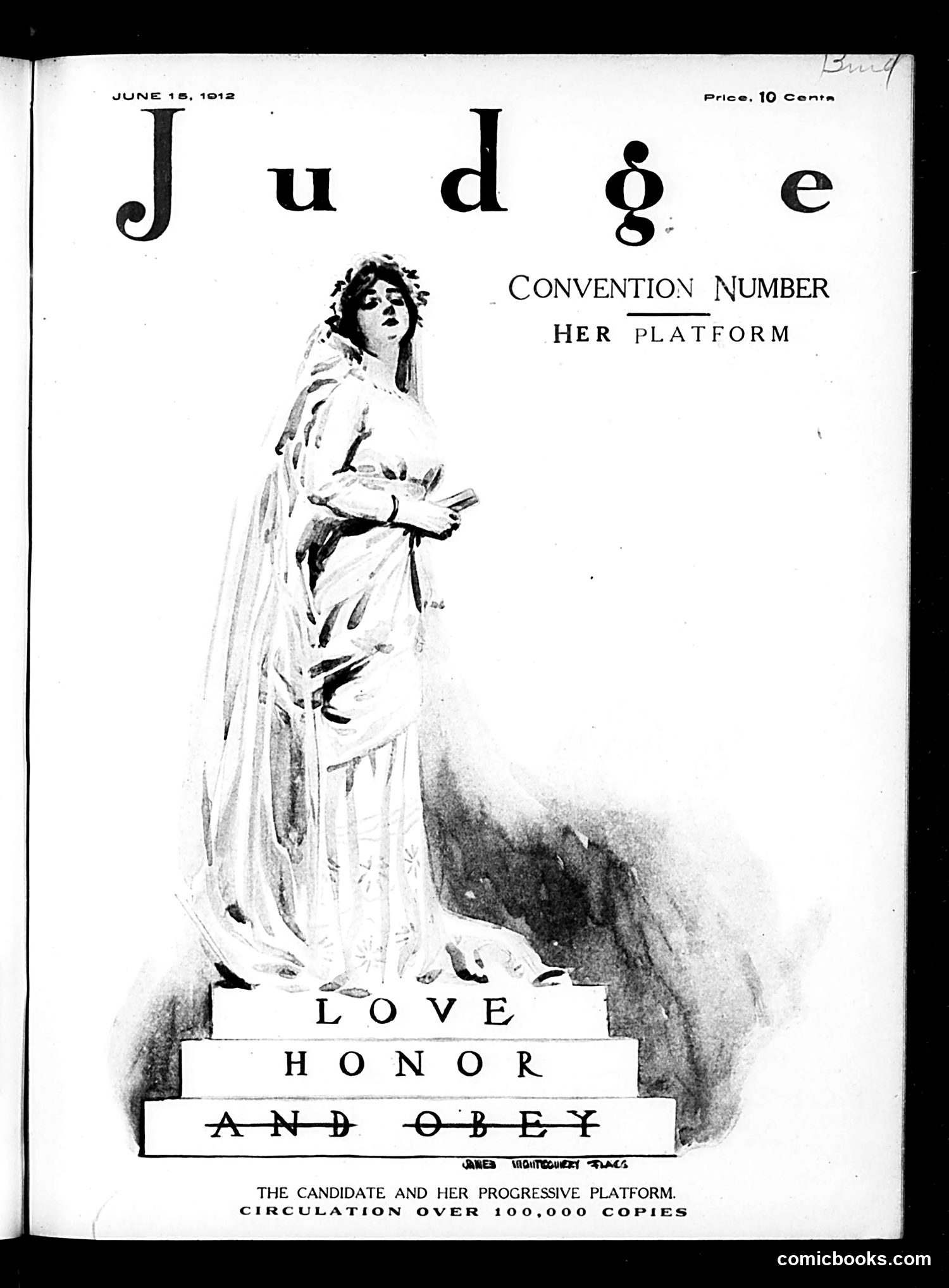
This *Judge* magazine cover satirizes women's suffrage activism during the 1912 presidential convention season. The illustration depicts an idealized female figure standing on a three-tiered platform labeled "LOVE," "HONOR," and "AND OBEY" (the traditional marriage vows). The satire mocks female political candidates by suggesting their platform is simply traditional feminine virtues rather than substantive policy. The caption—"Convention Number Her Platform"—indicates this targets a specific female political candidate, likely from the 1912 Progressive Party convention, which was notably progressive on women's issues. The cartoon represents conservative opposition to women's political participation, implying women's political ambitions were frivolous or inappropriately based on romantic ideals rather than serious governance.
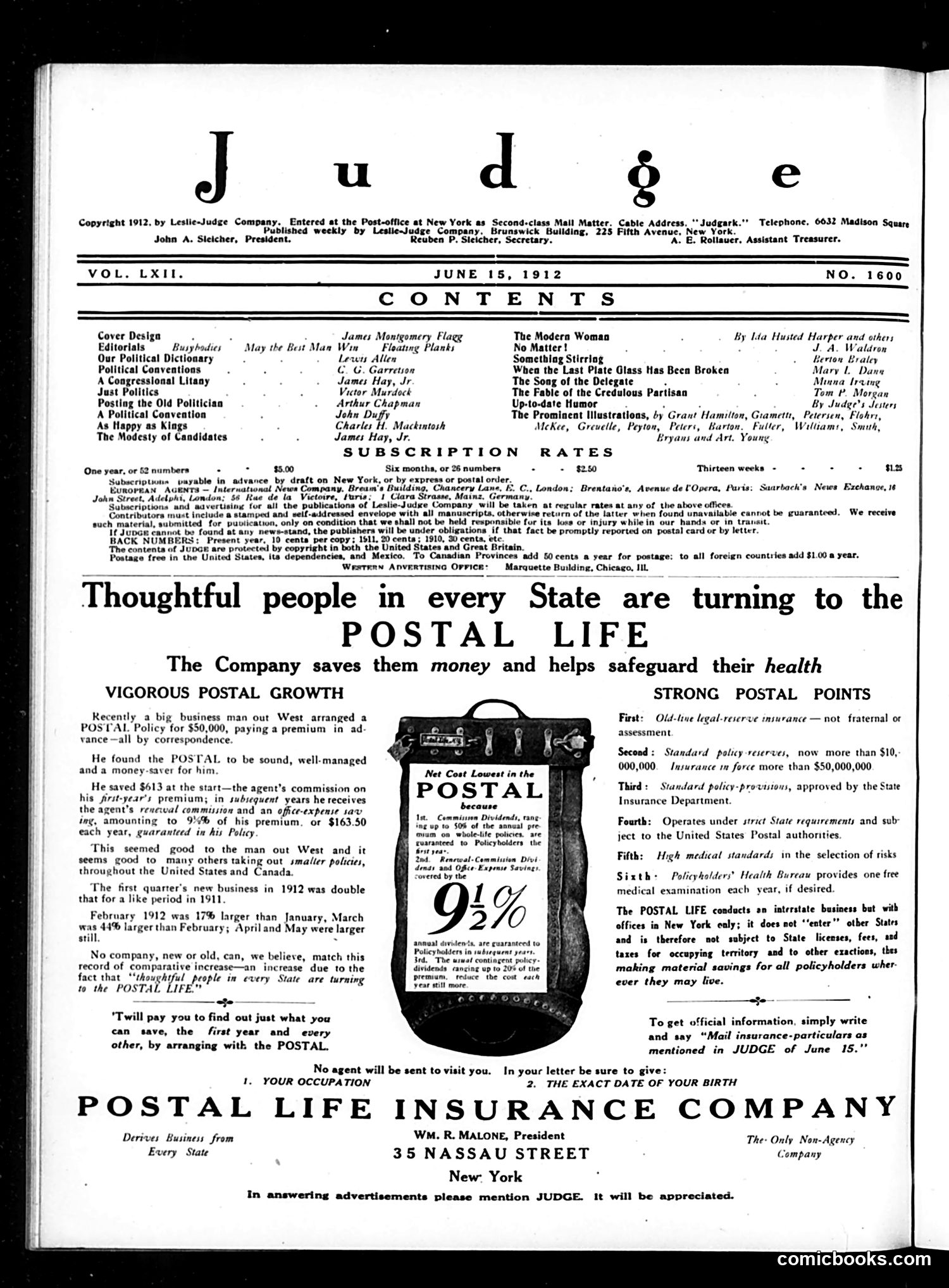
This page is primarily an **advertisement for Postal Life Insurance Company**, not a cartoon or satire. The ad occupies most of the space and promotes mail-based insurance policies as a sound financial product for American workers. The ad includes a testimonial about a Western businessman who purchased a $50,000 policy and received an $613 agent commission—presented as evidence of the company's legitimate profitability and trustworthiness. It emphasizes the company's growth (business doubled in early 1912) and lists six "strong postal points" about policy standards. The only visual element is a small illustration of what appears to be a **postal mail bag or safe**, symbolizing security and reliability. The overall message targets "thoughtful people" seeking affordable health and financial protection through mail-order insurance.
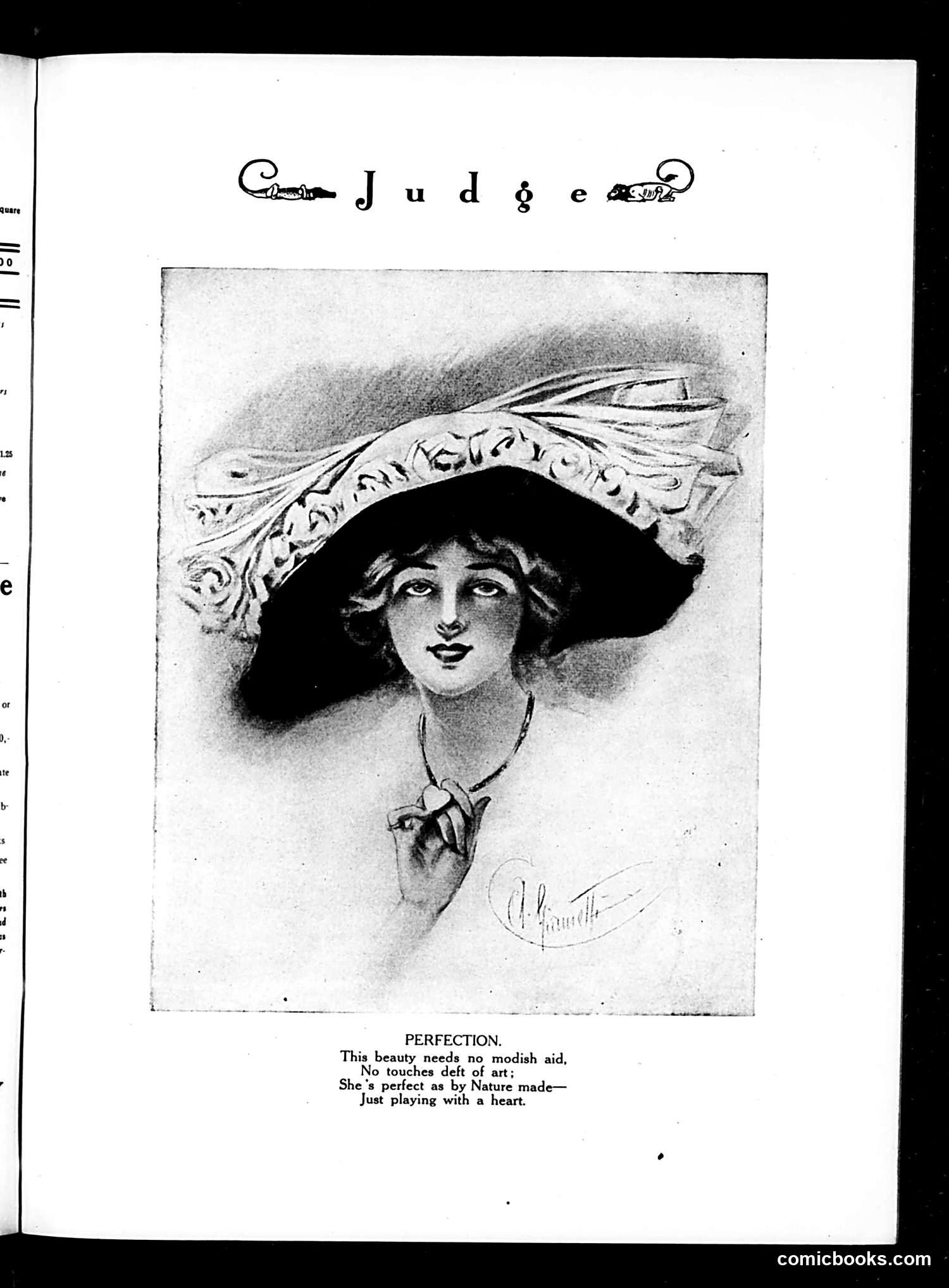
This page presents a portrait illustration titled "Perfection" accompanied by verse. The image shows an elegant woman wearing an elaborate, wide-brimmed hat with decorative plumage, rendered in a soft, flattering style typical of early 20th-century fashion illustration. The accompanying poem critiques the subject ironically: "This beauty needs no modish aid, / No touches deft of art; / She's perfect as by Nature made— / Just playing with a heart." The satire suggests that despite her "natural perfection," the woman is manipulative in romantic matters—"playing with a heart." This reflects Judge magazine's frequent social commentary on feminine beauty, vanity, and deceptive romantic behavior among the fashionable classes. The ornate hat emphasizes the artificiality of her appearance, contradicting the poem's claims of natural perfection.
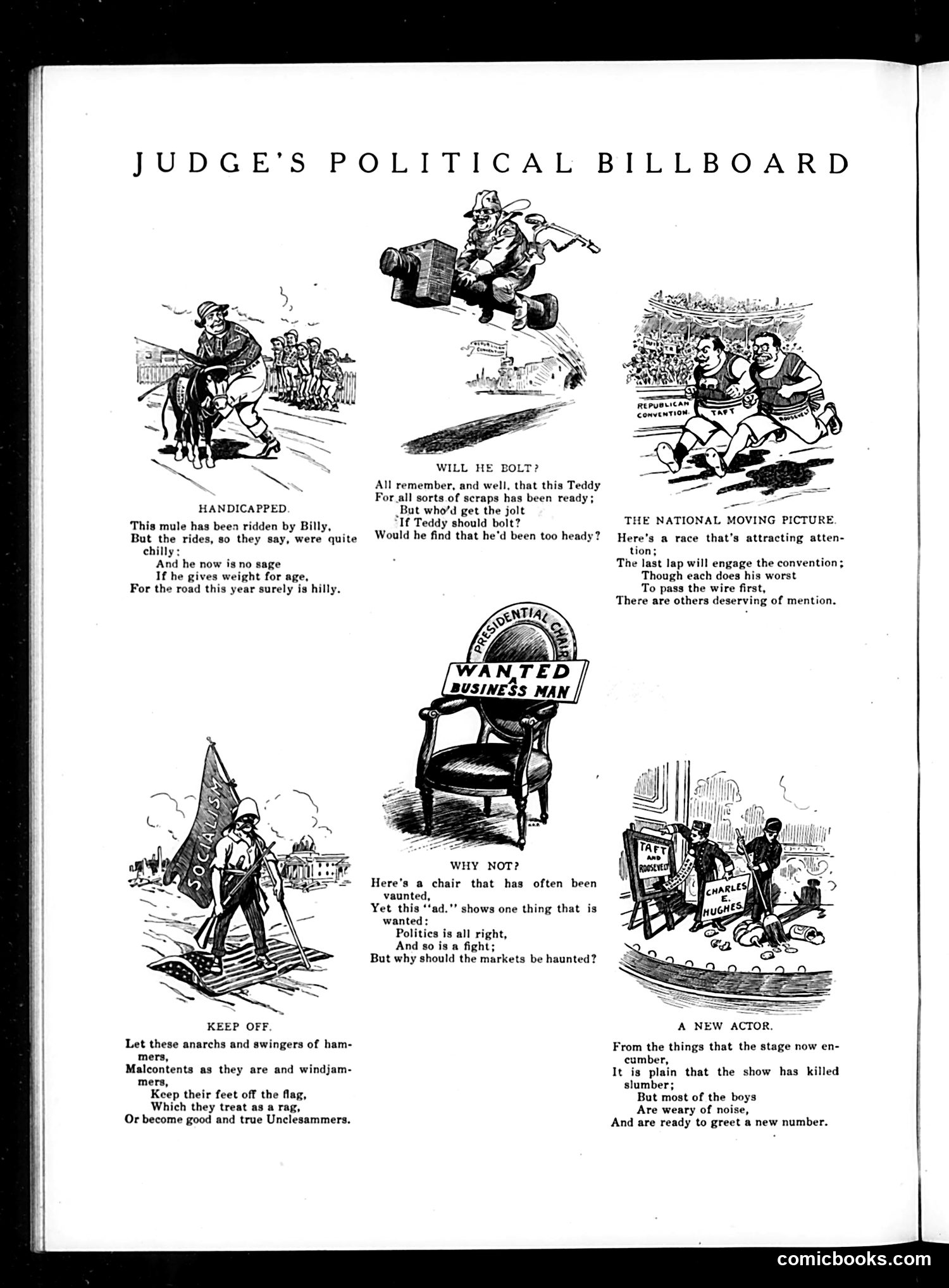
This page presents six political cartoons satirizing figures and events from an early 20th-century U.S. presidential context. "Handicapped" mocks a candidate's age and fitness for office. "Will He Bolt?" references concerns about Theodore Roosevelt potentially bolting from the Republican Party. "The National Moving Picture" depicts convention competition as a race. "Why Not?" suggests a business-oriented candidate for the presidency. "Keep Off" appears to target anarchists and labor radicals threatening the established order. "A New Actor" comments on political newcomers entering the arena. The cartoons collectively critique political instability, personality-driven campaigns, and unconventional candidates during what appears to be a turbulent election period—likely involving Roosevelt's 1912 Progressive Party split.
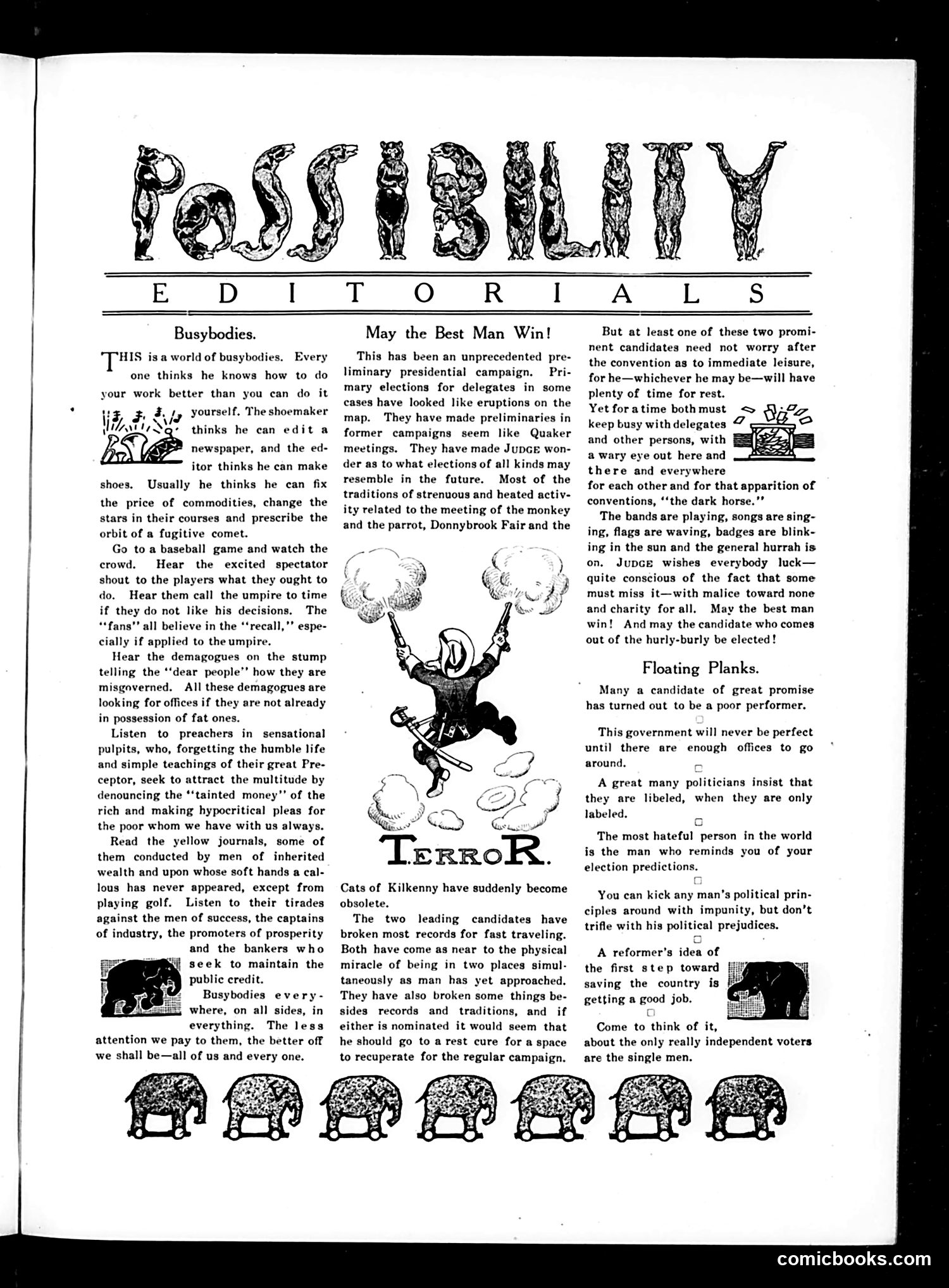
This editorial page satirizes the 1912 presidential campaign through multiple angles: **"Busybodies"** mocks self-important people who claim expertise on matters beyond their competence—the barber, shoemaker, and newspaper editor all pontificating on politics. The critique extends to demagogues making false promises and sensationalist yellow journalism. **"Terror"** (central cartoon) depicts a figure amid explosions, likely referencing anarchist/radical violence as a campaign issue. **"Floating Planks"** and subsequent sections offer cynical observations: candidates often fail to deliver; government has too many offices; politicians claim libel when criticized; election predictions are unreliable. The recurring theme: distrust of both ambitious politicians making grand promises and the ordinary citizens influenced by inflammatory rhetoric and poor information sources.
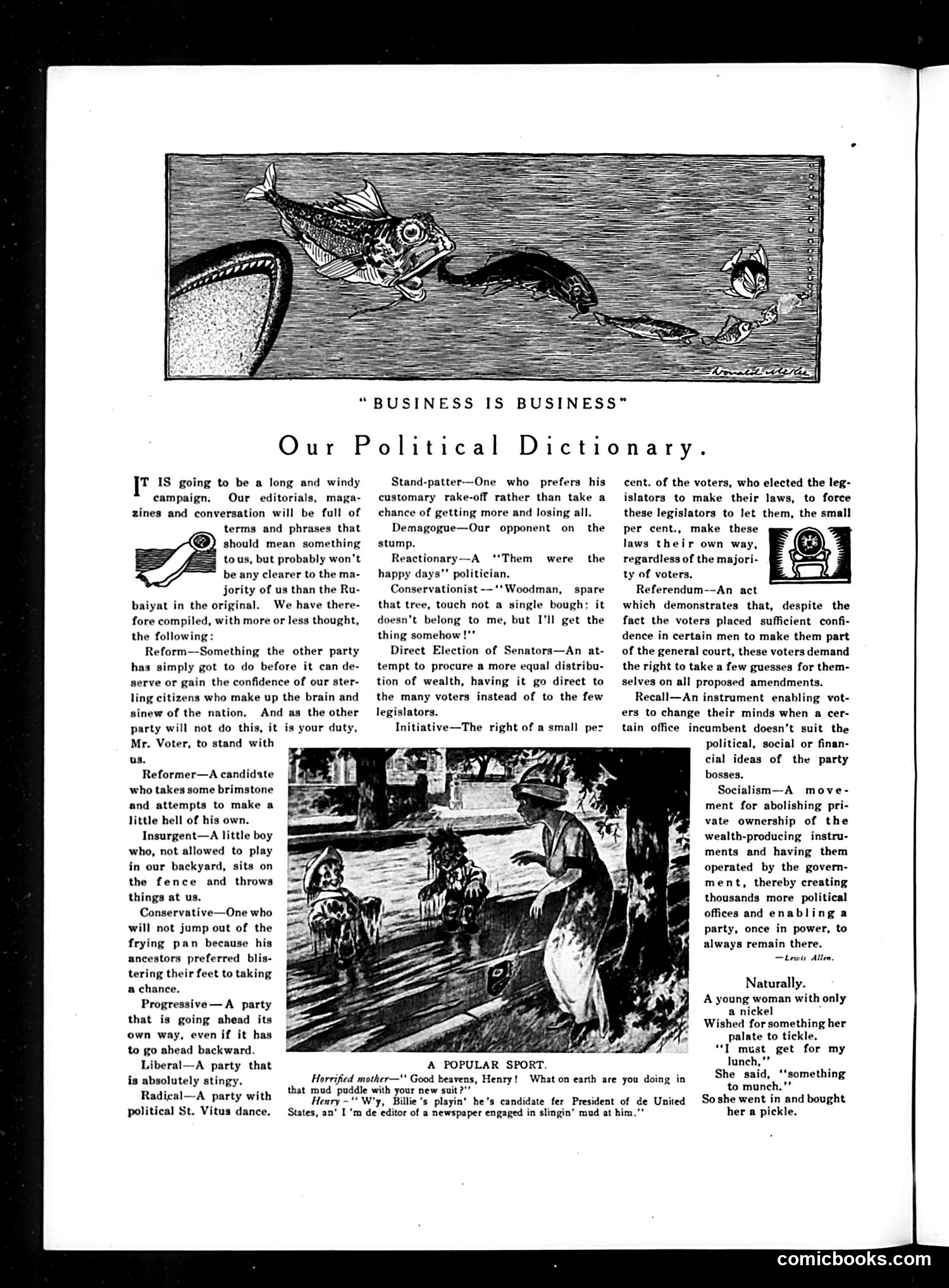
This page satirizes the terminology of early 20th-century American politics through mock definitions. The accompanying cartoon shows children playing "candidate for President" by slinging mud—literalizing the magazine's critique of campaign rhetoric. The definitions mock both major parties: "Reformers" are brimstone-wielding zealots; "Progressives" move backward; "Liberals" are stingy; "Radicals" have uncontrollable twitching. The satire targets specific proposals—Direct Election of Senators, Referendum, and Recall—as mechanisms enabling mob rule or perpetual party power. "Socialism" receives particular scorn as merely creating "thousands more political offices" to entrench power. Throughout, Judge presents politics as cynical self-interest disguised as principle. The humor relies on readers recognizing contemporary campaign slogans and reform movements while sharing the magazine's skepticism toward democratic expansion and progressive politics.
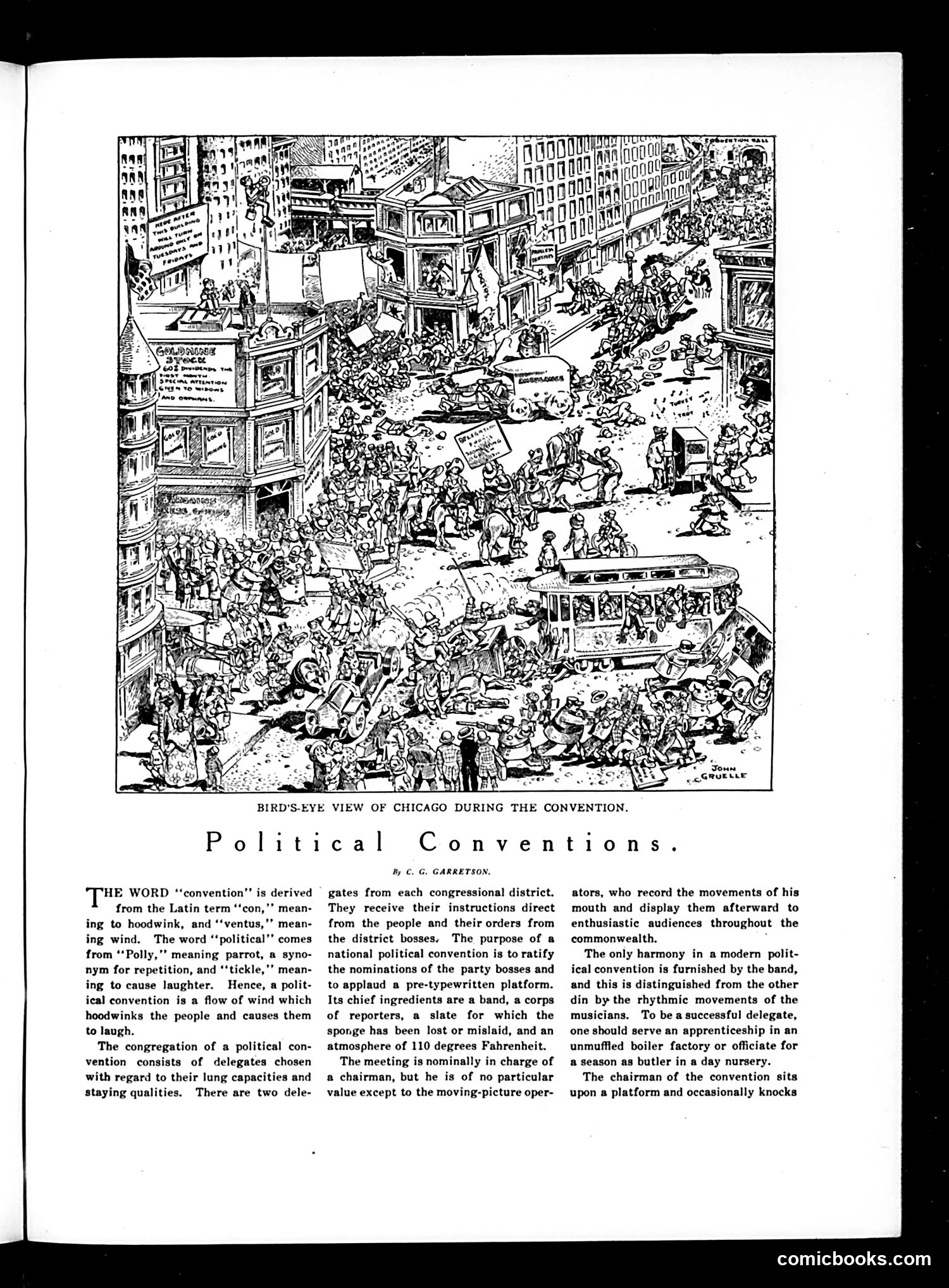
This 1890s satirical piece mocks American political party conventions through faux-etymology and cynical observation. The cartoon depicts a chaotic Chicago convention street scene crowded with delegates, bands, reporters, and crowds. The text's humor lies in fake Latin derivations: "convention" from "con" (hoodwink) and "ventus" (wind), and "political" from "Polly" (parrot—mindless repetition). The satire argues conventions are orchestrated spectacles where party bosses control outcomes before delegates arrive, with the chairman serving mainly as a prop for photographers. The piece ridicules the noise, heat (110 degrees), and performative nature of conventions, suggesting delegates need "boiler factory" experience to endure the pandemonium. The only authentic element mentioned is the band's music—everything else is predetermined theater designed to manipulate voters through spectacle and repetition.
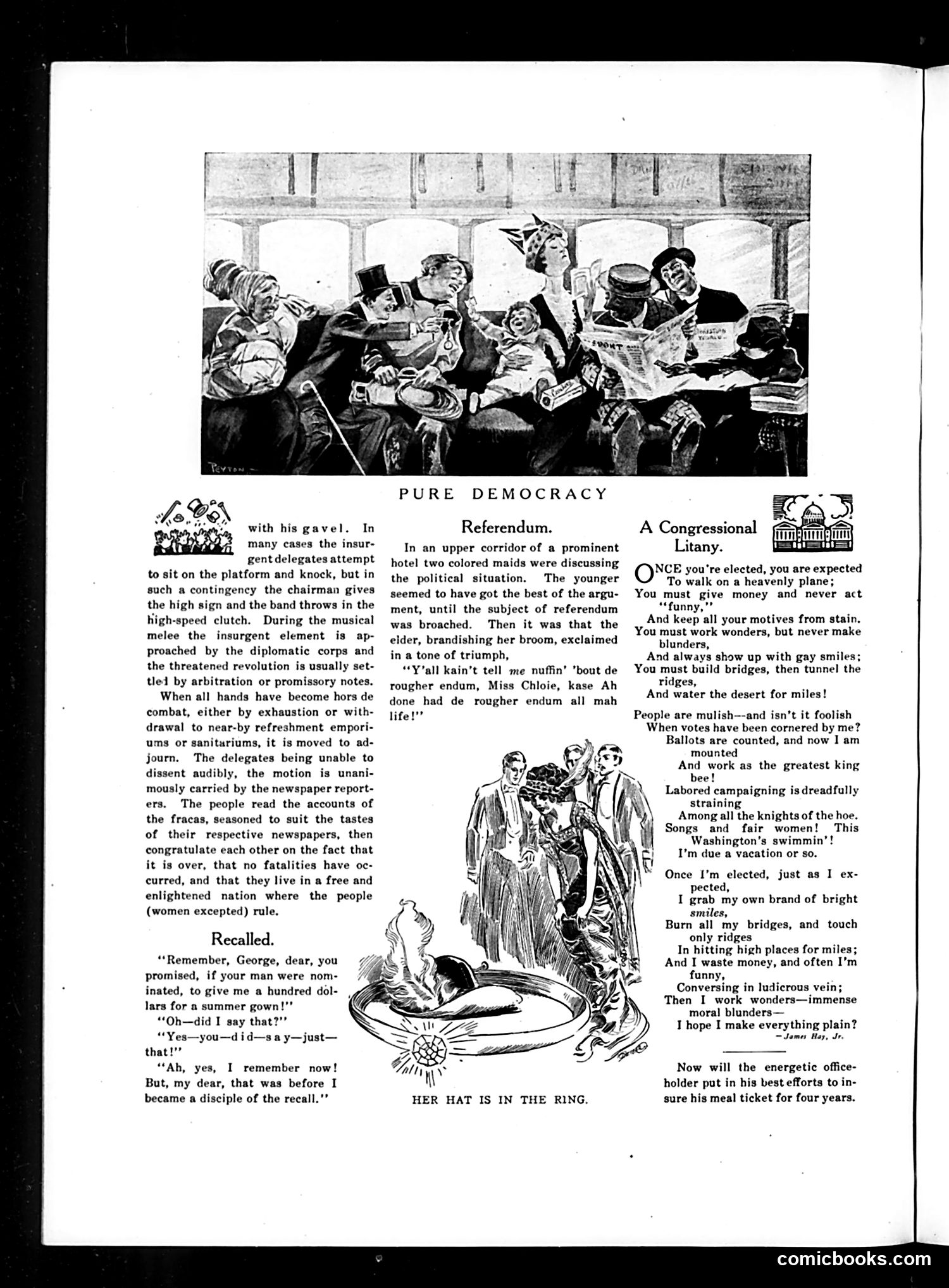
This page satirizes American democratic processes circa 1910s, using three interconnected pieces: **"Referendum"** mocks referendum voting through a dialect joke between Black maids, suggesting the concept is nonsensical compared to lived experience. **"A Congressional Litany"** (poem by James Hay Sr.) attacks elected officials' hypocrisy. Politicians promise moral virtue during campaigns ("walk on a heavenly plane," "keep motives from stain") but immediately abandon these pledges once elected, pursuing self-interest, wasting money, and making "moral blunders" while focusing solely on re-election ("meal ticket for four years"). **"Recalled"** shows a husband invoking the "recall" (a Progressive Era reform allowing voters to remove officials) to escape a financial promise to his wife—treating democracy as personal convenience rather than civic responsibility. Together, these pieces express Judge magazine's skepticism toward Progressive democratic reforms (referendum, recall) and politicians' fundamental dishonesty, suggesting democratic ideals are performative theater rather than genuine governance.
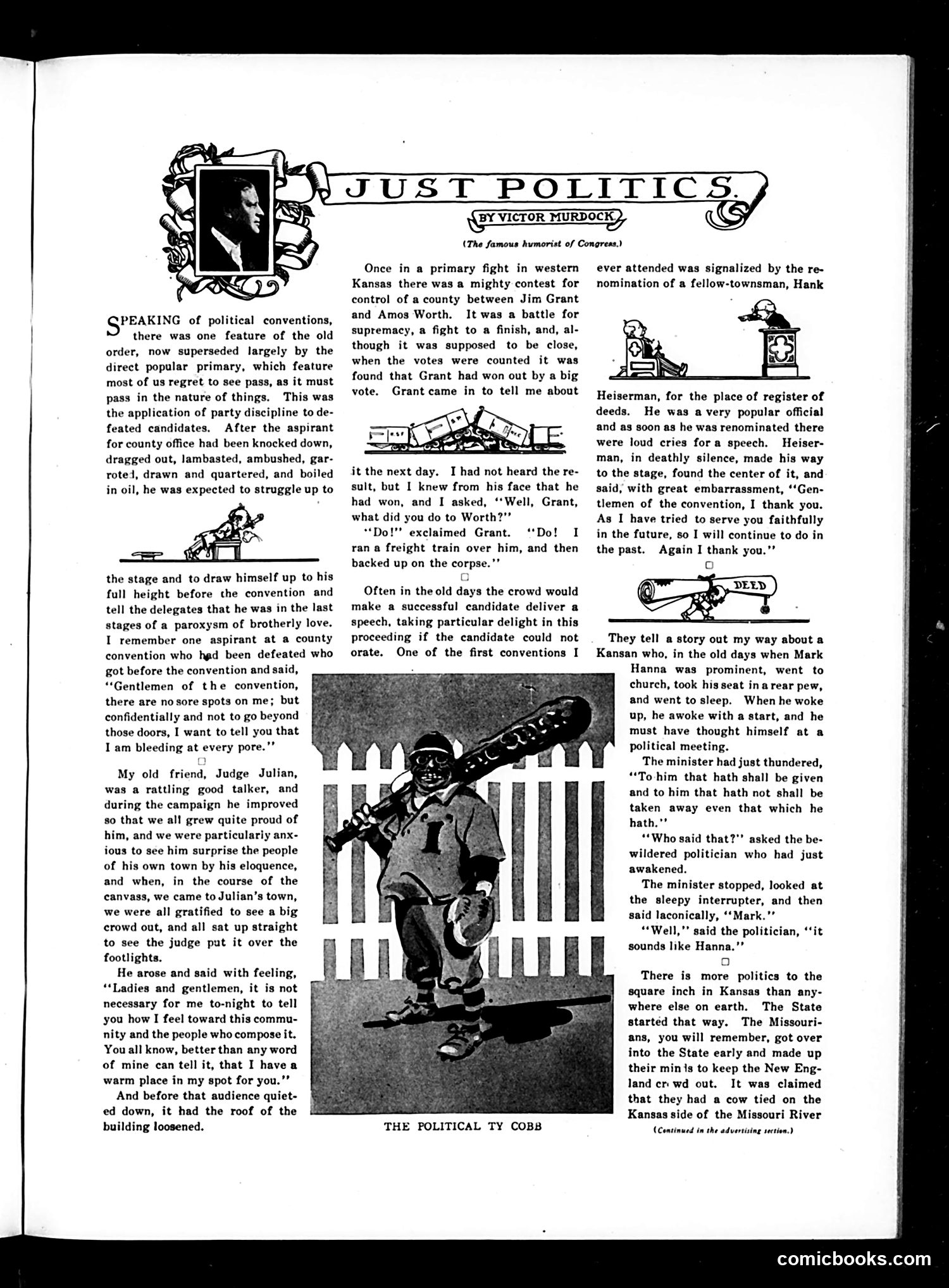
This article satirizes American political conventions and campaign rhetoric of the early 20th century. Murdock recounts anecdotes mocking the forced "gracious loser" speeches defeated candidates were expected to deliver at conventions—performing theatrical displays of party loyalty despite humiliating defeats. The humor centers on politicians' overwrought emotionality and empty oratory. Judge Julian's speech about having "a warm place in my spot for you" is intentionally malapropistic and ridiculous, yet the audience responds enthusiastically. Similarly, Heiserman's renomination speech is absurdly brief and formulaic. The cartoon "The Political Ty Cobb" (referencing baseball player Ty Cobb) depicts a politician as rough and brutish. The anecdotes mock both the artificiality of convention theatrics and politicians' general incompetence at public speaking—satirizing how crowds rewarded bad speeches simply because they expected emotional display over substance.
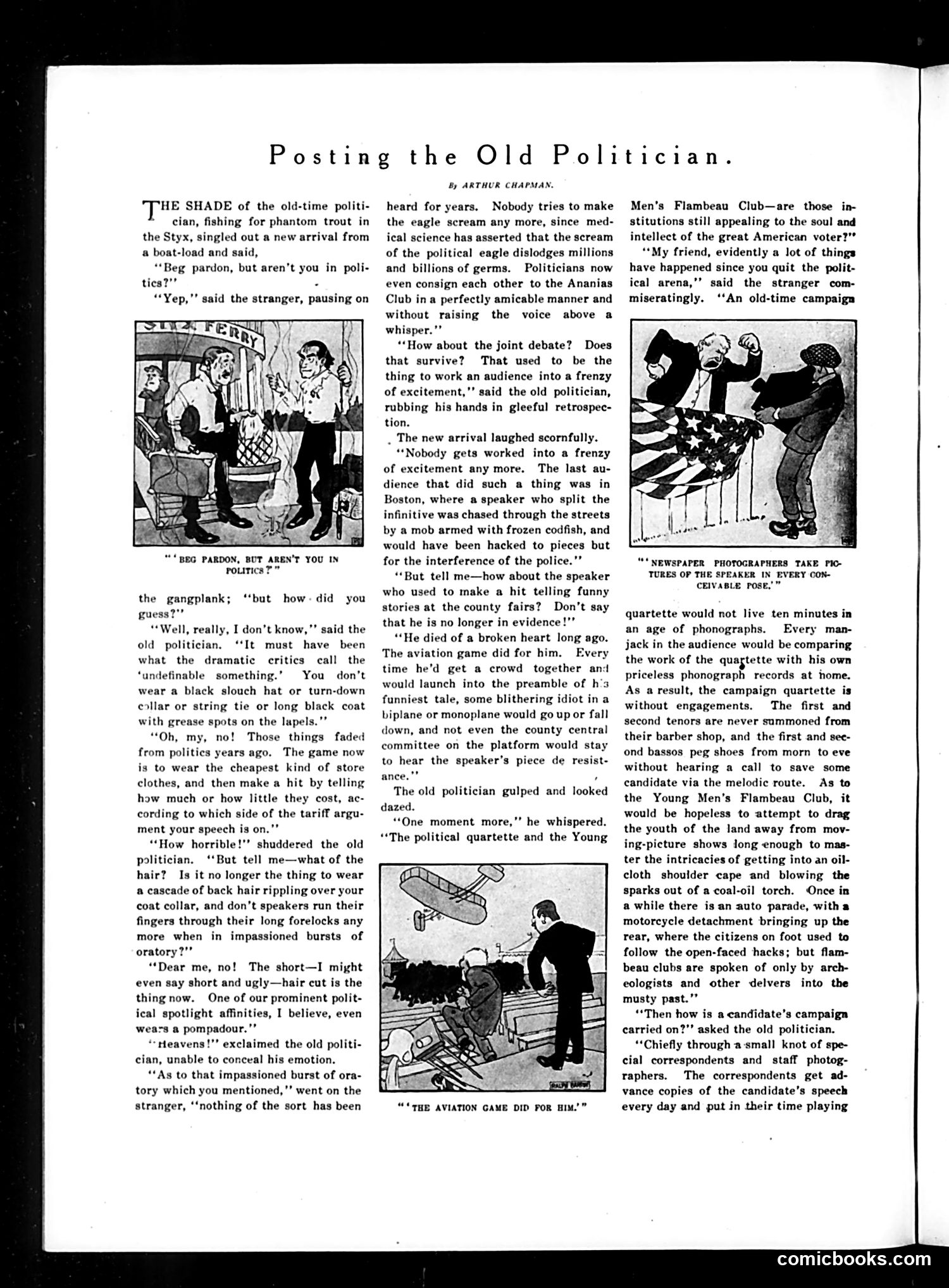
This satirical piece by Arthur Chapman contrasts old-style 19th-century political campaigning with modern (early 20th-century) methods. A deceased old politician meets a newcomer in the afterlife and interrogates him about how campaigning has changed. The satire mocks the obsolescence of traditional tactics: flamboyant dress, dramatic hair styling, passionate oratory designed to make audiences emotional, county fair storytelling, and political quartettes. The newcomer reveals these have been replaced by cheap store-bought clothes, short haircuts, soft-spoken delivery (blamed on germ theory), and newspaper photography documentation. Key jokes: politicians no longer try to excite crowds; the "Ananias Club" (liars' club) is now amicable; aviation stunts distract audiences; phonographs make singing quartettes pointless. The underlying critique: modern politics has become bland, calculated, and media-driven rather than genuinely passionate—suggesting both nostalgia for old politics and cynicism about new marketing-focused campaigns.
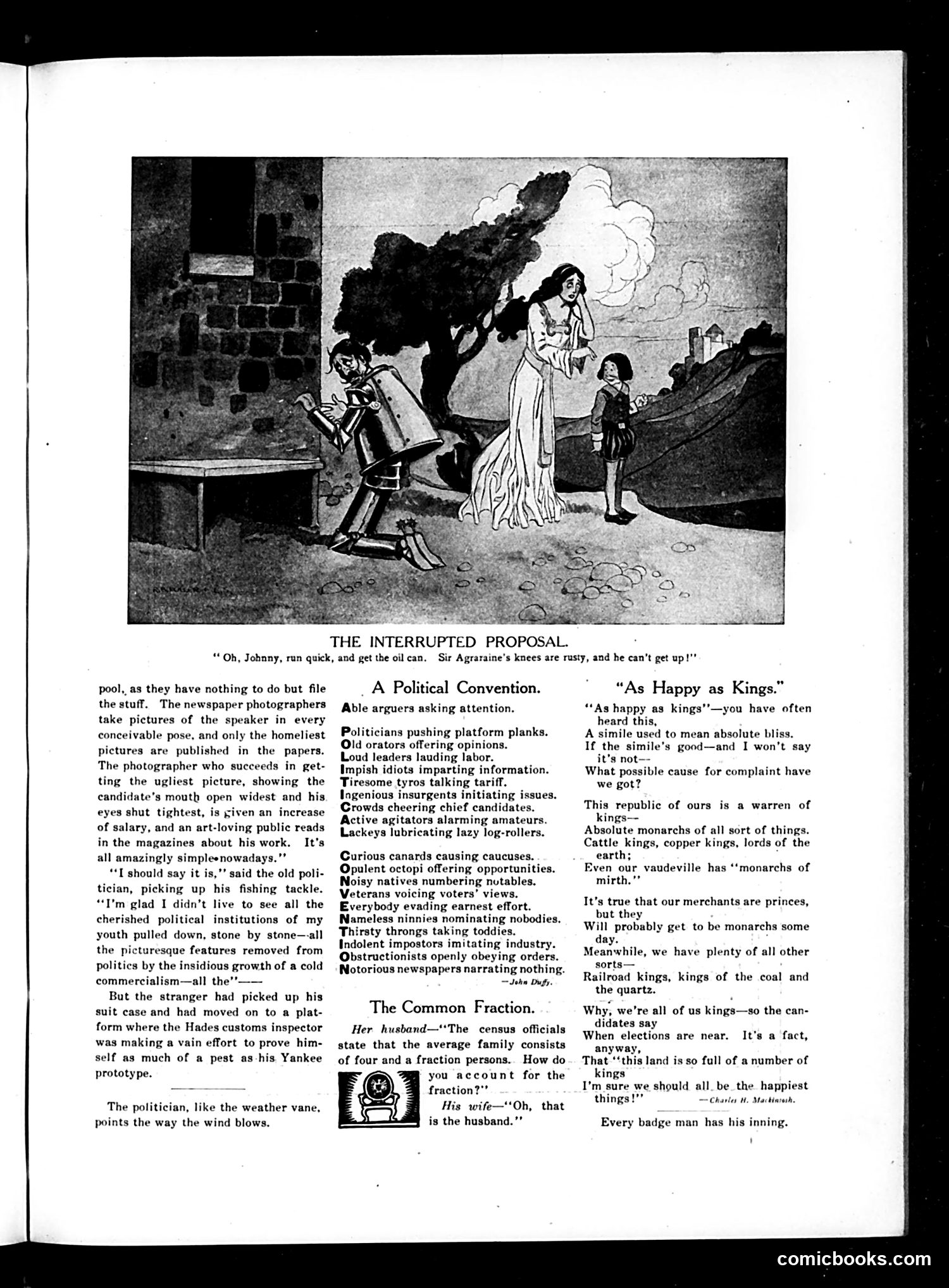
**"The Interrupted Proposal"** (top cartoon) satirizes political photography during campaigns. The joke: a soldier proposing to a woman is interrupted by a photographer capturing an unflattering angle. The accompanying text explains that newspapers deliberately publish the ugliest candidate photos—mouths agape, eyes shut—because readers find them amusing. Photographers who obtain the most unflattering images receive raises. This mocks the emerging practice of sensationalist political coverage and the public's appetite for embarrassing imagery of political figures. **"A Political Convention"** is a humorous alliterative list mocking the chaotic absurdity of political conventions: self-serving politicians, lazy operatives, drunken attendees ("thirsty throngs taking toddies"), incompetent nominees, and newspapers reporting nothing substantive. It satirizes the entire convention process as theater rather than serious governance. **"As Happy as Kings"** uses the common phrase "happy as kings" to argue Americans are already monarchs—"cattle kings," "copper kings," railroad magnates—so why complain? It's gentle satire of wealthy industrialists and the ironic gap between democratic ideals and actual power distribution.
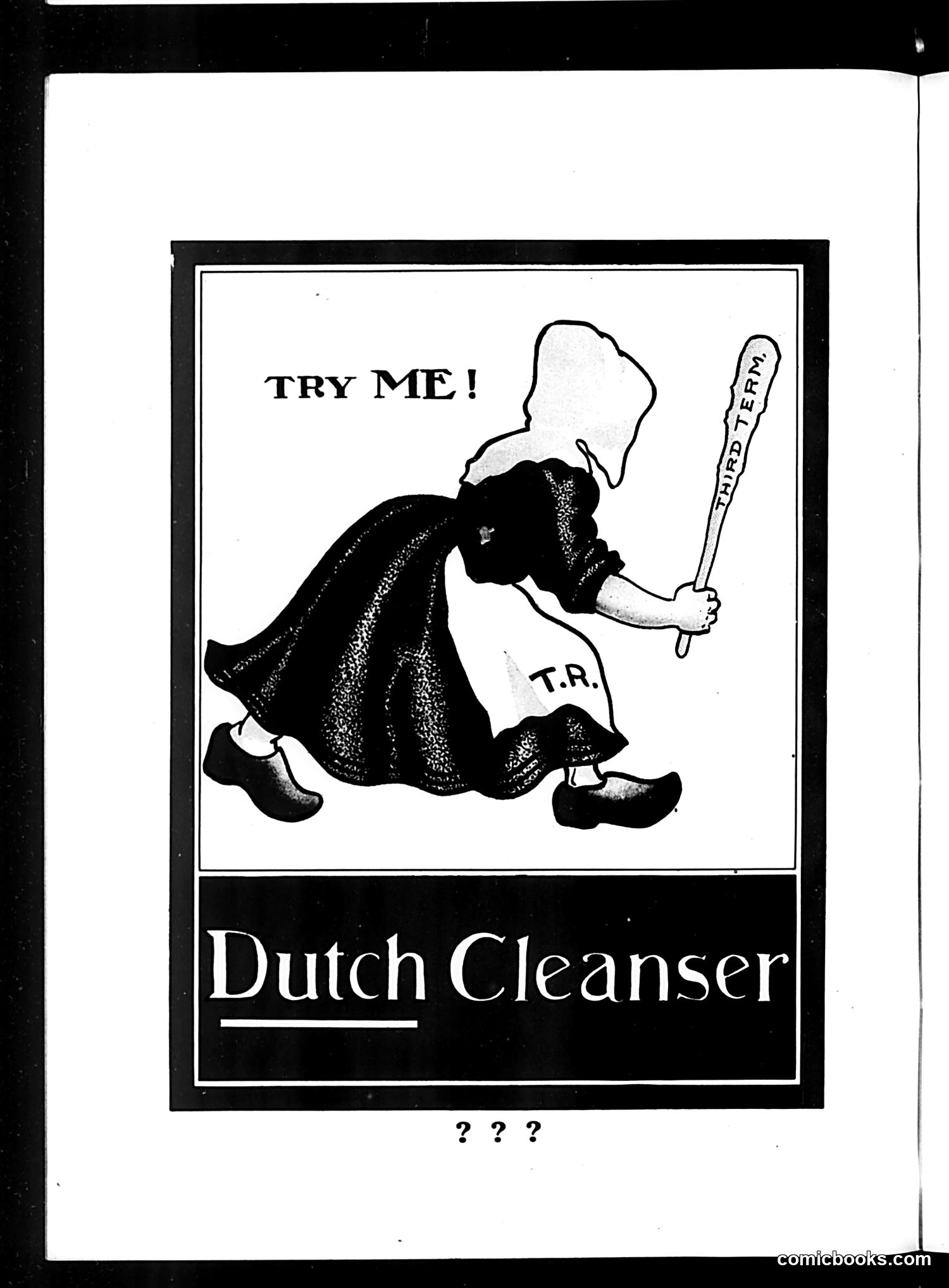
This is a vintage advertisement for Dutch Cleanser, a commercial cleaning product. The cartoon features a caricatured figure labeled "T.R." (likely Theodore Roosevelt, president 1901-1909) dressed as a Dutch maid or cleaning worker, holding a scrubbing brush labeled "TRIED & TESTED." The figure says "TRY ME!" The satire appears to equate Roosevelt's political persona or policies with a cleaning product—suggesting he "cleans up" or reforms things, a reference to his reputation as a "trust-buster" and reformer. By depicting him as a domestic cleaner in Dutch dress, the advertisement uses Roosevelt's recognizable public image to humorously promote the product while playing on his association with progressive reform and cleaning up corruption.
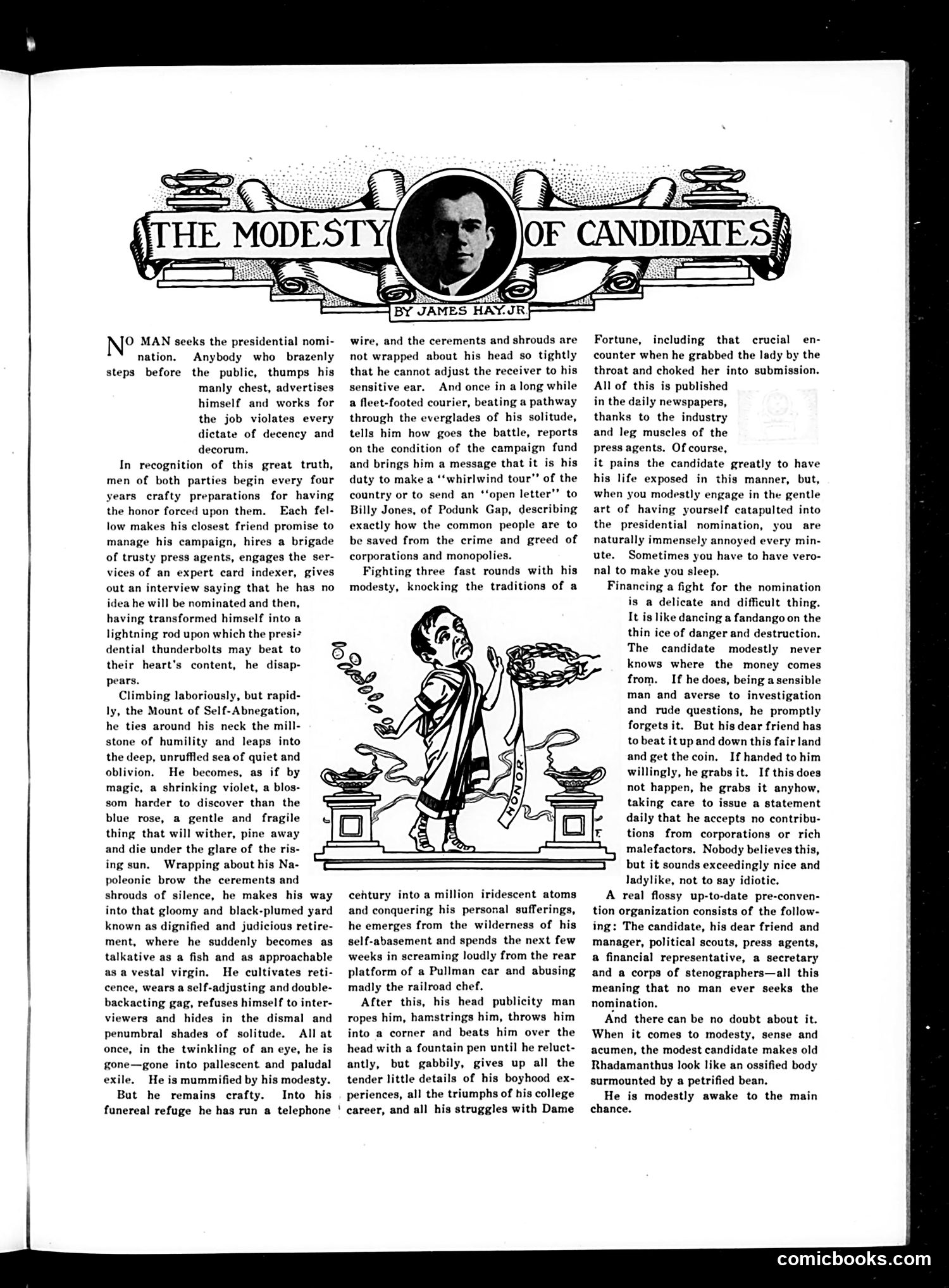
This satirical article mocks the hypocrisy of presidential candidates who publicly claim reluctance about nomination while privately orchestrating elaborate campaigns. The accompanying cartoon depicts a candidate juggling money bags while standing on a pedestal—illustrating the contradiction between professed modesty and actual self-promotion. The piece ridicules the ritualistic performance: candidates hire press agents, issue statements denying ambition, then mysteriously emerge from "retirement" to conduct whirlwind tours and expose intimate details of their lives to newspapers. The satire highlights how candidates manipulate the press, control campaign finances through intermediaries, and feign reluctance while aggressively pursuing the presidency. The author suggests this pantomime of "dignified withdrawal" fools no one—it's merely theater masking ruthless political ambition. The overall message: American political candidates are fundamentally dishonest about their motivations and methods, hiding behind false modesty while orchestrating sophisticated campaigns.
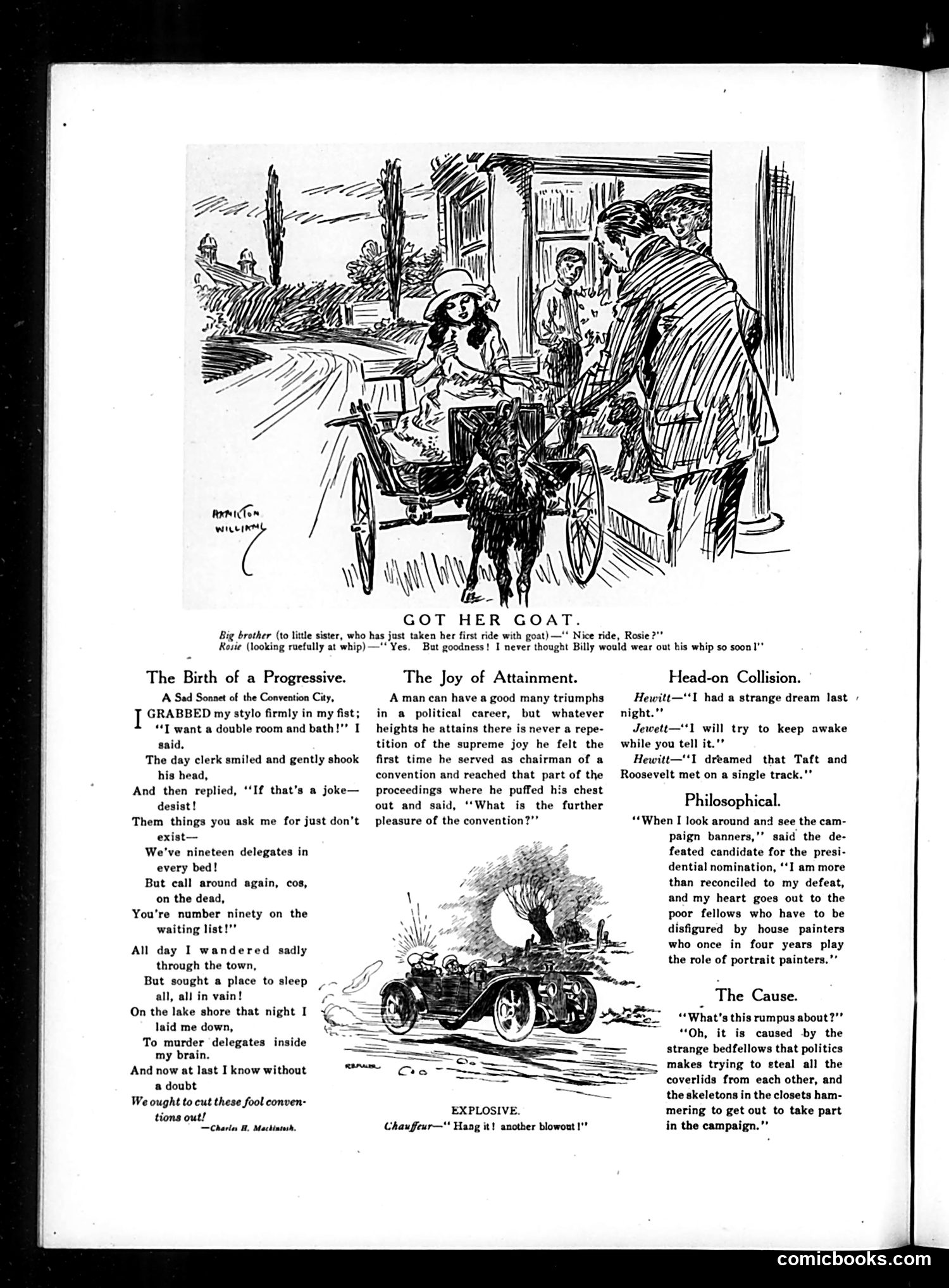
This page satirizes early 20th-century American politics, likely from a convention season. The cartoons mock: **"The Birth of a Progressive"**: A poet complains he can't find hotel rooms because delegates occupy every bed—satirizing the chaos and overcrowding of political conventions. **"The Joy of Attainment"**: References a political figure (possibly a convention chairman) who experiences peak satisfaction chairing proceedings, suggesting politicians' ambitions are petty. **"Head-on Collision"**: A brief joke about Taft and Roosevelt meeting on "a single track"—likely referencing their 1912 split, when Theodore Roosevelt's Progressive Party challenged incumbent Taft. **"The Cause"**: Politics creates "strange bedfellows" forced to cooperate while competing for advantage; skeletons in closets (scandals) emerge during campaigns. **"Got Her Goat"** and **"Explosive"**: Generic humor about animals and automobiles, unrelated to politics. The overall message criticizes political conventions as chaotic, self-serving spectacles where personal ambition trumps principle.
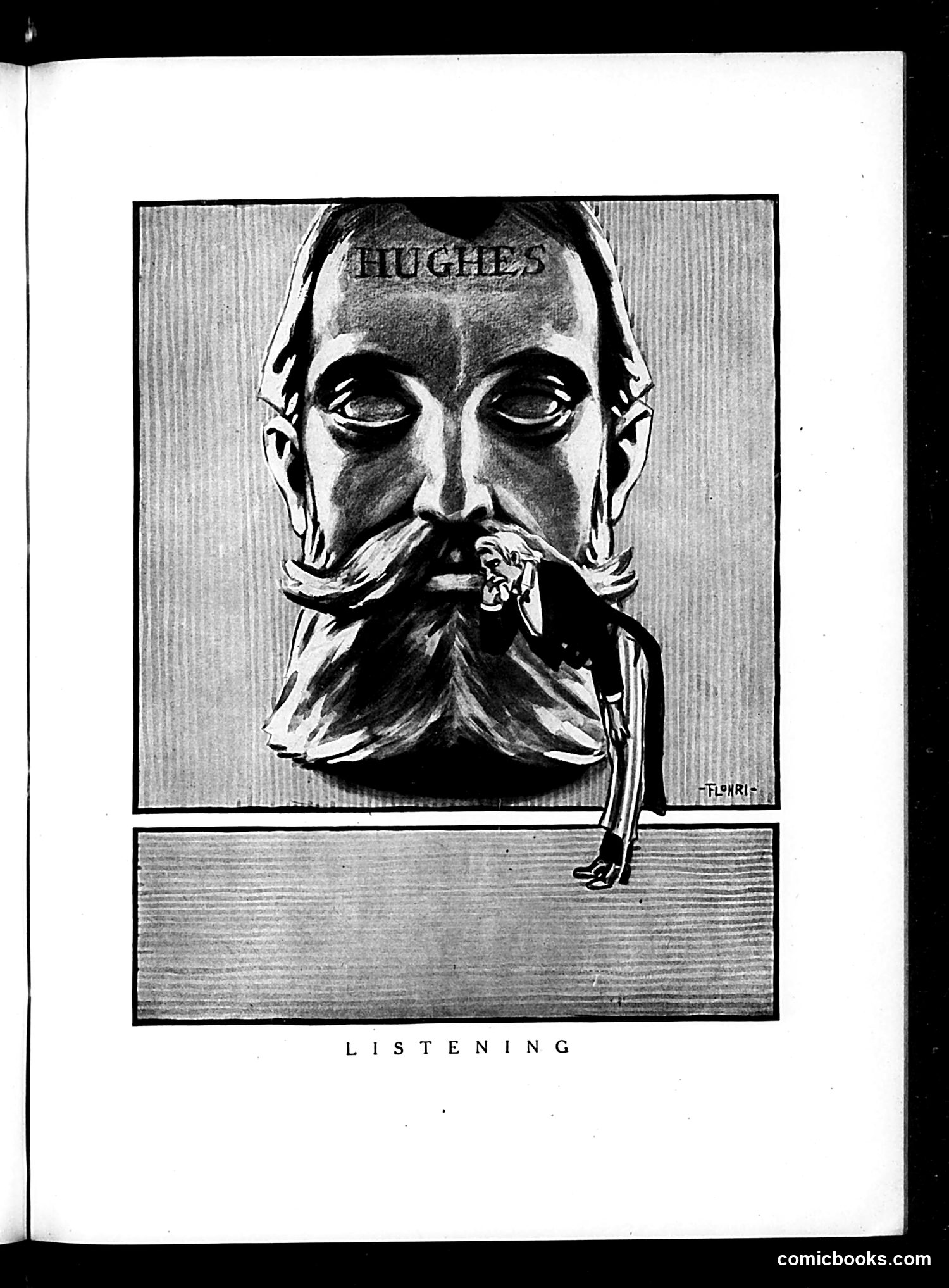
This appears to be a satirical cartoon from *Judge* magazine featuring a large bearded male head labeled "HUGHES" at the top. A small figure stands before it, appearing to speak or present something to the massive face. The caption reads "LISTENING," which suggests irony—likely implying that despite appearing to listen, Hughes is not actually receptive or responsive. The exaggerated scale contrast emphasizes power imbalance or dismissiveness. Without the publication date visible, I cannot identify which Hughes this references (the name was common among prominent figures). The cartoon likely satirizes a contemporary political or business figure known for ignoring public opinion or stakeholder concerns, despite outward appearances of attentiveness.
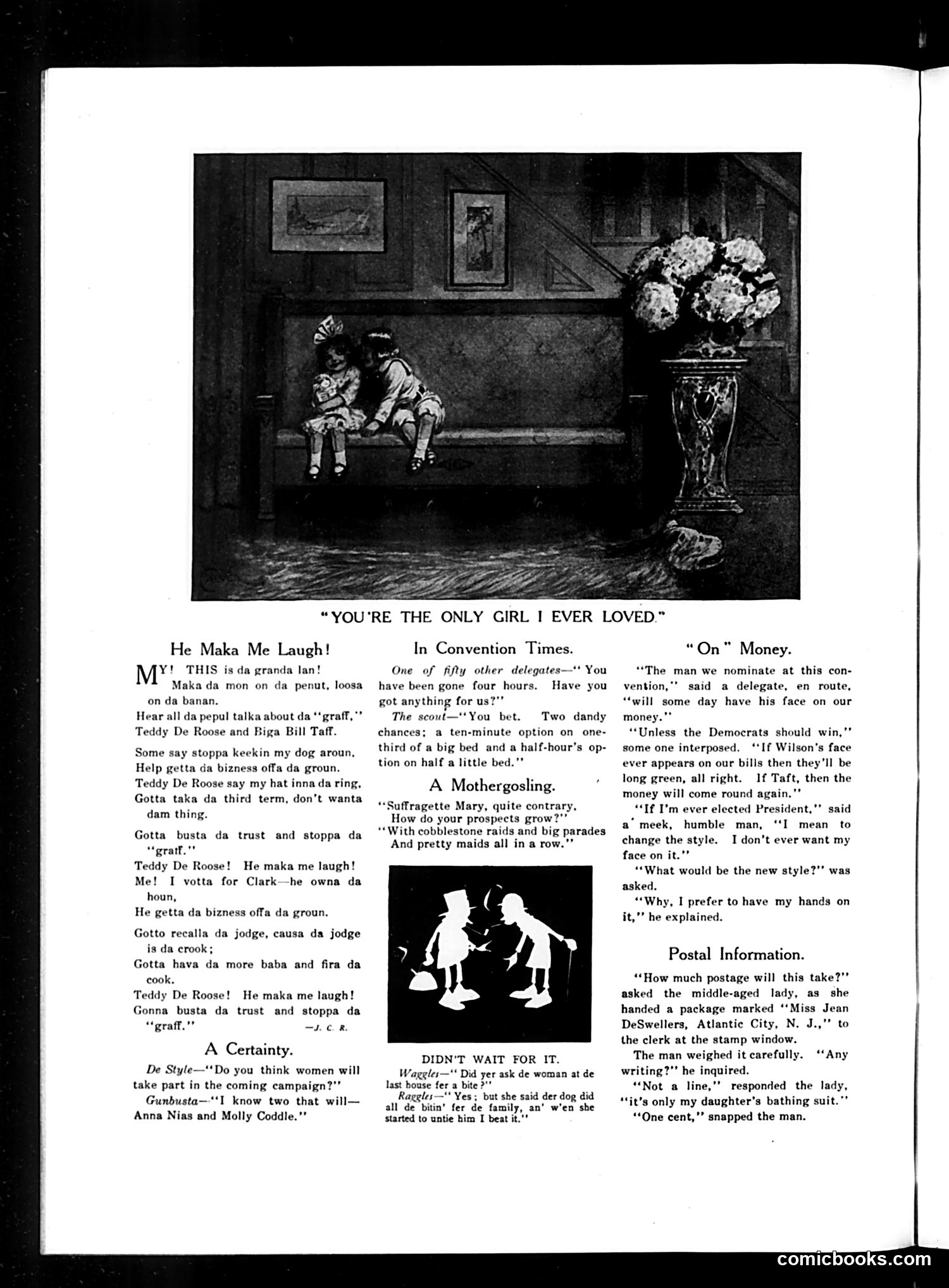
This page satirizes early 1910s American politics and social issues. The top section mocks an Italian immigrant's broken-English political commentary about Theodore Roosevelt and William Howard Taft during what appears to be a presidential campaign—likely the contentious 1912 election when Roosevelt split the Republican vote. The immigrant's malapropisms ("graff" for graft, phonetic Italian-American dialect) were a common contemporary stereotype used for both humor and social commentary. The small silhouette cartoon "Didn't Wait For It" depicts a vagrant avoiding a dog, playing on class humor. "A Mothergosling" parodies suffragette activism with references to "cobblestone raids"—likely alluding to the increasingly militant British suffrage movement. The convention-times dialogue jokes about delegates' poor accommodations and sexual impropriety. The final "Postal Information" item is a mild joke about the minimal weight of a woman's bathing suit requiring only one cent postage. Overall, the page reflects contemporary anxieties about immigration, women's political participation, and campaign corruption.
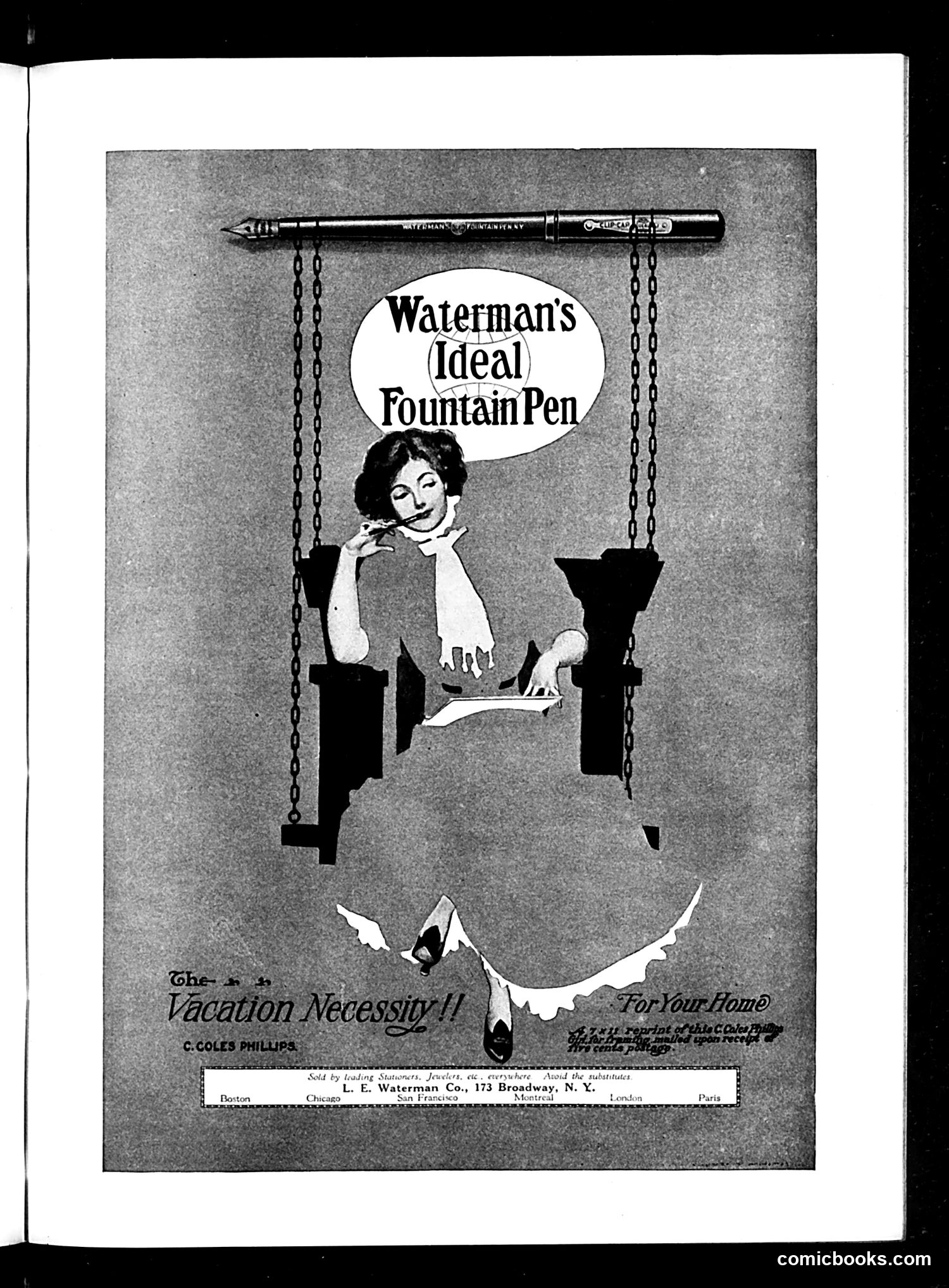
This is a **Waterman's Ideal Fountain Pen advertisement**, not a political cartoon. The image shows a woman on a swing with the tagline "Vacation Necessity!! For Your Home." The ad appears to target female consumers, suggesting that a quality fountain pen is essential for correspondence during vacations—implying women wrote letters while away. The woman's relaxed pose on the swing emphasizes leisure and pleasure. The advertisement credits "C. COLES PHILLIPS" as the artist (a prominent illustrator of the era). The Waterman Company's multiple office locations are listed at the bottom. This represents early 20th-century consumer marketing that associated luxury goods with leisure and femininity, targeting middle and upper-class women who had time and means for vacations.
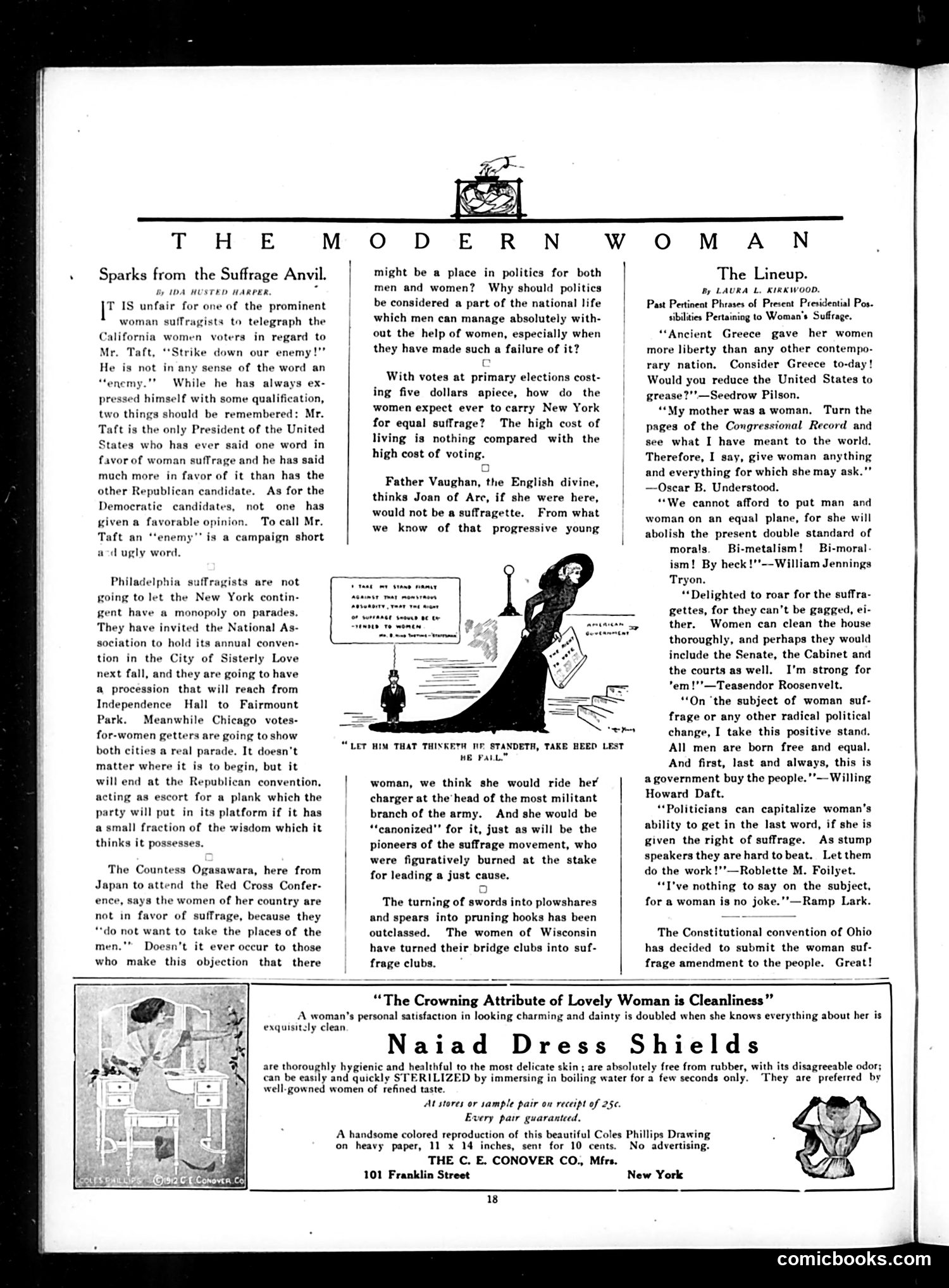
This page from the satirical magazine *Judge* addresses women's suffrage debates circa 1908-1912. **Main Content:** The left column ("Sparks from the Suffrage Anvil" by Ida Husted Harper) defends President Taft against suffragists calling him an "enemy," noting he's actually the only U.S. president to publicly support women's voting rights. It also discusses suffrage parades planned in Philadelphia and Chicago. **The Central Cartoon:** The illustration shows a figure about to fall, with text "LET HIM THAT THINKETH HE STANDETH, TAKE HEED LEST HE FALL"—satirizing male politicians' overconfidence regarding suffrage opposition. **"The Lineup" Column:** Mock quotations from unnamed presidential candidates reveal their contradictory stances: one warns reducing America to "grease" like Greece; another claims supporting women's rights; a third fears women will eliminate the "double standard of morals." The satire exposes male hypocrisy and evasiveness on suffrage. **Advertising:** The page includes a Naiad Dress Shields advertisement, typical of the era's product placement.
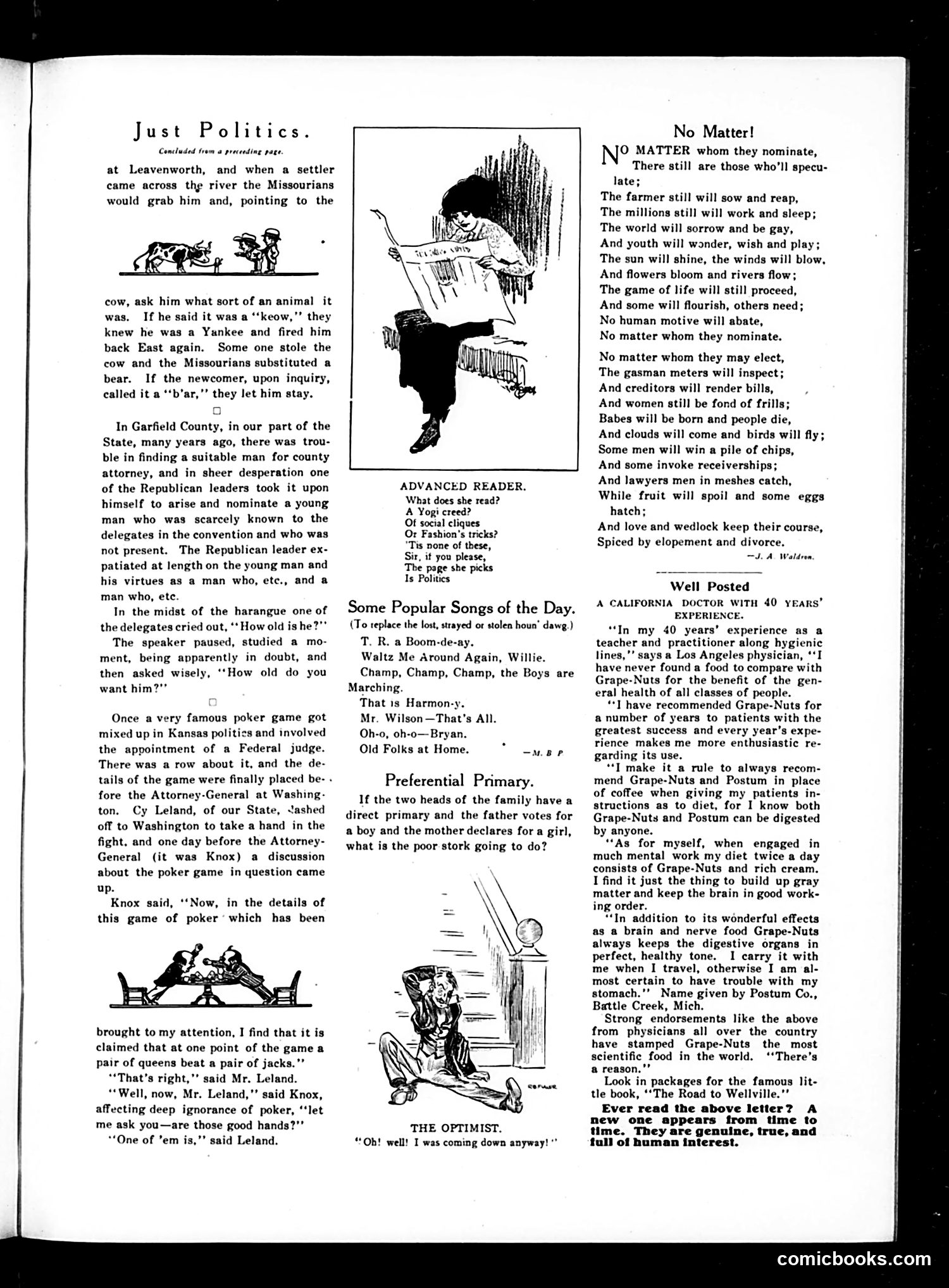
This page contains political humor from the early 1900s, likely pre-1912 based on references to Bryan and Wilson. **"Just Politics"** recounts anecdotes about Kansas politics, including a humorous story where Attorney General Philander Knox (shown as ignorant of poker) questions Cy Leland about whether queens and jacks are "good hands"—a setup to mock politicians' practical ignorance despite their authority. **"Some Popular Songs of the Day"** is a satirical list replacing legitimate song titles with political ones, referencing Theodore Roosevelt ("Boom-de-ay"), William Jennings Bryan ("Oh-o, oh-o"), and Woodrow Wilson ("That's All")—mocking the dominance of political figures in public discourse. **"No Matter!"** is a resigned poem suggesting that election outcomes are irrelevant to ordinary life's continuities—expressing voter cynicism or apathy about political changes. **"Preferential Primary"** jokes about the new direct primary system, asking absurdly what happens if parents vote for different-gendered candidates. The overall thrust: mockery of Kansas politicians, commentary on how politics saturates culture, and skepticism about electoral significance.
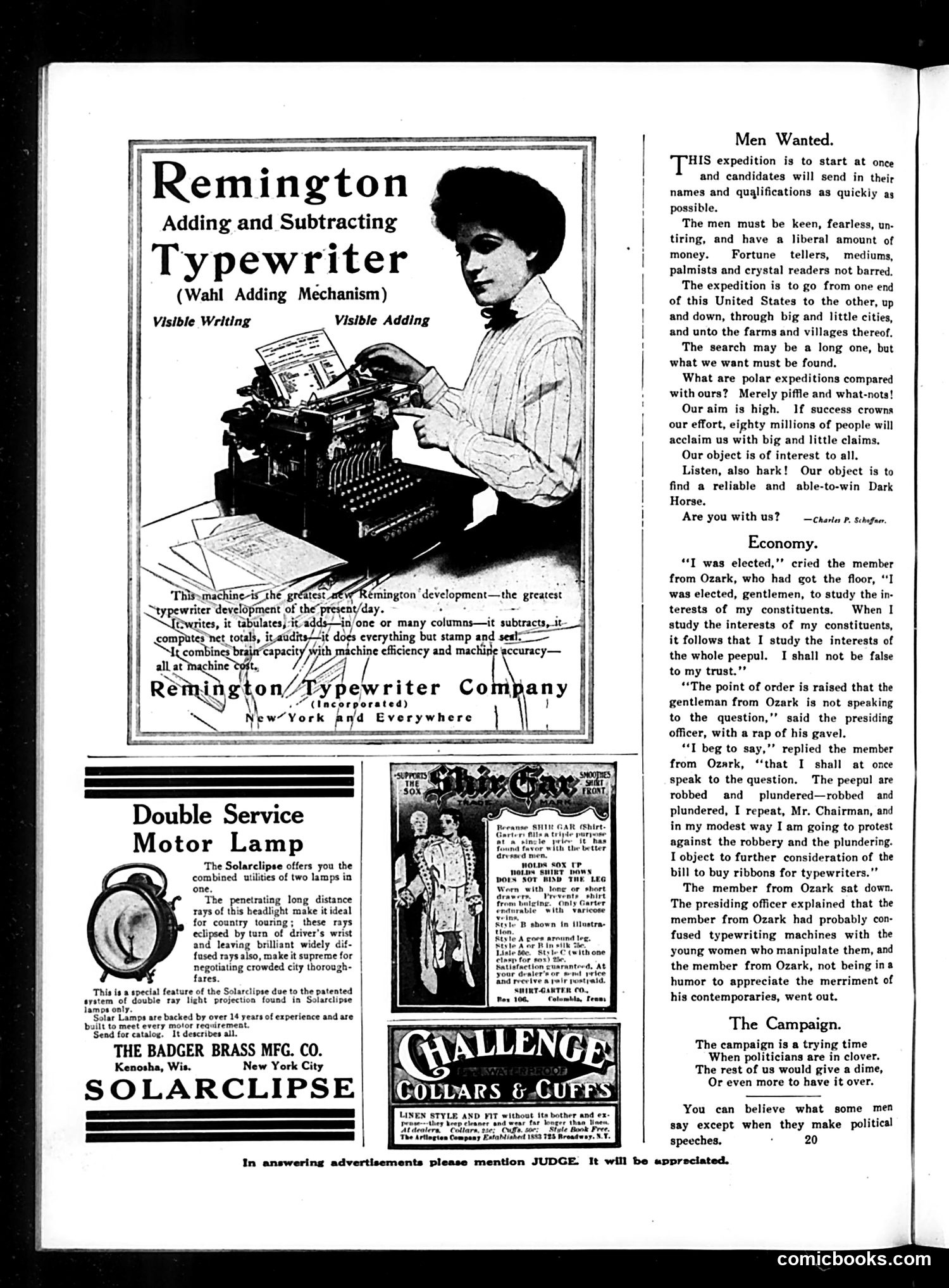
This page contains political satire and vintage advertisements. The main political content is a two-part satirical piece titled "Economy": **The Satire:** A congressman from Ozark makes a rambling speech claiming to represent "the peepul," asserting they are "robbed and plundered." When called to order, he insists he's addressing the question while actually discussing typewriter ribbons—a transparent non sequitur. The presiding officer dismisses him as confused about the machinery he's discussing. **The Point:** This mocks politicians who hide behind populist rhetoric and self-serving speeches while failing to address actual legislative questions. The typewriter ribbon detail suggests the congressman is disconnected from substantive issues. **"The Campaign" poem** that follows reinforces the satire: politicians benefit from campaigns while ordinary citizens find them exhausting and tedious. The page also contains period advertisements (Remington typewriter, motor lamp, collars) typical of Judge's revenue model. The "Men Wanted" section appears to be a genuine expedition recruitment notice, unrelated to the political satire.
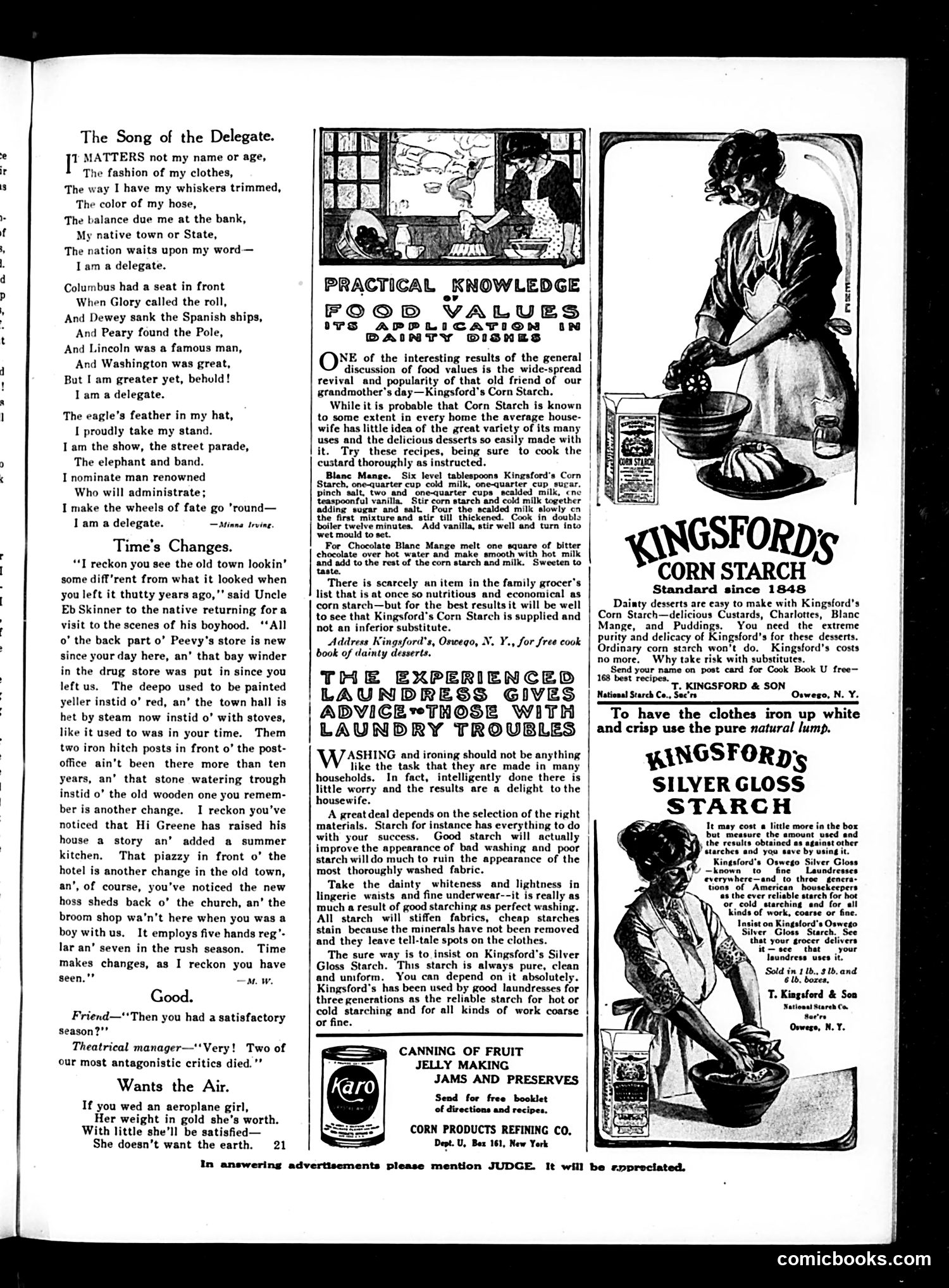
This page mocks the inflated self-importance of political convention delegates. "The Song of the Delegate" (poem by Minna Irvine) sarcastically claims that delegates—regardless of personal merit, wealth, or background—wield enormous power simply by virtue of their position. They "nominate" leaders and "make the wheels of fate go 'round," yet the poem's tone suggests this authority is absurdly disproportionate to their actual qualifications. The satire targets early 20th-century American political conventions, where delegates held genuine power in selecting presidential candidates. The poem compares ordinary delegates to historical giants (Columbus, Lincoln, Washington, Dewey), highlighting the gap between delegates' self-perception and reality. The "eagle's feather" and parade imagery mock their ceremonial pomp. The remainder of the page contains period advertisements and lighter humor pieces unrelated to the political satire.
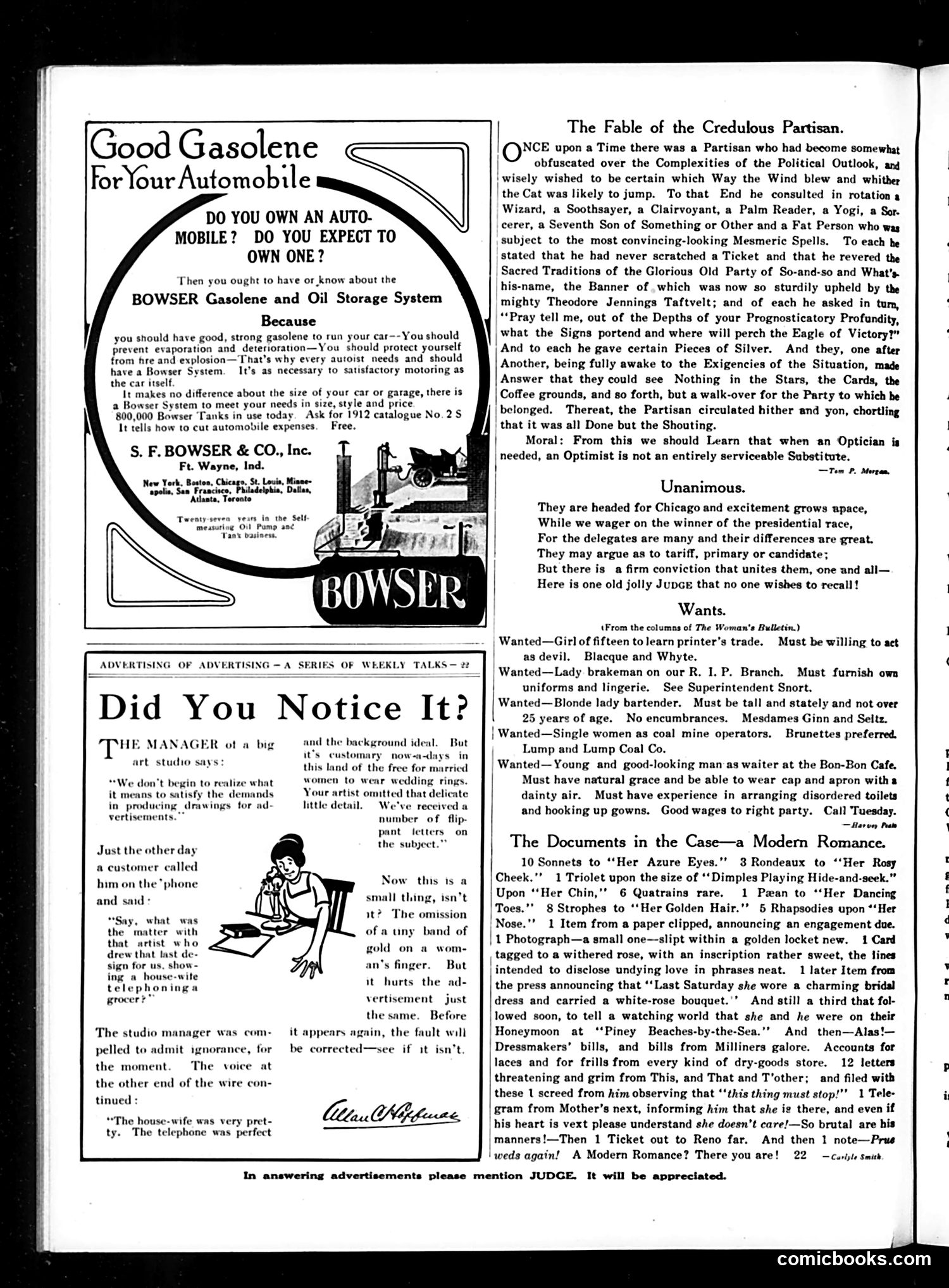
This page from Judge contains multiple sections of satire and advertising: **Advertisement (Top Left):** A Bowser gasoline storage system ad—straightforward commercial content about automobile fuel storage, reflecting the early auto industry. **"Did You Notice It?" (Bottom Left):** A satirical piece about advertising art direction. A studio manager receives complaint that an artist omitted a wedding ring on a housewife illustration—a tiny detail that undermines advertisement credibility. The satire mocks both the manager's initial ignorance and the absurd perfectionism required in commercial art production. **"The Fable of the Credulous Partisan" (Right):** Political satire using fable format. A confused partisan voter consults various fortune-tellers (wizards, soothsayers, psychics), each paid in silver, all reassuring him that his political party will win regardless. The moral: when an optimist is needed, don't trust one—they're biased. This mocks gullible voters who accept partisan predictions uncritically. **"Unanimous" (Bottom Right):** Brief verse about 1912 presidential delegates heading to Chicago, suggesting party unity despite surface disagreements.
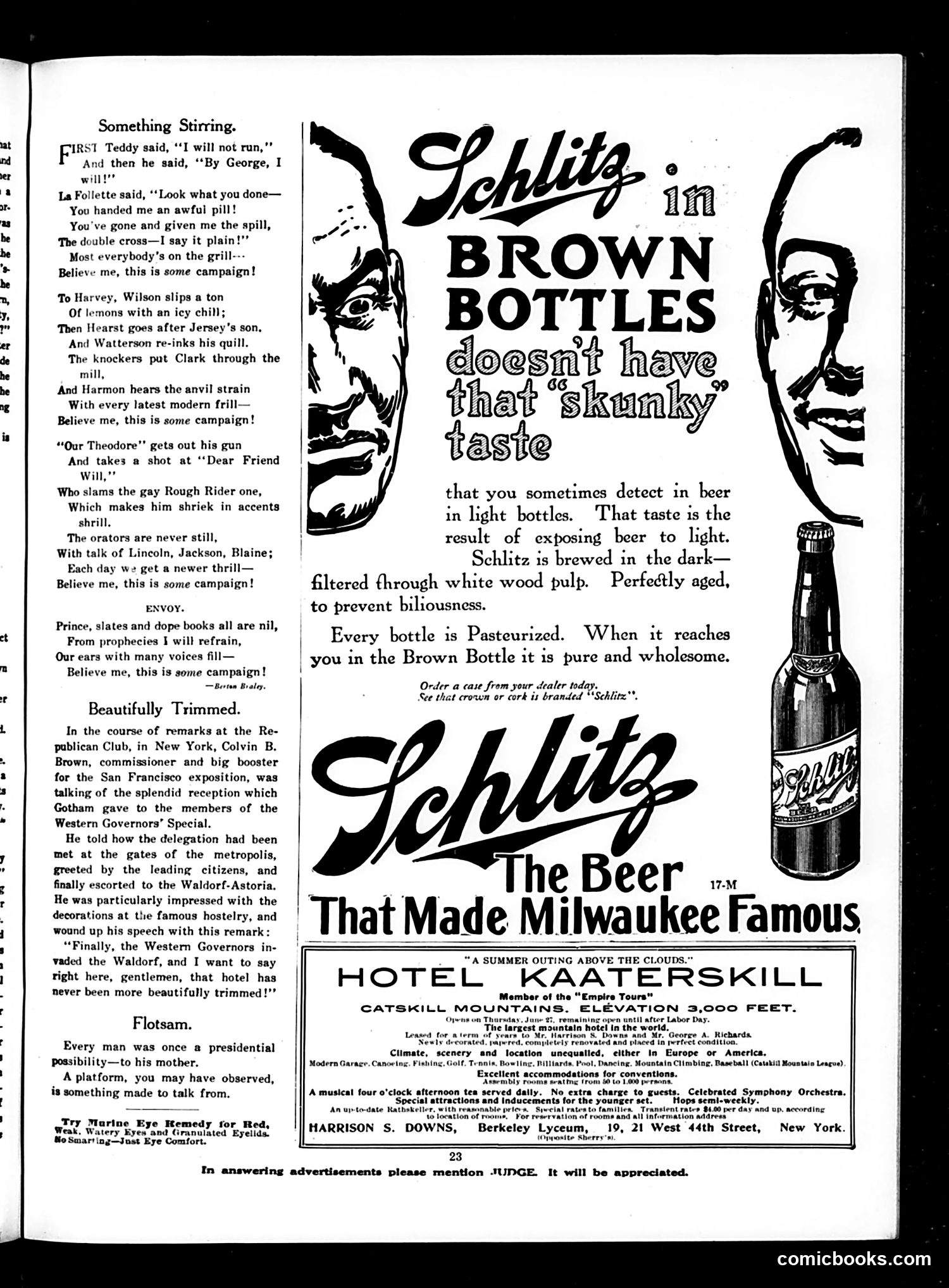
This page primarily contains **poetry satirizing the 1912 U.S. presidential campaign** rather than visual cartoons. The verses mock the chaos of multiple candidates competing: - **"Teddy" (Theodore Roosevelt)** flip-flopped on running ("I will not run"/"By George, I will!") - **La Follette** felt betrayed by Roosevelt's decision - **Wilson, Hearst, and Clark** are referenced as competing candidates - **Watterson** (likely Henry Watterson, a prominent editor) "re-inks his quill" to attack candidates The poem captures the fractured Republican Party in 1912, when Roosevelt's comeback split the GOP and handed victory to Democrat Woodrow Wilson. The remainder of the page consists of **advertisements** (Schlitz beer, Hotel Kaaterskill) and brief humorous observations ("Flotsam"), not political commentary. The satirical point: the 1912 race was chaotic infighting among numerous candidates—"every latest modern frill" of campaigning, yet unpredictable.
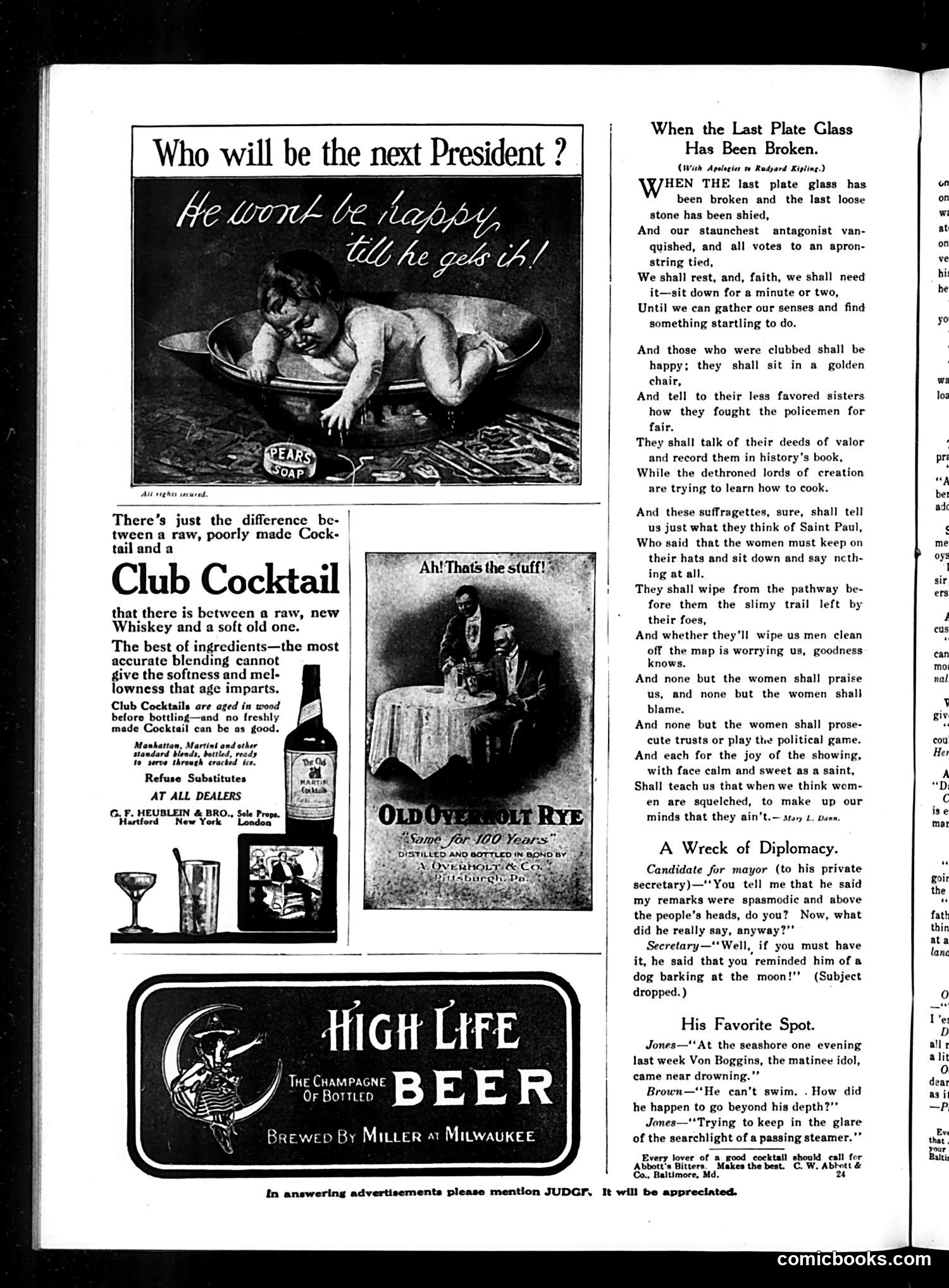
This page is primarily **advertising with satirical poetry**. The main content is a mock-heroic poem titled "When the Last Plate Glass Has Been Broken," a parody of Rudyard Kipling that imagines the aftermath of **women's suffrage activism**. The satire targets **suffragettes** (women fighting for voting rights), portraying their victory as destructive chaos. The poem mockingly predicts that once women gain power, they will: - Replace male leaders entirely - Force men to learn cooking - Control politics and business - Claim moral superiority while men become irrelevant The tone is dismissive—depicting suffragettes as vengeful and hypocritical, while suggesting their triumph would be civilization's collapse. This reflects **anti-suffrage sentiment common in 1910s America**, when Judge magazine frequently mocked women's rights activism. The surrounding content—cocktail and beer advertisements—is standard commercial filler typical of period magazines.
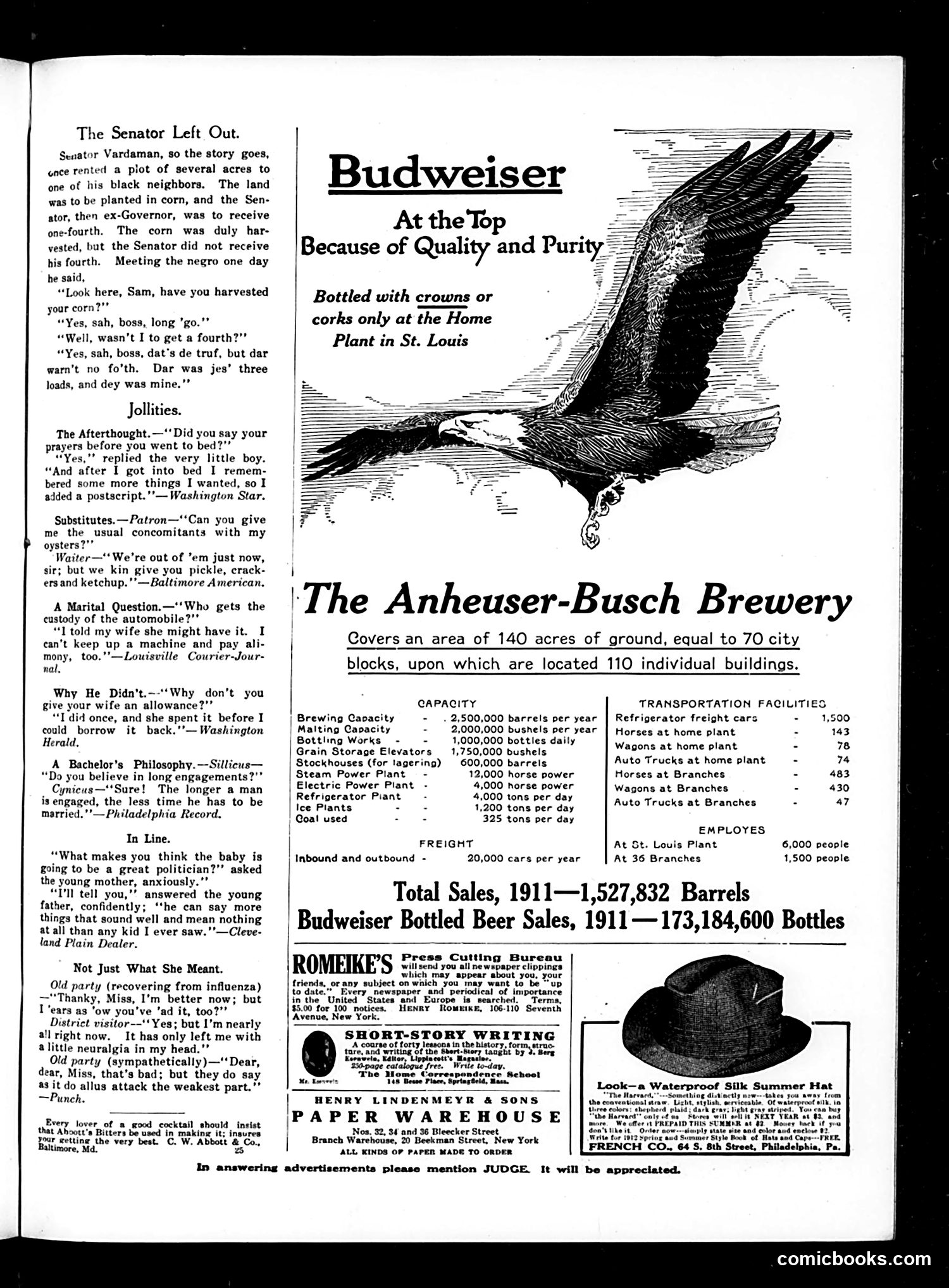
This page is primarily **advertising**, dominated by Budweiser and Anheuser-Busch brewery promotions. The large eagle logo and detailed brewery specifications showcase industrial scale and capacity—typical early-1900s corporate advertising emphasizing size and modernity. The left column contains brief **satirical humor pieces** typical of Judge's style: "The Senator Left Out" mocks Senator Vardaman (a Mississippi politician) through a dialect joke about a Black tenant farmer who claims there were only three loads of corn, not four—denying the Senator his share. The joke relies on period stereotypes about dishonest sharecroppers. Other brief jokes address marriage, politics, and domestic life with light humor—nothing historically weighty. The page reflects its era: casual racial stereotyping, corporate boosterism about American industrial capacity, and genteel domestic comedy. It's primarily a commercial vehicle disguised as satirical magazine content.
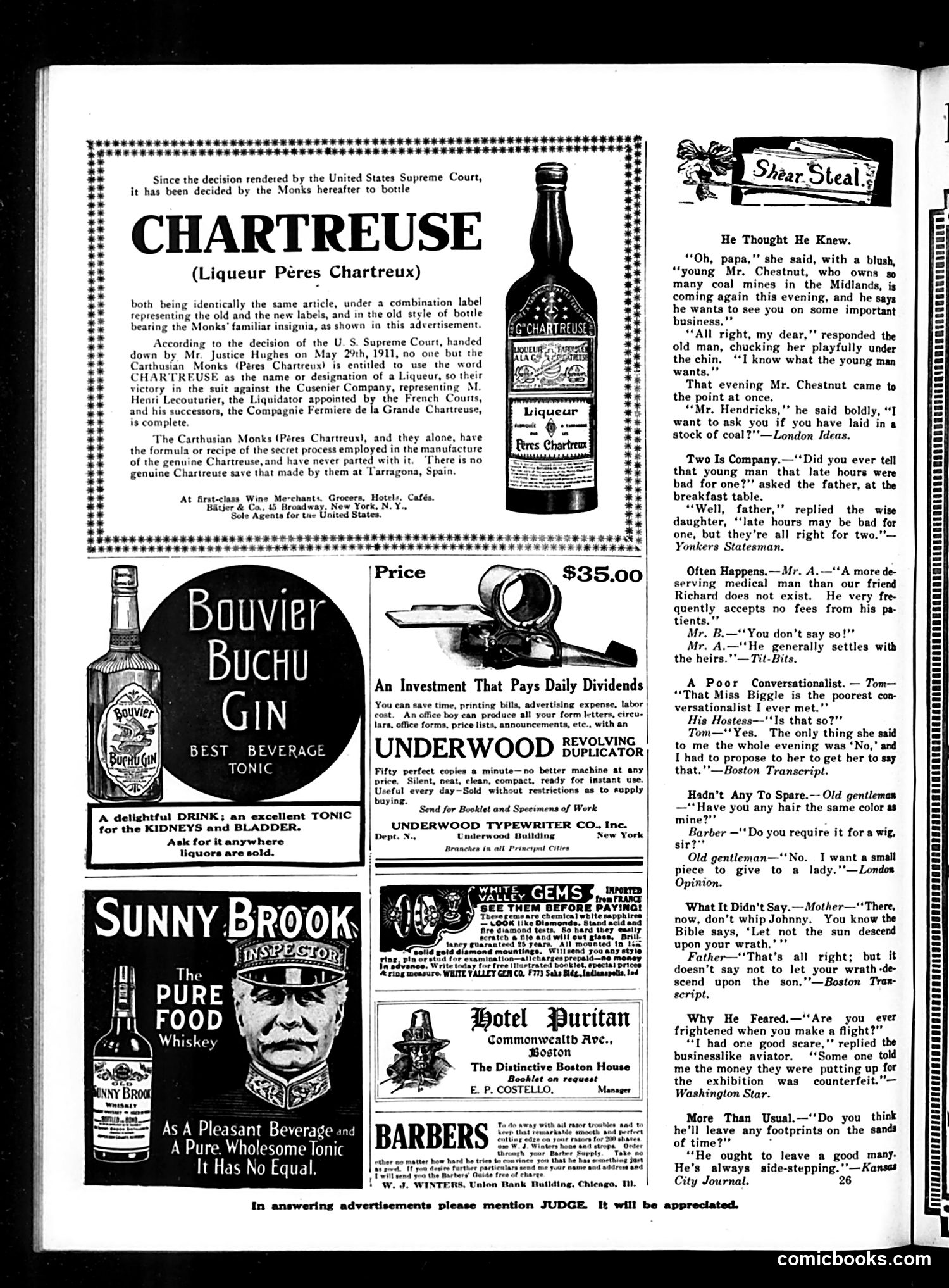
This is primarily **a page of advertisements with brief satirical humor pieces** rather than political cartoons. The main features are liquor and product advertisements (Chartreuse, Bouvier Buchu Gin, Sunny Brook Whiskey, Underwood duplicator, and Hotel Puritan), plus a section titled "**Shear Steal**" containing short comic anecdotes about everyday middle-class life. The humor pieces target familiar domestic scenarios: a daughter's suitor asking about coal supplies (the joke being the father assumes a marriage proposal), late-night courtship, a doctor who avoids payment by working until his patients die, and poor conversationalists. These represent typical **early 20th-century Judge magazine fare**—light social satire mocking Victorian propriety, courtship customs, and professional types, aimed at readers familiar with such situations. The page reflects **1911 consumer culture** (note the Supreme Court decision about Chartreuse at top) but contains no significant political content or identifiable figures.
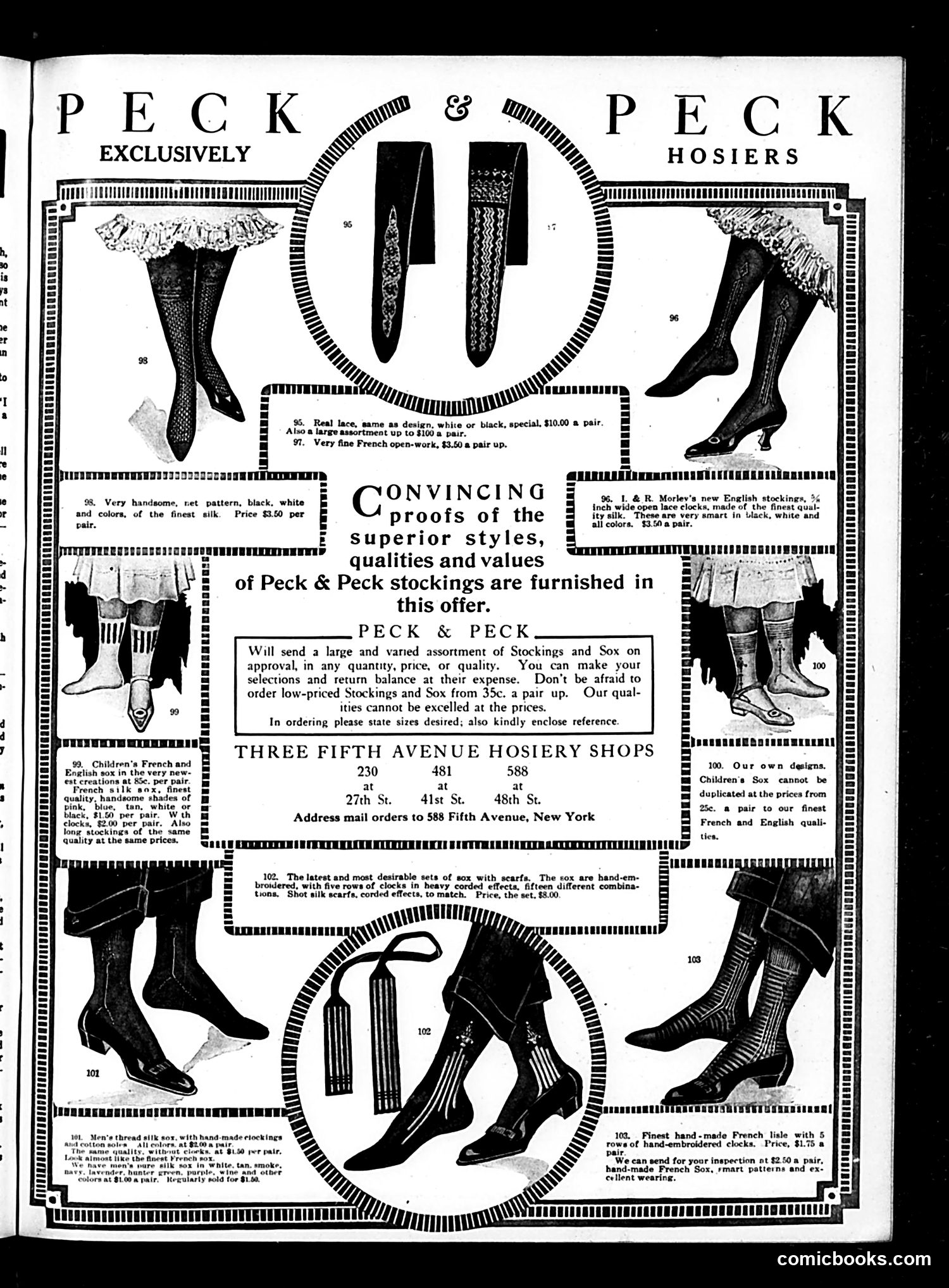
This page is **not a cartoon or satire**—it is a **fashion advertisement** for Peck & Peck, a Fifth Avenue hosiery shop. There is no political or social commentary. The page displays various styles of women's and children's stockings and socks from the early 20th century, with numbered product images showing different patterns (lace, open-work, embroidered clocks, colored designs). The text describes materials (silk, French linen), prices (ranging from 35 cents to $100 per pair), and ordering information for three Manhattan locations. The decorative border and product photography are typical commercial layout of the period. The "convincing proofs" headline simply means the display demonstrates the quality and variety of Peck & Peck's merchandise. There are no caricatures, political figures, or satirical intent—only retail promotion in Judge magazine's advertising section.
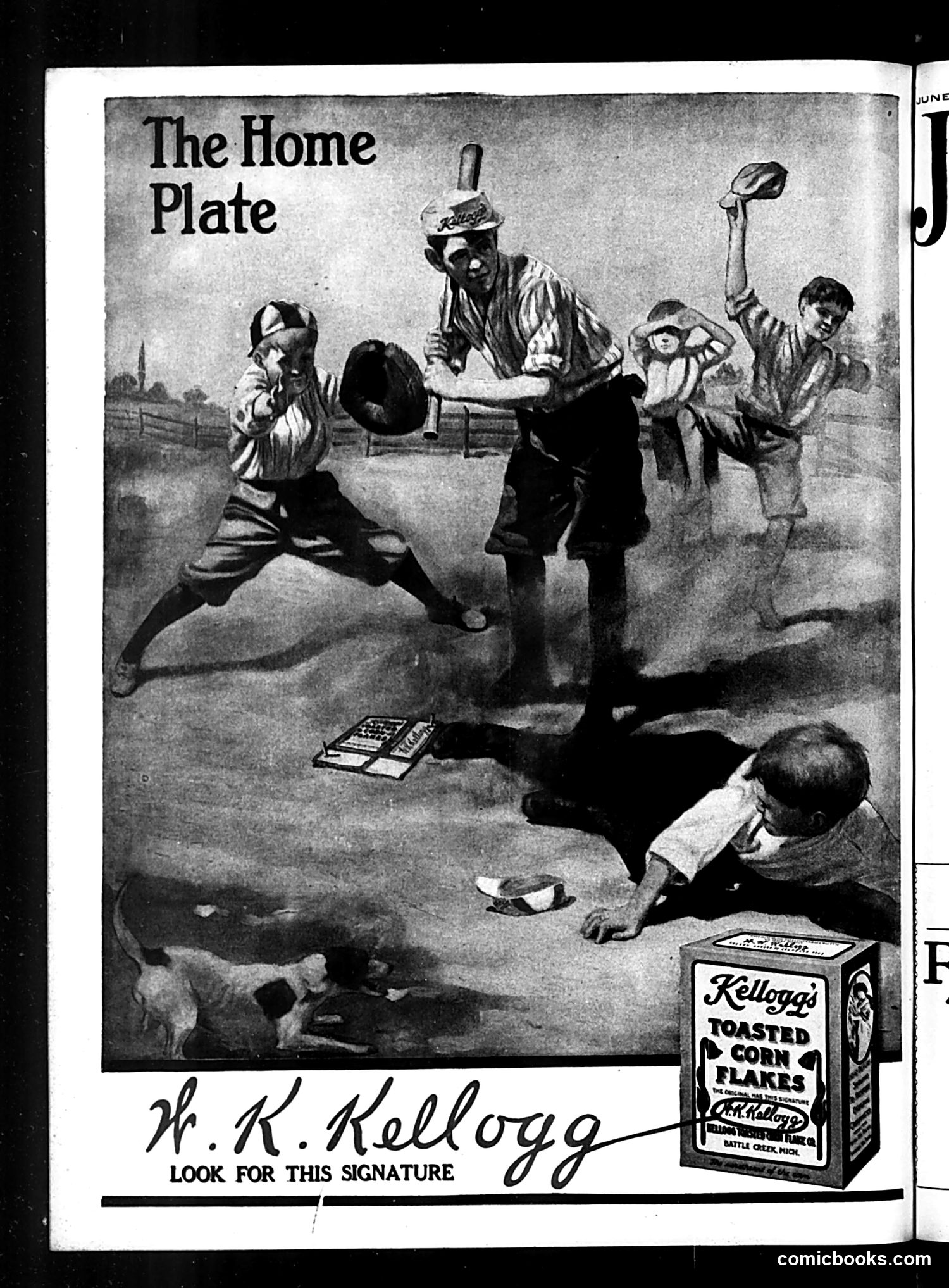
This is a Kellogg's Toasted Corn Flakes advertisement disguised as a humorous scene. The title "The Home Plate" puns on baseball terminology—a home plate is where batters stand, but here children are literally playing baseball using a home plate (dish) in a street or yard setting. The scene shows children engaged in casual street baseball, with one child batting, others in fielding positions, and a small child crawling on the ground. A dog watches nearby. The advertisement's joke conflates breakfast plates with baseball equipment, linking Kellogg's cereal to wholesome American childhood recreation. The W.K. Kellogg signature emphasizes brand authenticity. This represents early 20th-century advertising strategy: associating processed foods with idealized family life and outdoor play.