
Judge, 1912-06-15 · page 7 of 28
Judge — June 15, 1912 — page 7: what you’re looking at
What you’re looking at
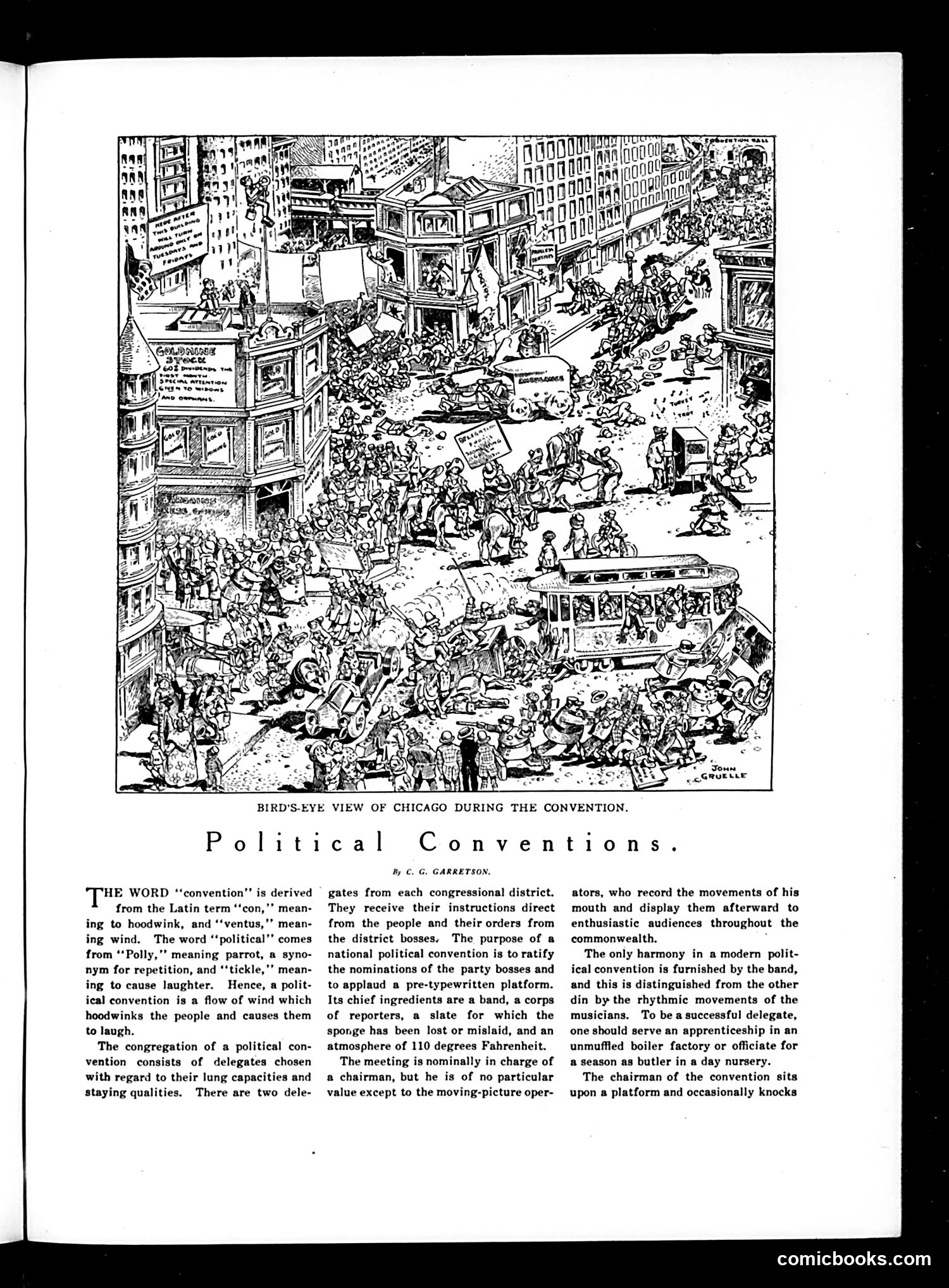
This 1890s satirical piece mocks American political party conventions through faux-etymology and cynical observation. The cartoon depicts a chaotic Chicago convention street scene crowded with delegates, bands, reporters, and crowds. The text's humor lies in fake Latin derivations: "convention" from "con" (hoodwink) and "ventus" (wind), and "political" from "Polly" (parrot—mindless repetition). The satire argues conventions are orchestrated spectacles where party bosses control outcomes before delegates arrive, with the chairman serving mainly as a prop for photographers. The piece ridicules the noise, heat (110 degrees), and performative nature of conventions, suggesting delegates need "boiler factory" experience to endure the pandemonium. The only authentic element mentioned is the band's music—everything else is predetermined theater designed to manipulate voters through spectacle and repetition.
📄 Transcribed text from this page (OCR, searchable)
Machine-transcribed from the original scan — historical spelling and the odd misread are preserved.
LUN ale 31) NEL SSG ( ( pou Oa BIRD'S-EYE VIEW OF CHICAGO DURING THE CONVENTION. Political HE WORD ‘‘convention’’ is derived from the Latin term ‘‘con,’’ mean- ing to hoodwink, and ‘‘ventus,’’ mean- ing wind. The word ‘‘political’”’ comes from ‘‘Polly,’’ meaning parrot, a syno- nym for repetition, and ‘‘tickle,”” mean- ing to cause laughter. Hence, a polit- ical convention is a flow of wind which hoodwinks the people and causes them to laugh. The congregation of a political con- vention consists of delegates chosen with regard to their lung capacities and staying qualities. There are two dele- By C. G. GARRETSON. gates from each congressional district. They receive their instructions direct from the people and their orders from the district bosses. The purpose of a national political convention is to ratify the nominations of the party bosses and to applaud a pre-typewritten platform. Its chief ingredients are a band, a corps of reporters, a slate for which the sponge has been lost or mislaid, and an atmosphere of 110 degrees Fahrenheit. The meeting is nominally in charge of a chairman, but he is of no particular value except to the moving-picture oper- Conventions. ators, who record the movements of his mouth and display them afterward to enthusiastic audiences throughout the commonwealth. The only harmony in a modern polit- ical convention is furnished by the band, and this is distinguished from the other din by the rhythmic movements of the musicians. To be a successful delegate, one should serve an apprenticeship in an unmuffled boiler factory or officiate for a season as butler in a day nursery. The chairman of the convention sits upon a platform and occasionally knocks comicbooks.com