
Judge, 1912-06-15 · page 9 of 28
Judge — June 15, 1912 — page 9: what you’re looking at
What you’re looking at
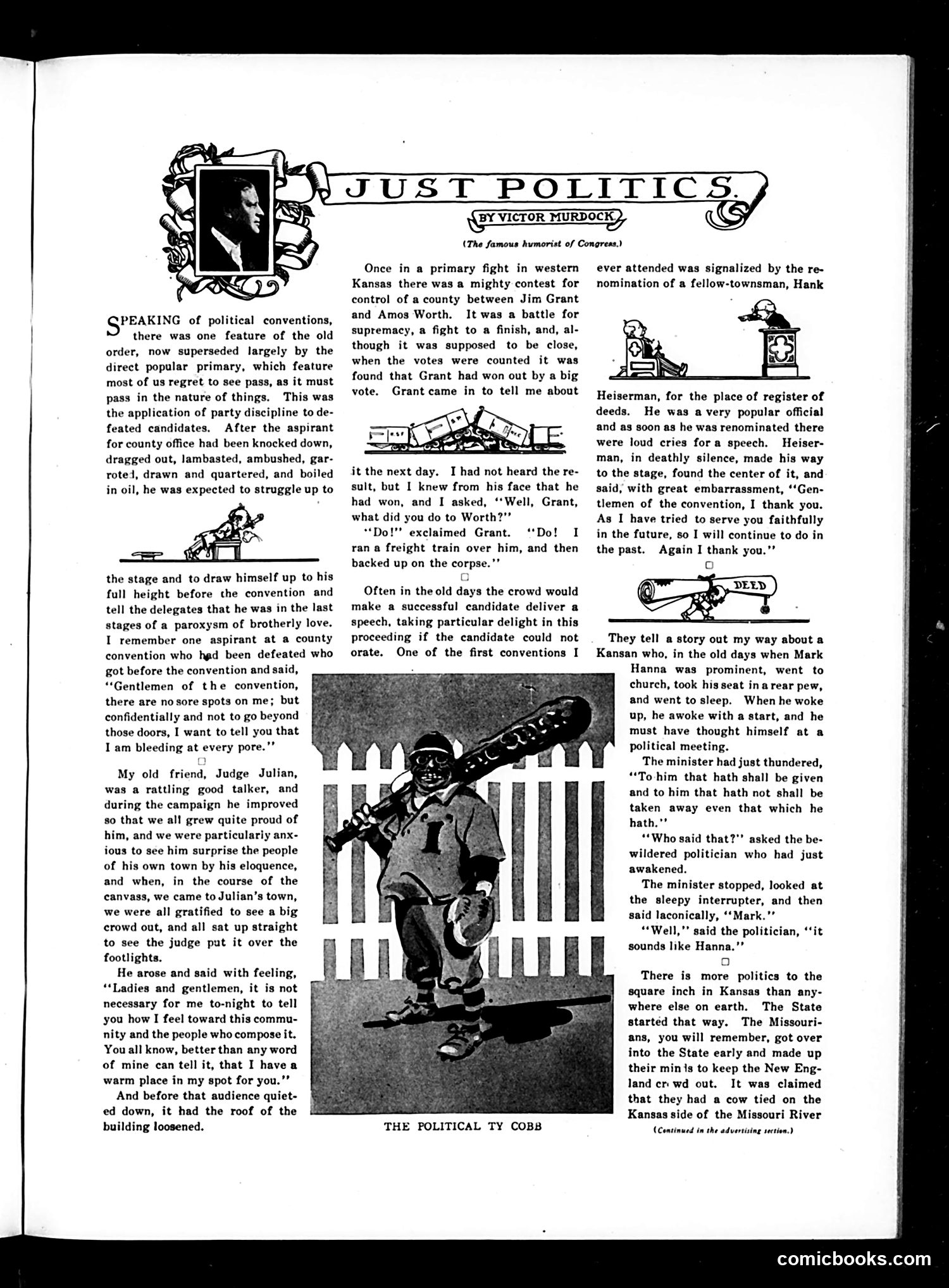
This article satirizes American political conventions and campaign rhetoric of the early 20th century. Murdock recounts anecdotes mocking the forced "gracious loser" speeches defeated candidates were expected to deliver at conventions—performing theatrical displays of party loyalty despite humiliating defeats. The humor centers on politicians' overwrought emotionality and empty oratory. Judge Julian's speech about having "a warm place in my spot for you" is intentionally malapropistic and ridiculous, yet the audience responds enthusiastically. Similarly, Heiserman's renomination speech is absurdly brief and formulaic. The cartoon "The Political Ty Cobb" (referencing baseball player Ty Cobb) depicts a politician as rough and brutish. The anecdotes mock both the artificiality of convention theatrics and politicians' general incompetence at public speaking—satirizing how crowds rewarded bad speeches simply because they expected emotional display over substance.
📄 Transcribed text from this page (OCR, searchable)
Machine-transcribed from the original scan — historical spelling and the odd misread are preserved.
PEAKING of political conventions, there was one feature of the old order, now superseded largely by the direct popular primary, which feature most of us regret to see pass, as it must pass in the nature of things. This was the application of party discipline to de- feated candidates. After the aspirant for county office had been knocked down, dragged out, lambasted, ambushed, gar- roted, drawn and quartered, and boiled in oil, he was expected to struggle up to the stage and to draw himself up to his full height before the convention and tell the delegates that he was in the last stages of a paroxysm of brotherly love. I remember one aspirant at a county convention who had been defeated who got before the convention and said, “Gentlemen of the convention, there are no sore spots on me; but confidentially and not to go beyond those doors, I want to tell you that I am bleeding at every pore.”’ My old friend, Judge Julian, was a rattling good talker, and during the campaign he improved so that we all grew quite proud of him, and we were particulariy anx- ious to see him surprise the people of his own town by his eloquence, and when, in the course of the canvass, we came to Julian’s town, we were all gratified to see a big crowd out, and all sat up straight to see the judge put it over the footlights. He arose and said with feeling, “Ladies and gentlemen, it is not necessary for me to-night to tell you how I feel toward this commu- nity and the people who compose it. You all know, better than any word of mine can tell it, that I havea warm place in my spot for you.”” And before that audience quiet- ed down, it had the roof of the building loosened. OCK, NEY VICTOR MURD: (The famous humorist of Congress.) Once in a primary fight in western Kansas there was a mighty contest for control of a county between Jim Grant and Amos Worth. It was a battle for supremacy, a fight to a finish, and, al- though it was supposed to be close, when the votes were counted it was found that Grant had won out by a big vote. Grant came in to tell me about it the next day. I had not heard the re- sult, but I knew from his face that he had won, and I asked, ‘Well, Grant, what did you do to Worth?” “*Do!’’ exclaimed Grant. ‘Do! I ran a freight train over him, and then backed up on the corpse.’” a Often in the old days the crowd would make a successful candidate deliver a speech, taking particular delight in this proceeding if the candidate could not orate. One of the first conventions I THE POLITICAL TY COBB ever attended was signalized by the re- nomination of a fellow-townsman, Hank Heiserman, for the place of register of deeds. He was a very popular official and as soon as he was renominated there were loud cries fora speech. Heiser- man, in deathly silence, made his way to the stage, found the center of it, and said, with great embarrassment, ‘‘Gen- tlemen of the convention, I thank you. As I have tried to serve you faithfully in the future, so I will continue to do in the past. Again I thank you.’’ They tell a story out my way about a Kansan who, in the old days when Mark Hanna was prominent, went to church, took his seat in arear pew, and went to sleep. When he woke up, he awoke with a start, and he must have thought himself at a political meeting. The minister had just thundered, “To-him that hath shall be given and to him that hath not shall be taken away even that which he hath."” “Who said that?"’ asked the be- wildered politician who had just awakened. The minister stopped, looked at the sleepy interrupter, and then said laconically, ‘‘Mark.’’ “‘Well,’’ said the politician, ‘‘it sounds like Hanna.’’ o There is more politics to the square inch in Kansas than any- where else on earth. The State started that way. The Missouri- ans, you will remember, got over into the State early and made up their minis to keep the New Eng- land cr. wd out. It was claimed that they had a cow tied on the Kansas side of the Missouri River (Continued in the advertising section.) comicbooks.com