
Judge, 1912-06-15 · page 10 of 28
Judge — June 15, 1912 — page 10: what you’re looking at
What you’re looking at
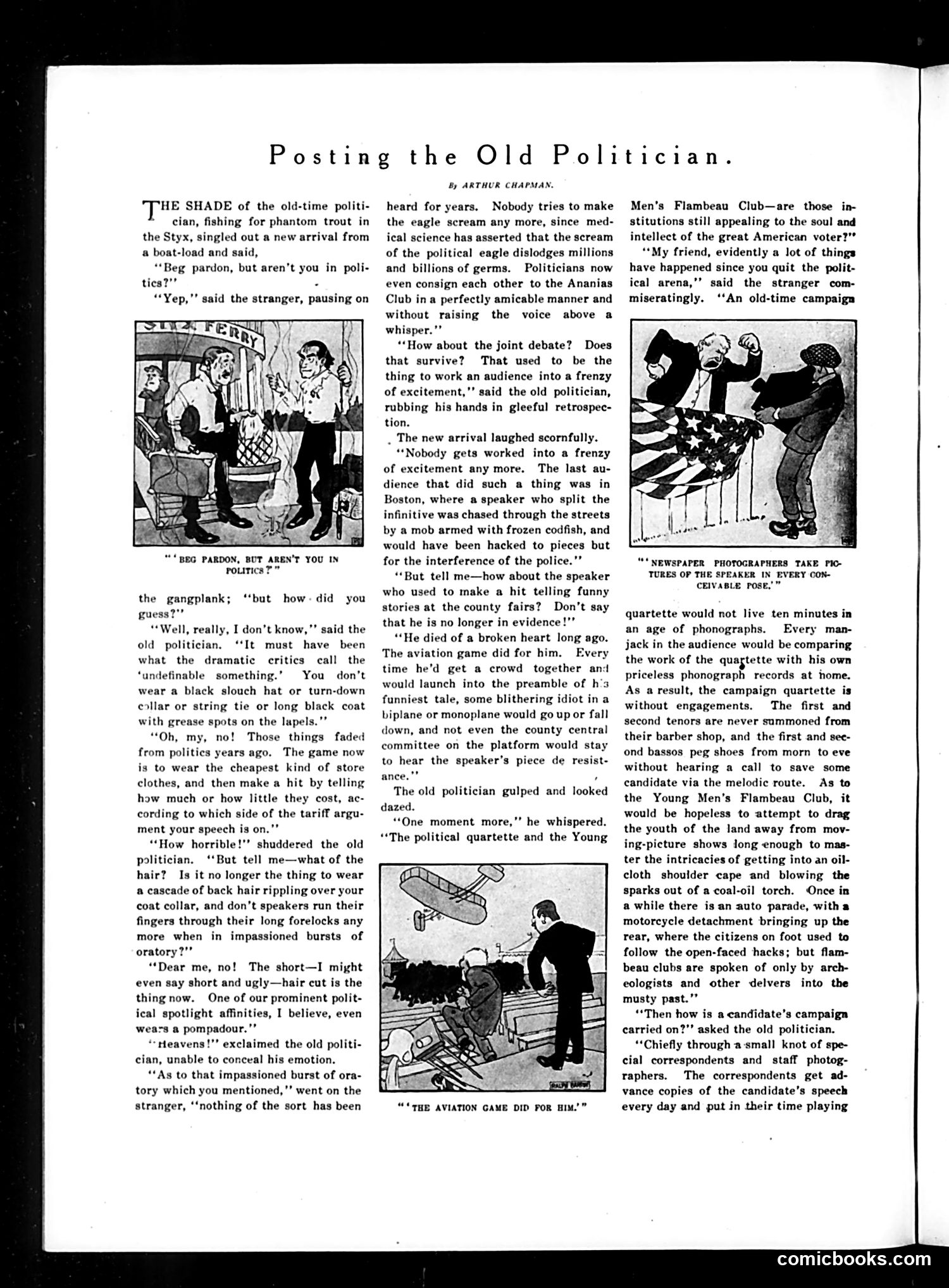
This satirical piece by Arthur Chapman contrasts old-style 19th-century political campaigning with modern (early 20th-century) methods. A deceased old politician meets a newcomer in the afterlife and interrogates him about how campaigning has changed. The satire mocks the obsolescence of traditional tactics: flamboyant dress, dramatic hair styling, passionate oratory designed to make audiences emotional, county fair storytelling, and political quartettes. The newcomer reveals these have been replaced by cheap store-bought clothes, short haircuts, soft-spoken delivery (blamed on germ theory), and newspaper photography documentation. Key jokes: politicians no longer try to excite crowds; the "Ananias Club" (liars' club) is now amicable; aviation stunts distract audiences; phonographs make singing quartettes pointless. The underlying critique: modern politics has become bland, calculated, and media-driven rather than genuinely passionate—suggesting both nostalgia for old politics and cynicism about new marketing-focused campaigns.
📄 Transcribed text from this page (OCR, searchable)
Machine-transcribed from the original scan — historical spelling and the odd misread are preserved.
Posting the Old Politician. HE SHADE of the old-time politi- " cian, fishing for phantom trout in the Styx, singled out a new arrival from a boat-load and said, “Beg pardon, but aren't you in poli- tics?” - “Yep,’’ said the stranger, pausing on “BEG PARDON, BUT AREN'T YOU IN Pouitics 7” the gangplank; ‘‘but how. did guess “Well, really, I don’t know,"’ said the “It must have been what the dramatic critics call the ‘undefinable something." You don’t wear a black slouch hat or turn-down collar or string tie or long black coat with grease spots on the lapels."’ “Oh, my, no! Those things faded from polities years ago. The game now is to wear the cheapest kind of store clothes, and then make a hit by telling how much or how little they cost, ac- cording to which side of the tariff argu- ment your speech is on."” “How horrible!’’ shuddered the old politician. ‘‘But tell me—what of the hair? Is it no longer the thing to wear a cascade of back hair rippling over your coat collar, and don’t speakers run their fingers through their long forelocks any more when in impassioned bursts of you old politician, oratory?"” “Dear me, no! The short—I might even say short and ugly—hair cut is the thing now. One of our prominent polit- ical spotlight affinities, I believe, even wears a pompadour."” “tleavens!’’ exclaimed the old politi- cian, unable to conceal his emotion. “As to that impassioned burst of ora- tory which you mentioned,"’ went on the stranger, ‘‘nothing of the sort has been By ARTHUR CHAPMAN, heard for years. Nobody tries to make the eagle scream any more, since med- ical science has asserted that the scream of the political eagle dislodges millions and billions of germs. Politicians now even consign each other to the Ananias Club in a perfectly amicable manner and without raising the voice above a whisper.” **How about the joint debate? Does that survive? That used to be the thing to work an audience into a frenzy of excitement,” said the old politician, rubbing his hands in gleeful retrospec- tion. . The new arrival laughed scornfully. “‘Nobody gets worked into a frenzy of excitement any more. The last au- dience that did such a thing was in Boston, where a speaker who split the infinitive was chased through the streets by a mob armed with frozen codfish, and would have been hacked to pieces but for the interference of the police.’’ “But tell me—how about the speaker who used to make a hit telling funny stories at the county fairs? Don’t say that he is no longer in evidence !"" “He died of a broken heart long ago. The aviation game did for him. Every time he'd get a crowd together an: would launch into the preamble of h’s funniest tale, some blithering idiot ina biplane or monoplane would go up or fall down, and not even the county central committee on the platform would stay to hear the speaker’s piece de resist- ance."” ' The old politician gulped and looked dazed. “One moment more,” he whispered. “The political quartette and the Young “THE AVIATION GAME DID FOR HIM.’” Men’s Flambeau Club—are those in- stitutions still appealing to the soul and intellect of the great American voter?” “*My friend, evidently a lot of things have happened since you quit the polit- ical arena,’’ said the stranger com- miseratingly. ‘‘An old-time campaign EWSPAPER PHOTOGRAPHERS TAKE PIC- TURES OP THE SPEAKER IN EVERY CON- CEIVABLE PosE,’” quartette would not live ten minutes in an age of phonographs. Every man- jack in the audience would be comparing the work of the quagtette with his own priceless phonograph records at home. As a result, the campaign quartette is without engagements. The first and second tenors are never sammoned from their barber shop, and the first and see- ond bassos peg shoes from morn to eve without hearing a call to save some candidate via the melodic route. As to the Young Men’s Flambeau Club, it would be hopeless to attempt to drag the youth of the land away from mov- ing-picture shows long enough to mas- ter the intricacies of getting into an oil- cloth shoulder cape and blowing the sparks out of acoal-oil torch. Once in a while there is an auto parade, witha motorcycle detachment bringing up the rear, where the citizens on foot used to follow the open-faced hacks; but flam- beau clubs are spoken of only by arch- eologists and other delvers into the musty past.”” “Then how is a candidate’s campaign carried on?” asked the old politician. “Chiefly through a-small knot of spe- cial correspondents and staff photog- raphers. The correspondents get ad- vance copies of the candidate’s speech every day and put in their time playing comicbooks.com