
Judge, 1912-06-15 · page 6 of 28
Judge — June 15, 1912 — page 6: what you’re looking at
What you’re looking at
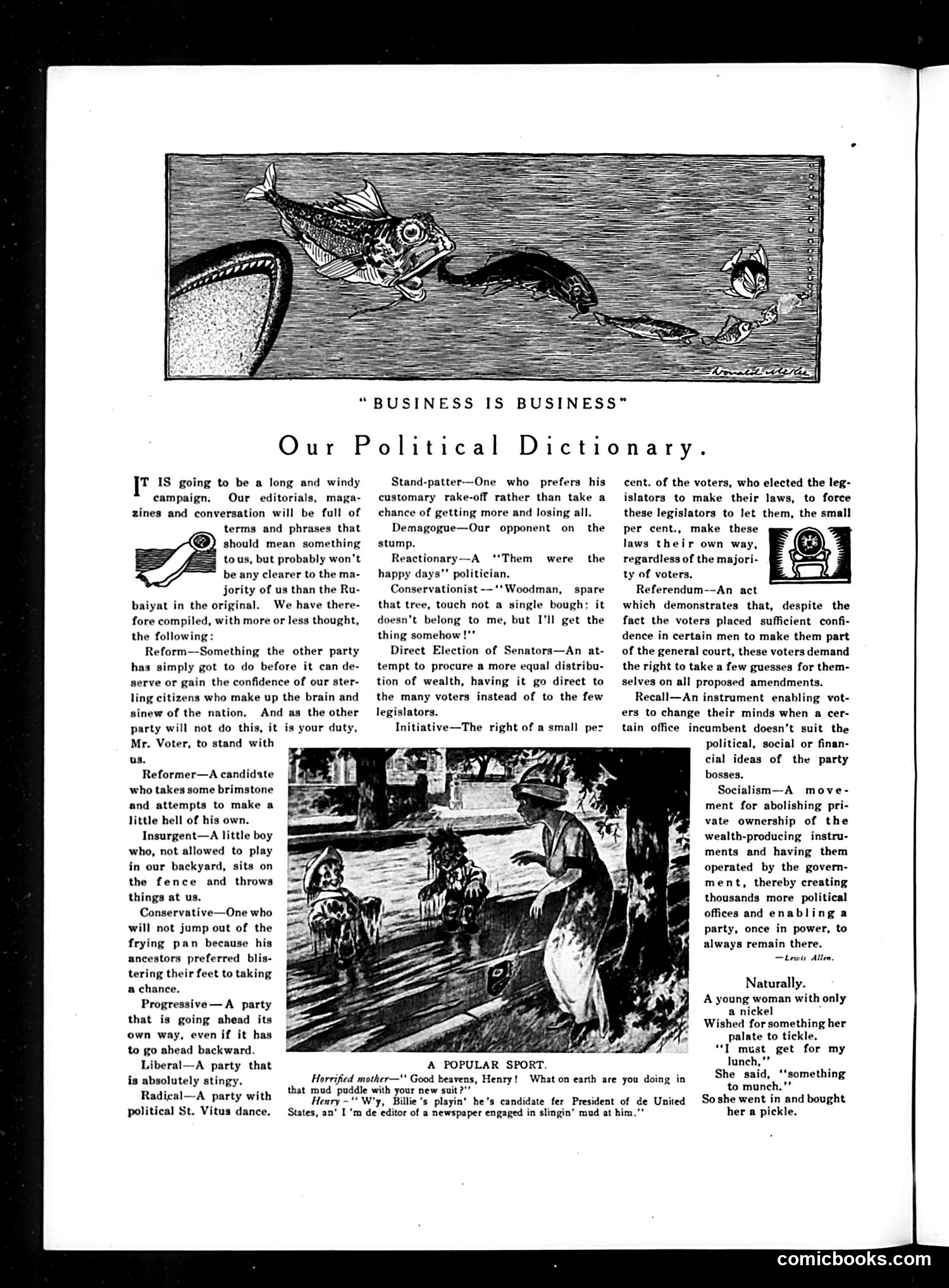
This page satirizes the terminology of early 20th-century American politics through mock definitions. The accompanying cartoon shows children playing "candidate for President" by slinging mud—literalizing the magazine's critique of campaign rhetoric. The definitions mock both major parties: "Reformers" are brimstone-wielding zealots; "Progressives" move backward; "Liberals" are stingy; "Radicals" have uncontrollable twitching. The satire targets specific proposals—Direct Election of Senators, Referendum, and Recall—as mechanisms enabling mob rule or perpetual party power. "Socialism" receives particular scorn as merely creating "thousands more political offices" to entrench power. Throughout, Judge presents politics as cynical self-interest disguised as principle. The humor relies on readers recognizing contemporary campaign slogans and reform movements while sharing the magazine's skepticism toward democratic expansion and progressive politics.
📄 Transcribed text from this page (OCR, searchable)
Machine-transcribed from the original scan — historical spelling and the odd misread are preserved.
—— a \ ——_ “BUSINESS IS BUSINESS” Our Political Dictionary. T IS going to be a long and windy campaign. Our editorials, maga- zines and conversation will be full of terms and phrases that should mean something tous, but probably won't be any clearer to the ma- jority of us than the Ru- baiyat in the original. We have there- fore compiled, with more or less thought, the following: Reform—Something the other party has simply got to do before it can de- serve or gain the confidence of our ster- ling citizens who make up the brain and sinew of the nation. And as the other party will not do this, it is your duty, Mr. Voter, to stand with us. Reformer—A candidate who takes some brimstone and attempts to make a little hell of his own. Insurgent—A little boy who, not allowed to play in our backyard, sits on the fence and throws things at us. Conservative—One who will not jump out of the frying pan because his ancestors preferred blis- tering their feet to taking a chance, Progressive—A party that is going ahead its own way, even if it has to go ahead backward. Liberal—A party that is absolutely stingy. Radical—A party with political St. Vitus dance. Horrified mother—‘‘ Good heavens, Henry! that mud puddle with your new suit ?"’ Henry -'* W'y, Billie's playin’ he's candidate fer President of de United States, an’ I'm de editor of a newspaper engaged in slingin’ mud at him."* Stand-patter—One who prefers his customary rake-off rather than take a chance of getting more and losing all. Demagogue—Our opponent on the stump. Reactionary—A happy days’’ politician. Conservationist ——‘*Woodman, spare that tree, touch not a single bough: it doesn’t belong to me, but I'll get the thing somehow !"" Direct Election of Senators—An at- tempt to procure a more equal distribu- tion of wealth, having it go direct to the many voters instead of to the few ators. ative—The right of a small pe> “Them were the A POPULAR SPORT. cent. of the voters, who elected the leg- islators to make their laws, to force these legislators to let them, the small per cent., make these laws their own way, regardless of the majori- ty of voters. Referendum—An act which demonstrates that, despite the fact the voters placed sufficient confi- dence in certain men to make them part. of the general court, these voters demand the right to take a few guesses for them- selves on all proposed amendments. Recall—An instrument enabling vot- ers to change their minds when a cer- tain office incumbent doesn’t suit the political, social or finan- cial ideas of the party bosses. Socialism—A move- ment for abolishing pri- vate ownership of the wealth-producing instru- ments and having them operated by the govern- ment, thereby creating thousands more political offices and enabling a party, once in power, to always remain there. Lewis Allen. Naturally. A young woman with only a nickel Wished for something her palate to tickle. “IT must get for my What on earth are you doing in So she went in and bought her a pickle. comicbooks.com