
A complete issue · 24 pages · 1912
Judge — April 13, 1912
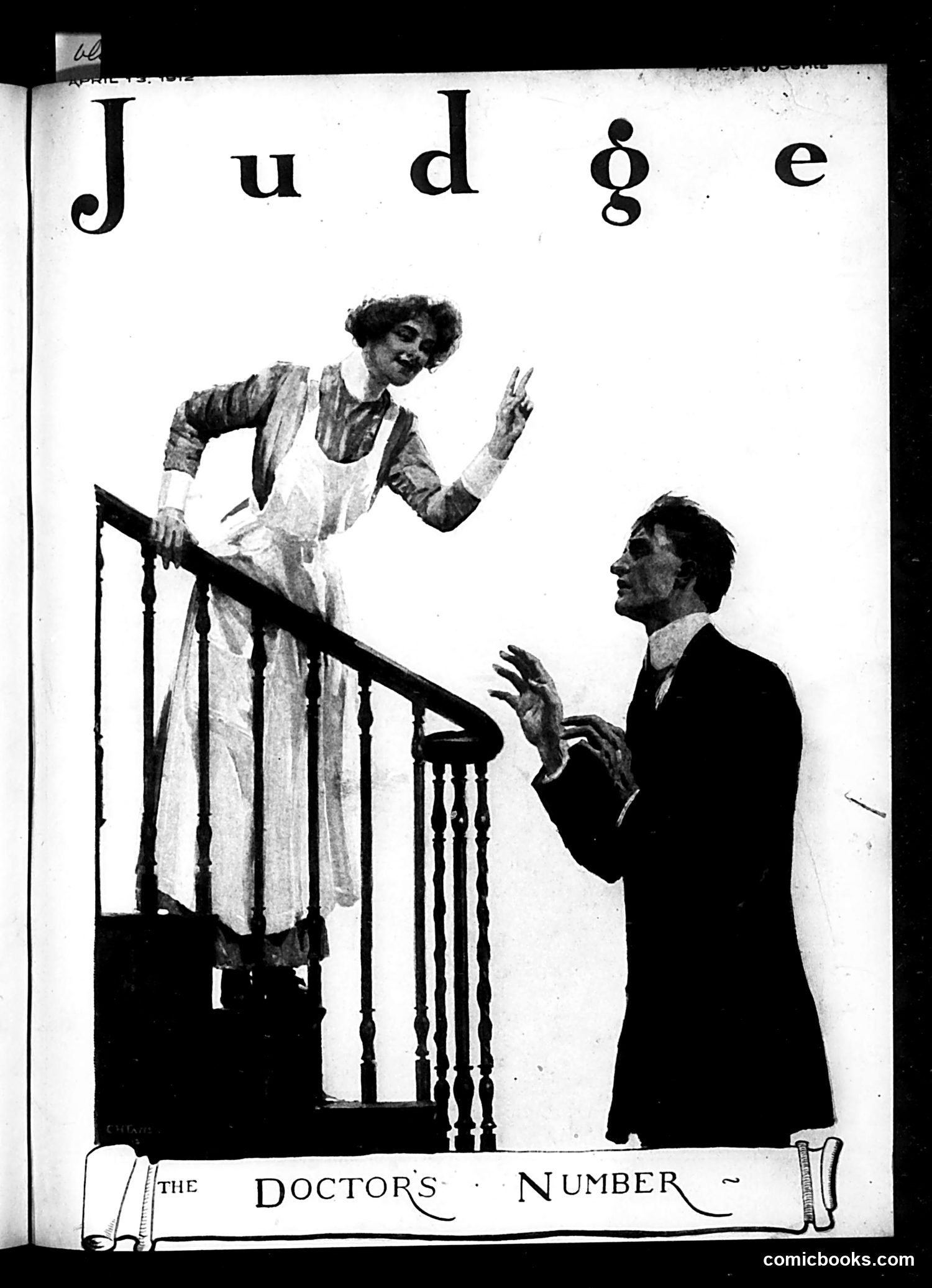
This appears to be a scene from a theatrical production or comedy sketch rather than a political cartoon. The title "The Doctor's Number" suggests a staged performance, likely from the early 20th century based on the styling and photography technique. The image shows a woman on a staircase in domestic clothing addressing a man in a dark suit below. Without additional context from the full text or surrounding pages, the specific satirical meaning is unclear. It may reference a popular play or comedy routine of the era, possibly involving medical themes given the "Doctor" reference in the title. The sketch likely relied on visual comedy and character interaction familiar to Judge's contemporary readers but now requires additional historical context to fully interpret.
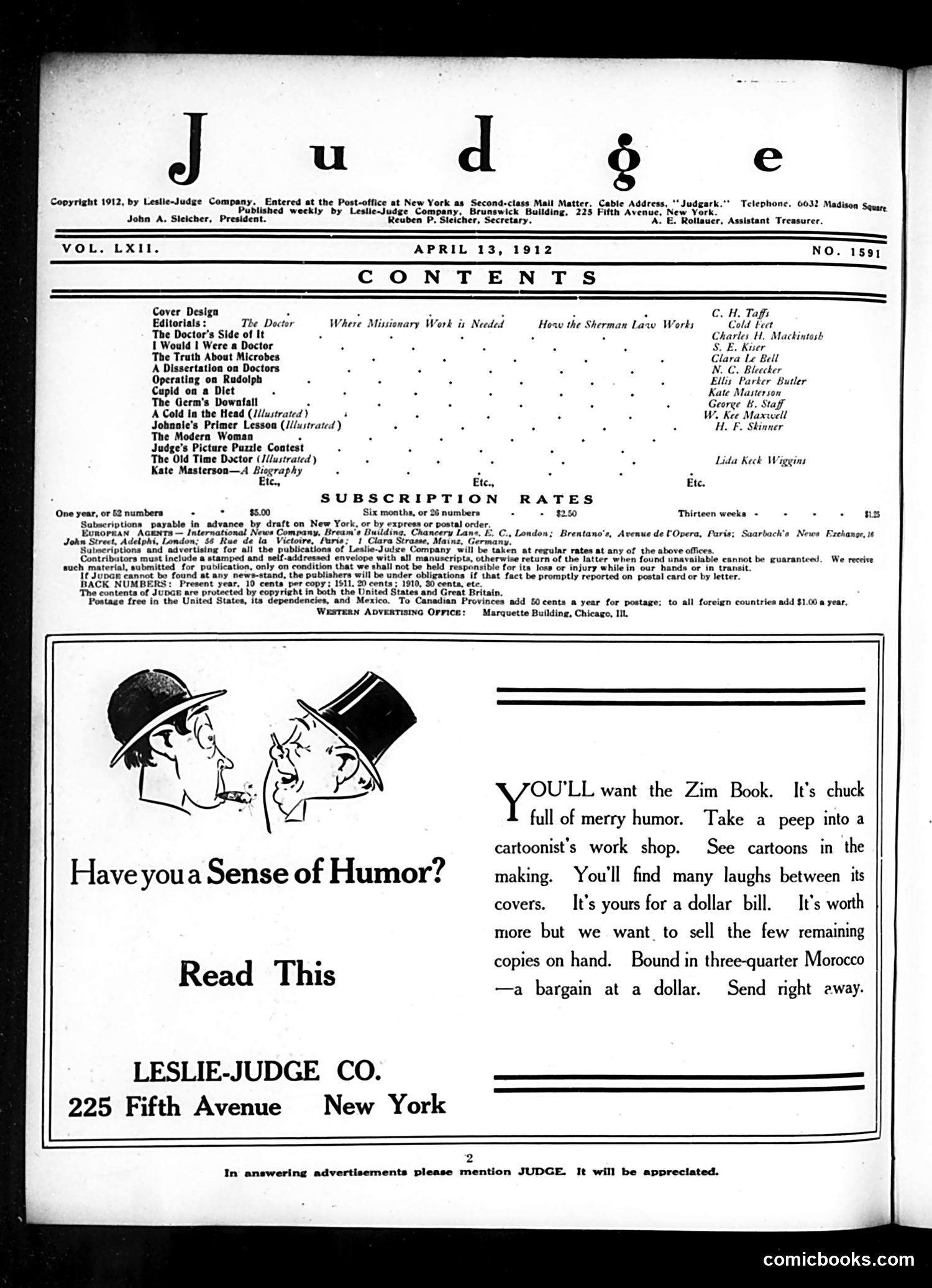
This page is primarily **advertising** for the Leslie-Judge Company's "Zim Book," a collection of cartoons. The main advertisement features two caricatured male heads in profile wearing different hats (bowler and top hat), with the question "Have you a Sense of Humor?" The ad copy promotes the Zim Book as humor-filled, describing it as showing "cartoonists' work shop" scenes and cartoons "in the making." Priced at one dollar, it's bound in three-quarter Morocco leather. The contents listing indicates Judge's typical satirical offerings: articles about doctors, politics, and social commentary. Without specific article context visible, the broader satirical intent remains unclear, though Judge generally mocked contemporary social figures and political events of 1912.
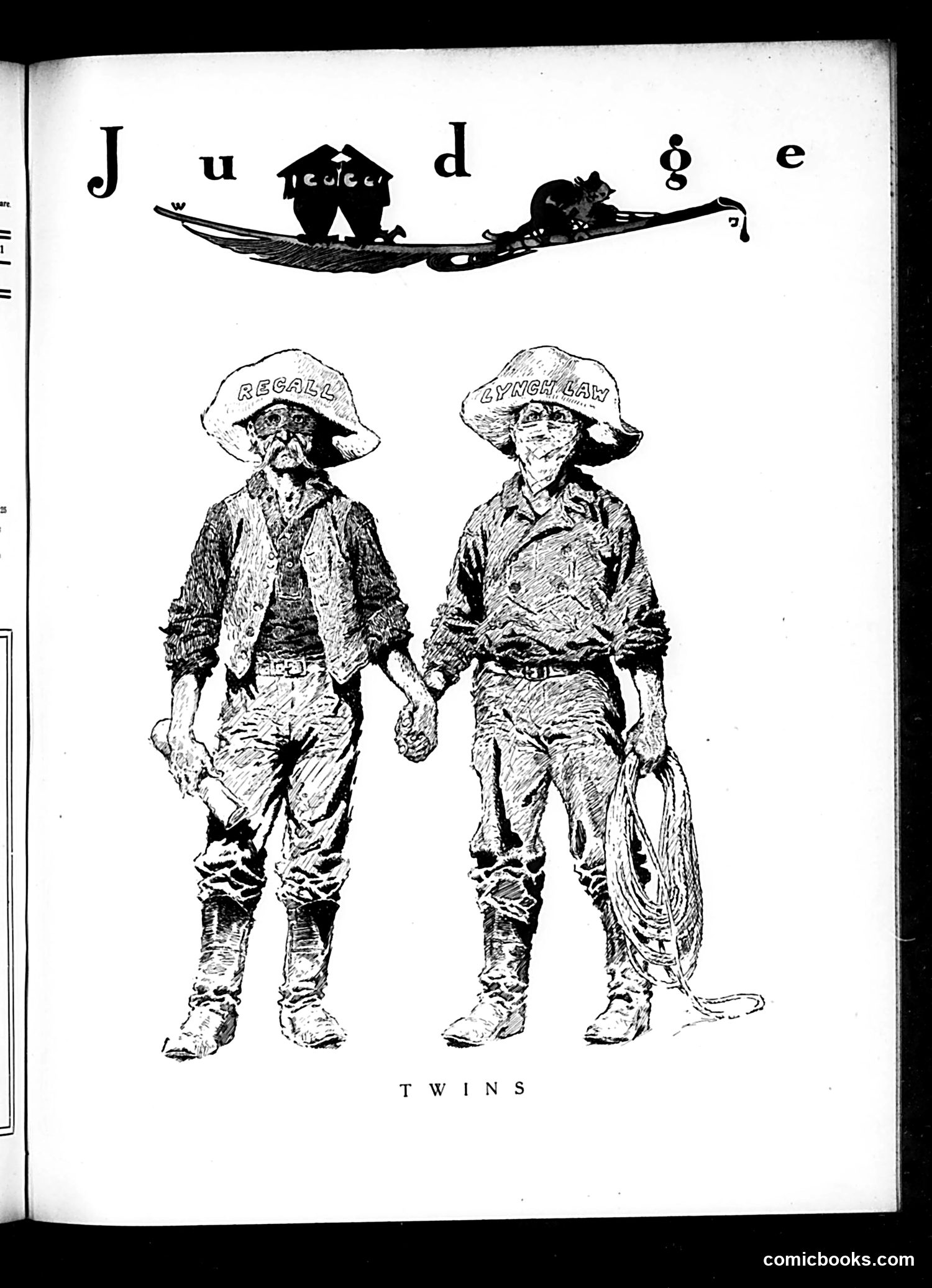
This page titled "TWINS" depicts two cowboy figures wearing wide-brimmed hats labeled "RECALL" and "LYNCH LAW." The cartoon appears to satirize two forms of justice operating outside formal legal systems—judicial recall (removing judges through popular vote) and lynch law (mob violence/extrajudicial punishment). By presenting them as identical twins, the cartoonist suggests these are morally equivalent threats to the rule of law, both representing popular passion overriding institutional justice. The decorative header shows what appears to be a frontier scene, reinforcing the "lawless frontier" metaphor. This likely reflects early-20th-century anxieties about the recall movement (popular in Progressive Era politics) being equated with mob justice—a controversial comparison suggesting democratic reforms threatened legal stability.
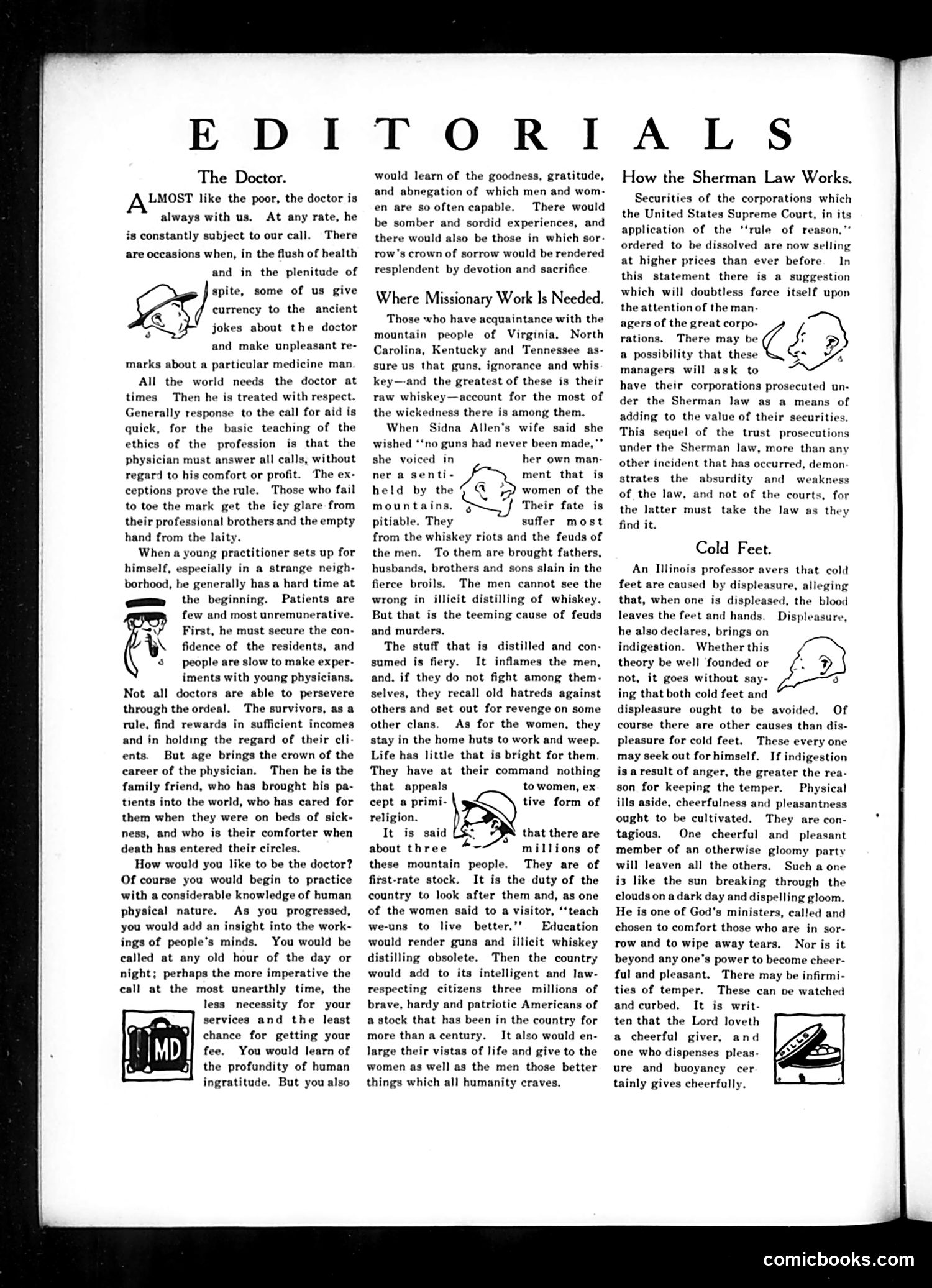
This page contains three separate editorials rather than political cartoons. "The Doctor" praises physicians for their service and dedication, noting they work without regard for comfort or profit. "Where Missionary Work Is Needed" argues for education to combat whiskey distilling and related violence in Appalachian regions (Virginia, North Carolina, Kentucky, Tennessee), attributing feuds and murders to illicit alcohol production. "Cold Feet" discusses an Illinois professor's claim that cold causes blood to leave extremities, leading to indigestion—offering advice on maintaining cheerfulness and temperament to counter such effects. The small illustrated heads accompanying each editorial appear decorative rather than caricatures of specific individuals. No clear political figures or events are referenced; these are general social commentary pieces typical of Judge's editorial voice.
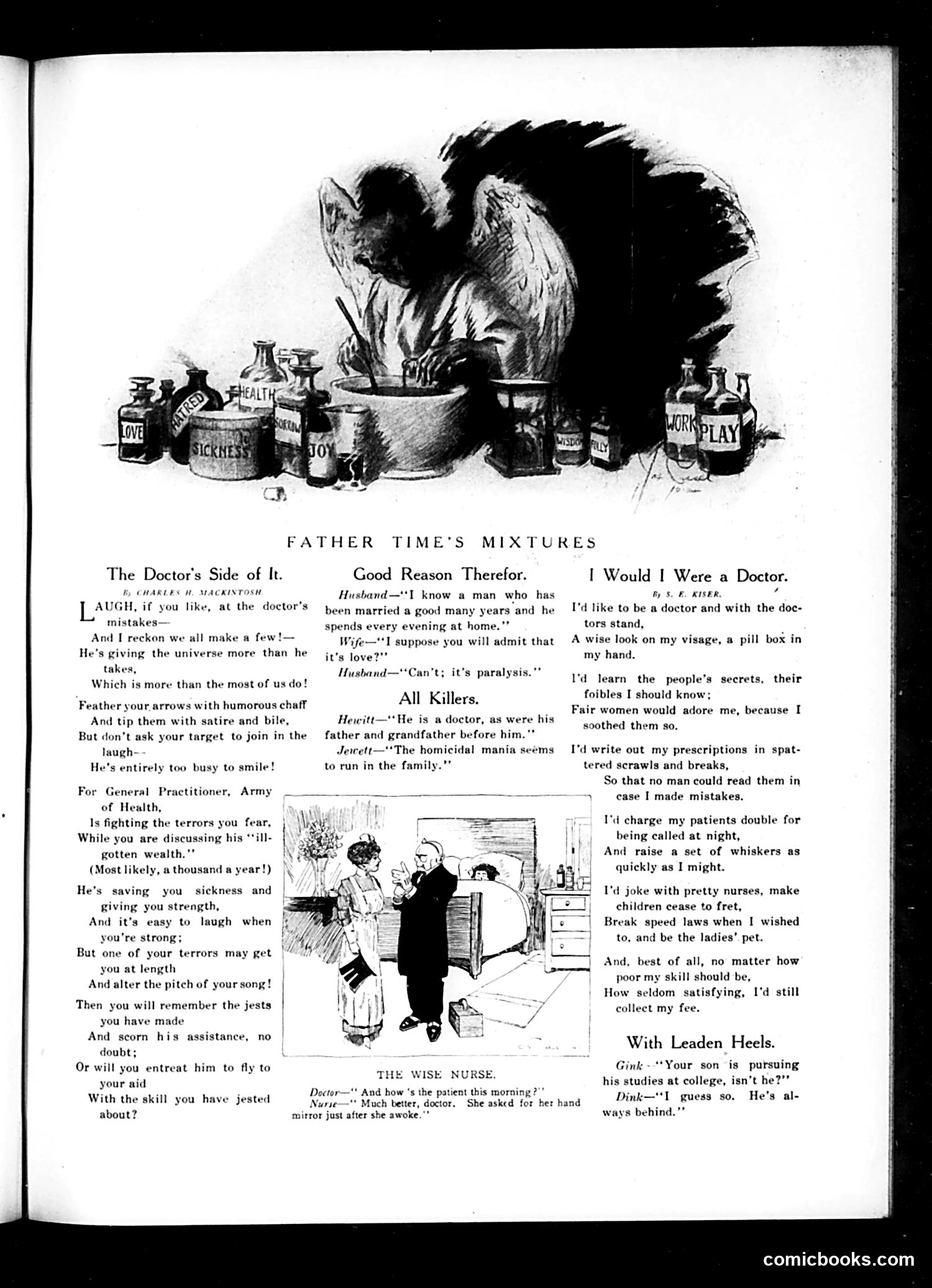
This page satirizes the medical profession through poems mocking doctors' incompetence and greed. "The Doctor's Side of It" ridicules physicians for causing harm while remaining too busy to care about consequences. "All Killers" sarcastically notes hereditary medical incompetence—suggesting doctors pass down fatal mistakes generationally. The central cartoon "The Wise Nurse" shows a doctor and nurse attending a patient, illustrating the contrast between medical professionals' supposed expertise and actual results. "I Would I Were a Doctor" explicitly mocks doctors' financial success despite poor outcomes, mentioning illegible prescriptions and patient overcharging. The illustration of bottles labeled "HEALTH," "SICKNESS," "JOY," and "WORK" visualizes how doctors supposedly treat all conditions identically. The satire targets early 20th-century medical practice's limited effectiveness and physicians' mercenary attitudes.
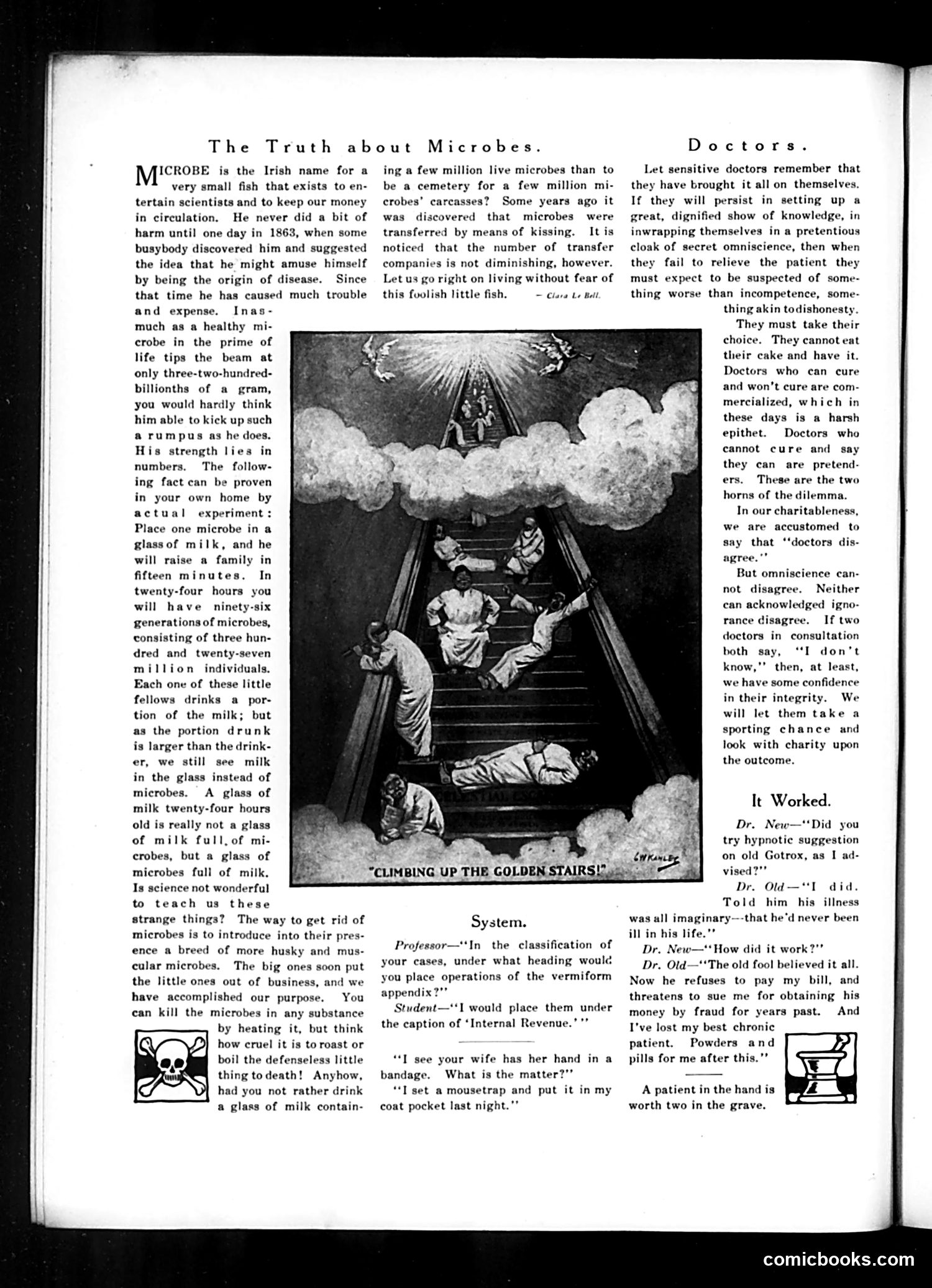
This page contains three distinct satirical pieces mocking contemporary medical and scientific pretensions: **"The Truth about Microbes"** ridicules germ theory skepticism. Written in mock-serious tone, it sarcastically dismisses microbes as harmless until 1863, when scientists "discovered" them for attention and profit. The satire suggests public distrust of the new germ theory—framing microbes as an invented threat used to justify scientific authority and medical expenses. **"Doctors"** attacks physicians' arrogance. Judge argues doctors create false dilemmas: either they're commercialized frauds or pretentious charlatans hiding ignorance behind mystique. The satire demands humility—honest admission of "I don't know" would restore public confidence. **The humor pieces** ("System" and "It Worked") mock medical education and hypnotic suggestion treatments. The "Internal Revenue" joke suggests surgeons profit from appendix operations; the mousetrap anecdote ridicules faith in hypnotic cure-alls. Overall, the page expresses widespread late-19th-century skepticism toward medical professionalism, emerging germ theory, and dubious treatments like hypnotic suggestion—reflecting public anxiety about doctors' expanding authority and questionable claims.
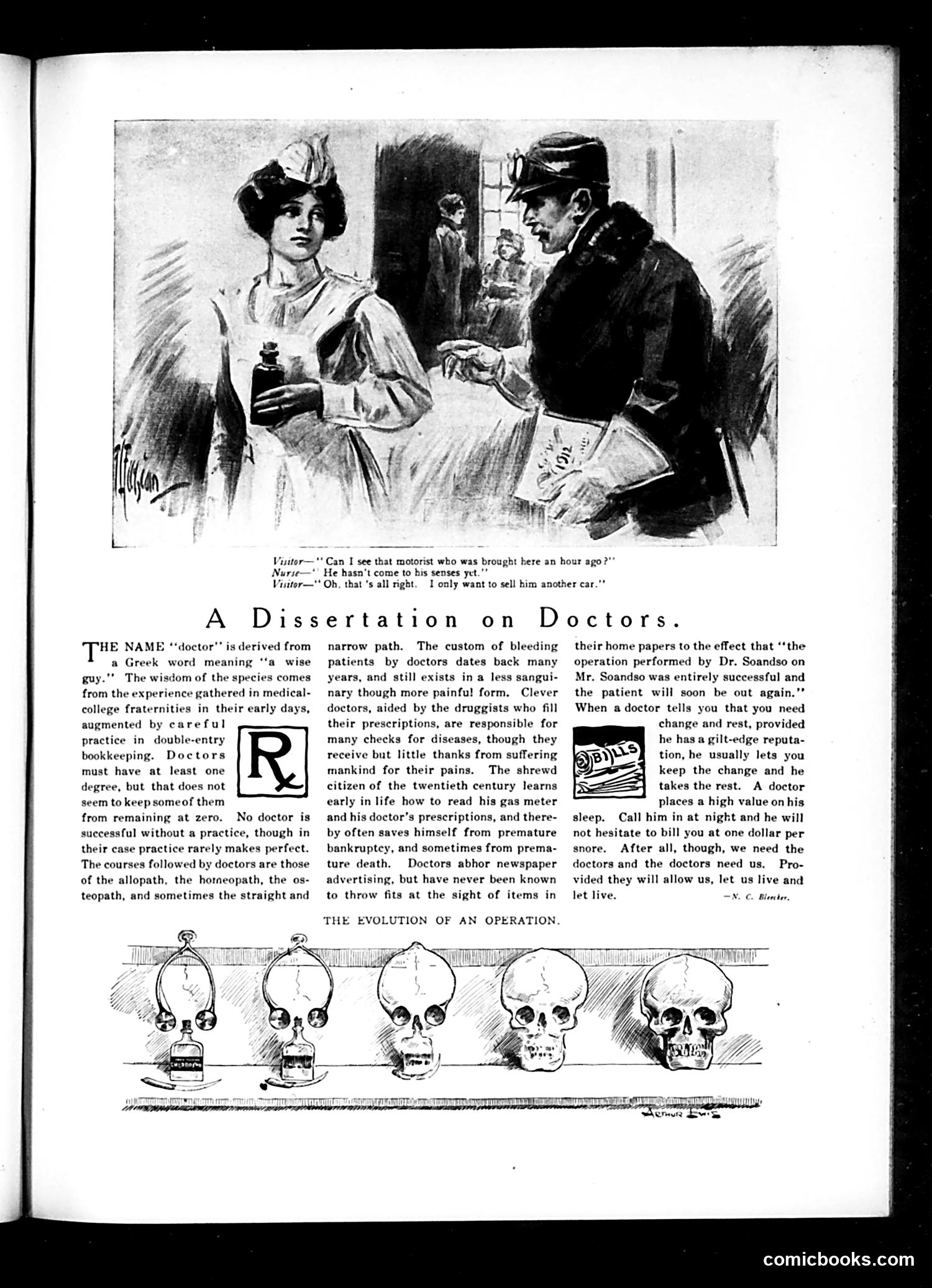
This is a satirical essay attacking doctors' practices and ethics in early 20th-century America. The top cartoon shows a motorist injured in a car accident; the joke is that a doctor visitor wants to sell him another car rather than treat him—implying doctors prioritize profit over patient care. The essay mocks doctors for: charging exorbitant fees ("one dollar per snore"), using outdated bloodletting practices, relying on druggists to sell unnecessary treatments, and exploiting patients' trust. It ridicules their pretensions to expertise while noting many lack genuine competence. The author sardonically observes that shrewd citizens learn to decode both gas meters and doctor's prescriptions to avoid financial ruin. The bottom diagram—"Evolution of an Operation"—appears to show progressively more invasive skull procedures, likely satirizing unnecessary surgical interventions. The overall tone suggests public frustration with medical profession overcharging and questionable practices during this era.
This humorous story satirizes hypochondria and marital dynamics in early 20th-century America. Mr. Rudolph Wirtz, a German-immigrant character (indicated by his accent and speech patterns), calls his doctor for a severe back problem. Dr. Flinders initially suspects serious conditions—spinal trouble, meningitis, paralysis—but the mystery deepens when Rudolph cannot lift his head or leave bed. The joke's payoff (visible in text but climaxing beyond this page) appears to be that Rudolph's dramatic incapacity stems from his wife's vigorous application of liniment—she literally rubbed so hard she caused his predicament. The satire mocks both Wirtz's exaggerated suffering and the era's tendency toward medical alarmism. The German-immigrant characterization was common in Judge's humor, often portraying working-class foreigners as amusingly dramatic or obstinate.
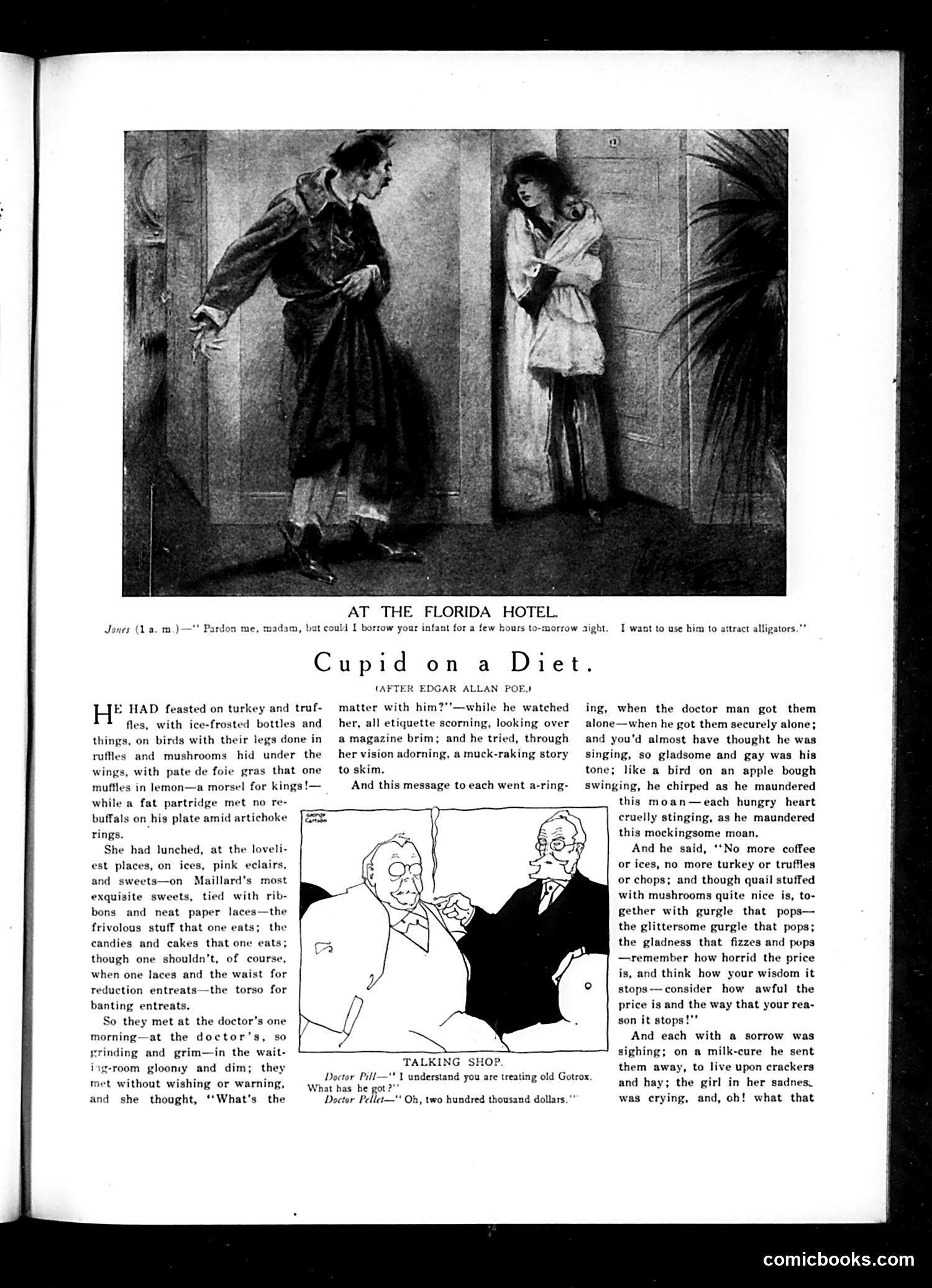
This page contains two separate satirical pieces about dietary restriction and medical practice in the early 20th century. **Main Story ("Cupid on a Diet"):** A parody of Edgar Allan Poe's style mocking romantic lovers forced onto strict diets by their doctor. The couple had enjoyed luxurious foods (turkey, truffles, foie gras, champagne), but the doctor prescribes a severe restriction to crackers and hay—leaving them miserable. The satire targets both the fad dieting culture of the era and the doctor's stern authority. **Bottom Cartoon ("Talking Shop"):** Two doctors discuss a wealthy patient ("Gotrox"). When asked what ailment he has, one replies: "Two hundred thousand dollars"—implying the patient's real "disease" is wealth, and doctors treat wealthy patients differently (more profitably). This mocks physicians for prioritizing rich patients. **Top Photograph:** An unrelated comedic scene showing a woman being asked to lend her infant to attract alligators at a Florida hotel—absurdist humor typical of Judge's tone. The overall theme: critiques of medical professionals and contemporary consumer culture.
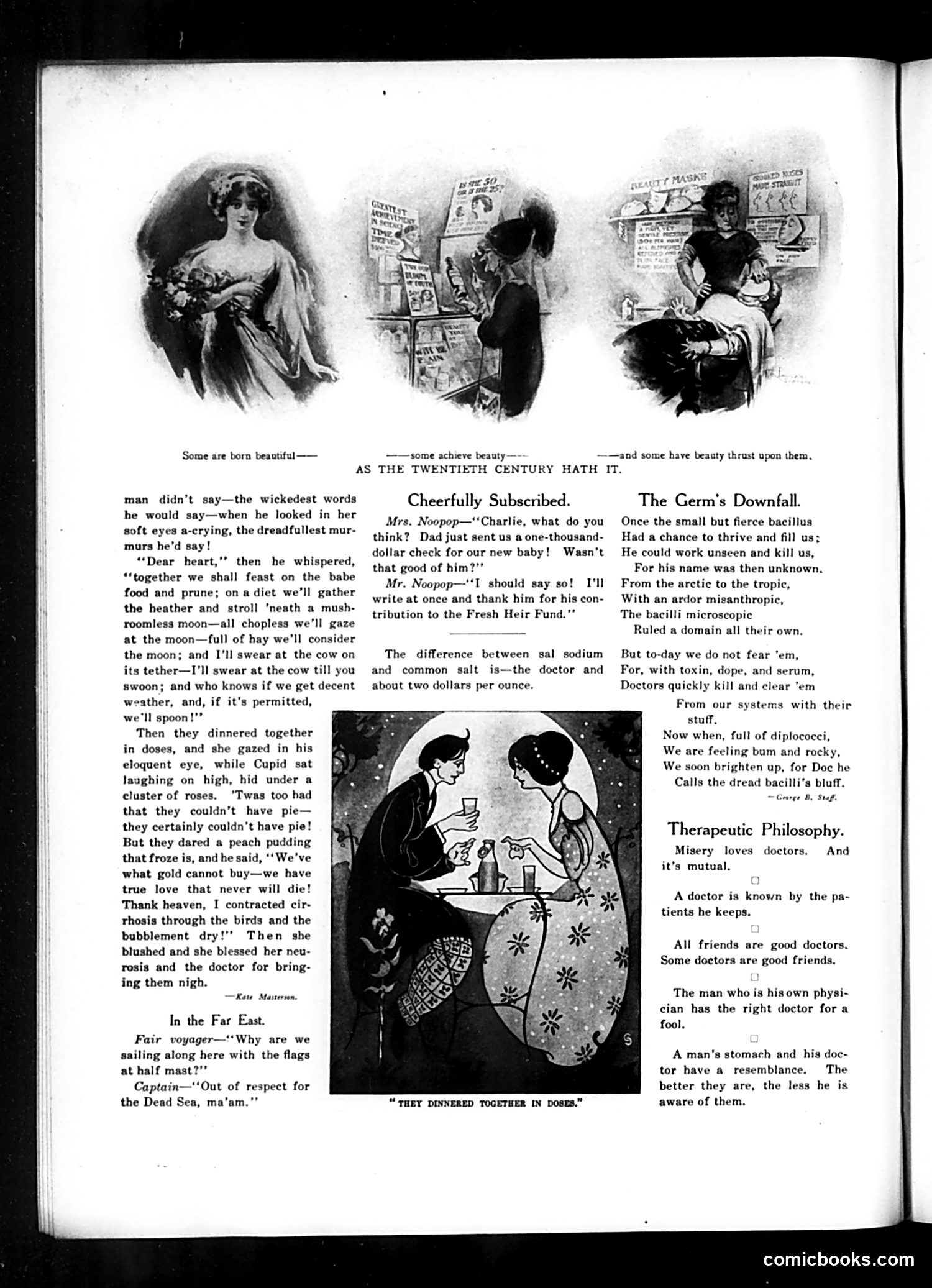
This page from *Judge* satirizes early 20th-century romantic ideals and medical/scientific progress. The left section parodies sentimental love poetry: a couple professes eternal devotion while subsisting on poverty food (prune, heather), yet celebrates their "true love" despite contracting serious illnesses (cirrhosis, neurosis)—the joke being that romantic love cannot overcome material hardship or disease. "The Germ's Downfall" celebrates modern medicine's conquest of microscopic bacteria through toxins and serums, contrasting past fear of invisible killers with present medical confidence. The "Therapeutic Philosophy" section offers tongue-in-cheek aphorisms mocking the doctor-patient relationship: doctors profit from illness ("misery loves doctors"), patients know doctors by results, and the best doctors remain invisible to their patients' awareness. The central illustration shows two people dining, labeled "They Dinnered Together in Doses," likely referring to medicinal treatments rather than food—reinforcing the magazine's skepticism about both romance and medicine as solutions to life's problems.
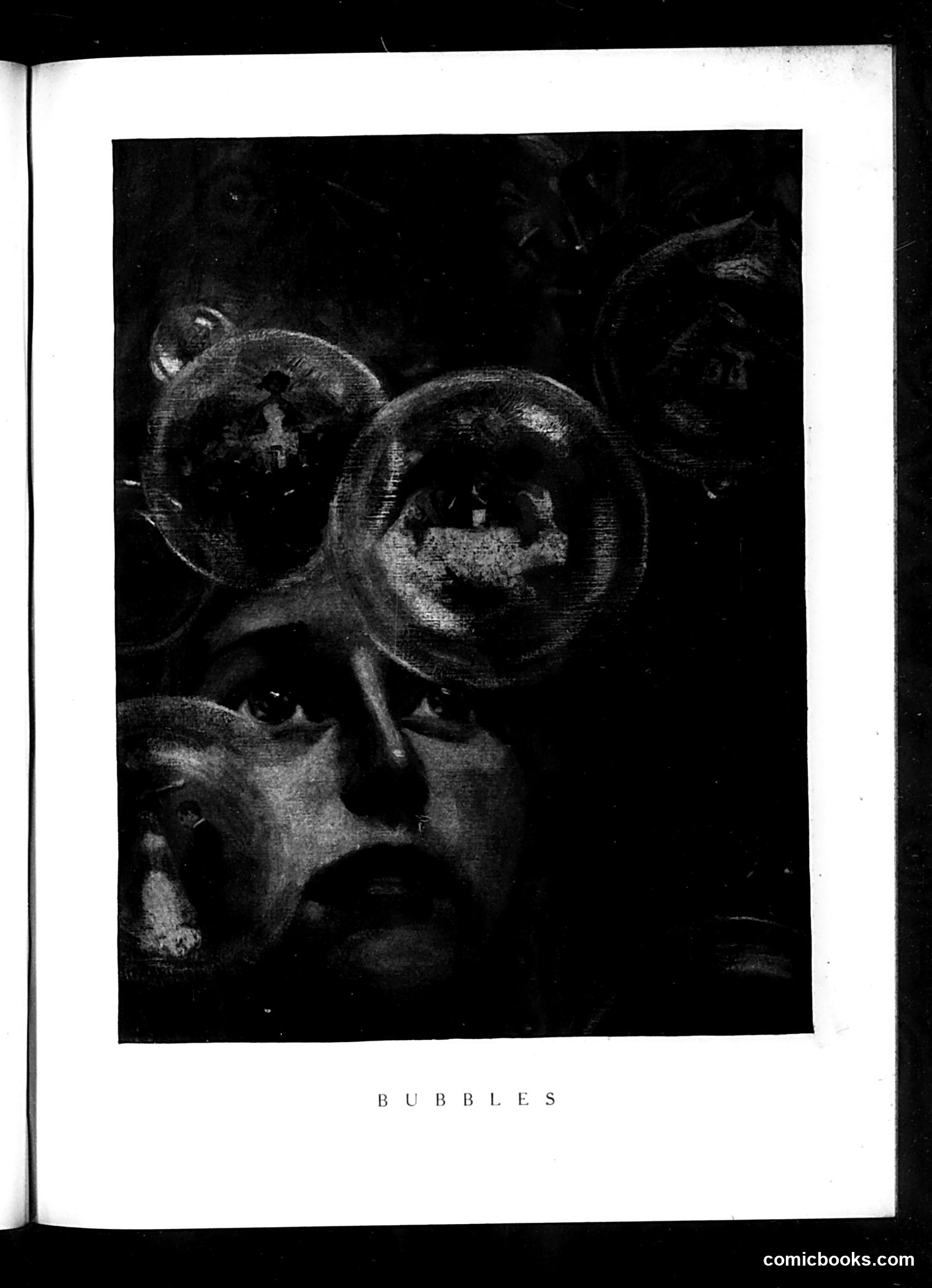
This appears to be a surreal or symbolic illustration rather than a traditional political cartoon. The black-and-white image shows a face with prominent, exaggerated features wearing or surrounded by large bubble-like spherical forms. The style suggests psychological or dreamlike satire typical of Judge magazine's avant-garde work. Without additional context or caption text beyond the simple label "BUBBLES," the specific political or social target remains unclear. The bubble imagery might satirize inflated ideas, false promises, or speculative excess—common Judge themes. However, the particular historical reference, whether this targets a specific person, event, or abstract concept, cannot be definitively determined from the image and minimal text alone. The surreal execution suggests modernist artistic influence popular in early-to-mid 20th century satire.
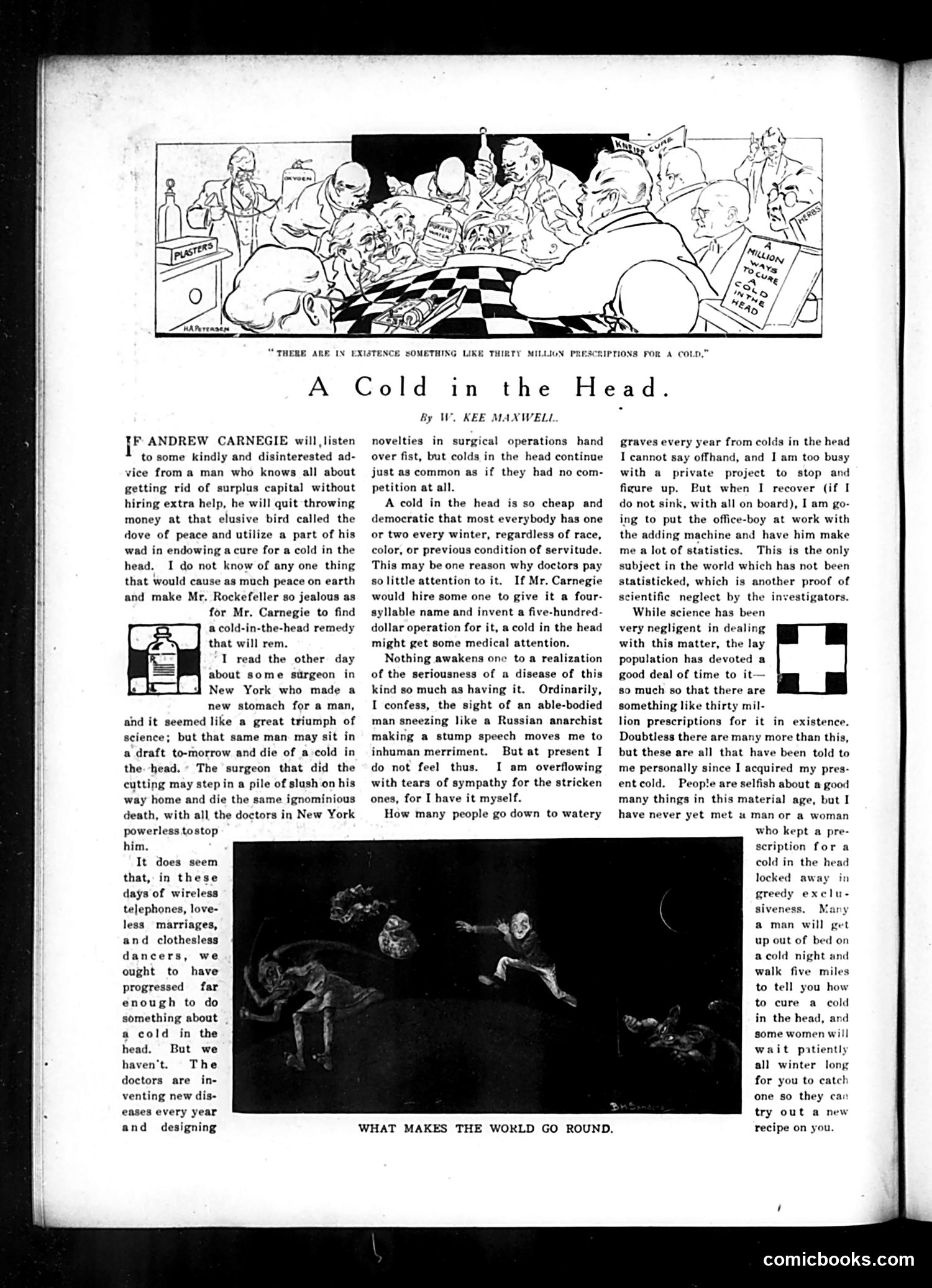
This satirical essay mocks the scientific and medical establishment's neglect of the common cold despite its universal prevalence. The author addresses Andrew Carnegie and John D. Rockefeller—wealthy industrialists of the era—sarcastically suggesting Carnegie endow a cold cure rather than funding peace initiatives, since thirty million prescriptions exist yet doctors ignore the condition. The satire targets the medical profession's obsession with dramatic surgical innovations (like creating artificial stomachs) while ignoring an ailment affecting everyone regardless of class or status. Maxwell highlights the contradiction: medicine advances spectacularly yet remains powerless against this "cheap and democratic" disease. The cartoon's accompanying image "What Makes the World Go Round" appears to visualize this paradox, though its specific reference is unclear from the visible portion. The piece is quintessential Progressive Era satire—mocking both wealthy philanthropists and medical pretension while highlighting social inequality in healthcare priorities.
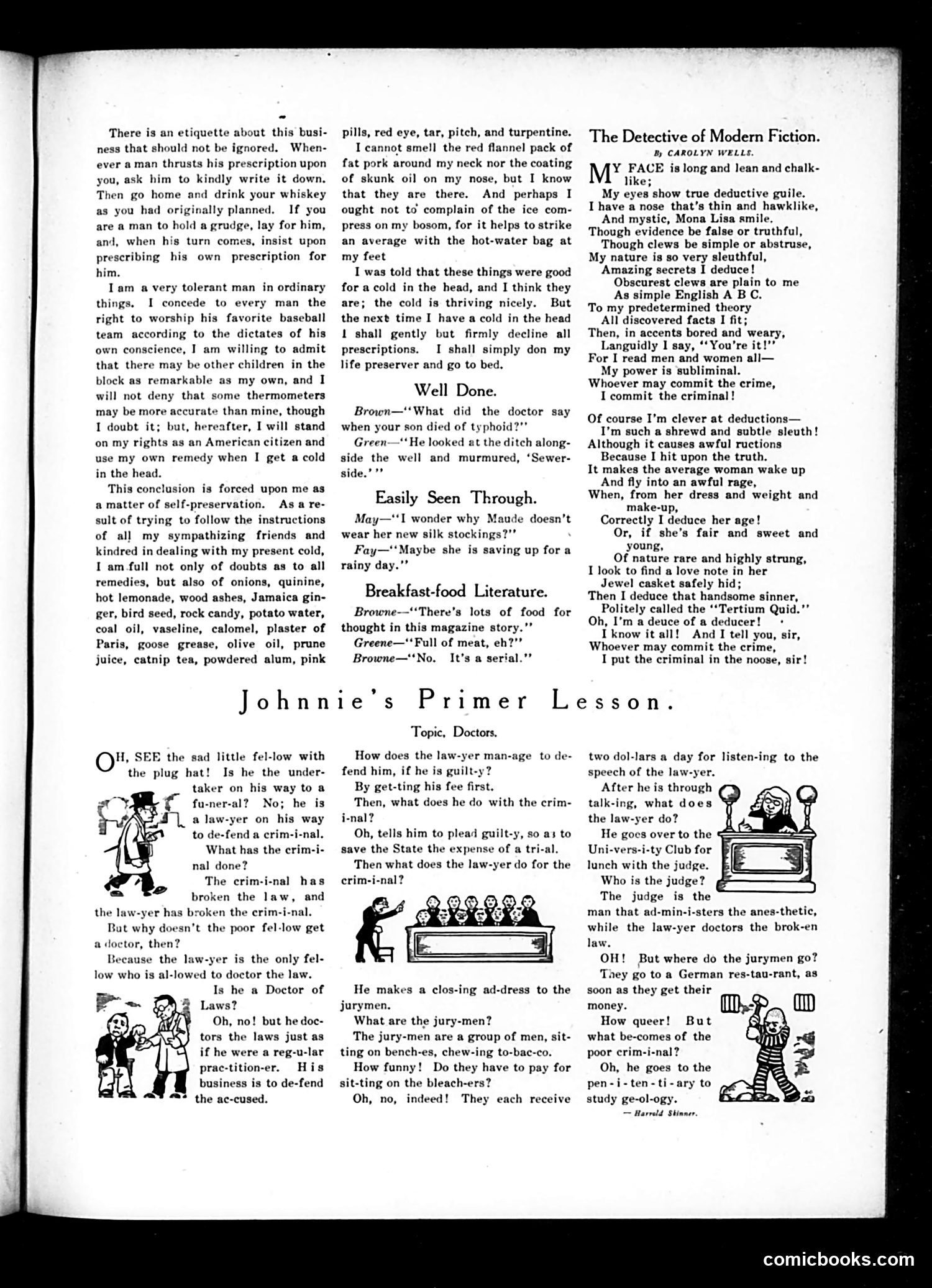
This page contains satirical educational content mocking the legal profession. The "Primer Lesson" section, illustrated with simple drawings, presents lawyers as corrupt defenders of criminals. **The Satire:** The cartoon depicts a lawyer (identified by his plug hat) defending accused criminals. The joke centers on the premise that lawyers "doctor the law" just as doctors treat patients—implying they manipulate justice. The catechism-style Q&A reveals the cynical mechanism: lawyers get paid first, then advise guilty clients to plead guilty anyway, thereby saving the state trial expenses while collecting fees. **The Point:** This reflects Progressive Era skepticism toward the legal establishment, portraying lawyers as self-serving facilitators of injustice who exploit the system rather than defend truth. The condescending "primer" format (typically for children learning ABC's) amplifies the mockery, suggesting such corruption is obvious even to a child. The other content—humorous anecdotes about cold remedies and relationships—represents typical Judge magazine filler material.
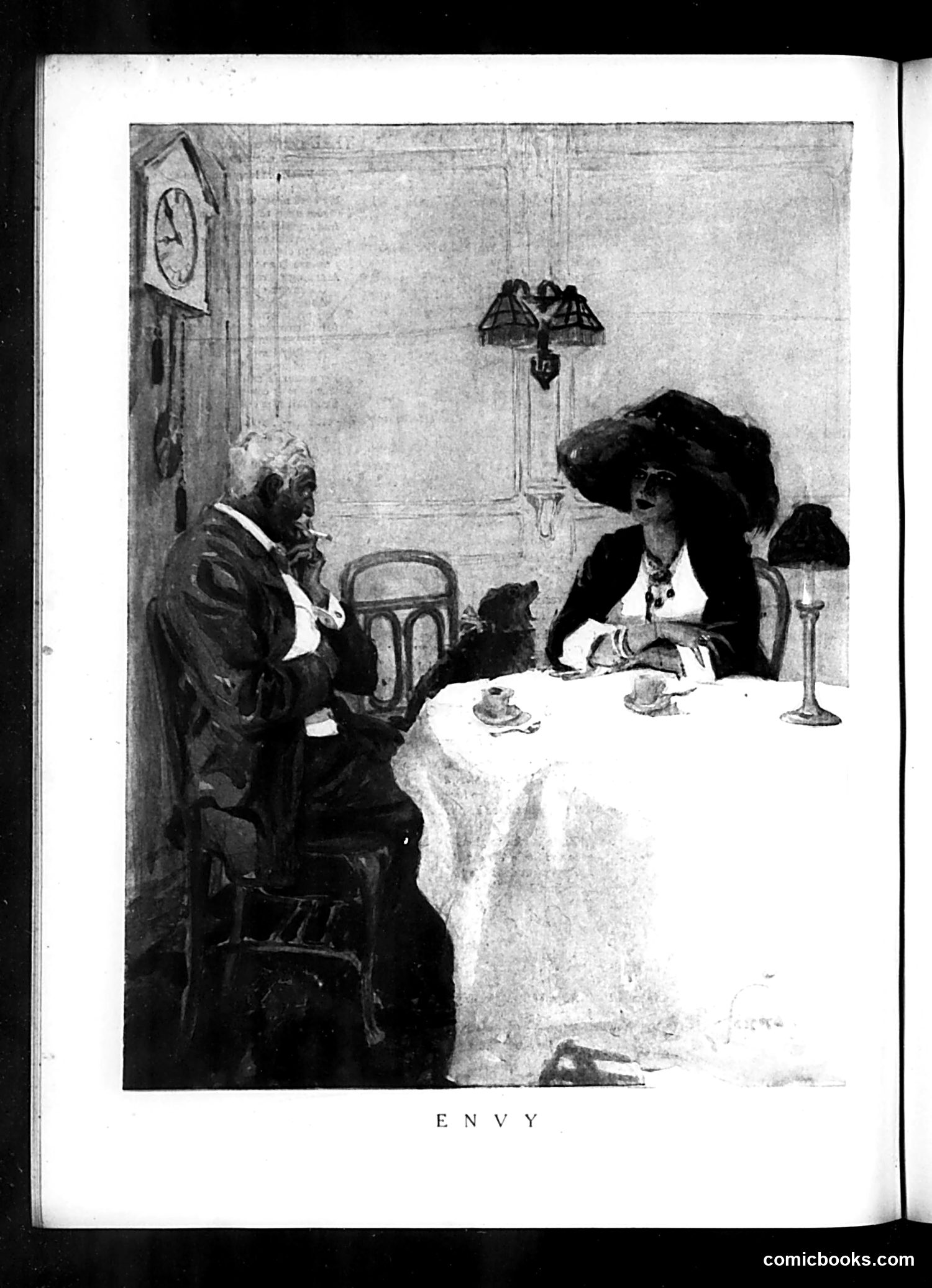
This illustration, captioned "ENVY," depicts a satirical scene of social commentary. An older gentleman in formal attire sits across a small table from a fashionably dressed woman wearing an elaborate feathered hat. They appear to be in an intimate café or restaurant setting, with a clock visible on the wall and what appear to be coffee cups on the table. The satire likely comments on class dynamics, romantic or social entanglement, or the conspicuous consumption represented by the woman's expensive fashion. The title "ENVY" suggests the cartoon critiques either jealousy between social classes or the envy inspired by ostentatious displays of wealth—themes Judge frequently targeted through social satire of the Gilded Age and Progressive Era.
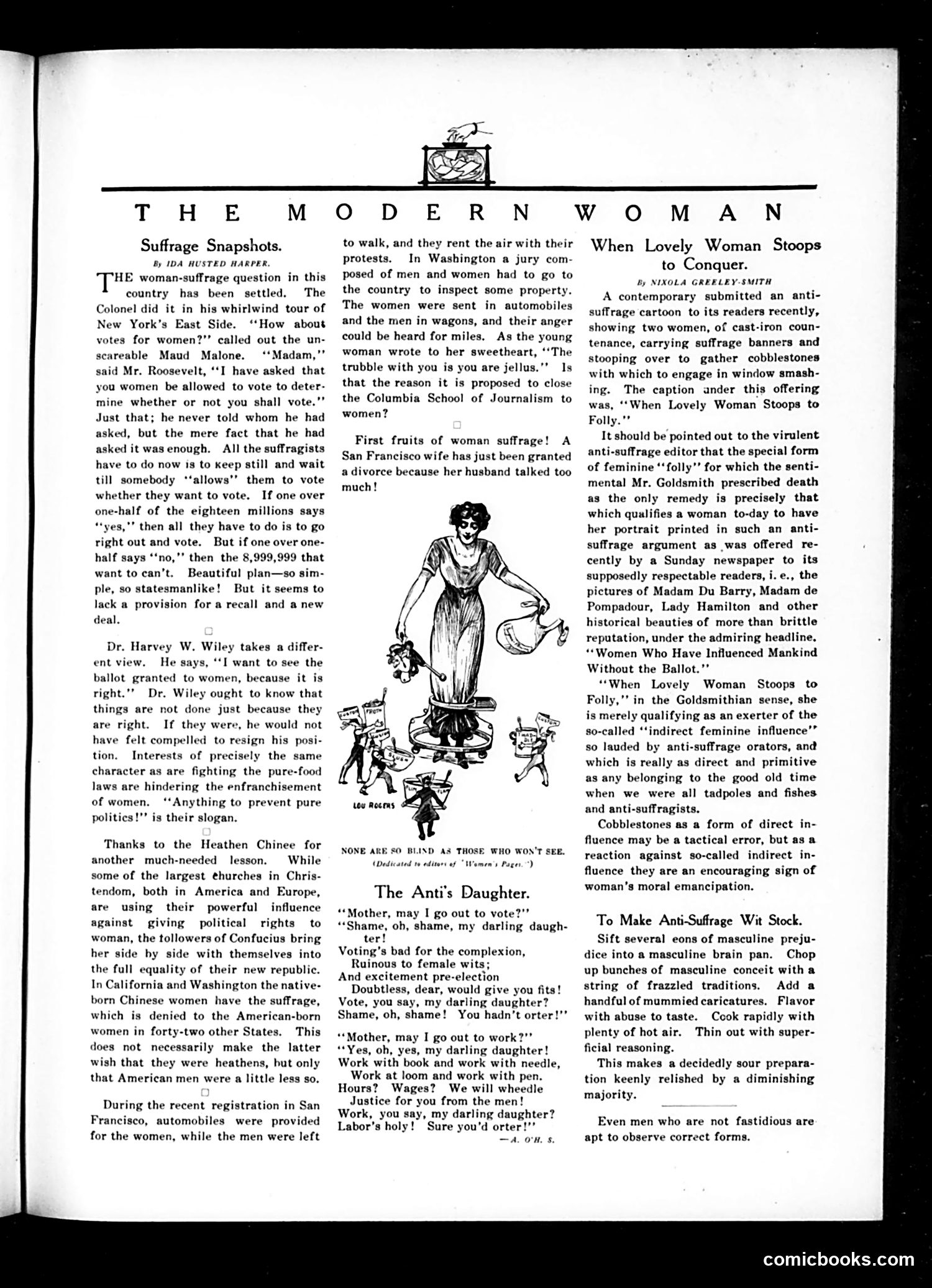
This page satirizes anti-suffrage arguments through multiple pieces. The main cartoon depicts a woman juggling domestic items while suffragists swirl around her—mocking the anti-suffrage claim that voting would distract women from home duties. The "Anti's Daughter" poem uses ironic contrast: a mother forbids her daughter to vote (claiming it harms complexion and "female wits") yet encourages her to work long hours in factories and mills without protection. The satire exposes the hypocrisy: anti-suffragists claim women are too delicate for politics but not too fragile for exploitative labor. References include Roosevelt's conditional suffrage stance and Dr. Wiley's principled support. The piece notes sardonically that Chinese immigrant women in California have voting rights denied to American-born women—shaming American masculinity. The overall message: anti-suffrage arguments are logically inconsistent and serve male interests in controlling women's political power while extracting their labor.
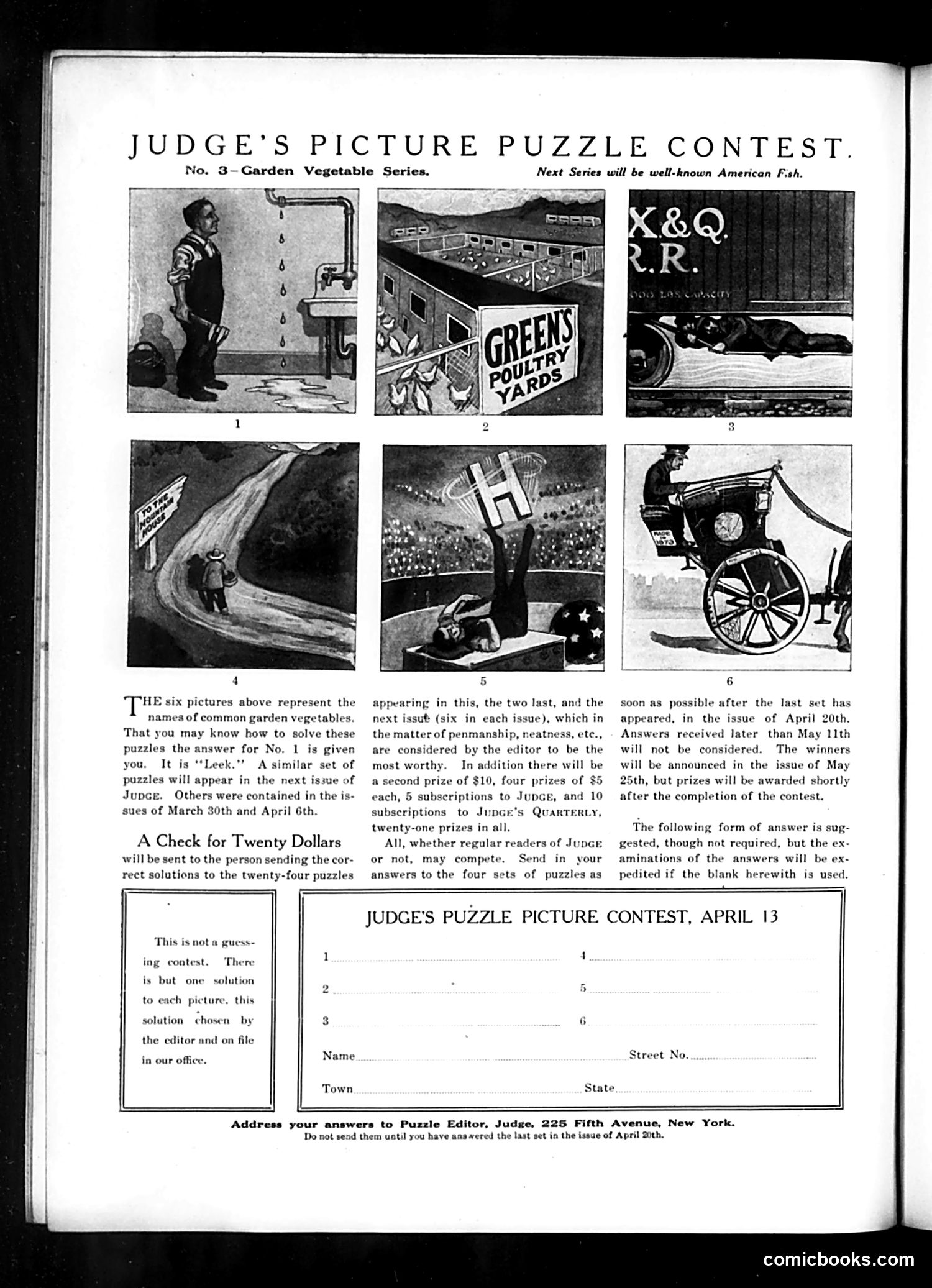
This page presents a visual word-puzzle contest rather than political satire. Readers must identify six common garden vegetables from abstract pictorial clues. Picture 1—a man at a sink with water dripping—represents "Leek" (sound-alike for "leak"). Pictures 2-6 use similar visual puns or representational images to suggest vegetable names. The contest offered real monetary prizes ($20 for complete solutions, plus additional awards totaling twenty-one prizes) and subscriptions to Judge magazine itself. This was a common early-20th-century engagement strategy: magazines ran contests to boost circulation and reader loyalty. The "next series will be well-known American Fish" indicates Judge ran sequential puzzle sets across multiple issues, requiring readers to purchase multiple copies to compete—a marketing technique disguised as entertainment. The deadline and submission instructions emphasize this was a legitimate contest with editor-determined answers on file.
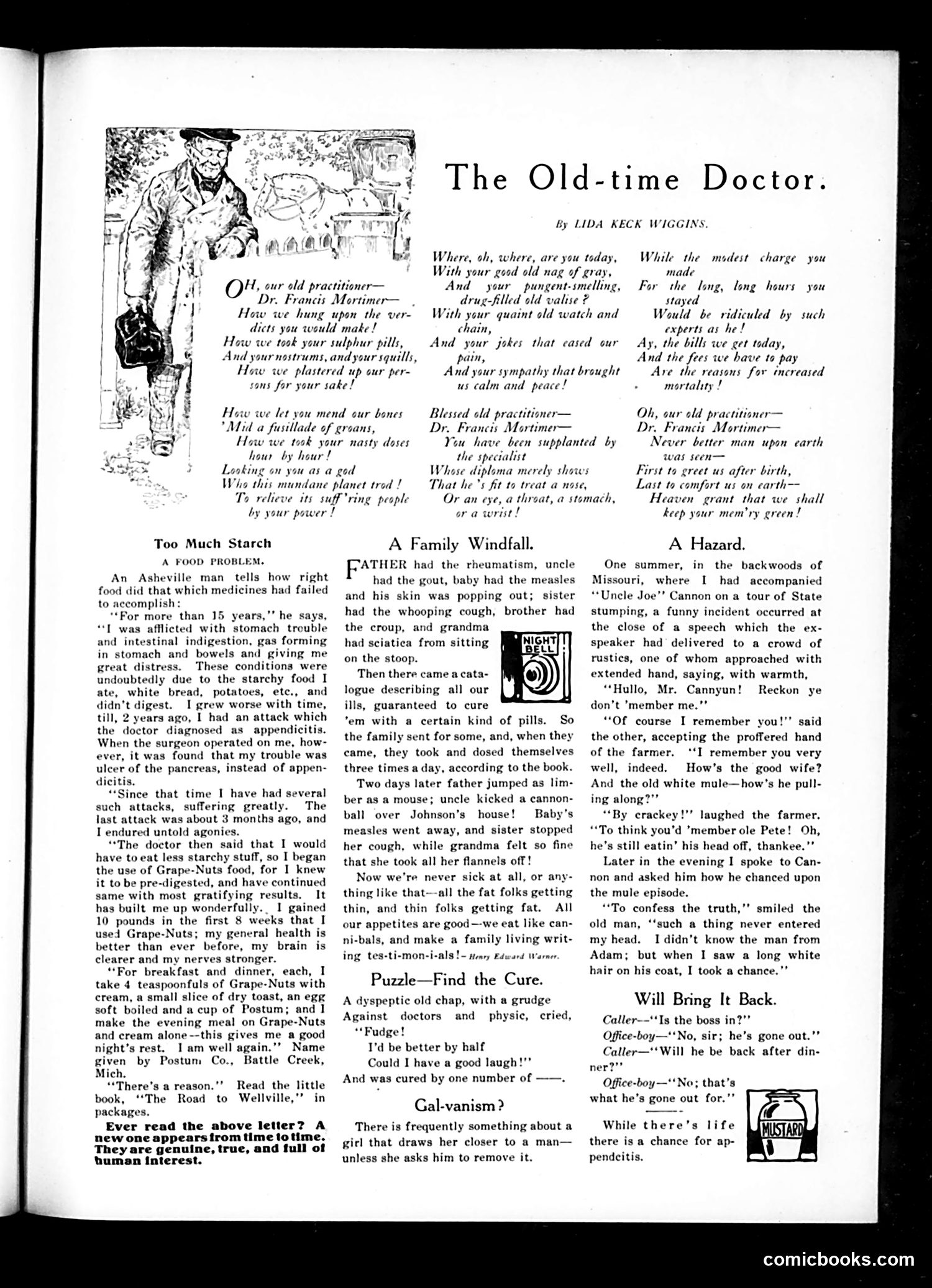
This page presents nostalgic criticism of modern medicine through poetry and humor. The title poem by Lida Keck Wiggins mourns the passing of the traditional family doctor (Dr. Francis Mortimer) who provided affordable, compassionate care. The satire targets the rise of medical **specialists**—doctors narrowly focused on single body parts (nose, eye, throat, stomach, wrist)—who charge significantly higher fees. The poem suggests this specialization has increased mortality through excessive billing rather than improving outcomes. It contrasts the old doctor's modest charges and emotional availability with modern specialists' expensive, impersonal approach. The page includes health-related advertisements (Grape-Nuts food) and humorous stories about patent medicines' exaggerated claims ("A Family Windfall"), reflecting early 20th-century skepticism toward both aggressive medical specialization and fraudulent health products. The overall message critiques healthcare commercialization while romanticizing an earlier medical era.
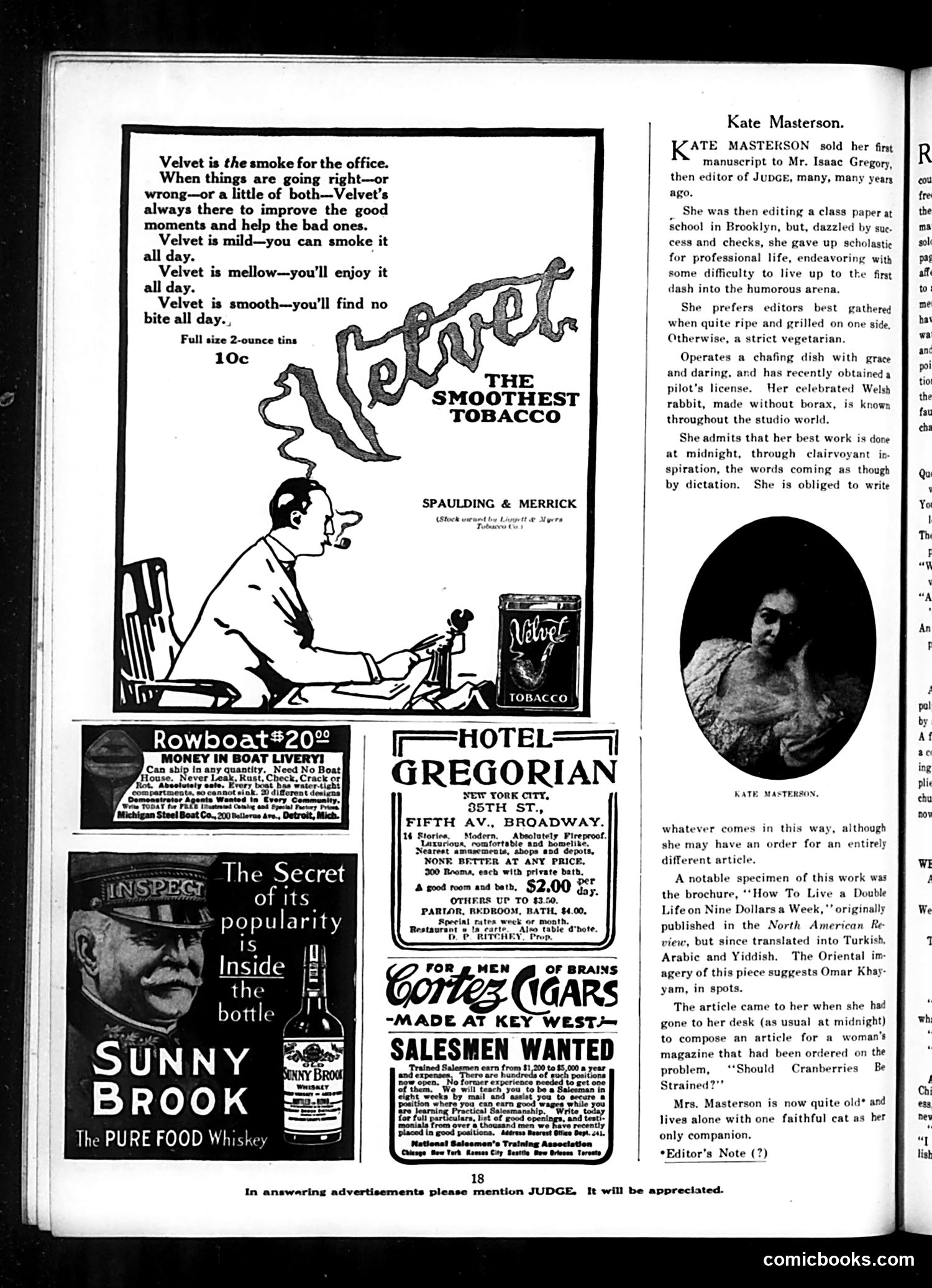
This page is primarily a **biographical profile** of Kate Masterson, a humorist and writer for *Judge* magazine, accompanied by period **advertisements**. **The Masterson Profile:** The text celebrates Masterson as an early female contributor to *Judge*, having sold her first manuscript to the magazine's editor Isaac Gregory years earlier. It humorously describes her as a strict vegetarian who cooks with a chafing dish, recently obtained a pilot's license, and does her best writing at midnight through "clairvoyant inspiration." Her notable work includes a piece titled "How To Live a Double Dollars a Week," translated into Turkish, Arabic, and Yiddish. The profile ends with a tongue-in-cheek editor's note that she's "quite old" and lives with a cat. **The Advertisements** include tobacco (Velvet), hotel lodging (Hotel Gregorian), liquor (Sunny Brook whiskey), cigars, and sales positions—typical of early 20th-century magazine advertising. The Masterson piece is essentially a **lighthearted tribute** to an early woman writer in American humor publishing.
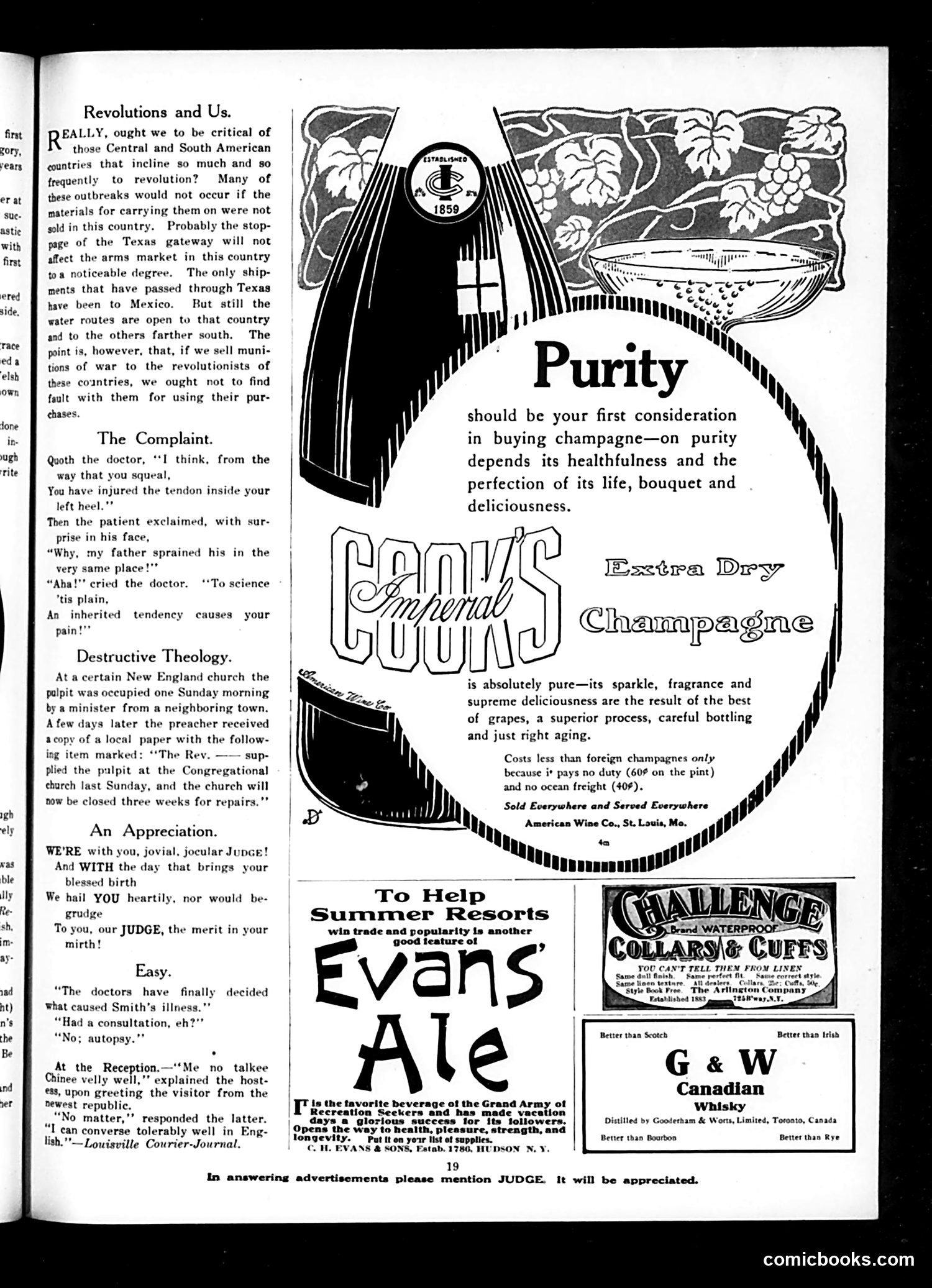
This page contains several satirical pieces and period advertisements reflecting early 20th-century American concerns. **"Revolutions and Us"** critiques American hypocrisy: the U.S. sells weapons to Central and South American revolutionaries, then complains when those countries experience instability. The satire points out the contradiction—Americans profit from arms sales while condemning the resulting upheaval. **Medical humor pieces** ("The Complaint," "Destructive Theology," "Easy") are unrelated joke columns typical of Judge's format, playing on doctor-patient exchanges and church anecdotes. The remaining content is primarily **period advertising**: Cooks champagne emphasizing "purity," Evans Ale, Challenge collars and cuffs, and G&W Canadian Whisky—all marketed with patriotic or quality-focused appeals typical of the era. The page exemplifies Judge's mix of political commentary and commercial content, with the opening editorial representing the magazine's satirical voice on foreign policy issues.
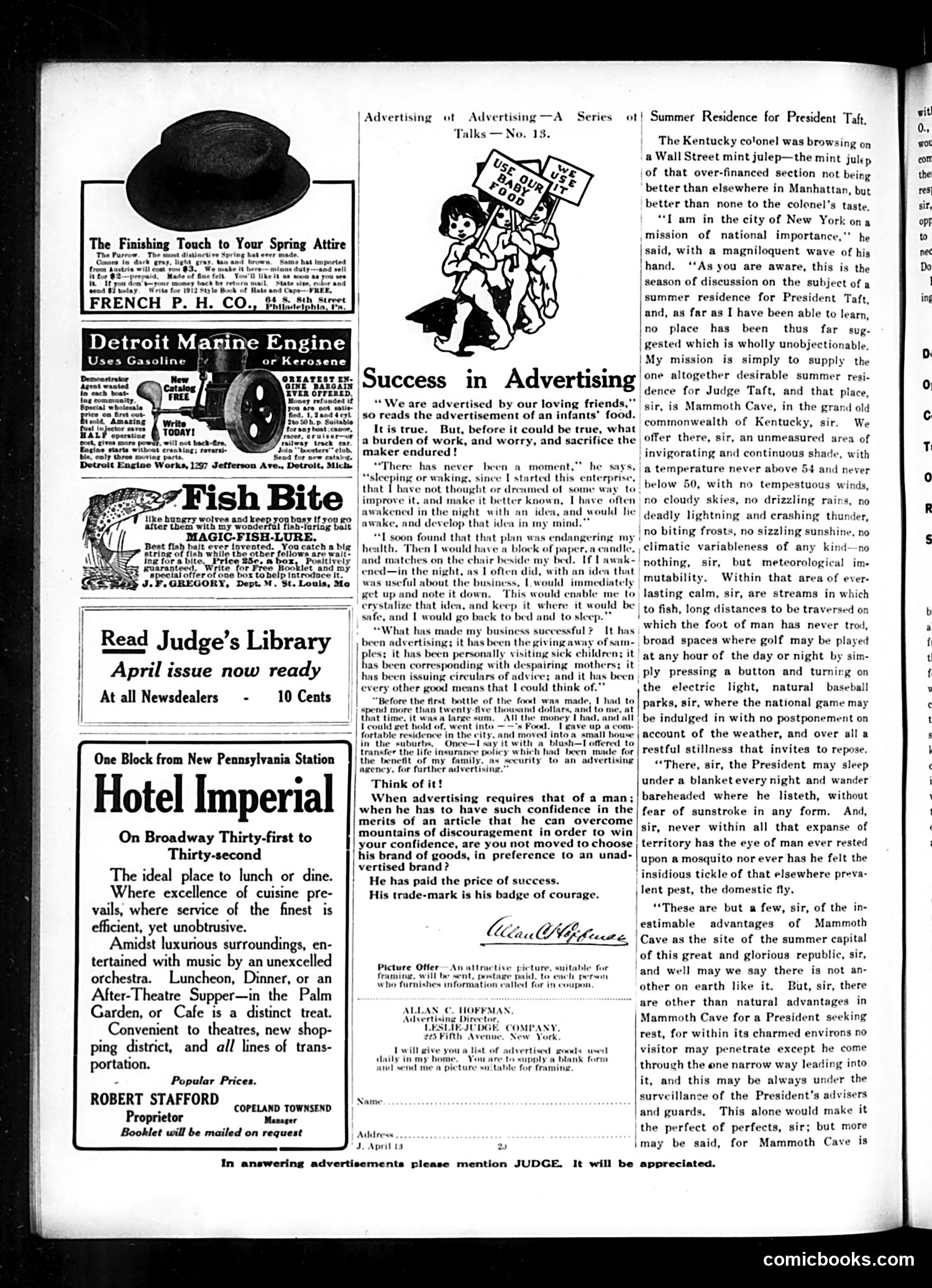
This page mixes advertisements with two short satirical pieces. **"Success in Advertising"** is a mock-serious tribute to an advertiser's dedication, quoting an unnamed businessman's sacrifices—sleeping little, constantly scheming, distributing free samples to desperate mothers, spending all money on advertising a food product. The satire is genteel: it celebrates obsessive entrepreneurial hustle and self-promotion as moral virtue, presenting advertising itself as requiring "courage" and "confidence." The piece gently mocks American commercial culture's elevation of relentless salesmanship. **"Summer Residence for President Taft"** (partially visible) depicts a Kentucky colonel in New York praising President Taft's supposed plan to spend summer at Mammoth Cave. The joke appears to mock Taft as needing a remote, cool refuge—implying criticism of his presidency or appearance. The colonel's elaborate language ("magniloquent wave") suggests satirical exaggeration of Southern pretension. Both pieces exemplify *Judge* magazine's urbane, class-conscious satire of American ambition and politics circa 1910s.
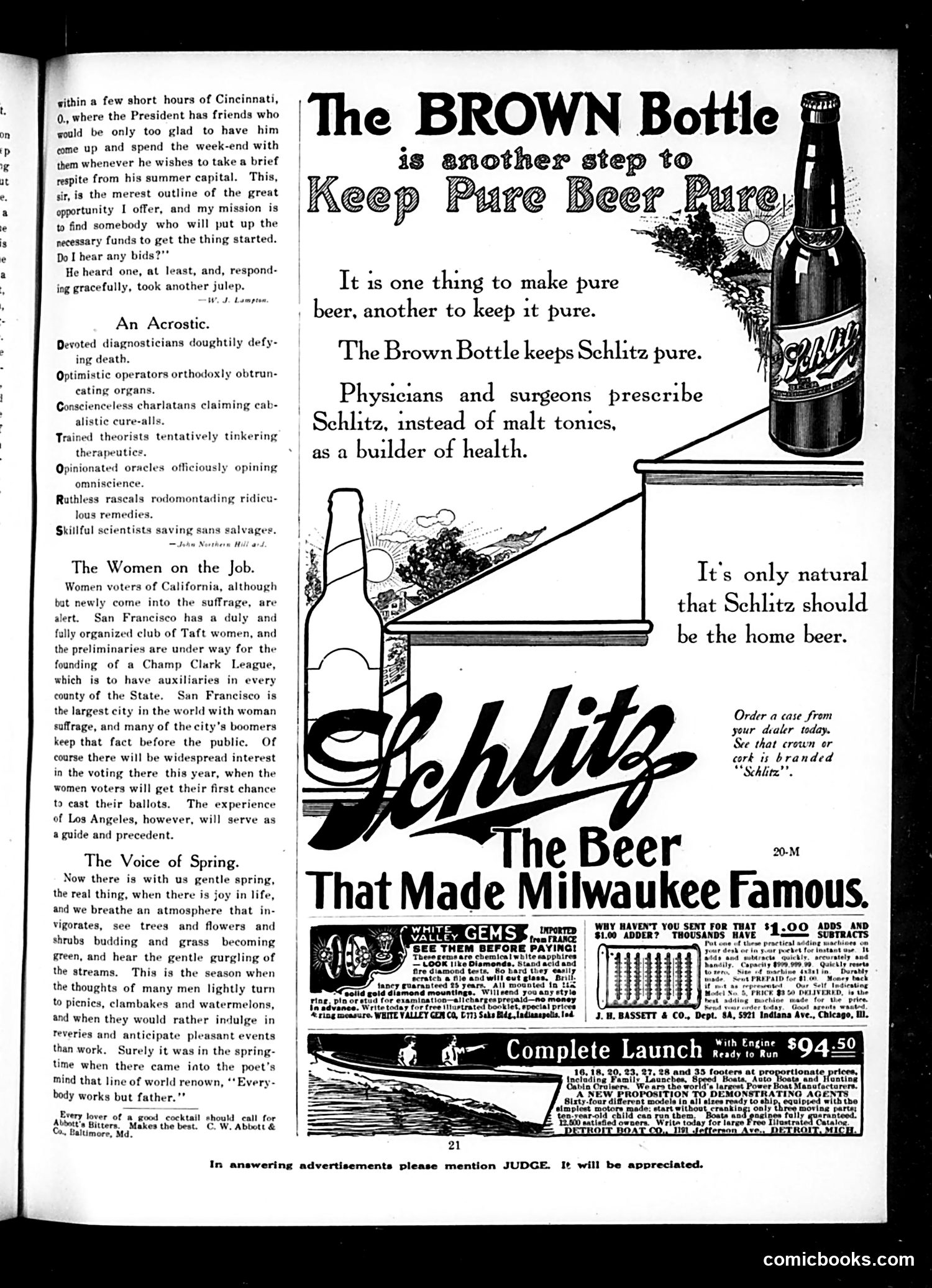
This page contains primarily **advertisements rather than satirical cartoons**. The dominant content is a large Schlitz beer advertisement claiming the brown bottle "keeps Schlitz pure" and that physicians prescribe it as "a builder of health." The upper left contains brief satirical pieces, including "An Acrostic" mocking incompetent doctors and charlatans, and sections on women voters in California and springtime nostalgia—typical Judge magazine humor of the era. **Historical context**: This appears to be from the 1912 election period (references to "Taft women" and "Champ Clark League"). The Schlitz ad is notable for making health claims about beer—practices that would later be prohibited. The page reflects early 20th-century attitudes where alcohol was openly marketed with medicinal properties, before Prohibition and modern advertising regulations. The satirical content is lightweight social commentary; the page's real purpose is advertising revenue.
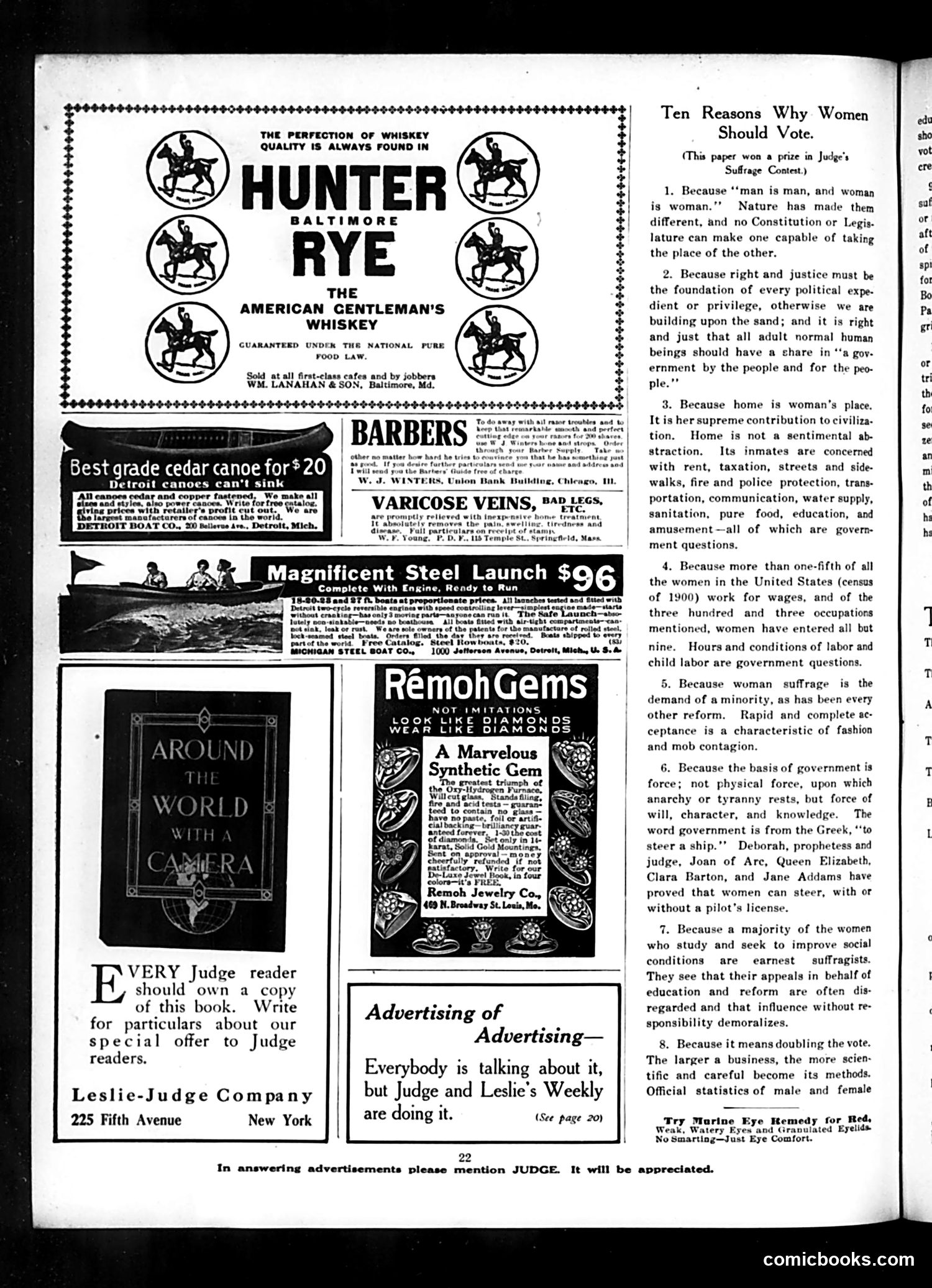
This page is primarily **text-based advocacy**, not satire. It presents "Ten Reasons Why Women Should Vote"—apparently a prize-winning essay from Judge's suffrage contest. The arguments blend practical and philosophical positions: women's domestic responsibilities encompass government matters (rent, sanitation, food safety); over one-fifth of working-age women are wage-earners; and historical female leaders (Joan of Arc, Clara Barton, Jane Addams) prove women's capability. The framing is notably **ironic for modern readers**: Reason #1 argues women *should* vote precisely *because* they're different from men—inverting the typical anti-suffrage claim that natural differences disqualified them. Reason #6 invokes classical governance metaphors ("steer a ship") to assert women's intellectual fitness. The surrounding **advertisements** (whiskey, canoes, synthetic gems) provide period context but no satirical commentary. This indicates Judge's editorial position: by 1910s standards, publishing pro-suffrage arguments represented a progressive stance, not mockery.
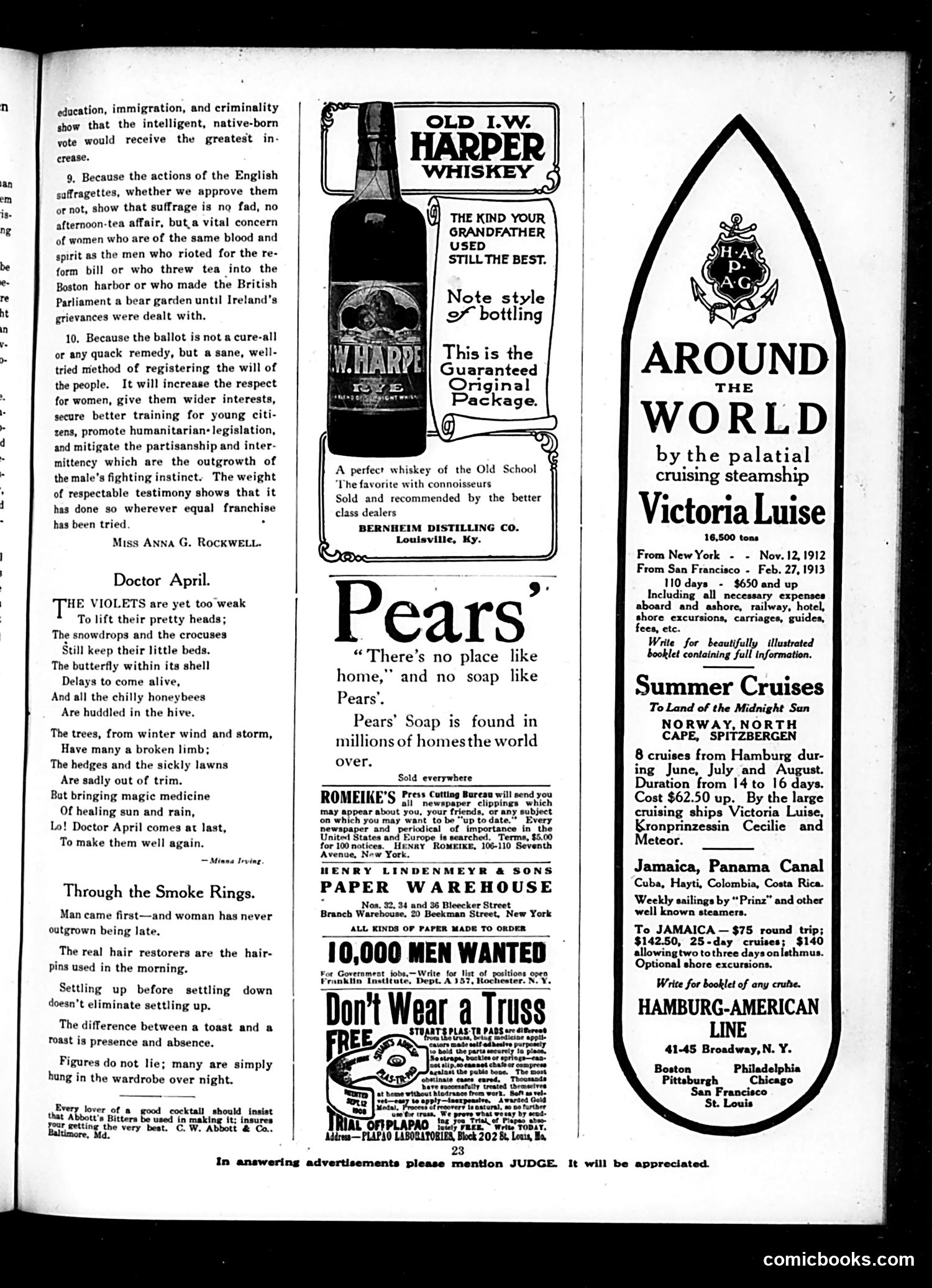
This page is primarily **advertising** with some editorial content supporting women's suffrage. The main editorial piece, attributed to Miss Anna G. Rockwell, argues for women's voting rights using ten numbered points. It references **English suffragettes** (the militant women's rights movement) and compares their struggle to American historical protests like the Boston Tea Party, positioning voting as a serious civic matter rather than frivolous. The piece contends the ballot will improve women's lives and society broadly. The accompanying poem "Doctor April" is seasonal verse unrelated to the suffrage debate. The page contains multiple advertisements typical of the era: Old I.W. Harper Whiskey, Pears' Soap, cruise ship bookings (Victoria Luise), job placement services, and a truss advertisement. These ads reflect early-1910s consumer culture and available services for middle/upper-class readers. The suffrage argument represents progressive thinking of the pre-19th Amendment era (1920), when women's voting rights remained contested and contentious in American politics.
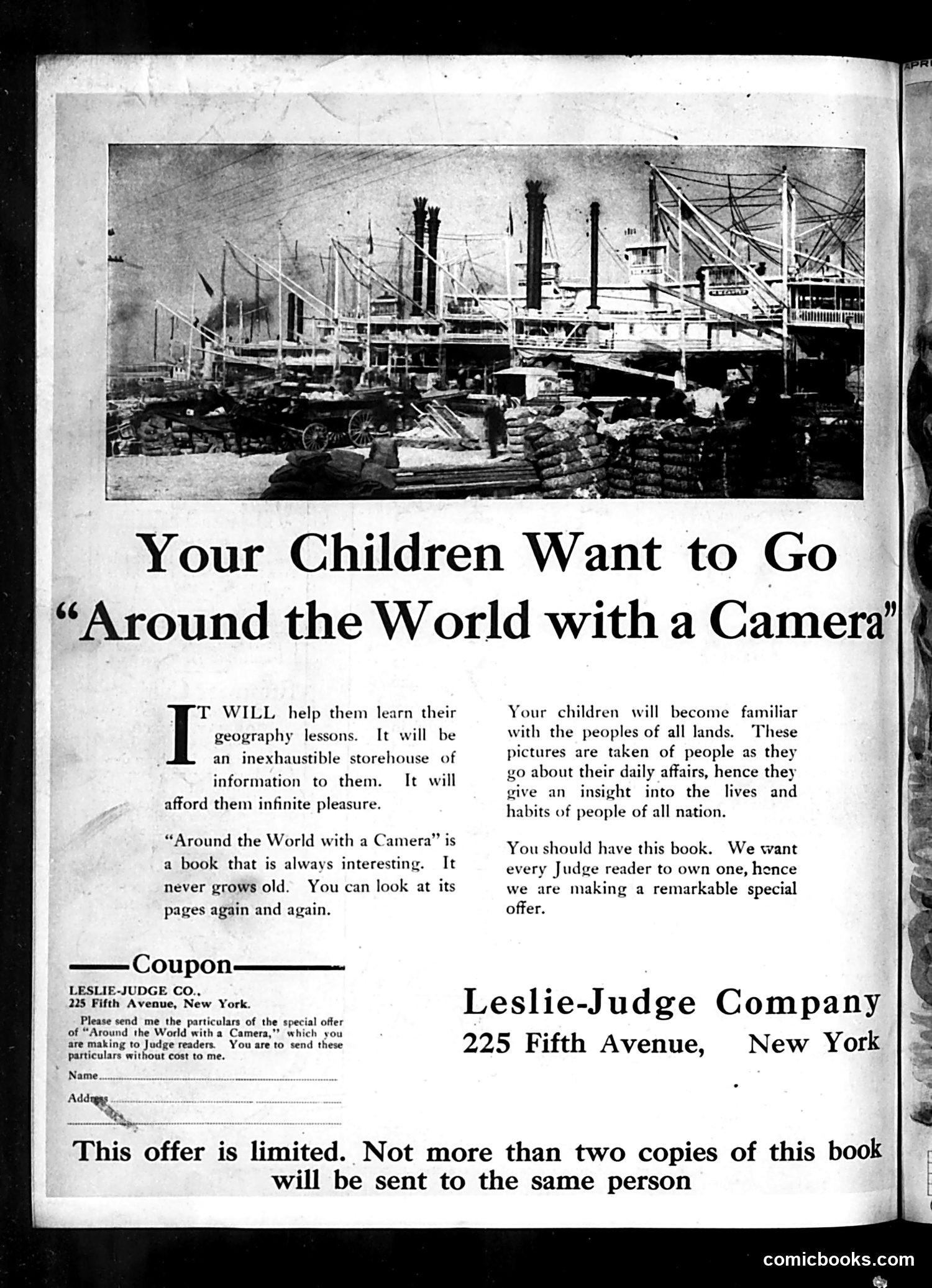
This is a **book advertisement**, not political satire. The Leslie-Judge Company promotes *"Around the World with a Camera,"* positioned as educational material for children studying geography. The pitch appeals to early 20th-century values: the book offers windows into foreign peoples' "daily affairs" and "habits of all nations"—a common framing for travel photography of the era, reflecting both genuine educational interest and the era's fascination with documenting "exotic" cultures. The photograph above shows a busy harbor with steamships, emphasizing global commerce and connectivity—the world as accessible through modern travel and publishing. The coupon mechanism was standard advertising practice. The limitation to two copies per person suggests either scarcity or an attempt to prevent bulk reselling. This represents typical **Judge magazine advertising**: wholesome, educational, targeting middle-class readers interested in self-improvement and their children's enlightenment.