
Judge, 1912-04-13 · page 6 of 24
Judge — April 13, 1912 — page 6: what you’re looking at
What you’re looking at
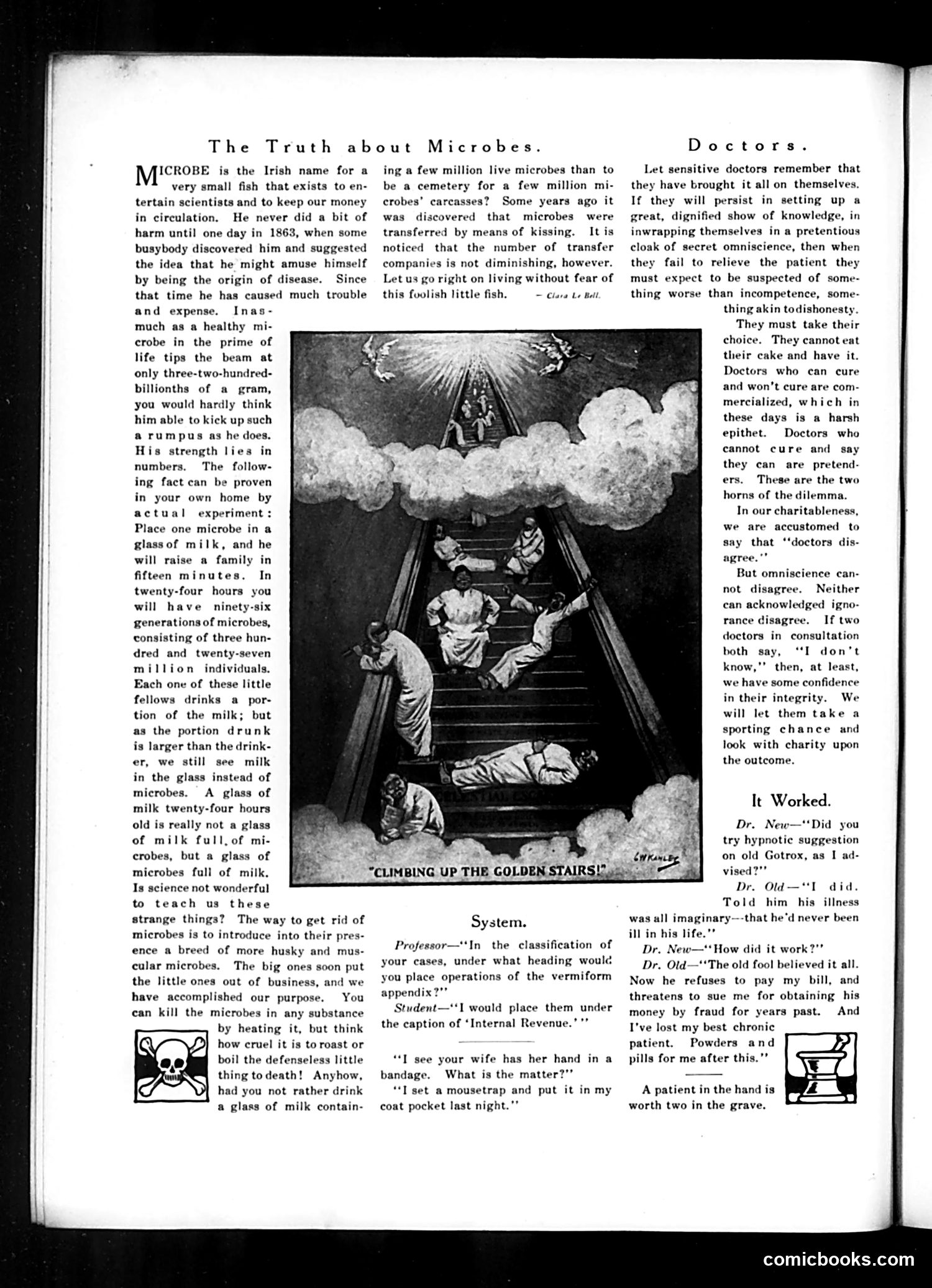
This page contains three distinct satirical pieces mocking contemporary medical and scientific pretensions: **"The Truth about Microbes"** ridicules germ theory skepticism. Written in mock-serious tone, it sarcastically dismisses microbes as harmless until 1863, when scientists "discovered" them for attention and profit. The satire suggests public distrust of the new germ theory—framing microbes as an invented threat used to justify scientific authority and medical expenses. **"Doctors"** attacks physicians' arrogance. Judge argues doctors create false dilemmas: either they're commercialized frauds or pretentious charlatans hiding ignorance behind mystique. The satire demands humility—honest admission of "I don't know" would restore public confidence. **The humor pieces** ("System" and "It Worked") mock medical education and hypnotic suggestion treatments. The "Internal Revenue" joke suggests surgeons profit from appendix operations; the mousetrap anecdote ridicules faith in hypnotic cure-alls. Overall, the page expresses widespread late-19th-century skepticism toward medical professionalism, emerging germ theory, and dubious treatments like hypnotic suggestion—reflecting public anxiety about doctors' expanding authority and questionable claims.
📄 Transcribed text from this page (OCR, searchable)
Machine-transcribed from the original scan — historical spelling and the odd misread are preserved.
The Truth Microbe is the Irish name for a very small fish that exists to en- tertain scientists and to keep our money in circulation, He never did a bit of harm until one day in 1863, when some busybody discovered him and suggested the idea that he might amuse himself by being the origin of disease. Since that time he has caused much trouble and expense. Inas- much as a healthy mi- crobe in the prime of life tips the beam at only three-two-hundred- billionths of a gram, you would hardly think him able to kick up such a rumpus as he does. His strength lies in numbers, The follow- ing fact can be proven in your own home by actual experiment: Place one microbe in a glassof milk, and he will raise a family in fifteen minutes. In twenty-four hours you will have generations of microbes, consisting of three hun- dred and twenty-seven million individuals. Each one of these little fellows drinks a por- tion of the milk; but as the portion drunk is larger than the drink- we still milk in the glass instead of microbes. A glass of milk twenty-four hours old is really not a glass of milk full,of mi- crobes, but a glass of microbes full of milk. Is science not wonderful to teach us these strange things? The way to get rid of microbes is to introduce into their pres- ninety-six er, see ence a breed of more husky and mus- cular microbes. The big on the little ones out of business, and we have accomplished our purpose. You can kill the microbes in any substance by heating it, but think how cruel it is to roast or boil the defenseless little thing todeath! Anyhow, had you not rather drink a glass of milk contain- soon put about Microbes. ing a few million live microbes than to be a cemetery for a few million mi- crobes’ carcasses? Some years ago it was that microbes were transferred by means of kissing. It is that the number of transfer companies is not diminishing, however. Let us go right on living without fear of this foolish little fish. discovered noticed — Clara Le Bell ‘CLIMBING UP THE GOLDEN STAIRS: System. Professor—‘‘In the classification of your cases, under what heading would you place operations of the vermiform appendix?" Student—‘‘I would place them under the caption of ‘Internal Revenue “I see your wife has her hand in a bandage. What is the matter?” “I set a mousetrap and put it in my coat pocket last night."* Doctors. Let sensitive doctors remember that they have brought it all on themselves, If they will persist in setting up a great, dignified show of knowledge, in inwrapping themselves in a pretentious cloak of secret omniscience, then when they fail to relieve the patient they must expect to be suspected of some- thing worse than incompetence, some thing akin todishones: They must take their choice. They cannot eat their cake and have it. Doctors who can cure and won't cure are com- mercialized, which in these days is a harsh epithet. Doctors who cannot cure and say they can are pretend- ers. These are the two horns of the dilemma. In our charitableness, we are accustomed to say that ‘doctors dis- agree.’ But omniscience can- not disagree. Neither can acknowledged igno- rance disagree. If two doctors in consultation both say, “I don’t know,"” then, at least, we have some confidence in their integrity. We will let them take a sporting chance and look with charity upon the outcome. It Worked. Dr. Ne ‘Did you try hypnotic suggestion on old Gotrox, as I ad- Old—“*l did. Told him his illness was all imaginary—-that he'd never been ill in his life. Dr, New—'* How did it work?"" Dr. Old—*‘*The old fool believed it all. Now he refuses to pay my bill, and threatens to sue me for obtaining his money by fraud for years past. And I've lost my best chronic patient. Powders and pills for me after this.’’ A patient in the hand is worth two in the grave. comicbooks.com