
Judge, 1912-04-13 · page 13 of 24
Judge — April 13, 1912 — page 13: what you’re looking at
What you’re looking at
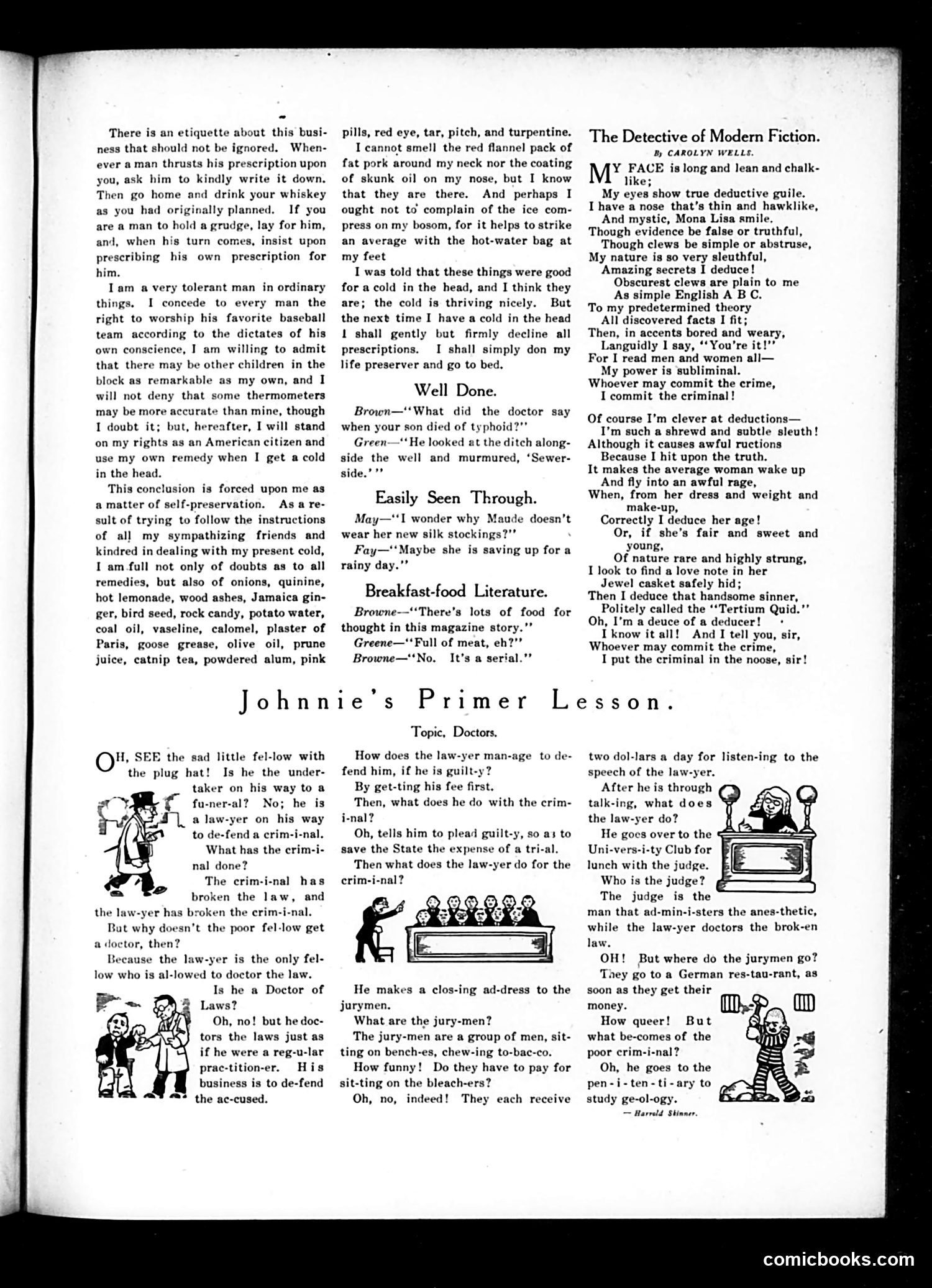
This page contains satirical educational content mocking the legal profession. The "Primer Lesson" section, illustrated with simple drawings, presents lawyers as corrupt defenders of criminals. **The Satire:** The cartoon depicts a lawyer (identified by his plug hat) defending accused criminals. The joke centers on the premise that lawyers "doctor the law" just as doctors treat patients—implying they manipulate justice. The catechism-style Q&A reveals the cynical mechanism: lawyers get paid first, then advise guilty clients to plead guilty anyway, thereby saving the state trial expenses while collecting fees. **The Point:** This reflects Progressive Era skepticism toward the legal establishment, portraying lawyers as self-serving facilitators of injustice who exploit the system rather than defend truth. The condescending "primer" format (typically for children learning ABC's) amplifies the mockery, suggesting such corruption is obvious even to a child. The other content—humorous anecdotes about cold remedies and relationships—represents typical Judge magazine filler material.
📄 Transcribed text from this page (OCR, searchable)
Machine-transcribed from the original scan — historical spelling and the odd misread are preserved.
There is an etiquette about this busi- ness that should not be ignored. When- ever aman thrusts his prescription upon you, ask him to kindly write it down, Then go home and drink your whiskey as you had originally planned. If you are a man to hold a grudge, lay for him, and, when his turn comes, insist upon prescribing his own prescription for him. Iam a very tolerant man in ordinary things. I concede to every man the right to worship his favorite baseball team according to the dictates of his own conscience, I am willing to admit that there may be other children in the block as remarkable as my own, and I will not deny that some thermometers may be more accurate than mine, though I doubt it; but, hereafter, I will stand on my rights as an American citizen and use my own remedy when I get a cold in the head. This conclusion is forced upon me as a matter of self-preservation. As a re- sult of trying to follow the instructions of all my sympathizing friends and kindred in dealing with my present cold, I am full not only of doubts as to all remedies, but also of onions, quinine, hot lemonade, wood ashes, Jamaica gin- ger, bird seed, rock candy, potato water, coal oil, vaseline, calomel, plaster of Paris, goose grease, olive oil, prune juice, catnip tea, powdered alum, pink Johnn H, SEE the sad little fel-low with the plug hat! Is he the under- taker on his way to a fu-ner-al? No; he is 3,4 |_ a law-yer on his way to de-fend a crim-i-nal, What has the crim-i- nal done? The crim-i-nal has broken the law, and -nal. the law-yer has broken the crim But why doesn’t the poor fel-low get a doctor, then? yer is the only fel- low who is al-lowed to doctor the law. Is he a Doctor of Laws? Oh, no! but he doc- tors the laws just as if he were a reg-u-lar prac-tition-er. His business is to de-fend the ac-cused. Because the law pills, red eye, tar, pitch, and turpentine. I cannot smell the red flannel pack of fat pork around my neck nor the coating of skunk oil on my nose, but I know that they are there. And perhaps I ought not to complain of the ice com- press on my bosom, for it helps to strike an average with the hot-water bag at my feet I was told that these things were good for a cold in the head, and I think they are; the cold is thriving nicely. But the next time I have a cold in the head 1 shall gently but firmly decline all prescriptions. I shall simply don my life preserver and go to bed. Well Done. Brown—‘‘What did the doctor say when your son died of typhoid?’ Green—*‘He looked at the ditch along- side the well and murmured, ‘Sewer- Easily Seen Through. May—‘‘I wonder why Maude doesn’t wear her new silk stockings?"" Fay—‘‘Maybe she is saving up fora rainy day.”’ side. Breakfast-food Literature. Browne—‘‘There’s lots of food for thought in this magazine story.’’ Greene—‘‘Full of meat, eh?’’ Browne—‘‘No. It's a seri . ’ ie’s Primer Topic, Doctors. How does the law-yer man-age to de- fend him, if he is guilt-y? By get-ting his fee first. Then, what does he do with the crim- i-nal? Oh, tells him to plead guilt-y, so as to save the State the expense of a tri-al. Then what does the law-yer do for the crim-i-nal? He makes a clos-ing ad-dress to the jurymen. What are the jury-men? The jury-men are a group of men, sit- ting on bench-es, chew-ing to-bac-co. How funny! Do they have to pay for sit-ting on the bleach-ers? Oh, no, indeed! They each receive The Detective of Modern Fiction. By CAROLYN WELLS. M* FACE is long and lean and chalk- like; My eyes show true deductive guile. I have a nose that’s thin and hawklike, And mystic, Mona Lisa smile. Though evidence be false or truthful, Though clews be simple or abstruse, My nature is so very sleuthful, Amazing secrets I deduce! Obscurest clews are plain to me As simple English A B C. To my predetermined theory All discovered facts I fit; Then, in accents bored and weary, Languidly 1 say, ‘‘You’re it!’’ For I read men and women all— My power is subliminal. Whoever may commit the crime, I commit the criminal! Of course I’m clever at deductions— I'm such a shrewd and subtle sleuth! Although it causes awful ructions Because I hit upon the truth. It makes the average woman wake up And fly into an awful rage, When, from her dress and weight and make-up, Correctly I deduce her age! Or, if she’s fair and sweet and young, Of nature rare and highly strung, 1 look to find a love note in her Jewel casket safely hid; Then I deduce that handsome sinner, Politely called the ‘‘Tertium Quid.’’ Oh, I’m a deuce of adeducer! + I know it all! And I tell you, sir, Whoever may commit the crime, I put the criminal in the noose, sir! Lesson. two dol-lars a day for listen-ing to the speech of the law-yer. After he is through talk-ing, what does the law-yer do? He goes over to the Uni-vers-i-ty Club for lunch with the judge. Who is the judge? The judge is the man that ad-min-i-sters the anes-thetic, while the law-yer doctors the brok-en law. OH! But where do the jurymen go? They go to a German res-tau-rant, as soon as they get their money. How queer! But what be-comes of the poor crim-i-nal? Oh, he goes to the pen-i-ten-ti-ary to study ge-ol-ogy. — Harreld Skinner. comicbooks.com