
Judge, 1912-04-13 · page 4 of 24
Judge — April 13, 1912 — page 4: what you’re looking at
What you’re looking at
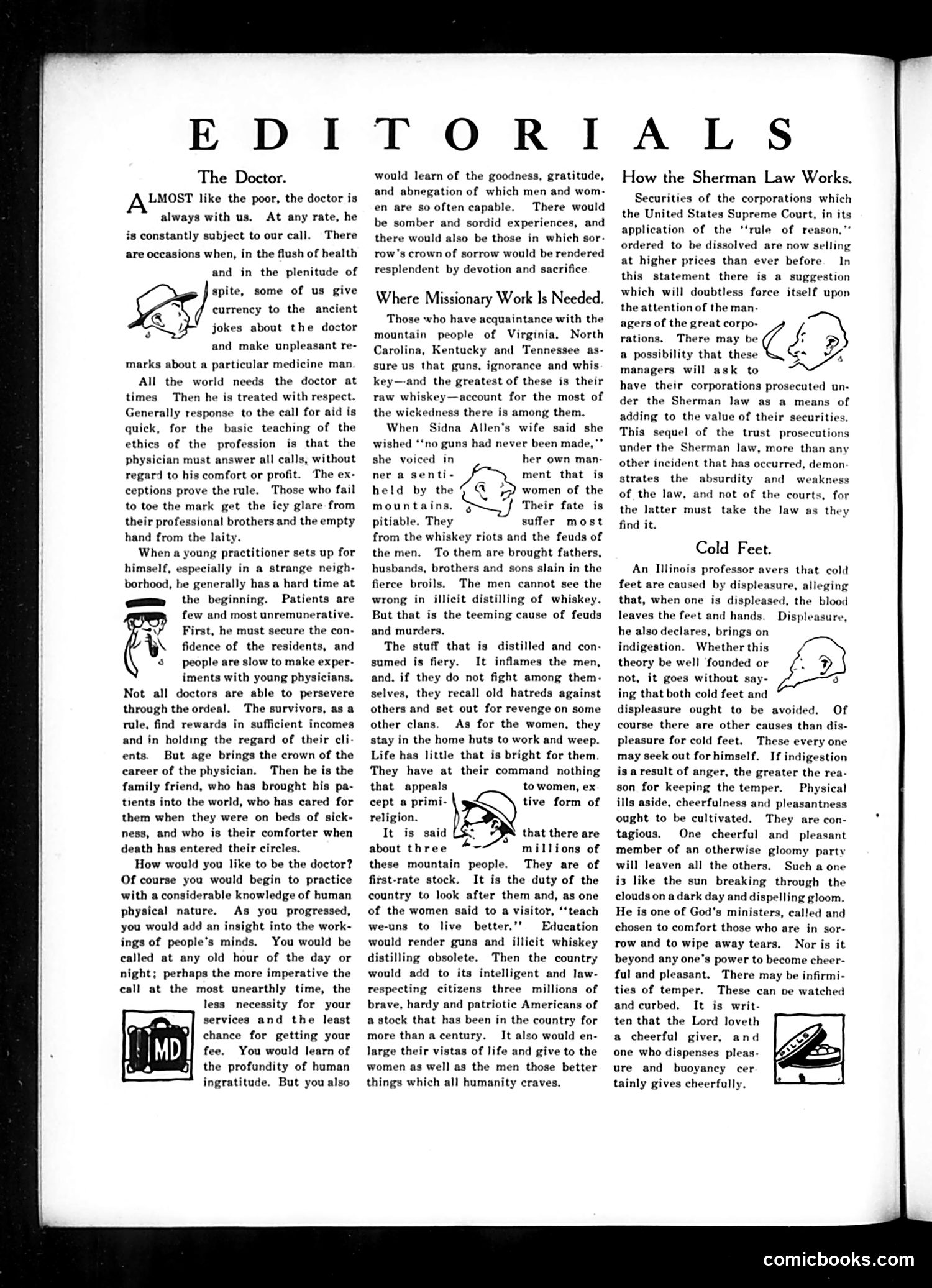
This page contains three separate editorials rather than political cartoons. "The Doctor" praises physicians for their service and dedication, noting they work without regard for comfort or profit. "Where Missionary Work Is Needed" argues for education to combat whiskey distilling and related violence in Appalachian regions (Virginia, North Carolina, Kentucky, Tennessee), attributing feuds and murders to illicit alcohol production. "Cold Feet" discusses an Illinois professor's claim that cold causes blood to leave extremities, leading to indigestion—offering advice on maintaining cheerfulness and temperament to counter such effects. The small illustrated heads accompanying each editorial appear decorative rather than caricatures of specific individuals. No clear political figures or events are referenced; these are general social commentary pieces typical of Judge's editorial voice.
📄 Transcribed text from this page (OCR, searchable)
Machine-transcribed from the original scan — historical spelling and the odd misread are preserved.
EDITORIALS How the Sherman Law Works. Securities of the corporations which the United States Supreme Court, in its application of the ‘‘rule of reason,’* ordered to be dissolved are now selling at higher prices than ever before In this statement there is a suggestion which will doubtless force itself upon The Doctor. LMOST like the poor, the doctor is always with us. At any rate, he constantly subject to our call. There are occasions when, in the flush of health and in the plenitude of spite, some of us give currency to the ancient jokes about the doctor and make unpleasant re- marks about a particular medicine man. All the world needs the doctor at times Then he is treated with respect. Generally response to the call for aid is quick, for the basic teaching of the ethics of the profession is that the physician must answer all calls, without regard to his comfort or profit. The ex- ceptions prove the rule. Those who fail to toe the mark get the icy glare from their professional brothers and the empty hand from the laity. When a young practitioner sets up for himself, especially in a strange neigh- borhood, he generally has a hard time at umm =the beginning. Patients are few and most unremunerative. =\ First, he must secure the con- aN fidence of the residents, and ‘S people are slow to make exper- iments with young physicians, Not all doctors are able to persevere through the ordeal. The survivors, as a tule, find rewards in sufficient incomes and in holding the regard of their cli- ents. But age brings the crown of the career of the physician. Then he is the family friend, who has brought his pa- tients into the world, who has cared for them when they were on beds of sick- ness, and who is their comforter when death has entered their circles, How would you like to be the doctor? Of course you would begin to practice with a considerable knowledge of human physical nature. As you progressed, you would add an insight into the work- ings of people's minds. You would be called at any old hour of the day or night; perhaps the more imperative the call at the most unearthly time, the less necessity for your services and the least chance for getting your fee. You would learn of the profundity of human ingratitude. But you also would learn of the goodness, gratitude, and abnegation of which men and wom- en are so often capable. There would be somber and sordid experiences, and there would also be those in which sor- row's crown of sorrow would be rendered resplendent by devotion and sacrifice Where Missionary Work Is Needed. Those who have acquaintance with the mountain people of Virginia, North Carolina, Kentucky and Tennessee as- sure us that guns, ignorance and whis key—and the greatest of these is their raw whiskey—account for the most of the wickedness there is among them. When Sidna Allen's wife said she wished ‘‘no guns had never been made,”’ she her own man- ner a senti- ment that is held by the q > women of the mountains. > Their fate is pitiable. They suffer most from the whiskey riots and the feuds of the men. To them are brought fathers, husbands, brothers and sons slain in the fierce broils, The men cannot see the wrong in illicit distilling of whiskey. But that is the teeming cause of feuds and murders, The stuff that is distilled and con- sumed is fiery. It inflames the men, and, if they do not fight among them- selves, they recall old hatreds against others and set out for revenge on some other clans. As for the women, they stay in the home huts to work and weep. Life has little that is bright for them. They have at their command nothing that appeals to women, ex cept a primi- tive form of religion. It is said voiced in that there are about three ~ millions of these mountain people. They are of first-rate stock. It is the duty of the country to look after them and, as one of the women said to a visitor, ‘‘teach we-uns to live better." Education would render guns and illicit whiskey distilling obsolete. Then the country would add to its intelligent and law- respecting citizens three millions of brave, hardy and patriotic Americans of a stock that has been in the country for more than acentury. It also would en- large their vistas of life and give to the women as well as the men those better things which all humanity craves. the attention of the man- agers of the great corpo- rations. There may be Cé P a possibility that these managers will ask to ‘8 have their corporations prosecuted un- der the Sherman law as a means of adding to the value of their securi i This sequel of the trust prosecutions under the Sherman law, more than any other incident that has occurred, demon- strates the absurdity and weakness of the law, and not of the courts, for the latter must take the law as they find it. Cold Feet. An Illinois professor avers that cold feet are caused by displeasure, alleging that, when one is displeased, the blood leaves the feet and hands. he also declares, brings on Whether this indigestion. Displeasure, theory be well founded or not, it goes without say- ing that both cold feet and displeasure ought to be avoided. of course there are other causes than dis- pleasure for cold feet. may seek out for himself. These every one If indigestion is a result of anger, the greater the rea- son for keeping the temper. Physical ills aside, cheerfulness and pleasantness ought to be cultivated. tagious. One cheerful member of an otherwise will leaven all the others, They are con- and pleasant gloomy party Such a one is like the sun breaking through the clouds on a dark day and dispelling gloom. He is one of God's ministers, called and chosen to comfort those who are in sor- row and to wipe away tears. Nor is it beyond any one’s power to become cheer- ful and pleasant. ties of temper. and curbed. It is writ- ten that the Lord loveth a cheerful giver, and one who dispenses pleas- ure and buoyancy cer tainly gives cheerfully. There may be infirmi- These can oe watched comicbooks.com