
Judge, 1912-04-13 · page 8 of 24
Judge — April 13, 1912 — page 8: what you’re looking at
What you’re looking at
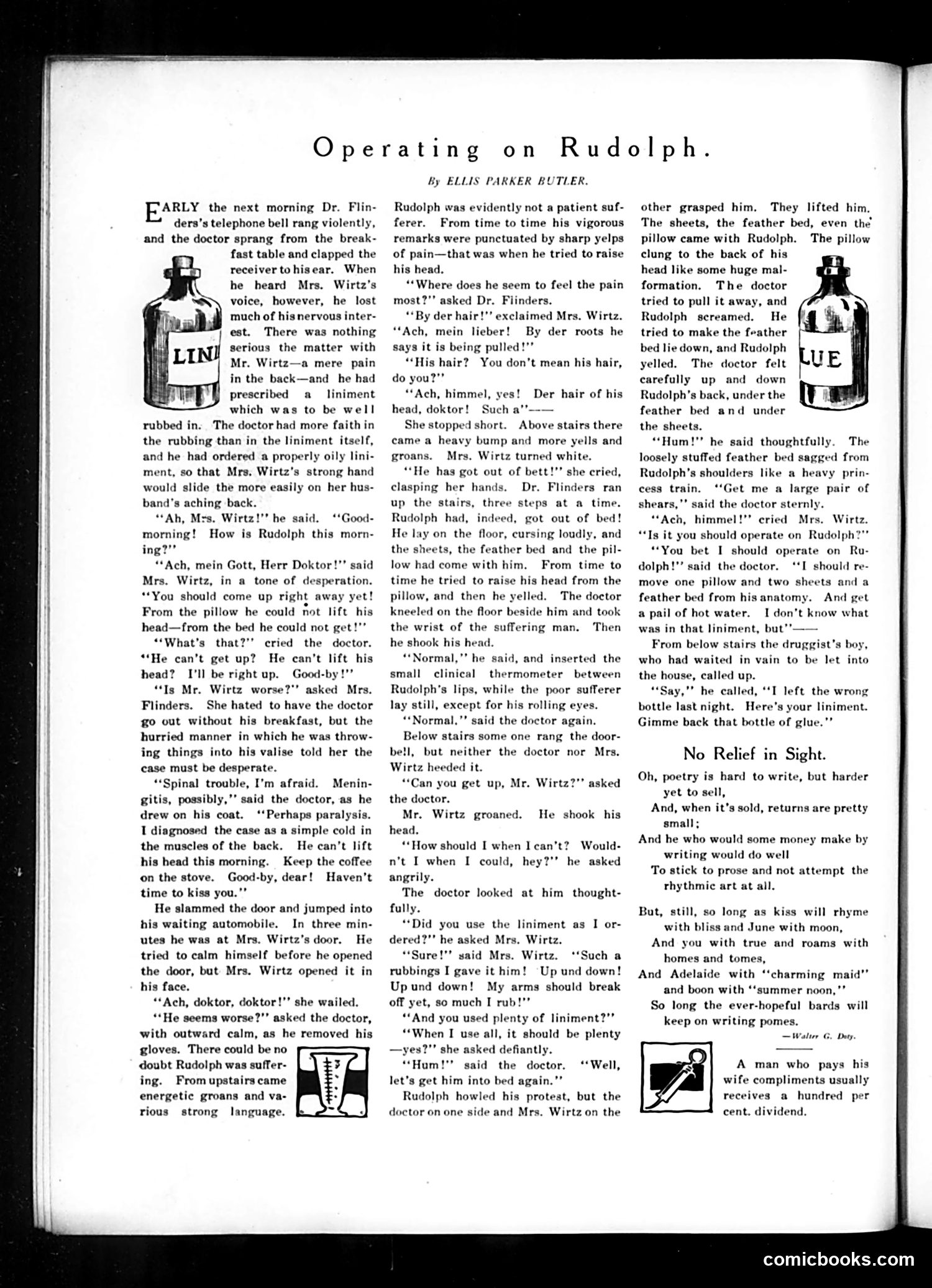
This humorous story satirizes hypochondria and marital dynamics in early 20th-century America. Mr. Rudolph Wirtz, a German-immigrant character (indicated by his accent and speech patterns), calls his doctor for a severe back problem. Dr. Flinders initially suspects serious conditions—spinal trouble, meningitis, paralysis—but the mystery deepens when Rudolph cannot lift his head or leave bed. The joke's payoff (visible in text but climaxing beyond this page) appears to be that Rudolph's dramatic incapacity stems from his wife's vigorous application of liniment—she literally rubbed so hard she caused his predicament. The satire mocks both Wirtz's exaggerated suffering and the era's tendency toward medical alarmism. The German-immigrant characterization was common in Judge's humor, often portraying working-class foreigners as amusingly dramatic or obstinate.
📄 Transcribed text from this page (OCR, searchable)
Machine-transcribed from the original scan — historical spelling and the odd misread are preserved.
Operating on ARLY the next morning Dr. Flin- ders’s telephone bell rang violently, and the doctor sprang from the break- fast table and clapped the receiver tohisear. When he heard Mrs. Wirtz’s voice, however, he lost much of his nervous inter- est. There was nothing serious the matter with Mr. Wirtz—a mere pain in the back—and he had prescribed a liniment which was to be well rubbed in. The doctor had more faith in the rubbing than in the liniment itself, and he had ordered a properly oily lini- ment, so that Mrs, Wirtz’s strong hand would slide the more easily on her hus- band’s aching back. “Ah, Mrs. Wirtz!"" he said. morning! ing?” “Ach, mein Gott, Herr Doktor!”’ said Mrs. Wirtz, in a tone of desperation. ‘ou should come up right away yet! From the pillow he could hot lift his head—from the bed he could not get!" “‘What'’s that?’’ cried the doctor. “He can’t get up? He can’t lift his head? I'll be right up. " “Is Mr. Wirtz worse?"’ asked Mrs. Flinders. She hated to have the doctor go out without his breakfast, but the hurried manner in which he was throw- ing things into his valise told her the case must be desperate. “Spinal trouble, I’m afraid. Menin- gitis, possibly,’’ said the doctor, as he drew on his coat. Perhaps paralysis. I diagnosed the case as a simple cold in the muscles of the back. He can’t lift his head this morning. Keep the coffee on the stove. Good-by, dear! Haven't time to kiss you."’ He slammed the door and jumped into his waiting automobile. In three min- utes he was at Mrs. Wirtz’s door. He tried to calm himself before he opened the door, but Mrs. Wirtz opened it in his face. ‘Ach, doktor, doktor!"’ she wailed. **He seems worse?’’ asked the doctor, with outward calm, as he removed his gloves. There could be no doubt Rudolph was suffer- [ 5 ra “*Good- How is Rudolph this morn- Good-b ing. From upstairs came energetic groans and va- rious strong language. By ELLIS PARKER BUTLER. Rudolph was evidently not a patient suf- ferer. From time to time his vigorous remarks were punctuated by sharp yelps of pain—that was when he tried to raise his head. “*Where does he seem to feel the pain most?"’ asked Dr. Flinders. “By der hair!"’ exclaimed Mrs. Wirtz. “Ach, mein lieber! By der roots he says it is being pulled!’’ “His hair? You don't mean his hair, do you?” “Ach, himm head, doktor! She stopped short. Above stairs there came a heavy bump and more yells and groans. Mrs, Wirtz turned white. “He has got out of bett!’’ she cried, clasping her hands. Dr. Flinders ran up the stairs, three steps at a time. Rudolph had, indeed, got out of bed! He lay on the floor, cursing loudly, and ts, the feather bed and the pil- low had come with him, From time to time he tried to raise his head from the pillow, and then he yelled. The doctor kneeled on the floor beside him and took the wrist of the suffering man. Then he shook his head. “‘Normal,’’ he said, and inserted the small clinical Rudolph’s lips, while the poor sufferer lay still, except for his rolling eyes. ‘*Normal,”’ said the doctor again. Below stairs some one rang the door- bell, but neither the doctor nor Mrs, Wirtz heeded it. “Can you get up, Mr. Wirtz?” asked the doctor. Mr. Wirtz groaned. head. “*How should I when I can’t? n't I when I could, hey?"’ he angrily. The doctor looked at him thought- fully. “Did you use the liniment as I or- dered?"' he asked Mrs, Wirtz. “*Sure!’’ said Mrs. Wirtz. ‘Such a rubbings I gave it him! Up und down! Up und down! My arms should break off yet, so much I rub! “And you used plenty of liniment?”” “When I use all, it should be plenty —yes?'’ she asked defiantly. “Hum!"" said the doctor. let’s get him into bed again.”” Rudolph howled his protest, but the doctor on one side and Mrs. Wirtz on the the she thermometer between He shook his Would- asked “Well, Rudolph. other grasped him. They lifted him. The sheets, the feather bed, even the pillow came with Rudolph. The pillow clung to the back of his head like some huge mal- formation. The doctor tried to pull it away, and Rudolph screamed. He tried to make the feather bed lie down, and Rudolph yelled. The doctor felt carefully up and down Rudolph’s back, under the feather bed and under the sheets. “‘Hum!"’ he said thoughtfully. The loosely stuffed feather bed sagged from Rudolph’s shoulders like a heavy prin- cess train. ‘‘Get me a large pair of shears,"’ said the doctor sternly. “Ach, Mrs. Wirtz. “Is it you should operate on Rudolph?" “You bet I should operate on Ru- dolph!"’ said the doctor. ‘‘I should re- move one pillow and two sheets and a feather bed from his anatomy. And get a pail of hot water. I don’t know what was in that liniment, but’'—— From below stairs the druggist'’s boy, n vain to be let into himmel!"" cried who had waited the house, called up. “Say,’’ he called, ‘I left the wrong bottle last night. Here's your liniment. Gimme back that bottle of glue."’ No Relief in Sight. Oh, poetry is hard to write, but harder yet to sell, And, when it’s sold, returns are pretty small; And he who would some money make by writing would do well To stick to prose and not attempt the rhythmic art at all. But, still, with bl And you with true and roams with homes and tomes, And Adelaide with ‘‘charming maid"’ and boon with ‘summer noon,’’ So long the ever-hopeful bards will keep on writing pomes. —Walter G. Dots long as kiss will rhyme sand June with moon, A man who pays his wife compliments usually receives a hundred per cent. dividend, comicbooks.com