
A complete issue · 24 pages · 1912
Judge — March 9, 1912
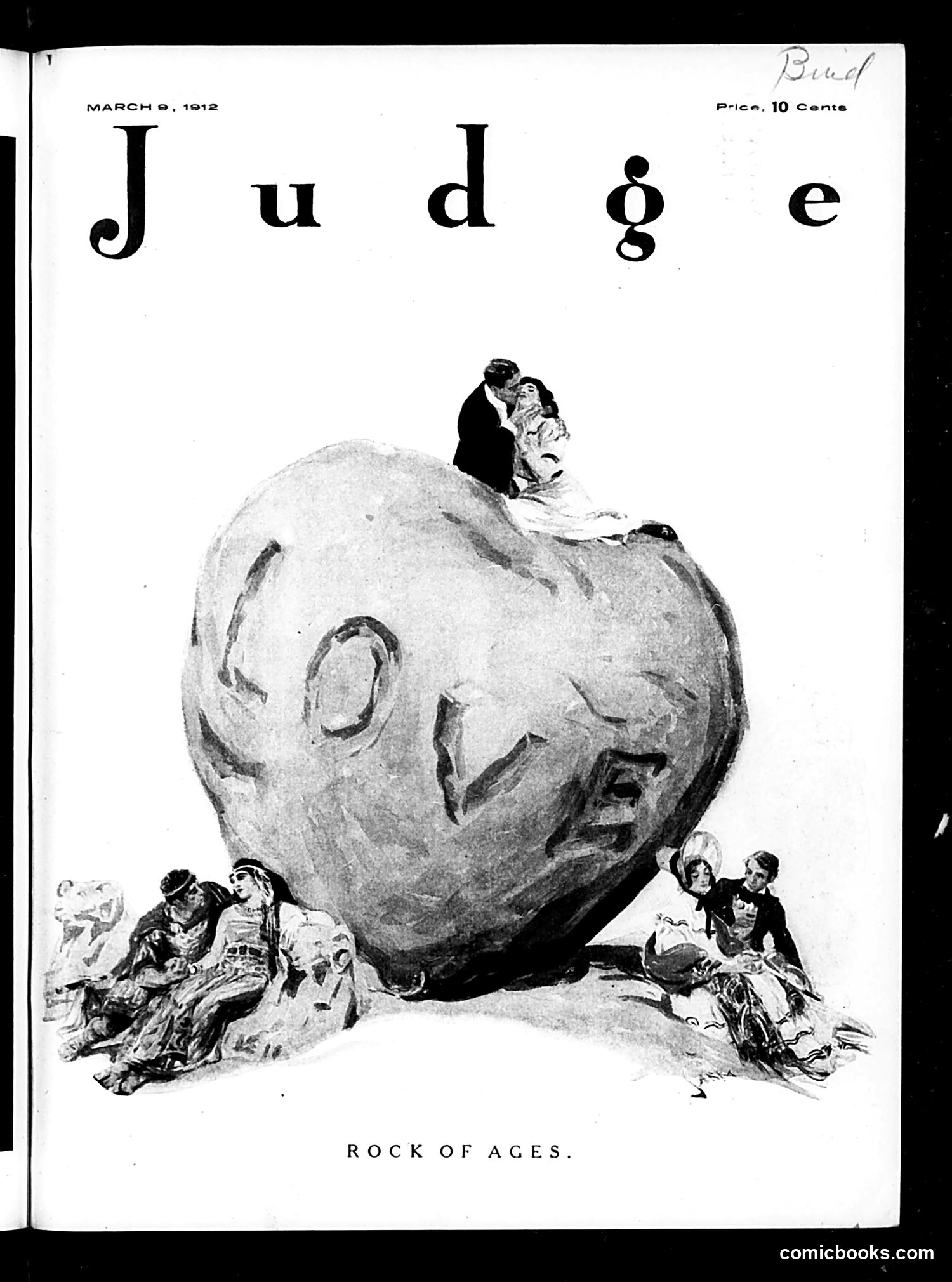
This satirical cover depicts "Rock of Ages"—a massive stone head with exaggerated facial features sitting among small human figures. The title references the hymn and suggests stability or permanence, but the cartoon appears to critique something or someone as immovable and monolithic. The exact political reference is unclear without additional context, though 1912 was a significant election year (Taft vs. Roosevelt vs. Wilson). The "rock" likely represents either a political figure, an institution, or an entrenched ideology that the cartoonist views as stolid, unchanging, and dominating the landscape—with ordinary citizens literally dwarfed beside it. The tiny figures' positioning emphasizes powerlessness against this massive, impassive force.
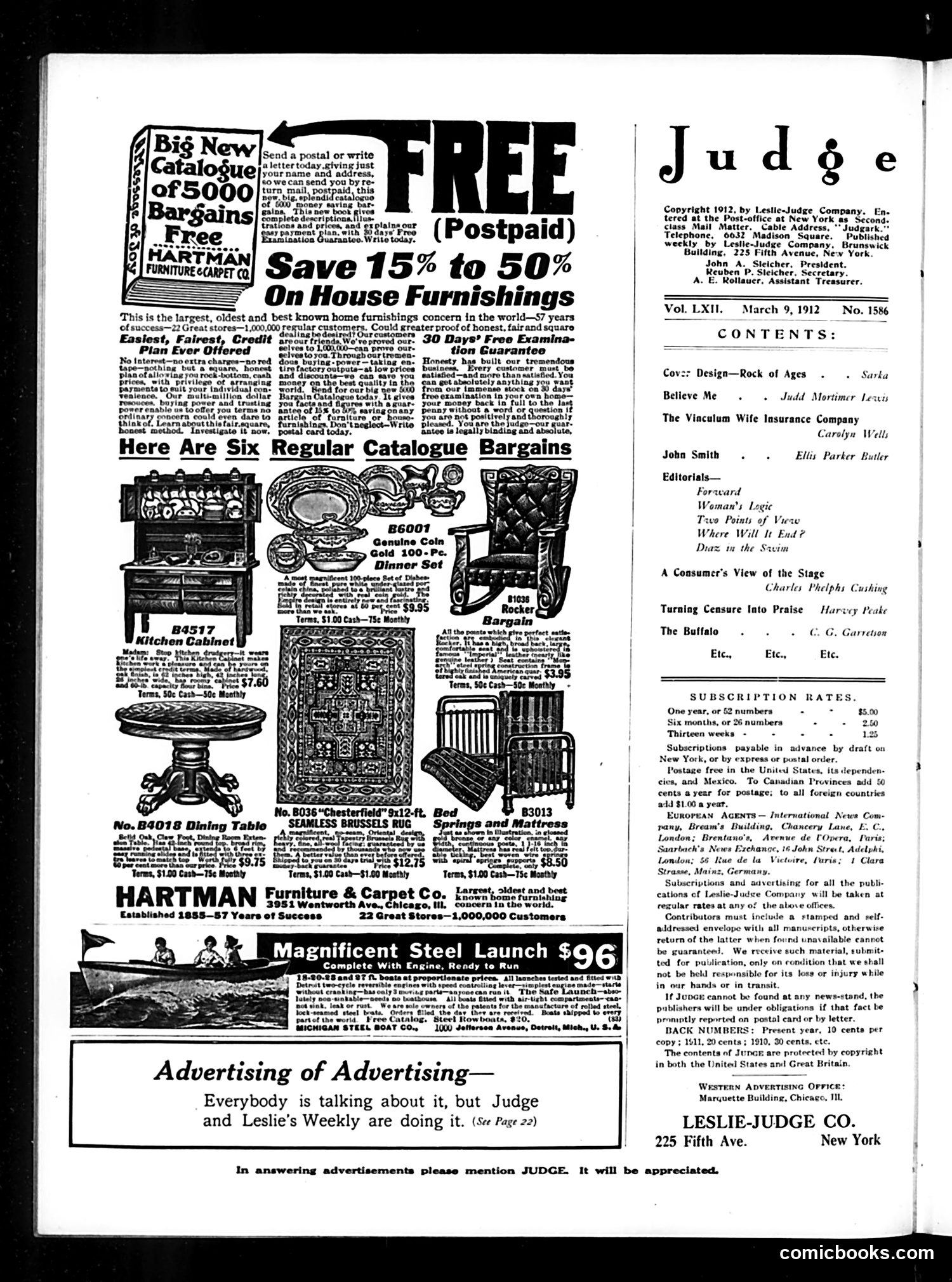
This page is primarily **advertising and masthead content** rather than political cartoons. The left side features Hartman Furniture Company advertisements showcasing dining tables, chairs, and dinnerware sets with savings of 15-50%. A steel boat company also advertises a "$96 Magnificent Steel Launch." The only editorial content appears at bottom: "Advertising of Advertising" notes that "Judge and Leslie's Weekly are doing it," suggesting the magazines are promoting themselves as effective advertising platforms (see page 22 for details). The right side displays typical magazine masthead information: copyright, subscription rates, and contents listing articles like "Design—Rock of Ages" and "The Visacum Wife Insurance Company." This is essentially a **trade publication page**, not satirical commentary.
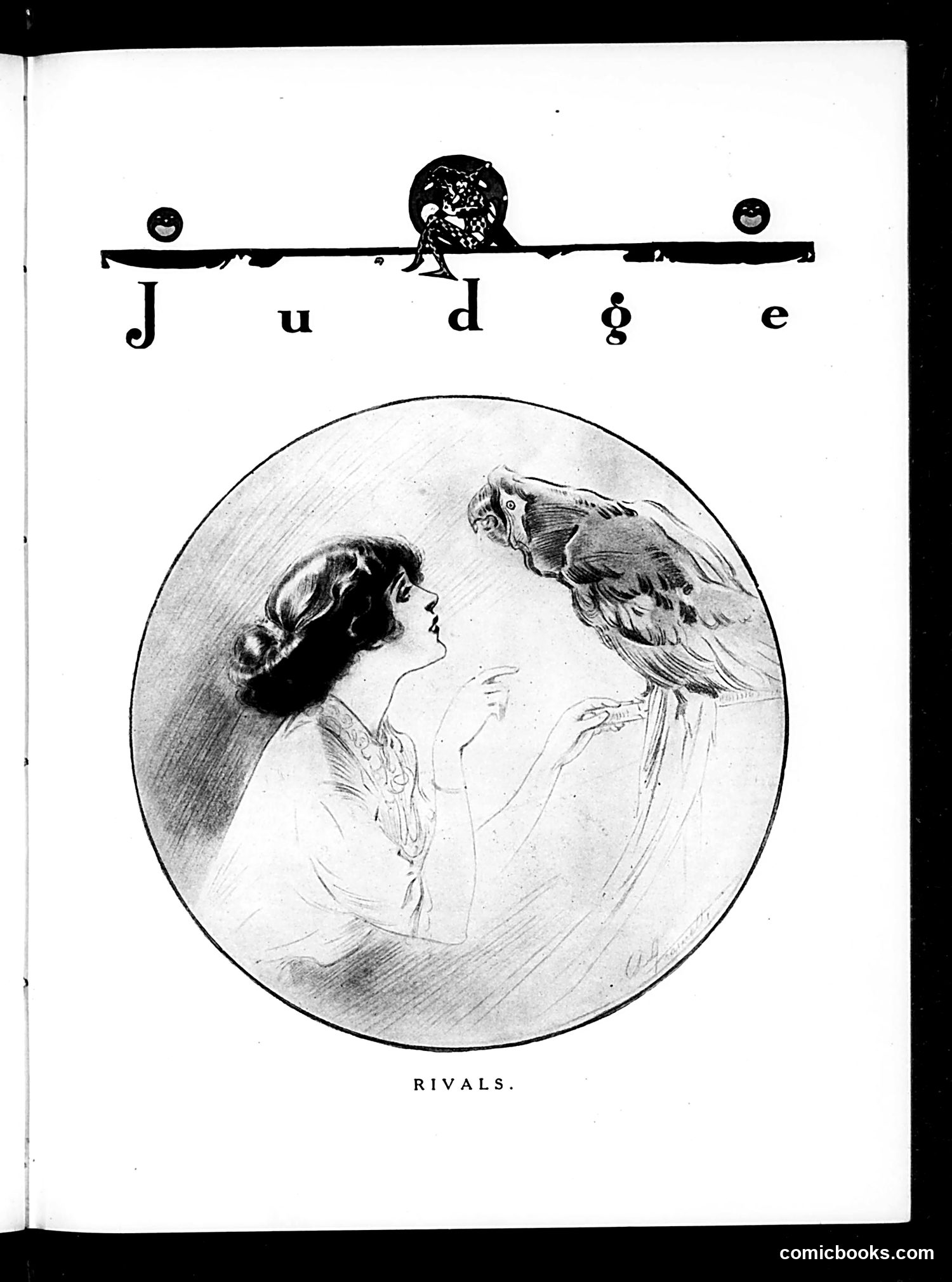
This page from *Judge* magazine features a circular illustration titled "Rivals" showing a woman in profile gazing at an owl perched on her shoulder. The page header reads "Judge" with decorative elements including small smiling faces. The cartoon appears to be a visual pun or romantic commentary: the woman admires the owl as a potential suitor or romantic interest. The satire likely plays on the owl's association with wisdom or the absurdity of courtship choices. Without additional context about the magazine's publication date, I cannot identify the specific historical or political references this may contain, though the Art Nouveau styling suggests early 20th-century origin. The humor seems primarily visual and romantic rather than explicitly political.
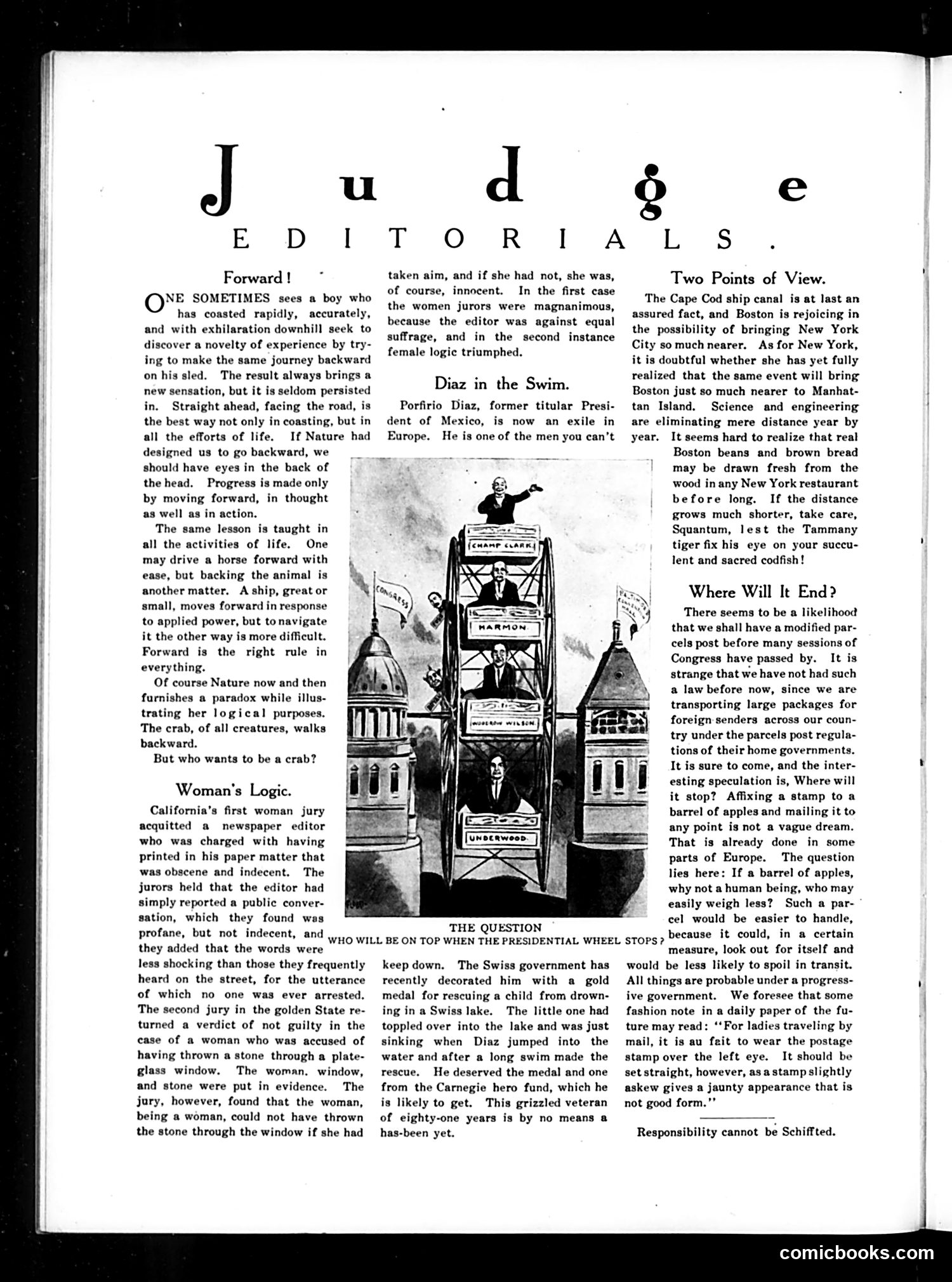
This is an editorial page featuring four separate opinion pieces and one central illustration titled "THE QUESTION: WHO WILL BE ON TOP WHEN THE PRESIDENTIAL WHEEL STOPS?" The cartoon shows a large rotating wheel with multiple men stacked vertically inside it—representing candidates competing for the presidency. The wheel appears to be stopping, symbolizing the election outcome determining who will be "on top." The surrounding editorials discuss contemporary issues: California's first female jury verdict (praising women's logic), Porfirio Díaz's exile from Mexico, distance reduction between East Coast cities via engineering projects, and speculation about parcel post regulations. The cartoon's central joke concerns presidential succession uncertainty—which candidate will ultimately win when the electoral "wheel" stops spinning.
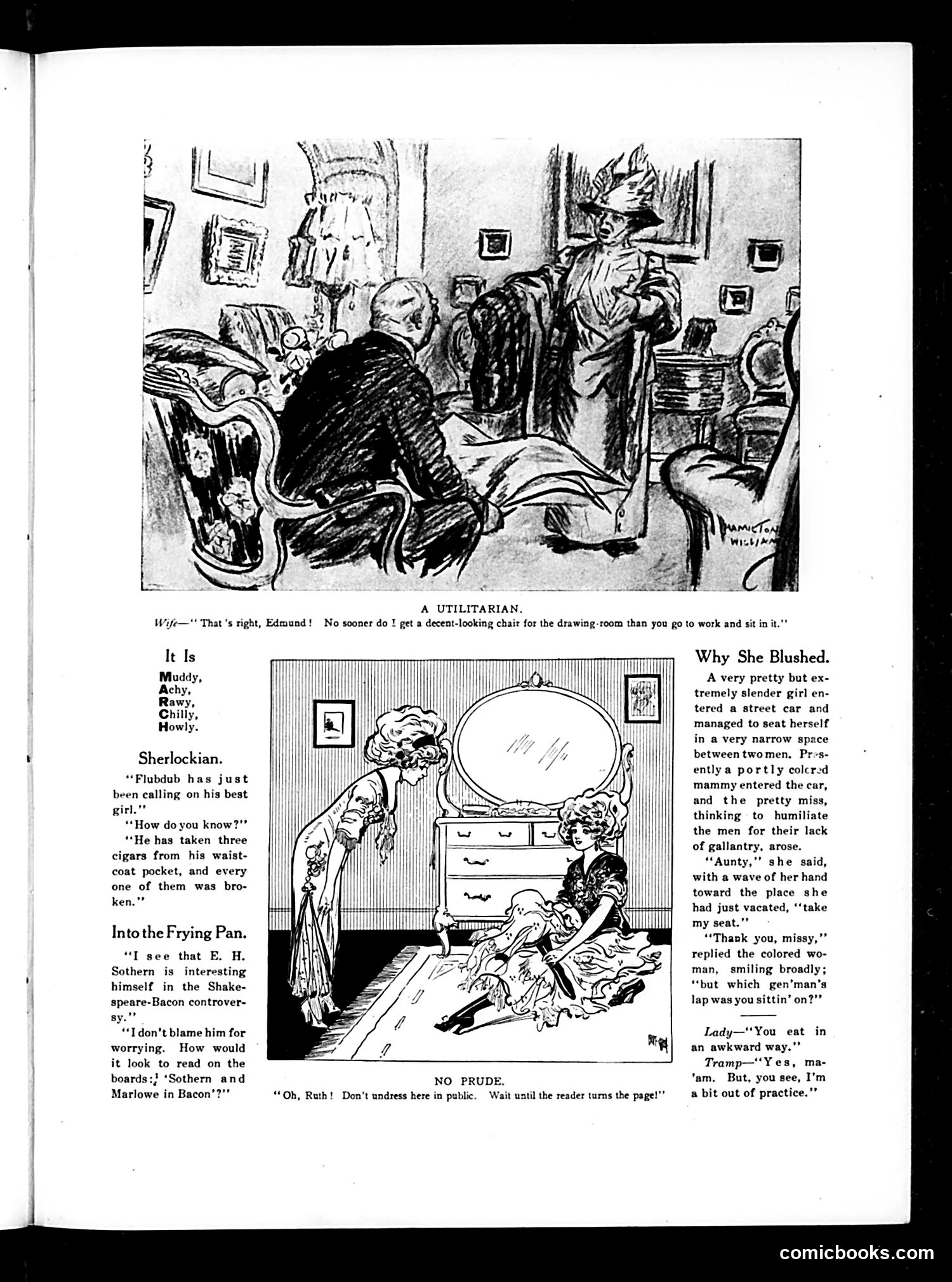
This page contains four separate humor pieces typical of early 20th-century Judge magazine: 1. **"A Utilitarian"** (top): A domestic scene satirizing furniture practicality—a wife mocks her husband for immediately sitting in a new drawing-room chair, suggesting he prioritizes comfort over aesthetics. 2. **"It Is"** (left): A wordplay joke listing synonyms for "messy" (Muddy, Achy, Rawy, Chilly, Howly) in response to "Sherlockian" detective work. 3. **"Why She Blushed"** (right): A woman on a crowded streetcar is embarrassed when a colored woman sarcastically thanks her for a seat, implying the white woman's gesture was performative rather than genuinely courteous—commentary on social hypocrisy regarding race relations. 4. **"No Prude"** (bottom): A bathroom humor joke about undressing in public. The content reflects period attitudes, including casual racial stereotyping common in early 1900s American humor magazines.
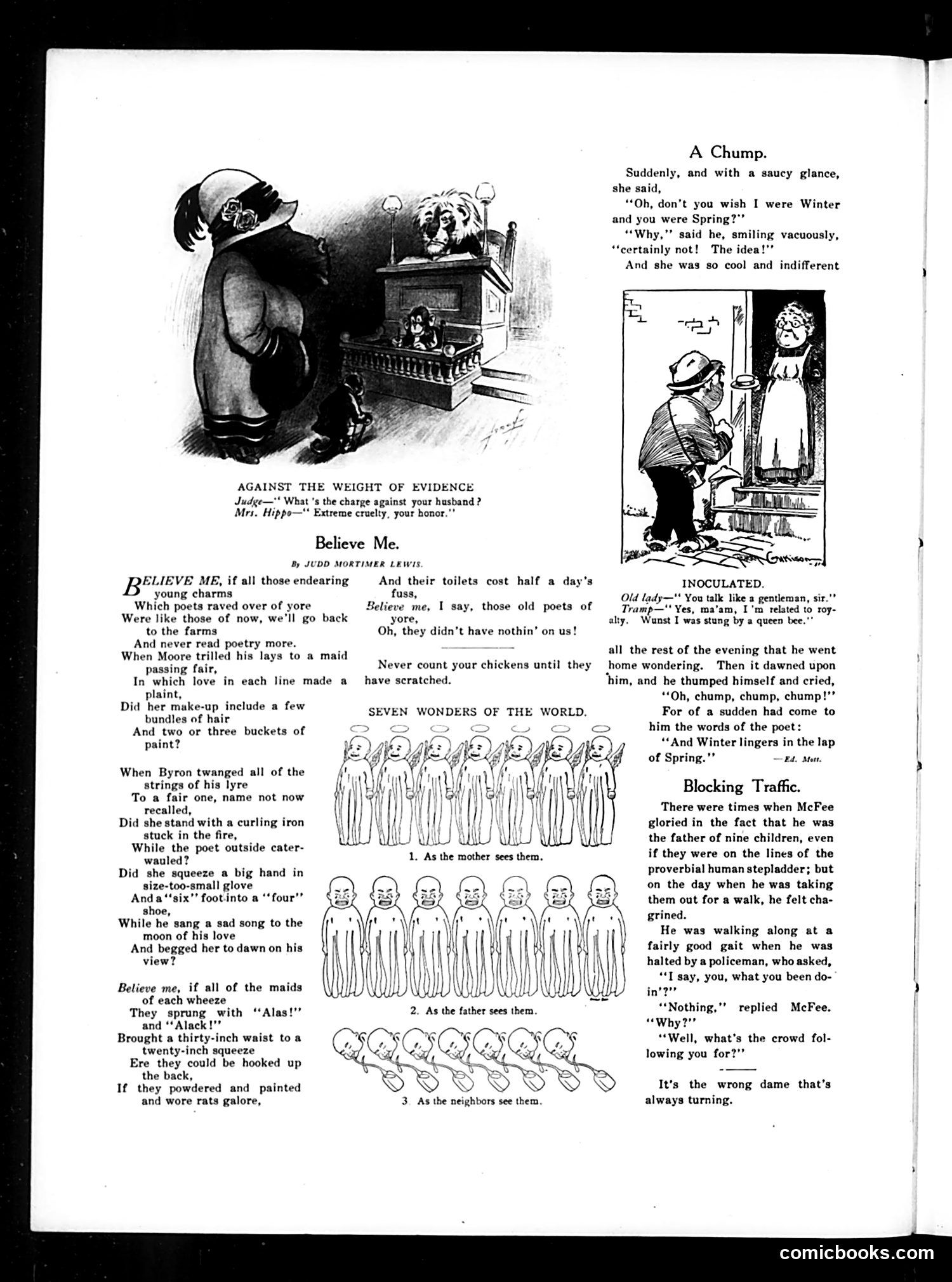
This Judge magazine page contains several satirical pieces mocking early 20th-century social conventions: **"Believe Me"** (main poem): Criticizes modern women's appearance and fashion choices compared to romantic ideals of earlier poetry. The satire attacks women's use of cosmetics, false hair ("rats"), corsets ("thirty-inch waist to a twenty-inch squeeze"), and uncomfortable shoes—suggesting contemporary women sacrificed natural beauty for artificial appearance, unlike the women poets like Byron and Moore supposedly inspired. **"Against the Weight of Evidence"**: A cartoon joke about a hippo wife charging her husband with "extreme cruelty," likely commenting on marital disputes of the era. **"A Chump"**: A man foolishly rejects a woman's romantic proposition, then later regrets it, realizing he missed his chance—a common romantic comedy trope. **"Seven Wonders of the World"**: Simple cartoons showing how children appear different to their mother, father, and neighbors—mildly humorous observation of perspective. **"Blocking Traffic"** and "Inoculated"**: Short anecdotes with modest comedic punchlines about everyday situations. The page primarily satirizes contemporary women's fashion and beauty standards while offering light domestic humor.
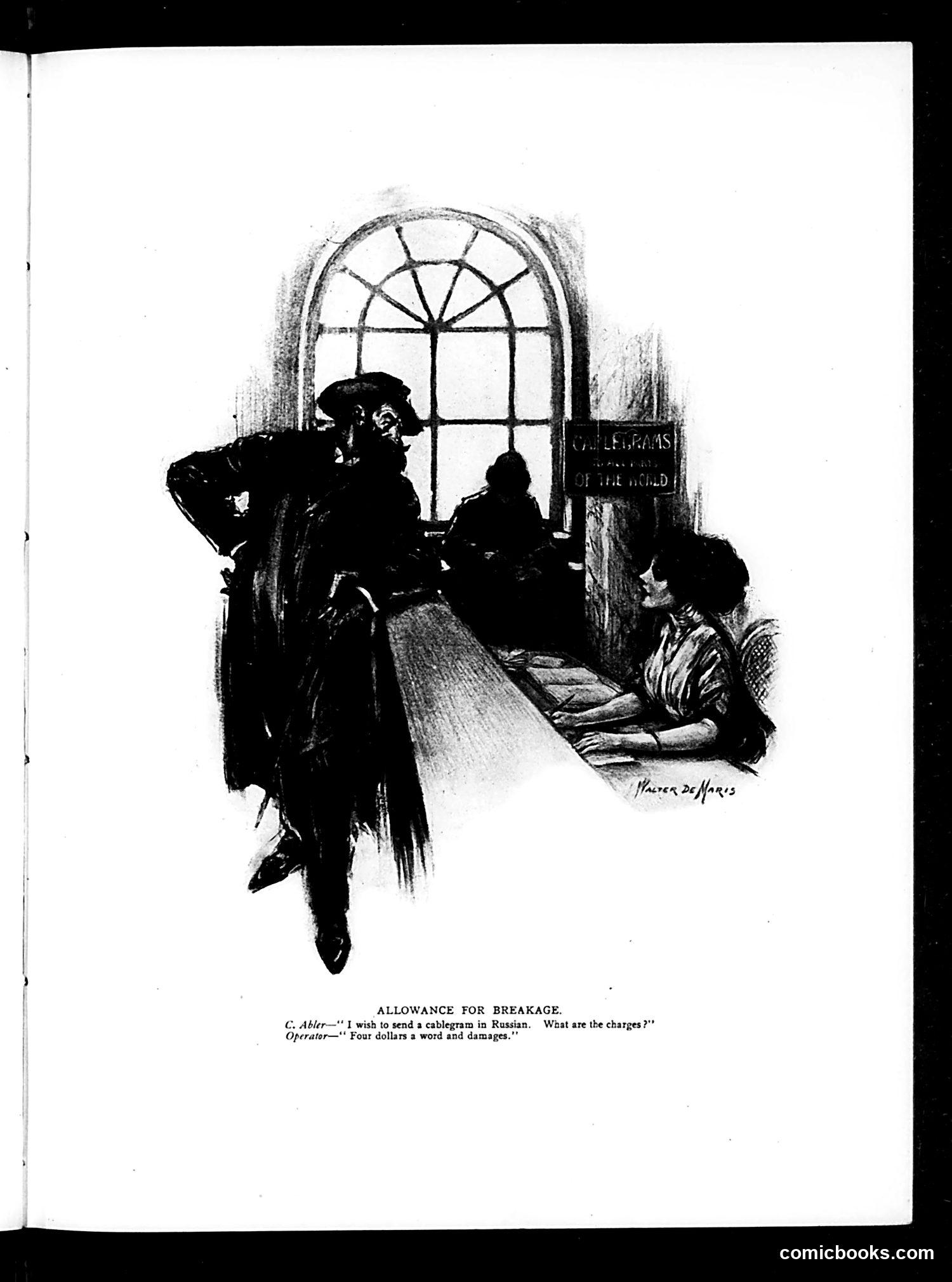
This cartoon satirizes the difficulties of international communication, likely referencing early 20th-century telegraph services. The humor centers on sending messages in Russian, which apparently required an unusual surcharge. The joke plays on "damages"—the operator charges not just per word but adds a fee for "damages," suggesting that Russian-language telegrams were so difficult to transmit or translate that they inherently caused problems or breakage in the communication process. The well-dressed figure (C. Abler) represents a typical customer, while the operator sits in a telegraph office with a large window. The cartoon mocks both the complexity of Russian as a language and perhaps the inefficiency of telegraph companies in handling non-English communications. It's commentary on practical frustrations of international business in the pre-radio era.
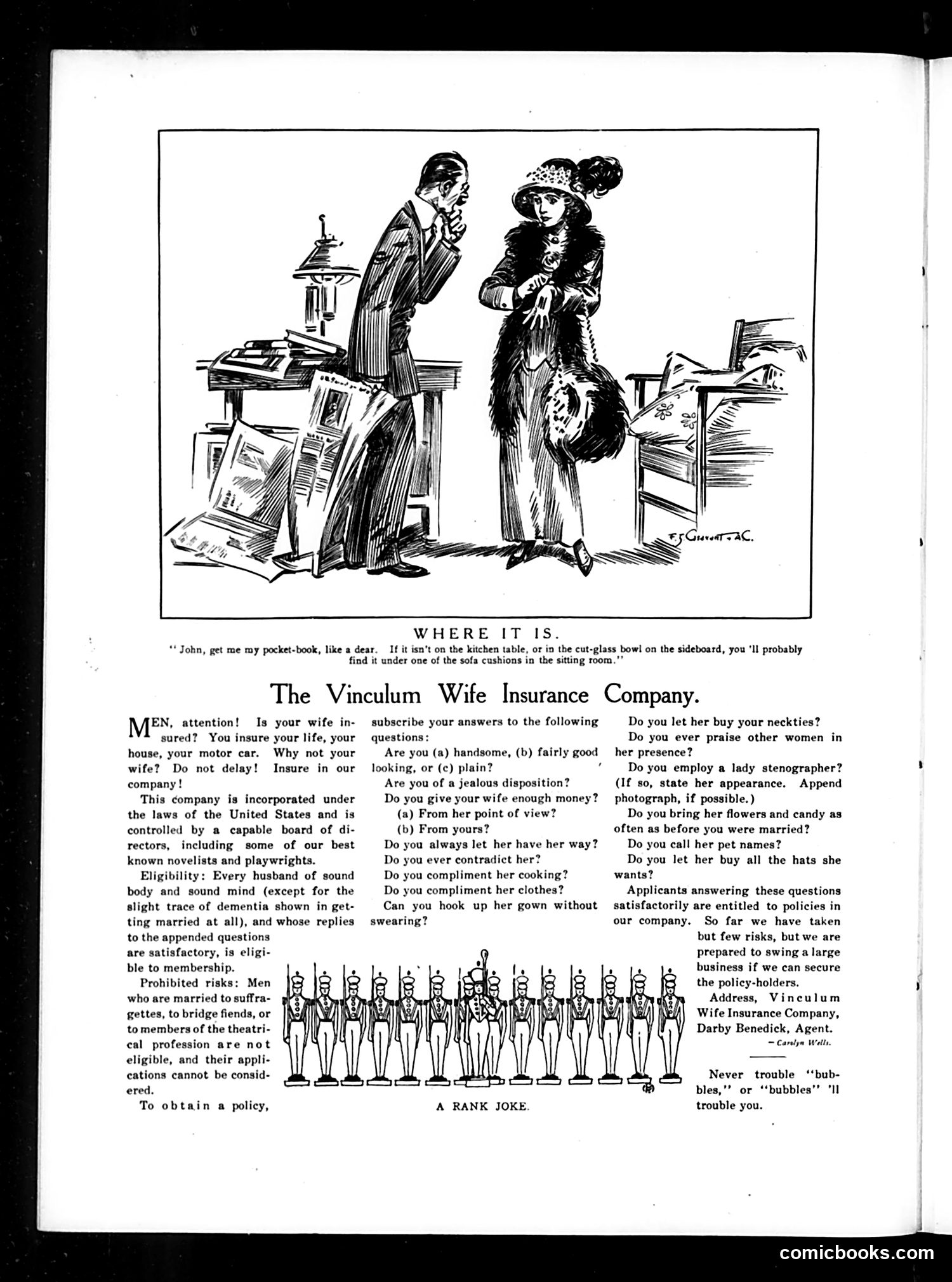
This satirical advertisement mocks both married life and insurance culture. The cartoon depicts a wife asking her husband to locate her pocket-book—implying wives are scatterbrained and dependent on men. The "insurance company" is presented as a tongue-in-cheek solution: husbands should insure their wives like property. The eligibility questions reveal the satire's targets: wives who are suffragettes (women's rights activists), bridge players, or actresses are "prohibited risks," suggesting these independent women threaten traditional marriage. Husbands must answer whether they praise other women, employ attractive stenographers, and whether they've stopped bringing flowers since marriage. The joke mocks both sexes: wives for being frivolous and forgetful; husbands for being foolish enough to marry. The caption "A RANK JOKE" confirms this is satirizing contemporary gender relations and the era's anxiety about women's changing social roles, particularly suffrage activism.
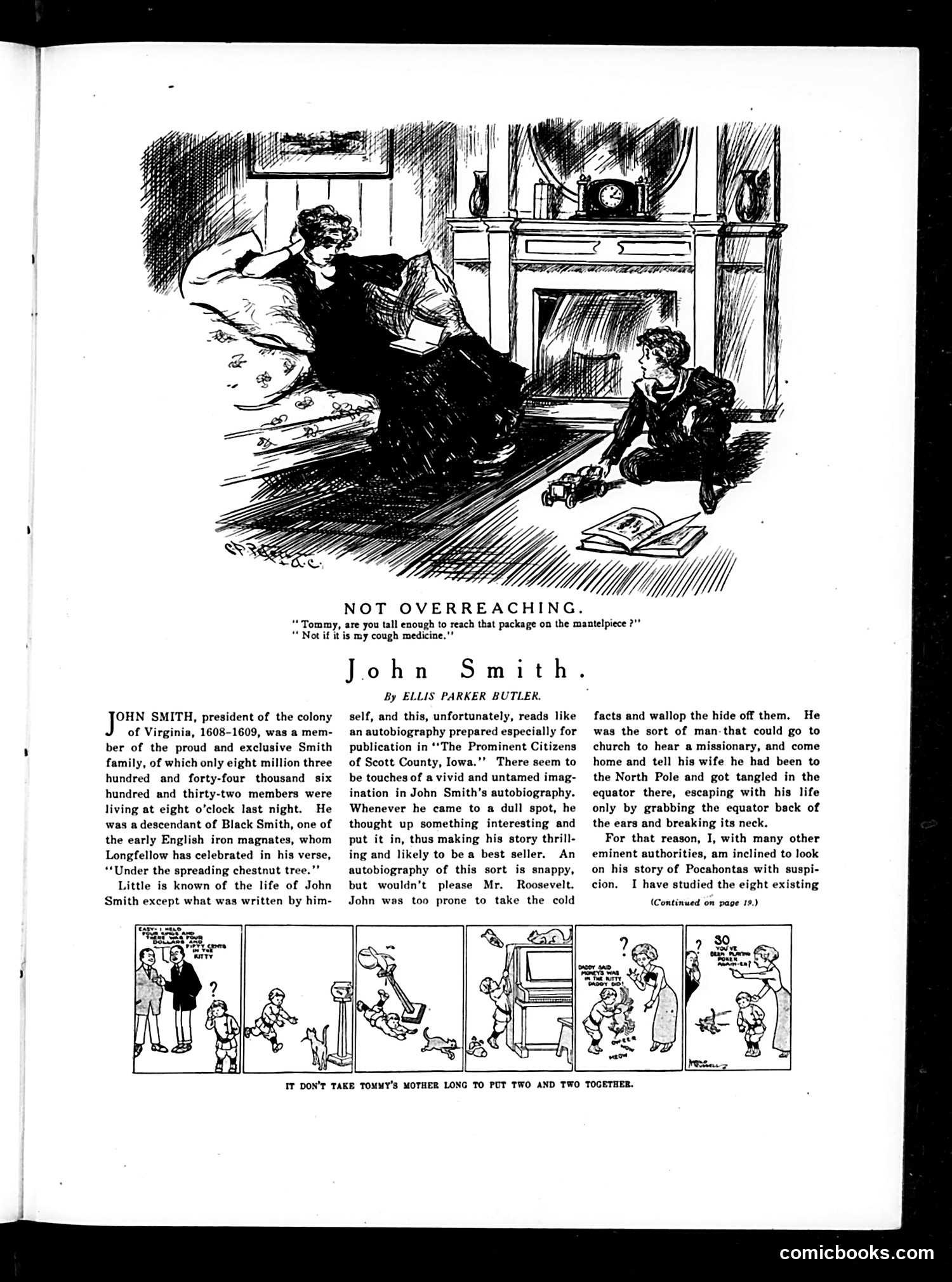
The top cartoon depicts a child asking his mother if he's tall enough to reach a package on the mantelpiece. His refusal—claiming it's his cough medicine—is a humorous double meaning: he's implying the medicine tastes so bad he deliberately can't reach it, avoiding taking it. The accompanying article by Ellis Parker Butler is a satirical biography of John Smith (Virginia colony president, 1608-1609), mocking his inflated autobiography and dubious claims. Butler suggests Smith fabricated details to make his story "thrilling and likely to be a best seller," inventing wildly implausible adventures (like the equator tale). The satire specifically targets Smith's famous Pocahontas story as suspect—Butler claims to have studied "eight existing" accounts questioning its authenticity. The piece humorously suggests Smith was more creative fiction-writer than historian, padding dull facts with entertainment value. The bottom comic strip (caption visible) appears to continue this theme of miscommunication or exaggeration.
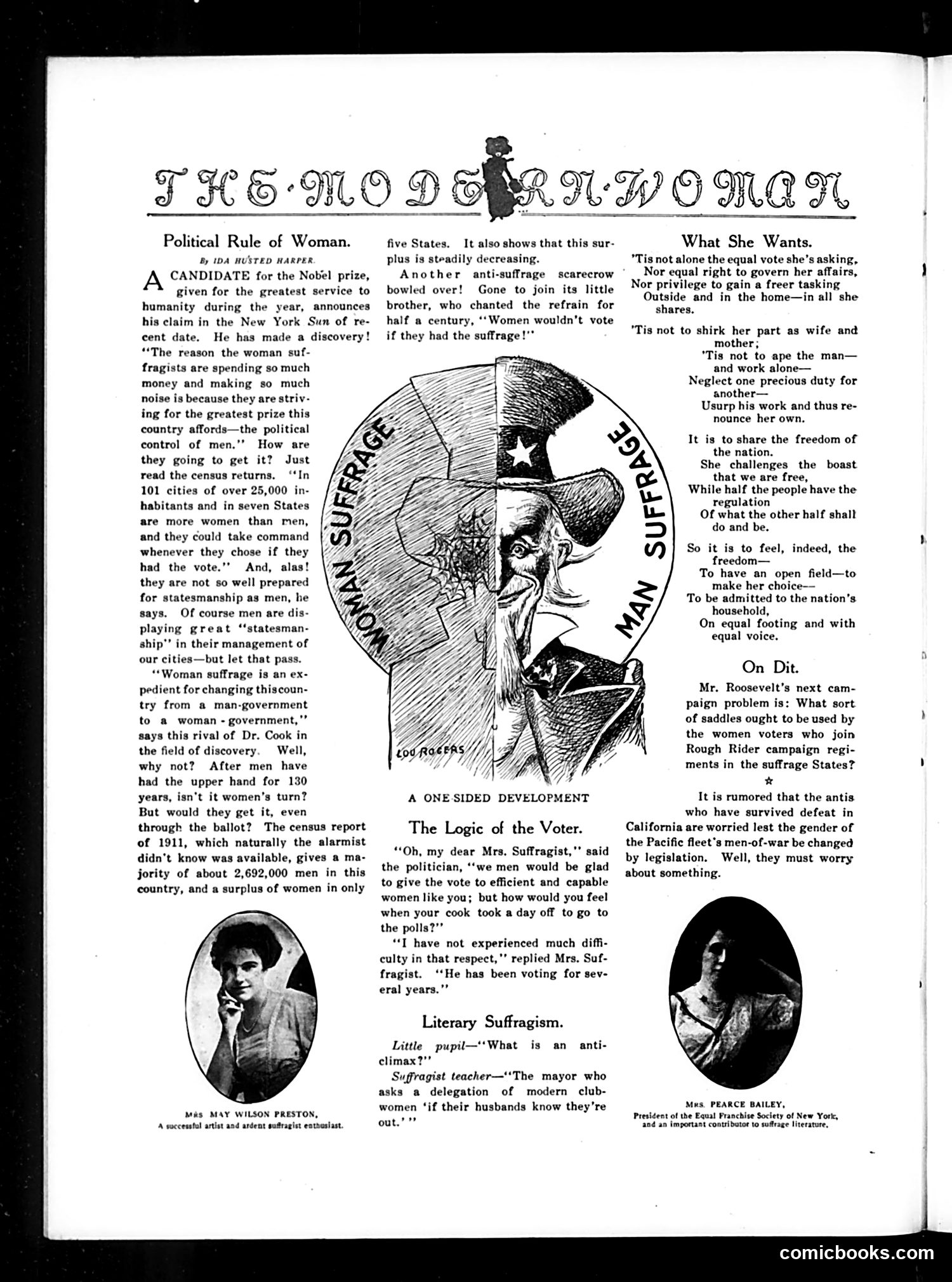
This *Judge* magazine page advocates for women's suffrage by satirizing anti-suffrage arguments. The central cartoon depicts a man labeled "Man Suffrage" and "Woman Suffrage" as a one-sided scale, implying the unequal political power. The main article by Ida Husted Harper rebuts a common anti-suffrage claim: that women outnumber men in certain cities and would "control" politics if voting. Harper cites 1911 census data showing men actually outnumber women nationally—and the female surplus is decreasing. This dismantles the "scare" argument. "The Logic of the Voter" satirizes politicians who object to women voting because servants might skip work to vote—absurd since male servants vote without complaint. The "Literary Suffragism" section mocks anti-suffragists' patronizing attitudes toward clubwomen, asking if their husbands know they're out. "What She Wants" is a earnest poem asserting women seek not special privileges but equal freedom and voice in democracy. The page represents pro-suffrage satire targeting male anxiety about women's political power.
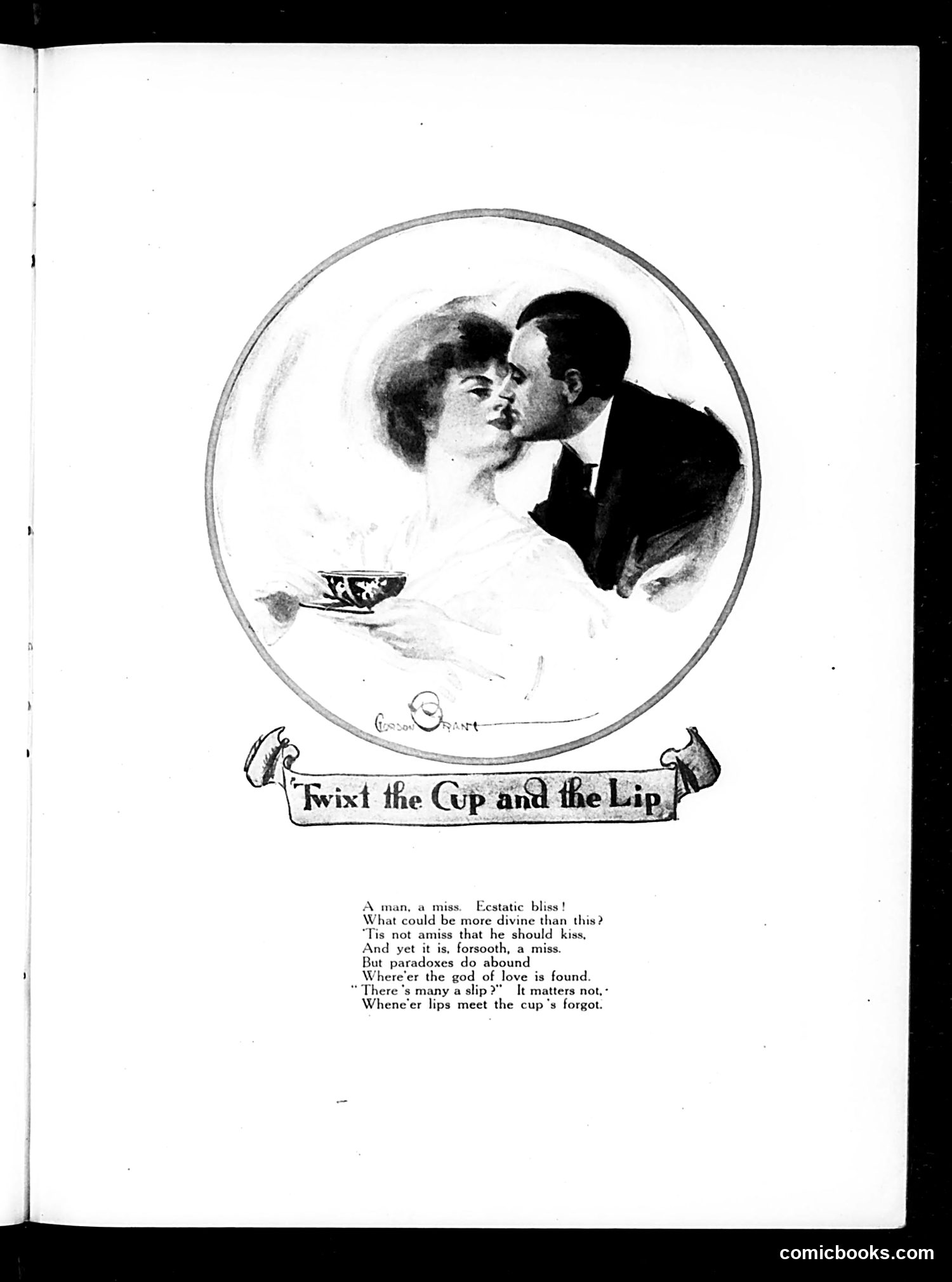
This illustration depicts a romantic moment between a man and woman sharing a kiss, with the woman holding a teacup. The accompanying verse plays on the paradox: kissing is "divine," yet simultaneously "a miss" (a failure). The title references the proverb "there's many a slip 'tween cup and lip"—meaning plans often fail before completion. Here, the satire suggests that when romance and intimacy occur, practical concerns (represented by the teacup) are forgotten or abandoned. The joke centers on the ironic contrast between romantic intention and social propriety—the "slip" being not just a missed cup-sip, but the couple's momentary abandonment of decorum in favor of passion. This reflects early 20th-century attitudes about courtship and propriety.
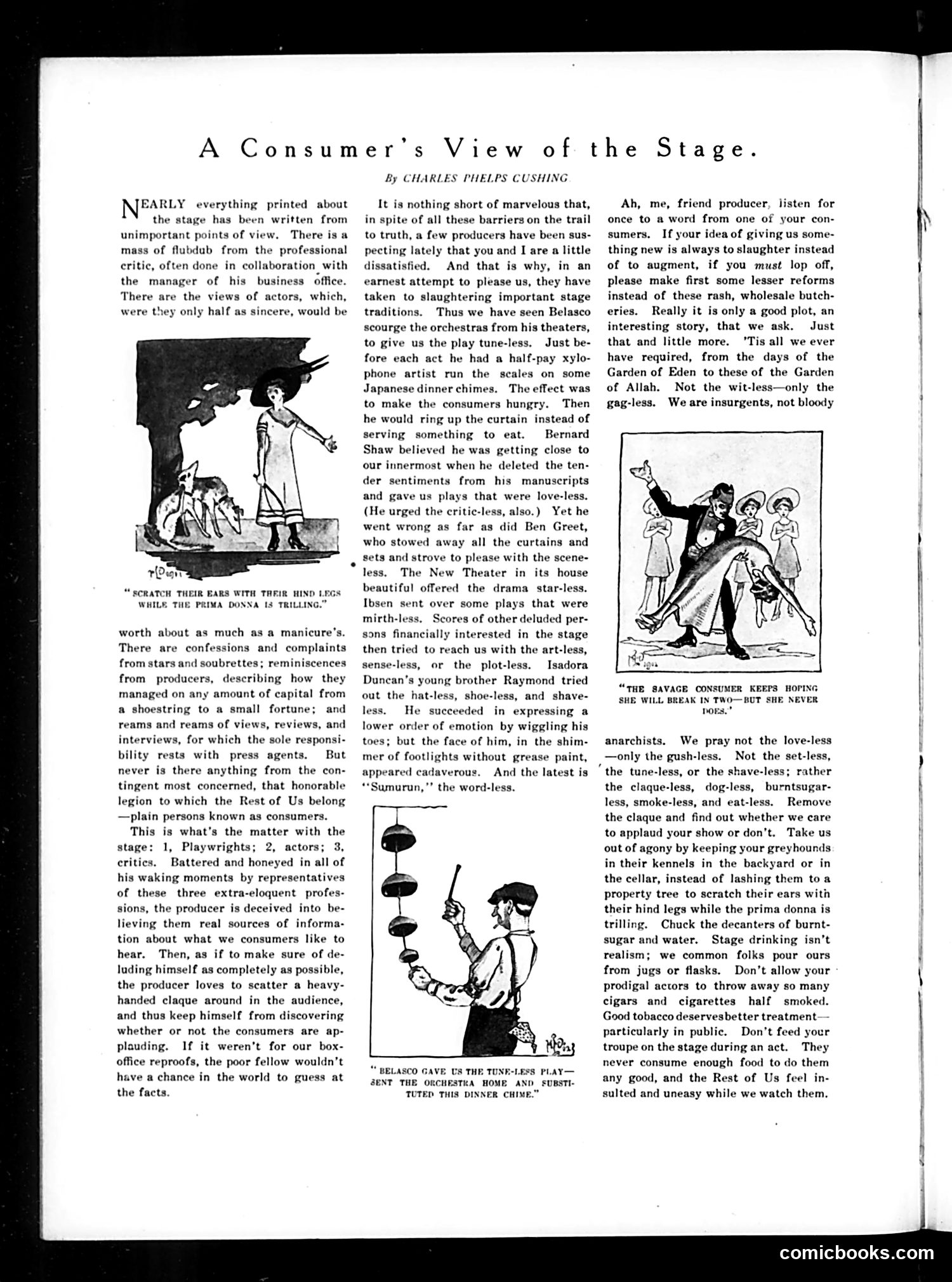
This article satirizes theatrical producers' attempts to modernize by eliminating traditional elements. Author Charles Phelps Cushing, writing as an ordinary audience member, criticizes famous producers and directors—including **David Belasco** (who removed orchestras), **Bernard Shaw** (who eliminated sentimental dialogue), **Ben Greet** (who removed scenery), and **Isadora Duncan's brother Raymond** (who performed without hats or shoes)—for their misguided "reforms." The cartoons mock these experiments: one shows a prima donna's performance reducing the audience to scratching dogs; another depicts Belasco's dinner-chime substitute making audiences hungry instead of entertained. Cushing's point: producers mistake cutting elements for innovation. The real problem isn't missing music, sentiment, or sets—it's missing good plots and interesting stories. The satire targets avant-garde theater trends as pretentious failures that ignore what actual consumers want.
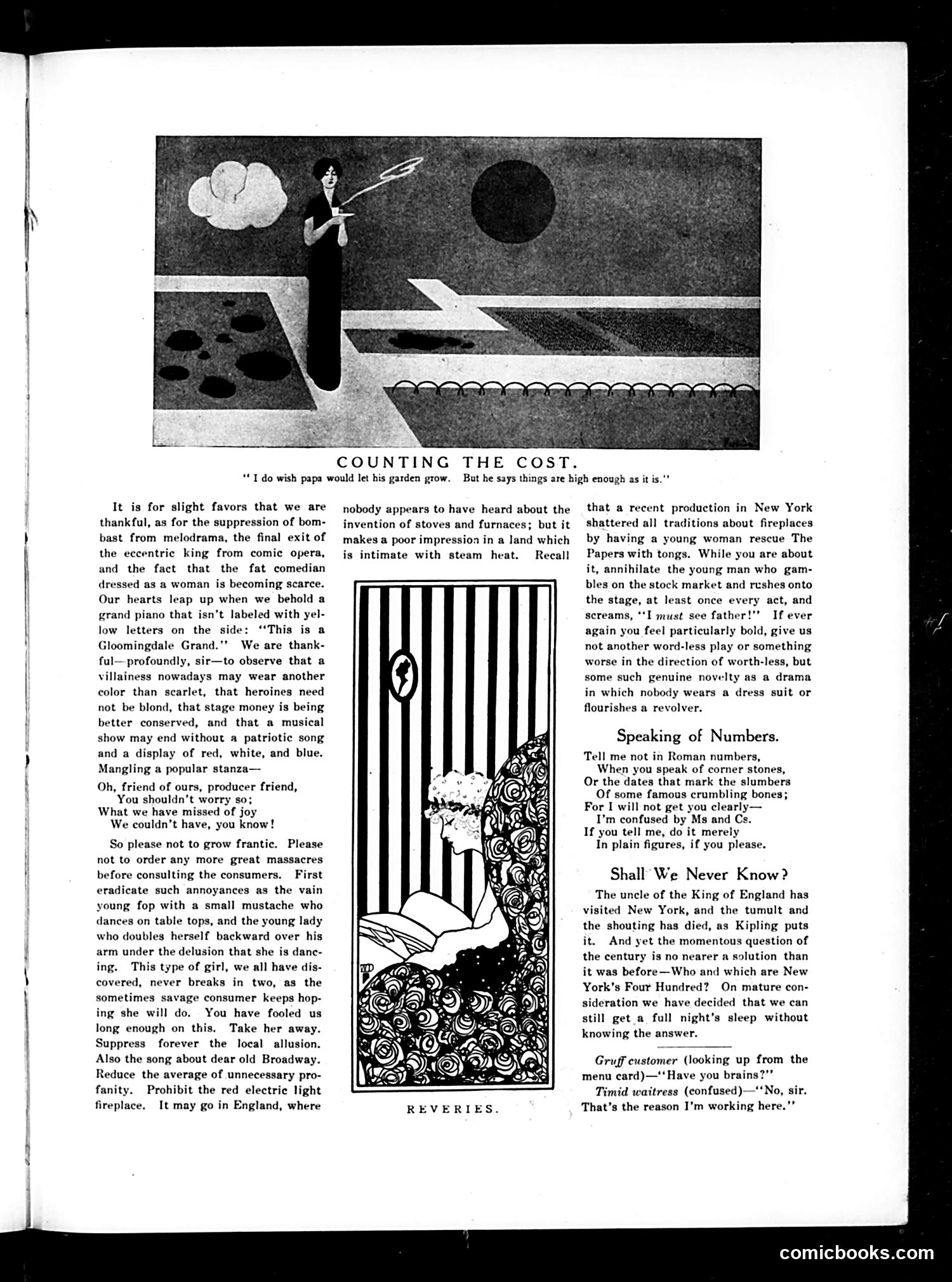
The top cartoon depicts a woman gesturing at economic hardship—clouds, a dark sun, and barren landscape—while lamenting her father won't let his garden grow. The caption suggests complaints about rising costs of living. The page's main text satirizes theatrical conventions the author wants eliminated: melodramatic massacres, vain dancing fops, young women bending backward "under the delusion that she is dancing," product placement ("Gloomingdale Grand" pianos), unnecessary profanity, fake electric fireplaces, and repeated stock-market-crisis plots. Judge ridicules Broadway theater's tired tropes and heavy-handed Americana (patriotic songs, red-white-blue displays). The "Speaking of Numbers" poem mocks the use of Roman numerals in public inscriptions. "Shall We Never Know?" jokes about New York's social elite—the "Four Hundred"—as ultimately unimportant gossip. The bottom joke plays on class: a gruff customer asks if the waitress has "brains"; she replies she lacks them *because* she's working as a waitress—satirizing low-wage labor's supposed relationship to intelligence.
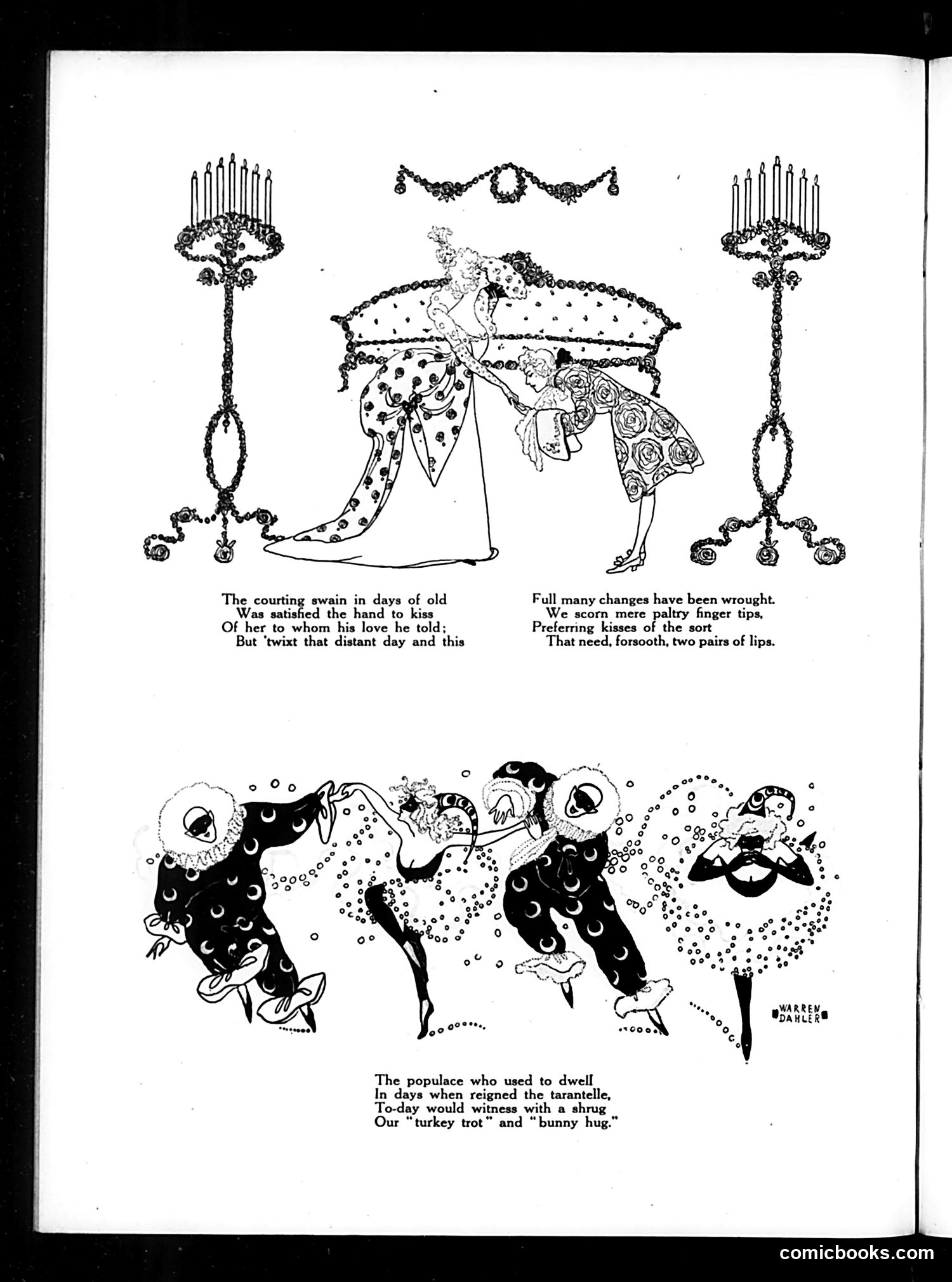
This page contrasts old-fashioned courtship with contemporary (early 1900s) dance crazes. The top panel mocks the evolution from genteel hand-kissing to modern mouth-kissing, suggesting modern couples are more physically forward. The bottom panel depicts the "turkey trot" and "bunny hug"—popular ragtime dances of the 1910s-1920s known for close physical contact and energetic movements that scandalized conservative society. The satire targets social change: what previous generations viewed as shocking (full kissing, uninhibited dancing) has become normalized. The reference to the "tarantelle" (a traditional Italian dance) emphasizes how dramatically dance culture has shifted toward more provocative styles. Judge's humor plays on generational hand-wringing over youth culture's perceived moral decline—a recurring satirical theme of the era.
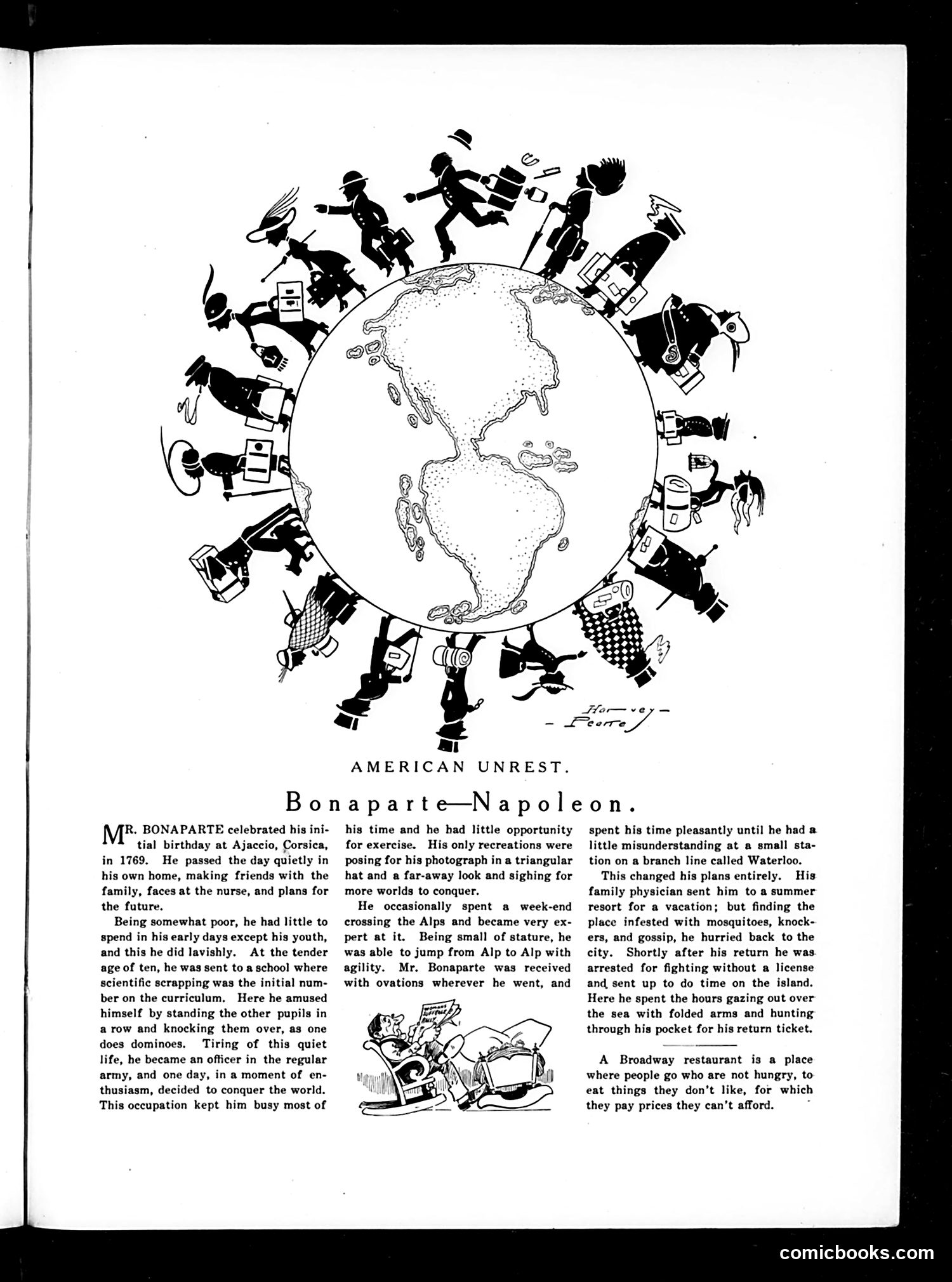
This is a satirical biographical sketch of Napoleon Bonaparte, presented as humorous "American Unrest." The cartoon depicts figures orbiting a globe, representing Napoleon's military campaigns. The satire mocks Napoleon through absurdist humor: his childhood "scientific scrapping" (bullying), his world-conquering ambitions, his famous pose (triangular hat, far-away look), and—crucially—his defeat at Waterloo, casually mentioned as a "little misunderstanding at a small station." The final joke, about Broadway restaurants, appears unrelated to Napoleon and may be a standard Judge-magazine quip about contemporary American consumer culture. The "American Unrest" headline likely connects Napoleon's ambitions to anxieties about American political or social upheaval at the time of publication, though the exact historical context remains unclear without a date.
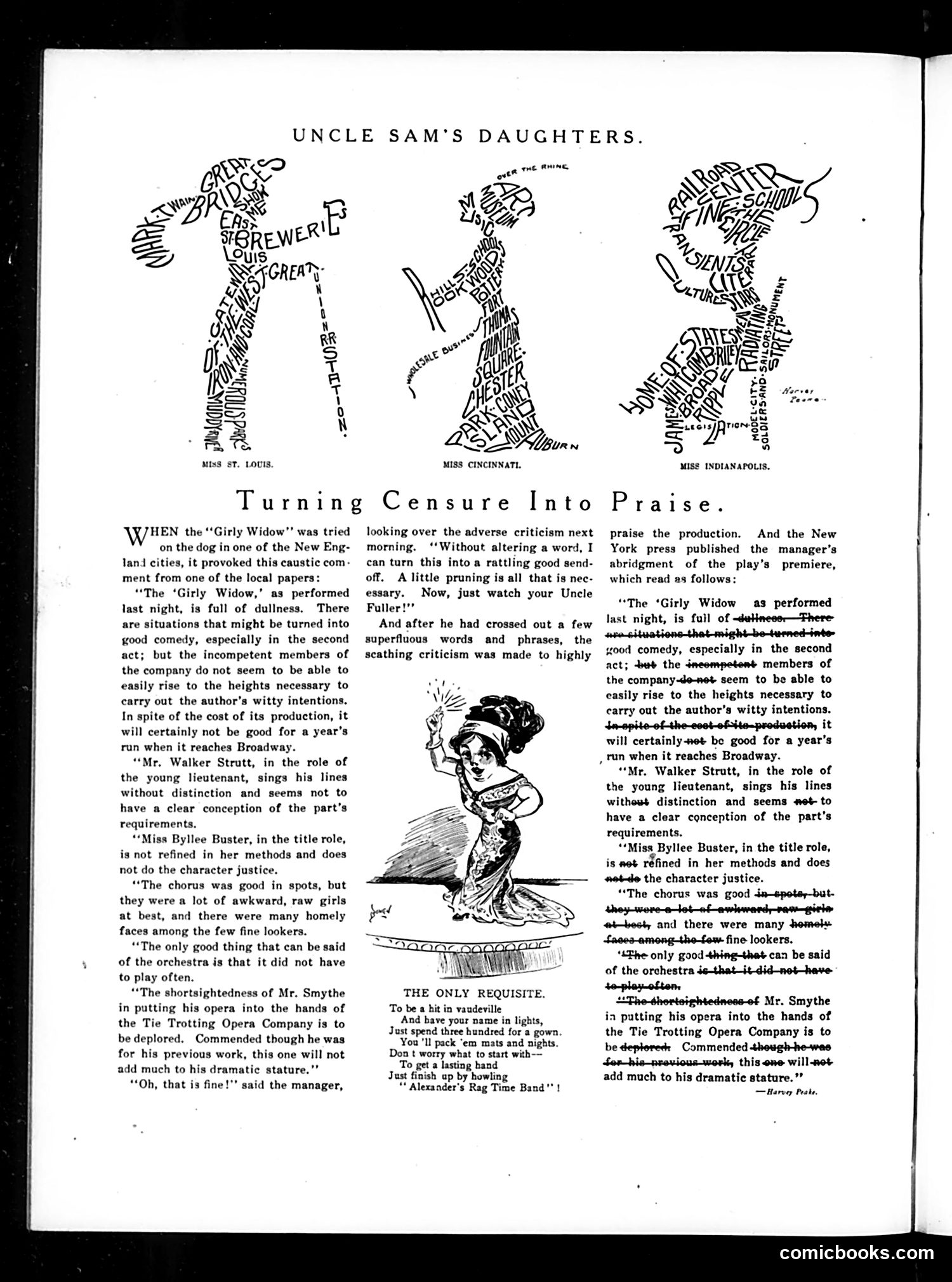
**Top Section:** Three female figures composed of text representing personified American cities—St. Louis, Cincinnati, and Indianapolis. This is a common Judge magazine device using word-art to represent regional or civic identities. **Main Article:** This satirizes theatrical press manipulation. A Broadway manager receives scathing reviews of "The Girly Widow" (a real play from this era). Rather than address the criticism, he simply *crosses out negative words* from the published review—removing "dullness," "incompetent," "homely," etc.—and republishes it as praise. The joke: by deleting adjectives and qualifiers, devastating criticism becomes glowing endorsement without changing a single substantive fact. **"The Only Requisite":** A brief satirical poem about vaudeville success, mocking that performers need only an expensive costume and to end their act by singing "Alexander's Ragtime Band" (a 1911 hit) to pack the house, regardless of talent. **Satire Point:** Both pieces mock entertainment industry dishonesty—critics' manipulation and performers' reliance on spectacle over substance.
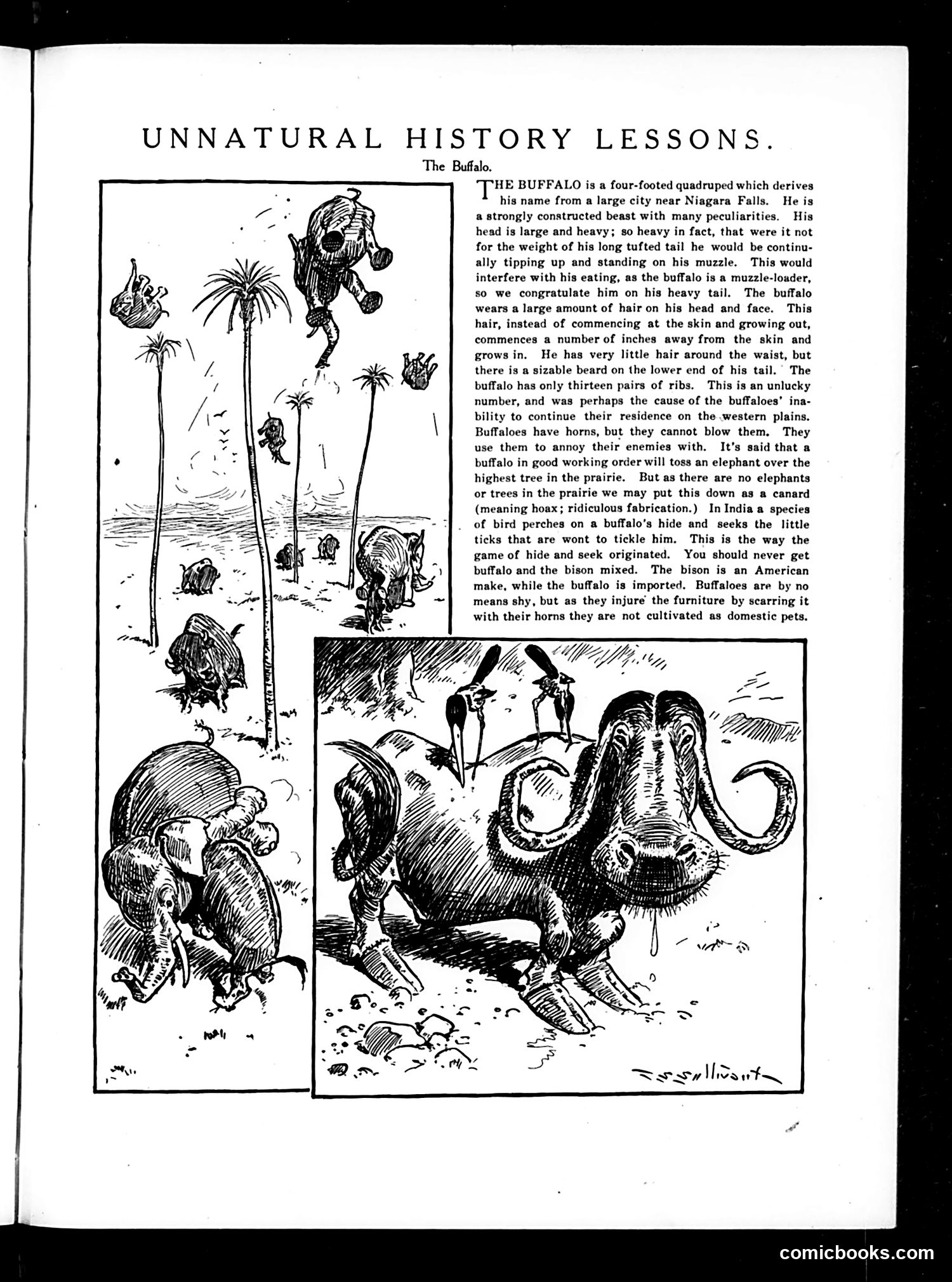
This is satirical pseudoscience disguised as educational content. The text humorously "explains" buffalo anatomy with absurd logic: the animal's heavy head is balanced by its tail (so it won't tip forward), its hair grows *inward* from inches away from skin, and it has unlucky thirteen rib pairs. The joke references Buffalo, New York near Niagara Falls, playing on the city name. Actual factual claims mix with obvious fabrications—buffaloes can toss elephants over prairie trees (which don't exist there), birds playing "hide and seek" on buffalo hides originated the game. The final punchline: buffaloes aren't kept as pets because they damage furniture with their horns. This mocks both pseudo-intellectual "natural history" writing popular in the era and readers who might believe such nonsense. The cartoons' exaggerated illustrations reinforce the absurdity. It's gentle, playful satire rather than pointed political commentary.
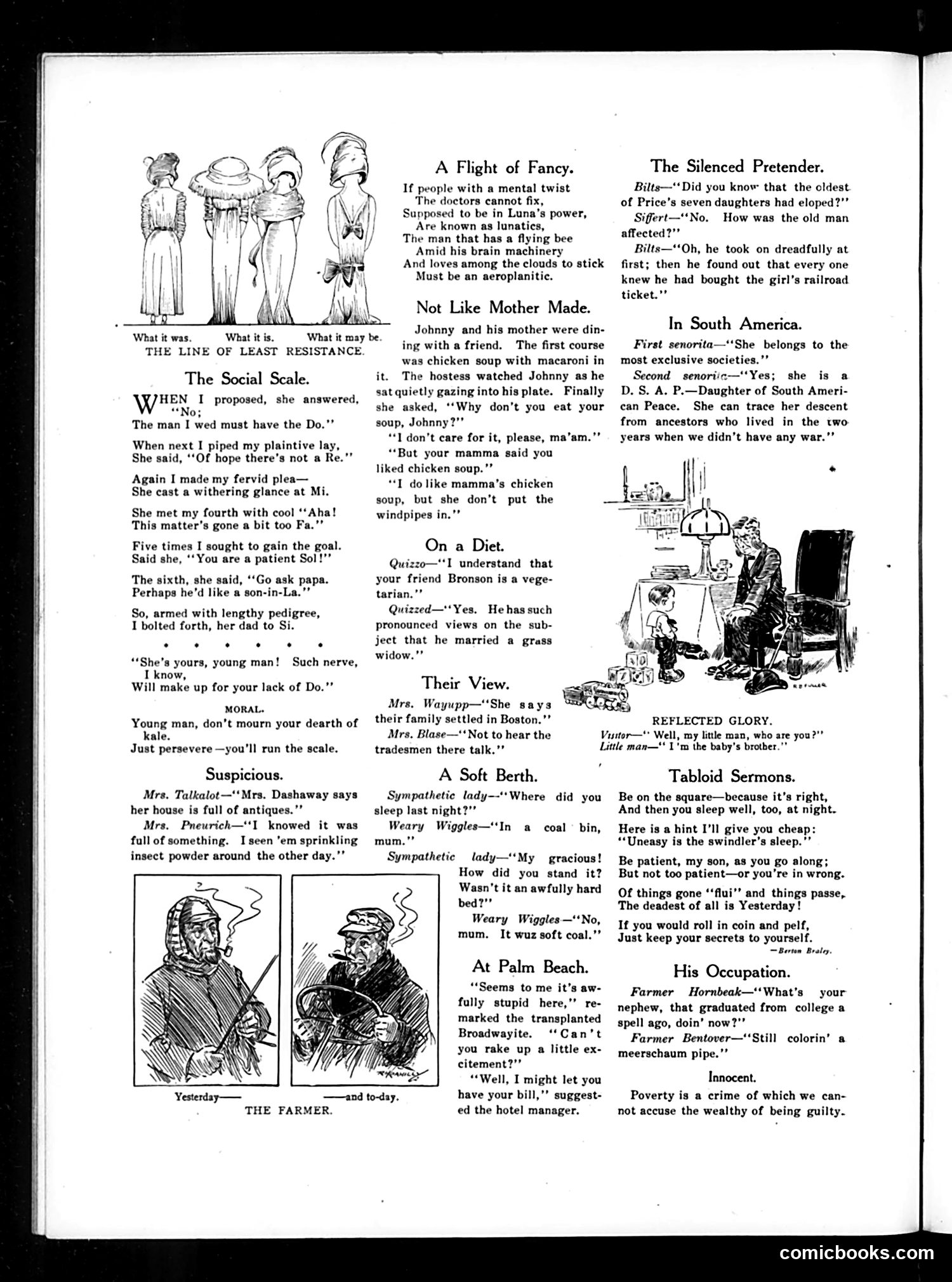
This page contains various satirical humor pieces typical of early 20th-century American comedy magazines. **"The Social Scale"** uses musical notes (Do, Re, Mi, Fa, Sol, La) as puns to mock a suitor's persistent marriage proposals. Each rejection plays on the note names, with the moral suggesting perseverance in romance mirrors climbing musical scales—a clever wordplay joke about social climbing. **"The Farmer" cartoons** (Yesterday/Today) appear to depict rural characters, likely commenting on agricultural or rural life changes. **Other pieces** include light domestic humor: a child finding chicken soup unappetizing without organs; a woman claiming antique furniture actually harbors insects; a vegetarian who married a "grass widow" (divorced woman); and a homeless man sleeping in soft coal. **"In South America"** jokes about South American political instability by claiming a woman's ancestors lived "in the two years when we didn't have any war"—satirizing that region's frequent conflicts. The humor is gentle, domestic, and relies on wordplay and cultural stereotypes rather than harsh political commentary.
This page contains a satirical biographical narrative about Captain John Smith, mocking the romantic legend of Pocahontas saving him. The author ridicules Smith's appearance (calling him "the homeliest Smith that ever chewed tobacco") and presents an absurdist alternative history: Powhatan captured Smith not for ransom, but as a circus curiosity. When Smith proves unmarketable as a "Dog-faced Man" or "Wild Man of Borneo," Powhatan threatens to use him as a target for war clubs. Smith responds with comedic pomposity, claiming the "Great White Father at London" watches over him and bribing Powhatan with trivial goods (tin pans, suspender buttons, empty bottles). The satire mocks both Smith's self-importance and American frontier mythology. The joke relies on deflating heroic narratives through crude realism and absurdist humor—typical of Judge's irreverent approach. The page also contains unrelated advertisements for Postum (coffee substitute) and Club Cocktails.
This page is primarily **advertisements** for hotels (The Montclair in New Jersey, The Kirkwood in Camden, South Carolina) and a boat company, with a secondary "Brief Decisions" opinion section. The opinion pieces target **Democratic Party internal discord**, specifically mocking candidates like Wilson, Harmon, and Bailey for being afraid to associate with each other or with William Jennings Bryan—each wanting to run independently. It's satirizing the fracturing of the Democratic Party's unity. A **Tennyson parody** mocks Bryan, wishing for his political demise. Other brief items comment on: churches showing flammable motion pictures (a safety hazard), a wealthy man struggling to give away charity money, and a tailor's obsessive craftsmanship. A final note references the Kaiser losing ground to German Socialists in Potsdam. The page reflects early 20th-century Democratic Party tensions and contemporary concerns about new technologies (motion pictures) and social change (socialism in Germany).

This page consists mainly of **advertising** for Schlitz beer, with several short humorous anecdotes in the left column. ## The Main Advertisement The Schlitz ad uses a now-dated marketing claim: beer brewed in brown bottles stays fresher because "light spoils even pure beer." Modern readers would recognize this as legitimate chemistry (light does degrade beer), though the ad's grandiose framing ("Beer was first Brewed in a Hut—NOW Agencies for the BROWN BOTTLE dot the Earth") seems overwrought by today's standards. ## The Humor Pieces The left column contains five brief comedic sketches satirizing early-1900s urban life and social customs: - A man trying to cross Manhattan streets amid chaotic traffic - Wordplay about "good figure" (financial vs. physical) - A gas leak causing house fire - Status-conscious neighbors faking attendance at the opera - A failed public speaker These reflect **period anxieties**: dangerous modern traffic, class consciousness, and embarrassment—concerns recognizable but expressed through now-quaint scenarios.
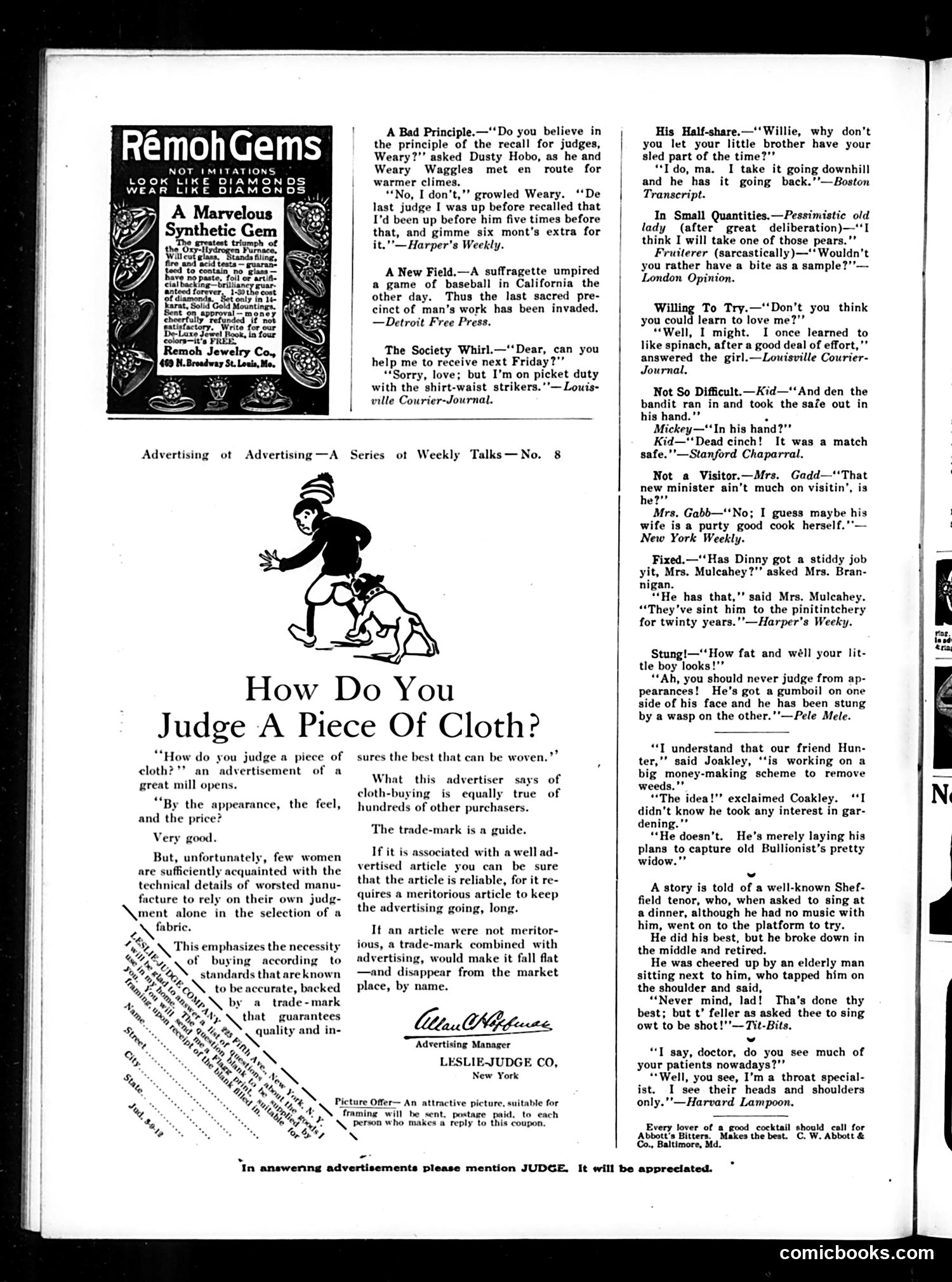
This page from *Judge* magazine contains several short satirical quips and one major advertisement rather than a single cartoon. The main content is an ad for cloth quality, using the headline "How Do You Judge A Piece Of Cloth?" to promote the importance of trade-marks as consumer guides. The accompanying illustration shows a woman and small dog. The surrounding humor pieces mock contemporary social issues: - **"A New Field"** satirizes women's suffrage by noting a woman umpired a baseball game—"the last sacred precinct of man's work"—suggesting anxiety about female encroachment into male domains. - **"The Society Whirl"** references labor strikes (shirt-waist strikers), suggesting ongoing industrial unrest. - Other brief jokes poke fun at judges, poverty, Irish immigrants (suggested by names like "Muleahey"), and childhood mishaps. The content reflects early 20th-century *Judge* concerns: labor disputes, women's equality movements, and class anxiety—all presented through light humor rather than serious political commentary.
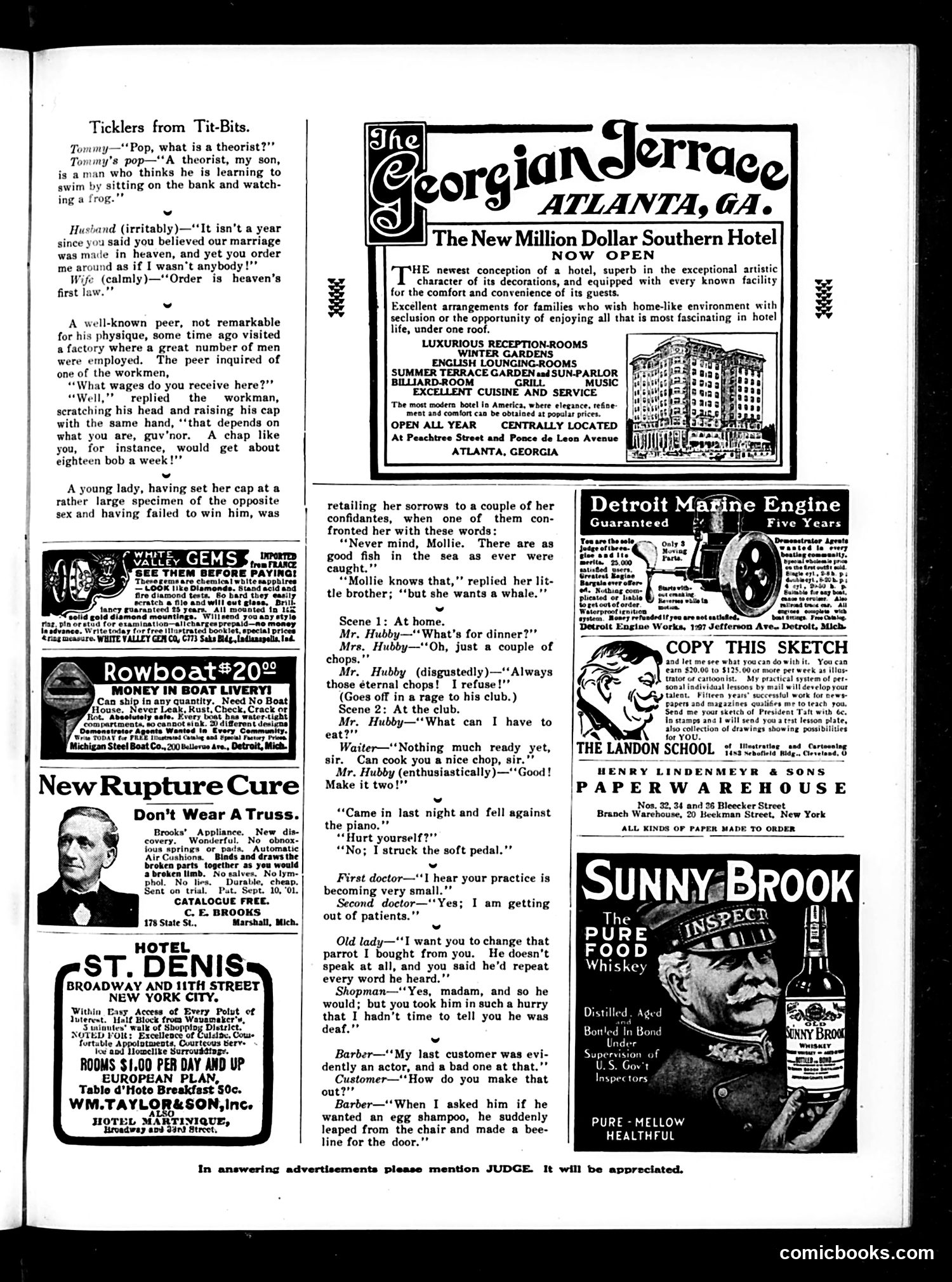
This page from *Judge* magazine is primarily **advertising with a few brief comic anecdotes** ("Ticklers from Tit-Bits"). The jokes are simple domestic humor typical of early 20th-century publications: - A theorist is someone who talks without doing (swimming from a bank while watching a frog) - A husband complains his wife ordered him around despite once claiming their marriage was "made in heaven"—she replies "Order is heaven's first law" - A peer asks a factory worker his wages; the worker cheekily suggests the peer would earn only eighteen shillings weekly because of his small physique - A young woman pursues a large man unsuccessfully; her brother notes she "wants a whale" (implying she's too ambitious) The remaining content consists of period advertisements for hotels (The Georgian Terrace in Atlanta, St. Denis in New York), medical devices (rupture cures, trusses), boats, gems, and whiskey. **No political commentary or caricature is present**—these are gentle, class-conscious jokes reflecting Victorian-era social attitudes.
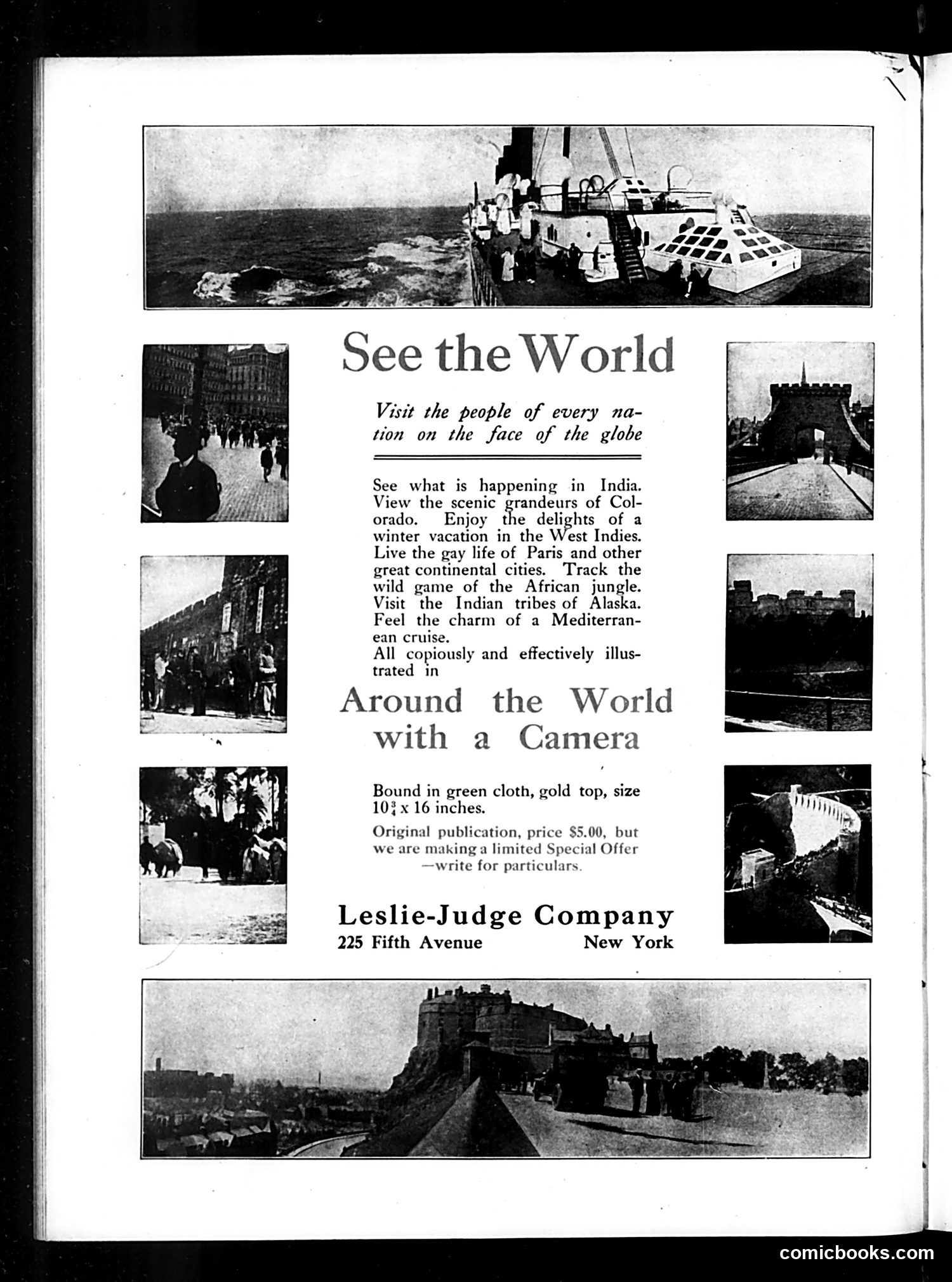
This is primarily an advertisement rather than political satire. The Leslie-Judge Company is promoting a travel photography book titled "Around the World with a Camera." The page features photographs of various global destinations—Indian streets, Colorado scenery, Paris, African wildlife, Alaskan indigenous peoples, and Mediterranean locations—arranged around promotional text. The advertisement appeals to early 20th-century leisure travelers and armchair adventurers, emphasizing exotic locales and the appeal of visual documentation through photography. The $5.00 price point and "limited Special Offer" suggest this was a luxury goods promotion targeting affluent readers of *Judge* magazine. There is no apparent political satire or cartoon on this page—it functions purely as a commercial advertisement leveraging the era's fascination with global exploration and photographic imagery.