
Judge, 1912-03-09 · page 13 of 24
Judge — March 9, 1912 — page 13: what you’re looking at
What you’re looking at
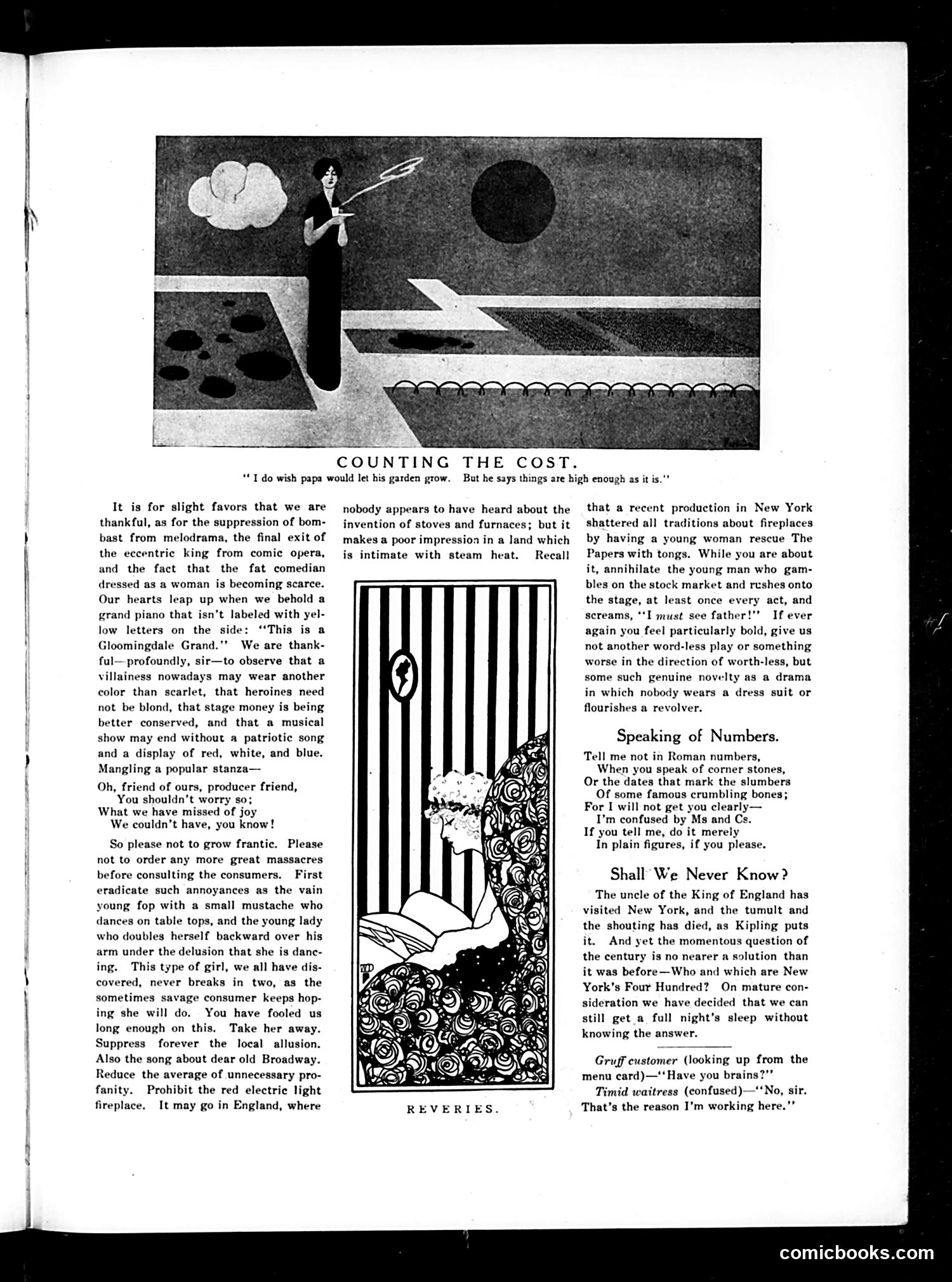
The top cartoon depicts a woman gesturing at economic hardship—clouds, a dark sun, and barren landscape—while lamenting her father won't let his garden grow. The caption suggests complaints about rising costs of living. The page's main text satirizes theatrical conventions the author wants eliminated: melodramatic massacres, vain dancing fops, young women bending backward "under the delusion that she is dancing," product placement ("Gloomingdale Grand" pianos), unnecessary profanity, fake electric fireplaces, and repeated stock-market-crisis plots. Judge ridicules Broadway theater's tired tropes and heavy-handed Americana (patriotic songs, red-white-blue displays). The "Speaking of Numbers" poem mocks the use of Roman numerals in public inscriptions. "Shall We Never Know?" jokes about New York's social elite—the "Four Hundred"—as ultimately unimportant gossip. The bottom joke plays on class: a gruff customer asks if the waitress has "brains"; she replies she lacks them *because* she's working as a waitress—satirizing low-wage labor's supposed relationship to intelligence.
📄 Transcribed text from this page (OCR, searchable)
Machine-transcribed from the original scan — historical spelling and the odd misread are preserved.
oe sr “« I do wish papa would let his garden grow. It is for slight favors that we are thankful, as for the suppression of bom- bast from melodrama, the final exit of the eccentric king from comic opera, and the fact that the fat comedian dressed as a woman is becoming scarce. Our hearts leap up when we behold a grand piano that isn’t labeled with yel- low letters on the side: ‘This is a Gloomingdale Grand.’’ We are thank- ful—profoundly, sir—to observe that a villainess nowadays may wear another color than scarlet, that heroines need not be blond, that stage money is being better conserved, and that a musical show may end without a patriotic song and a display of red, white, and blue. Mangling a popular stanza— Oh, friend of ours, producer friend, You shouldn't worry so; What we have missed of joy We couldn’t have, you know! So please not to grow frantic. Please not to order any more great massacres before consulting the consumers. First eradicate such annoyances as the vain young fop with a small mustache who dances on table tops, and the young lady who doubles herself backward over his arm under the delusion that she is danc- ing. This type of girl, we all have dis- covered, never breaks in two, as the sometimes savage consumer keeps hop- ing she will do. You have fooled us long enough on this. Take her away. Suppress forever the local allusion. Also the song about dear old Broadway. Reduce the average of unnecessary pro- fanity. Prohibit the red electric light fireplace. It may go in England, where nobody appears to have heard about the invention of stoves and furnaces; but it makes a poor impression in a land which is intimate with steam heat. Recall aS WARS XS) = REVERIES. But he says things are high enough as it is."” that a recent production in New York shattered all traditions about fireplaces by having a young woman rescue The Papers with tongs. While you are about it, annihilate the young man who gam- bles on the stock market and rushes onto the stage, at least once every act, and screams, ‘‘I must see father!"’ If ever again you feel particularly bold, give us not another word-less play or something worse in the direction of worth-less, but some such genuine novelty as a drama in which nobody wears a dress suit or flourishes a revolver. Speaking of Numbers. Tell me not in Roman numbers, When you speak of corner stones, Or the dates that mark the slumbers Of some famous crumbling bones; For I will not get you clearly— I’m confused by Ms and Cs. If you tell me, do it merely In plain figures, if you please. Shall’ We Never Know? The uncle of the King of England has visited New York, and the tumult and the shouting has died, as Kipling puts it. And yet the momentous question of the century is no nearer a solution than it was before—Who and which are New York’s Four Hundred? On mature con- sideration we have decided that we can still get a full night’s sleep without knowing the answer. Gruff customer (looking up from the menu card)—‘‘Have you brains?”” Timid waitress (confused)—‘‘No, sir. That’s the reason I'm working here.’” comicbooks.com