
Judge, 1912-03-09 · page 10 of 24
Judge — March 9, 1912 — page 10: what you’re looking at
What you’re looking at
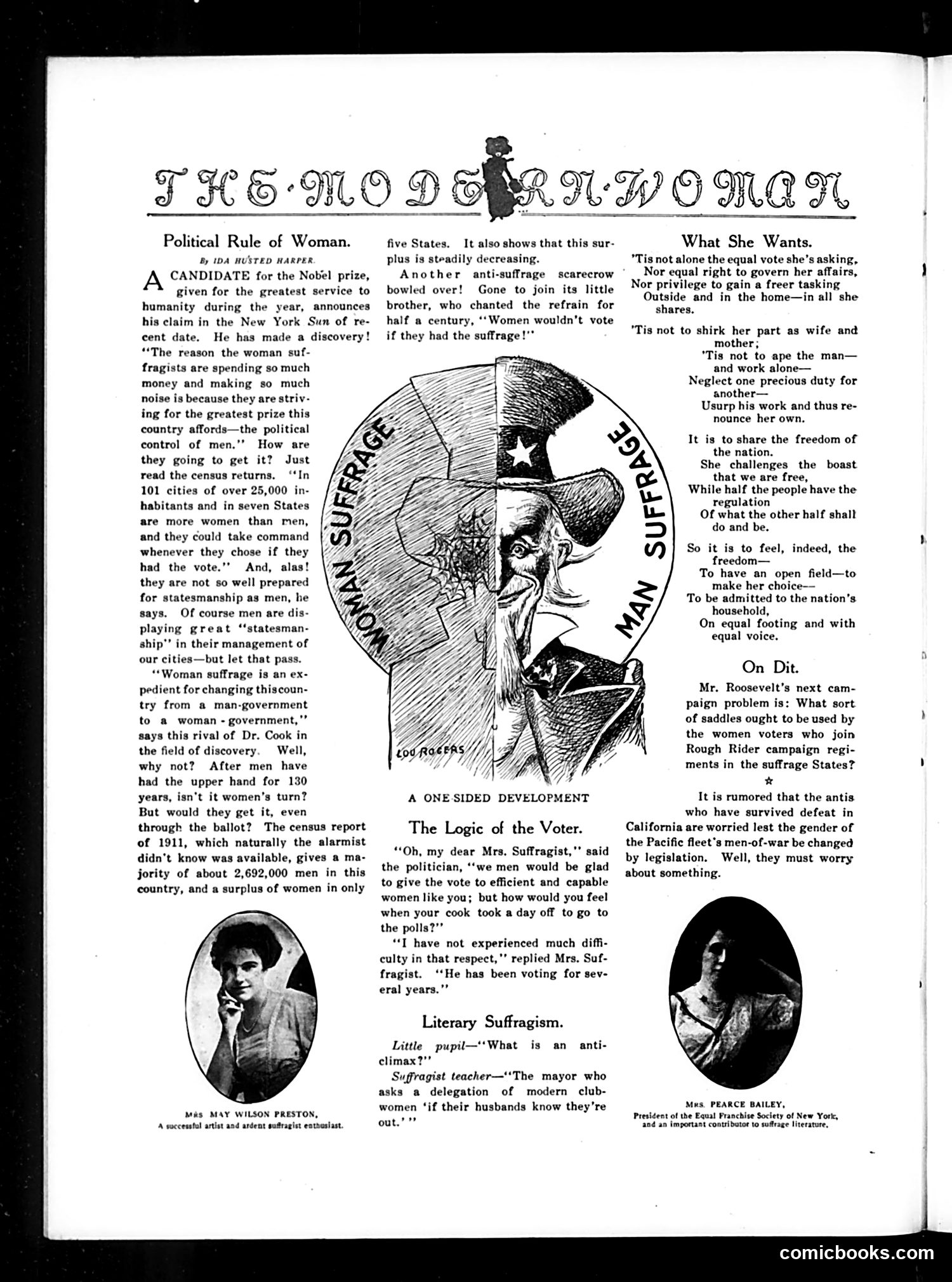
This *Judge* magazine page advocates for women's suffrage by satirizing anti-suffrage arguments. The central cartoon depicts a man labeled "Man Suffrage" and "Woman Suffrage" as a one-sided scale, implying the unequal political power. The main article by Ida Husted Harper rebuts a common anti-suffrage claim: that women outnumber men in certain cities and would "control" politics if voting. Harper cites 1911 census data showing men actually outnumber women nationally—and the female surplus is decreasing. This dismantles the "scare" argument. "The Logic of the Voter" satirizes politicians who object to women voting because servants might skip work to vote—absurd since male servants vote without complaint. The "Literary Suffragism" section mocks anti-suffragists' patronizing attitudes toward clubwomen, asking if their husbands know they're out. "What She Wants" is a earnest poem asserting women seek not special privileges but equal freedom and voice in democracy. The page represents pro-suffrage satire targeting male anxiety about women's political power.
📄 Transcribed text from this page (OCR, searchable)
Machine-transcribed from the original scan — historical spelling and the odd misread are preserved.
Political Rule of Woman. By IDA HUSTED HARPER A CANDIDATE for the Nobel prize, given for the greatest service to humanity during the year, announces his claim in the New York Sun of re- cent date. He has made a discovery! “The reason the woman suf- fragists are spending so much money and making so much noise is because they are striv- ing for the greatest prize this country affords—the political control of men.’’ How are they going to get it? Just read the census returns. ‘‘In 101 cities of over 25,000 in- habitants and in seven States are more women than men, and they could take command whenever they chose if they had the vote.’’ And, alas! they are not so well prepared for statesmanship as men, he says. Of course men are dis- playing great ‘‘statesman- ship’’ in their management of our cities—but let that pass. ‘*Woman suffrage is an ex- pedient for changing thiscoun- try from a man-government to a woman - government,” says this rival of Dr. Cook in the field of discovery. Well, why not? After men have had the upper hand for 130 years, isn't it women’s turn? But would they get it, even through the ballot? The census report of 1911, which naturally the alarmist didn’t know was available, gives a ma- jority of about 2,692,000 men in this country, and a surplus of women in only Mas MAY WILSON PRESTON, A soccesstal artist and ardent sufragist eotbaslast. J HOMO D five States. It also shows that this sur- plus is steadily decreasing. Another anti-suffrage scarecrow bowled over! Gone to join its little brother, who chanted the refrain for half a century, ‘‘Women wouldn't vote if they had the suffrage !"* A ONE-SIDED DEVELOPMENT The Logic of the Voter. “Oh, my dear Mrs. Suffragist,'’ said the politician, ‘‘we men would be glad to give the vote to efficient and capable women like you; but how would you feel when your cook took a day off to go to the polls?”” “TI have not experienced much diffi- culty in that respect,"’ replied Mrs. Suf- fragist. ‘‘He has been voting for sev- eral years.”’ Literary Suffragism. Little pupil—*What is an anti- climax?"’ Suffragist teacher—‘‘The mayor who asks a delegation of modern club- women ‘if their husbands know they’re out.’ What She Wants. ’Tis not alone the equal vote she’s asking, Nor equal right to govern her affairs, Nor privilege to gain a freer tasking Outside and in the home—in all she shares. 'Tis not to shirk her part as wife and mother, ‘Tis not to ape the man— and work alone— Neglect one precious duty for another— Usurp his work and thus re- nounce her own. It is to share the freedom of the nation. She challenges the boast that we are free, While half the people have the regulation Of what the other half shall do and be. So it is to feel, indeed, the freedom— To have an open field—to make her choice-— To be admitted to the nation’s household, On equal footing and with equal voice. On Dit. Mr. Roosevelt’s next cam- paign problem is: What sort of saddles ought to be used by the women voters who join Rough Rider campaign regi- ments in the suffrage States? x It is rumored that the antis who have survived defeat in California are worried lest the gender of the Pacific fleet's men-of-war be changed by legislation. Well, they must worry about something. Mus. PEARCE BAILEY, President of the Equal Pranchise Society of New York, and an important contributor to suffrage literature, comicbooks.com