
Judge, 1912-03-09 · page 16 of 24
Judge — March 9, 1912 — page 16: what you’re looking at
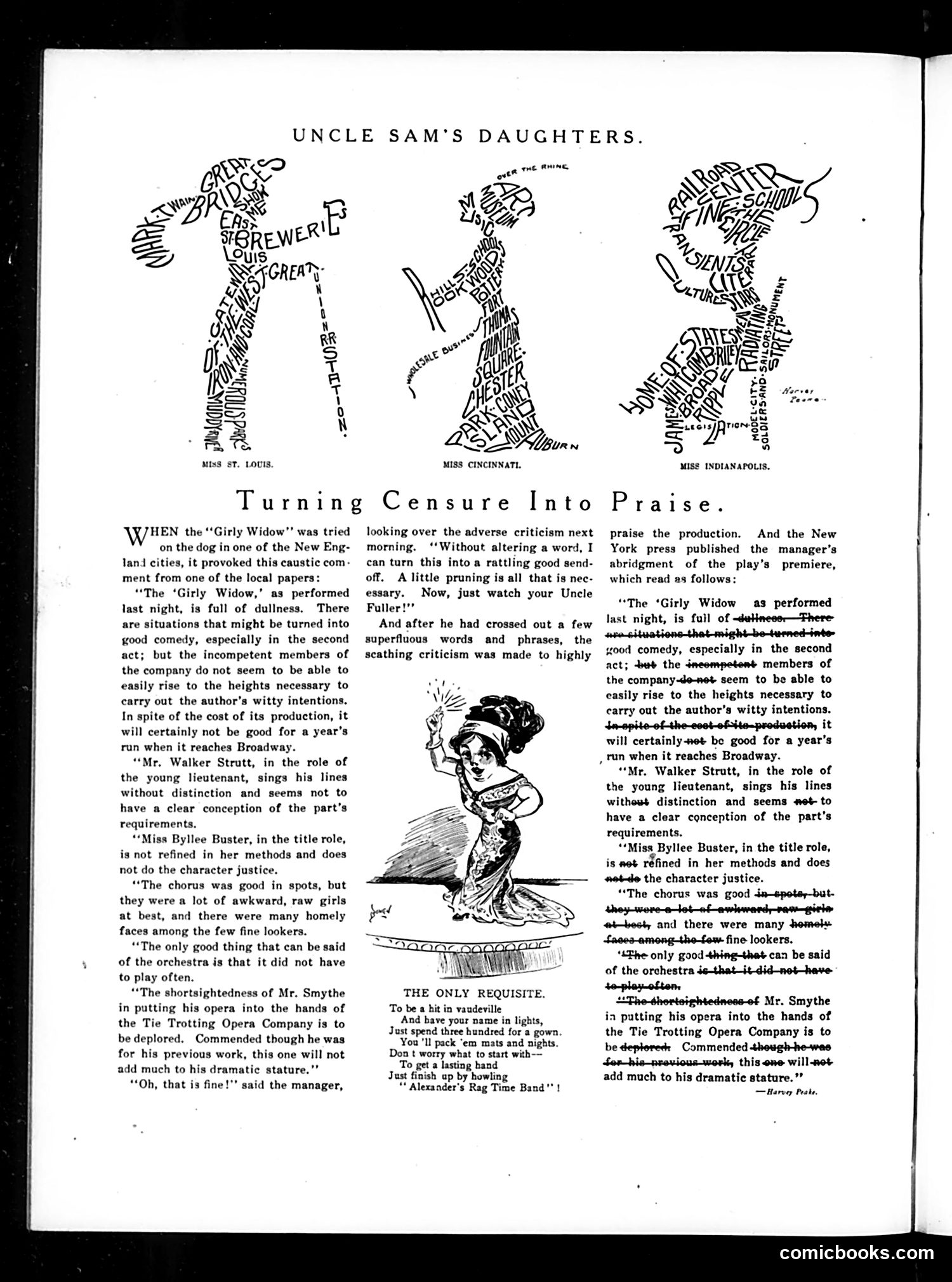
What you’re looking at
**Top Section:** Three female figures composed of text representing personified American cities—St. Louis, Cincinnati, and Indianapolis. This is a common Judge magazine device using word-art to represent regional or civic identities. **Main Article:** This satirizes theatrical press manipulation. A Broadway manager receives scathing reviews of "The Girly Widow" (a real play from this era). Rather than address the criticism, he simply *crosses out negative words* from the published review—removing "dullness," "incompetent," "homely," etc.—and republishes it as praise. The joke: by deleting adjectives and qualifiers, devastating criticism becomes glowing endorsement without changing a single substantive fact. **"The Only Requisite":** A brief satirical poem about vaudeville success, mocking that performers need only an expensive costume and to end their act by singing "Alexander's Ragtime Band" (a 1911 hit) to pack the house, regardless of talent. **Satire Point:** Both pieces mock entertainment industry dishonesty—critics' manipulation and performers' reliance on spectacle over substance.
📄 Transcribed text from this page (OCR, searchable)
Machine-transcribed from the original scan — historical spelling and the odd misread are preserved.
UNCLE SAM'S DAUGHTERS. MISS sf. LOUIS. ene RHINE, Pa WZ Wey 5; BS, Air, te a aoe 4 % a 5 a. —= > xs o> res ae oes WS ae YW Jorn N MISS CINCINNATI. SQ Oe Lyk \ os CK RES, ANTE: ee ‘=: if NV | FrADATIN SAI MODEL-CITY. SOLDIERS'AND MISS INDIANAPOLIS, Turning Censure Into Praise. HEN the ‘Girly Widow"’ was tried on the dog in one of the New Eng- land cities, it provoked this caustic com- ment from one of the local papers: “The ‘Girly Widow,’ as performed last night, is full of dullness. There are situations that might be turned into good comedy, especially in the second act; but the incompetent members of the company do not seem to be able to easily rise to the heights necessary to carry out the author’s witty intentions. In spite of the cost of its production, it will certainly not be good for a year’s run when it reaches Broadway. “Mr. Walker Strutt, in the role of the young lieutenant, sings his lines without distinction and seems not to have a clear conception of the part’s requirements. “Miss Byllee Buster, in the title role, is not refined in her methods and does not do the character justice. “The chorus was good in spots, but they were a lot of awkward, raw girls at best, and there were many homely faces among the few fine lookers. “The only good thing that can be said of the orchestra is that it did not have to play often. “The shortsightedness of Mr. Smythe in putting his opera into the hands of the Tie Trotting Opera Company is to be deplored. Commended though he was for his previous work, this one will not add much to his dramatic stature."’ “Oh, that is fine!" said the manager, looking over the adverse criticism next morning. ‘‘Without altering a word, I can turn this into a rattling good send- off. A little pruning is all that is nec- essary. Now, just watch your Uncle Fuller!’" And after he had crossed out a few superfluous words and phrases, the scathing criticism was made to highly THE ONLY REQUISITE. To be a hit in vaudeville ‘And have your name in lights, Just spend three hundred for a gown. You 'll pack ‘em mats and nights. Don t worry what to start with-— To get a lasting hand Just finish ap by howling “* Alexander's Rag Time Band"*! praise the production. And the New York press published the manager's abridgment of the play’s premiere, which read as follows: “The ‘Girly Widow as performed last night, is full of ~teHneee-—Fhere yood comedy, especially in the second act; bet the +neompetent members of the company-de-net seem to be able to easily rise to the heights necessary to carry out the author’s witty intentions. . it will certainly-net be good for a year’s , tun when it reaches Broadway. “Mr. Walker Strutt, in the role of the young lieutenant, sings his lines withewt distinction and seems #et- to have a clear conception of the part's requirements. “Miss Byllee Buster, in the title role, is net refined in her methods and does #et-de the character justice. “The chorus was good in—epotey-but- Abney ee teste te ath GAC @t—best, and there were many homely tacces-among-the-fom fine lookers. ‘tT he only good -thing-that can be said of the orchestra iethat-it-did_-not—have depletion, +The-shorteightedness-of Mr. Smythe ia putting his opera into the hands of the Tie Trotting Opera Company is to bedeptored: Commended theugh-he-was forhie—nreviouswork, this one will-not add much to his dramatic stature. ”” —Hareg Peale, comicbooks.com