
Judge, 1912-03-09 · page 12 of 24
Judge — March 9, 1912 — page 12: what you’re looking at
What you’re looking at
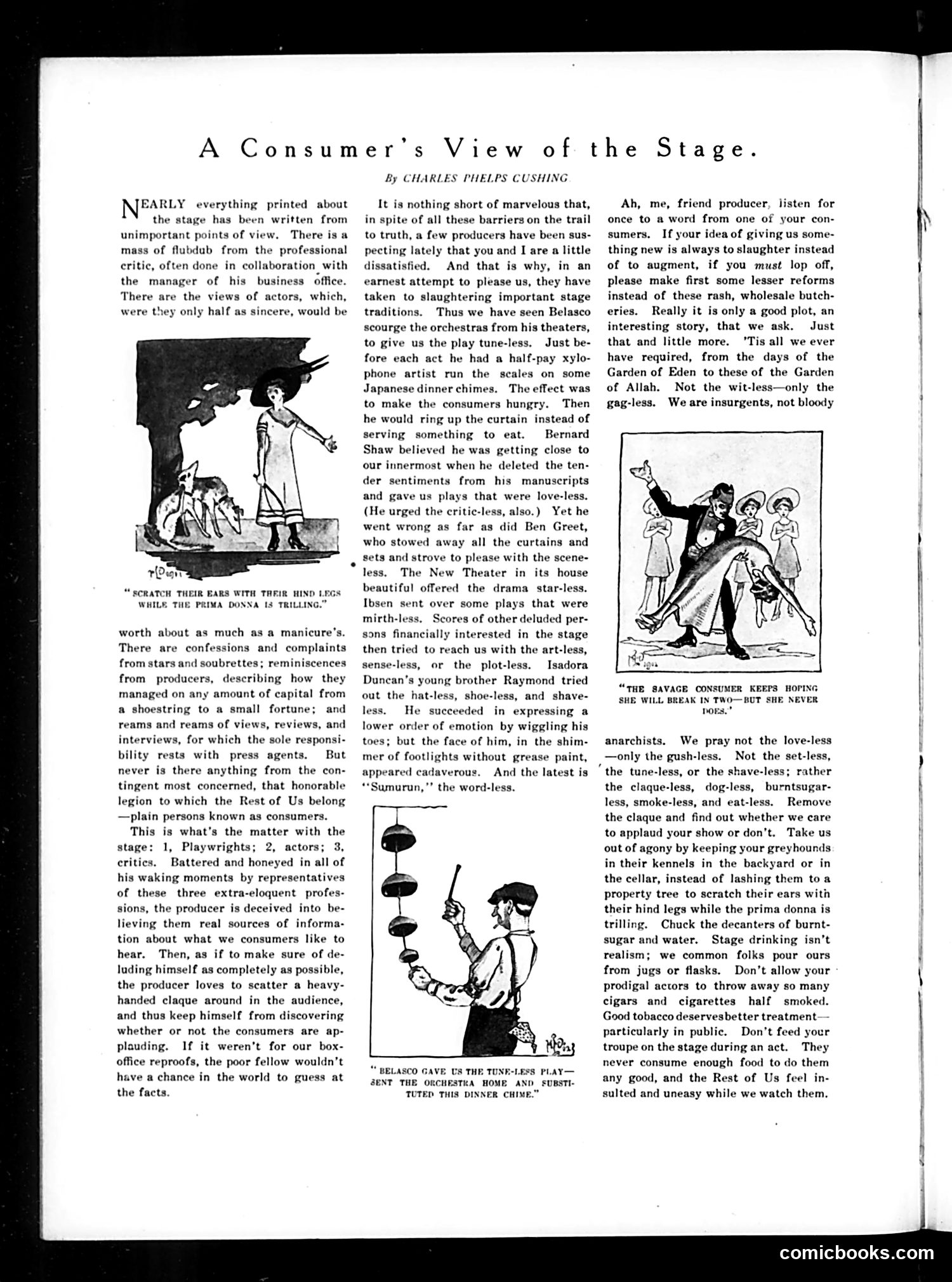
This article satirizes theatrical producers' attempts to modernize by eliminating traditional elements. Author Charles Phelps Cushing, writing as an ordinary audience member, criticizes famous producers and directors—including **David Belasco** (who removed orchestras), **Bernard Shaw** (who eliminated sentimental dialogue), **Ben Greet** (who removed scenery), and **Isadora Duncan's brother Raymond** (who performed without hats or shoes)—for their misguided "reforms." The cartoons mock these experiments: one shows a prima donna's performance reducing the audience to scratching dogs; another depicts Belasco's dinner-chime substitute making audiences hungry instead of entertained. Cushing's point: producers mistake cutting elements for innovation. The real problem isn't missing music, sentiment, or sets—it's missing good plots and interesting stories. The satire targets avant-garde theater trends as pretentious failures that ignore what actual consumers want.
📄 Transcribed text from this page (OCR, searchable)
Machine-transcribed from the original scan — historical spelling and the odd misread are preserved.
NEARLY everything printed about the stage has been written from unimportant points of view. There is a mass of flubdub from the professional critic, often done in collaboration with the manager of his business office. There are the views of actors, which, were they only half as sincere, would be “SCRATCH THEIR EARS WITH THFIR HIND LEGS WHILE THE PRIMA DONNA 13 TRILLIN worth about as much as a manicure’s. There are confessions and complaints from stars and soubrettes; reminiscences from producers, describing how they managed on any amount of capital from a shoestring to a small fortune; and reams and reams of views, reviews, and interv: for which the sole responsi- bility rests with press agents. But never is there anything from the con- tingent most concerned, that honorable legion to which the Rest of Us belong —plain persons known as consumers. This is what's the matter with the stage: 1, Playwrights; 2, actors; 3, critics, Battered and honeyed in all of his waking moments by representatives of these three extra-eloquent profes- sions, the producer is deceived into be- lieving them real sources of informa- tion about what we consumers like to hear. Then, as if to make sure of de- luding himself as completely as possible, the producer loves to scatter a heavy- handed claque around in the audience, and thus keep himself from discovering whether or not the consumers are ap- plauding. If it weren’t for our box- office reproofs, the poor fellow wouldn’t have a chance in the world to guess at the facts. A Consumer's View of the Stage. By CHARLES PHELPS CUSHING It is nothing short of marvelous that, in spite of all these barriers on the trail to truth, a few producers have been sus- pecting lately that you and I are a little dissatisfied. And that is why, in an earnest attempt to please us, they have taken to slaughtering important stage traditions. Thus we have seen Belasco scourge the orchestras from his theaters, to give us the play tune-less, Just be- fore each act he had a half-pay xylo- phone artist run the scales on some Japanese dinner chimes. The effect was to make the consumers hungry. Then he would ring up the curtain instead of serving something to eat. Bernard Shaw believed he was getting close to our innermost when he deleted the ten- der sentiments from his manuscripts and gave us pl that were love-less. (He urged the critic-less, also.) Yet he went wrong as far as did Ben Greet, who stowed away all the curtains and . Sets and strove to please with the scene- less. The N beautiful offe Ibsen sent o mirth-less, sons financially interested in the stage then tried to reach us with the art-less, 3, or the plot-less. Isadora Duncan’s young brother Raymond tried out the hat-less, shoe-less, and shave- le: He succeeded in expressing a lower order of emotion by wiggling his toes; but the face of him, in the shim- mer of footlights without grease paint, appeared cadaverous. And the latest is “*Sumurun,”’ the word-less. w Theater in its house 1 the drama star-less. er some plays that were Scores of other deluded per- BELASCO GAVE U; SENT THE ORCHES' TUTED THIS DID THE TUNE-LESS PLAY— HOME AND SURSTI- ER CHIME.” Ah, me, friend producer, listen for once to a word from one of your con- sumers. If your idea of giving us some- thing new is always to slaughter instead of to augment, if you must lop off, please make first some lesser reforms instead of these rash, wholesale butch- eries. Really it is only a good plot, an interesting story, that we ask. Just that and little more. ‘Tis all we ever have required, from the days of the Garden of Eden to these of the Garden of Allah. Not the wit-less—only the gag-less. We are insurgents, not bloody “THE SAVAGE CONSUMER KEEPS HOPING SHE WILL BREAK IN TWO—BUT SHE NEVE! Does.” anarchists. We pray not the love-less —only the gush-less, Not the set-les “the tune-less, or the shave-less; rather the claque-less, dog-less, burntsugar- less, smoke-less, and eat-less. Remove the claque and find out whether we care to applaud your show or don’t. Take us out of agony by keeping your greyhounds in their kennels in the backyard or in the cellar, instead of lashing them toa property tree to scratch their ears with their hind legs while the prima donna is trilling. Chuck the decanters of burnt- sugar and water. Stage drinking isn’t realism; we common folks pour ours from jugs or flasks. Don’t allow your prodigal actors to throw away so many cigars and cigarettes half smoked. Good tobacco deserves better treatment particularly in public. Don’t feed your troupe on the stage during an act. They never consume enough food to do them any good, and the Rest of Us feel in- sulted and uneasy while we watch them, comicbooks.com