
A complete issue · 24 pages · 1912
Judge — January 13, 1912
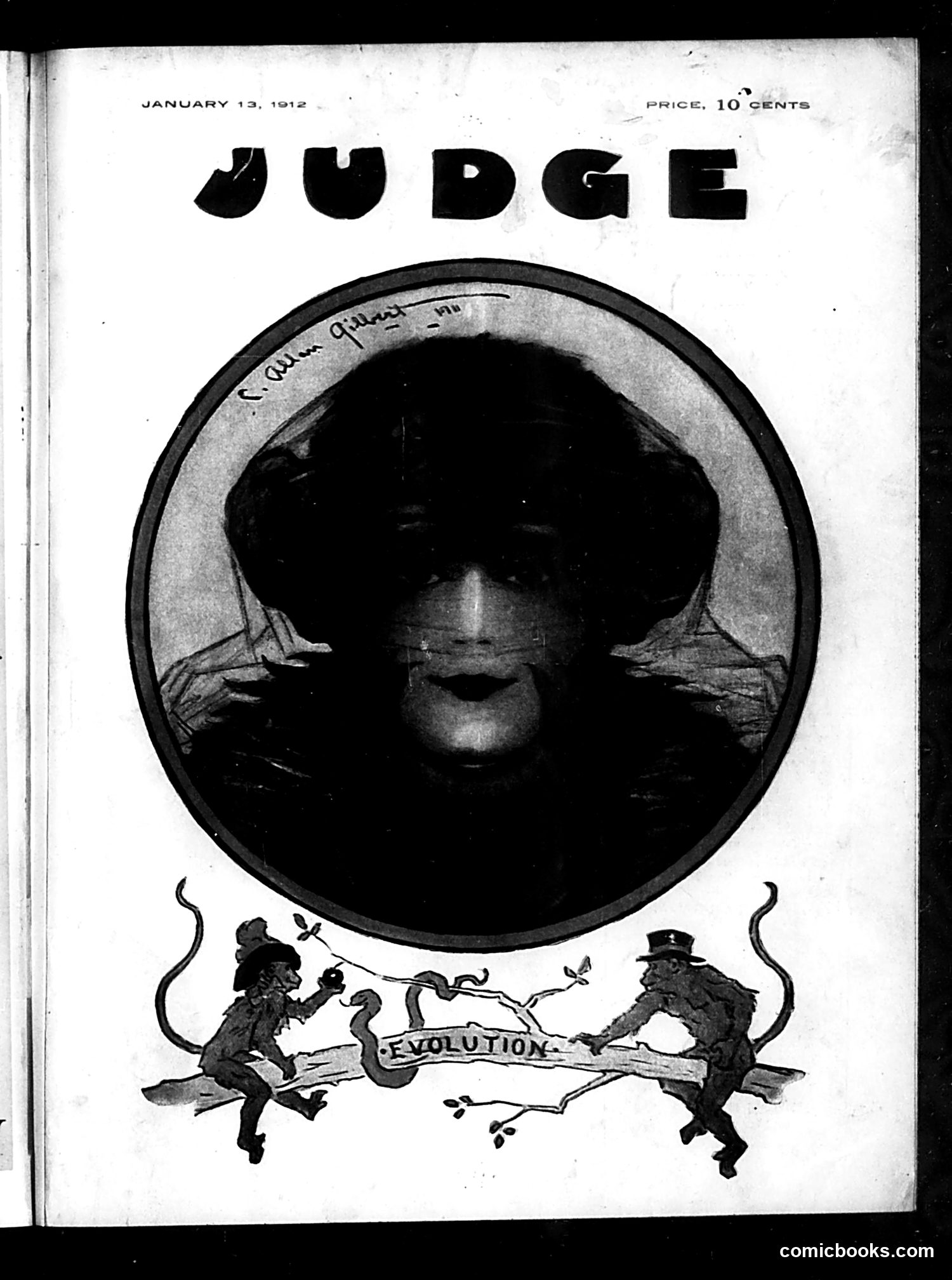
This cover features a large circular portrait of what appears to be a political figure, with a banner reading "EVOLUTION" below, flanked by two caricatured figures—likely representing monkeys or evolutionary stages. The imagery references the contentious early-20th-century debate over Darwin's theory of evolution. The satirical point appears to criticize a politician or public figure by invoking evolutionary imagery, suggesting they represent a "lower" stage of development or are "primitive." This was a common rhetorical attack of the era. Without clearer identification of the portrait subject, the specific political target remains unclear, though the January 1912 date suggests it may reference a contemporary political figure or controversy during that election year.
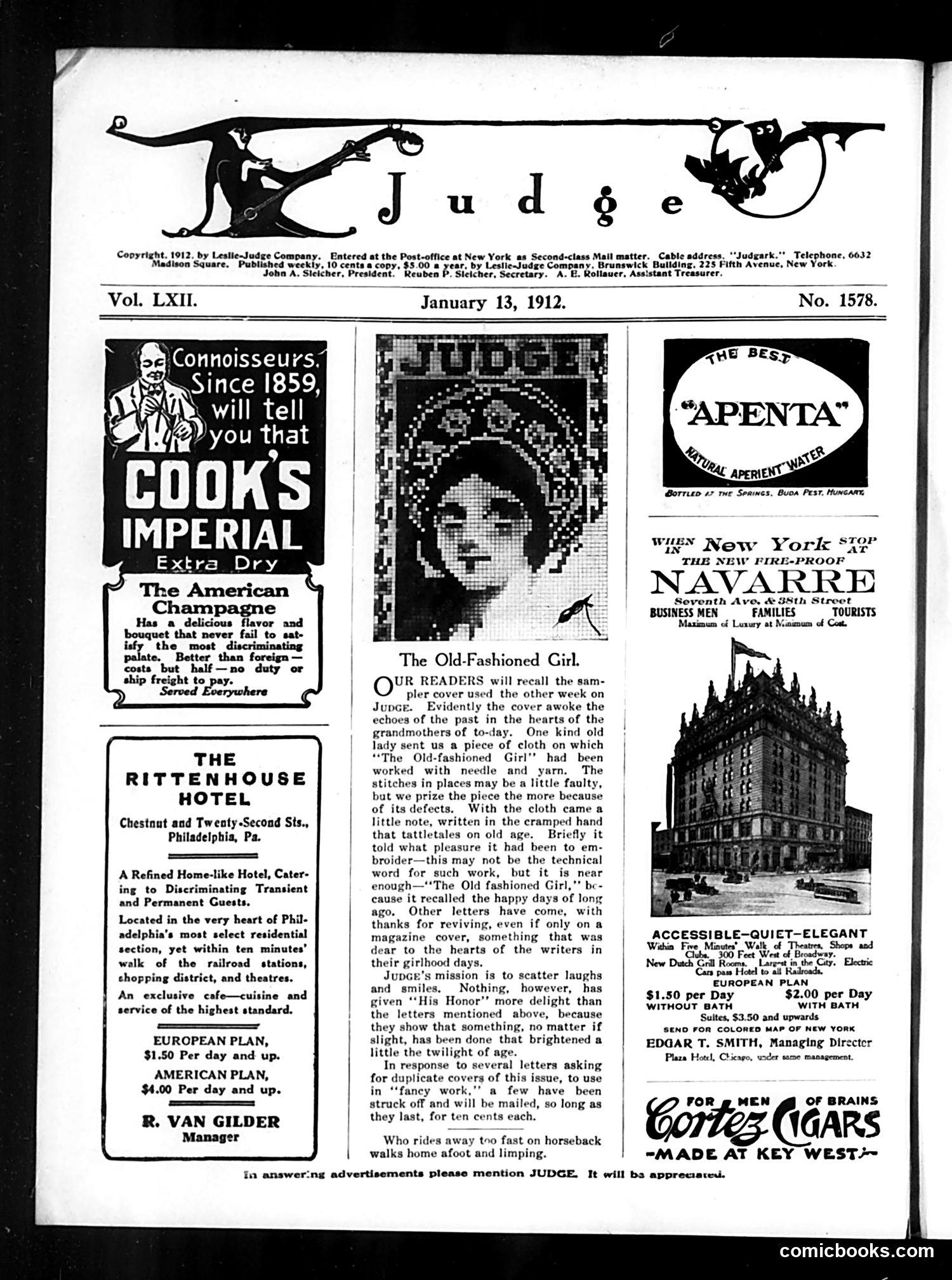
This page is primarily **advertising and editorial content** rather than political satire. The main feature is "The Old-Fashioned Girl," where Judge's editors respond to reader mail. A grandmother sent in embroidered needlework labeled "The Old-fashioned Girl," which prompted nostalgic letters about simpler times. The editors use this as a lighthearted vehicle to celebrate traditional femininity and craftsmanship, contrasting with modern life. Readers expressed pleasure that something "old-fashioned" could still delight and brighten "the twilight of age." The surrounding advertisements (Cook's champagne, Apenta water, the Rittenhouse Hotel, and Coolees cigars) reflect upper-class consumer culture of the Gilded Age era, with no discernible political commentary on this particular page.
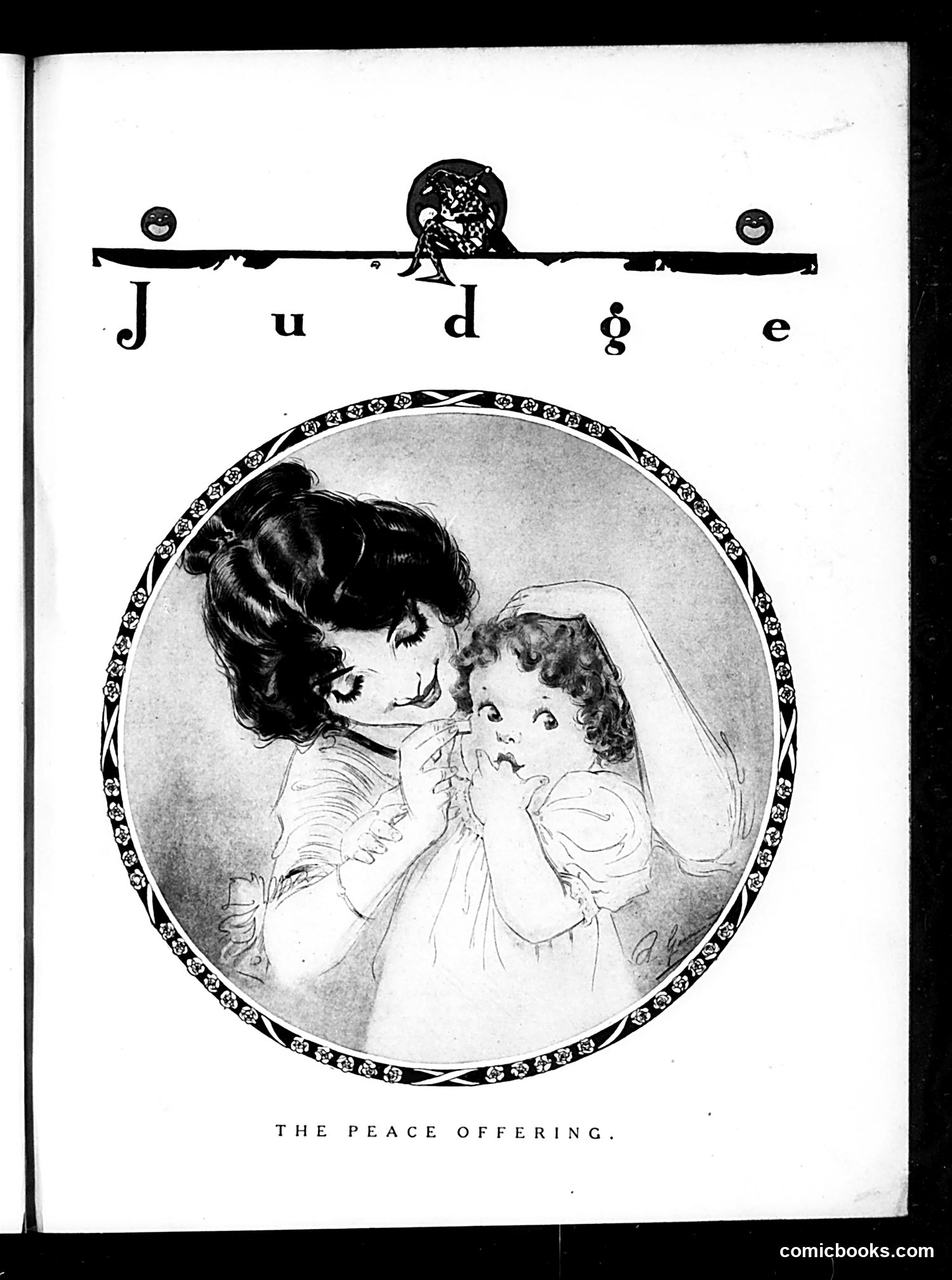
This page from *Judge* magazine depicts a tender domestic scene titled "The Peace Offering." A woman and small child are shown in an intimate moment, the child appearing to offer reconciliation or affection to the adult. The illustration likely satirizes marital reconciliation or domestic peace-making, common themes in early 20th-century American humor. The "peace offering" — traditionally a gesture meant to resolve conflict — is rendered here in sweetly sentimental terms through the child's innocent participation. Without additional context or visible date, the specific political or social reference remains unclear. The image may comment on domestic relations generally, or possibly reference a particular contemporary political situation using domestic metaphor. The decorative circular border and ornamental header elements are typical of *Judge*'s design aesthetic.
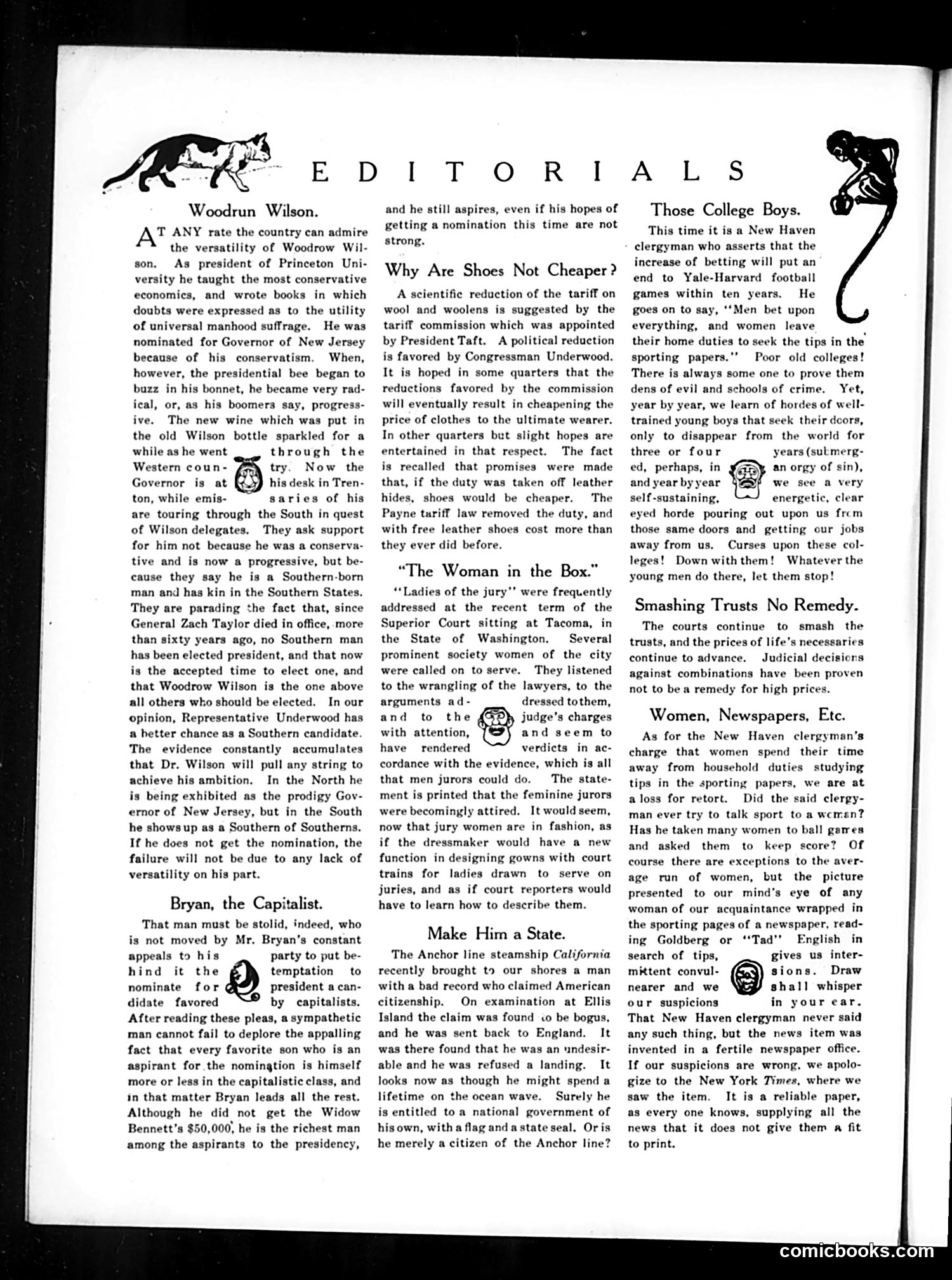
This is a satirical editorial page from **Judge** magazine featuring several commentary pieces: **Top left**: "Woodrow Wilson" - praises Wilson's conservative economics as Princeton president, noting Southern delegates now support his presidential candidacy despite initial doubts about his conservative credentials. **Center sections** contain three shorter editorials critiquing: - Tariff policy on wool/woolen goods - Women jurors in Tacoma, Washington courts (mocking their presence) - Immigration practices regarding the steamship *California* **Bottom right**: "Those College Boys" mocks Yale-Harvard students betting on football games instead of studying, presenting moral outrage at their corruption. The page demonstrates *Judge*'s satirical approach: supporting Wilson politically while simultaneously mocking women's expanding civic roles, critiquing tariffs, and expressing concern about youth morality.
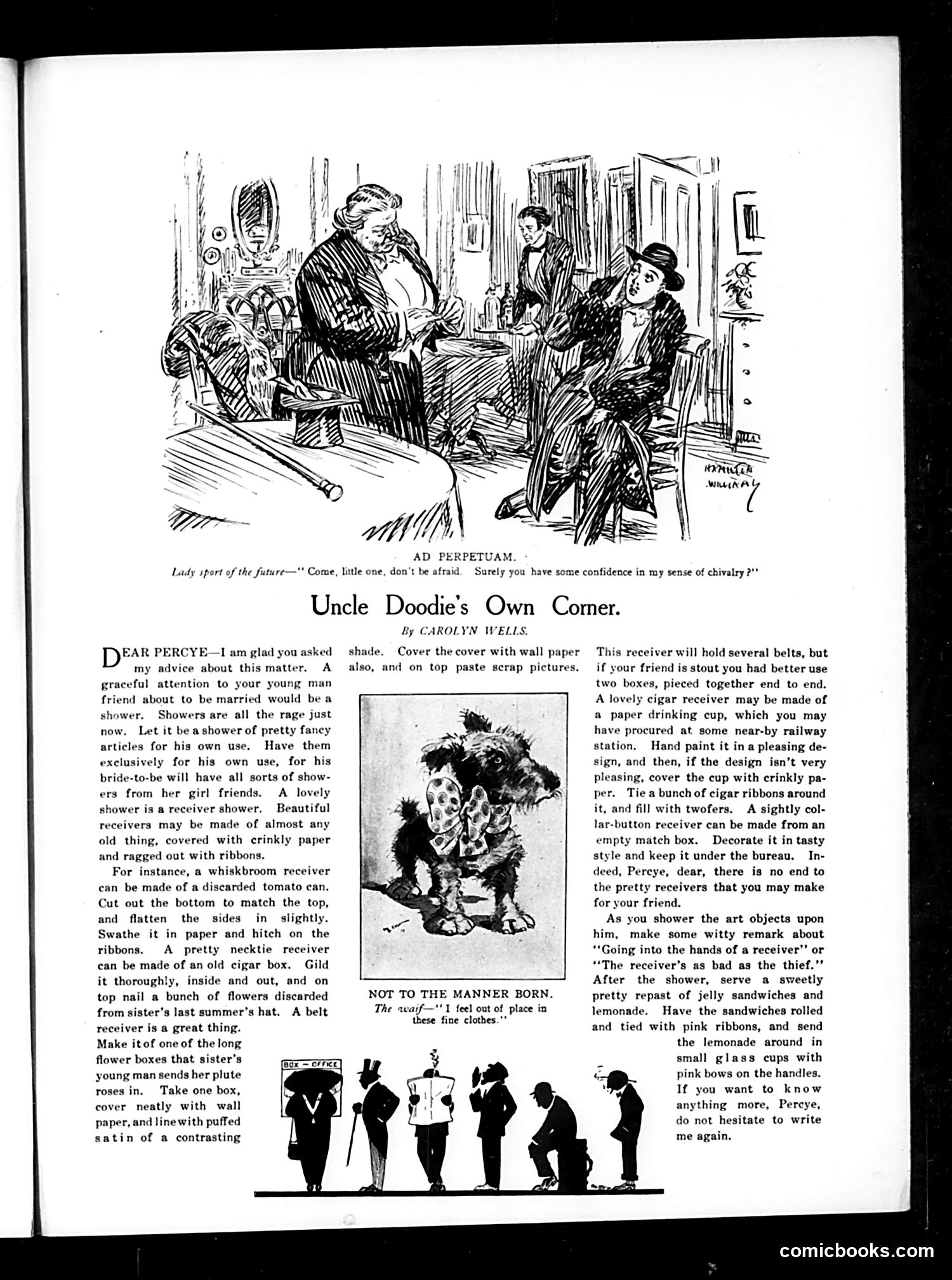
This page contains advice columnist "Uncle Doodie" (by Carolyn Wells) responding to a reader named Percye about shower gift etiquette for an upcoming wedding. The top cartoon depicts a social gathering where someone appears to be presenting shower gifts, illustrating the contemporary practice being discussed. Below, the columnist advises against fancy, expensive shower gifts, instead recommending DIY "receiver" gifts made from ordinary items—a discarded tomato can, old cigar box, flower box, or match box—decorated creatively with paper and ribbons. The satirical point targets the social pretension of modern weddings: rather than obligatory expensive gifts, homemade, humorous alternatives are preferable and more honest. The small silhouette cartoon at bottom appears to mock formal wedding etiquette conventions. The humor lies in advocating deliberately humble, whimsical gifts over society's materialistic expectations.
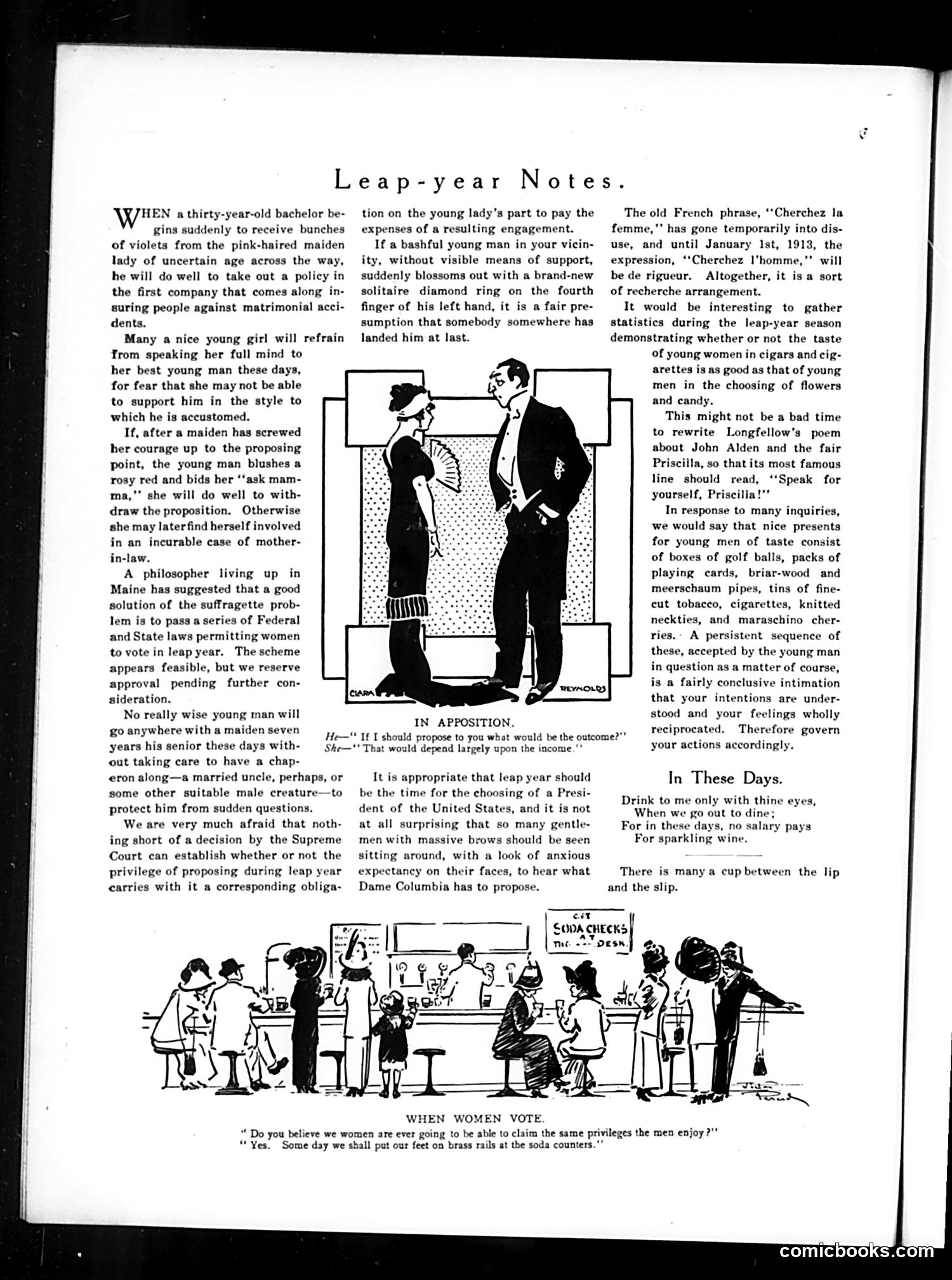
This Judge magazine page satirizes the social upheaval of leap year, when tradition permitted women to propose to men—a radical inversion of courtship norms that challenged gender expectations during the suffrage movement era. The main cartoon "In Apposition" shows a woman and man discussing marriage prospects, with her calculating his income before accepting. The satire mocks women's economic dependence and the transactional nature of marriage. The lower cartoon "When Women Vote" depicts women at a soda fountain, sarcastically suggesting that if women gained voting rights during leap year, they'd soon demand equal privileges at social venues—a common anti-suffrage argument. The editorial text humorously catalogs leap-year anxieties: men needing chaperones, women unable to support suitors, and the reversal of traditional proposal dynamics. References to "Dame Columbia" (America personified) and the 1912 presidential election ground the satire in contemporary politics, suggesting women's suffrage and leap-year role reversals were seen as equally destabilizing to social order. The satire fundamentally ridicules women's ambitions for economic and social equality.
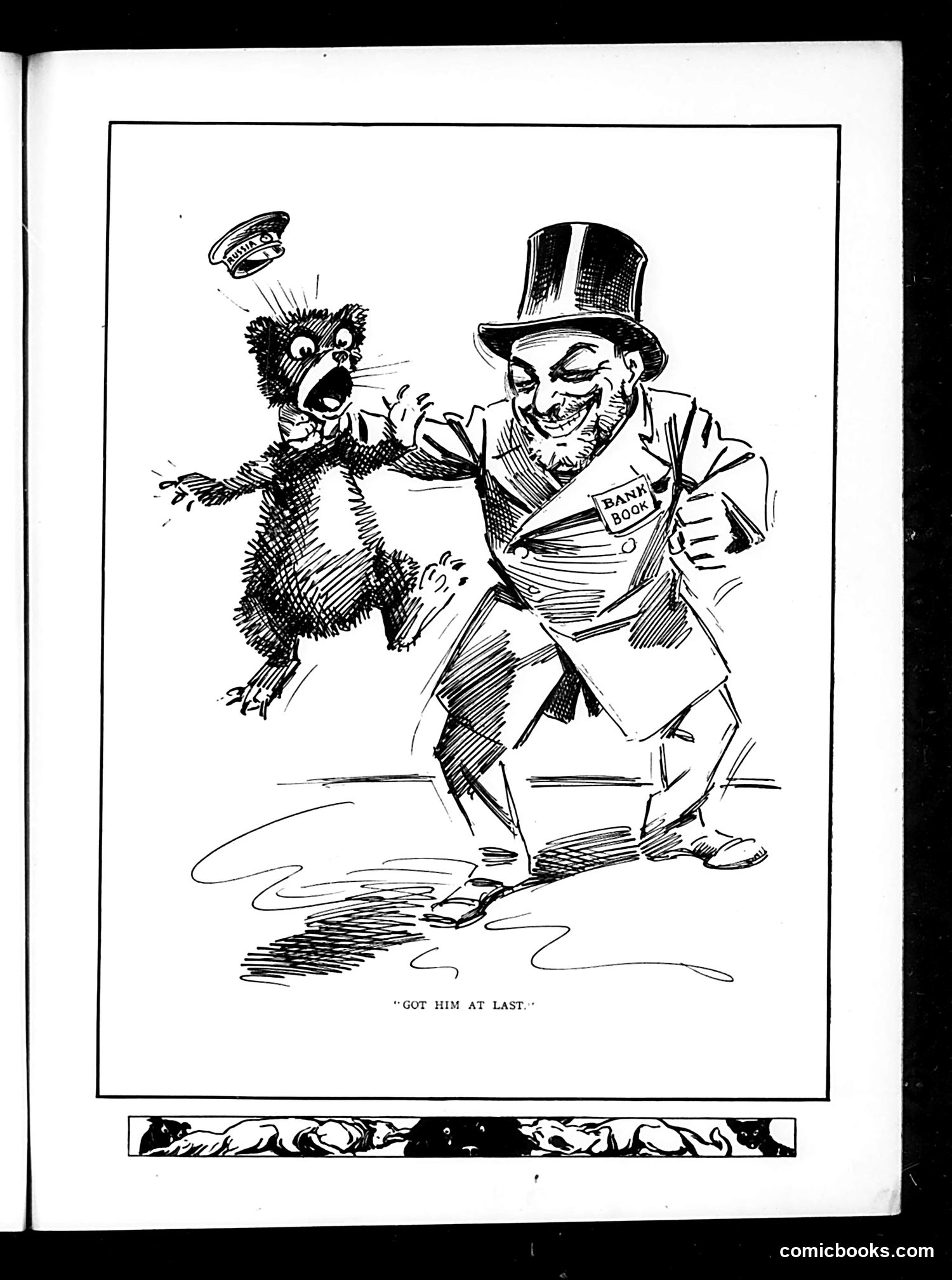
This cartoon depicts a well-dressed man with a top hat holding a "Bank Book" while triumphantly displaying a distressed animal (appears to be a cat or similar creature wearing a police cap). The caption reads "GOT HIM AT LAST." The satire likely references financial or banking corruption, with the animal representing either a specific corrupt official or the concept of malfeasance that authorities finally apprehended. The banker's gleeful expression and formal attire suggest he's the villain rather than hero—implying the "catch" represents successfully eliminating a rival, competitor, or obstacle rather than genuine justice. Without clearer historical context about Judge magazine's publication date or specific contemporary events, the exact identity of the figures remains unclear. The cartoon appears to mock either banking interests or law enforcement's relationship with financial institutions during the Gilded Age or Progressive Era.
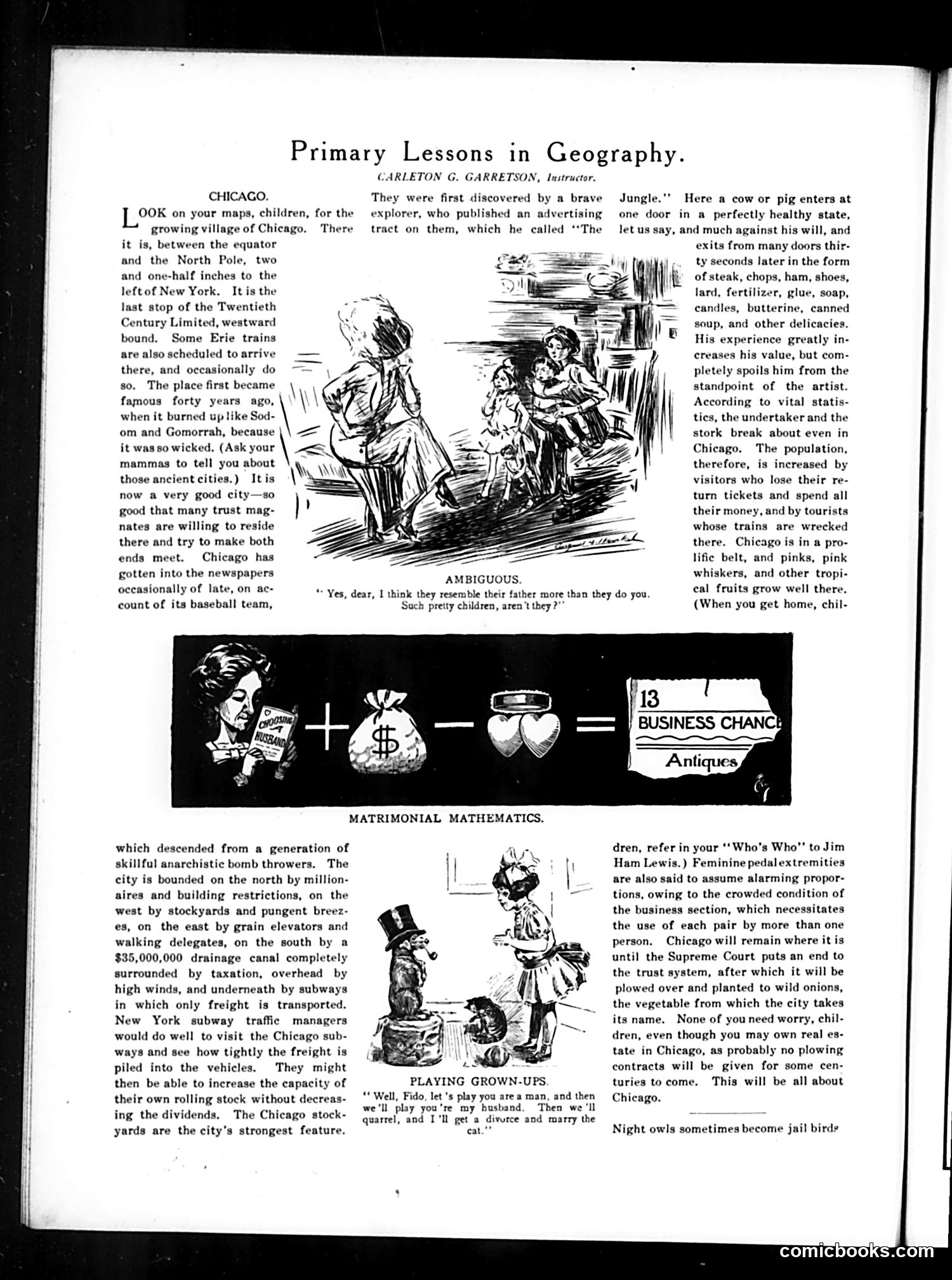
This page satirizes Chicago through mock geography lessons and social commentary. The "Primary Lessons in Geography" section ridicules Chicago's reputation—referencing its 1871 fire ("burned up like Sodom and Gomorrah"), anarchist bomb-throwers, and industrial squalor (stockyards stench, grain elevators, drainage canals). The satire notes how Chicago's population grows paradoxically through tourists losing money and train wrecks. The "Matrimonial Mathematics" cartoon uses a crude equation (woman + money - beauty = business opportunity/antiques) to mock shallow marriages based on financial calculation rather than love. "Playing Grown-Ups" depicts children role-playing adult marriage and divorce casually, satirizing the era's apparently cavalier attitude toward matrimony and marital dissolution. The "Ambiguous" caption jokes about paternity uncertainty—a comment on infidelity or questionable parentage. Overall, the page combines geographic mockery of Chicago's industrial brutality with social critique of contemporary marriage practices and urban corruption.
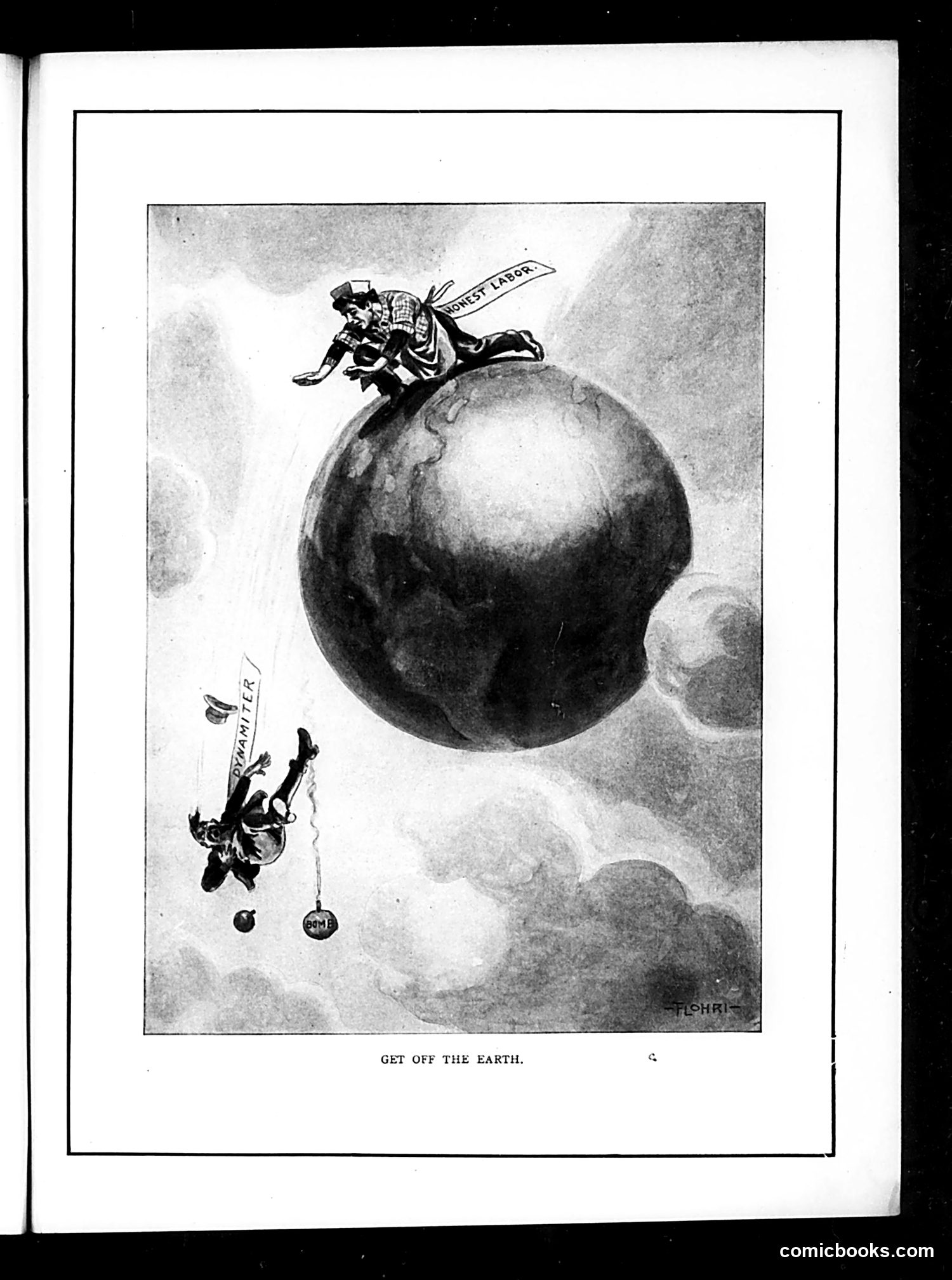
This satirical cartoon depicts two figures in conflict over a large globe. One figure labeled "Honest Labor" sits atop the Earth holding a flag, while below, another figure (labeled "Capital," though partially unclear) appears to be falling or being pushed away, holding what looks like a money bag marked "$$$." The cartoon comments on late-19th-century labor-versus-capital tensions. The composition—with "Honest Labor" elevated and dominant—suggests the cartoonist's sympathy for workers' rights and criticism of wealthy capitalists. The exaggerated, almost violent imagery of expulsion ("Get Off the Earth") reflects the period's intense class conflict and labor movement debates about economic fairness and workers' power. The style and subject matter are typical of *Judge* magazine's progressive-leaning political satire.
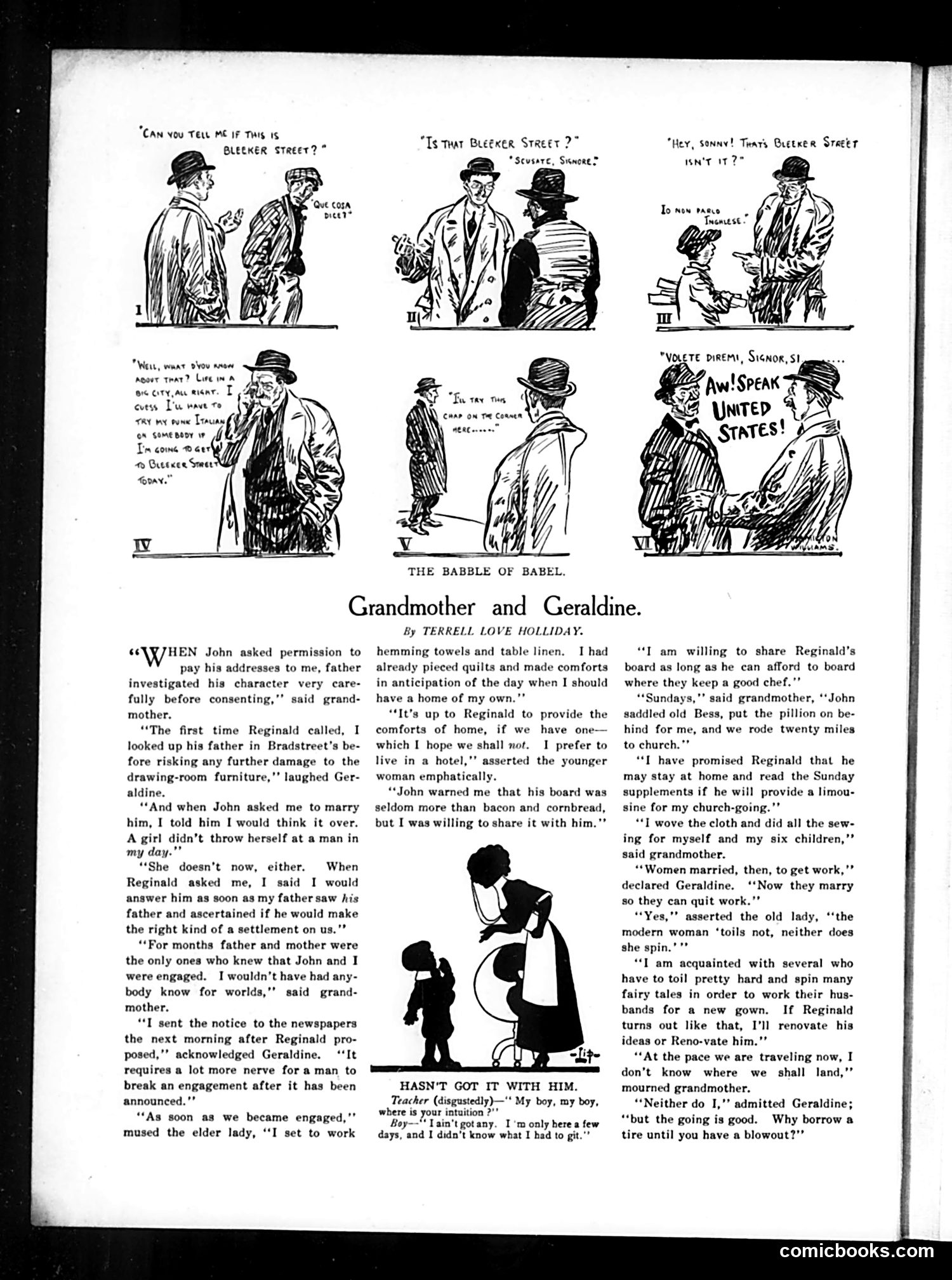
**Top cartoon**: This satirizes immigrant communication difficulties in New York City. Six panels show a pedestrian repeatedly asking for "Bleecker Street" but receiving increasingly garbled, incomprehensible responses from immigrants speaking broken English. The final panel features someone shouting "Aw! Speak United States!"—the satire's point. This reflects early-20th-century American anxieties about foreign immigration and language barriers, mocking both the immigrants' accents and the native speaker's impatience. **Bottom story**: A contrasting generational commentary. Grandmother recalls courtship customs: parental investigation, modest announcements, domestic preparation (hemming, quilting), and simple married life. Granddaughter Geraldine dismisses these values—she wants hotels over homemaking, newspaper announcements over secrecy, and leisure over labor. The dialogue satirizes the "modern woman" as idle and materialistic, while also mocking grandmother's earnest self-sacrifice. The piece reflects Jazz Age debates about changing female roles and values.
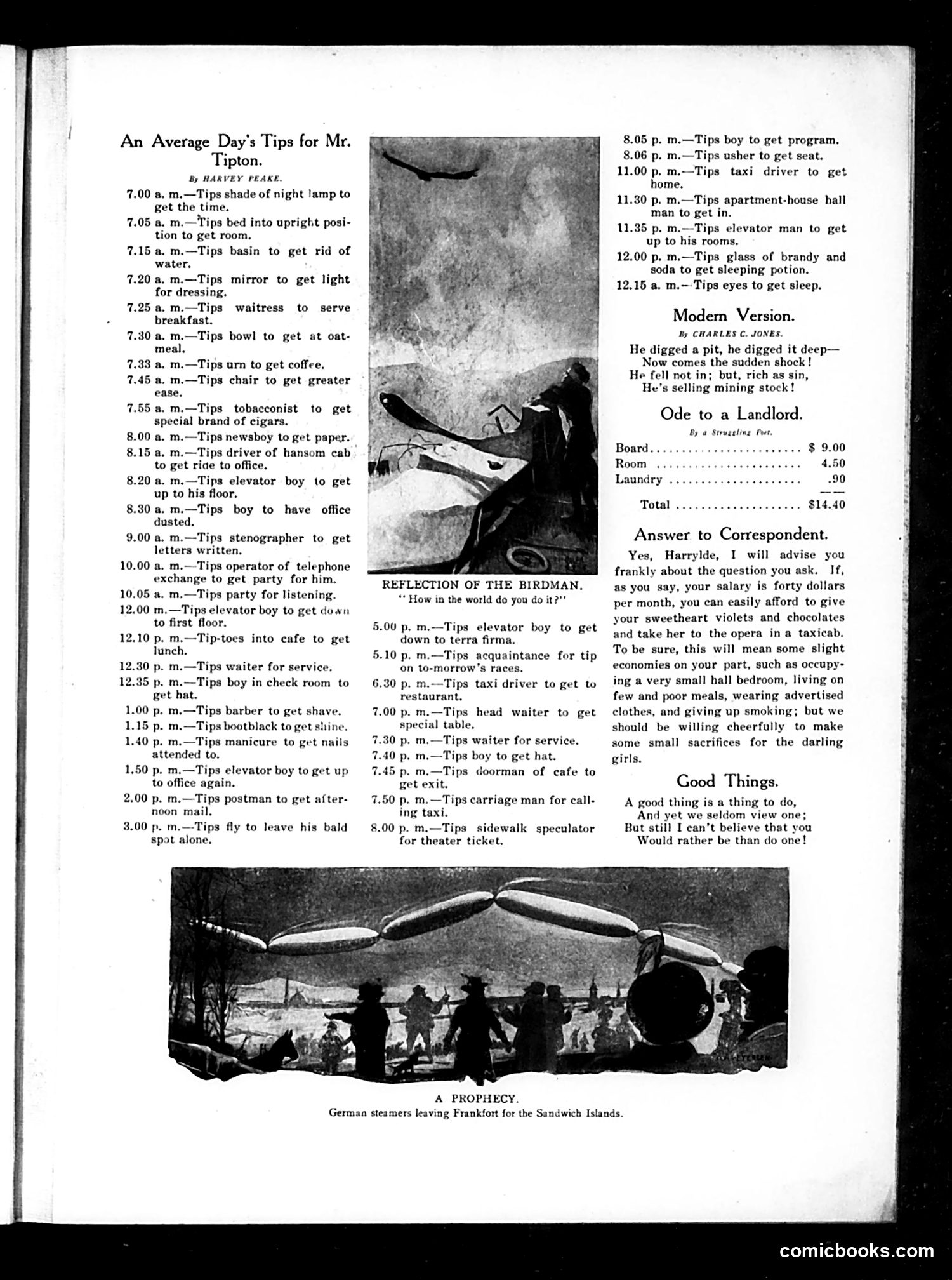
This satirical piece mocks the era's tipping culture by presenting "Mr. Tipton," an absurdly wealthy man who tips for virtually everything throughout his day—from a lamp shade to a fly. By 7:00 a.m. through midnight, he tips dozens of people for minor services (elevator boys, washroom attendants, stenographers), the humor escalating as the list grows increasingly ridiculous. The satire targets two social anxieties of the period: the proliferation of expected gratuities across service industries, and the ostentatious wealth-display of the wealthy class. By listing over fifty tipping scenarios, the author (Harvey Peake) suggests both the absurdity of this custom and Tipton's compulsive need to demonstrate his affluence through constant monetary generosity. The accompanying illustration shows Tipton in formal dress, reinforcing his wealthy status. The satire reflects genuine contemporary concern about tip inflation and class performance in early 20th-century urban America.
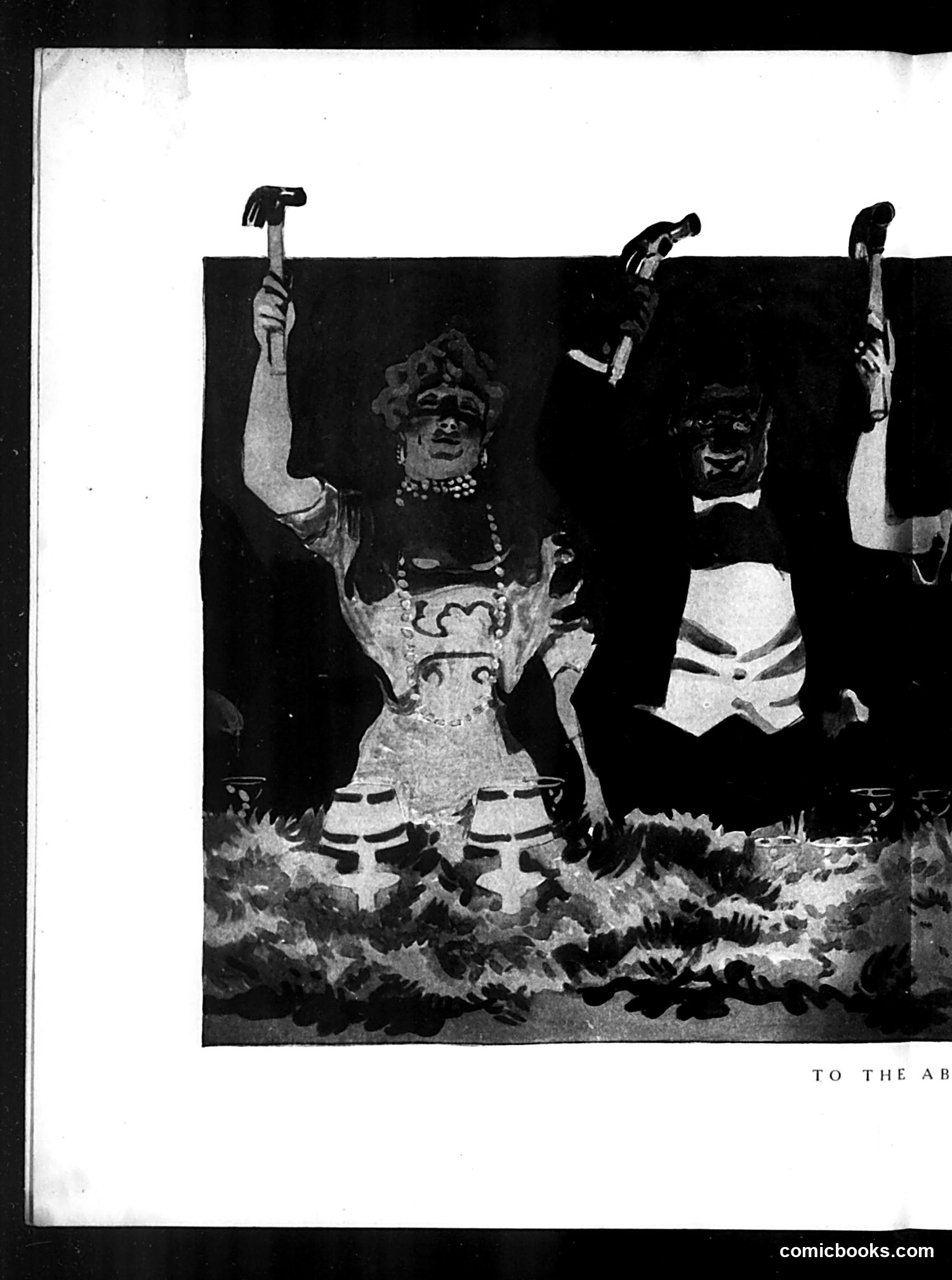
I can see this is a black and white illustration from Judge magazine showing figures in exaggerated theatrical or costume dress, holding hammers aloft in what appears to be a celebratory or triumphant pose. The figures wear ornate clothing with decorative patterns and jewelry. However, the OCR text provides only "comicbooks.com" and partial text reading "TO THE AB[...]" at the page bottom—insufficient to identify the specific political or social references, the figures depicted, or the satirical point being made. Without legible caption text or date information, I cannot reliably explain what historical event, political figures, or social commentary this cartoon addresses. The image quality and text limitations prevent accurate identification of the intended satire for a modern reader.
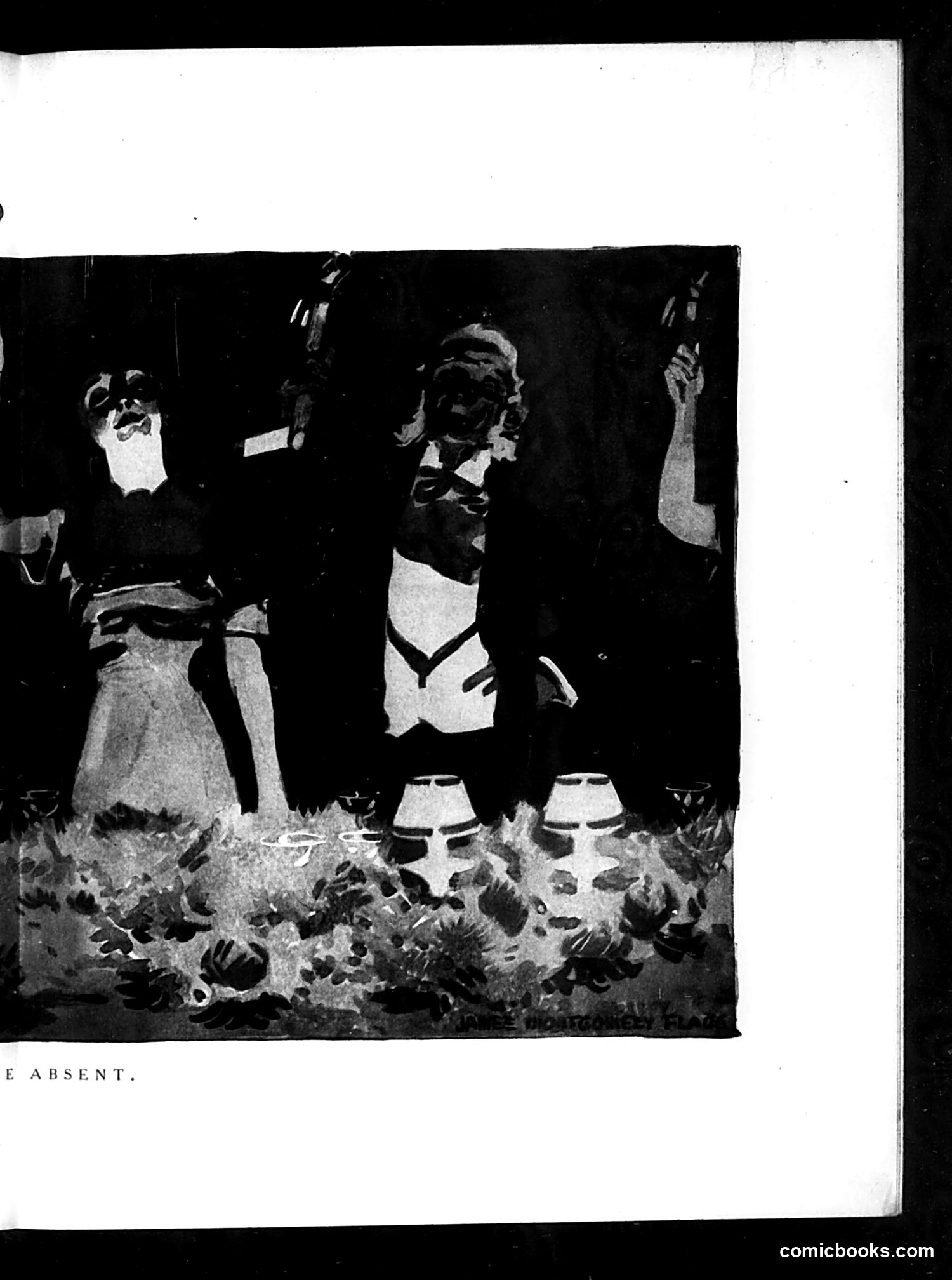
This page from *Judge* magazine shows a black and white photograph or illustration labeled "ABSENT" at the bottom. The image depicts two figures in formal attire (tuxedos) with exaggerated facial features characteristic of late 19th/early 20th-century caricature, standing among decorative potted plants. Without additional text or context visible on this page, the specific political or social satire is unclear. The title "ABSENT" suggests commentary on someone's non-attendance at an event, possibly a formal gathering or official function. However, I cannot definitively identify which public figures are caricatured or what particular event or scandal is being referenced without more contextual information from surrounding pages or dated publication details.
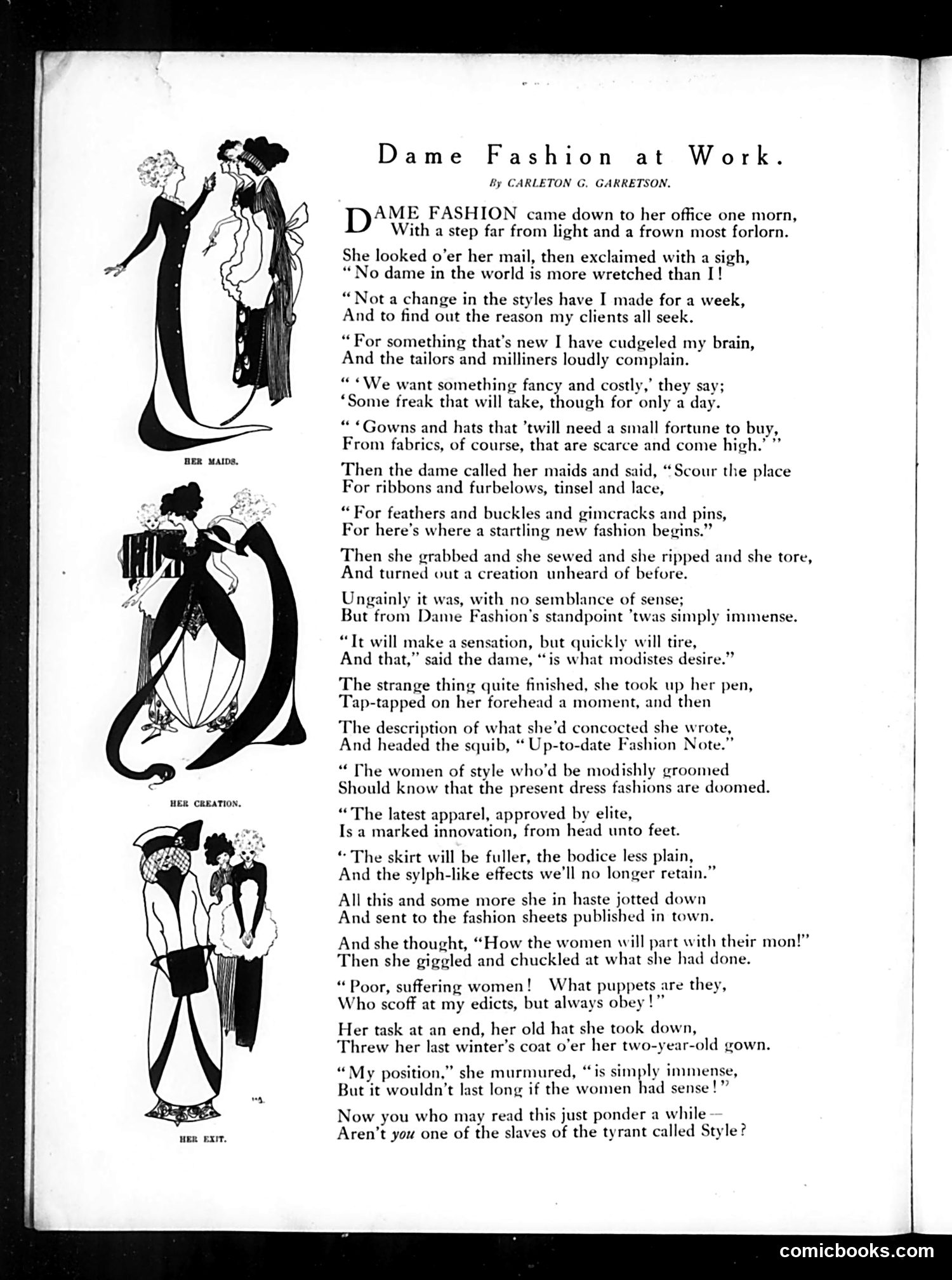
This satirical poem by Carleton G. Garretson mocks the fashion industry and women's susceptibility to style trends. "Dame Fashion"—personified as a powerful businesswoman—represents the fashion establishment itself. The cartoon shows her manipulating her clients through manufactured demand. The satire works on two levels: First, it exposes how fashion designers cynically create new styles not from inspiration but from commercial pressure, deliberately making garments expensive and impractical ("scarce and come high"). Second, it ridicules women as helpless "puppets" and "slaves" who unquestioningly follow absurd edicts despite claiming to scoff at them—even Dame Fashion herself wears a shabby two-year-old gown, revealing her hypocrisy. The final moral asks readers: aren't you all enslaved by "Style"? The piece critiques consumerism and suggests fashion's irrationality while simultaneously mocking women's perceived weakness for fashion fads.
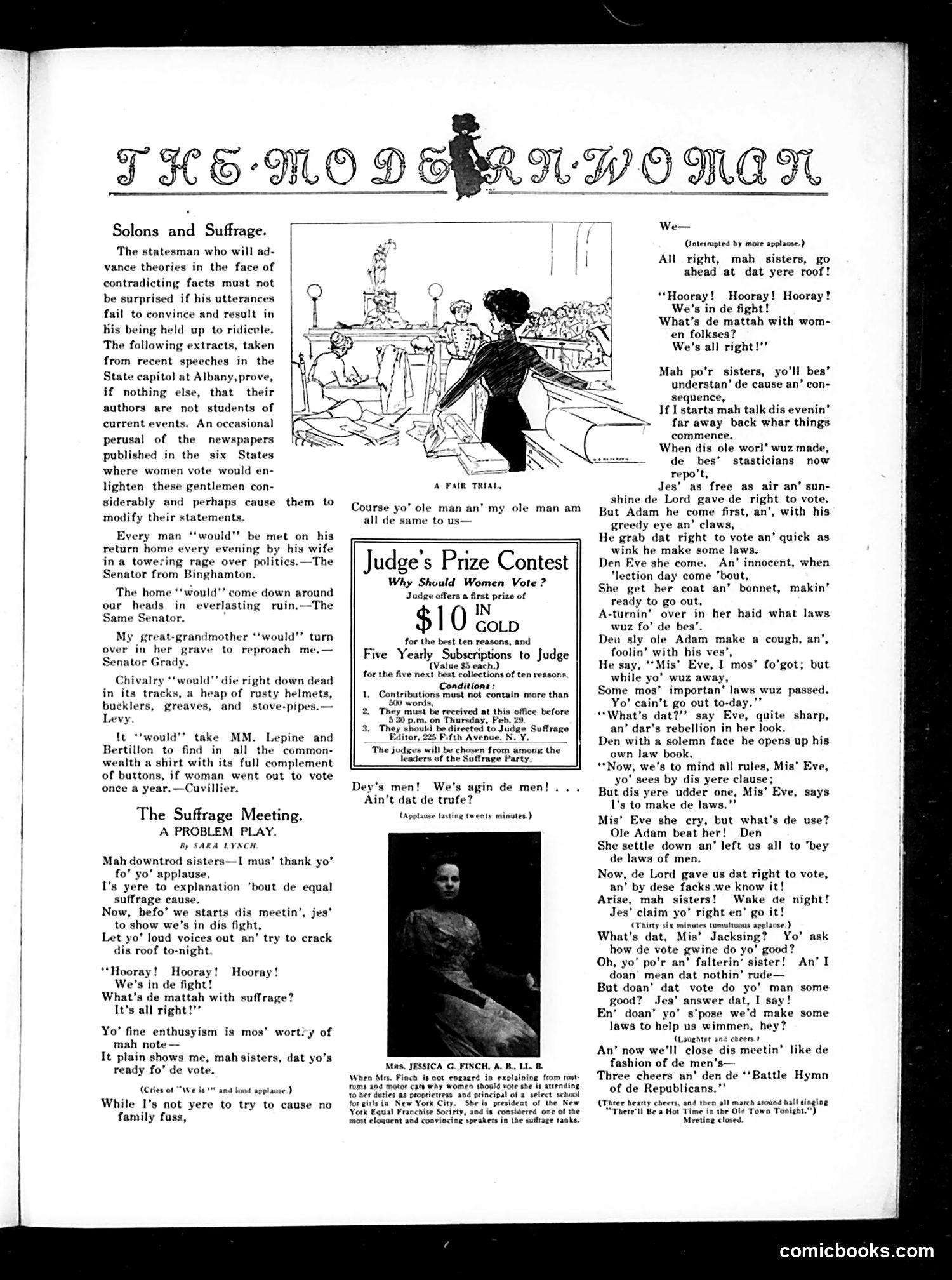
This satirical page mocks male politicians opposing women's voting rights. The left column quotes actual New York State legislators making absurd predictions: wives would nag husbands constantly about politics, homes would collapse, chivalry would die, and shirts would lose buttons if women voted. The central cartoon "A Fair Trial" depicts a woman at what appears to be a trial or debate, sarcastically titled to show the "fairness" of excluding women from voting. The right column contains "The Suffrage Meeting," a dialect-heavy monologue by a Black female speaker promoting voting rights. While advocating for suffrage, the passage uses exaggerated African American vernacular typical of period minstrelsy, likely reflecting Judge's satirical intent to mock both the cause and the speaker through stereotype. A portrait of suffragist Jessica G. Finch appears, identified as an actual advocate and educator. The bottom advertises Judge's prize contest asking "Why Should Women Vote?"—inviting readers to submit arguments, suggesting the magazine engaged with the contemporary suffrage debate.
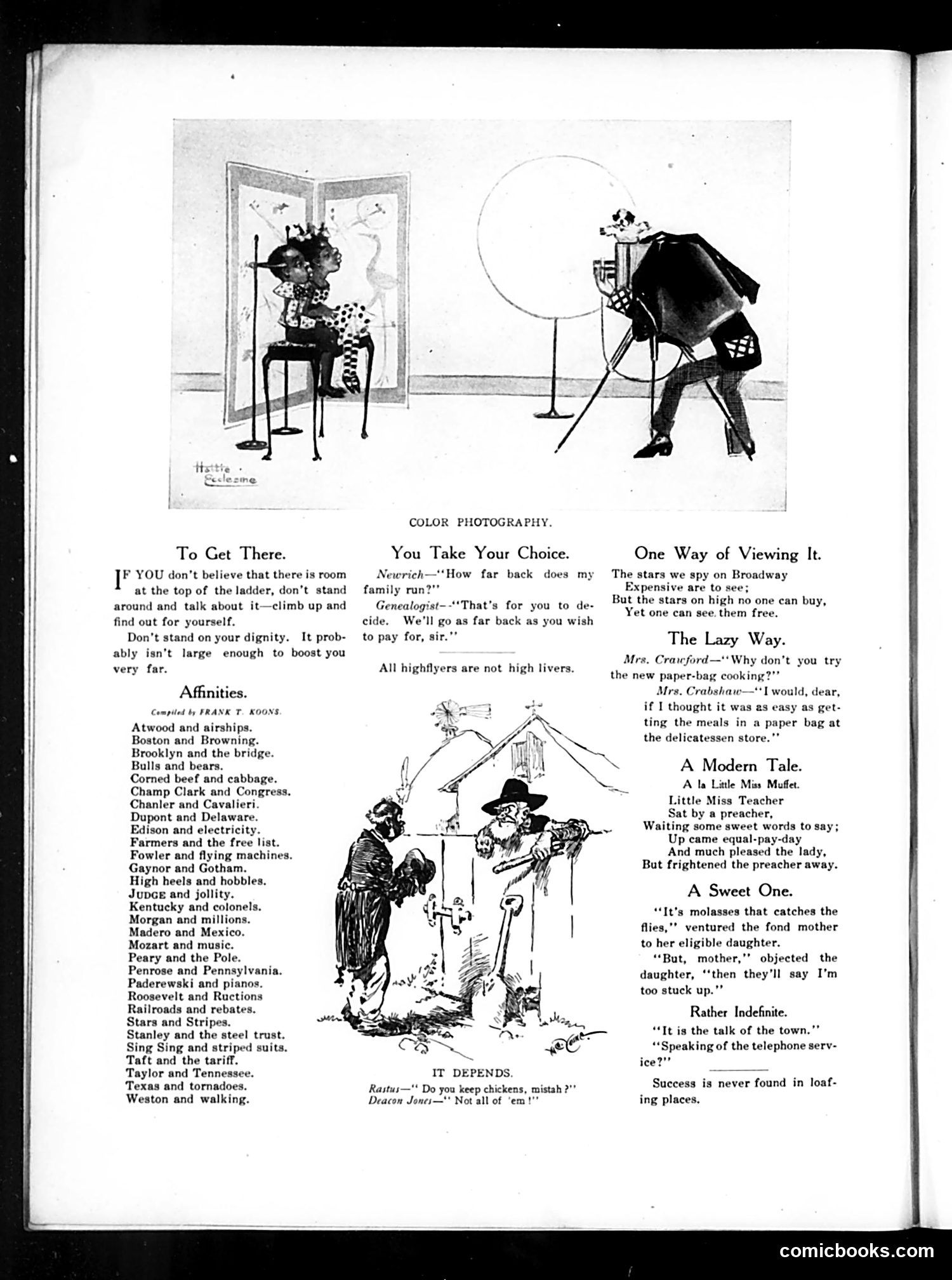
**The Top Cartoons:** The "Color Photography" section shows three related jokes about photography technology. The left panel depicts a wealthy woman ("Newrich") sitting for a portrait while discussing genealogy—she wants her family history traced "as far back as you wish to pay for," satirizing nouveau riche pretensions. The right panel mocks Broadway theater-goers: expensive tickets buy access to stars, but one can see actual stars in the sky free. The humor targets class anxieties and consumerism circa the early 1900s. **"Affinities" Section:** This compiled list by Frank T. Koons pairs unlikely concepts as humorous associations—"Atwood and airships," "Boston and Browning," "Sing Sing and striped suits." The jokes rely on contemporary references (Champ Clark was a politician; Sing Sing is a prison) but mostly work through wordplay and absurdist pairing rather than requiring specific historical knowledge. **Small Comic Snippets:** The remaining jokes address everyday life: cooking innovations, sermon attendance, and rural humor (the final "Rastus" dialogue involves African American vernacular humor, typical of the era's problematic conventions).
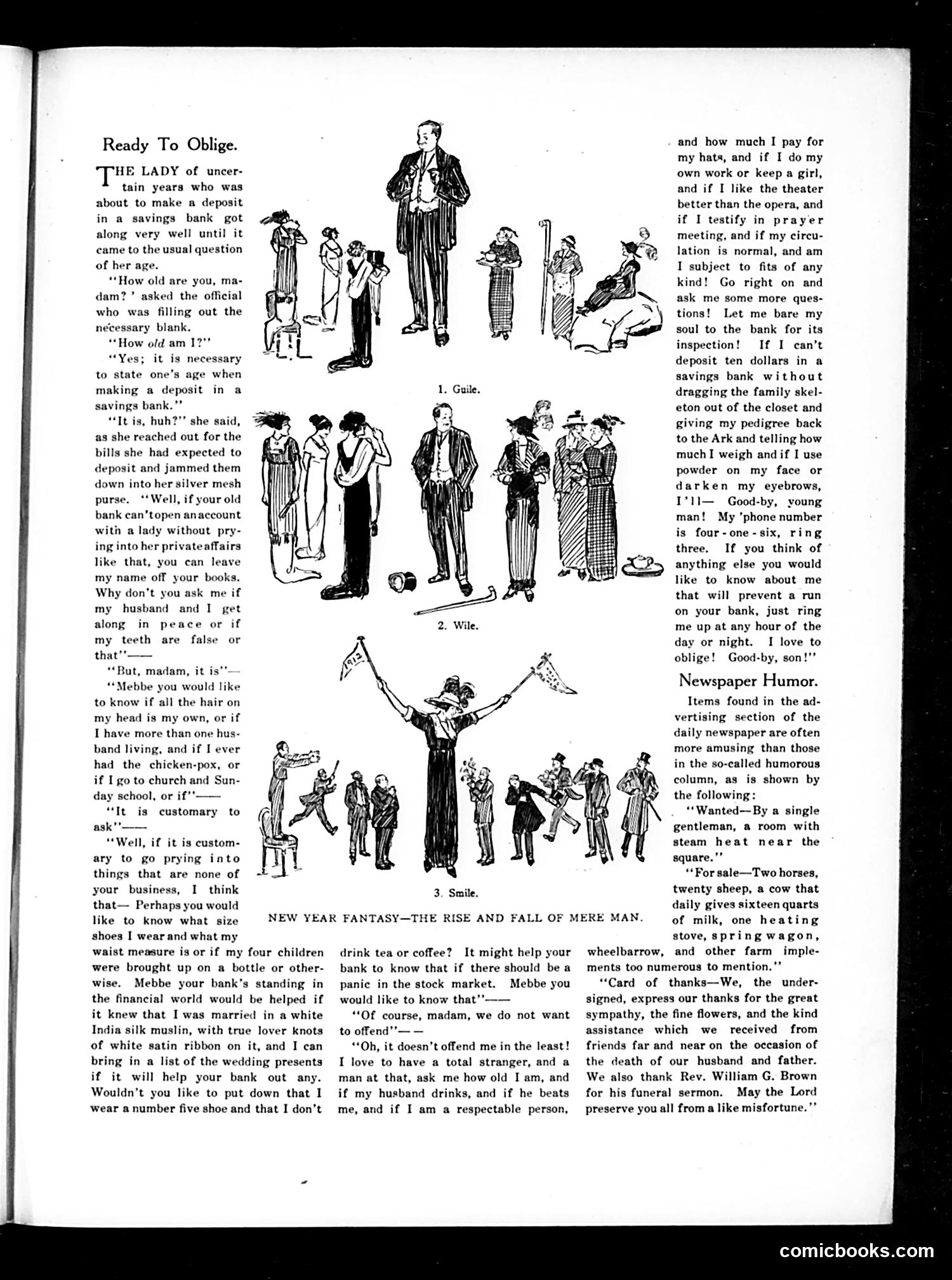
This piece mocks intrusive banking practices of the era. A middle-aged woman attempting to open a savings account becomes indignant when asked her age—a required disclosure for account opening. She responds with biting sarcasm, sarcastically offering to reveal ever-more personal information: her marital status, children, clothing, shoe size, cosmetics use, prayer habits, and health conditions. The satire targets two things: (1) banks' invasive data-collection practices, framed as "customary," and (2) society's general nosiness about women's private affairs. The woman's escalating tirade exposes how absurd such inquiries seem when listed together. By feigning enthusiastic compliance ("I love to oblige!"), she highlights the absurdity of surrendering privacy simply to deposit money. The humor lies in her refusal to normalize institutional prying into personal life.
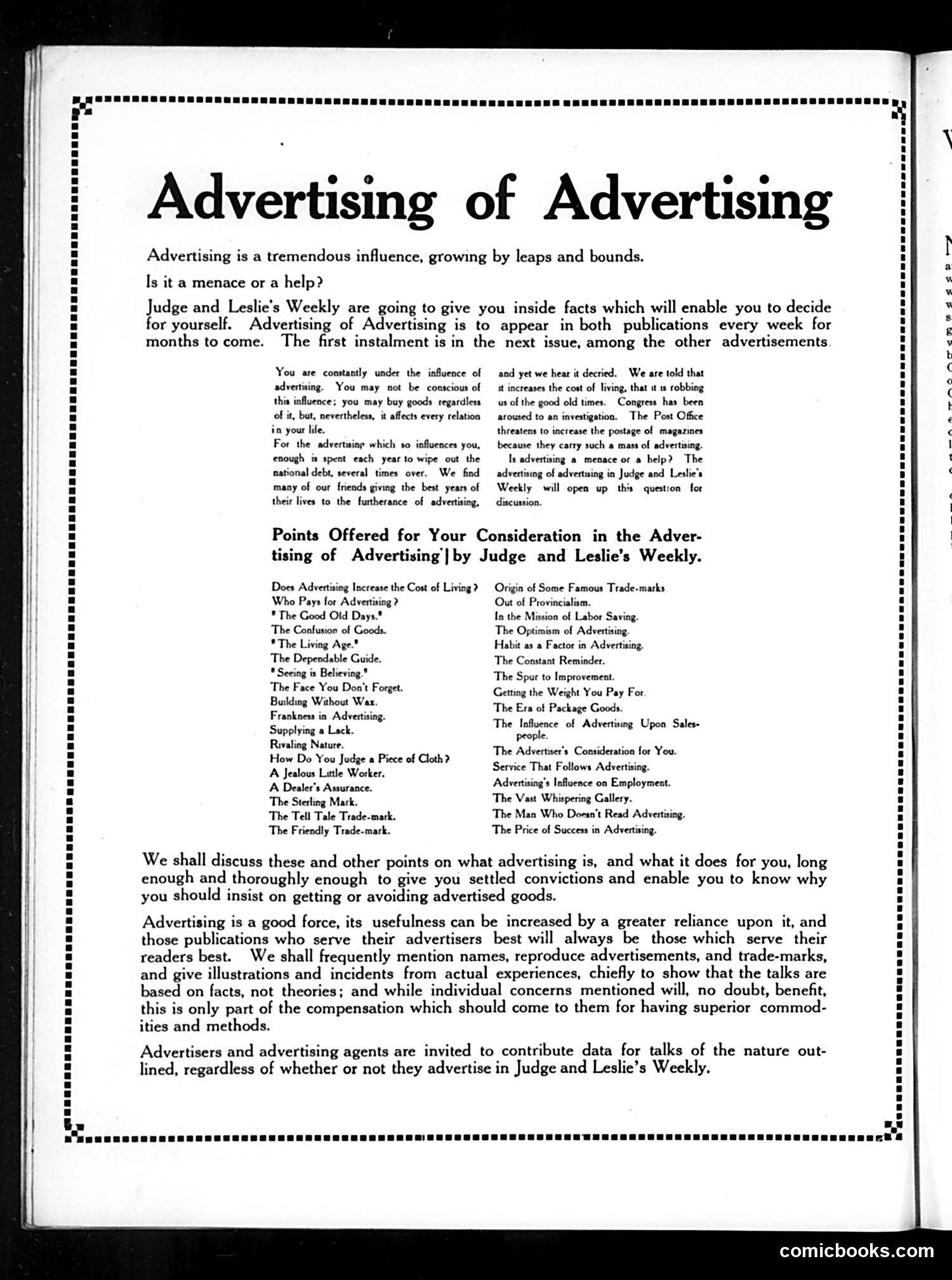
This is **not a cartoon but a manifesto/announcement page** for a series Judge and Leslie's Weekly planned to run examining advertising itself. The context: Early 20th-century America was experiencing explosive growth in advertising, which generated public anxiety. Congress had launched investigations; the Post Office considered raising magazine postage due to advertising volume; critics claimed ads inflated living costs and corrupted "the good old times." Judge positions itself as a neutral arbiter, promising readers "inside facts" to decide whether advertising is "a menace or a help." The publication lists dozens of discussion topics (trade-marks, cost-of-living, labor-saving innovations, employment effects) it will explore. The key pitch: advertising itself is "a good force" deserving serious examination rather than blanket condemnation. Judge invites both skeptics and advertisers to engage with this inquiry, claiming analysis will be "based on facts, not theories." This reflects the era's growing professionalization of advertising and public debate about consumer culture's social impact.
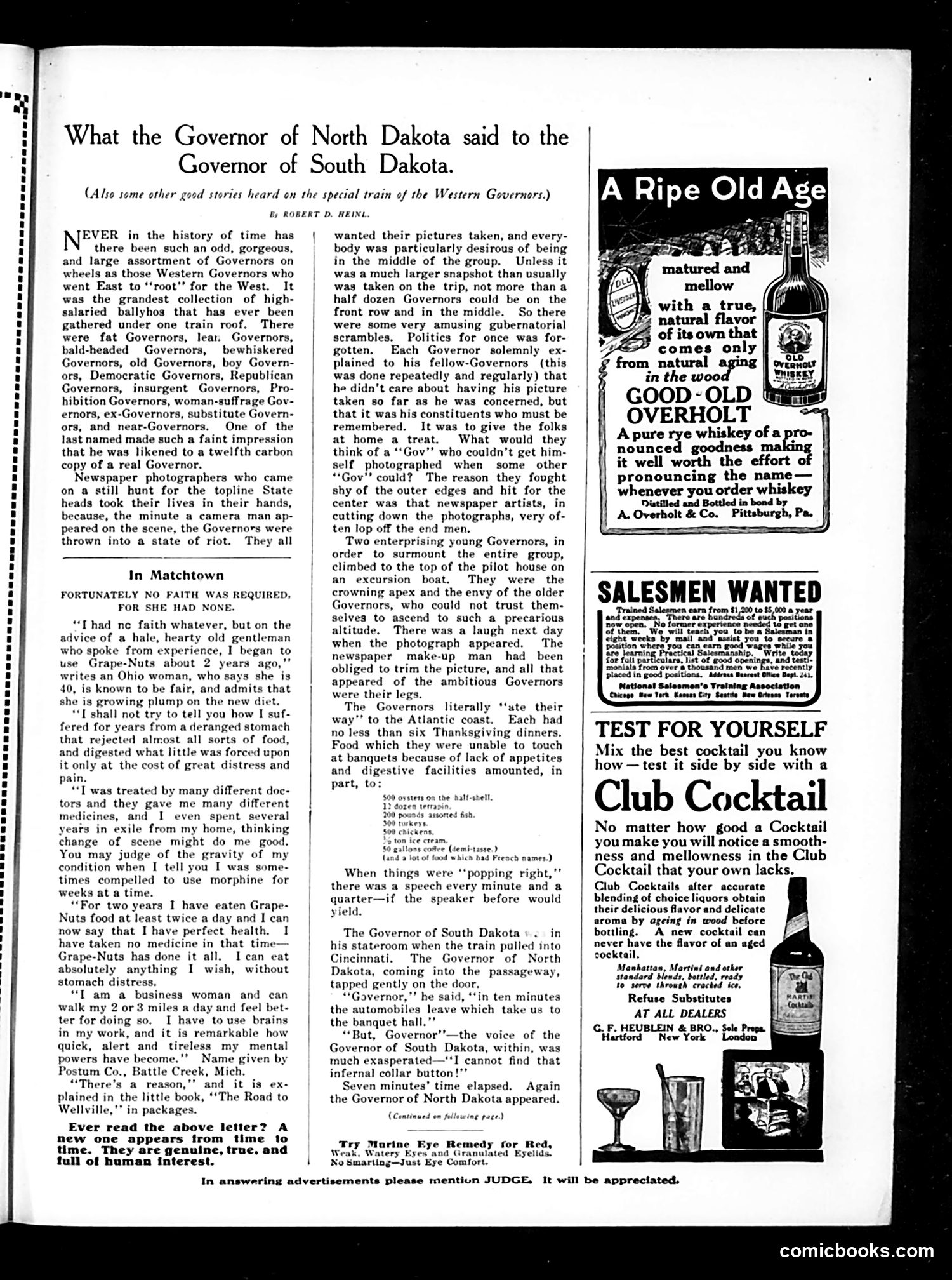
This page contains a humorous story about Western governors traveling east to promote their regions. The satire mocks governors' vanity and self-promotion. **The Main Story's Point:** Judge ridicules how a large group of governors—described as an absurd collection of "fat," "bald," "bewhiskered," and various political types—traveled together on a train. When newspaper photographers appeared, the governors scrambled frantically to position themselves in the center of group photos, each claiming they only wanted their picture taken for their constituents back home. The joke is transparent: politicians prioritize personal publicity while hypocritically denying their vanity. **Context:** This satirizes the early 1900s culture of political theater and promotional tours, where elected officials staged public appearances to boost their regions' images and their own prominence. **Advertisements:** The page also includes ads for Grape-Nuts cereal (testimonial format), whiskey, and cocktails—typical Judge revenue sources.
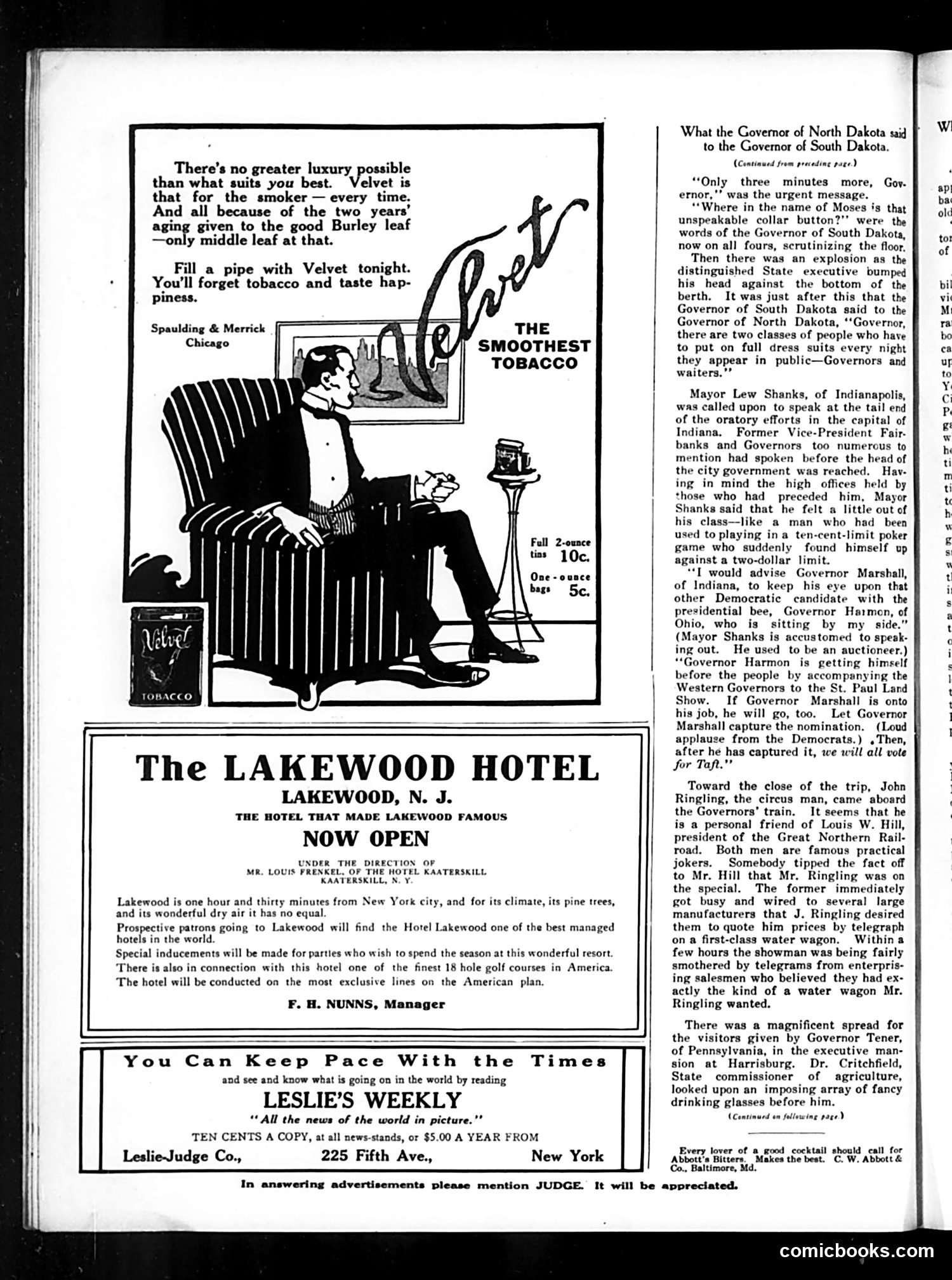
This page is primarily **advertising** with one substantial **political humor article** about Western governors. **Main Content:** A humorous account titled "What the Governor of North Dakota said to the Governor of South Dakota" describes governors traveling together by train. The joke centers on formal dress requirements—South Dakota's governor struggles with a collar button while crawling on the floor, then quips that only "Governors and waiters" must wear full dress every night. **Political Figures Referenced:** Mayor Lew Shanks (Indianapolis), Vice-President Fairbanks, Governor Marshall (Indiana), and Governor Harmon (Ohio)—all appear to be competing Democratic candidates or considering presidential ambitions. The article mockingly suggests Marshall should follow Harmon's public appearances to stay competitive. **The Satire:** Politicians are portrayed as vain, competitive, and absurd—struggling with dress codes, jockeying for visibility, and vulnerable to practical jokes by circus owner John Ringling. **Advertisements:** Velvet tobacco, Lakewood Hotel (New Jersey resort), and Leslie's Weekly magazine fill remaining space.
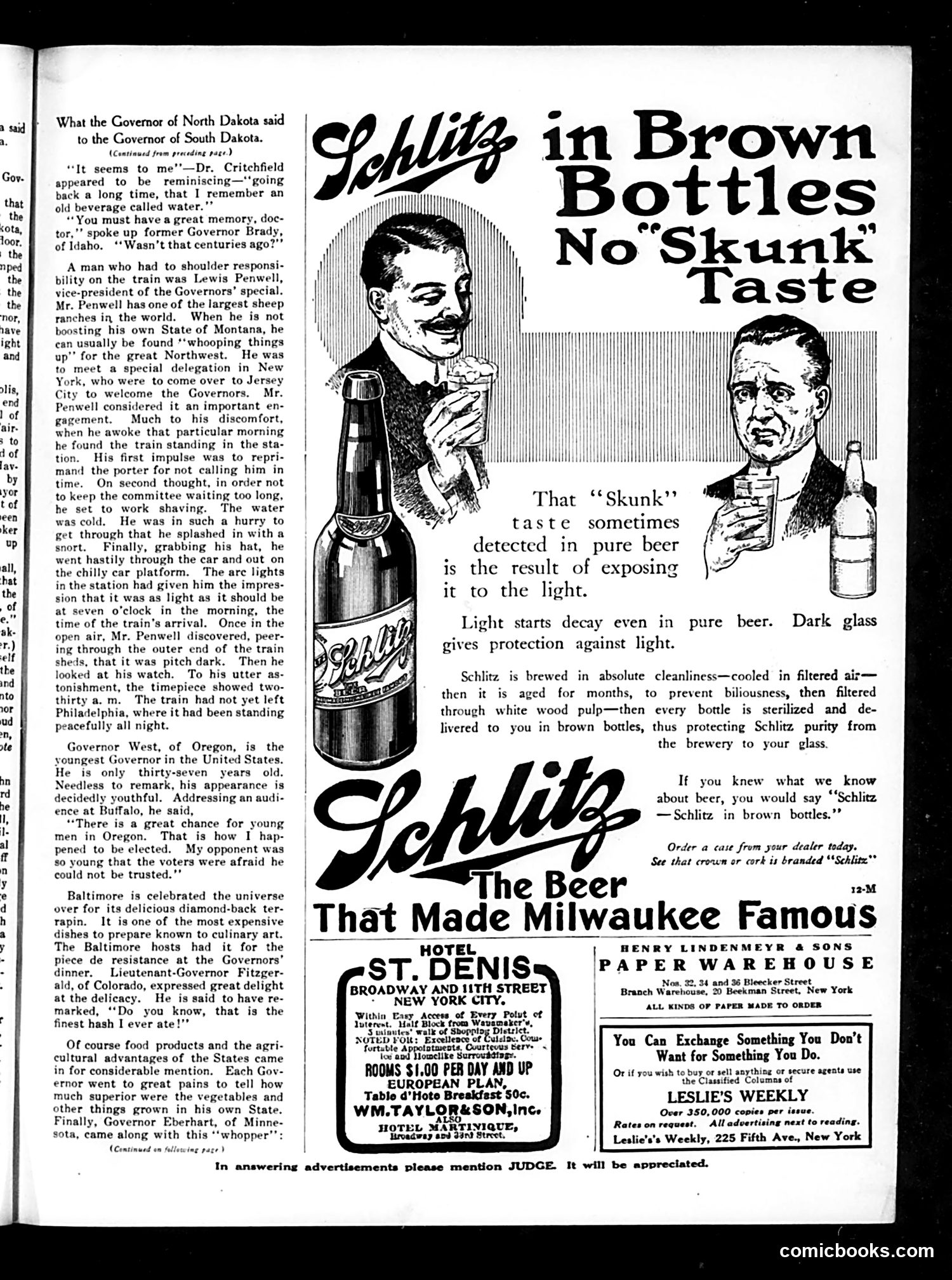
This page mixes political humor with beer advertising. The left column contains three anecdotes about American Governors attending a governors' convention, joking about their states' superiority and hardships—particularly the famous story of Montana's Lewis Penwell accidentally shaving at 2:30 a.m., thinking it was 7 a.m. The dominant feature is a **Schlitz beer advertisement** claiming their product has "no skunk taste" because it's protected in brown bottles from light exposure. The ad shows two men comparing bottles. The satire lies in the contrast: Judge magazine juxtaposes earnest political boasting by state officials with a beer company's reassurance that their product won't taste "skunky"—implying the governors' claims about their states are similarly dubious marketing. The term "skunk" taste refers to the off-flavor light creates in beer, but the placement creates an implicit joke about politicians' reliability. The page also includes advertisements for the Hotel Dennis and Leslie's Weekly.
This page is primarily **advertising** for hotels and resorts, with a sidebar containing humorous anecdotes about state governors. The main satirical content concerns **Governors' conventions** (likely early 1900s). The jokes mock governors' exaggerated tall tales: North Dakota's governor claims Minnesota potatoes grow so large they "explode like dynamite" and replace blasting powder. Nevada's governor allegedly delays joining the group due to signing divorce papers, satirizing Reno's notoriously lax divorce laws. The humor targets **gubernatorial pomposity and dishonesty**—the governors are portrayed as tired, fraught men fabricating stories while secretly sneaking away to entertainment venues rather than attending official functions. One supposedly ill governor abandons his hospital ruse once away from peers to visit the Hippodrome theater. The satire suggests these state executives are self-important liars more interested in leisure than governance—a common *Judge* magazine theme mocking political hypocrisy and vanity.
This page is primarily **advertising and light humor** rather than political satire. The content includes: **Humorous anecdotes:** - "Only an Imitation" jokes about urban/rural attitudes: a city boy dismisses his grandmother's impressive fireplace as "only an imitation gas log" because New York has "real ones"—satirizing modern urban superiority and consumer culture. - Other brief jokes about marital dynamics and a soporific preacher. **Major advertisement:** A large Chartreuse liqueur ad celebrating a 1911 U.S. Supreme Court decision (Justice Hughes) protecting Carthusian Monks' exclusive rights to use the name "Chartreuse" against competitors like the Cusenier Company. **Other ads:** Hotel Imperial, book promotion ("At Good Old Siwash"), and various commercial services. The page reflects early 20th-century consumer culture and advertising prominence in Judge magazine, with minimal political content—mostly social commentary through gentle humor about changing American attitudes toward modernity.
This page is primarily a **cigarette advertisement** for Pall Mall brand cigarettes, not a political cartoon or satirical content from Judge magazine. The ad emphasizes the product's international availability and affordability—"A Shilling in London / A Quarter Here"—appealing to consumers on both sides of the Atlantic. The decorative border features a chessboard pattern and heraldic emblem with the French motto "Dieu et Mon Droit" (God and My Right), which appears designed to convey sophistication and Old World prestige. The image of an open cigarette package reinforces the product name and availability. This is vintage advertising rather than satire or political commentary.