
Judge, 1912-01-13 · page 4 of 24
Judge — January 13, 1912 — page 4: what you’re looking at
What you’re looking at
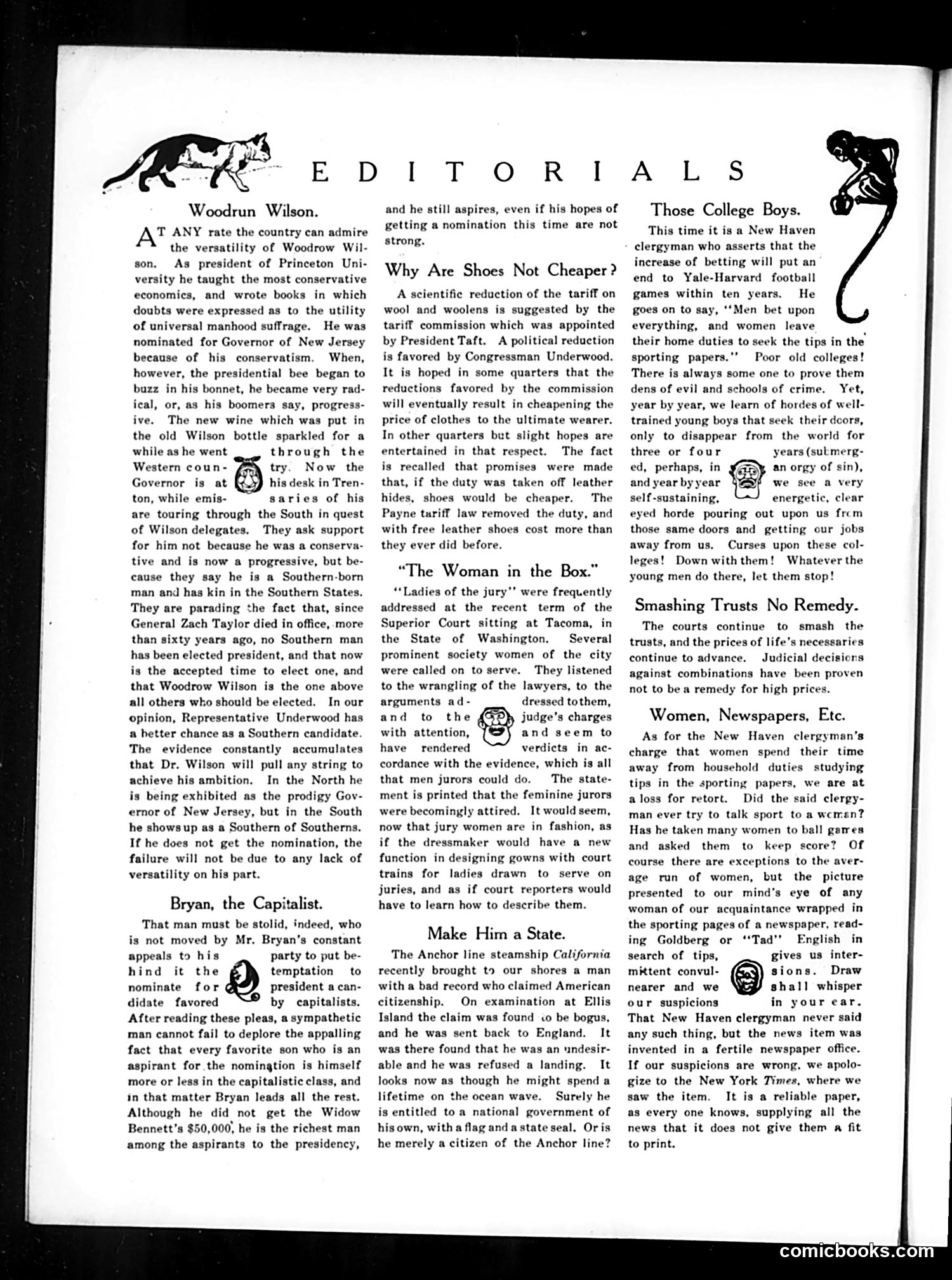
This is a satirical editorial page from **Judge** magazine featuring several commentary pieces: **Top left**: "Woodrow Wilson" - praises Wilson's conservative economics as Princeton president, noting Southern delegates now support his presidential candidacy despite initial doubts about his conservative credentials. **Center sections** contain three shorter editorials critiquing: - Tariff policy on wool/woolen goods - Women jurors in Tacoma, Washington courts (mocking their presence) - Immigration practices regarding the steamship *California* **Bottom right**: "Those College Boys" mocks Yale-Harvard students betting on football games instead of studying, presenting moral outrage at their corruption. The page demonstrates *Judge*'s satirical approach: supporting Wilson politically while simultaneously mocking women's expanding civic roles, critiquing tariffs, and expressing concern about youth morality.
📄 Transcribed text from this page (OCR, searchable)
Machine-transcribed from the original scan — historical spelling and the odd misread are preserved.
Woodrun Wilson. T ANY rate the country can admire the versatility of Woodrow Wi son. As president of Princeton Uni- versity he taught the most conservative economics, and wrote books in which doubts were expressed as to the utility of universal manhood suffrage. He was nominated for Governor of New Jersey because of his conservatism. When, however, the presidential bee began to buzz in his bonnet, he became very rad- ical, or, as his boomers say, progress- ive. The new wine which was put in the old Wilson bottle sparkled for a while as he went through the Western coun- try. Now the Governor is at his desk in Tren- ton, while emis- saries of his are touring through the South in quest of Wilson delegates. They ask support for him not because he was a conserva- tive and is now a progressive, but be- cause they say he is a Southern-born man and has kin in the Southern States. They are parading the fact that, since General Zach Taylor died in office, more than sixty years ago, no Southern man has been elected president, and that now is the accepted time to elect one, and that Woodrow Wilson is the one above all others who should be elected. In our opinion, Representative Underwood has a better chance as a Southern candidate. The evidence constantly accumulates that Dr. Wilson will pull any string to achieve his ambition. In the North he is being exhibited as the prodigy Gov- ernor of New Jersey, but in the South he shows up as a Southern of Southerns. If he does not get the nomination, the failure will not be due to any lack of versatility on his part. Bryan, the Capitalist. That man must be stolid, indeed, who is not moved by Mr. Bryan's constant appeals to his party to put be- hind it the temptation to nominate for president a can- didate favored by capitalists. After reading these pleas, a sympathetic man cannot fail to deplore the appalling fact that every favorite son who is an aspirant for the nomingtion is himself more or less in the capitalistic class, and in that matter Bryan leads all the rest. Although he did not get the Widow Bennett's $50,000, he is the richest man among the aspirants to the presidency, T OR I and he still aspires, even if his hopes of getting a nomination this time are not strong. Why Are Shoes Not Cheaper ? A scientific reduction of the tariff on wool and woolens is suggested by the tariff commission which was appointed by President Taft. A political reduction is favored by Congressman Underwood. It is hoped in some quarters that the reductions favored by the commission will eventually result in cheapening the price of clothes to the ultimate wearer. In other quarters but slight hopes are entertained in that respect. The fact is recalled that promises made that, if the duty was taken off leather hides, shoes would be cheaper. The Payne tariff law removed the duty, and with free leather shoes cost more than they ever did before. “The Woman in the Box.” “Ladies of the jury’ were frequently addressed at the recent term of the Superior Court sitting at Tacoma, in the State of Washington. Several prominent society women of the city were called on to serve. They listened to the wrangling of the lawyers, to the dressed tothem, were arguments ad- and to the judge’s charges with attention, and seem to have rendered verdicts in ac- cordance with the evidence, which is all that men jurors could do. ‘The state- ment is printed that the feminine jurors were becomingly attired. It would seem, now that jury women are in fashion, as if the dressmaker would have a new function in designing gowns with court trains for ladies drawn to serve on juries, and as if court reporters would have to learn how to describe them. Make Him a State. The Anchor line steamship California recently brought to our shores a man with a bad record who claimed American citizenship. On examination at Ellis Island the claim was found .o be bogus, and he was sent back to England. It was there found that he was an undesir- able and he was refused a landing. It looks now as though he might spend a lifetime on the ocean wave. Surely he is entitled to a national government of his own, with a flag anda state seal. Oris he merely a citizen of the Anchor line? A LS Those College Boys. This time it is a New Haven clergyman who asserts that the increase of betting will put an end to Yale-Harvard football games within ten years. He goes on to say, ‘Men bet upon everything, and women leave their home duties to seek the tips in the sporting papers."’ Poor old colleges! There is always some one to prove them dens of evil and schools of crime. Yet, year by year, we learn of hordes of well- trained young boys that seek their decors, only to disappear from the world for three or four years (sutmerg- ed, perhaps, in an orgy of sin), and year by year S) we see a very self-sustaining, energetic, clear eyed horde pouring out upon us frem those same doors and getting our jobs away from us, Curses upon these col- leges! Down with them! Whatever the young men do there, let them sto Smashing Trusts No Remedy. The courts continue to smash the trusts, and the prices of life's necessaries continue to advance. Judicial decisions against combinations have been proven not to be a remedy for high prices. Women, Newspapers, Etc. As for the New Haven clergyman’s charge that women spend their time away from household duties studying tips in the sporting papers, we are at aloss for retort. Did the said clergy- man ever try to talk sport to a wcmen? Has he taken many women to ball garres and asked them to keep score? Of course there are exceptions to the aver- age run of women, but the picture presented to our mind's eye of any woman of our acquaintance wrapped in the sporting pages of a newspaper, rei ing Goldberg or ‘‘Tad'’ English in search of tips, gives us inter- mittent convul- sions. Draw nearer and we @ shall whisper our suspicions in your ear. That New Haven clergyman never said any such thing, but the news item was invented in a fertile newspaper office. If our suspicions are wrong, we apolo- gize to the New York Times, where we saw the item. It is a reliable paper, as every one knows, supplying all the news that it does not give them a fit to print. comicbooks.com