
Judge, 1912-01-13 · page 6 of 24
Judge — January 13, 1912 — page 6: what you’re looking at
What you’re looking at
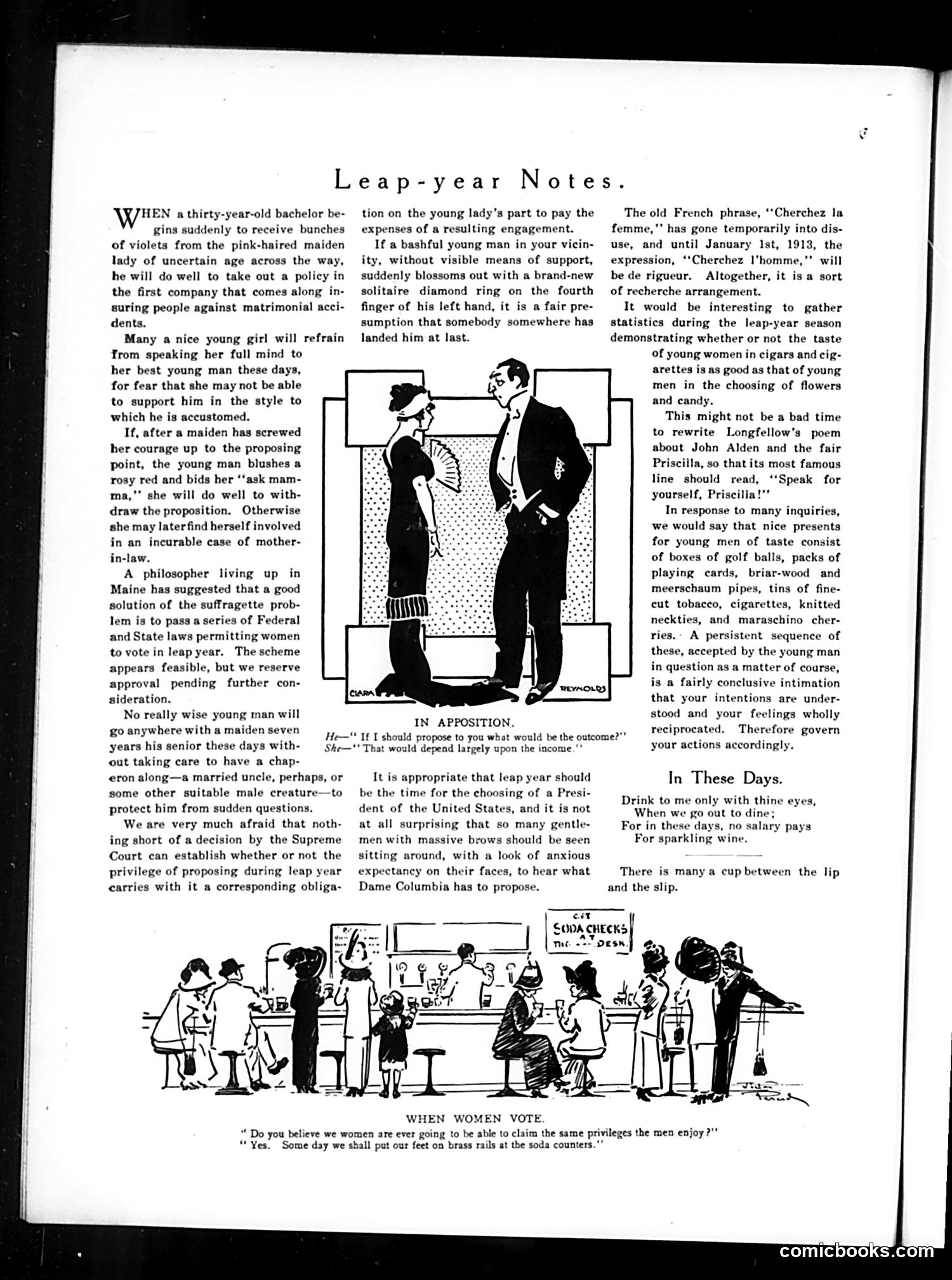
This Judge magazine page satirizes the social upheaval of leap year, when tradition permitted women to propose to men—a radical inversion of courtship norms that challenged gender expectations during the suffrage movement era. The main cartoon "In Apposition" shows a woman and man discussing marriage prospects, with her calculating his income before accepting. The satire mocks women's economic dependence and the transactional nature of marriage. The lower cartoon "When Women Vote" depicts women at a soda fountain, sarcastically suggesting that if women gained voting rights during leap year, they'd soon demand equal privileges at social venues—a common anti-suffrage argument. The editorial text humorously catalogs leap-year anxieties: men needing chaperones, women unable to support suitors, and the reversal of traditional proposal dynamics. References to "Dame Columbia" (America personified) and the 1912 presidential election ground the satire in contemporary politics, suggesting women's suffrage and leap-year role reversals were seen as equally destabilizing to social order. The satire fundamentally ridicules women's ambitions for economic and social equality.
📄 Transcribed text from this page (OCR, searchable)
Machine-transcribed from the original scan — historical spelling and the odd misread are preserved.
WHEN a thirty-year-old bachelor be- gins suddenly to receive bunches of violets from the pink-haired maiden lady of uncertain age across the way, he will do well to take out a policy in the first company that comes along in- suring people against matrimonial acci- dents. Many a nice young girl will refrain from speaking her full mind to her best young man these days, for fear that she may not be able to support him in the style to which he is accustomed. If, after a maiden has screwed her courage up to the proposing point, the young man blushes a rosy red and bids her ‘‘ask mam- ma,"’ she will do well to with- draw the proposition. Otherwise she may laterfind herself involved in an incurable case of mother- in-law. A philosopher living up Maine has suggested that a good solution of the suffragette prob- lem is to pass a series of Federal and State laws permitting women to vote in leap year. The scheme appears feasible, but we reserve pending further con- in approval sideration. No really wise young man will go anywhere with a maiden seven years his senior these days with- out taking care to have a chap- eron along—a married uncle, perhaps, or some other suitable male creature—to protect him from sudden questions. We are very much afraid that noth- ing short of a decision by the Supreme Court can establish whether or not the privilege of proposing during leap year carries with it a corresponding obliga- Leap-year Notes tion on the young lady’s part to pay the expenses of a resulting engagement. If a bashful young man in your vicin- ity, without visible means of support, suddenly blossoms out with a brand-new solitaire diamond ring on the fourth finger of his left hand, it is a fair pre- sumption that somebody somewhere has landed him at last. IN APPOSITION. He—"* If I should propose to you what would be the outcome?" She—"' That would depend largely upon the income.’* It is appropriate that leap year should be the time for the choosing of a Presi- dent of the United States, and it is not at all surprising that so many gentle- men with massive brows should be seen sitting around, with a look of anxious expectancy on their faces, to hear what Dame Columbia has to propose. me = Ke Sana, CHECKS | | mc Abe The old French phrase, ‘‘Cherchez la femme,’’ has gone temporarily into dis- use, and until January Ist, 1913, the expression, ‘‘Cherchez I’homme,"’ will be de rigueur. Altogether, it is a sort of recherche arrangement. It would be interesting to gather statistics during the leap-year season demonstrating whether or not the taste of young women in cigars and cig- arettes is as good as that of young men in the choosing of flowers and candy. This might not be a bad time to rewrite Longfellow’s poem about John Alden and the fair Priscilla, so that its most famous line should read, ‘‘Speak for yourself, Priscilla!"’ In response to many inquiries, we would say that nice presents for young men of taste consist of boxes of golf balls, packs of playing cards, briar-wood and meerschaum pipes, tins of fine- cut tobacco, cigarettes, knitted neckties, and maraschino cher- ries. A persistent sequence of these, accepted by the young man in question as a matter of course, is a fairly conclusive intimation that your intentions are under- stood and your feelings wholly reciprocate Therefore govern your actions accordingly. In These Days. Drink to me only with thine eyes, When we go out to dine; For in these days, no salary pays For sparkling wine. There is many a cup between the lip and the slip. WHEN WOMEN VOTE. “ Do you believe we women are ever going to be able to claim the same privileges the men enjoy ?"" “Yes. Some day we shall put our feet on brass rails at the soda counters." comicbooks.com