
Judge, 1912-01-13 · page 18 of 24
Judge — January 13, 1912 — page 18: what you’re looking at
What you’re looking at
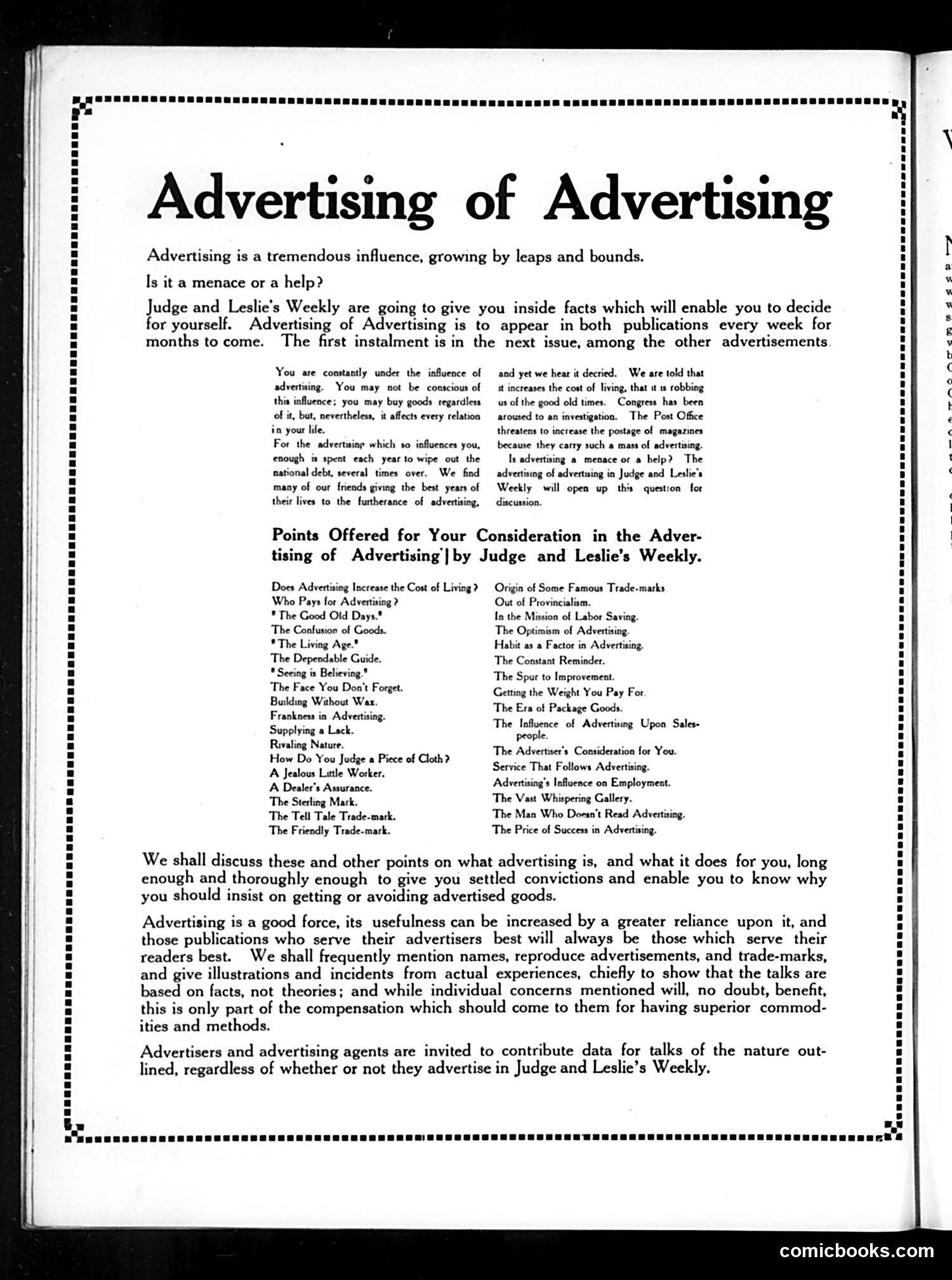
This is **not a cartoon but a manifesto/announcement page** for a series Judge and Leslie's Weekly planned to run examining advertising itself. The context: Early 20th-century America was experiencing explosive growth in advertising, which generated public anxiety. Congress had launched investigations; the Post Office considered raising magazine postage due to advertising volume; critics claimed ads inflated living costs and corrupted "the good old times." Judge positions itself as a neutral arbiter, promising readers "inside facts" to decide whether advertising is "a menace or a help." The publication lists dozens of discussion topics (trade-marks, cost-of-living, labor-saving innovations, employment effects) it will explore. The key pitch: advertising itself is "a good force" deserving serious examination rather than blanket condemnation. Judge invites both skeptics and advertisers to engage with this inquiry, claiming analysis will be "based on facts, not theories." This reflects the era's growing professionalization of advertising and public debate about consumer culture's social impact.
📄 Transcribed text from this page (OCR, searchable)
Machine-transcribed from the original scan — historical spelling and the odd misread are preserved.
Advertising of Advertising Advertising is a tremendous influence, growing by leaps and bounds. Is it a menace or a help? Judge and Leslie’s Weekly are going to give you inside facts which will enable you to decide for yourself. Advertising of Advertising is to appear in both publications every week for months to come. The first instalment is in the next issue, among the other advertisements You are constantly under the influence of advertising. You may not be conscious of this influence; you may buy goods regardless of it, but, nevertheless, it affects every relation in your life. For the advertising which so influences you, enough is spent each year to wipe out the national debt, several times over. We find many of our friends giving the best years of and yet we hear it decried. We are told that it increases the cost of living, that it w robbing us of the good old times. Congress has been aroused to an investigation. The Post Office threatens to increase the postage of magazines because they carry such a mass of advertising. Is advertising a menace or a help? The advertising of advertising in Judge and Leslie's Weekly will open up this question for zc cae nan ima 6 ia ab ee their lives to the furtherance of advertising, discussion. Points Offered for Your Consideration in the Adver- tising of Advertising| by Judge and Leslie’s Weekly. Does Advertising Increase the Cost of Living? Origin of Some Famous Trade-marks Who Pays for Advertising > Out of Provincialism. * The Good Old Days.* In the Mission of Labor Saving. The Confusion of Goods. The Optimism of Advertsing "The Living Age.* Habit as a Factor in Advertising, The Dependable Guide. The Constant Reminder. "Seeing is Baticving.* The Spur to Improvement. The Face You Don’t Forget. Getting the Weight You Pay For Building Without Wax The Era of Package Goods. Frankness in Advertsing. : rice pers The Influence of Advertinng Upoa Sales- Rivaling Na erie waling Nature. hii 8 How Do You Judge a Piece of Cloth? ee onion hn i Kalen Lake Woke, ice That Follows Advertsing. Pcsonsig lady Advertsing’s Influence on Employment. The Sterling Mark. The Vast Whispering Gallery. The Man Who Doesn't Read Advertising. The Tell Tale Trade-mark. The Friendly Trade-mark. The Price of Success in Advertising. We shall discuss these and other points on what advertising is, and what it does for you, long enough and thoroughly enough to give you settled convictions and enable you to know why you should insist on getting or avoiding advertised goods. Advertising is a good force, its usefulness can be increased by a greater reliance upon it, and those publications who serve their advertisers best will always be those which serve their readers best. We shall frequently mention names, reproduce advertisements, and trade-marks, and give illustrations and incidents from actual experiences, chiefly to show that the talks are based on facts, not theories; and while individual concerns mentioned will, no doubt, benefit, this is only part of the compensation which should come to them for having superior commod- ities and methods. Advertisers and advertising agents are invited to contribute data for talks of the nature out- lined, regardless of whether or not they advertise in Judge and Leslie’s Weekly. a PITT TTI comicbooks.com