
A complete issue · 23 pages · 1911
Judge — October 14, 1911
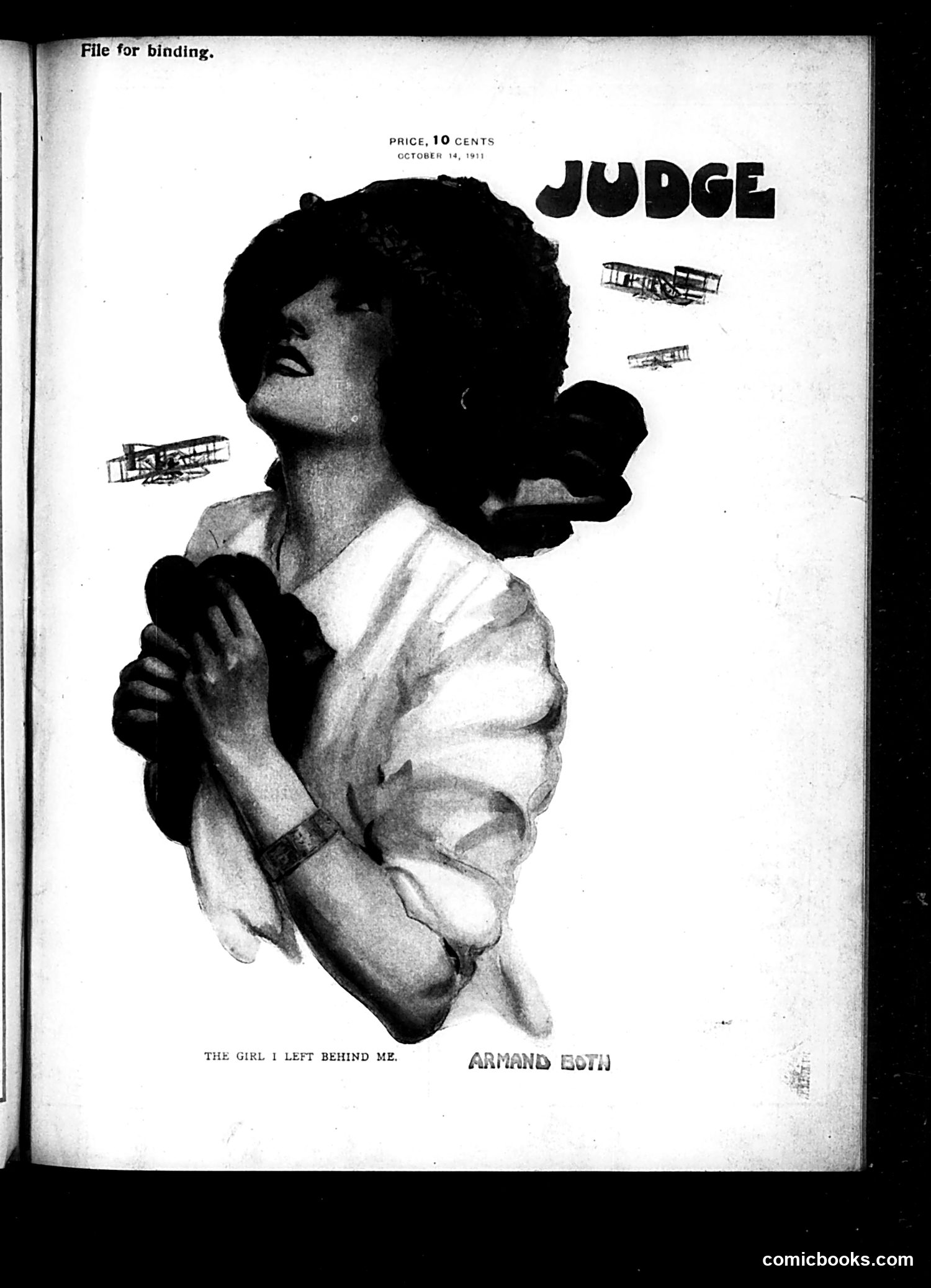
This appears to be a magazine cover featuring artwork by Armand Both. The image shows a woman in early 1900s dress holding what appear to be toy or model early aircraft, with several small planes sketched around her head. The title "The Girl I Left Behind Me" paired with the aviation imagery likely references the song of that name (a popular military marching tune) combined with the contemporary aviation craze of 1911. The satire probably comments on the rapid development of airplane technology and its cultural impact—suggesting that modern aviation was such an all-consuming obsession that it displaced romantic attention or traditional courtship. The woman's prominent display of the aircraft emphasizes this technological preoccupation over personal relationships.
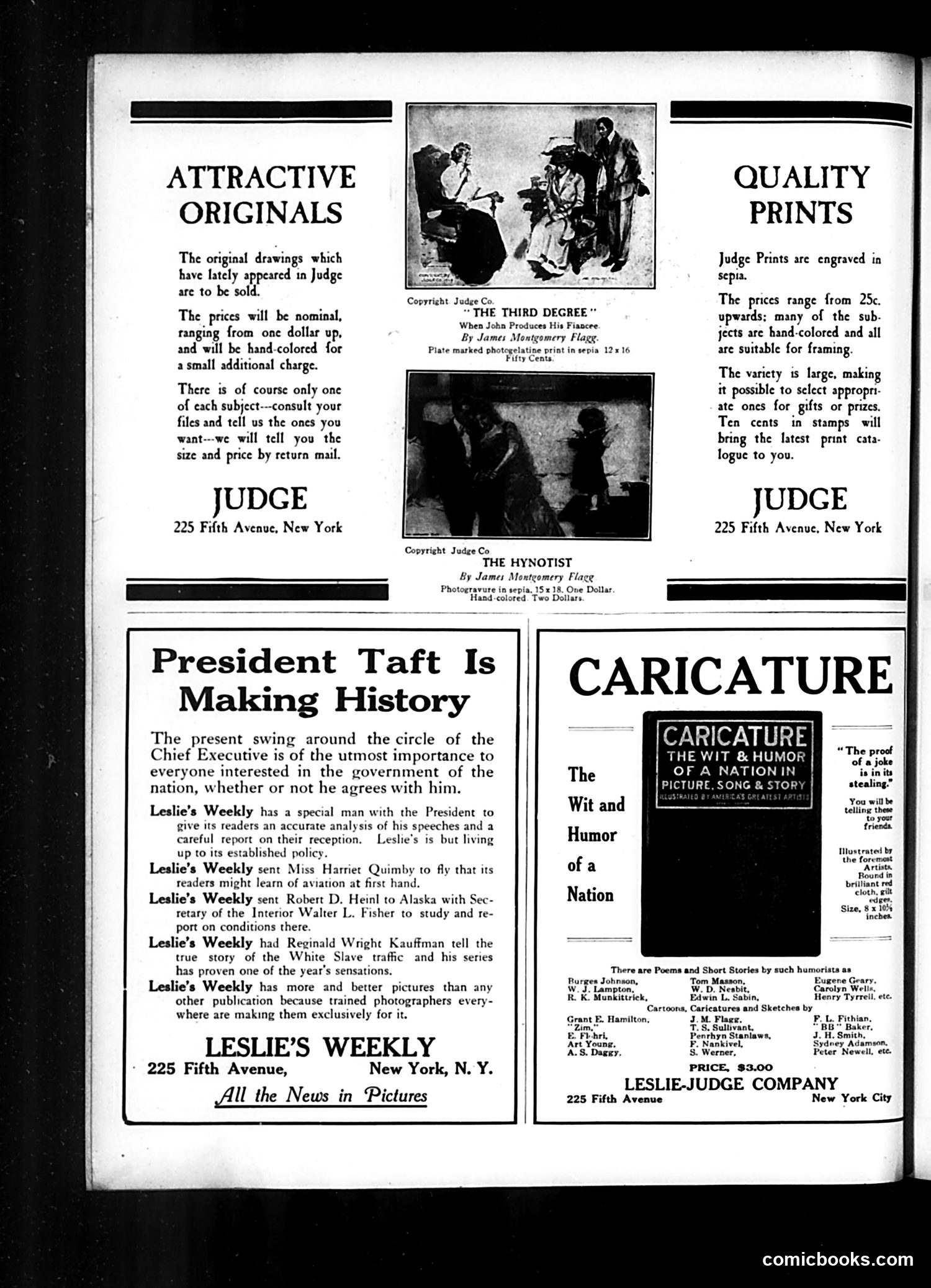
This page is primarily **advertising** for Judge magazine's products and related publications, rather than political satire. The two visible cartoon images are stills from James Montgomery Flagg films—"The Third Degree" and "The Hypnotist"—being sold as photogravure prints. The advertisements promote Judge Company's offerings: original drawings, quality prints, and a book called "Caricature: The Wit & Humor of a Nation." The only political content is a brief text section titled "President Taft Is Making History," which mentions Leslie's Weekly's coverage of President Taft's activities and claims about their exclusive reporting and photography. This appears promotional rather than satirical—emphasizing Leslie's Weekly's journalistic reach rather than mocking Taft himself. The page functions essentially as a catalog and house advertisement.
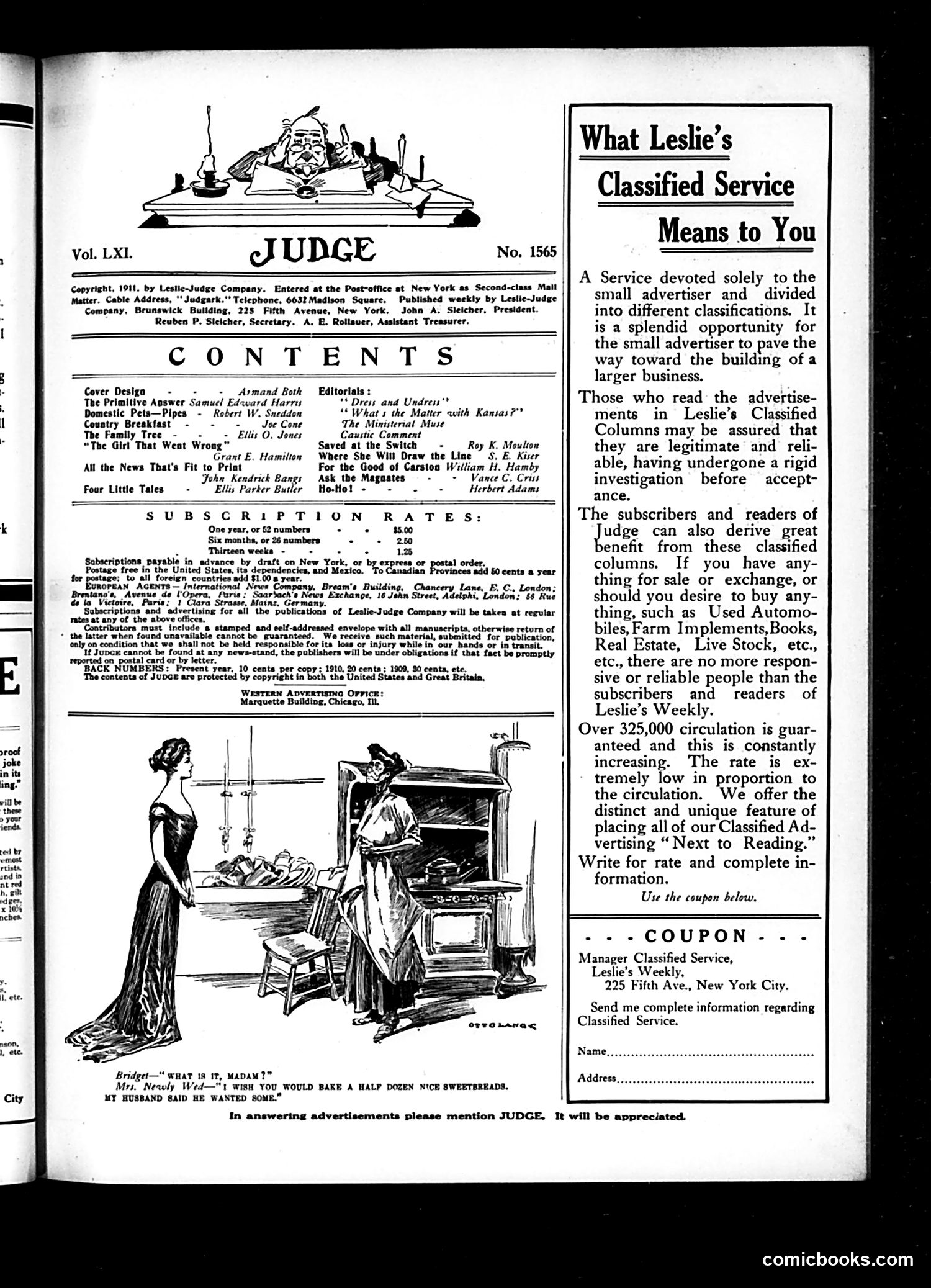
This page is primarily **advertising and editorial matter** rather than political satire. The main cartoon shows two women in a kitchen—one elegant, one working—with the caption "Bridge—'WHAT IS IT, MADAM?' Mrs. Newly Wed—'I WISH YOU WOULD BAKE A HALF DOZEN NICE SWEETBREADS. MY HUSBAND SAID HE WANTED SOME.'" This is a **domestic humor joke** playing on the phrase "sweetbreads" (a culinary term for organ meats). The new bride misunderstands, suggesting the cook should literally bake sweet bread, revealing her ignorance of cooking terminology—a common comedic trope mocking upper-class women's lack of practical household knowledge. The cartoon relies on period-specific class assumptions about servants and mistresses.
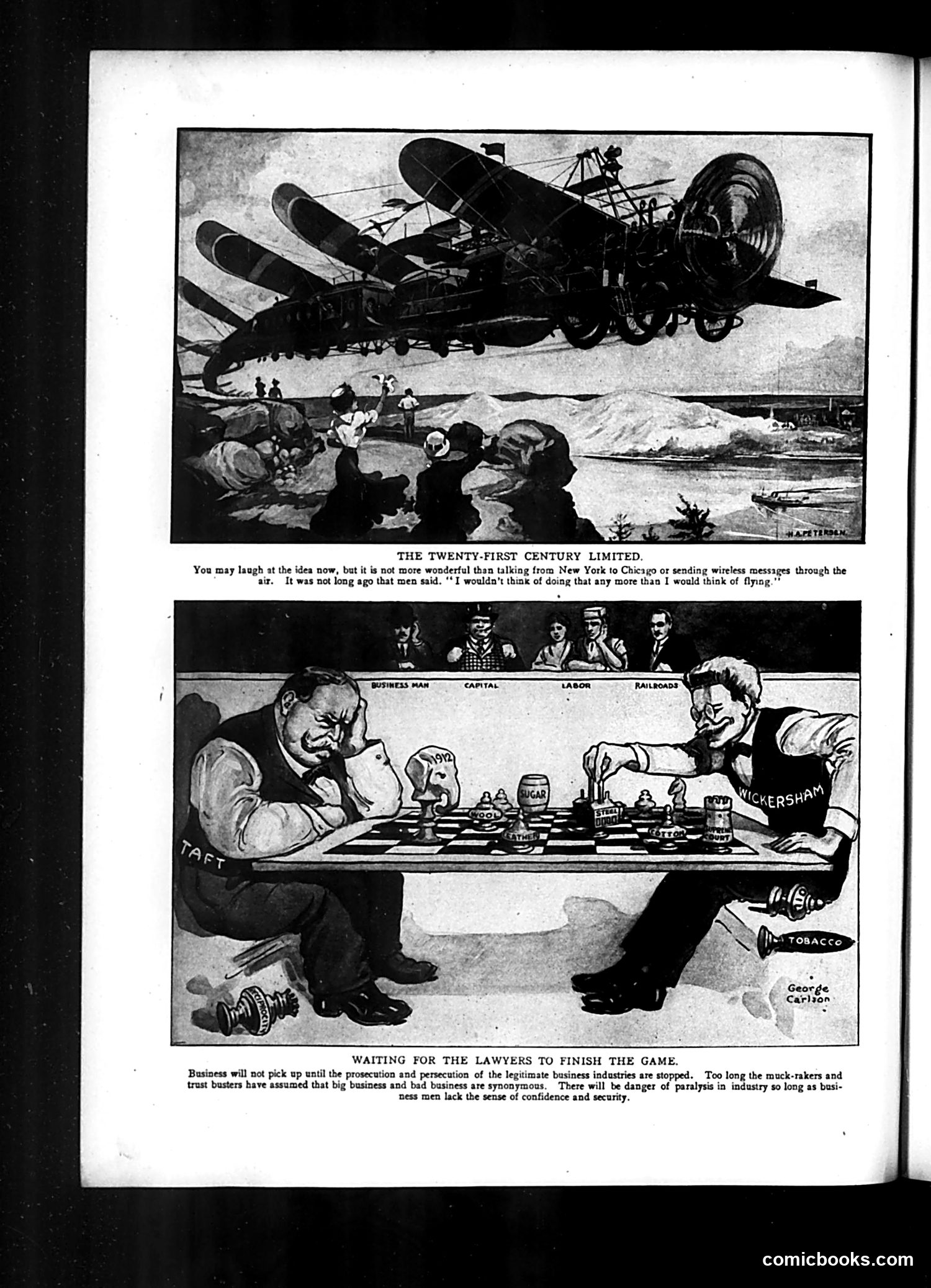
**Top cartoon ("The Twenty-First Century Limited"):** Depicts a massive futuristic airplane with four engines, representing technological optimism about aviation. The caption notes that flying seemed as improbable to previous generations as wireless communication, suggesting skepticism about ambitious technological claims was common. **Bottom cartoon ("Waiting for the Lawyers to Finish the Game"):** Shows two figures playing chess over a chessboard labeled with industries (Capital, Labor, Business Man, Railroad, Tobacco, Sugar). The caption criticizes how legal battles between legitimate and illegitimate business have paralyzed industry, arguing that prolonged litigation creates uncertainty that undermines business confidence and security. This appears to reference early 20th-century antitrust litigation and trust-busting controversies.
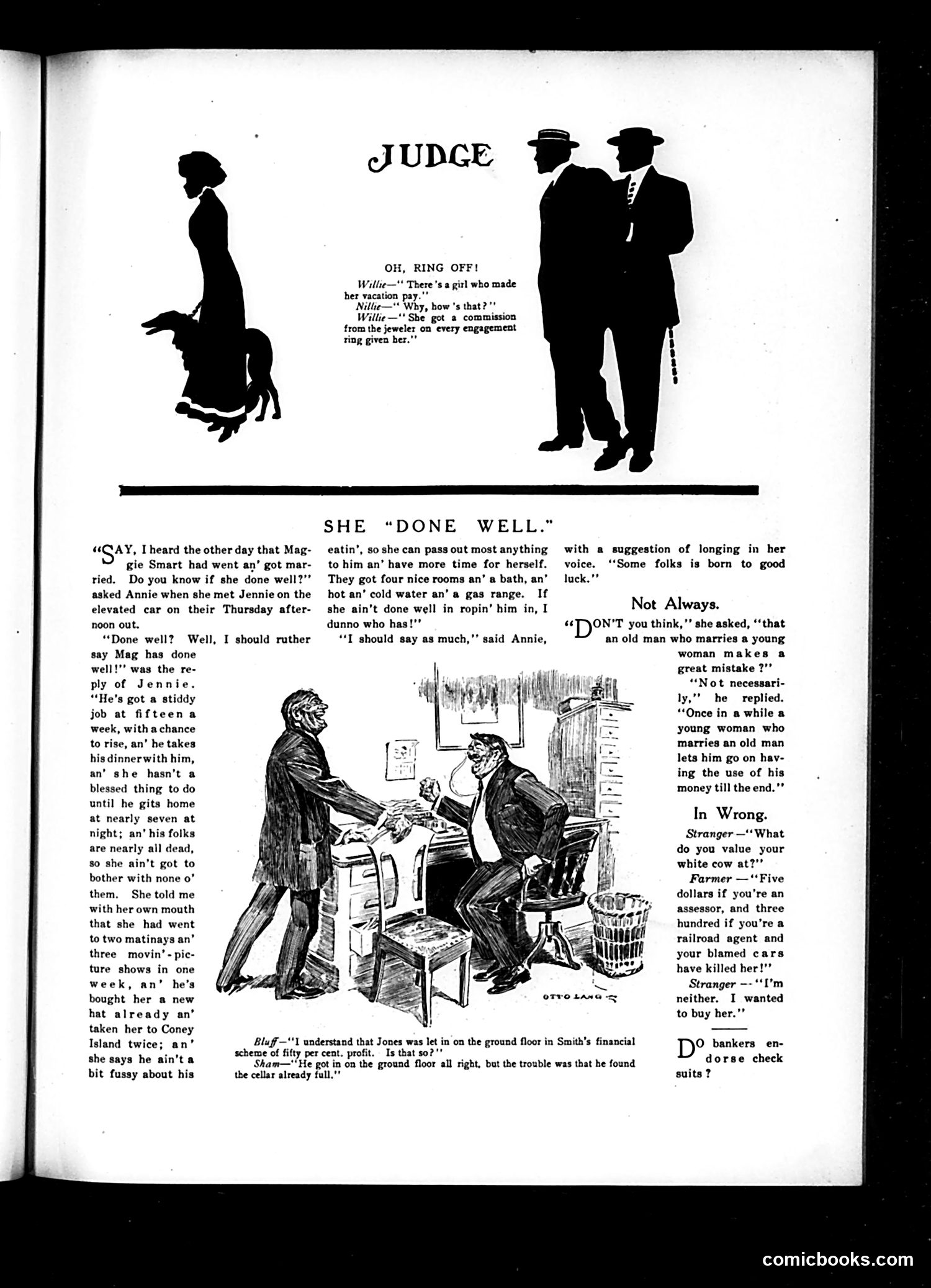
This page from *Judge* magazine contains satirical humor pieces targeting early 20th-century social conventions. **"Judge" (top)**: A silhouette cartoon mocking women who collect engagement rings. One woman shows off multiple "commissions from the jeweler on every engagement ring given her"—satirizing women perceived as serial fiancées who break engagements for jewelry profits. **"She 'Done Well"**: A dialogue jokes about Maggie Smart's advantageous marriage to a man with steady employment and decent prospects—portraying marriage as primarily transactional economic arrangement for women. **"Not Always" and "In Wrong"**: Brief humorous anecdotes questioning whether marrying older men guarantees women's financial security, and a joke about a farmer undervaluing his cow to a stranger. The overall theme critiques both women's marriage-market calculations and the commodification of matrimony in the period.
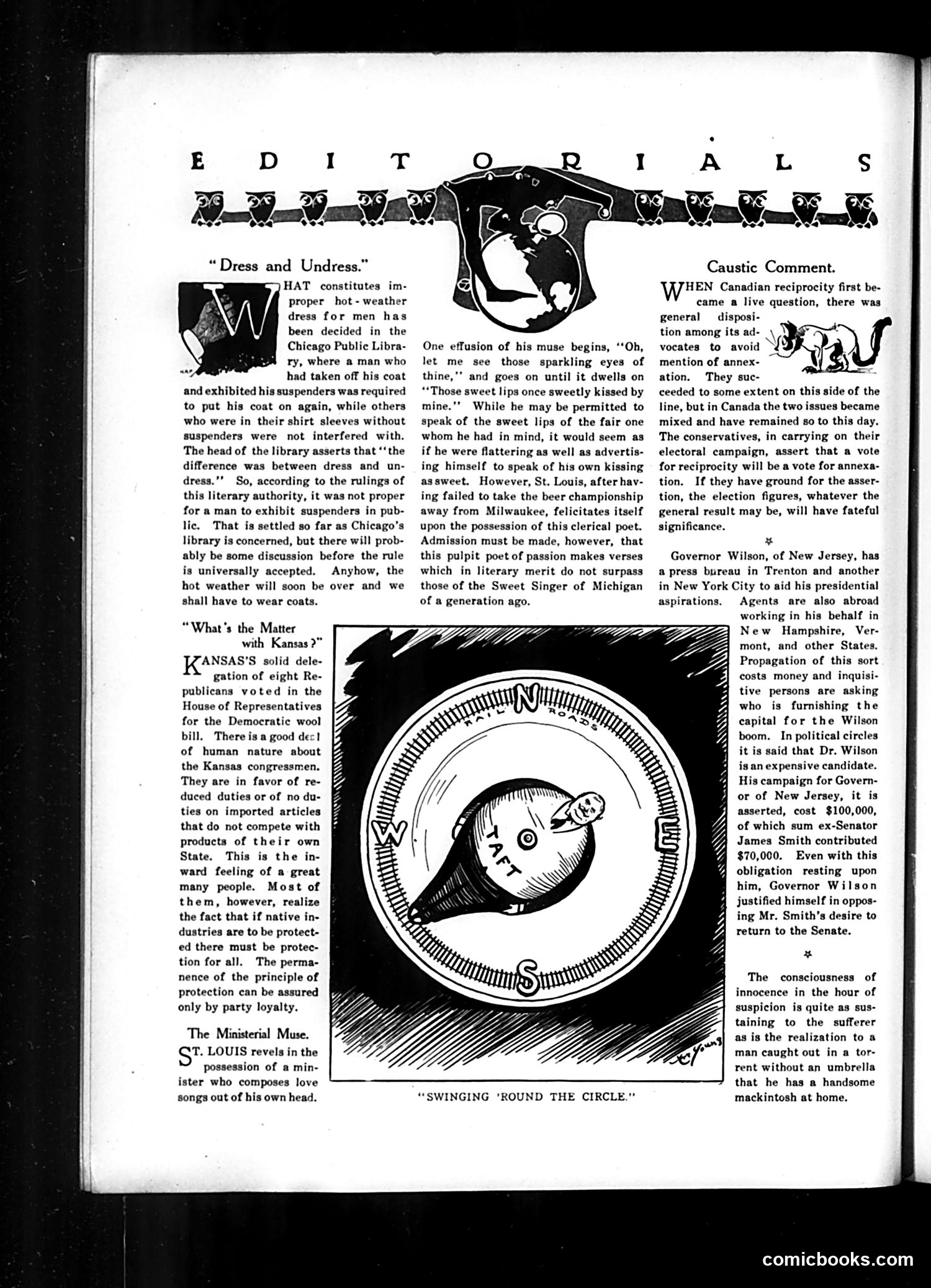
This page contains several satirical commentaries typical of early 20th-century American political humor: **"Dress and Undress"** mocks the Chicago Public Library's arbitrary dress code—permitting shirtsleeves but prohibiting exposed suspenders as "undress." The satire highlights the absurdity of such inconsistent social rules. **"What's the Matter with Kansas?"** criticizes Kansas Republicans who voted for a Democratic wool tariff bill, betraying party loyalty for local economic interests. The title echoes a famous 1896 populist essay, using it ironically to question their protectionist inconsistency. **"The Ministerial Muse"** ridicules a St. Louis minister composing love poetry about kissing—deemed inappropriate self-advertisement from a clergyman, compared unfavorably to Michigan's "Sweet Singer." **"Caustic Comment"** addresses Canadian reciprocity trade debates (linking reciprocity to annexation fears) and Governor Woodrow Wilson's expensive presidential campaign, allegedly funded by ex-Senator James Smith ($70,000 of $100,000), questioning Wilson's independence. The central cartoon "Swinging 'Round the Circle" remains unclear without additional context.
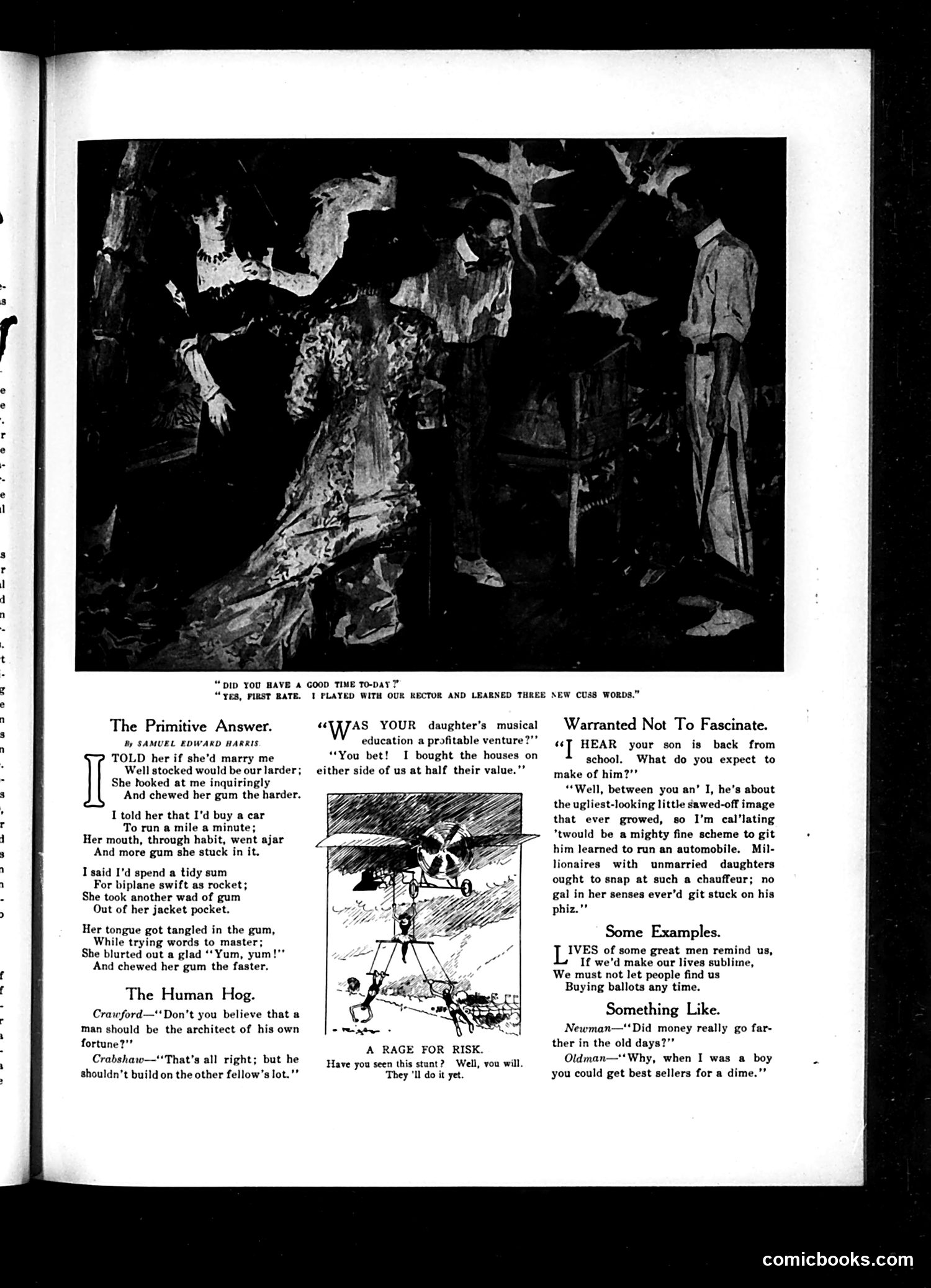
This Judge magazine page contains multiple satirical pieces mocking early 1900s social attitudes: **Top photo caption**: A child reports learning "cuss words" from the rector (parish priest), satirizing religious hypocrisy. **"The Primitive Answer"**: A poem ridiculing a woman who responds to marriage proposals with indifference, only reacting with enthusiasm to chewing gum—mocking both her materialism and the era's stereotypes about women's shallow interests. **"The Human Hog"**: A dialogue joke where a man boasts about buying neighboring houses cheaply after his daughter's loud piano practice devalued them—satirizing real estate manipulation. **"Warranted Not To Fascinate"**: A father plans to make his ugly son a chauffeur to attract wealthy heiresses—dark satire on marriage-market calculations. **Lower sections**: Brief quips about political corruption ("buying ballots") and inflation nostalgia. The overall theme: satirizing American materialism, social climbing, marital transactions, and corruption during the Progressive Era.
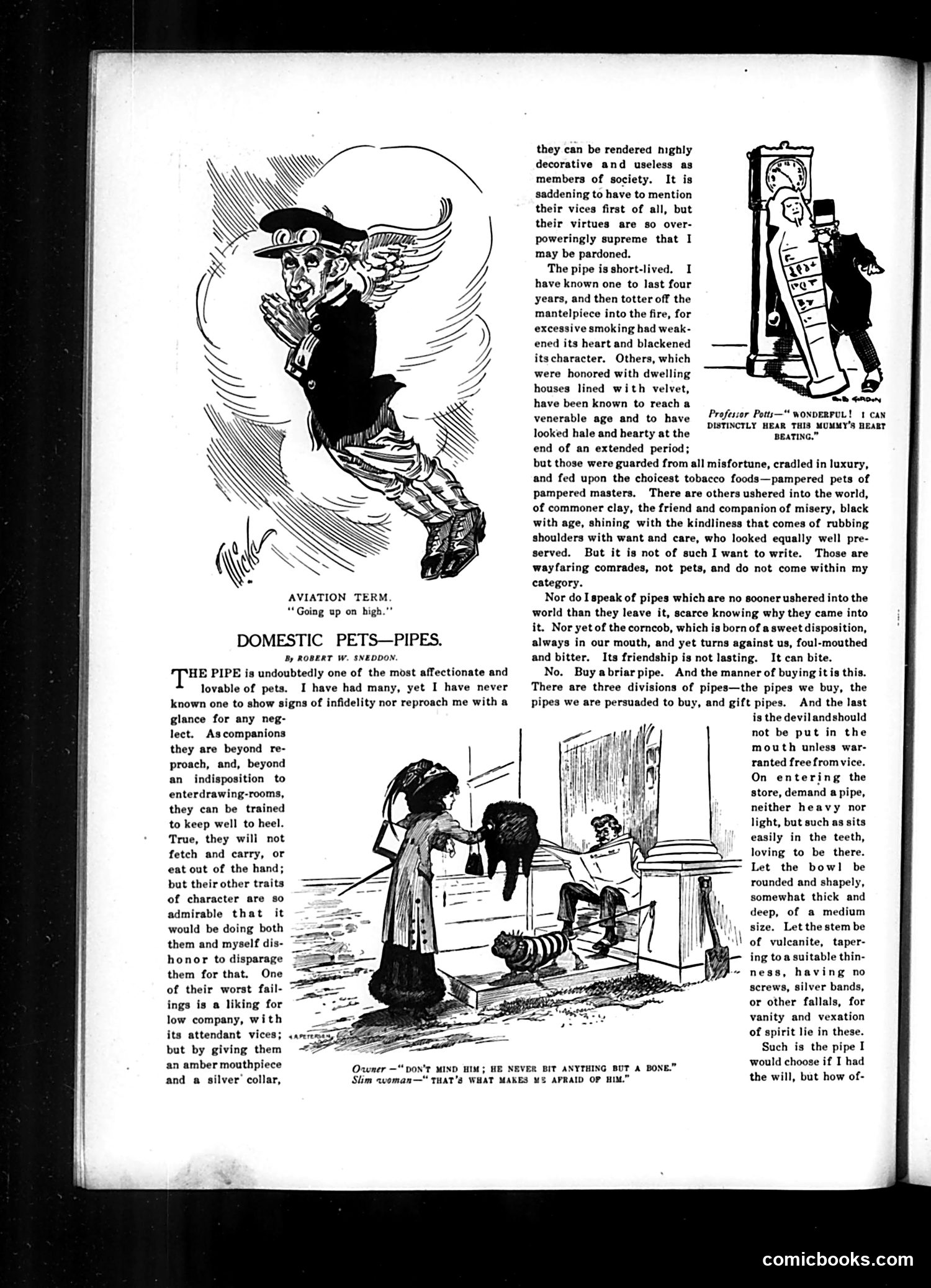
This is a humorous essay by Robert W. Sneddon personifying smoking pipes as beloved household pets. The author treats pipes with affectionate mock-seriousness, describing their "character," "vices," and "virtues" as if they were actual companions. The satire gently mocks Victorian gentleman culture and the sentimental attachment men developed to their smoking pipes. The accompanying illustrations show pipes anthropomorphized with facial features, and a domestic scene where a woman warns against a man's "dangerous" pipe—the humor suggesting pipes could become obsessive, even threatening, to proper household order. The essay offers tongue-in-cheek advice on selecting the "right" pipe (briar, not corncob; no excessive ornamentation), treating what was actually a trivial consumer choice with elaborate, serious consideration. This exaggeration of masculine preferences for quality tobacco accessories reflects period class anxieties and gender dynamics around domestic leisure.
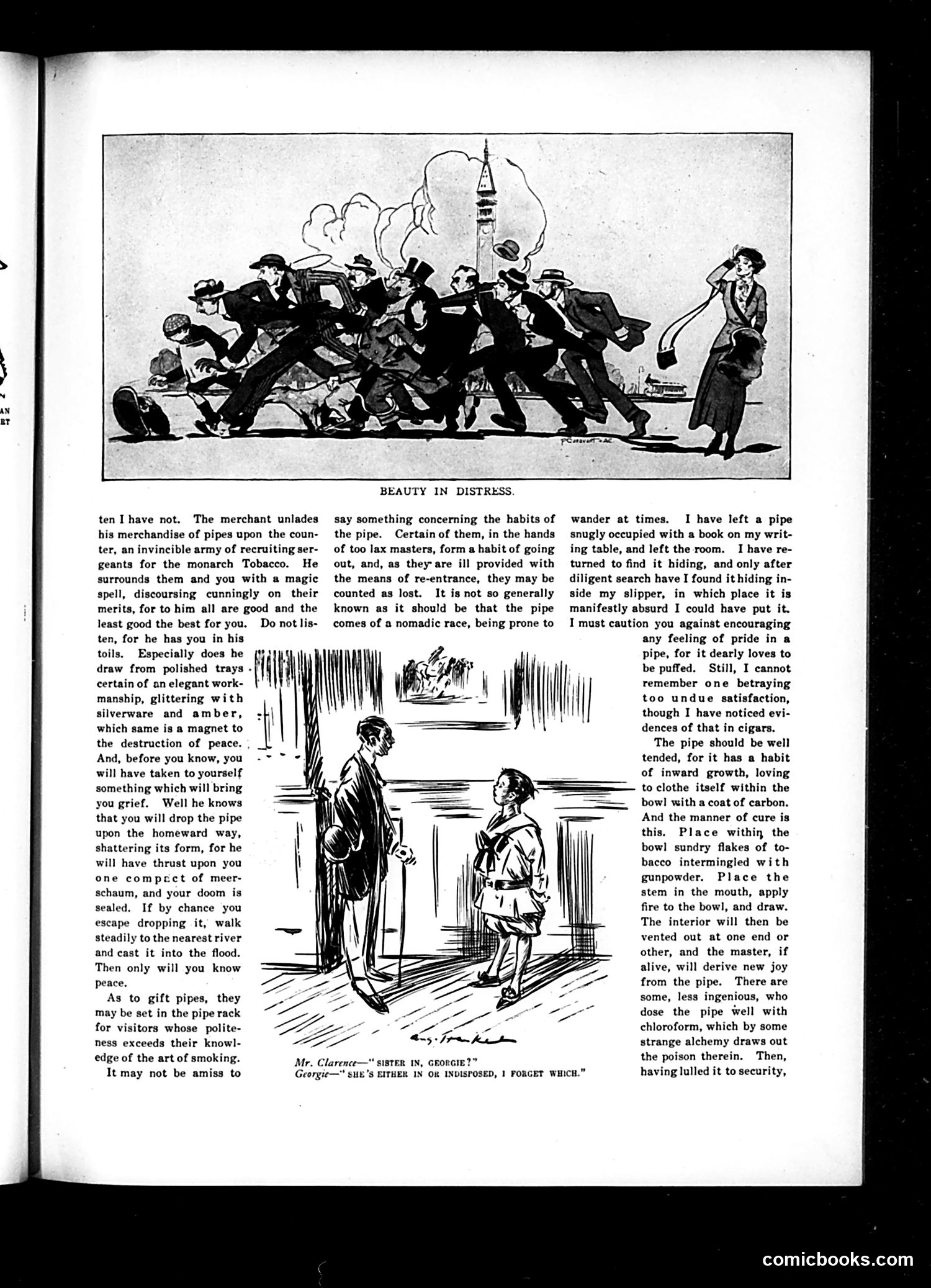
This Judge magazine page contains two distinct elements: **Top Cartoon ("Beauty in Distress"):** A chaotic scene showing a woman in distress while men in formal attire (appearing to be politicians or officials) scramble around her. The tower in the background suggests an urban setting. The satire likely critiques male incompetence or corruption in response to a woman's crisis—a common Judge theme mocking political bungling. **Bottom Illustration & Essay:** A domestic scene where a man (Mr. Clarence) asks about his sister Georgie's indisposition. The accompanying text is a lengthy, humorous essay about pipe-smoking—treating it as a serious matter requiring careful maintenance and warning against the "habit" pipes create. The tone is mock-solemn, satirizing both Victorian obsession with proper gentlemanly conduct and the affectations surrounding tobacco use. The overall page mocks bourgeois male preoccupations: their helplessness during emergencies (top) and their fussy, elaborate attention to masculine rituals like pipe-smoking (bottom). Tobacco advertising appears embedded throughout—typical for the era.
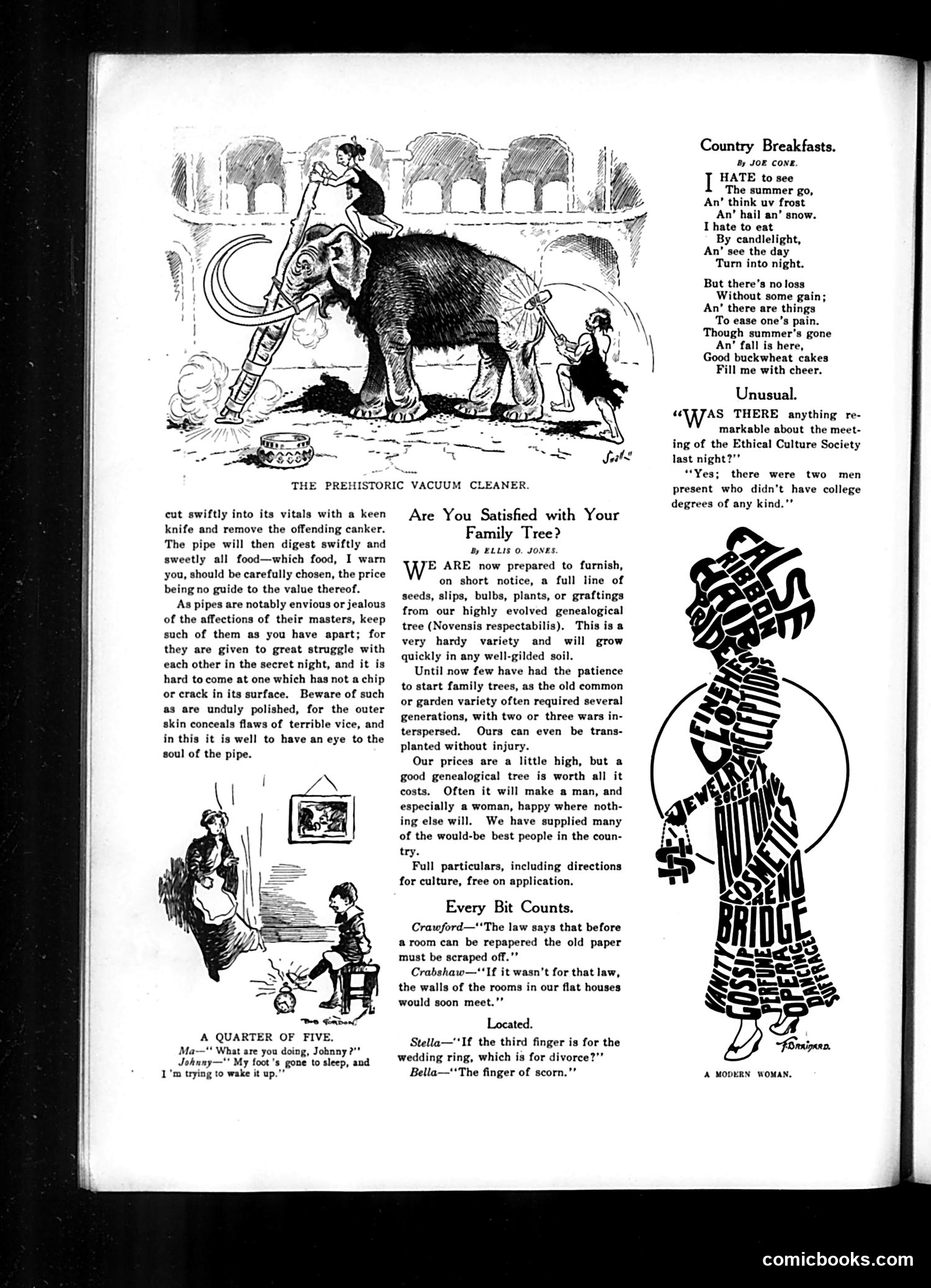
This page contains multiple satirical pieces targeting early 20th-century social pretensions: **"The Prehistoric Vacuum Cleaner"** mocks ornate, affected writing about pipe smoking—pretentious advice wrapped in pseudo-scientific language. **"Are You Satisfied with Your Family Tree?"** satirizes the nouveau riche obsession with genealogy and aristocratic lineage. The advertisement parodies ads for actual genealogical services by offering instant, artificially "evolved" family trees that can be "transplanted without injury"—implying one can simply purchase respectability and social status rather than inherit it legitimately. **"Unusual"** jokes that the Ethical Culture Society meeting was remarkable because two attendees lacked college degrees—mocking elitist assumptions about education and moral superiority. **"Located"** and other brief items offer witty commentary on marriage, divorce, and social conventions. The overall theme: Judge ridicules the artificial status-seeking and snobbery of aspiring upper-class Americans who pursue genealogy, education credentials, and cultural affectations as shortcuts to legitimacy.
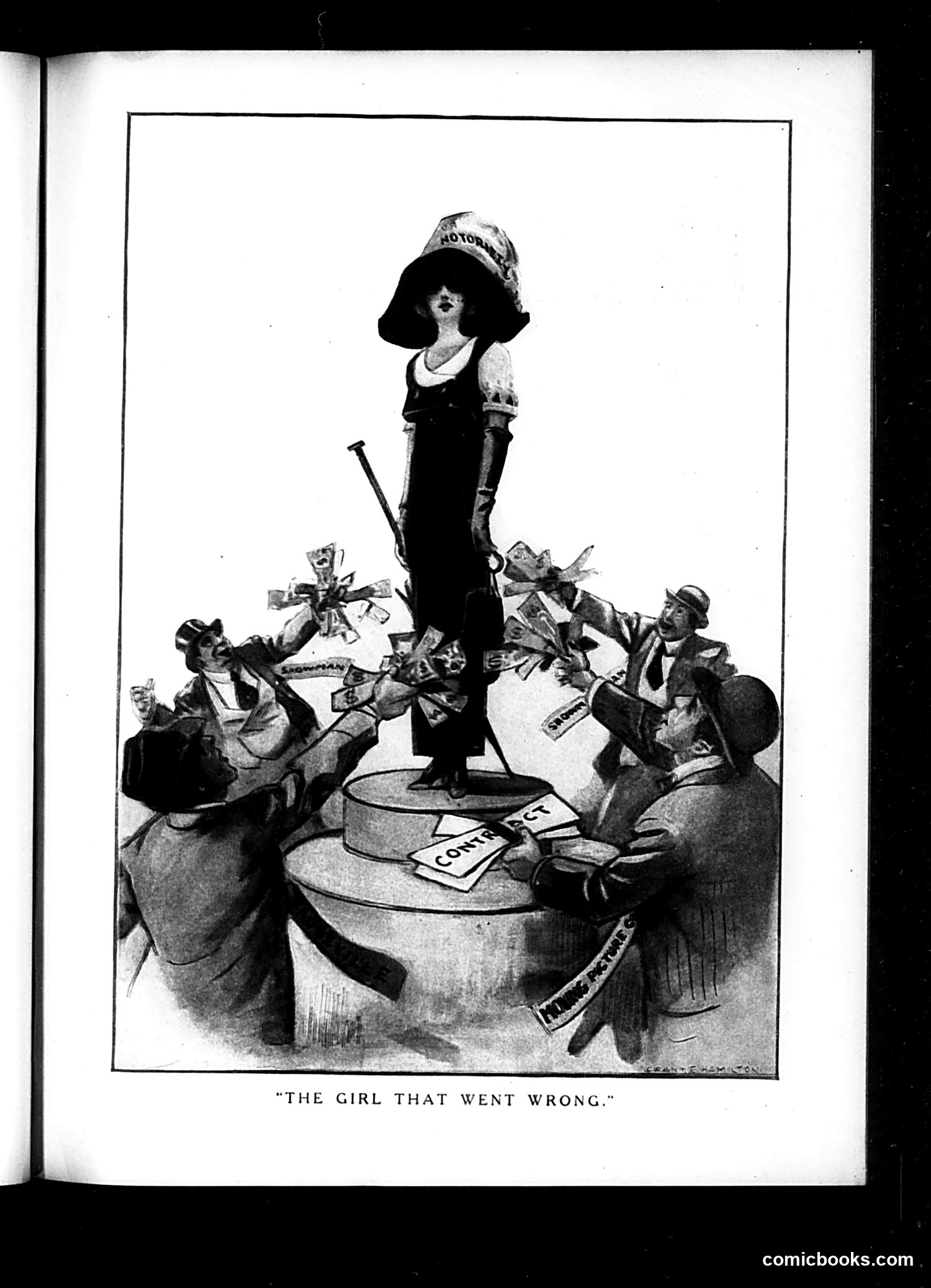
This Judge magazine cartoon satirizes a woman standing elevated above several men in suits and hats seated around a table. The woman wears a large hat labeled "MOTOR" and holds a club or bat. The men appear to be reaching toward her with money or documents visible on the table. The satire likely critiques women's increasing independence and economic power in the early 20th century—particularly in the emerging automobile industry. The title "The Girl That Went Wrong" suggests social anxiety about women gaining financial autonomy and authority (symbolized by her elevated position and weapon). The men's gestures imply they're either courting her favor or losing control to her. The cartoon reflects period anxieties about shifting gender roles and female participation in modern commerce and industry.
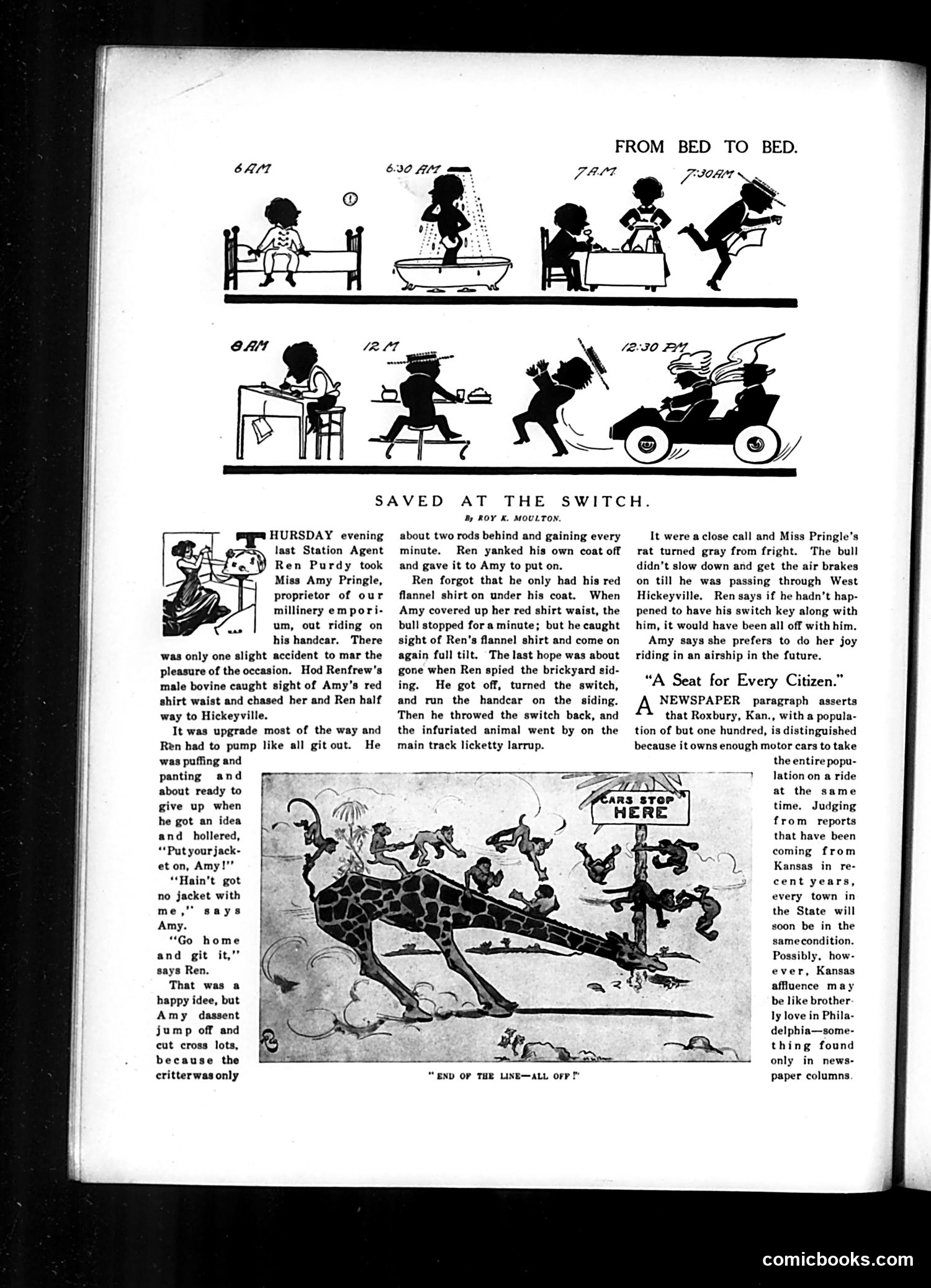
This humorous story illustrates small-town life and early automotive/railway culture. Agent Ren Purdy takes millinery shop owner Amy Pringle on a hand-pumped railway car when a bull, attracted to her red shirt, chases them. Ren devises a clever solution: he gives Amy his coat (revealing his red flannel shirt underneath), which briefly confuses the bull. He then uses his railroad switch key to divert the charging animal onto a siding, saving them both. The humor derives from rural incongruity (a bull attacking over clothing color), Ren's quick thinking, and the understated Kansas dialect. The accompanying sidebar mocks small-town Kansas pretensions about automobile wealth, suggesting that stories of even tiny villages owning enough cars for "every citizen" exist only in newspaper boasts rather than reality—a gentle satire of regional exaggeration and automotive-age optimism.
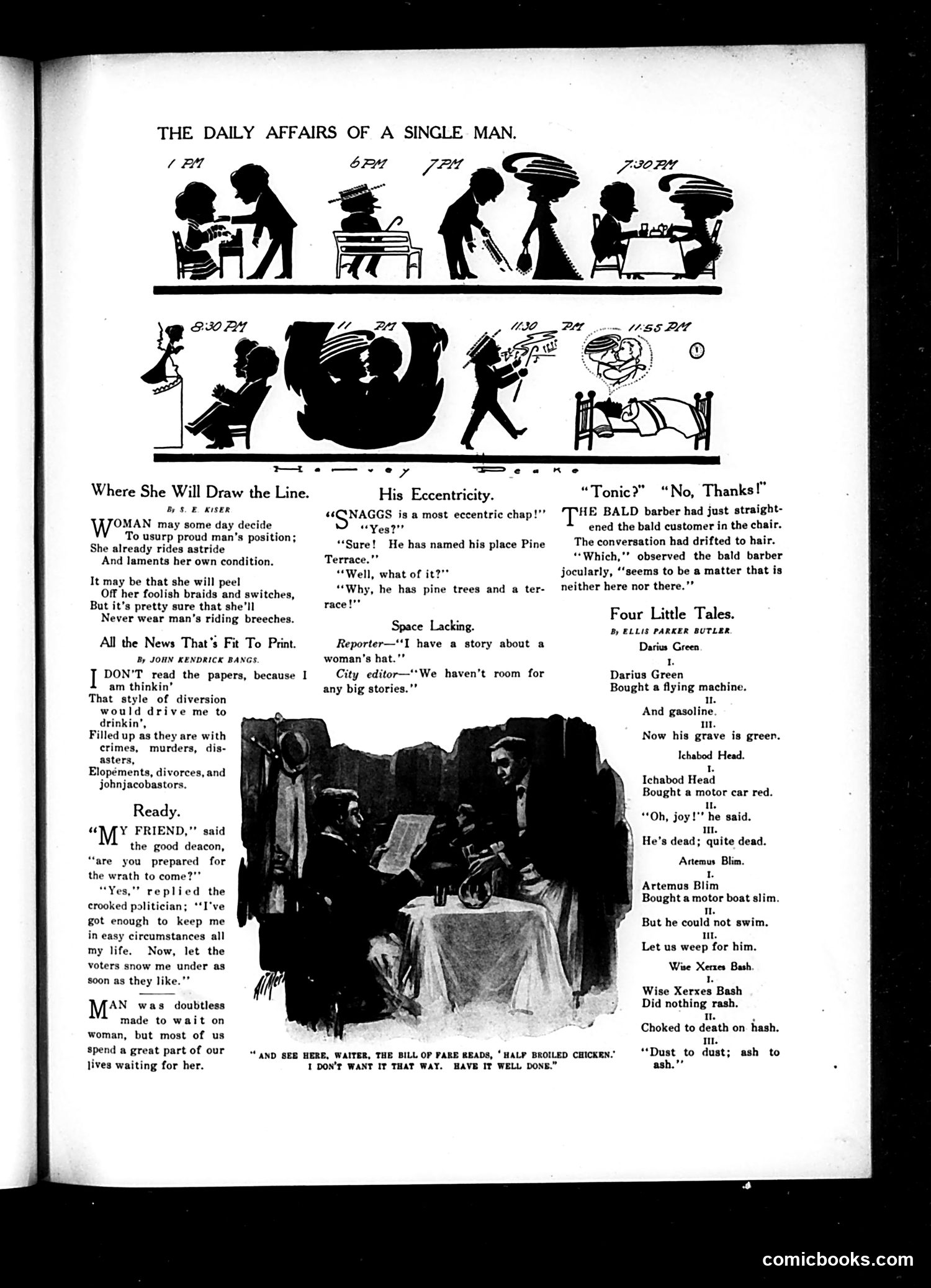
This page collects several short humorous pieces satirizing early 20th-century American life: **Top cartoon**: Silhouettes show a man's daily routine, mocking domestic life and relationships. **"Where She Will Draw the Line"**: Satirizes the women's suffrage/rights movement. It jokes that while women may adopt masculine behaviors (riding astride, abandoning hairstyles), they'll never fully abandon femininity—a skeptical comment on women's liberation. **"All the News That's Fit To Print"**: Mocks sensationalist newspapers filled with crime, scandal, and divorces—suggesting modern journalism is depressing garbage. **"Ready"**: A politician boasts he's "prepared" for electoral defeat because corruption has made him wealthy—cynical commentary on political corruption. **Other shorts**: "His Eccentricity," "Space Lacking," and "Tonic"/"No Thanks" are brief wordplay jokes about absurdity. **"Four Little Tales"**: Dark humor about new technology (flying machines, automobiles, motor boats) killing their enthusiastic owners—reflecting early anxiety about dangerous modern inventions.
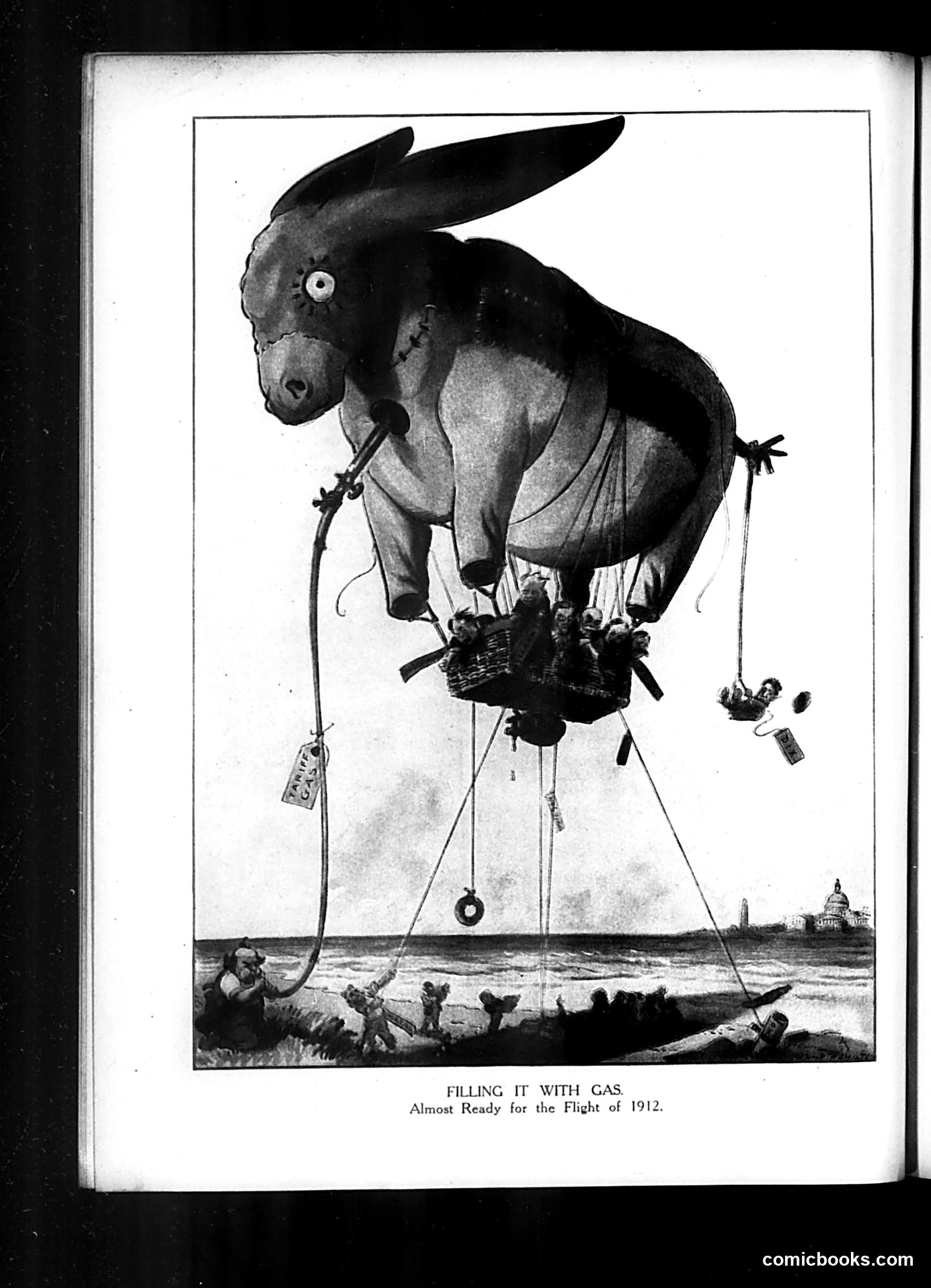
This is a satirical cartoon depicting a giant rabbit as an airship or balloon being inflated with gas. The rabbit, shown with long ears and anthropomorphic features, is tethered to the ground with ropes while people below prepare it for flight. The Capitol building is visible in the distant background. The satire likely references early 1912 political events or candidates being promoted with hot air and empty promises—the "gas" filling the balloon represents inflated rhetoric. The rabbit imagery suggests foolishness or absurdity. Without additional context about 1912 American politics, the specific targets remain unclear, but this is typical Judge magazine satire mocking political pretension and the gap between campaign promises and reality.
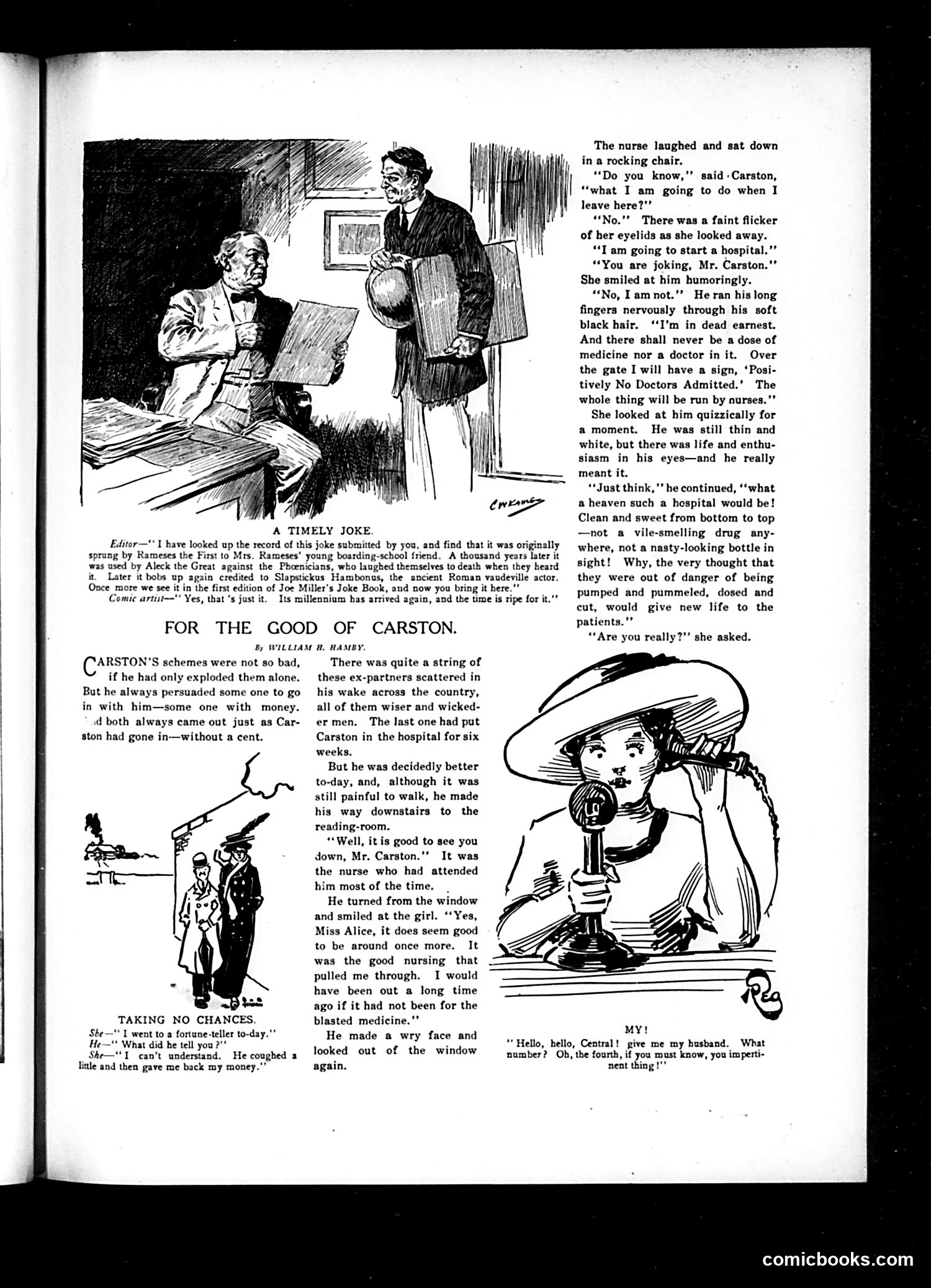
This is a humorous short story illustrated in Judge magazine. The plot centers on **Carston**, a chronic schemer who repeatedly involves others in failed business ventures, leaving them broke. He's currently recovering in a hospital after his last partner put him there six weeks earlier. The satire targets Carston's optimistic obliviousness: despite his track record of failure, he announces plans to start a hospital—staffed entirely by nurses with a sign reading "Positively No Doctors Admitted." He credits his recovery solely to nursing care, dismissing medicine as "blasted." The accompanying joke box ("A Timely Joke") satirizes how old material gets recycled, claiming the submitted joke originated with Rameses the First and has been reused for millennia—a jab at unoriginal comedy. The social commentary critiques both naive entrepreneurs who exploit investors and the era's skepticism toward medical science versus folk remedies. Carston embodies the type who learns nothing from repeated failure.
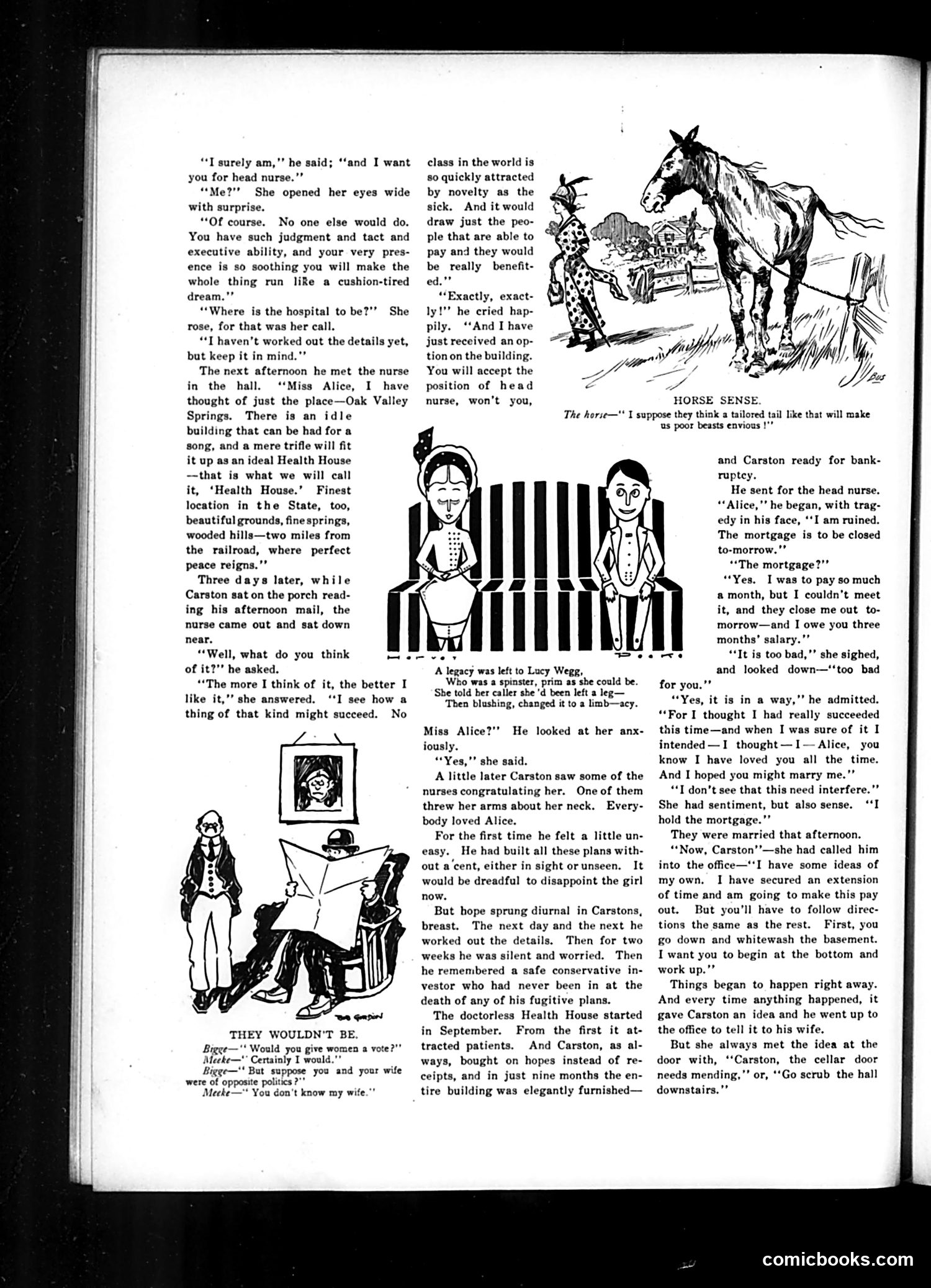
This Judge magazine page satirizes romantic and gender dynamics of its era through several sketches: **Main narrative**: A man (Carston) proposes to his nurse Alice that she become head nurse at a new health resort he plans to build. He's financially reckless—building without capital—and eventually faces bankruptcy. When he confesses his ruin and that he "loves" her, Alice reveals she holds the mortgage he owes. She agrees to marry him anyway, pragmatically securing her investment. The satire targets men's assumption that women will be swayed by romantic sentiment rather than self-interest. Alice's response—that she "had sentiment, but also sense"—mocks the contemporary ideal of the selfless, romantic woman. By holding the mortgage, she's the shrewd businessman, not him. **Side cartoons**: "Horse Sense" jokes about fashion; the small sketch below ridicules voting rights for women through a husband assuming his wife would defer to him politically ("You don't know my wife"). The overall message appears critical of male financial irresponsibility and female sentimentality, while simultaneously reinforcing stereotypes about women's inability to participate equally in public life.
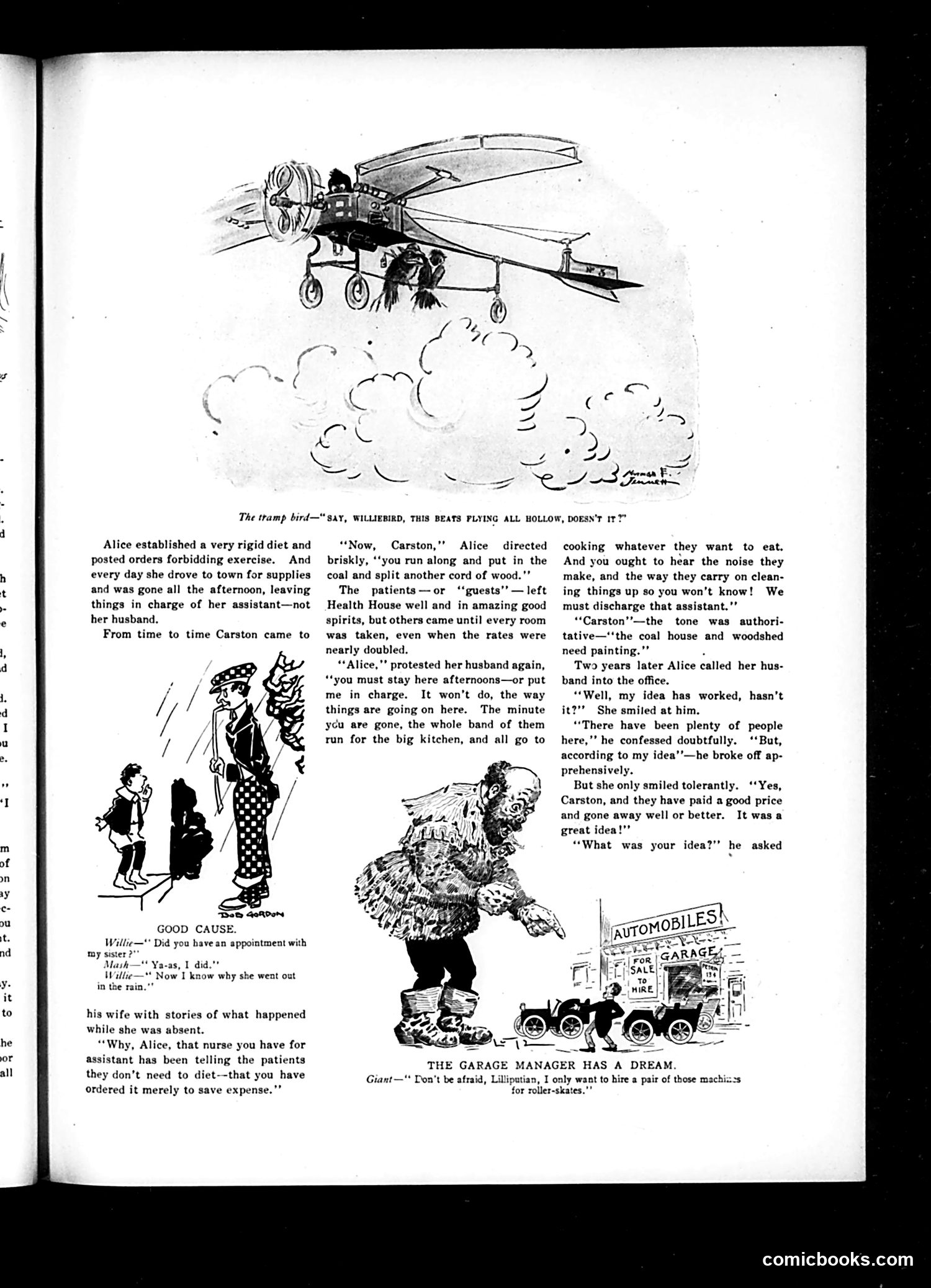
This page from *Judge* contains two satirical narratives about gender dynamics and business management in the early 20th century. The main story mocks a husband named Carston who objects to his wife Alice's management of a health sanitarium. While he complains about disorder and rules being broken, Alice—by ignoring his concerns and keeping him occupied with manual labor ("run along and put in the coal")—actually succeeds financially. The satire targets ineffectual husbands and suggests women are better business managers, inverting contemporary gender expectations. The secondary cartoon at bottom depicts a giant wanting to rent mechanical machines for roller-skates from a tiny garage manager—a absurdist joke about scale and impractical desires that lacks clear political meaning beyond simple humor. The "Good Cause" vignette similarly shows a woman outwitting male authority through indirect methods. The overall message mocks male incompetence in domestic/business spheres while celebrating female resourcefulness, typical of early-20th-century satirical magazine humor.
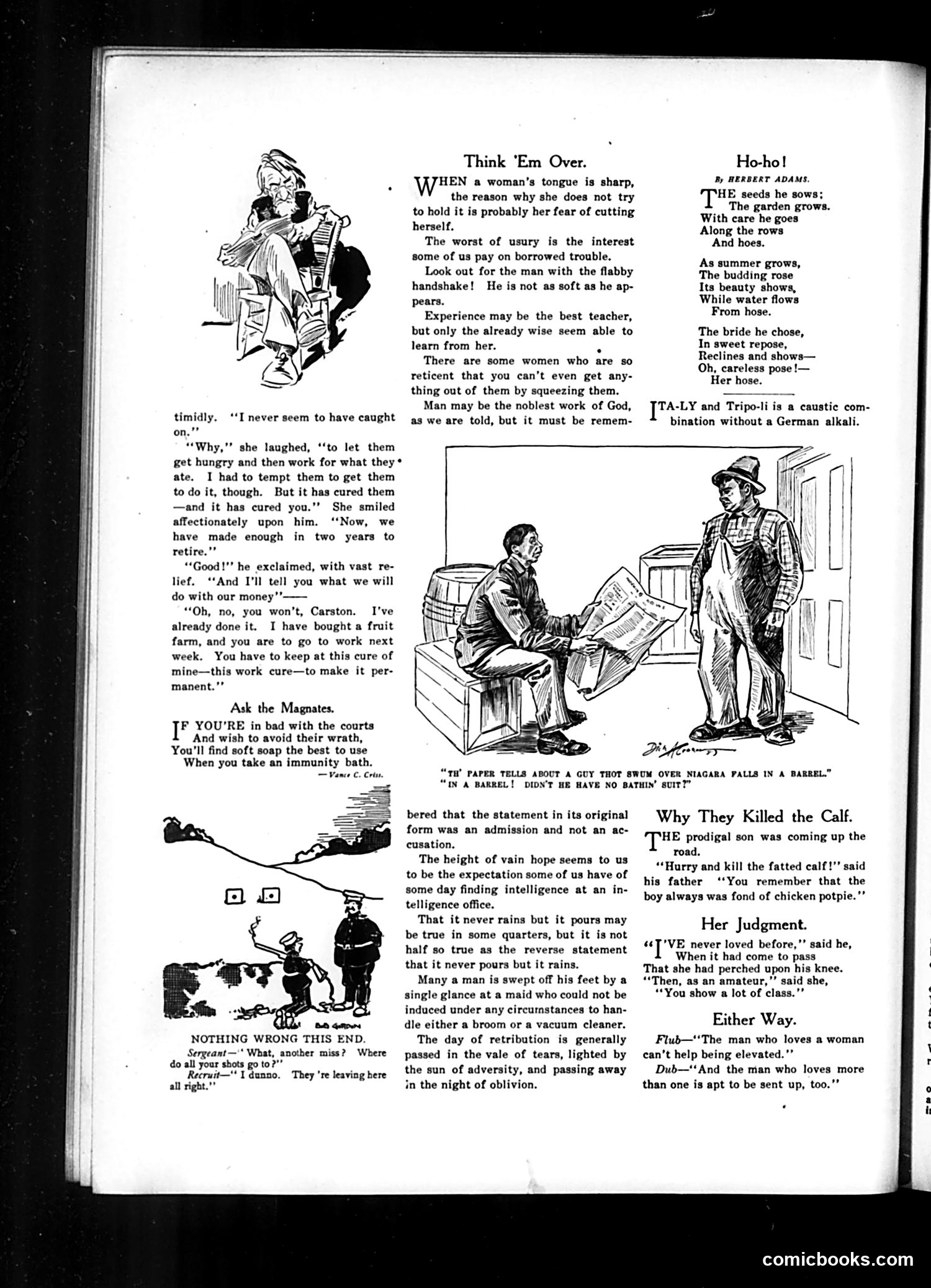
This page contains several short humorous pieces typical of early-20th-century satirical magazines: **Main Story (top left):** A domestic comedy about a wife who cured her husband's laziness through enforced work, then—having made enough money—immediately buys a fruit farm and puts him back to work. The satire targets both marital dynamics and the notion that work is inherently therapeutic. **"Think 'Em Over":** Aphoristic humor mocking human nature—sharp-tongued women, borrowed trouble, soft handshakes, and reticent women. **"Ho-ho!":** A poem by Herbert Adams playing on homophones: "hose" (garden hose) versus "hose" (women's stockings), with the punchline being a bride carelessly exposing her stockings. **Bottom cartoons:** Include military humor (a recruit's poor marksmanship), a barrel-stunt reference, and brief joke exchanges about love and ambition. The page reflects Edwardian-era concerns: gender relations, work ethic, social pretense, and mild innuendo about women's clothing—humor that assumes a male readership comfortable with gentle mockery of wives and romantic conquest.
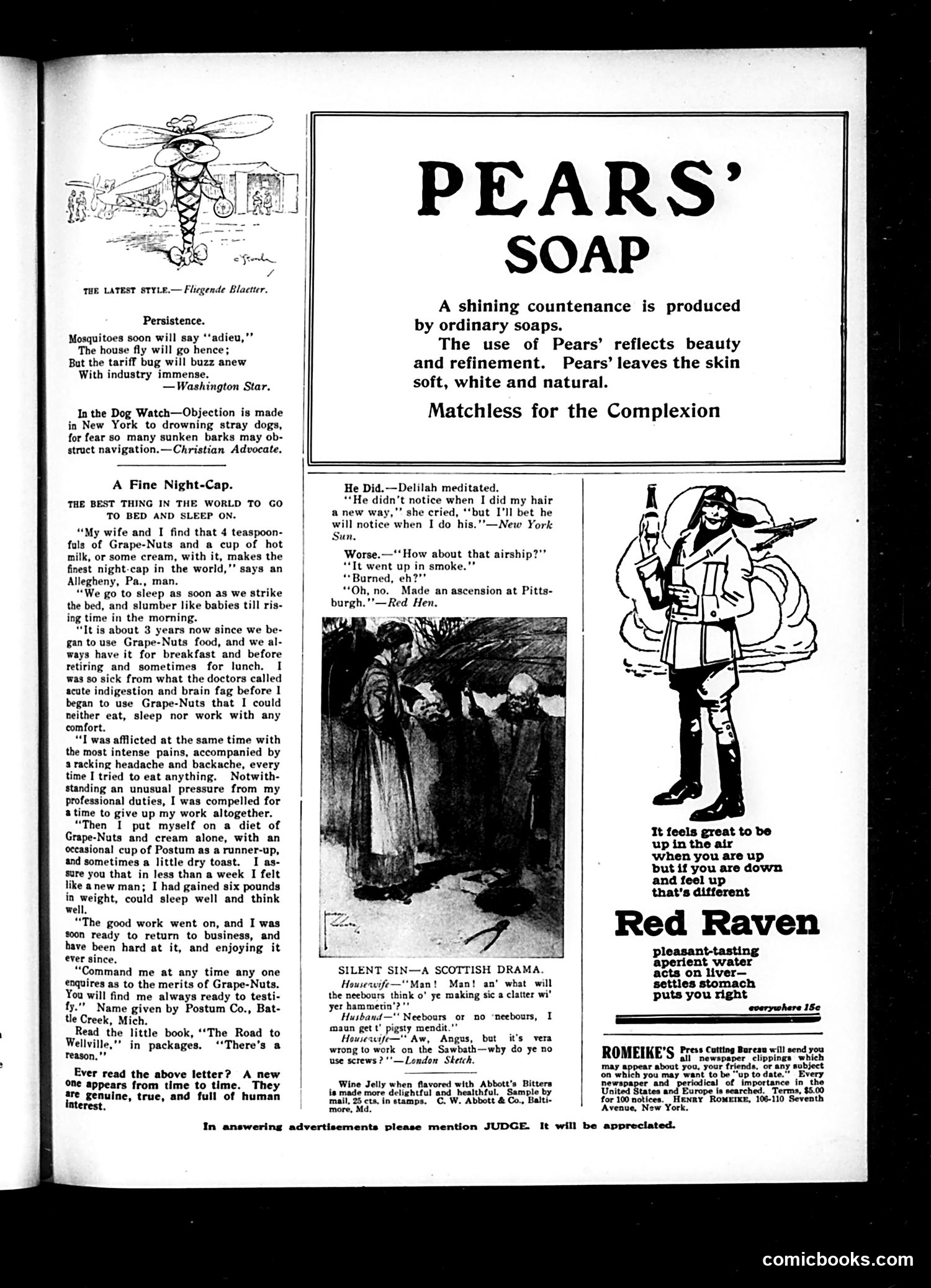
This page from *Judge* magazine contains several short satirical pieces and advertisements typical of early 20th-century American humor: **"Persistence"** (top left): A brief joke about persistent problems—mosquitoes and houseflies may disappear, but the "tariff bug" will continue buzzing with industrial activity. This references contemporary debates over trade tariffs. **"In the Dog Watch"**: A pun-based joke about New York objecting to drowning stray dogs because their sunken bodies ("barks") might obstruct navigation. **"Silent Sin—A Scottish Drama"** (center): A domestic humor sketch where a Scottish husband hammers on the Sabbath (Sunday), violating religious observance. His wife objects that he should use screws instead—a play on religious propriety versus practical solutions. **"He Did"** and **"Worse"**: Brief one-liners about marital dynamics and failed airship experiments. The page is otherwise dominated by period **advertisements** for Pears' Soap, Grape-Nuts cereal, and other products using testimonial format typical of the era.
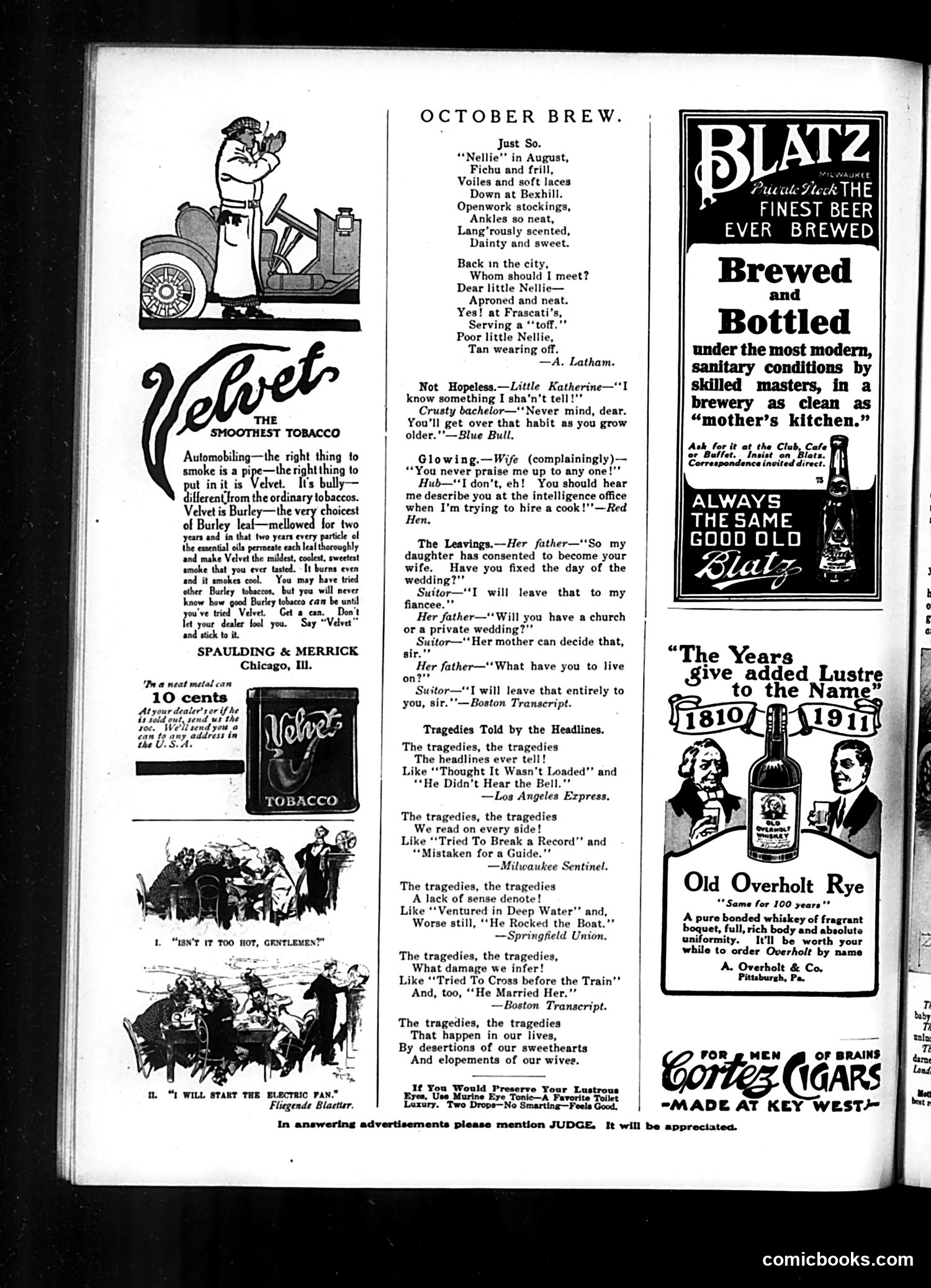
This page is primarily **advertising and light humor** rather than political satire. The content includes: **Main Elements:** 1. **Velvet Tobacco ad** (left): Appeals to automobile drivers, positioning pipe tobacco as appropriate for motorists. The ad emphasizes the product's mildness and quality. 2. **"October Brew" poem** (center): A romantic narrative about encountering "Nellie" at a seaside resort in August, then meeting her again working as a servant at a London restaurant. The satire gently mocks social class differences and the contrast between vacation leisure and working-class reality. 3. **Humor sections**: Brief jokes about bachelor habits, marriage negotiations, and domestic life—conventional period comedy with no political content. 4. **"Tragedies Told by Headlines"** (center): Dark humor listing newspaper headlines about accidental deaths (gun mishaps, drowning, trains), exploiting sensational journalism. 5. **Advertisements** (right): Blatz beer, Old Overholt whiskey, and Cortez cigars. **Overall**: This is a typical early-20th-century magazine page mixing consumer advertising with genteel social humor. No specific political figures or events are referenced.
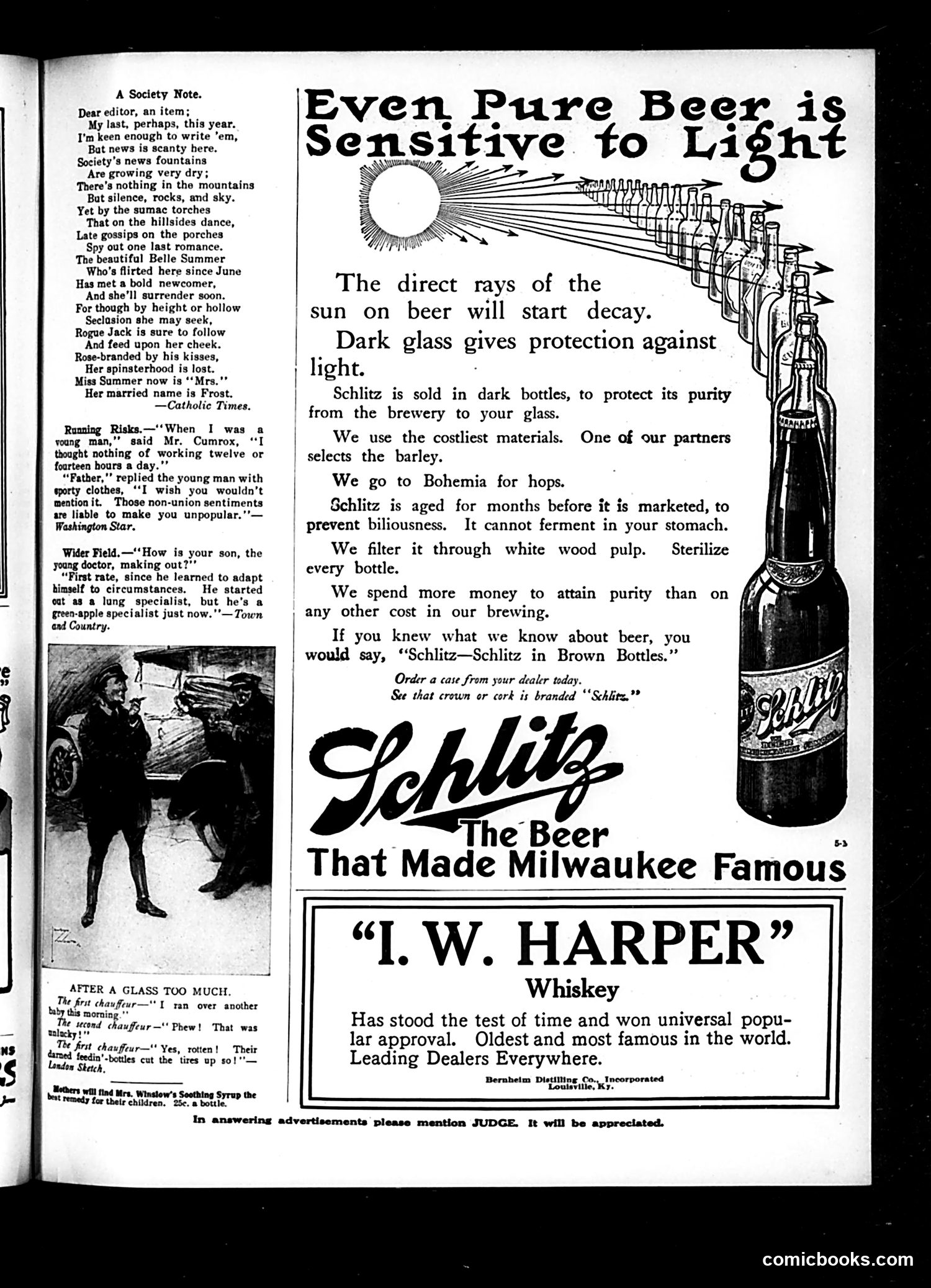
This page contains **primarily advertisements** with brief satirical humor pieces in the left margin. ## Satirical Content: **"A Society Note"** is a romantic poem about "Belle Summer" who elopes with "rogue Jack," becoming "Mrs. Frost"—a play on seasonal names suggesting their romance bloomed and ended with the seasons. **"Running Risks"** satirizes labor tensions: an older man boasts of working long hours, and a young man warns him such "non-union sentiments" will make him unpopular—reflecting early 20th-century union organizing anxieties. **"Wider Field"** jokes that a lung specialist became a "green-apple specialist," implying he treats digestive ailments caused by eating unripe fruit. **"After a Glass Too Much"** depicts drunk chauffeurs blaming their poor driving on London taxi cabs damaging tires. ## Advertisements: Large Schlitz beer and I.W. Harper whiskey ads emphasize purity and quality—common selling points for beverages in this pre-Prohibition era when such claims were unregulated.
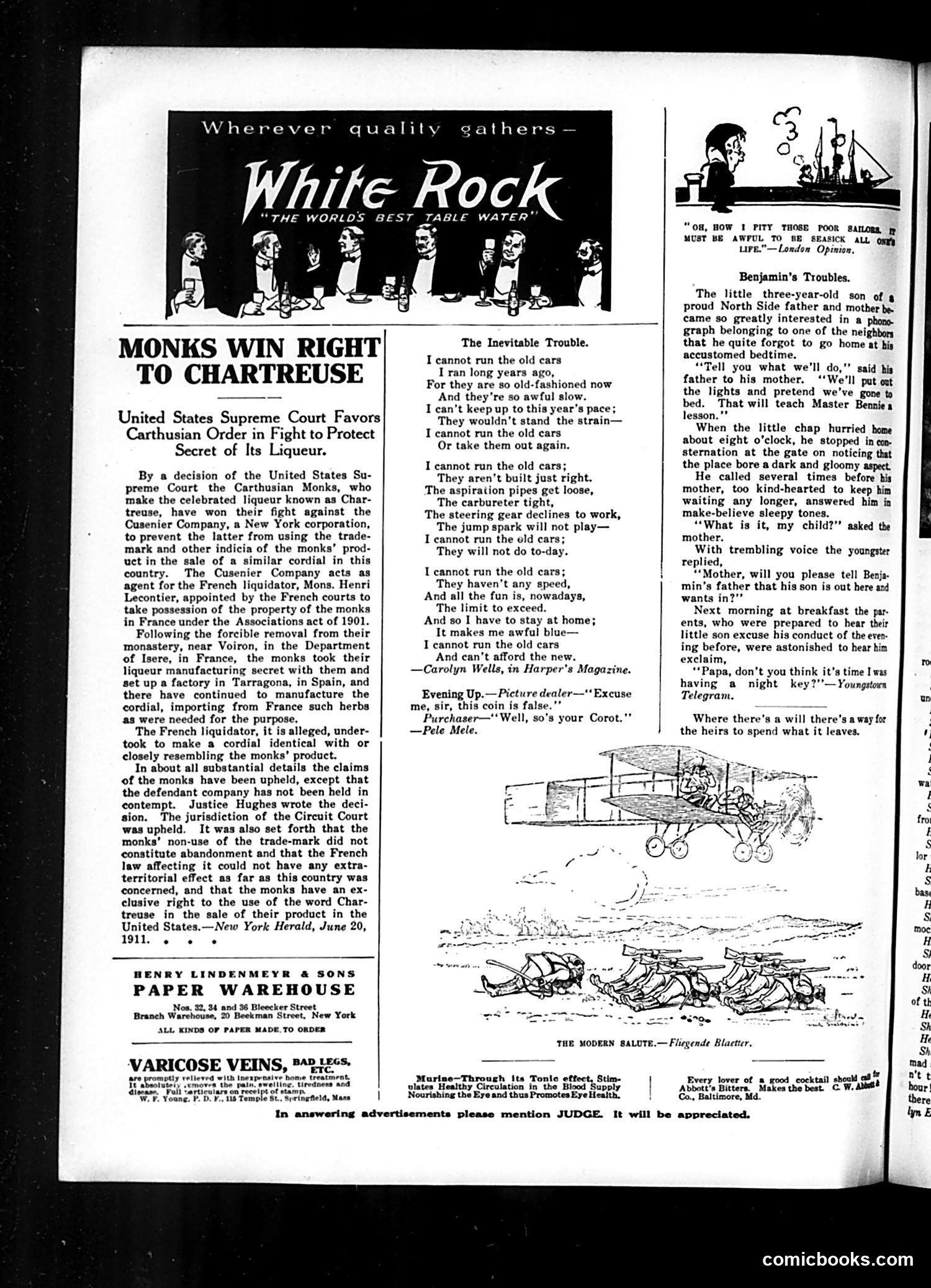
This page from Judge contains several distinct elements: **Main Article**: Reports on a U.S. Supreme Court decision favoring Carthusian monks' trademark rights to Chartreuse liqueur against a New York company attempting to manufacture an imitation. The decision upheld the monks' exclusive right to use "Chartreuse" in America, despite French legal complications from their expulsion under France's 1901 Association laws. **Poetry ("The Inevitable Trouble")**: A humorous lament about obsolete automobiles—unable to keep pace with modern traffic, constantly breaking down, yet owners can't afford new ones. It satirizes the rapid technological change and planned obsolescence of early automobiles. **Short Humor Pieces**: Include "Benjamin's Troubles" (a child's punishment backfires) and "Evening Up" (an art dealer's comeuppance). **Advertisements**: For paper warehouse and medical treatments. The page reflects Judge's satirical approach to contemporary issues: legal/commercial disputes, automotive innovation, and domestic comedy.
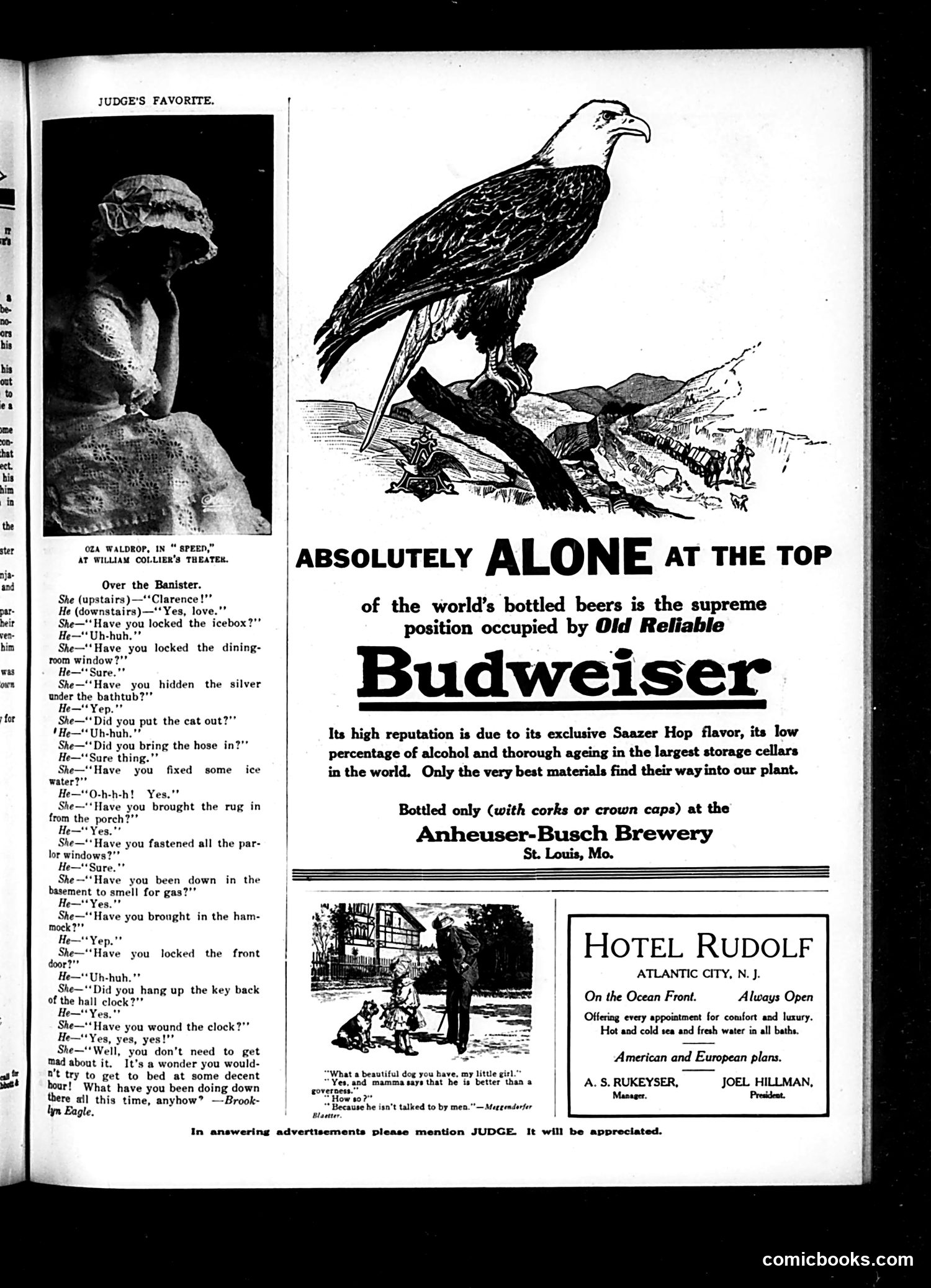
This page mixes humor with advertising. The main comic sketch, "Over the Banister," depicts a domestic scene where an anxious wife (She) bombardards her husband (He) with endless safety questions from upstairs—about locking the icebox, windows, hiding silver, securing the cat, bringing in the hose and hammock, checking for gas leaks, and winding the clock. The husband grows increasingly exasperated, finally snapping that he doesn't need to be nagged about bedtime. The joke satirizes domestic anxiety, particularly the neurotic worry-culture of the period regarding home security and preparation. The wife's compulsive questioning reflects early 20th-century anxieties about household management and theft. The page also features advertisements for Budweiser beer and Hotel Rudolf in Atlantic City, plus a small joke about a dog being preferable to a husband because "he isn't talked to by men"—a jab at male silence in marriages.