
Judge, 1911-10-14 · page 18 of 23
Judge — October 14, 1911 — page 18: what you’re looking at
What you’re looking at
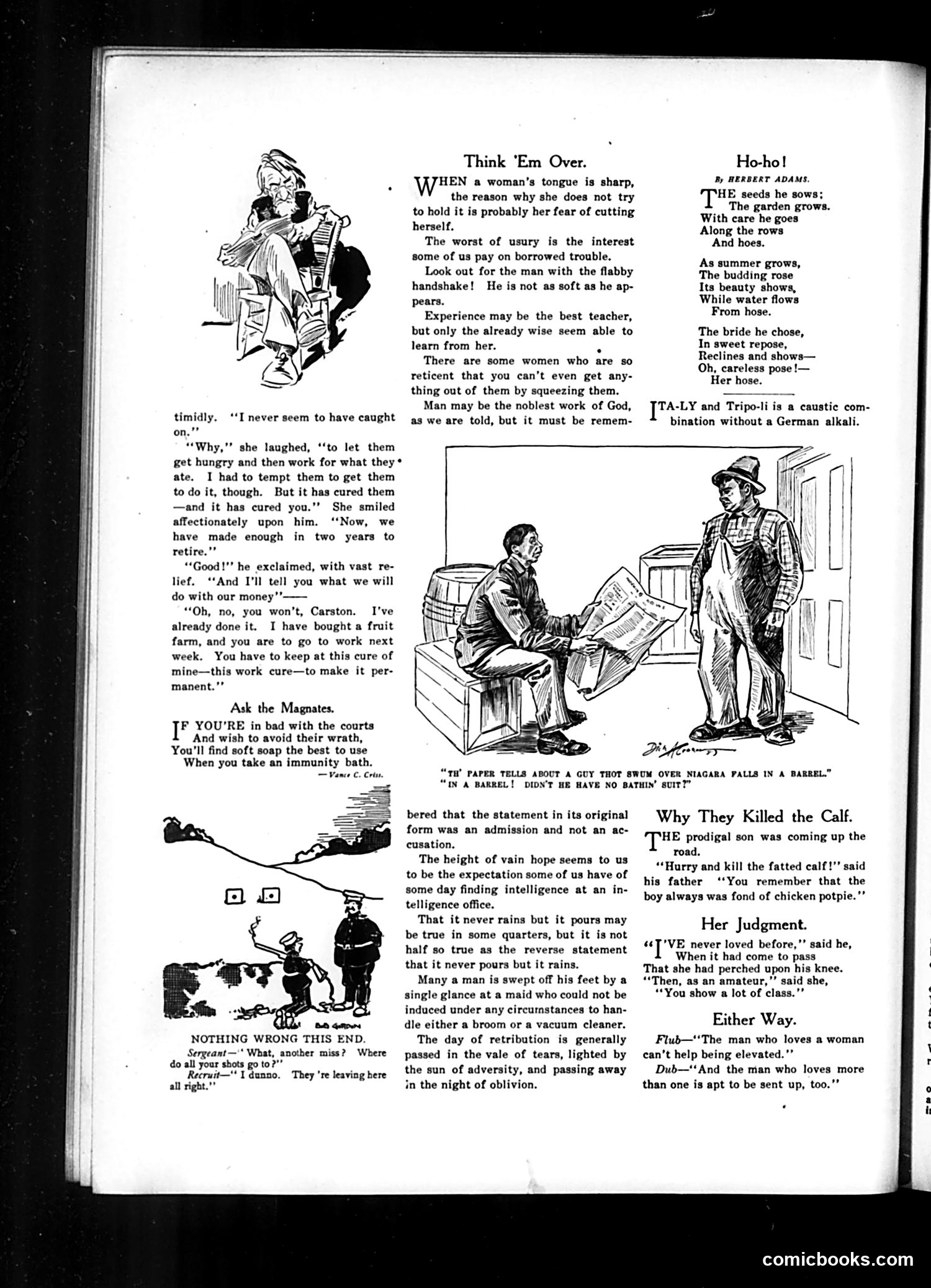
This page contains several short humorous pieces typical of early-20th-century satirical magazines: **Main Story (top left):** A domestic comedy about a wife who cured her husband's laziness through enforced work, then—having made enough money—immediately buys a fruit farm and puts him back to work. The satire targets both marital dynamics and the notion that work is inherently therapeutic. **"Think 'Em Over":** Aphoristic humor mocking human nature—sharp-tongued women, borrowed trouble, soft handshakes, and reticent women. **"Ho-ho!":** A poem by Herbert Adams playing on homophones: "hose" (garden hose) versus "hose" (women's stockings), with the punchline being a bride carelessly exposing her stockings. **Bottom cartoons:** Include military humor (a recruit's poor marksmanship), a barrel-stunt reference, and brief joke exchanges about love and ambition. The page reflects Edwardian-era concerns: gender relations, work ethic, social pretense, and mild innuendo about women's clothing—humor that assumes a male readership comfortable with gentle mockery of wives and romantic conquest.
📄 Transcribed text from this page (OCR, searchable)
Machine-transcribed from the original scan — historical spelling and the odd misread are preserved.
timidly. ‘‘I never seem to have caught on.’” ““Why,’’ she laughed, ‘‘to let them get hungry and then work for what they * ate. I had to tempt them to get them to do it, though. But it has cured them —and it has cured you.’’ She smiled affectionately upon him. ‘Now, we have made enough in two years to retire.’" “Good!'’ he exclaimed, with vast re- lief. ‘‘And I'll tell you what we will do with our money"?—— “Oh, no, you won't, Carston. I’ve already done it. I have bought a fruit farm, and you are to go to work next week. You have to keep at this cure of mine—this work cure—to make it per- manent.’” Ask the Magnates, F YOU'RE in bad with the courts And wish to avoid their wrath, You'll find soft soap the best to use When you take an immunity bath. Vance C. Criss. NOTHING WRONG THIS END. Sergeant —'* What, another miss? Where do all your shots go to?” Recruit—"* I dunno. all right."” They ‘re leaving here Think ‘Em Over. WEEN @ woman’s tongue is sharp, the reason why she does not try to hold it is probably her fear of cutting herself. The worst of usury is the interest some of us pay on borrowed trouble. Look out for the man with the flabby handshake! He is not as soft as he ap- pears. Experience may be the best teacher, but only the already wise seem able to learn from her. . There are some women who are so reticent that you can’t even get any- thing out of them by squeezing them. Man may be the noblest work of God, as we are told, but it must be remem- Ho-ho! By HERBERT ADAMS. HE seeds he sows; The garden grows. With care he goes Along the rows And hoes. As summer grows, The budding rose Its beauty shows, While water flows From hose. The bride he chose, In sweet repose, Reclines and shows— Oh, careless pose !— Her hose. TA-LY and Tripo- a caustic com- bination without a German alkali. ae NW EG “TH PAPER TELLS ABOUT A GUY THOT SWUM OVER NIAGARA PALLS IN A BARREL.” IN A BARREL! bered that the statement in its original form was an admission and not an ac- cusation. The height of vain hope seems to us to be the expectation some of us have of some day finding intelligence at an in- telligence office. ‘That it never rains but it pours may be true in some quarters, but it is not half so true as the reverse statement that it never pours but it rains. Many a man is swept off his feet by a single glance at a maid who could not be induced under any circumstances to han- dle either a broom or a vacuum cleaner. The day of retribution is generally passed in the vale of tears, lighted by the sun of adversity, and passing away in the night of oblivion. DIDN'T HE HAVE NO BATHIN’ suIT?” Why They Killed the Calf. THe prodigal son was coming up the road. “Hurry and kill the fatted calf!’ said his father ‘‘You remember that the boy always was fond of chicken potpie."’ Her Judgment. «éT’VE never loved before,’’ said he, When it had come to pass That she had perched upon his knee. “Then, as an amateur,” said she, “You show a lot of class.’” Either Way. Flub—‘‘The man who loves a woman can’t help being elevated.’"’ Dub—‘‘And the man who loves more than one is apt to be sent up, too.’” comicbooks.com