
Judge, 1911-10-14 · page 16 of 23
Judge — October 14, 1911 — page 16: what you’re looking at
What you’re looking at
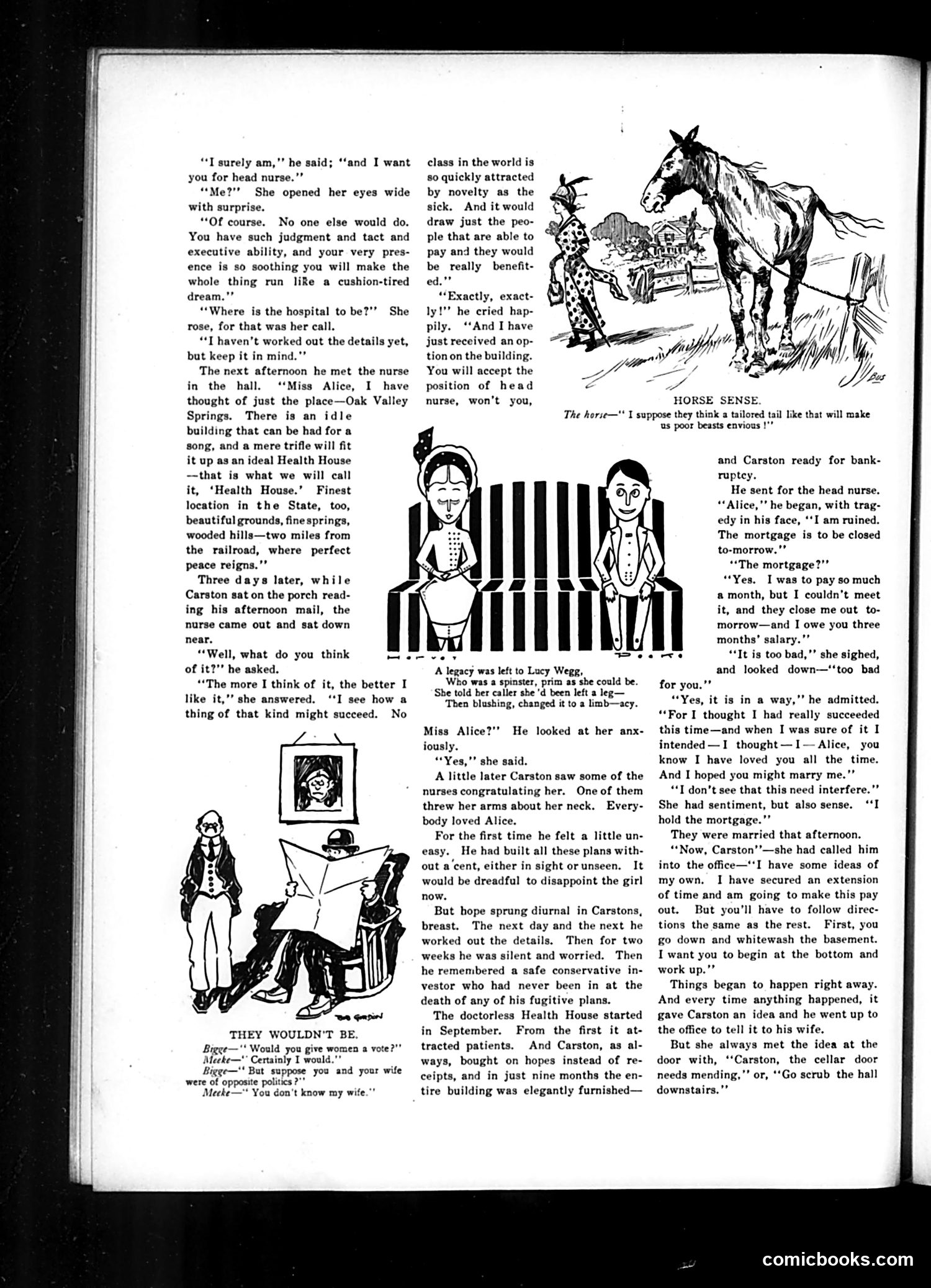
This Judge magazine page satirizes romantic and gender dynamics of its era through several sketches: **Main narrative**: A man (Carston) proposes to his nurse Alice that she become head nurse at a new health resort he plans to build. He's financially reckless—building without capital—and eventually faces bankruptcy. When he confesses his ruin and that he "loves" her, Alice reveals she holds the mortgage he owes. She agrees to marry him anyway, pragmatically securing her investment. The satire targets men's assumption that women will be swayed by romantic sentiment rather than self-interest. Alice's response—that she "had sentiment, but also sense"—mocks the contemporary ideal of the selfless, romantic woman. By holding the mortgage, she's the shrewd businessman, not him. **Side cartoons**: "Horse Sense" jokes about fashion; the small sketch below ridicules voting rights for women through a husband assuming his wife would defer to him politically ("You don't know my wife"). The overall message appears critical of male financial irresponsibility and female sentimentality, while simultaneously reinforcing stereotypes about women's inability to participate equally in public life.
📄 Transcribed text from this page (OCR, searchable)
Machine-transcribed from the original scan — historical spelling and the odd misread are preserved.
“IT surely am,"’ he said; ‘‘and I want you for head nurse.’” “*Me?'’’ She opened her eyes wide with surprise. “Of course. No one else would do. You have such judgment and tact and executive ability, and your very pres- ence is so soothing you will make the whole thing run like a cushion-tired dream."” “Where is the hospital to be?’’ rose, for that was her call. “T haven't worked out the details yet, but keep it in mind." The next afternoon he met the nurse in the hall. ‘‘Miss Alice, I have thought of just the place—Oak Valley Springs. There is an idle building that can be had for a song, and a mere trifle will fit it up as an ideal Health House -—that is what we will call it, ‘Health House.’ Finest location in the State, too, beautiful grounds, fine springs, wooded hills—two miles from the railroad, where perfect peace reigns.” Three days later, while Carston sat on the porch read- ing his afternoon mail, the nurse came out and sat down near. “Well, what do you think of it?’’ he asked. “The more I think of it, the better I like it,’”’ she answered. ‘‘I see how a thing of that kind might succeed. No She THEY WOULDN'T BE. Bigge—'* Would you give women a vote?"” Meeke—"' Certainly I would.” Bigge—'' But suppose you and your wife were of opposite politics ?"” Mecke—"* You don't know my wife."’ y ps \_ATEL (fell yl class in the world is 8o quickly attracted by novelty as the sick. And it would draw just the peo- ple that are able to pay and they would be really benefit- ed.”” “Exactly, exact- ly!’ he cried hap- pily. ‘‘And I have just received an op- tion on the building. You will accept the position of head nurse, won't you, HORSE SENSE. The horie—'* I suppose they think a tailored tail like that will make lf | A legacy was left to Lucy Wegg, Who was a spinster, prim as she could be. She told her caller she'd been left a leg— Then blushing, changed it to a limb—acy. Miss Alice?’’ He looked at her anx- jously. “Yes,’’ she said. A little later Carston saw some of the nurses congratulating her. One of them threw her arms about her neck. Every- body loved Alice. For the first time he felt a little un- easy. He had built all these plans with- out a‘cent, either in sight or unseen. It would be dreadful to disappoint the girl now. But hope sprung diurnal in Carstons, breast. The next day and the next he worked out the details. Then for two weeks he was silent and worried. Then he remembered a safe conservative in- vestor who had never been in at the death of any of his fugitive plans. The doctorless Health House started in September. From the first it at- tracted patients. And Carston, as al- ways, bought on hopes instead of re- ceipts, and in just nine months the en- tire building was elegantly furnished— (lh Wee us poor beasts envious !"” and Carston ready for bank- ruptey. He sent for the head nurse. *‘Alice,’’ he began, with trag- edy in his face, ‘I am ruined. The mortgage is to be closed to-morrow.'” “*The mortgage?’’ “Yes. I was to pay so much a month, but I couldn't meet it, and they close me out to- morrow—and I owe you three months’ salary.”’ we “It is too bad,”’ she sighed, and looked down—‘‘too bad for you.”” “Yes, it is in a way,’’ he admitted. “For I thought I had really succeeded this time—and when I was sure of it I intended —I thought—I— Alice, you know I have loved you all the time. And I hoped you might marry me.’” “I don’t see that this need interfere."” She had sentiment, but also sense. ‘‘I hold the mortgage.’’ They were married that afternoon. “Now, Carston’’—she had called him into the office—‘'I have some ideas of my own, I have secured an extension of time and am going to make this pay out. But you'll have to follow direc- tions the same as the rest. First, you go down and whitewash the basement. I want you to begin at the bottom and work up.’” Things began to happen right away. And every time anything happened, it gave Carston an idea and he went up to the office to tell it to his wife. But she always met the idea at the door with, ‘‘Carston, the cellar door needs mending,”’ or, *‘Go scrub the hall downstairs.’” comicbooks.com