
A complete issue · 24 pages · 1911
Judge — October 7, 1911
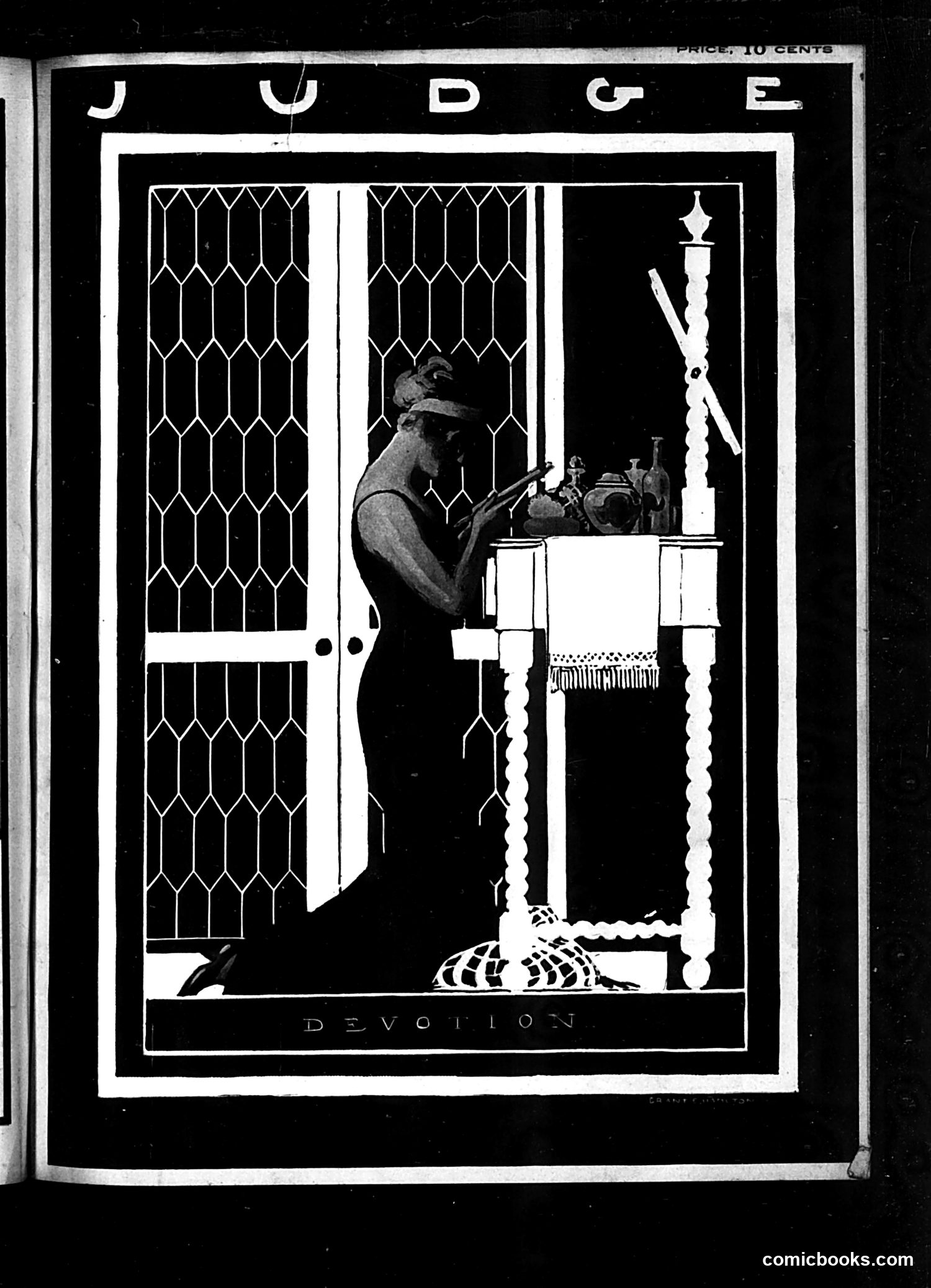
This is a stylized illustration titled "DEVOTION" showing a figure in classical/Egyptian-style dress performing what appears to be a religious or ritualistic act at an altar. The figure is depicted in silhouette against ornate Art Deco geometric patterns featuring chain-link designs and decorative architectural elements. The caption "DEVOTION" and the reverent pose suggest satirical commentary on religious devotion or worship, possibly critiquing excessive ritualism or blind faith. The Egyptian styling may reference ancient religious practices to underscore the point about dated or primitive forms of worship. Without additional OCR text or historical context identifying the specific political figures or events referenced, the precise satirical target remains unclear. The Art Deco style dates this to the 1920s-1930s era.
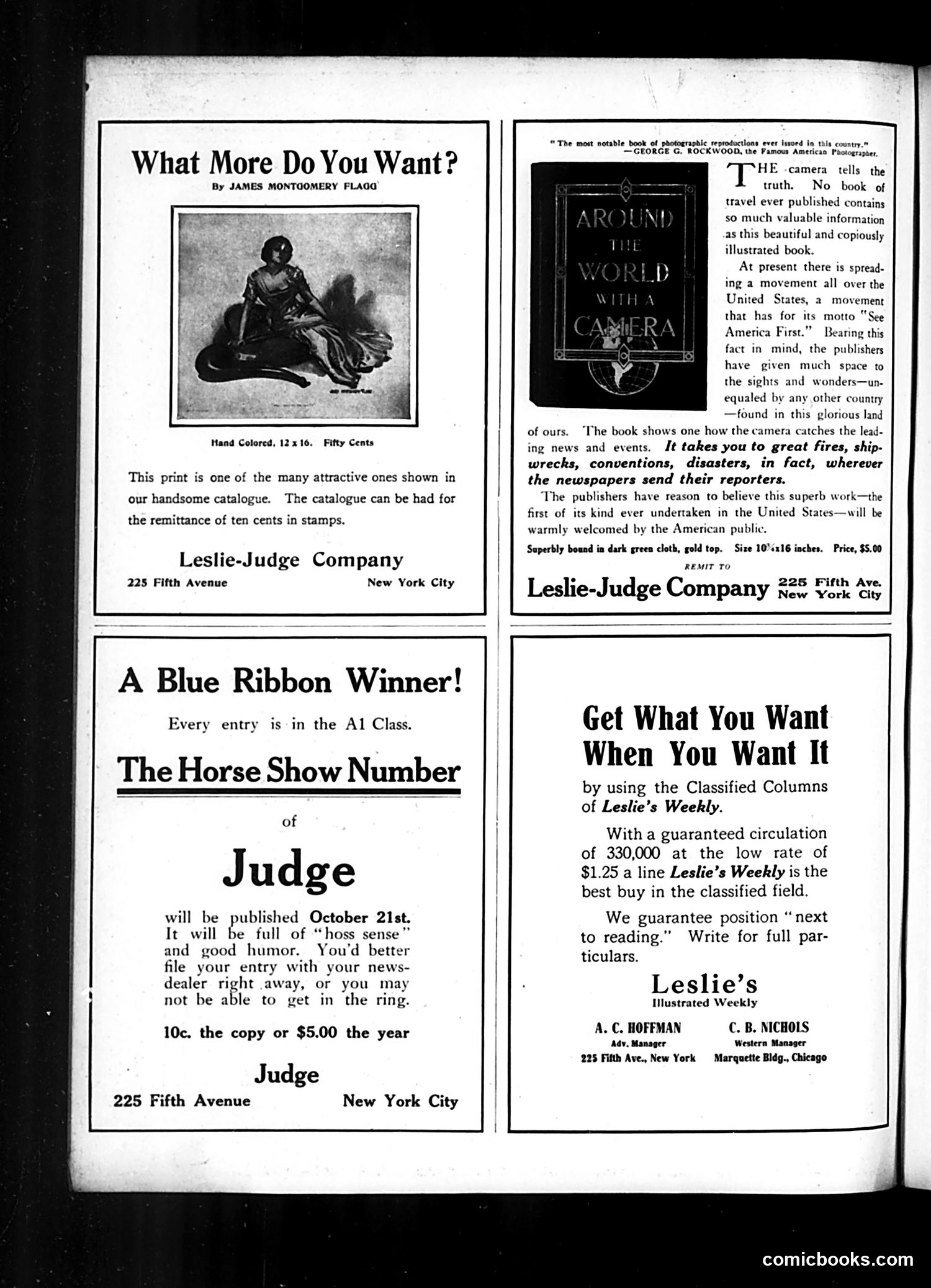
This page is primarily **advertising**, not satirical content. It contains four advertisements: 1. **"What More Do You Want?"** – Leslie-Judge Company advertisement for hand-colored prints ($0.50), featuring a romantic illustration. 2. **"Around the World with a Camera"** – Leslie-Judge Company promoting an illustrated travel book showing photojournalism ($5.00), emphasizing American superiority in publishing. 3. **"A Blue Ribbon Winner!"** – Advertisement for *Judge* magazine's October 21st "Horse Show Number" issue ($0.10/copy or $5.00/year), appealing to readers to subscribe early. 4. **"Get What You Want When You Want It"** – Advertisement for classified ads in *Leslie's Weekly*, promoting its circulation reach (330,000) and low rates ($1.25/line). The page demonstrates how Judge supported itself through advertising revenue from sister publications.
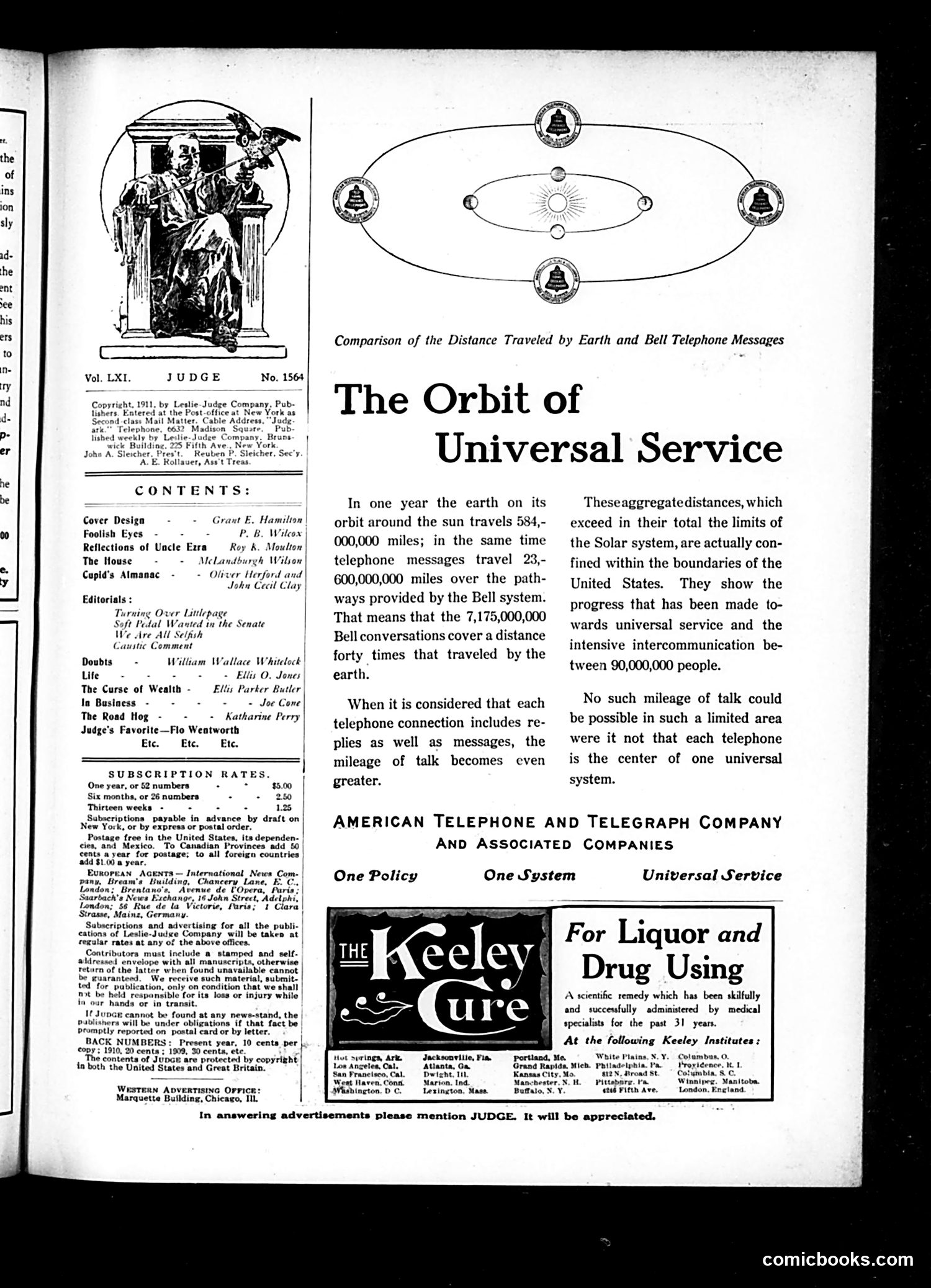
This page is primarily **advertising and editorial content** rather than political satire. The main feature is "The Orbit of Universal Service," an article celebrating Bell Telephone's infrastructure achievements. It compares the distance Earth travels annually (584 million miles) to Bell's telephone message transmissions (23.6 billion miles), arguing this demonstrates progress toward "universal service" connecting 90 million Americans. The accompanying diagram shows an orbital system with the sun at center and bell symbols at cardinal points—a metaphor for Bell's expansive network. Below sits a Keeley Institute advertisement for addiction treatment, unrelated to the telephone content. No political cartoon or satire appears on this page; it represents **Judge's commercial advertising content** interspersed with corporate promotional articles typical of early 1910s magazines.
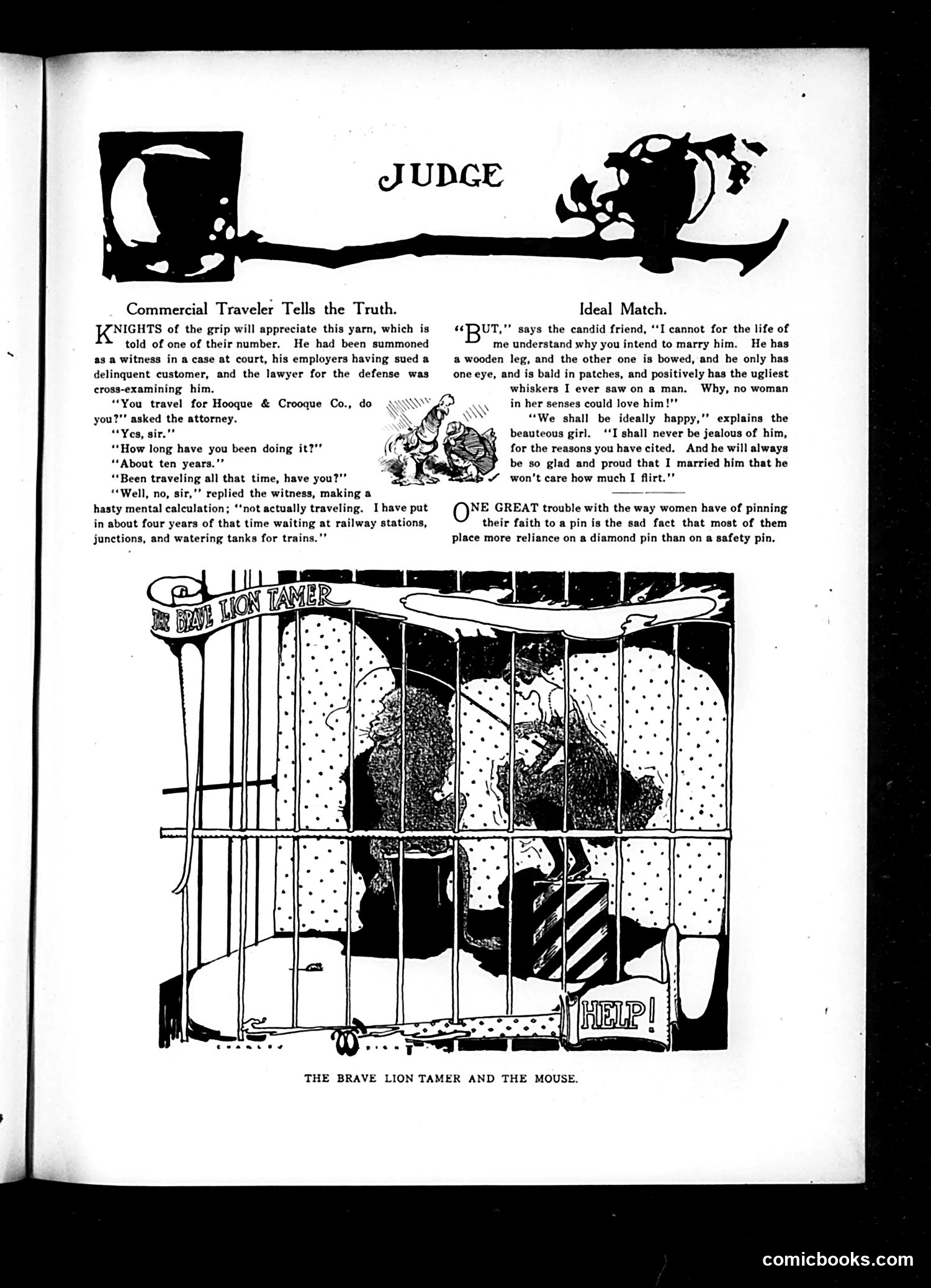
This Judge magazine page contains two satirical pieces: **"Commercial Traveler Tells the Truth"** mocks a railroad worker testifying in court. He admits to years of not actually traveling—just waiting at stations and junctions—contradicting his employer's claims. The satire targets corporate dishonesty and employee negligence in the railroad industry. **"Ideal Match"** ridicules women's unrealistic romantic expectations. A woman claims she'll marry a man with a wooden leg, one eye, and severe disfigurement, insisting she won't be jealous. The satire suggests women's stated tolerance masks actual shallowness. **"The Brave Lion Tamer and the Mouse"** (cartoon) shows a lion tamer cowering in a cage from a mouse—inverting power dynamics for comedic effect. The page reflects early 20th-century attitudes: skepticism toward corporate reliability and somewhat dismissive humor about women's sincerity.
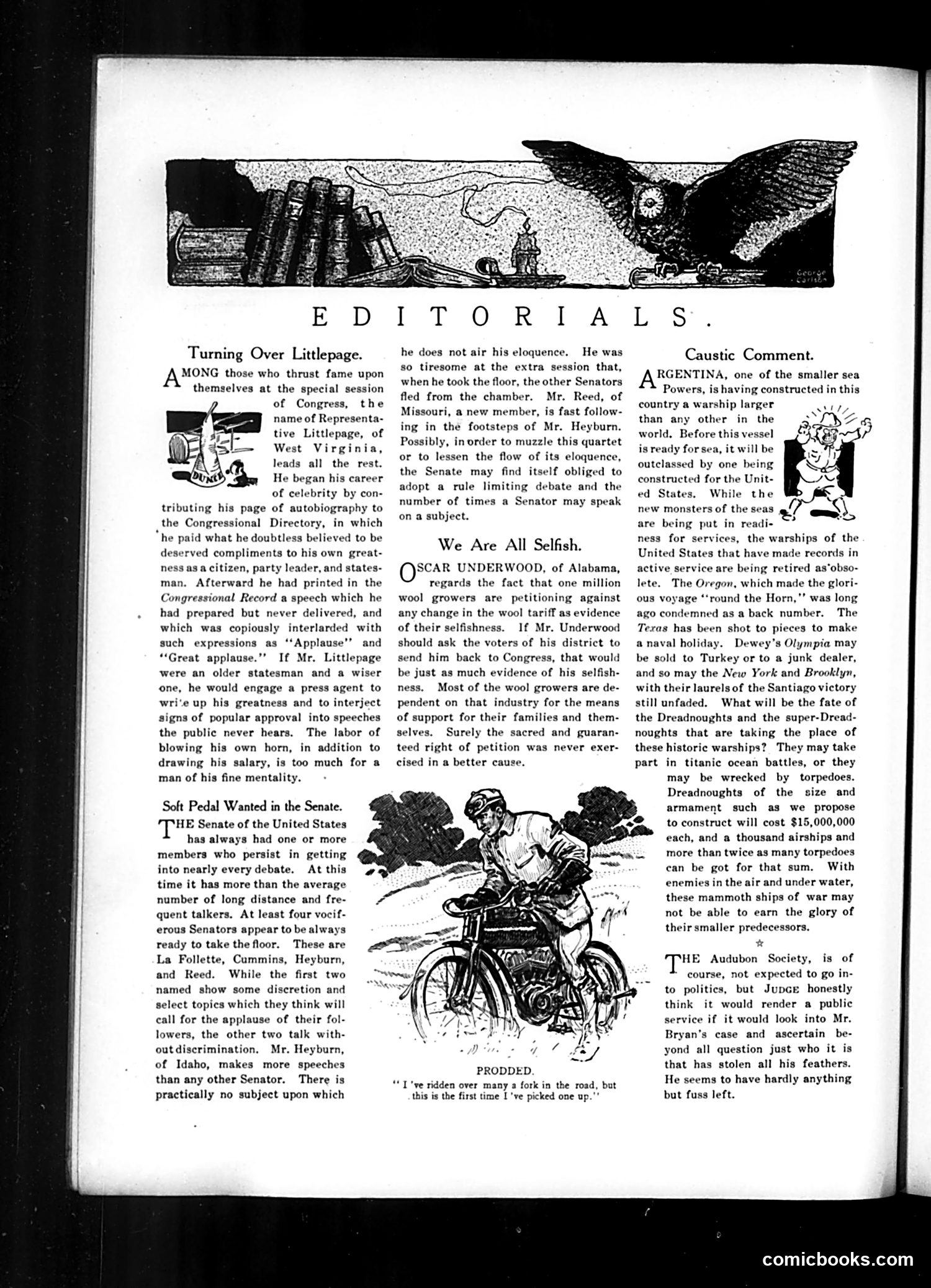
This 1910s editorial page satirizes several Congressional figures and political issues: **"Turning Over Littlepage"** mocks Representative Littlepage of West Virginia for shamelessly self-promotion—writing autobiography for the Congressional Directory and printing an undelivered speech in the Congressional Record, padding it with fake "[Applause]" notations. The satire suggests he should hire a professional press agent rather than tire himself with self-aggrandizement. **"Soft Pedal Wanted in the Senate"** criticizes verbose senators, particularly Heyburn (Idaho) and Reed (Missouri), who dominate debate on nearly every subject. La Follette and Cummins show "discretion," but Heyburn was so tedious colleagues fled the chamber. Judge suggests adopting debate limits. **"We Are All Selfish"** defends wool growers' tariff petition against Congressman Underwood's accusation of selfishness—arguing workers advocating for their livelihoods deserve the same respect as politicians seeking reelection. The bicycle cartoon humorously illustrates the tariff debate's chaos.
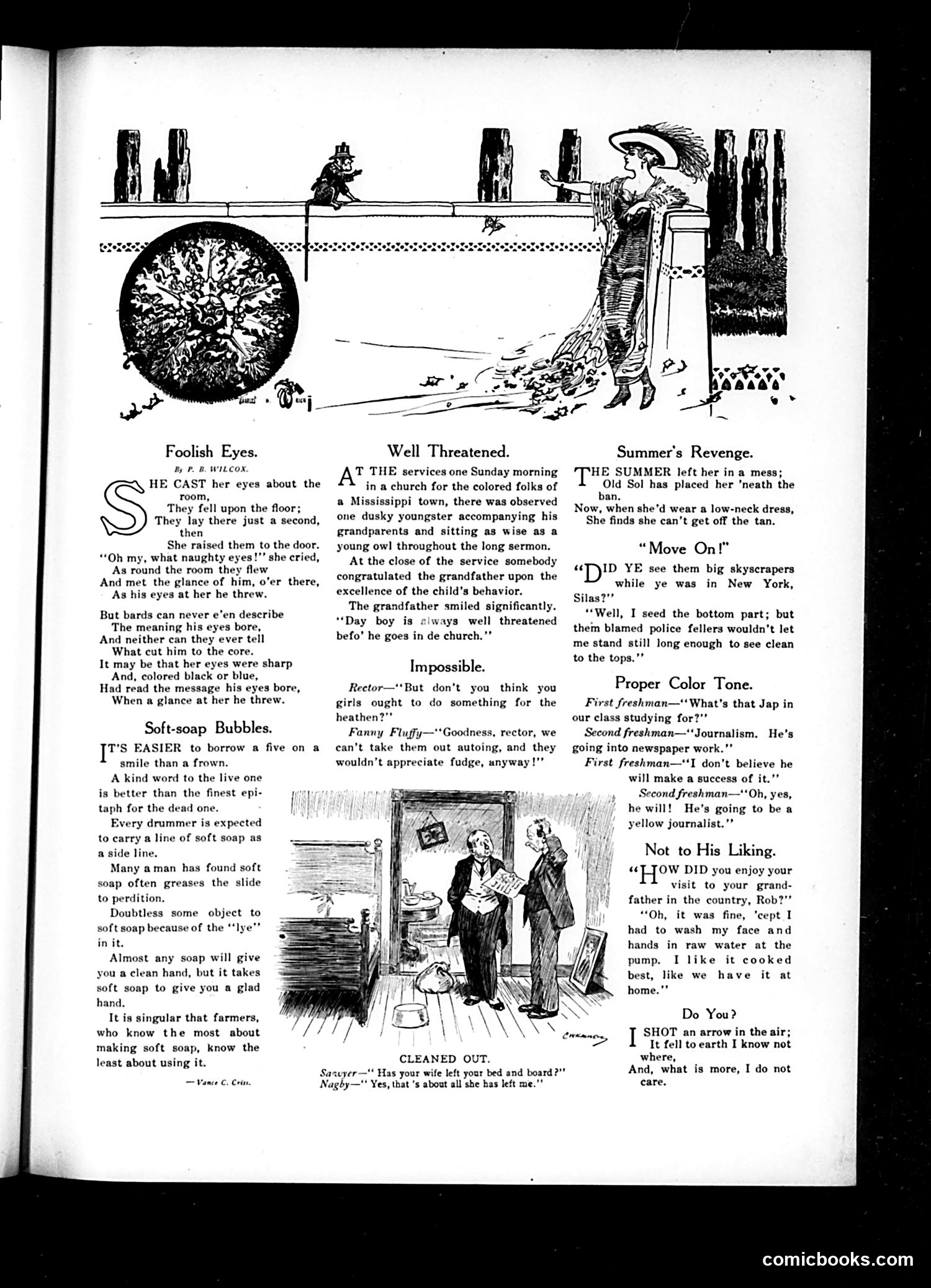
This page contains multiple short humor pieces typical of early 20th-century American satirical magazines: **"Foolish Eyes"** and **"Soft-soap Bubbles"** are lighthearted verses about flirtation and flattery, without specific political content. **"Well Threatened"** satirizes racial stereotypes, presenting a caricatured dialogue where a Black grandfather in Mississippi explains his grandson's good church behavior through threats—reflecting the period's offensive racial humor common to Judge. **"Summer's Revenge"** jokes about suntan lines on women wearing low-neck dresses—commentary on changing fashion and women's activities. **"Move On!"** satirizes overzealous New York police preventing vagrants from loitering near skyscrapers. **"Proper Color Tone"** uses a racist pun about Japanese students and "yellow journalism." **"Not to His Liking"** mocks urban children's disconnection from rural life. The page is primarily humorous filler rather than political commentary, reflecting Judge's mix of social satire and gentle comedy for middle-class readers.
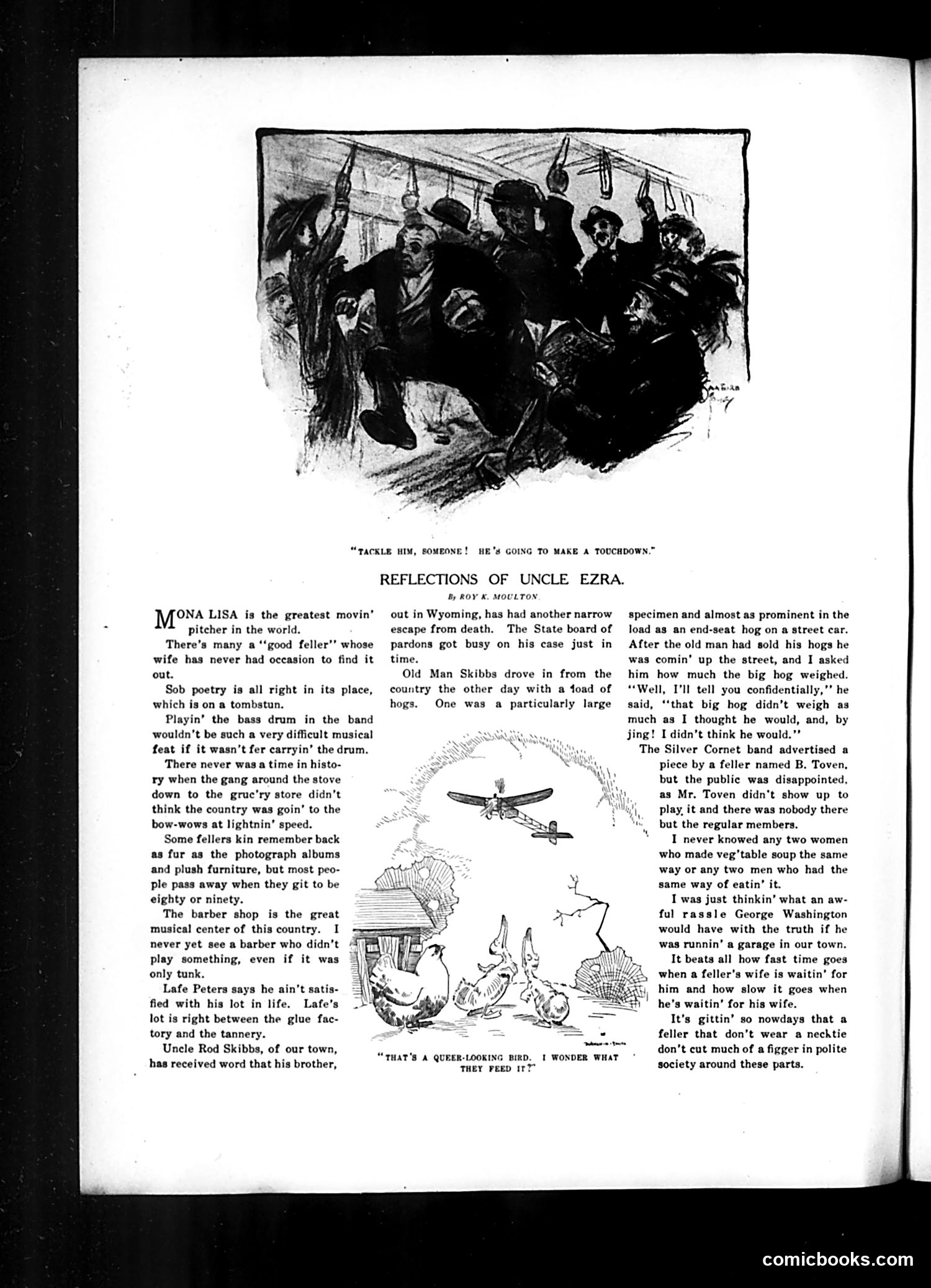
This page combines folksy rural humor with two distinct cartoons. The top illustration shows crowded passengers on public transportation with the caption "Tackle him, someone! He's going to make a touchdown"—likely satirizing the chaos of urban mass transit, where aggressive passengers jostle for space like football players. The middle cartoon depicts a strange bird being fed, with the caption "That's a queer-looking bird. I wonder what they feed it?"—the joke's meaning is unclear without additional context, though it may reference contemporary events or public figures. The text consists of "Uncle Ezra" musings—homespun observations in rural dialect about small-town life: barber shops, grocery store gossip, marriage, and social pretension. The humor relies on contrarian folk wisdom and mild social critique (for instance, that neckties have become unnecessarily important to "polite society"). This was typical Judge magazine fare: satirizing both urban sophistication and rural ignorance through a supposedly wise country perspective.
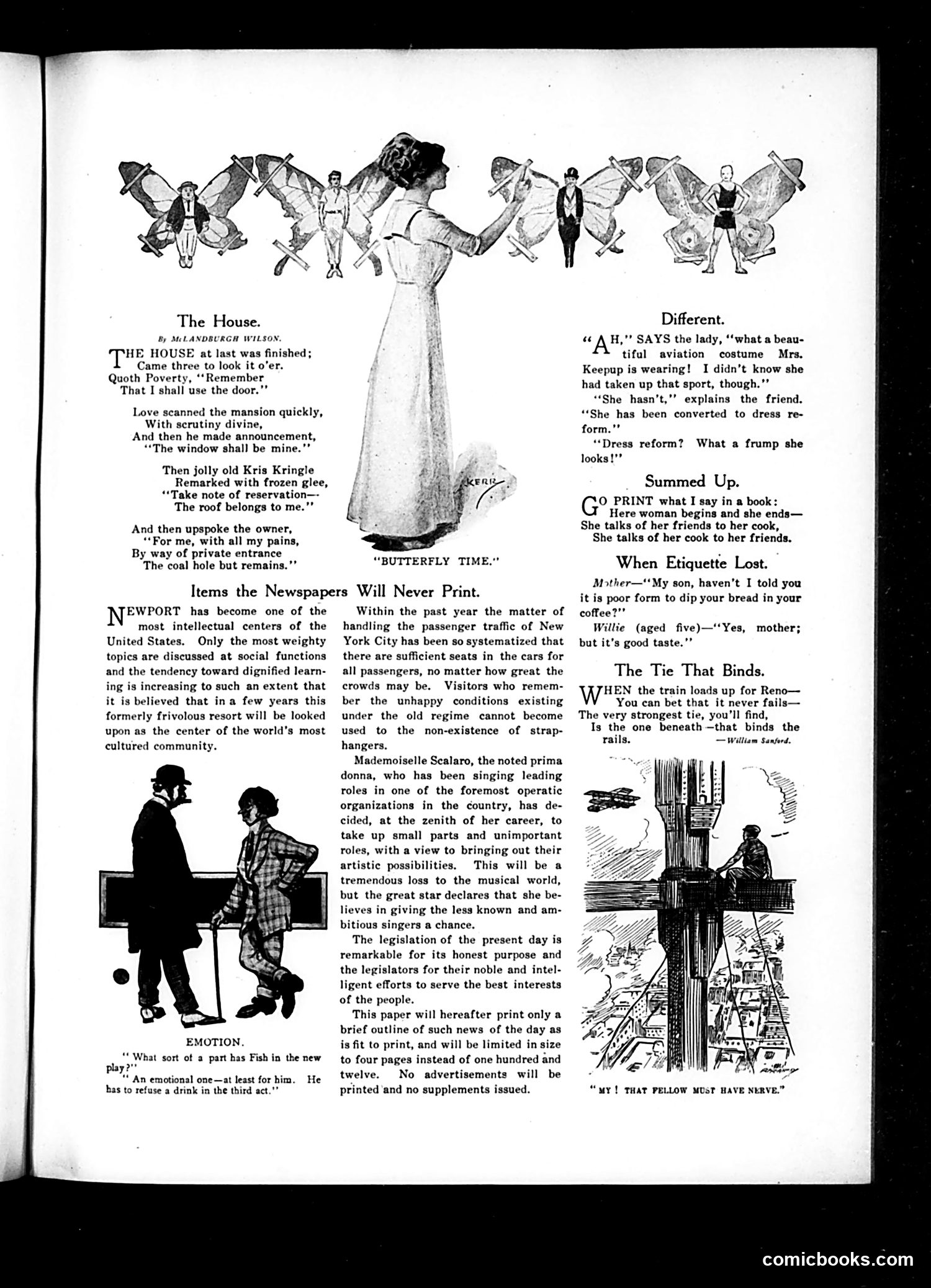
This page contains several satirical pieces mocking American social pretensions and hypocrisy circa early 1900s. **"The House"** poem depicts three abstract figures (Poverty, Love, and Santa Claus) claiming parts of a finished mansion, with the owner left only the coal hole—satirizing how life's hardships encroach on one's own home. **"Items the Newspapers Will Never Print"** is ironic fake-news section mocking Newport's claimed intellectual transformation, NYC's supposedly solved transit problems, and opera star Mademoiselle Scalaro's career shift. The final item sarcastically praises current legislators' honesty—all obviously false claims meant to highlight actual problems readers would recognize. **The shorter jokes** mock fashion ("aviation costume" as mere dress reform), feminine gossip networks, and "Reno" (Nevada divorce destination), suggesting marriage bonds dissolve easily. **"EMOTION"** jokes about a character refusing alcohol on stage—presented as surprisingly difficult acting. The page's satire targets wealthy social hypocrisy, municipal failures, and changing gender roles, using exaggeration and false praise to expose contemporary problems.
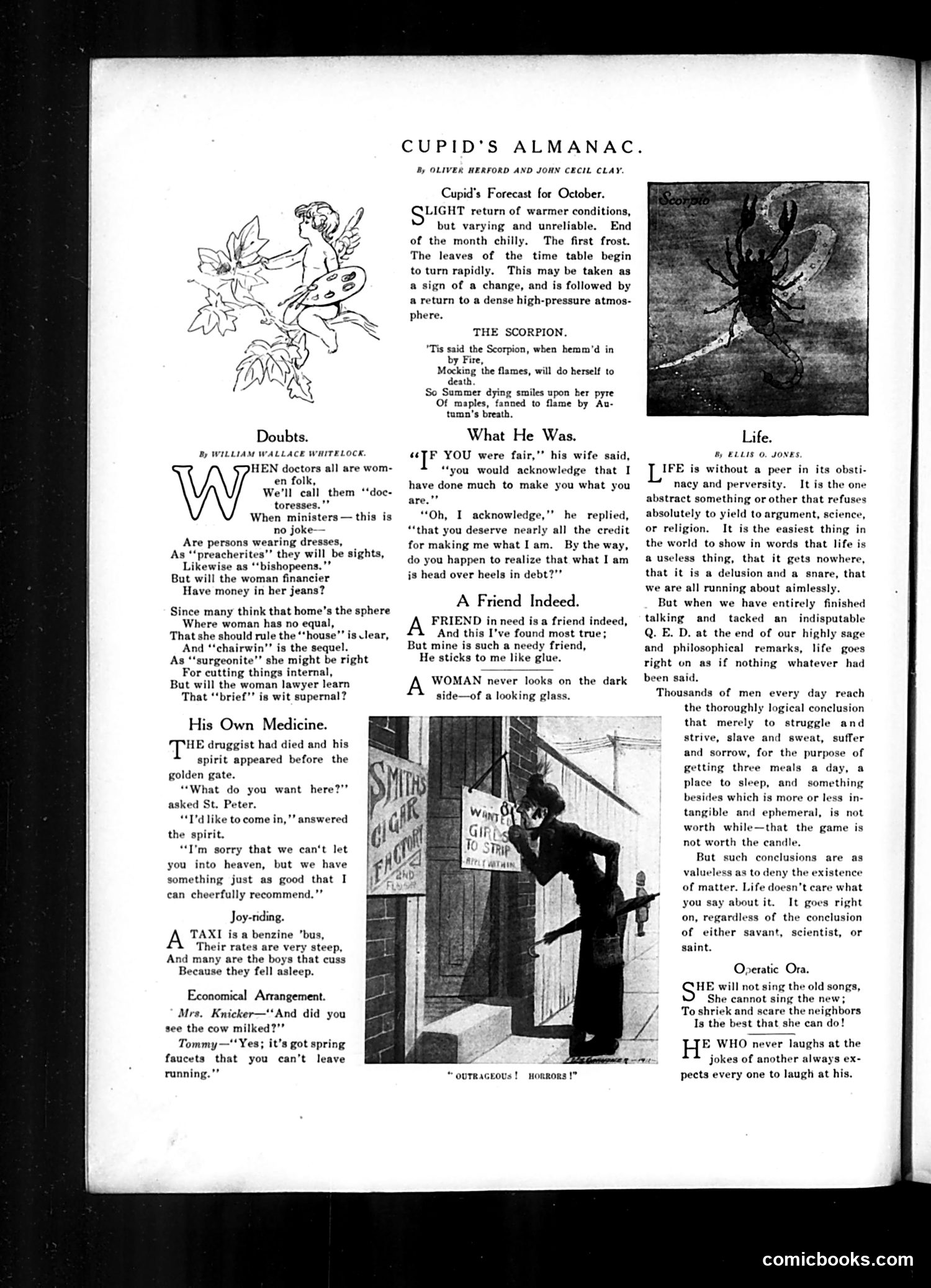
This Judge magazine page contains several satirical pieces mocking emerging social changes of the early 20th century, particularly women's expanding roles. **"Doubts"** by William Wallace Whitelock ridicules feminism through wordplay, questioning whether women can truly succeed in traditionally male professions. The humor derives from invented feminine job titles ("doctoresses," "preacherites," "bishopeens") and rhetorical questions implying women are unfit—notably, asking if a female financier will have "money in her jeans" (implying women lack financial credibility). **"His Own Medicine"** presents a darkly comic morality tale: a deceased druggist seeking heaven is denied entry but offered "something just as good"—hell itself, perhaps, suggesting pharmacists deserve damnation. The remaining brief pieces ("Joy-riding," "Economical Arrangement," the "Cupid's Almanac" section) are gentle observational humor about taxis, domestic servants, and seasonal romance. The overall page reflects Judge's conservative satirical stance opposing women's liberation, using humor to delegitimize feminist aspirations while maintaining plausible deniability through comedy.
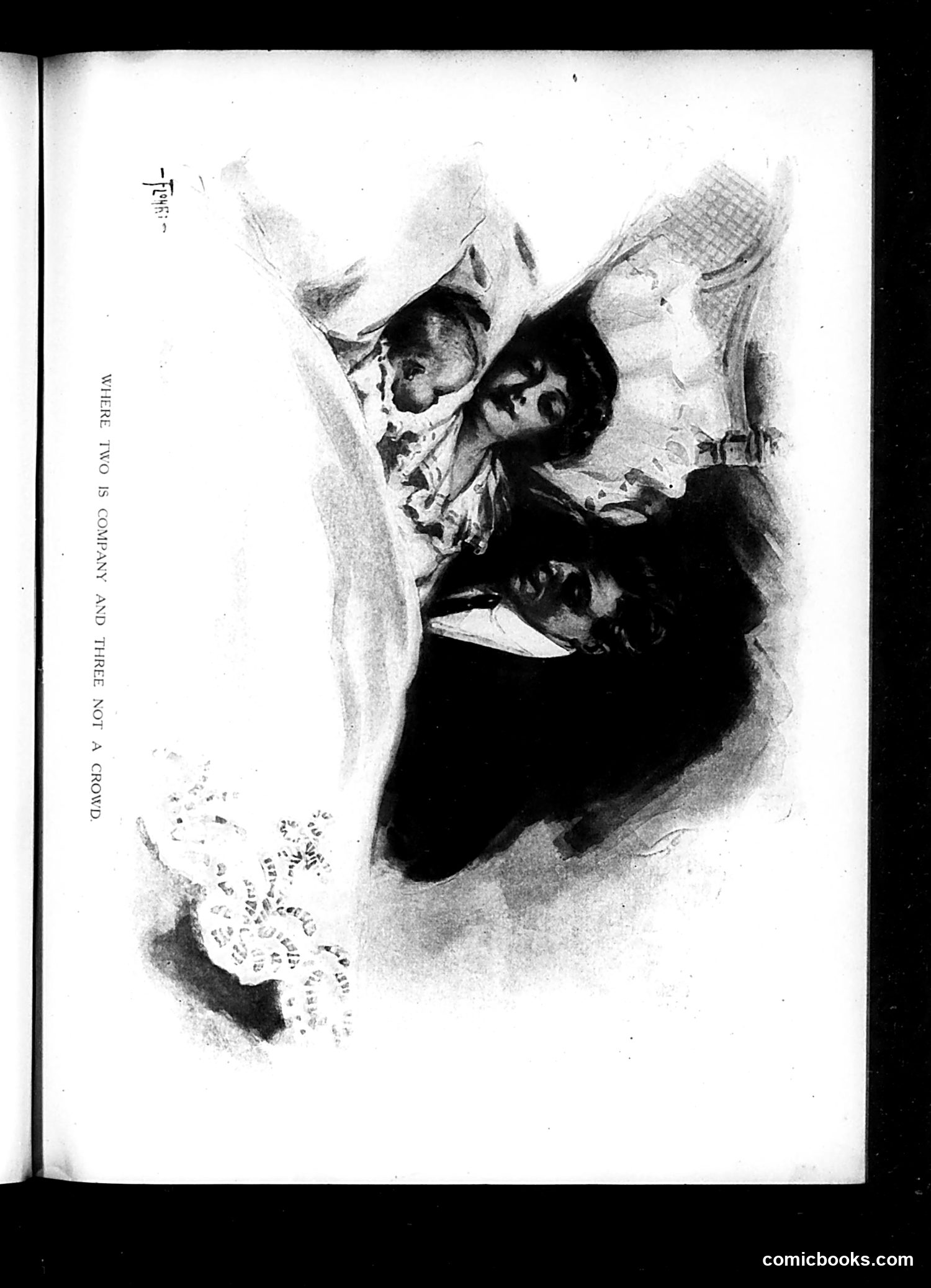
This appears to be a satirical illustration from *Judge* magazine showing two figures in an intimate or compromising position. The caption reads "WHERE TWO IS COMPANY AND THREE NOT A CROWD." The image depicts what seems to be a romantic or scandalous encounter between two people, with detailed period clothing visible (including elaborate hats and formal dress). The caption suggests commentary on propriety or discretion—implying that two people together is acceptable ("company"), while three would constitute gossip or exposure. Without clearer identification of the specific figures or a visible date, I cannot definitively identify who is being satirized. However, this appears to be social satire targeting either a specific scandal or broader commentary on Victorian-era moral hypocrisy and discretion in affairs of romance or politics.
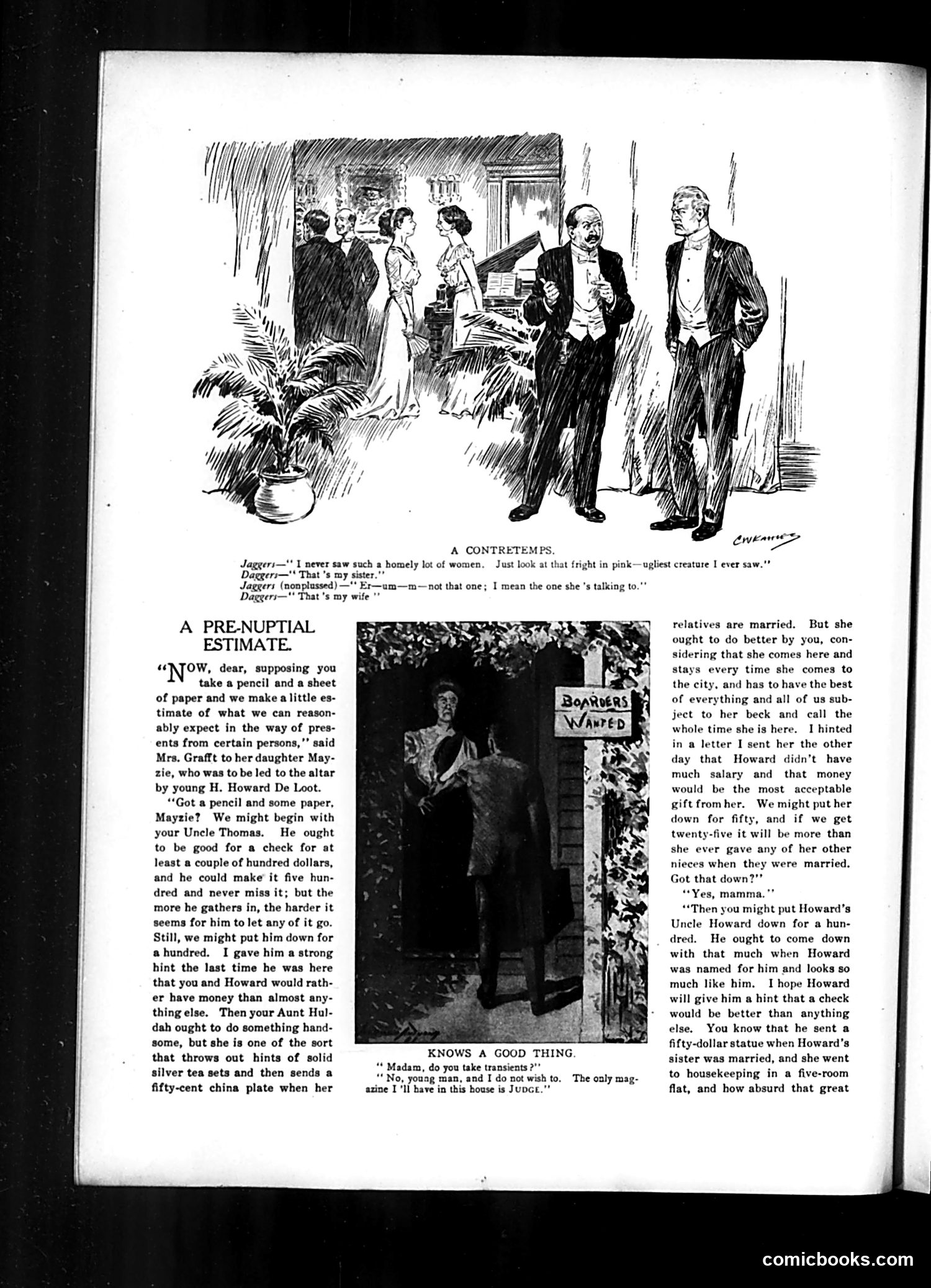
This page contains two distinct satirical pieces about money and marriage etiquette among the upper class. **"A Contretemps"** (top cartoon): A man insulting women at a formal gathering makes a social blunder when he derides "that fright in pink" as "the ugliest creature I ever saw"—only to learn she's the host's sister, then wife. The humor lies in his escalating embarrassment as each correction worsens the insult. **"A Pre-Nuptial Estimate"** (main story): Mother and daughter cynically calculate wedding gifts from relatives, not out of gratitude but as a financial strategy. They assign dollar amounts to family members based on past stinginess, hint broadly about monetary preferences, and grumble when relatives give thoughtless items (like a fifty-dollar statue) instead of cash. The satire mocks mercenary attitudes toward marriage gifts and the transparent gold-digging of the bride's family. Both pieces satirize Gilded Age social pretension and financial obsession among the wealthy.
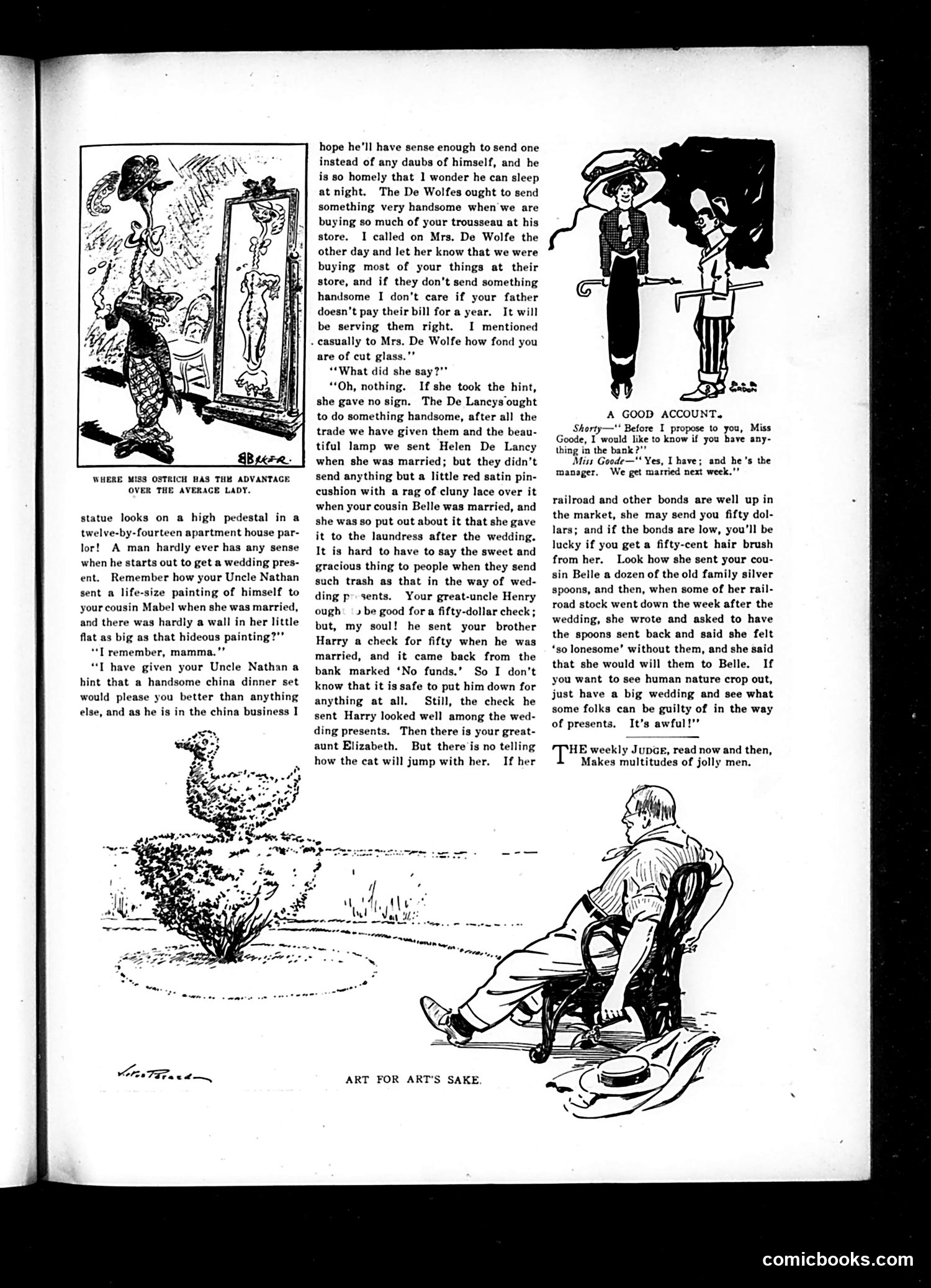
This page satirizes **wedding gift etiquette and social climbing** among the upper-middle class. The main text depicts a mother coaching her daughter on extracting expensive gifts from relatives before her wedding. She shamelessly manipulates gift-givers: hints to merchants about buying their trousseau elsewhere to pressure gifts, judges relatives' financial stability to predict gift amounts, and recalls past slights (the De Lancys' inadequate red satin pincushion). The satire exposes the hypocrisy of "sweet and gracious" wedding etiquette masking crude transactional behavior and social calculation. The cartoons support this theme: "Where Miss Ostrich Has the Advantage" jokes about ostriches burying their heads (avoiding awkward situations), while "A Good Account" presents a woman whose only "bank account" is marrying the bank manager—another swipe at mercenary matrimony. The final poem celebrates *Judge* magazine itself as spreading good cheer.
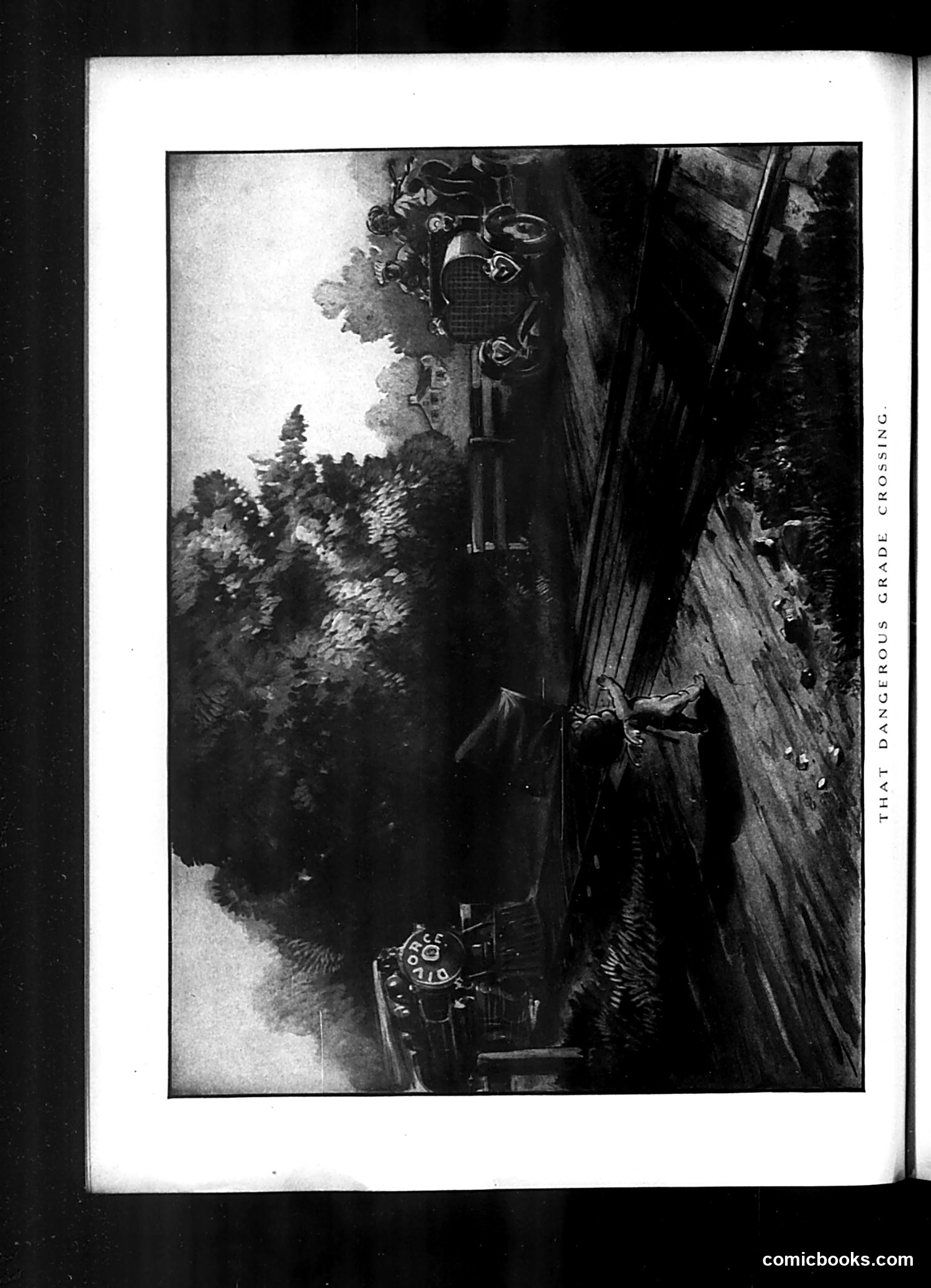
This page appears to be from *Judge* magazine and is titled "THAT DANGEROUS GRADE CROSSING" (visible on the right margin). The image shows a rotated/sideways photograph of a railroad scene with what appears to be a train on tracks and vegetation alongside. The caption indicates this is satirical commentary on railroad safety hazards, specifically dangerous grade crossings where trains and road traffic intersect. The "dangerous grade crossing" reference suggests the cartoon critiques inadequate safety measures or warnings at railroad intersections—a genuine public safety concern during the early 20th century when train accidents were common. However, the OCR text is largely illegible, preventing fuller interpretation of the specific satirical point or any political figures involved.
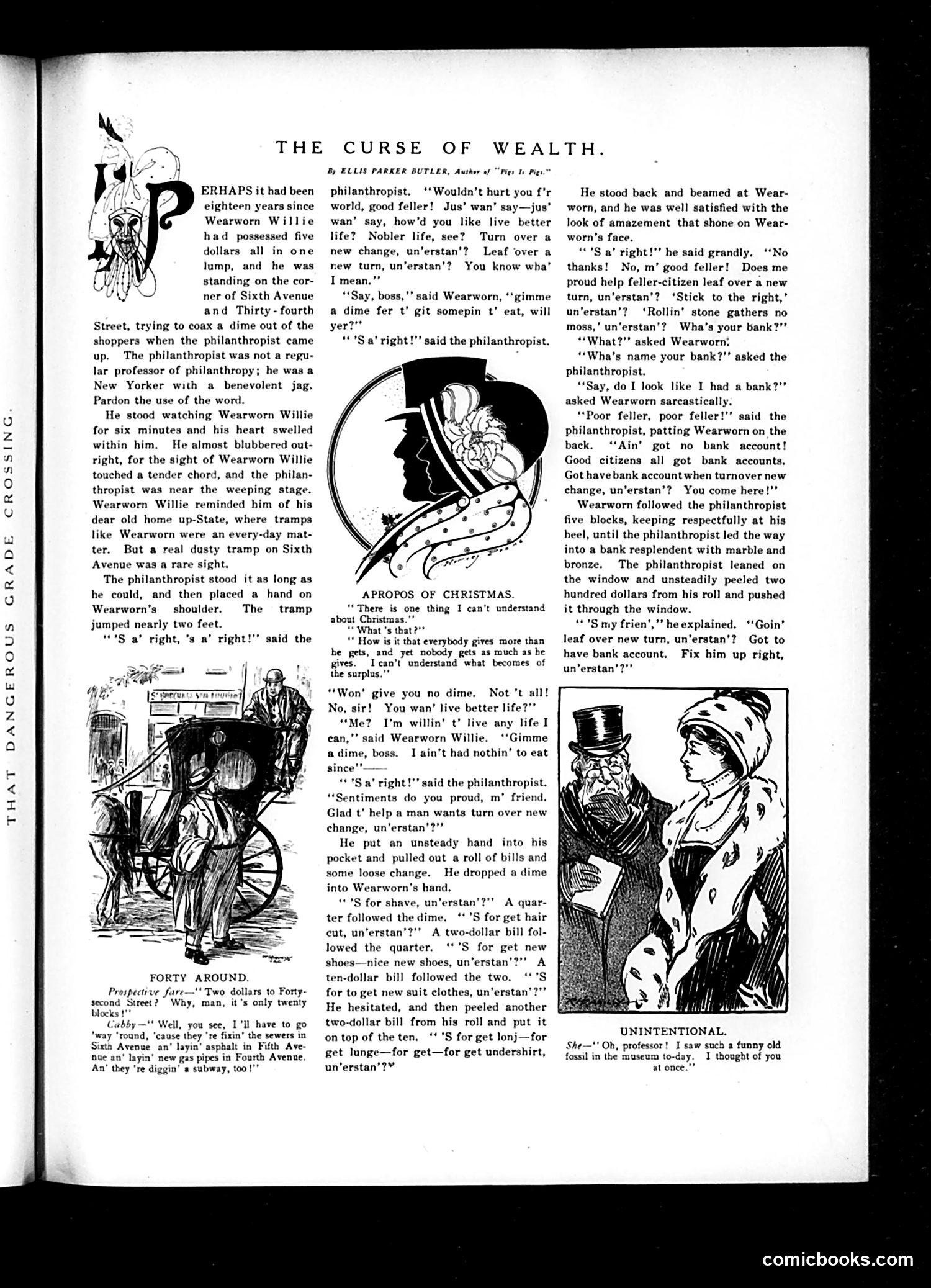
This story by Ellis Parker Butler satirizes sanctimonious, self-congratulatory charity. A wealthy man encounters "Wearworn Willie," a destitute beggar, and becomes emotionally moved—but refuses his simple request for a dime to buy food. Instead, the philanthropist lectures Willie about "turning over a new leaf" and "living a nobler life," then compulsively distributes escalating amounts of money ($0.10, $0.25, $2, $10, $2 more) for shaving, haircuts, shoes, and suits—items the philanthropist deems appropriate for self-improvement. The satire lies in the gap between the donor's self-righteous moralizing and his actual response: he's less interested in Willie's immediate hunger than in orchestrating a moral transformation that makes *himself* feel virtuous. The humor comes from Willie's bewilderment and the philanthropist's obliviousness—he even asks Willie's bank name, absurdly assuming a homeless man has banking accounts. The title "The Curse of Wealth" suggests that money, without wisdom or genuine compassion, becomes a vehicle for self-aggrandizement rather than authentic help.
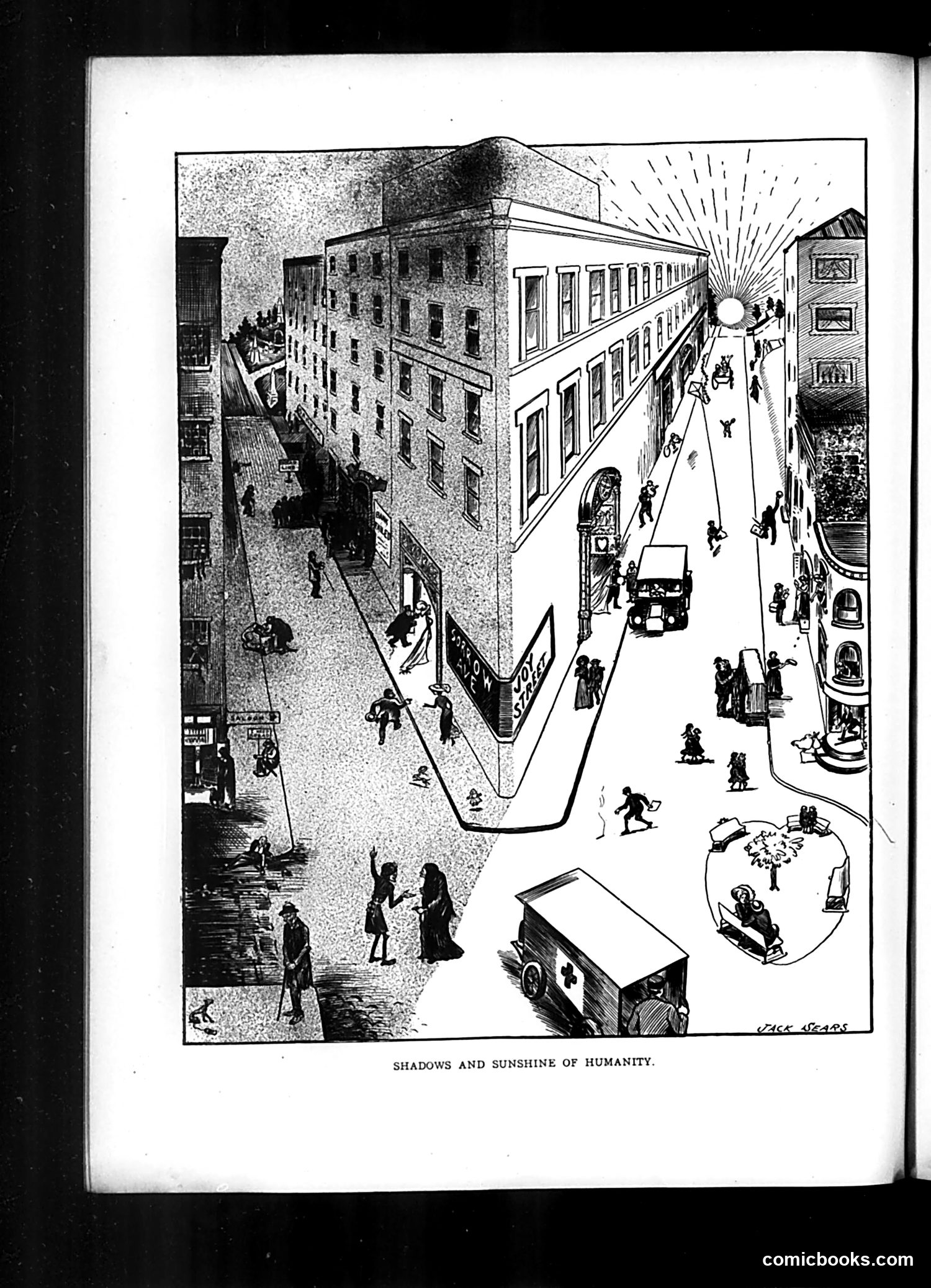
This satirical illustration contrasts urban poverty with prosperity in a single cityscape. On the left, dark, densely-packed tenement buildings cast deep shadows, depicting crowded, impoverished neighborhoods where people struggle in cramped conditions. On the right, a bright, sunlit street shows wealth and leisure—well-dressed figures stroll past shops, children play in parks, and an ambulance serves the healthy community. The cartoon critiques economic inequality in industrial cities, suggesting that poverty and wealth exist side-by-side, separated by literal light and shadow. This reflects early 20th-century Progressive Era concerns about slum conditions versus gilded-age affluence. The visual metaphor—literal sunshine illuminating the wealthy while shadows engulf the poor—emphasizes how fortune divides urban populations, likely advocating for social reform to illuminate conditions in tenement districts.
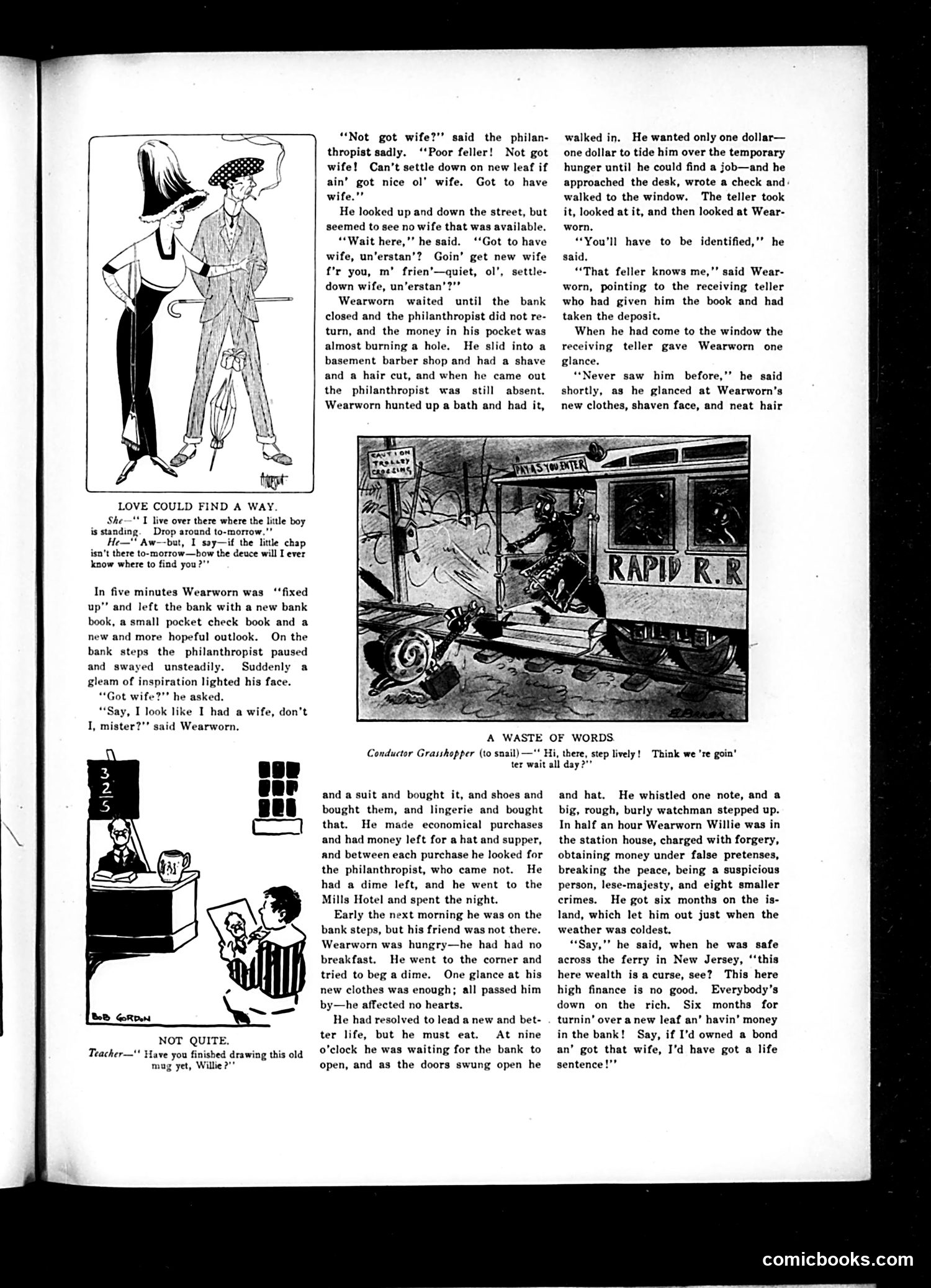
This page contains two satirical stories mocking American social hypocrisy and class prejudice. **"Love Could Find a Way"** ridicules wealthy philanthropists' condescending charity. A well-meaning rich man gives a destitute man money specifically to find a "wife" (viewing marriage as moral reform). The man uses the money to improve himself—bathing, buying new clothes and food. However, once respectable-looking, no one recognizes him. When he tries to cash a check at the bank, the teller who gave him the original deposit refuses to identify him because his new appearance makes him unrecognizable. He's arrested for forgery and forged checks, receiving six months imprisonment. **The satire's point**: Society judges people by appearance alone. The poor man's attempt at self-improvement—enabled by charity—ironically destroys his credibility. The system punishes the poor regardless of their actions; the man concludes bitterly that owning bonds would have gotten him better treatment than honest effort. **"A Waste of Words"** (bottom) offers a brief joke about a conductor rushing passengers.
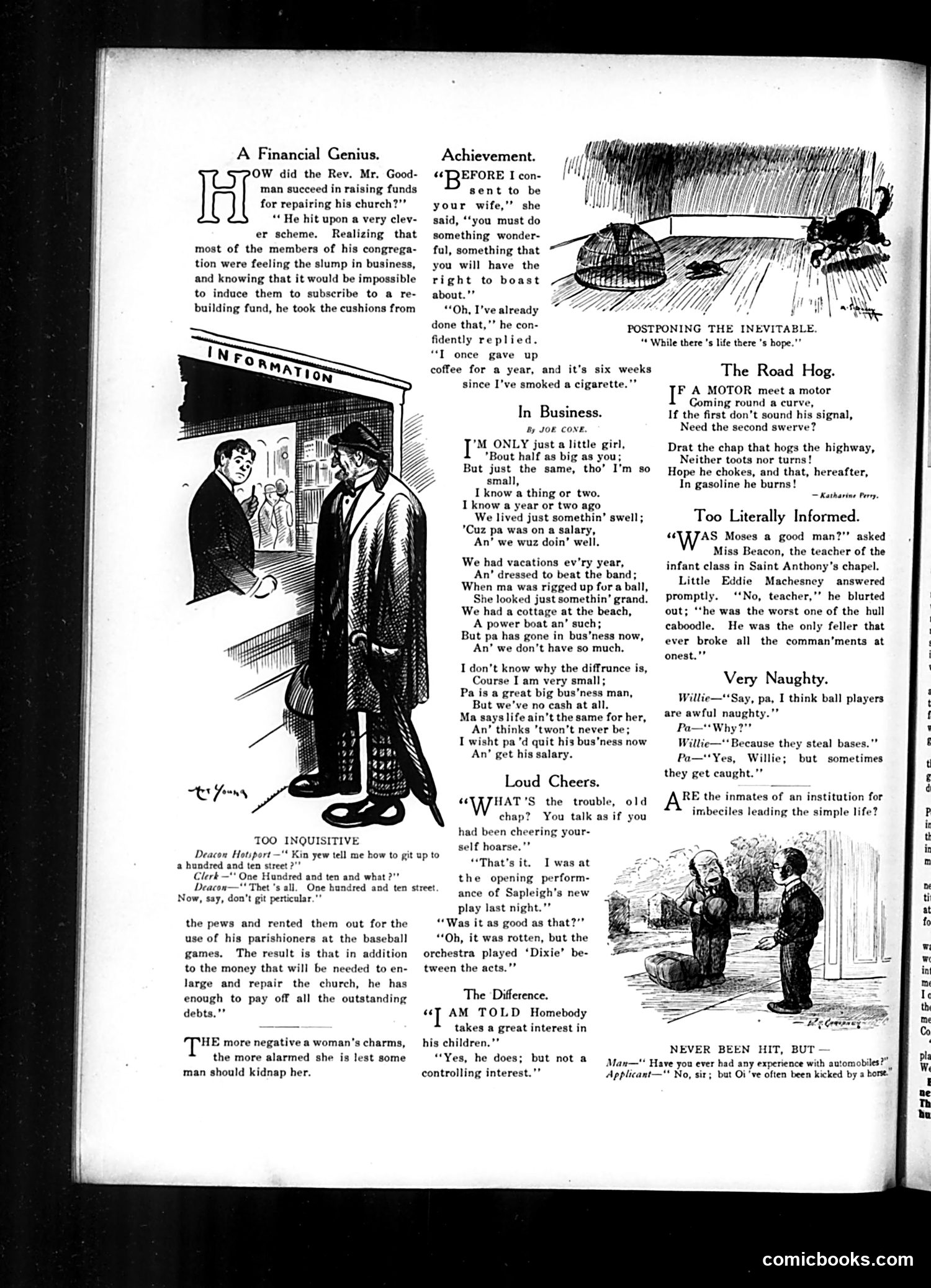
This page contains multiple short humorous pieces typical of Judge magazine's satirical style: **"A Financial Genius"** mocks clergy fundraising by depicting a pastor renting church pew cushions to parishioners attending baseball games—a clever but undignified scheme that satirizes both the financial desperation of the era and the tension between religious institutions and secular entertainment. **"In Business"** by Joe Cone presents a child's-eye view of economic decline, contrasting her family's former comfortable life (salary, vacations, cottage) with their current poverty after her father entered business. The satire targets either business instability or the false promise that entrepreneurship brings wealth. **"Too Inquisitive"** and various other brief jokes mock pedestrian social awkwardness and literal-minded interpretation. **The cartoons** (particularly "The Road Hog") target dangerous automobile drivers, while child-focused pieces humorously capture innocent misunderstandings and youthful bluntness. The overall tone reflects early 20th-century American anxieties about urban life, automobiles, economic security, and changing social values.
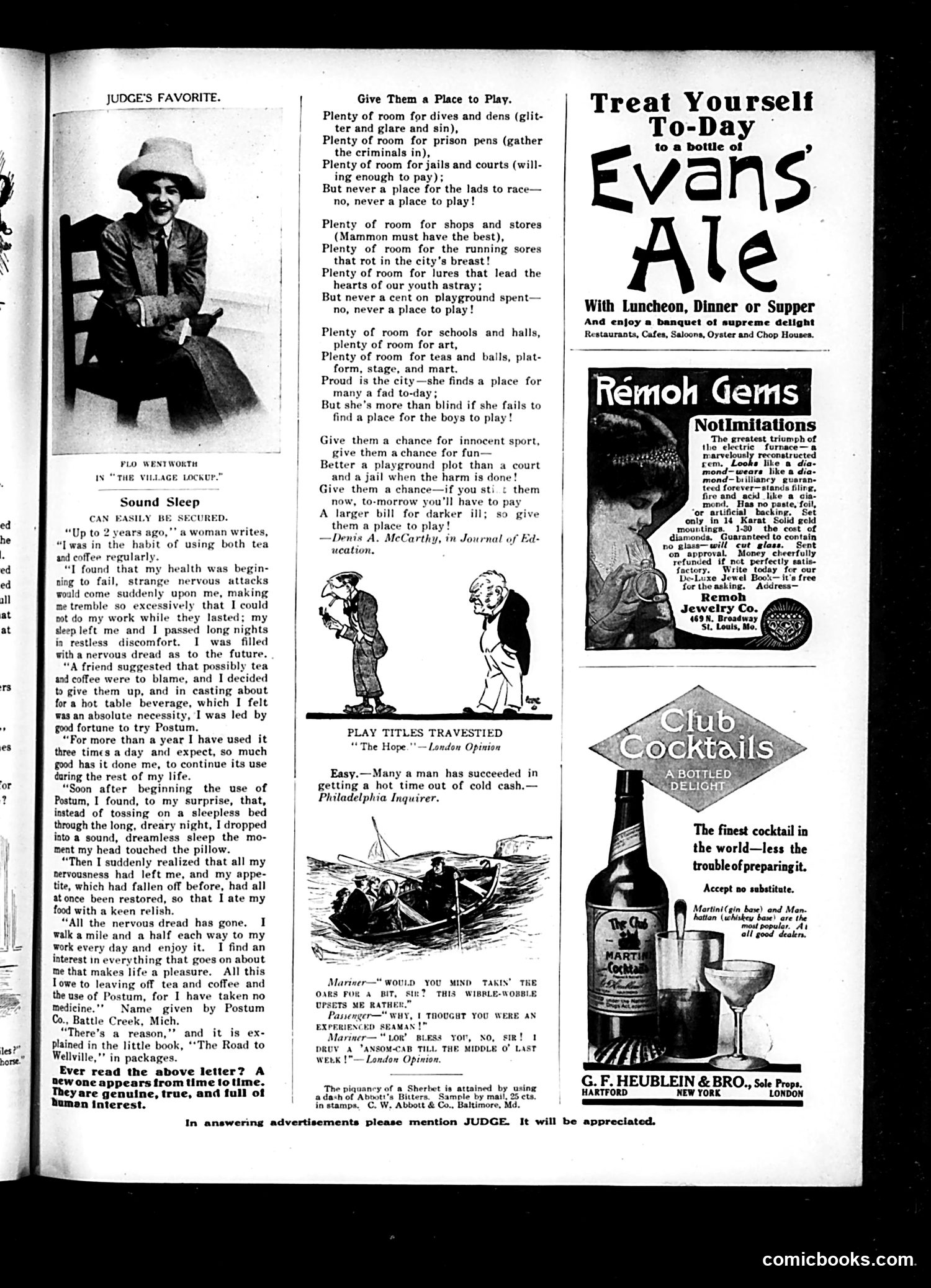
This page mixes editorial content with advertising, typical of early 20th-century American magazines. **Main Editorial Content:** - "Judge's Favorite" features actor Flo Wentworth in "The Village Lockup" - "Sound Sleep" is a testimonial letter (likely fictional, as was common) promoting Postum, a caffeine-free coffee substitute, claiming it cured the writer's nervousness and insomnia - "Give Them a Place to Play" is a poem by Denis A. McCarthy advocating for public playgrounds for children, criticizing cities that fund jails and shops but neglect recreational spaces for youth **Cartoons & Humor:** - "Play Titles Travestied" offers one-liner jokes about theater titles - A naval joke depicts a seasick sailor revealed to be a former taxi driver **Advertisements:** The page includes ads for Evans Ale, Remoh Gems (jewelry), and Club Cocktails. The overall tone reflects Progressive Era concerns about urban poverty, youth welfare, and public health—themes Judge regularly addressed alongside lighthearted satire.
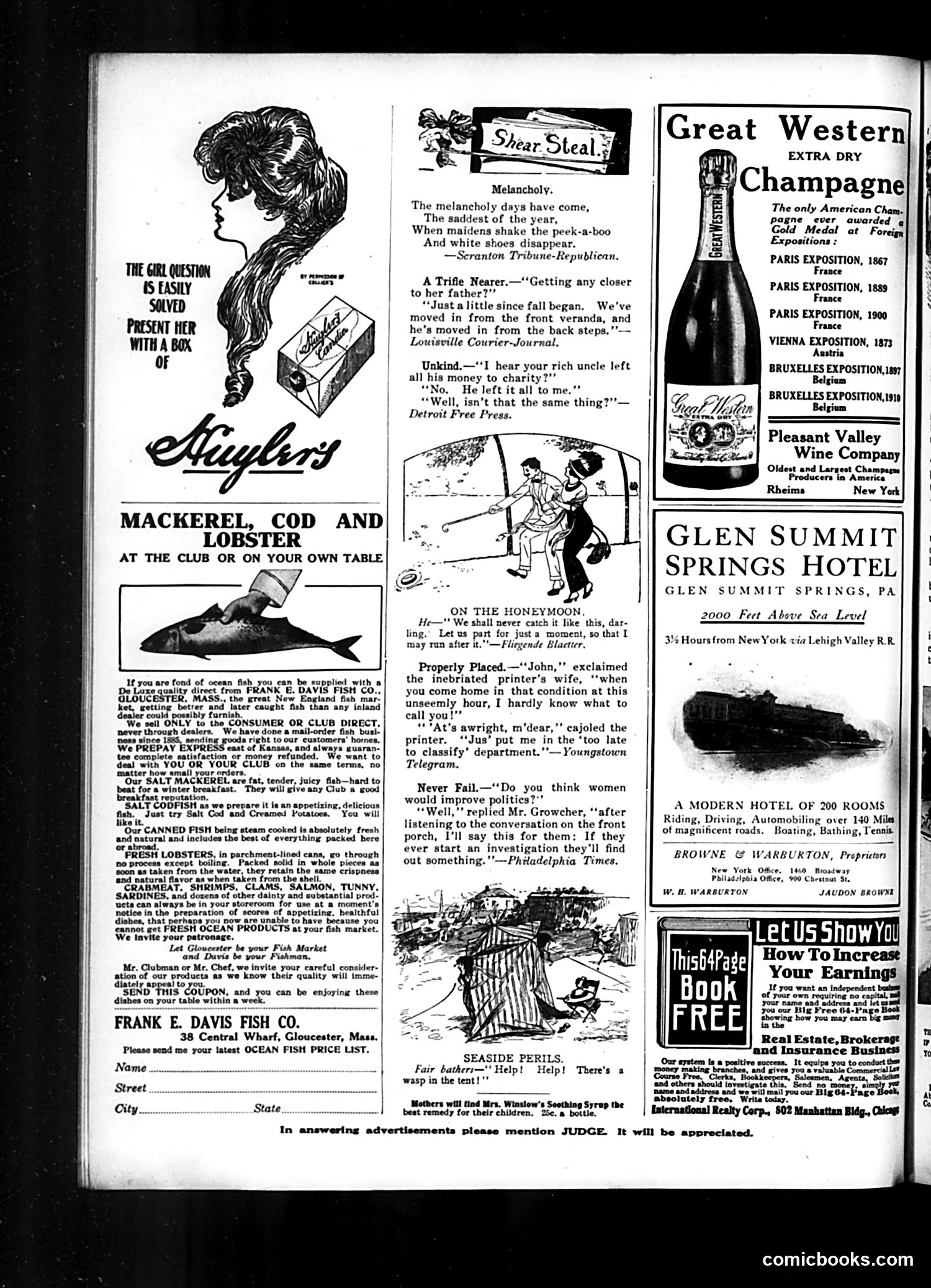
This page from Judge magazine is primarily an **advertising and content miscellany** rather than a focused political cartoon. The page contains several brief, light-hearted jokes and humorous anecdotes about courtship and domestic life—none with clear political content. Examples include quips about autumn romance ("Melancholy") and a honeymoon scene. The bulk of the page features **commercial advertisements**: Frank E. Davis Fish Co. promoting mackerel, cod, and lobster; Great Western Extra Dry Champagne listing Paris and Vienna exposition medals; Glen Summit Springs Hotel advertising a Pennsylvania resort; and real estate/brokerage services. There are small **cartoon vignettes** illustrating the jokes, but they depict generic domestic scenes without identifiable public figures or specific political targets. The humor is domestic and social rather than satirical of contemporary events or politics. In context, this appears to be a typical late-19th/early-20th-century magazine page mixing entertainment with revenue-generating advertisements.
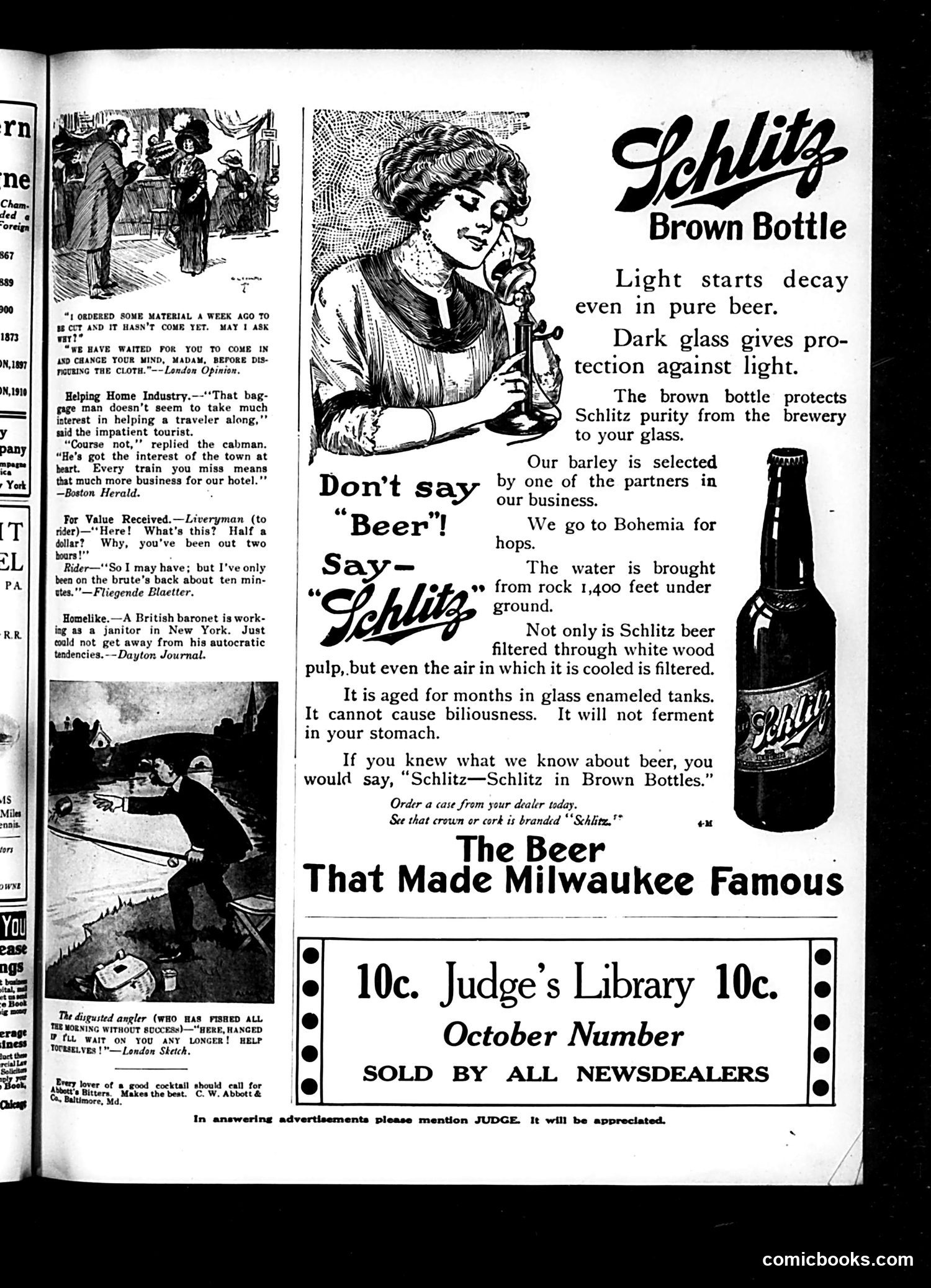
This page combines vintage humor cartoons with a Schlitz beer advertisement. The top cartoons mock everyday frustrations: 1. **"I Ordered Some Material"**: A customer complains about delayed merchandise; the clerk suggests she's been indecisive, implying women change their minds constantly—a period stereotype. 2. **"Helping Home Industry"**: A cabman admits he *profits* when travelers miss trains, sarcastically suggesting self-interest masquerades as civic duty. 3. **"For Value Received"** and **"Homelike"**: Brief jokes about overcharging and a snobbish British servant unable to shed aristocratic pretension. The dominant content is Schlitz's advertisement emphasizing purity—brown bottles protect beer from light decay, water comes from deep underground, and the brewing process involves extensive filtration. This reflects early 1900s marketing emphasizing scientific cleanliness and ingredient sourcing as selling points. The tagline "The Beer That Made Milwaukee Famous" reinforces Milwaukee's dominance in American brewing at that time.
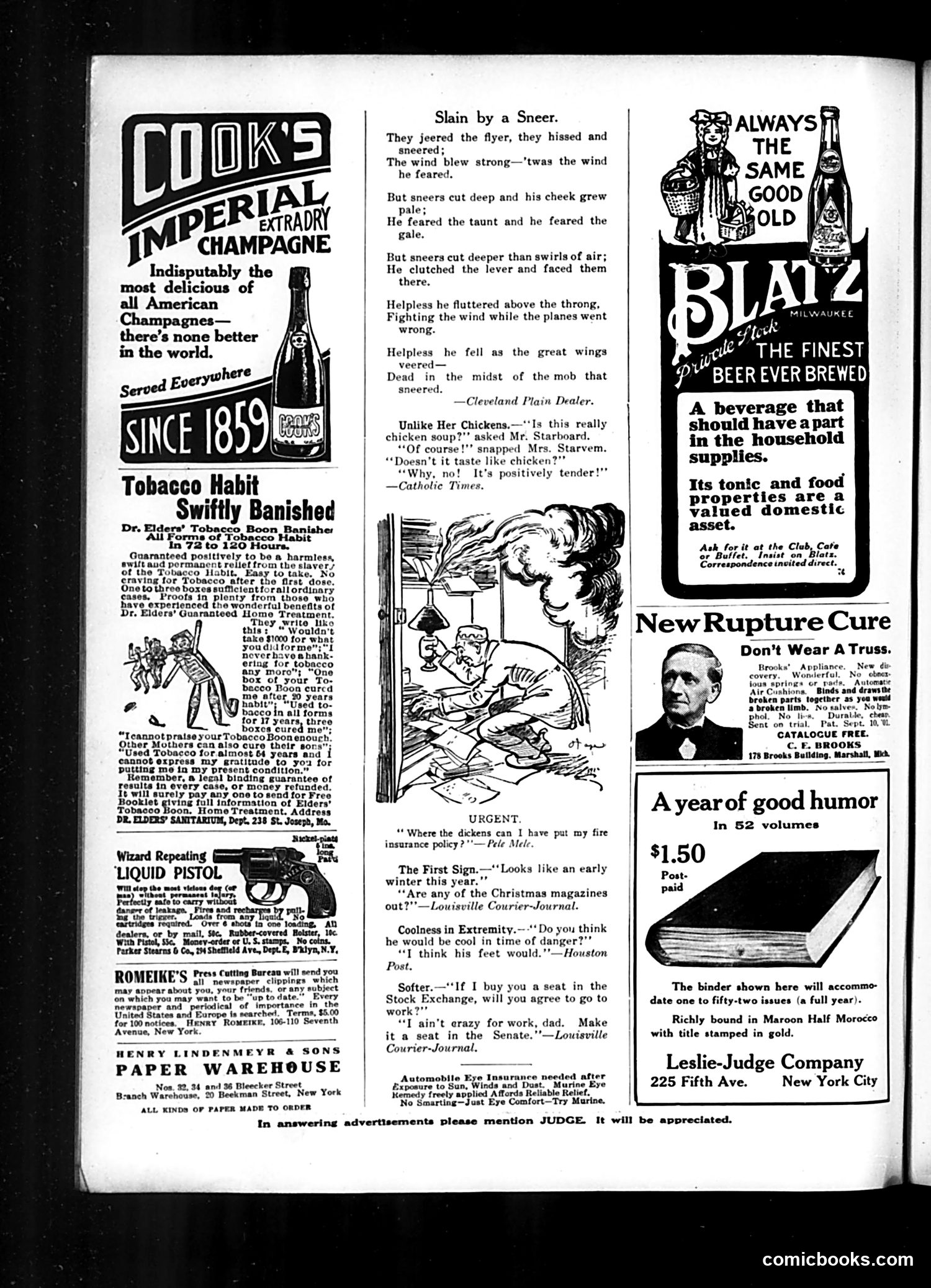
This page from *Judge* magazine is primarily **advertising with some humor content**. The main elements: **Center cartoon**: "Slain by a Sneer" depicts an early aviation accident—a pilot loses control during flight after being mocked by a crowd. The accompanying poem emphasizes that ridicule and jeers wounded him more than the actual wind and mechanical failure. This reflects early-1900s anxieties about aviation's dangers and the social pressures on pioneers. **Left ads**: Promote dubious patent medicines—a tobacco-cessation treatment and a toy "liquid pistol"—typical of the era's unregulated medical claims. **Right ads**: Feature beer (Blatz) and champagne, positioned as respectable household staples; also a "rupture cure" (hernia treatment) and a humor anthology. **Bottom humor**: Brief joke snippets about chicken soup, winter forecasts, and stock exchange humor—light social commentary on domestic life and financial markets. The page reflects early-1900s consumer culture, aviation novelty, and dubious medical/patent product marketing.
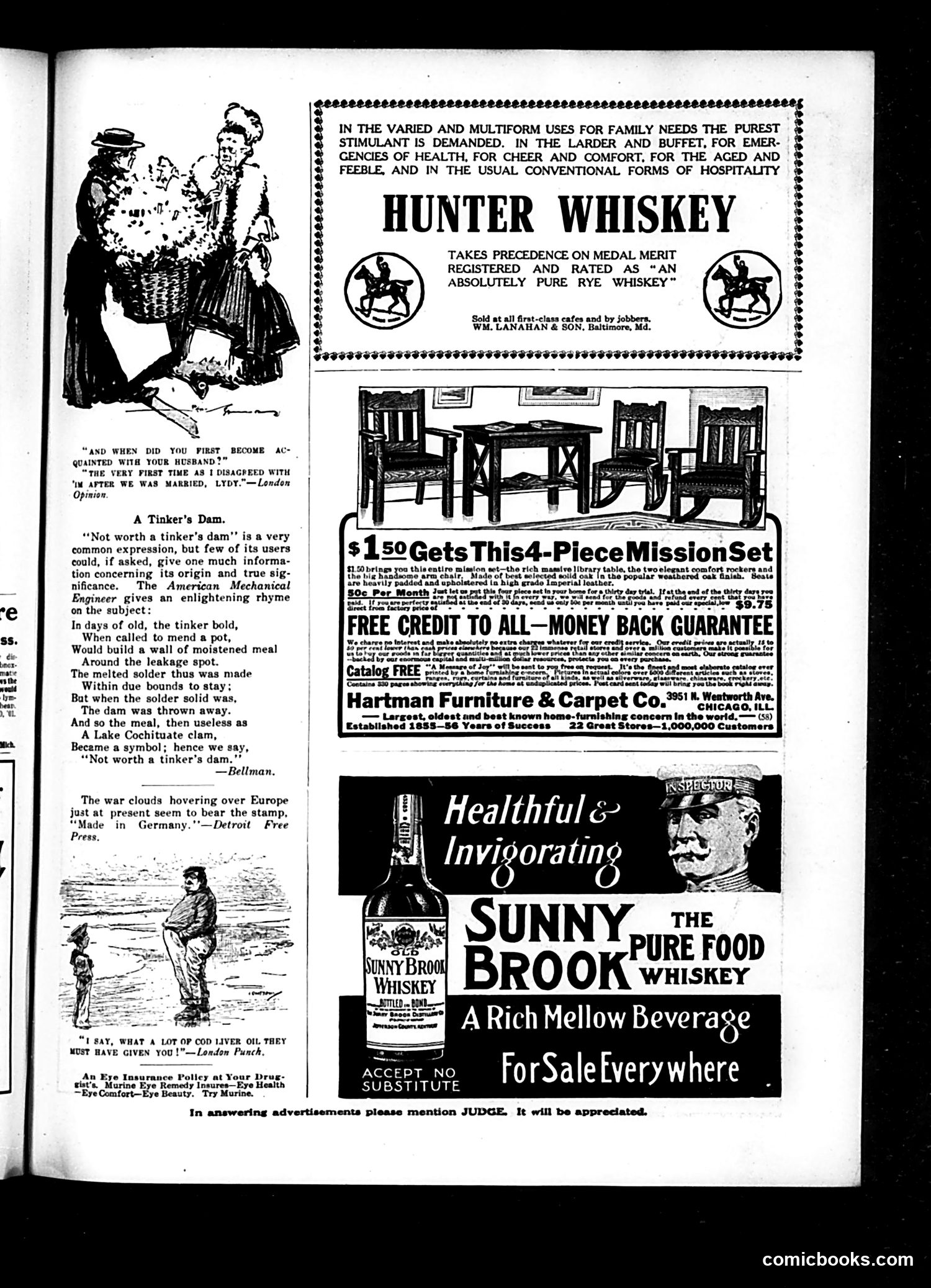
This page contains primarily **advertising and filler content** rather than political satire. The two small cartoon jokes at top left are generic domestic humor: one depicts a newlywed couple where the wife claims she "first became acquainted" with her husband when they disagreed after marriage—a dig at marital discord. Below that is "A Tinker's Dam," an explanatory verse about the origin of the phrase "not worth a tinker's dam," tracing it to medieval tinkers who used temporary meal dams when soldering. The bulk of the page is **whiskey and furniture advertisements**—Hunter Whiskey, Sunny Brook Whiskey, and Hartman Furniture's "$1.50 gets this 4-piece mission set" offer with payment plans. These ads emphasize whiskey as a health stimulant and household necessity, reflecting early 20th-century attitudes toward alcohol. A brief editorial note references war clouds "made in Germany," likely referencing pre-WWI tensions, but provides no developed commentary. The page reflects Judge's commercial nature more than its satirical purpose.
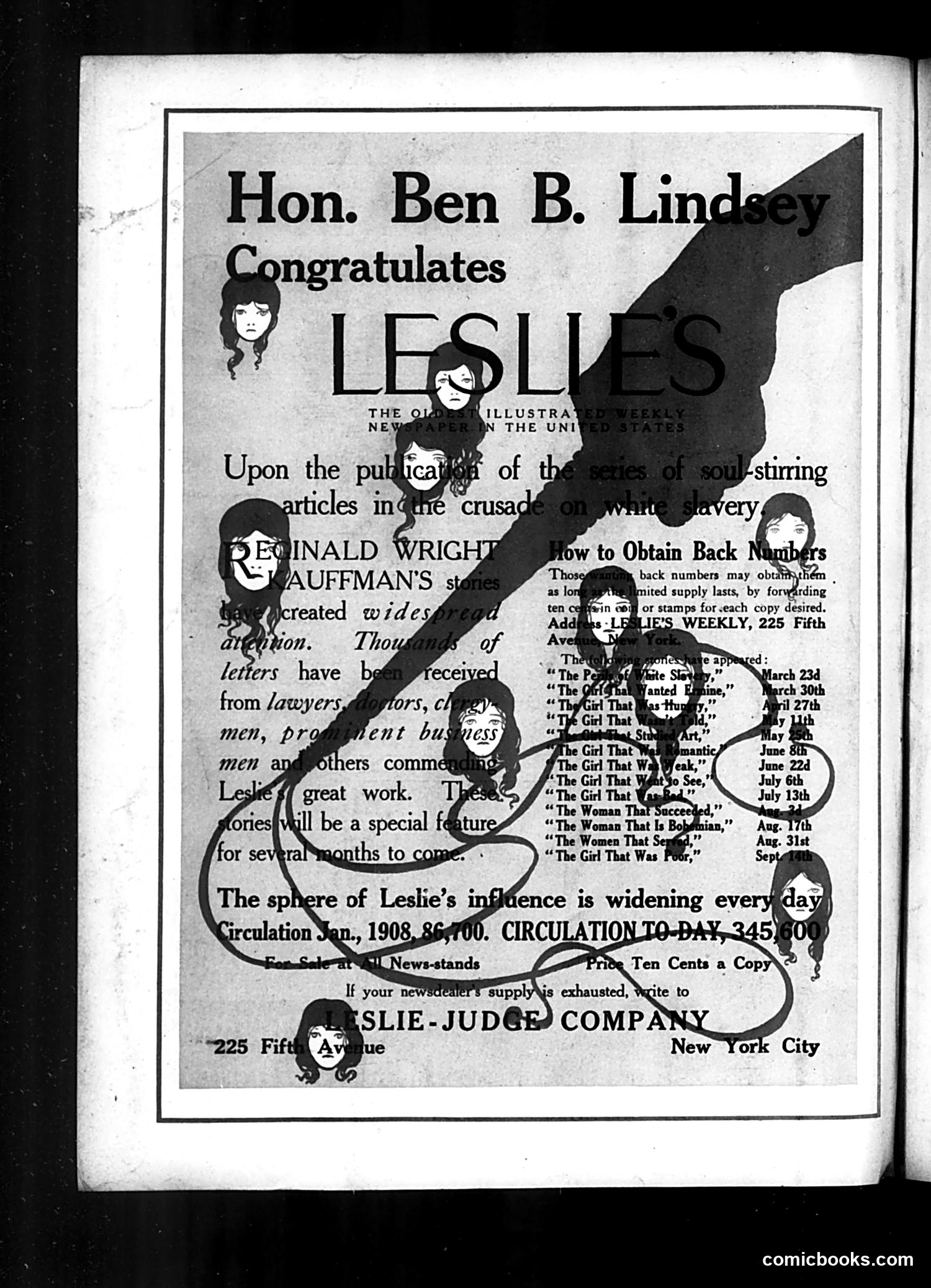
This is primarily a **full-page advertisement**, not a political cartoon. It's a promotional piece for *Leslie's Weekly*, a major illustrated newspaper, congratulating itself on publishing anti-slavery articles by Reginald Wright Kauffman. The ad claims the series generated widespread praise from "lawyers, doctors, clergymen, prominent businessmen" and others, positioning the publication as a crusader against social injustice. The decorative illustrations of women's faces frame the text. The circulation figures (Jan. 1908: 86,100; current: 345,800) emphasize the magazine's growing reach and influence. This appears designed to appeal to readers' sense of supporting reform while boosting the publication's prestige and sales.