
Judge, 1911-10-07 · page 15 of 24
Judge — October 7, 1911 — page 15: what you’re looking at
What you’re looking at
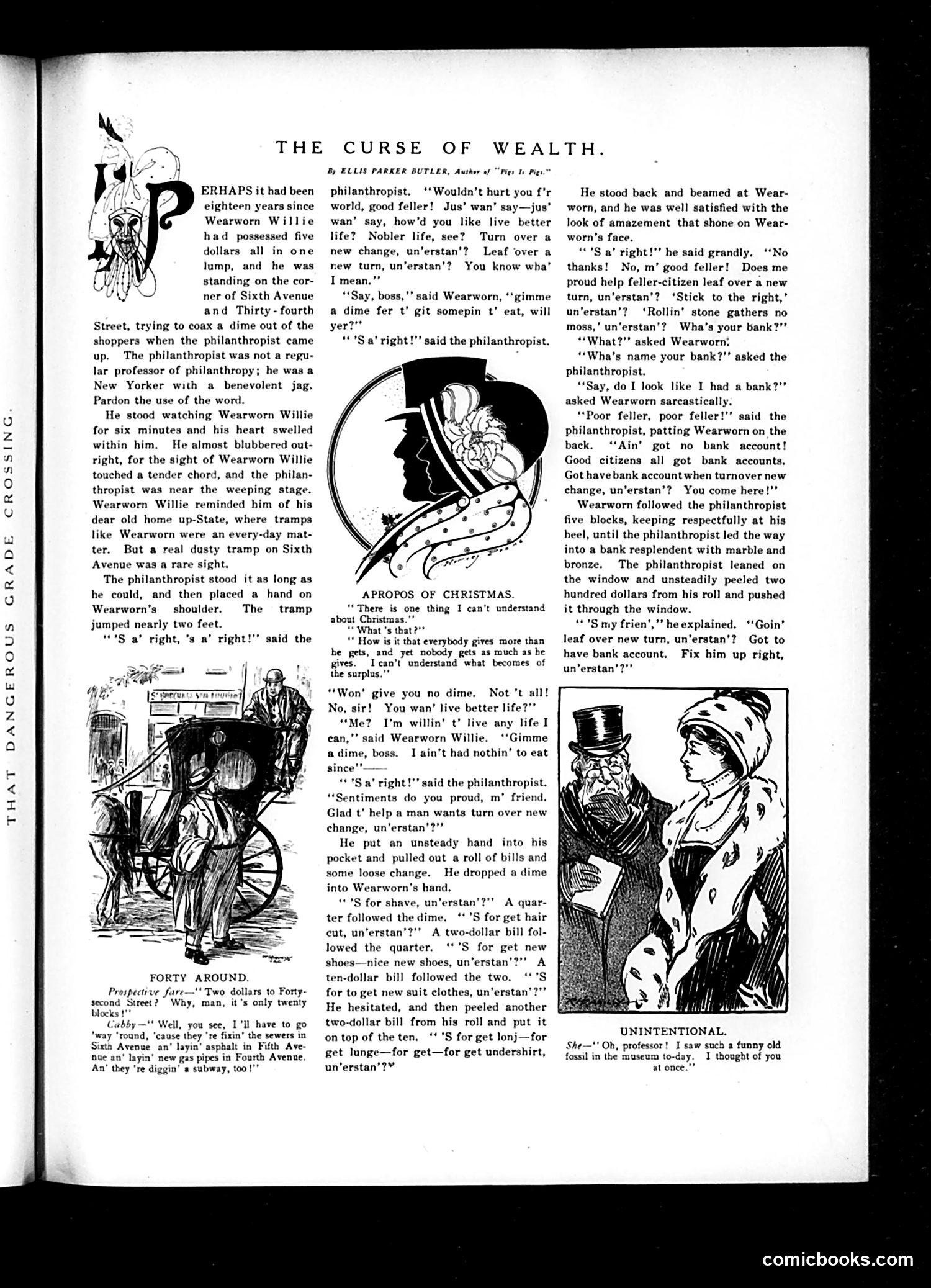
This story by Ellis Parker Butler satirizes sanctimonious, self-congratulatory charity. A wealthy man encounters "Wearworn Willie," a destitute beggar, and becomes emotionally moved—but refuses his simple request for a dime to buy food. Instead, the philanthropist lectures Willie about "turning over a new leaf" and "living a nobler life," then compulsively distributes escalating amounts of money ($0.10, $0.25, $2, $10, $2 more) for shaving, haircuts, shoes, and suits—items the philanthropist deems appropriate for self-improvement. The satire lies in the gap between the donor's self-righteous moralizing and his actual response: he's less interested in Willie's immediate hunger than in orchestrating a moral transformation that makes *himself* feel virtuous. The humor comes from Willie's bewilderment and the philanthropist's obliviousness—he even asks Willie's bank name, absurdly assuming a homeless man has banking accounts. The title "The Curse of Wealth" suggests that money, without wisdom or genuine compassion, becomes a vehicle for self-aggrandizement rather than authentic help.
📄 Transcribed text from this page (OCR, searchable)
Machine-transcribed from the original scan — historical spelling and the odd misread are preserved.
CROSSING. GRADE n 5 ° 4 w e} Zz < a THAT THE CURSE OF WEALTH. ERHAPS it had been eighteen years since Wearworn Willie had possessed five dollars all in one lump, and he was standing on the cor- ner of Sixth Avenue and Thirty- fourth Street, trying to coax a dime out of the shoppers when the philanthropist came up. The philanthropist was not a regu- lar professor of philanthropy; he was a New Yorker with a benevolent jag. Pardon the use of the word. He stood watching Wearworn Willie for six minutes and his heart swelled within him, He almost blubbered out- right, for the sight of Wearworn Willie touched a tender chord, and the philan- thropist was near the weeping stage. Wearworn Willie reminded him of his dear old home up-State, where tramps like Wearworn were an every-day mat- ter. But a real dusty tramp on Sixth Avenue was a rare sight. The philanthropist stood it as long as he could, and then placed a hand on Wearworn’s shoulder. The tramp jumped nearly two feet. “'S a’ right, 's a’ right!'’ said the FORTY AROUND. Prospective fare—'' Two dollars to Forty- second Street?” Why, man, it’s only twenty locks !"" Cabby —"" Well, you see, I'll have to go ‘way ‘round, ‘cause they ‘re fixin’ the sewers in Sixth Avenue an’ layin’ asphalt in Fifth Ave- nue an’ layin’ new gas pipes in Fourth Avenue. An’ they ‘re diggin’ a subway, too!"” By ELLIS PARKER BUTLER, Author of “Pies Ii Pits.” philanthropist. ‘Wouldn’t hurt you f’r world, good feller! Jus’ wan’ say—jus’ wan’ say, how'd you like live better life? Nobler life, see? Turn over a new change, un’erstan’? Leaf ‘over a new turn, un’erstan’? You know wha’ I mean.” “Say, boss,"’ said Wearworn, ‘‘gimme a dime fer t’ git somepin t’ eat, will yer?”’ “*"S a’ right!’ said the philanthropist. APROPOS OF CHRISTMAS. “There is one thing I can't understand about Christmas."’ “What 's that ?"* “ How is it that everybody gives more than he gets, and yet nobody gets as much as he gives. Ican't understand what becomes of the surplus.” Won’ give you no dime. Not 't all! No, sir! You wan’ live better life?’’ ‘Me? I'm willin’ t’ live any life I can,’’ said Wearworn Willie. ‘‘Gimme adime, boss. I ain’t had nothin’ to eat since’’ “*’S a’ right!’’ said the philanthropist. ntiments do you proud, m’ friend. Glad t’ help a man wants turn over new change, un'erstan’?’” He put an unsteady hand into his pocket and pulled out a roll of bills and some loose change. He dropped a dime into Wearworn's hand. “*"S for shave, un’erstan’?’’ A quar- ter followed the dime, ‘*’S for get hair cut, un’erstan’?"’ A two-dollar bill fol- lowed the quarter. ‘‘’S for get new shoes—nice new shoes, un’erstan’?’’ A ten-dollar bill followed the two. ‘*’S for to get new suit clothes, un’erstan’?”’ He hesitated, and then peeled another two-dollar bill from his roll and put it on top of the ten. ‘*'S for get lonj—for get lunge—for get—for get undershirt, un’erstan’?” He stood back and beamed at Wear- worn, and he was well satisfied with the look of amazement that shone on Wear- worn’s face. “'S a’ right!’ he said grandly. ‘‘No thanks! No, m’ good feller! Does me proud help feller-citizen leaf over a new turn, un’erstan’? ‘Stick to the right,’ un’erstan’? ‘Rollin’ stone gathers no moss,’ un’erstan’? Wha’s your bank?’’ “*What?”’ asked Wearworn: “‘Wha’s name your bank?”’ asked the philanthropist. “Say, do I look like I had a bank?’ asked Wearworn sarcastically. “Poor feller, poor feller!’’ said the philanthropist, patting Wearworn on the back. ‘‘Ain’ got no bank account! Good citizens all got bank accounts. Got have bank account when turnover new change, un’erstan’? You come here!’’ Wearworn followed the philanthropist five blocks, keeping respectfully at his , until the philanthropist led the way into a bank resplendent with marble and bronze. The philanthropist leaned on the window and unsteadily peeled two hundred dollars from his roll and pushed it through the window. ““'S my frien’,’’ he explained. ‘Goin’ leaf over new turn, un’erstan’? Got to have bank account. Fix him up right, un’erstan’?"" UNINTENTIONAL. She—"" Oh, professor! I saw such a funny old fossil in the museum to-day. I thought of you at once,"" comicbooks.com