
Judge, 1911-10-07 · page 12 of 24
Judge — October 7, 1911 — page 12: what you’re looking at
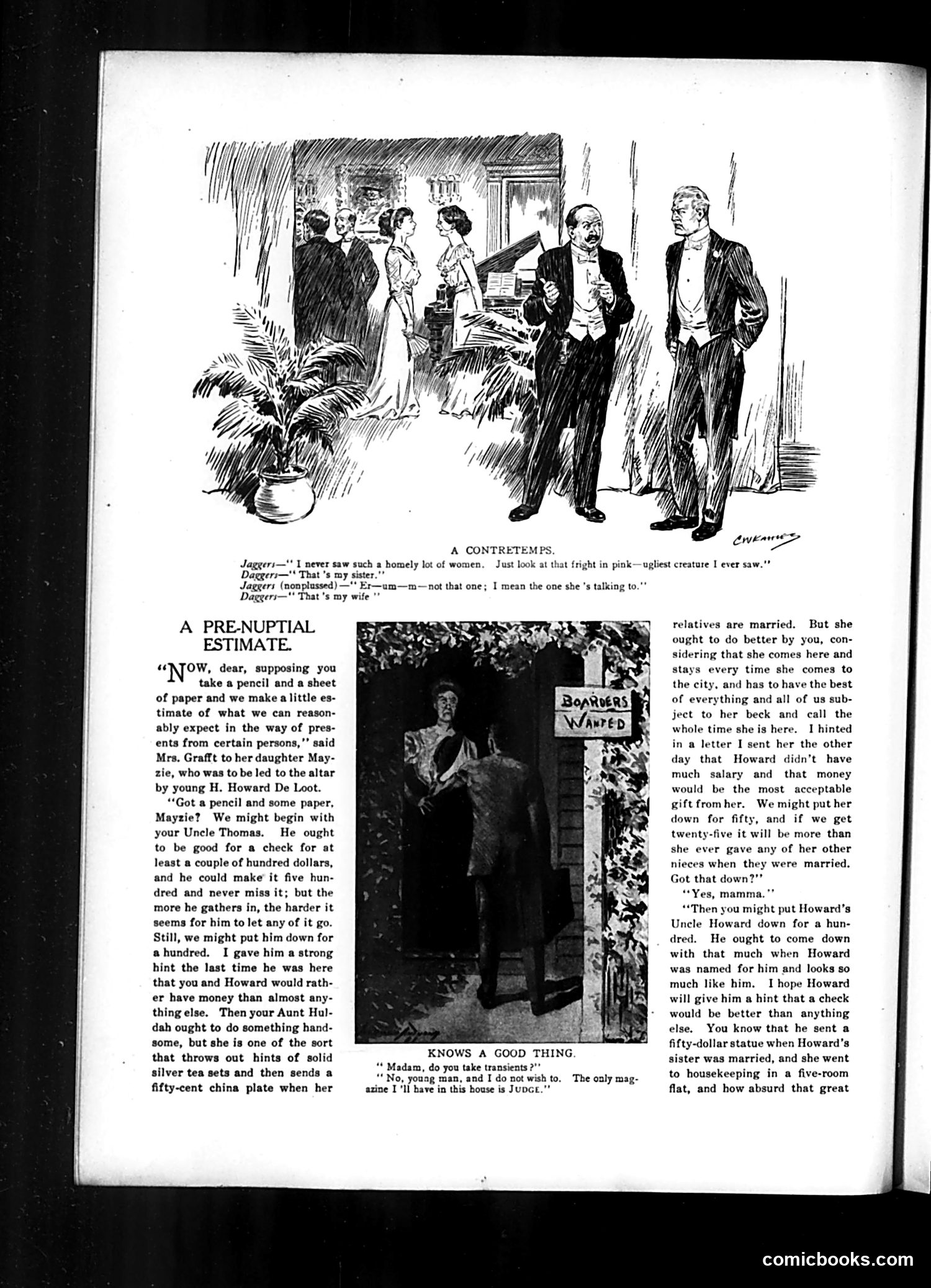
What you’re looking at
This page contains two distinct satirical pieces about money and marriage etiquette among the upper class. **"A Contretemps"** (top cartoon): A man insulting women at a formal gathering makes a social blunder when he derides "that fright in pink" as "the ugliest creature I ever saw"—only to learn she's the host's sister, then wife. The humor lies in his escalating embarrassment as each correction worsens the insult. **"A Pre-Nuptial Estimate"** (main story): Mother and daughter cynically calculate wedding gifts from relatives, not out of gratitude but as a financial strategy. They assign dollar amounts to family members based on past stinginess, hint broadly about monetary preferences, and grumble when relatives give thoughtless items (like a fifty-dollar statue) instead of cash. The satire mocks mercenary attitudes toward marriage gifts and the transparent gold-digging of the bride's family. Both pieces satirize Gilded Age social pretension and financial obsession among the wealthy.
📄 Transcribed text from this page (OCR, searchable)
Machine-transcribed from the original scan — historical spelling and the odd misread are preserved.
A CONTRETEMPS, Crease “* [never saw such a homely lot of women. Just look at that fright in pink—ugliest creature I ever saw." egers—'* That 's my siste: Jaggers (nonplussed) —'* E. Daggers—"' That 's my wife A PRE-NUPTIAL ESTIMATE. «©NTOW, dear, supposing you take a pencil and a sheet of paper and we make a little es- timate of what we can reason- ably expect in the way of pres- ents from certain persons,’’ said Mrs. Grafft to her daughter May- zie, who was to be led to the altar by young H. Howard De Loot. “Got a pencil and some paper, Mayzie? We might begin with your Uncle Thomas. He ought to be good for a check for at least a couple of hundred dollars, and he could make it five hun- dred and never miss it; but the more he gathers in, the harder it seems for him to let any of it go. Still, we might put him down for ahundred. I gave him a strong hint the last time he was here that you and Howard would rath- er have money than almost any- thingelse. Then your Aunt Hul- dah ought to do something hand- some, but she is one of the sort that throws out hints of solid silver tea sets and then sends a fifty-cent china plate when her ‘um—m—not that one; I mean the one she's talking to." KNOWS A GOOD THING “* Madam, do you take transients?” “No, youag man, and I do not wish to. azine I'll have in this house is Jupce."" The only mag- relatives are married. But she ought to do better by you, con- sidering that she comes here and stays every time she comes to the city, and has to have the best of everything and all of us sub- ject to her beck and call the whole time she is here. I hinted in a letter I sent her the other day that Howard didn’t have much salary and that money would be the most acceptable giftfromher. We might put her down for fifty, and if we get twenty-five it will be more than r gave any of her other were married. she e' nieces when th Got that down “Yes, mamma."’ “Then you might put Howard’s Uncle Howard down for a hun- dred. He ought to come down with that much when Howard was named for him and looks so much like him. I hope Howard will give him a hint that a check would be better than anything else. You know that he sent a fifty-dollar statue when Howard's sister was married, and she went to housekeeping in a five-room flat, and how absurd that great comicbooks.com