
Judge, 1911-10-07 · page 17 of 24
Judge — October 7, 1911 — page 17: what you’re looking at
What you’re looking at
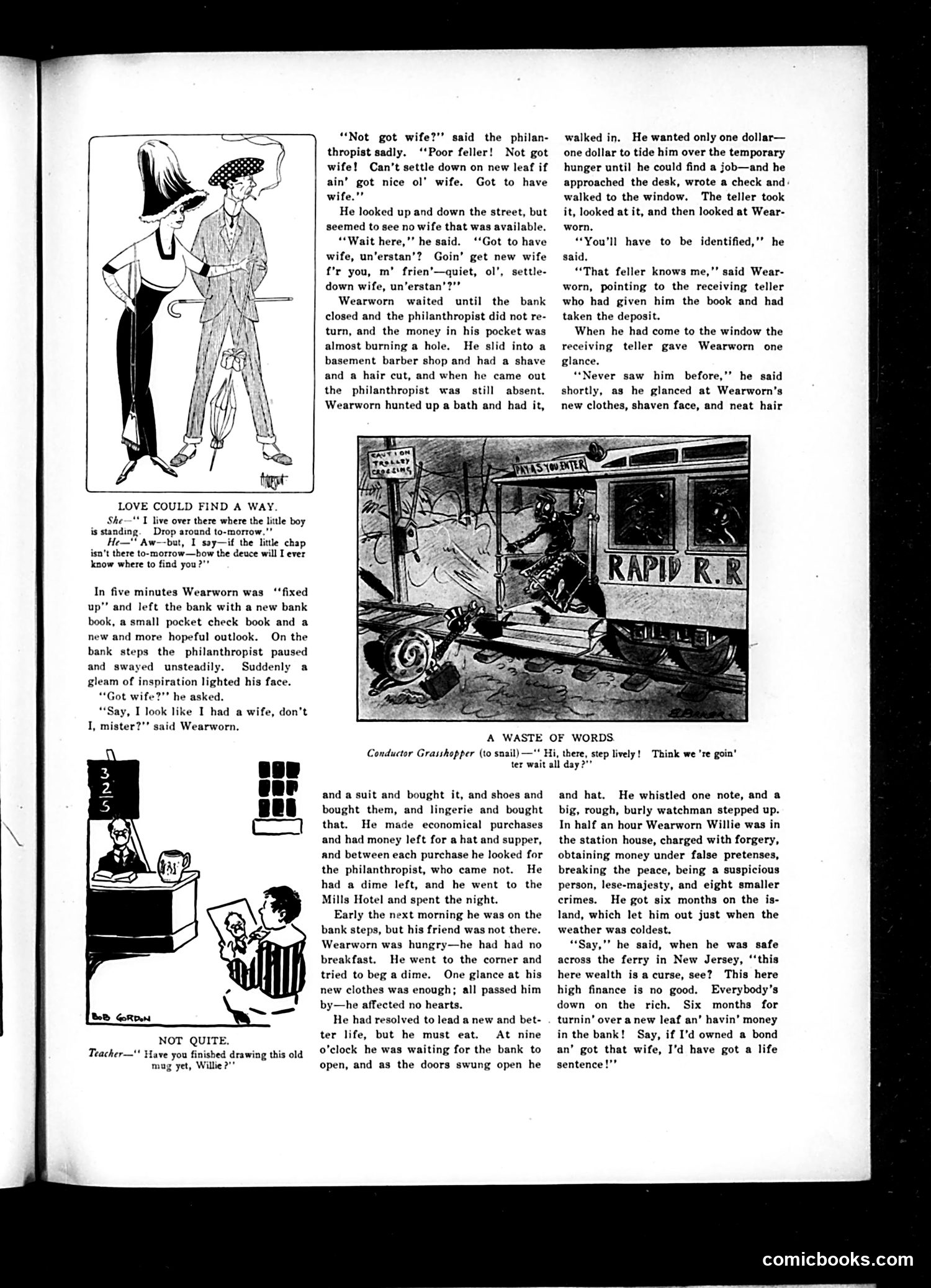
This page contains two satirical stories mocking American social hypocrisy and class prejudice. **"Love Could Find a Way"** ridicules wealthy philanthropists' condescending charity. A well-meaning rich man gives a destitute man money specifically to find a "wife" (viewing marriage as moral reform). The man uses the money to improve himself—bathing, buying new clothes and food. However, once respectable-looking, no one recognizes him. When he tries to cash a check at the bank, the teller who gave him the original deposit refuses to identify him because his new appearance makes him unrecognizable. He's arrested for forgery and forged checks, receiving six months imprisonment. **The satire's point**: Society judges people by appearance alone. The poor man's attempt at self-improvement—enabled by charity—ironically destroys his credibility. The system punishes the poor regardless of their actions; the man concludes bitterly that owning bonds would have gotten him better treatment than honest effort. **"A Waste of Words"** (bottom) offers a brief joke about a conductor rushing passengers.
📄 Transcribed text from this page (OCR, searchable)
Machine-transcribed from the original scan — historical spelling and the odd misread are preserved.
L LOVE COULD FIND A WAY. She—'* I live over there where the little boy is standing. Drop around to-morrow."" He—"' Aw—but, I say—if the little chap isn't there to-morrow—how the deuce will I ever know where to find you?" In five minutes Wearworn was ‘‘fixed up’ and left the bank with a new bank book, a small pocket check book and a new and more hopeful outlook. On the bank steps the philanthropist paused and unsteadily. Suddenly a gleam of inspiration lighted his face. “Got wife?’’ he asked. Say, I look like I had a wife, don’t I, mister?"’ said Wearworn. swayed NOT QUITE. Teacher—"' Have you finished drawing this old mug yet, Willie?" “Not got wife?’’ said the philan- thropist sadly. ‘‘Poor feller! Not got wife! Can’t settle down on new leaf if ain’ got nice ol’ wife. Got to have wife.” He looked up and down the street, but seemed to see no wife that was available. “Wait here,”’ he said. ‘‘Got to have wife, un'erstan’? Goin’ get new wife f'r you, m’ frien’—quiet, ol’, settle- down wife, un’erstan’?’’ Wearworn waited until the bank closed and the philanthropist did not re- turn, and the money in his pocket was almost burning a hole. He slid into a basement barber shop and had a shave and a hair cut, and when he came out the philanthropist was still absent. Wearworn hunted up a bath and had it, A WASTE Conductor Grasshopper (to snail) — ter wa and a suit and bought it, and shoes and bought them, and lingerie and bought that. He made economical purchases and had money left for a hat and supper, and between each purchase he looked for the philanthropist, who came not. He had a dime left, and he went to the Mills Hotel and spent the night. Early the next morning he was on the bank steps, but his friend was not there. Wearworn was hungry—he had had no breakfast. He went to the corner and tried to beg adime. One glance at his new clothes was enough; all passed him by—he affected no hearts. He had resolved to lead a new and bet- ter life, but he must eat. At nine o’clock he was waiting for the bank to open, and as the doors swung open he walked in. He wanted only one dollar— one dollar to tide him over the temporary hunger until he could find a job—and he approached the desk, wrote a check and: walked to the window. The teller took it, looked at it, and then looked at Wear- worn. “You'll have to be identified,’’ he said. “That feller knows me,’’ said Wear- worn, pointing to the receiving teller who had given him the book and had taken the deposit. When he had come to the window the receiving teller gave Wearworn one glance. “‘Never saw him before,’ he said shortly, as he glanced at Wearworn’s new clothes, shaven face, and neat hair OF WORDS. fi, there, step lively! all day?” Think we 're goin’ and hat. He whistled one note, and a big, rough, burly watchman stepped up. In half an hour Wearworn Willie was in the station house, charged with forgery, obtaining money under false pretenses, breaking the peace, being a suspicious person, lese-majesty, and eight smaller crimes. He got six months on the is- land, which let him out just when the weather was coldest. “Say,'’ he said, when he was safe across the ferry in New Jersey, ‘‘this here wealth is a curse, see? This here high finance is no good. Everybody’s down on the rich, Six months for turnin’ over a new leaf an’ havin’ money in the bank! Say, if I'd owned a bond an’ got that wife, I’d have got a life sentence !’" comicbooks.com