
Judge, 1911-10-07 · page 9 of 24
Judge — October 7, 1911 — page 9: what you’re looking at
What you’re looking at
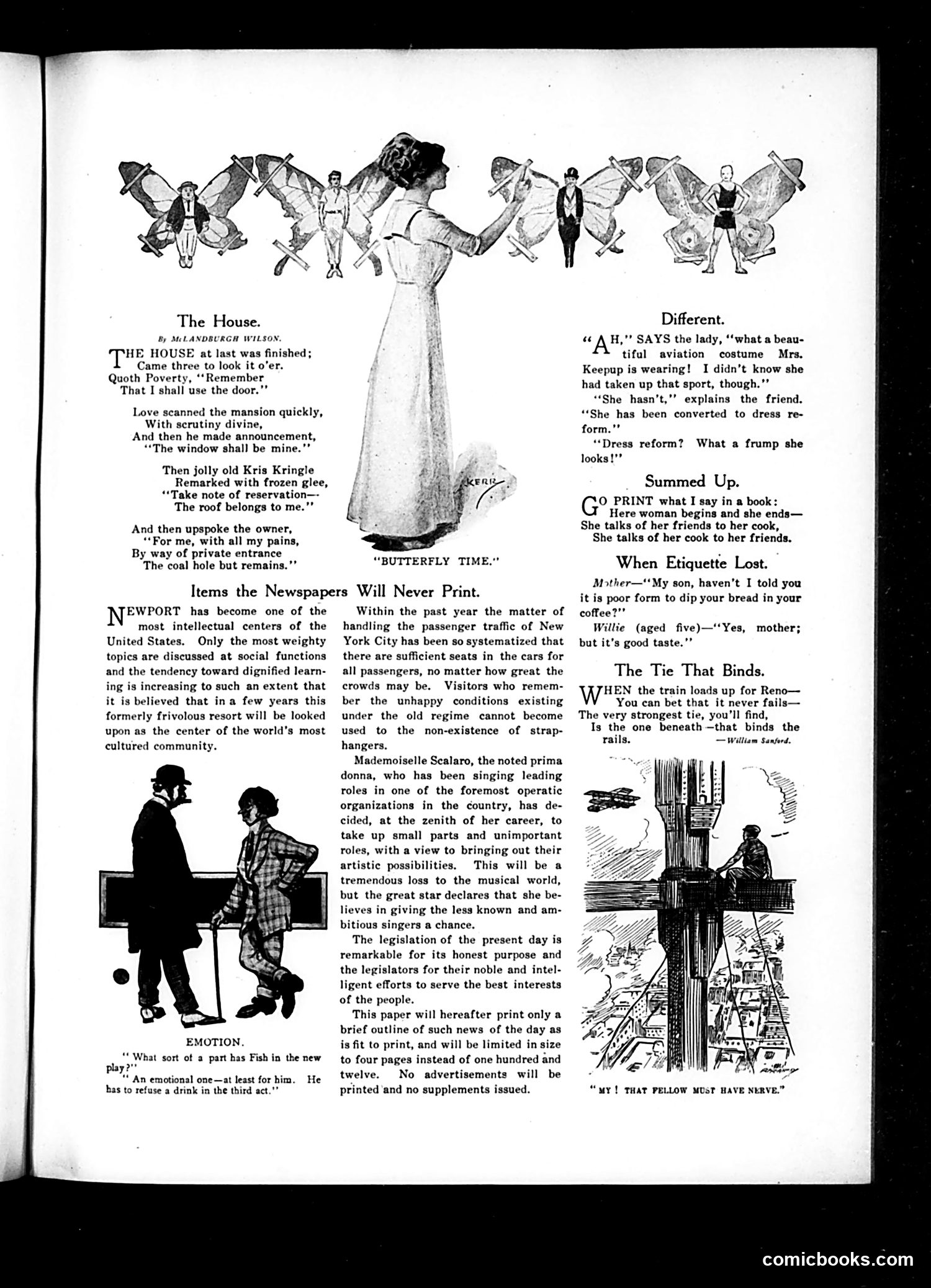
This page contains several satirical pieces mocking American social pretensions and hypocrisy circa early 1900s. **"The House"** poem depicts three abstract figures (Poverty, Love, and Santa Claus) claiming parts of a finished mansion, with the owner left only the coal hole—satirizing how life's hardships encroach on one's own home. **"Items the Newspapers Will Never Print"** is ironic fake-news section mocking Newport's claimed intellectual transformation, NYC's supposedly solved transit problems, and opera star Mademoiselle Scalaro's career shift. The final item sarcastically praises current legislators' honesty—all obviously false claims meant to highlight actual problems readers would recognize. **The shorter jokes** mock fashion ("aviation costume" as mere dress reform), feminine gossip networks, and "Reno" (Nevada divorce destination), suggesting marriage bonds dissolve easily. **"EMOTION"** jokes about a character refusing alcohol on stage—presented as surprisingly difficult acting. The page's satire targets wealthy social hypocrisy, municipal failures, and changing gender roles, using exaggeration and false praise to expose contemporary problems.
📄 Transcribed text from this page (OCR, searchable)
Machine-transcribed from the original scan — historical spelling and the odd misread are preserved.
The House. By McLANDBURGH WILSON. HE HOUSE at last was finished; Came three to look it o'er. Quoth Poverty, ‘‘Remember That I shall use the door.’ Love scanned the mansion quickly, With scrutiny divine, And then he made announcement, “The window shall be mine.’’ Then jolly old Kris Kringle Remarked with frozen glee, “Take note of reservation—- The roof belongs to me.’” And then upspoke the owner, “For me, with all my pains, By way of private entrance The coal hole but remains.’’ “BUTTERFLY TIME.” Items the Newspapers Will Never Print. EWPORT has become one of the most intellectual centers of the United States. Only the most weighty topics are discussed at social functions and the tendency toward dignified learn- ing is increasing to such an extent that it is believed that ina few years this formerly frivolous resort will be looked upon as the center of the world’s most cultured community. EMOTION. “What sort of a part has Fish in the new play?" “* An emotional one—at least for him. He has to refuse a drink in the third act."’ Within the past year the matter of handling the passenger traffic of New York City has been so systematized that there are sufficient seats in the cars for all passengers, no matter how great the crowds may be. Visitors who remem- ber the unhappy conditions existing under the old regime cannot become used to the non-existence of strap- hangers. Mademoiselle Scalaro, the noted prima donna, who has been singing leading roles in one of the foremost operatic organizations in the country, has de- cided, at the zenith of her career, to take up small parts and unimportant roles, with a view to bringing out their artistic possibilities, This will be a tremendous loss to the musical world, but the great star declares that she be- lieves in giving the less known and am- bitious singers a chance. The legislation of the present day is remarkable for its honest purpose and the legislators for their noble and intel- ligent efforts to serve the best interests of the people. This paper will hereafter print only a brief outline of such news of the day as is fit to print, and will be limited in size to four pages instead of one hundred and twelve. No advertisements will be printed ‘and no supplements issued. Different. 6¢ AH," SAYS the lady, ‘‘what a beau- tiful aviation costume Mrs. Keepup is wearing! I didn’t know she had taken up that sport, though.’’ “She hasn’t,’’ explains the friend. “She has been converted to dress re- form.”” “Dress reform? looks !’" What a frump she Summed Up. O PRINT what I say in a book: Here woman begins and she ends— She talks of her friends to her cook, She talks of her cook to her friends. When Etiquette Lost. Mother—‘‘My son, haven't I told you it is poor form to dip your bread in your coffee?” Willie (aged five)—‘‘Yes, but it’s good taste.’” The Tie That Binds. HEN the train loads up for Reno— You can bet that it never fails— The very strongest tie, you'll find, Is the one beneath —that binds the William Sanford. mother; “wy | THAT PELLOW MUST HAVE NERVE.” comicbooks.com