
Judge, 1911-10-07 · page 6 of 24
Judge — October 7, 1911 — page 6: what you’re looking at
What you’re looking at
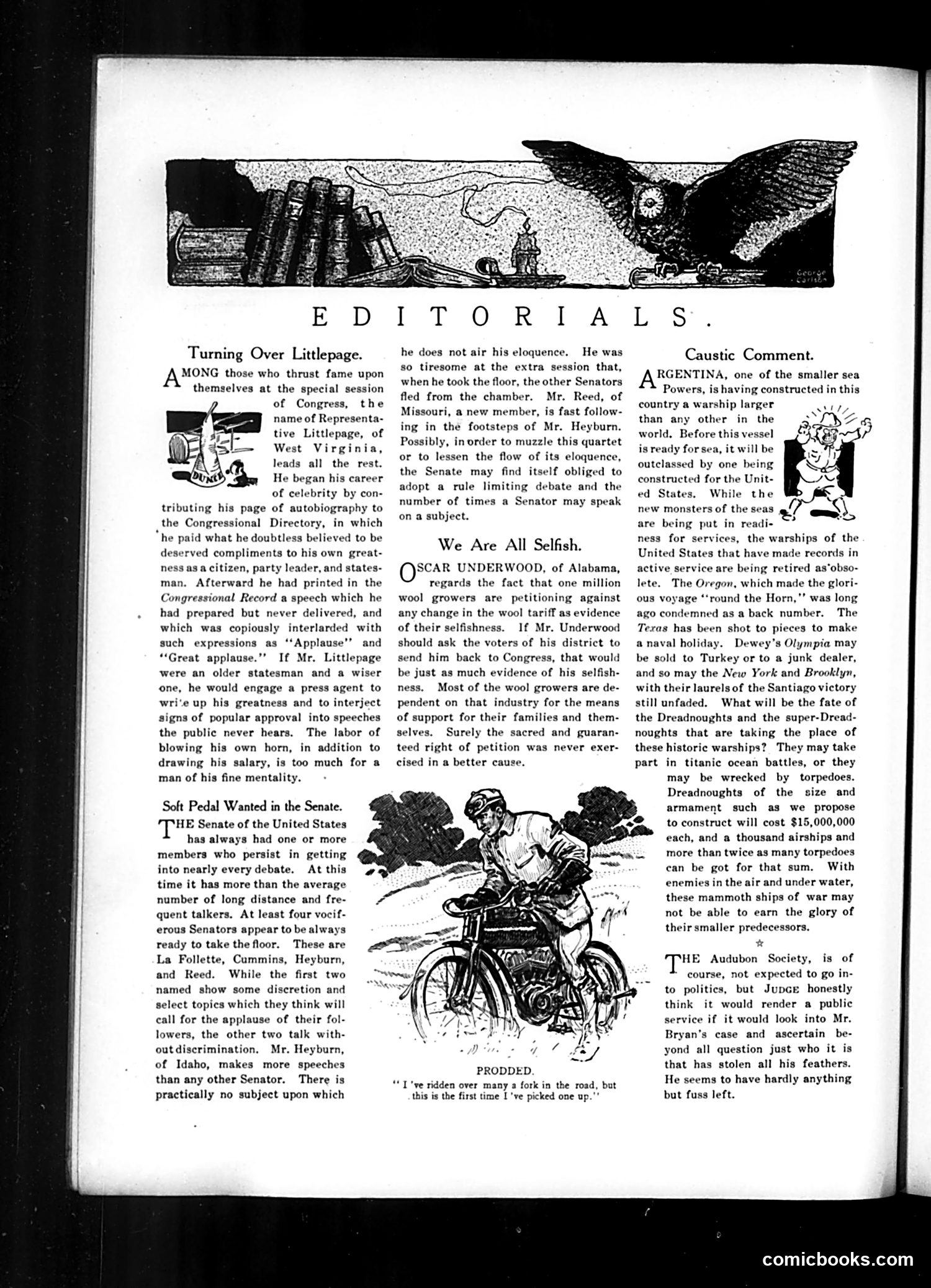
This 1910s editorial page satirizes several Congressional figures and political issues: **"Turning Over Littlepage"** mocks Representative Littlepage of West Virginia for shamelessly self-promotion—writing autobiography for the Congressional Directory and printing an undelivered speech in the Congressional Record, padding it with fake "[Applause]" notations. The satire suggests he should hire a professional press agent rather than tire himself with self-aggrandizement. **"Soft Pedal Wanted in the Senate"** criticizes verbose senators, particularly Heyburn (Idaho) and Reed (Missouri), who dominate debate on nearly every subject. La Follette and Cummins show "discretion," but Heyburn was so tedious colleagues fled the chamber. Judge suggests adopting debate limits. **"We Are All Selfish"** defends wool growers' tariff petition against Congressman Underwood's accusation of selfishness—arguing workers advocating for their livelihoods deserve the same respect as politicians seeking reelection. The bicycle cartoon humorously illustrates the tariff debate's chaos.
📄 Transcribed text from this page (OCR, searchable)
Machine-transcribed from the original scan — historical spelling and the odd misread are preserved.
a EDITORIAL Turning Over Littlepage. MONG those who thrust fame upon themselves at the special session of Congress, the name of Representa- tive Littlepage, of West Virginia, leads all the rest. He began his career of celebrity by con- tributing his page of autobiography to the Congressional Directory, in which “he paid what he doubtless believed to be deserved compliments to his own great- ness as a citizen, party leader, and states- man. Afterward he had printed in the Congressional Record a speech which he had prepared but never delivered, and which was copiously interlarded with such pressions as ‘‘Applause’’ and “Great applause.” If Mr. Littlepage were an older statesman and a wiser ‘one, he would engage a press agent to wri‘e up his greatness and to interject signs of popular approval into speeches the public never hears. The labor of blowing his own horn, in addition to drawing his salary, is too much for a man of his fine mentality. Soft Pedal Wanted in the Senate. HE Senate of the United States has always had one or more members who persist in getting into nearly every debate. At this time it has more than the average number of long distance and fre- quent talkers. At least four vocif- erous Senators appear to be always ready to take the floor. These are La Follette, Cummins, Heyburn, and Reed. While the first two named show some discretion and select topics which they think will call for the applause of their fol- lowers, the other two talk with- outdiscrimination. Mr. Heyburn, of Idaho, makes more speeches than any other Senator. There is practically no subject upon which he does not air his eloquence. He was so tiresome at the extra session that, when he took the floor, the other Senators fled from the chamber. Mr. Reed, of Missouri, a new member, is fast follow- ing in the footsteps of Mr. Heyburn. Possibly, inorder to muzzle this quartet or to lessen the flow of its eloquence, the Senate may find itself obliged to adopt a rule limiting debate and the number of times a Senator may speak on a subject. We Are All Selfish. SCAR UNDERWOOD, of Alabama, regards the fact that one million wool growers are petitioning against any change in the wool tariff as evidence of their selfishness. If Mr. Underwood should ask the voters of his district to send him back to Congress, that would be just as much evidence of his selfish- ness. Most of the wool growers are de- pendent on that industry for the means of support for their families and them- selves. Surely the sacred and guaran- teed right of petition was never exer- cised in a better cause, PRODDED. “* T've ridden over many a fork in the road, but this is the first time I've picked one up."” Caustic Comment. RGENTINA, one of the smaller sea Powers, is having constructed in this country a warship larger than any other in the world. Before this vessel is ready for sea, it will be outclassed by one being constructed for the Unit- ed States. While the new monsters of the seas are being put in readi- ness for services, the warships of the United States that have made records in active service are being retired as‘obso- lete. The Oregon, which made the glori- ous voyage ‘round the Horn,"’ was long ago condemned as a back number. The Texas has been shot to pieces to make a naval holiday. Dewey’s Olympia may be sold to Turkey or to a junk dealer, and so may the New York and Brooklyn, with their laurels of the Santiago victory still unfaded. What will be the fate of the Dreadnoughts and the super-Dread- noughts that are taking the place of these historic warships? They may take part in titanic ocean battles, or they may be wrecked by torpedoes. Dreadnoughts of the size and armament such as we propose to construct will cost $15,000,000 each, and a thousand airships and more than twice as many torpedoes can be got for that sum. With enemies in the air and under water, these mammoth ships of war may not be able to earn the glory of their smaller predecessors. * HE Audubon Society, is of course, not expected to go in- to politics, but Jupce honestly think it would render a public service if it would look into Mr. Bryan’s case and ascertain be- yond all question just who it is that has stolen all his feathers. He seems to have hardly anything but fuss left. SW, comicbooks.com