
A complete issue · 24 pages · 1911
Judge — July 29, 1911
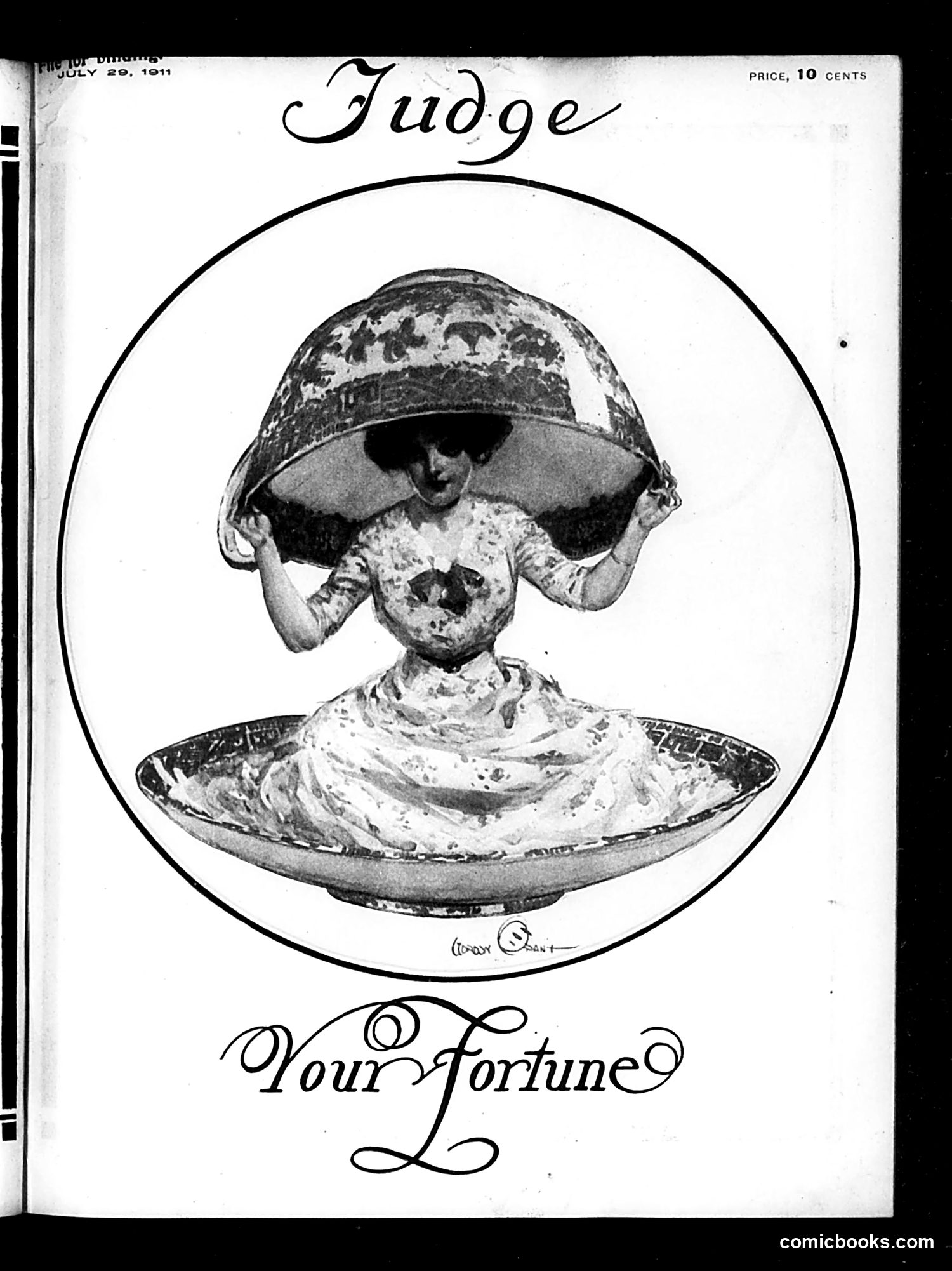
This is a cover illustration titled "Your Fortune" from Judge magazine (dated November 23, 1911, priced at 10 cents). The image depicts a woman's head emerging from a large bowl or dish, wearing an oversized decorative hat. The surreal, grotesque composition—where the woman's proportions are distorted and she appears almost emerging from food—suggests commentary on wealth, consumption, or social pretension. The "fortune" reference likely mocks either wealth-seeking behavior or fortune-telling trends popular in the early 1900s. The exaggerated hat and refined clothing contrast absurdly with the woman's placement within/emerging from a serving dish, possibly satirizing wealthy women's obsession with fashion and appearance, or critiquing the superficiality of high society. The exact social commentary remains somewhat unclear without additional context from the issue.
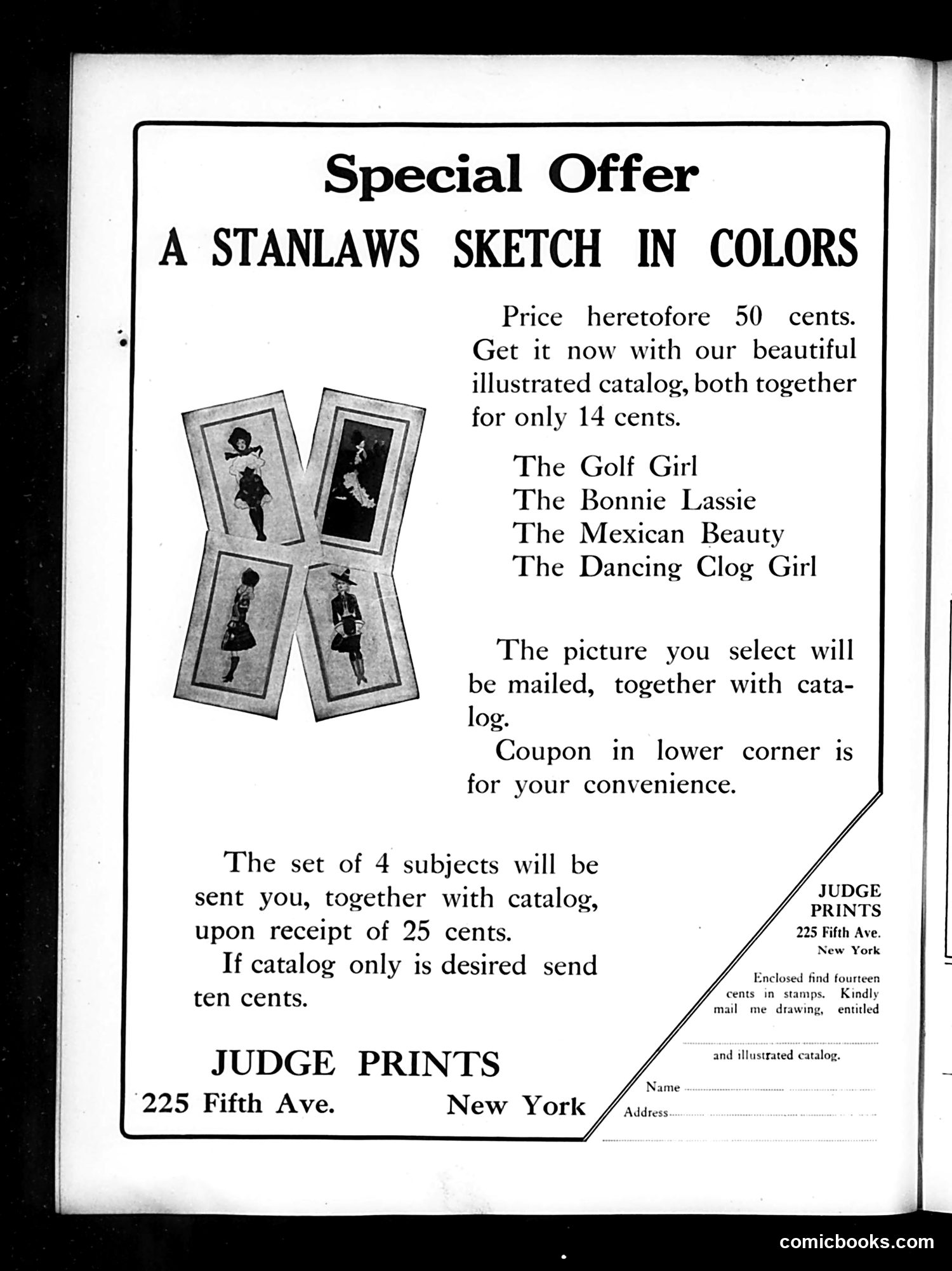
This page is primarily **advertising, not editorial content**. Judge Prints, a New York company at 225 Fifth Avenue, is promoting a special offer on "Stanlaws Sketch in Colors"—hand-tinted illustrations by the artist Stanlaws (likely Penrhyn Stanlaws, a popular illustrator of the era). The four featured sketches depict stylized female characters: "The Golf Girl," "The Bonnie Lassie," "The Mexican Beauty," and "The Dancing Clog Girl." These represent the kind of decorative, idealized feminine imagery typical of early 20th-century commercial art. The offer bundles a single sketch with an illustrated catalog for 14 cents (previously 50 cents for the sketch alone), or all four sketches plus catalog for 25 cents. This appears to be a mass-market promotional strategy rather than satirical commentary.
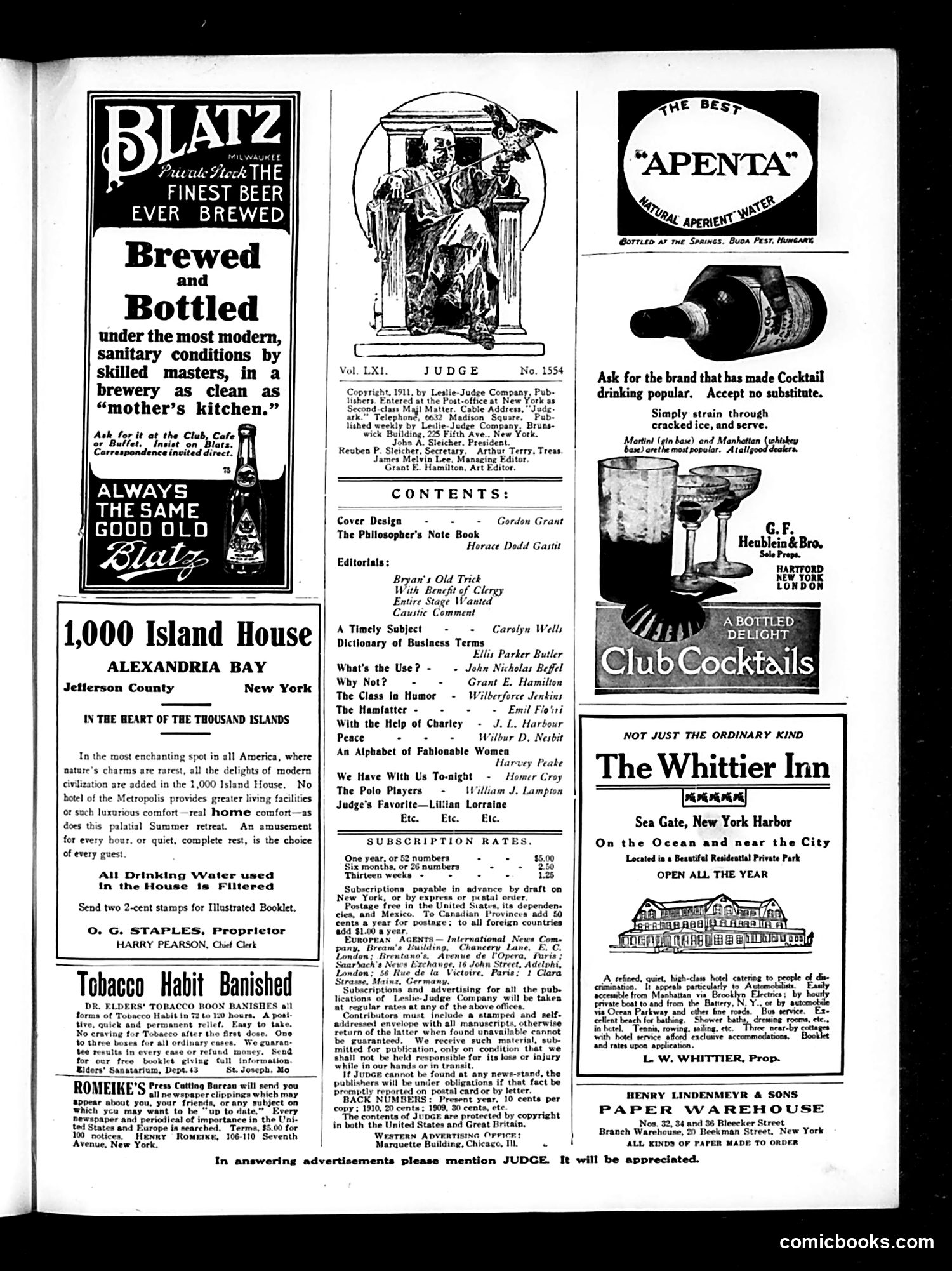
This page is **primarily advertising** rather than editorial content or political satire. The main elements are: **Central Image:** A classical engraving labeled "Vol. LXI. JUDGE No. 1554" depicting a seated figure labeled "JUDGE" in robes, apparently the magazine's mascot or personification. **Advertisements:** The page features ads for Blatz Beer (Milwaukee), Apenta mineral water, The Whittier Inn (Sea Gate, New York), and other period products. Below is an article titled "Tobacco Habit Banished" promoting a tobacco-cessation treatment. **Contents section:** Lists editorial pieces with titles like "Bryan's Old Trick" and "Why Not?"—suggesting political commentary—but the actual articles aren't reproduced here. The page reflects early 20th-century magazine layout and consumer culture rather than presenting satirical commentary.
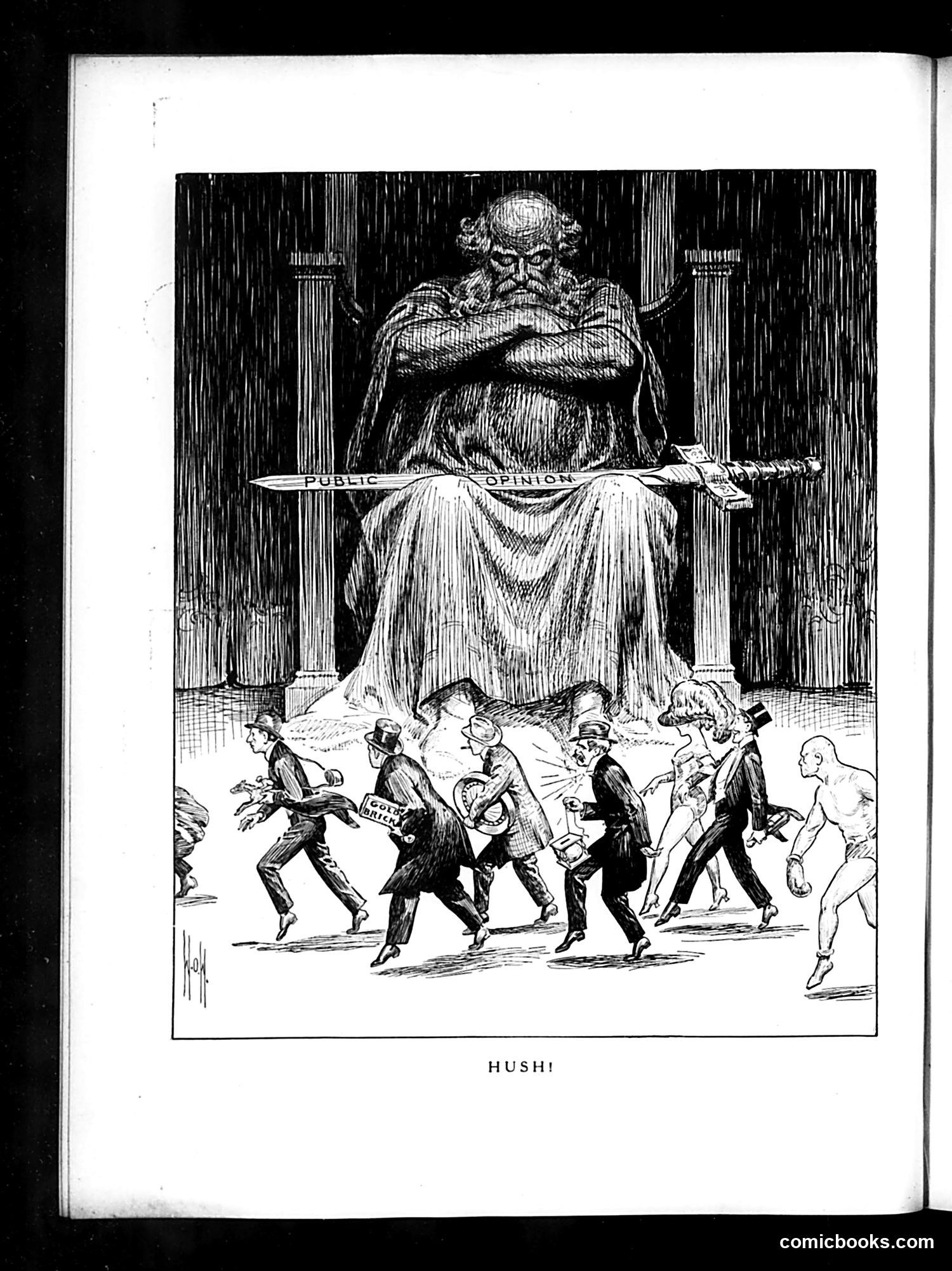
This Judge magazine cartoon depicts a giant seated figure representing "Public Opinion" wielding a sword labeled "PUBLIC OPINION." Below, various small figures—appearing to be politicians or public figures in formal dress—cower or flee from beneath the figure's crossed arms. The title "HUSH!" suggests suppression or silencing. The satire criticizes how powerful interests attempted to quiet or control public discourse, while the towering Public Opinion figure ironically dominates the scene, suggesting that despite attempts at censorship, public sentiment ultimately cannot be suppressed. The cartoon reflects late 19th or early 20th-century anxieties about free speech, political manipulation, and the power of democratic will—themes Judge regularly explored through social satire.
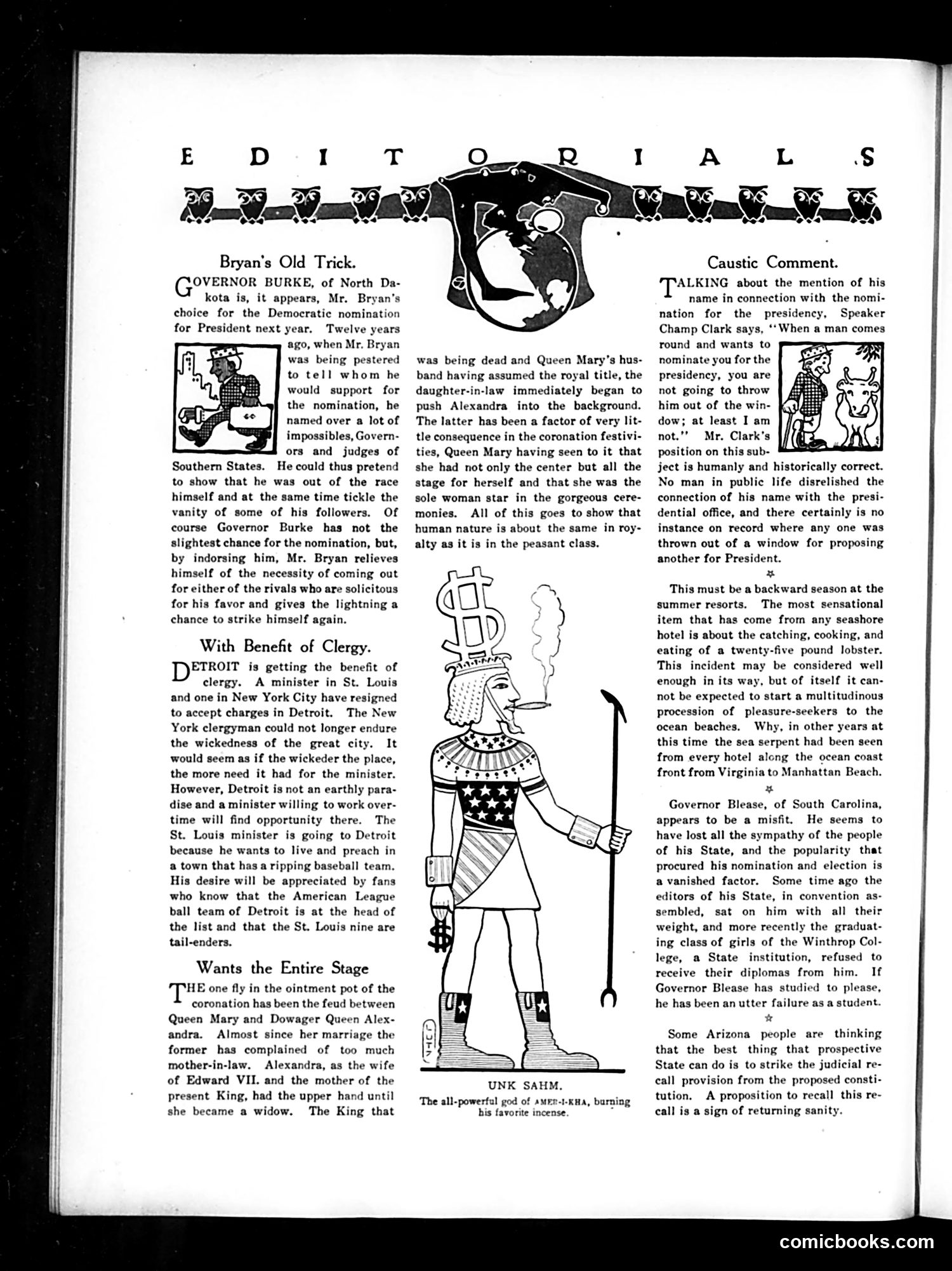
This page contains three political satires: **"Bryan's Old Trick"**: William Jennings Bryan is accused of endorsing Governor Burke of North Dakota—a politically insignificant figure—for the Democratic presidential nomination. The satire suggests Bryan uses this tactic to appear magnanimous while avoiding backing a serious rival candidate, thereby keeping himself in contention for the nomination. **"With Benefit of Clergy"**: Clergy relocating from St. Louis and New York to Detroit receive ironic commentary. One minister leaves because Detroit has a superior baseball team (the American League leader) rather than spiritual need, mocking misplaced priorities in religious life. **"Wants the Entire Stage"**: Queen Mary's dominance at the coronation festivities, relegating Dowager Queen Alexandra to the background, is satirized. The cartoon points out that even royalty exhibits petty human vanity and jealousy—proving "human nature is about the same in royalty as it is in the peasant class." Human nature, ambition, and hypocrisy are the recurring themes.
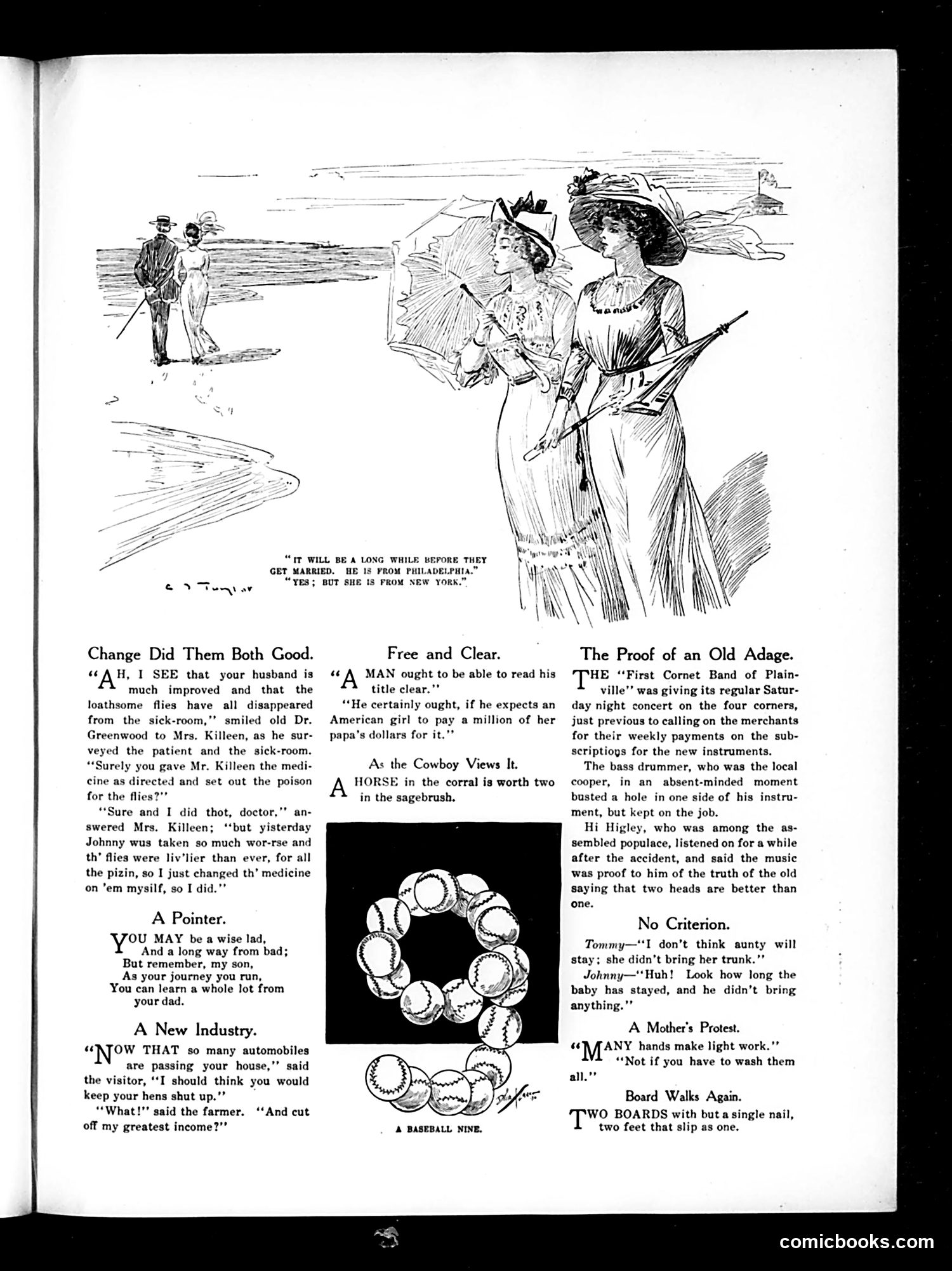
This page contains several short humorous pieces typical of early 20th-century American satire: **Main Cartoon (top):** Features two fashionable women with parasols on a beach discussing courtship delays. The joke plays on regional prejudice—one woman is from Philadelphia, the other from New York, implying their different origins complicate romance. **Short Pieces Below:** - "Change Did Them Both Good": An Irish immigrant woman (indicated by dialect) accidentally improves her husband's condition by changing his medicine herself, outwitting the doctor - "A New Industry": A farmer welcomes automobiles passing his house because he profits from killing hens (presumably hit by cars) for income - Several brief jokes about marriage, literacy, and rural life **Context:** The humor relies on ethnic stereotypes (Irish servants), class commentary (wealthy suitors, working farmers), and period-specific references (automobiles as novelty, cornet bands as community institutions). The satire targets social pretension, marital complications, and rural-urban differences characteristic of early 1900s American society.
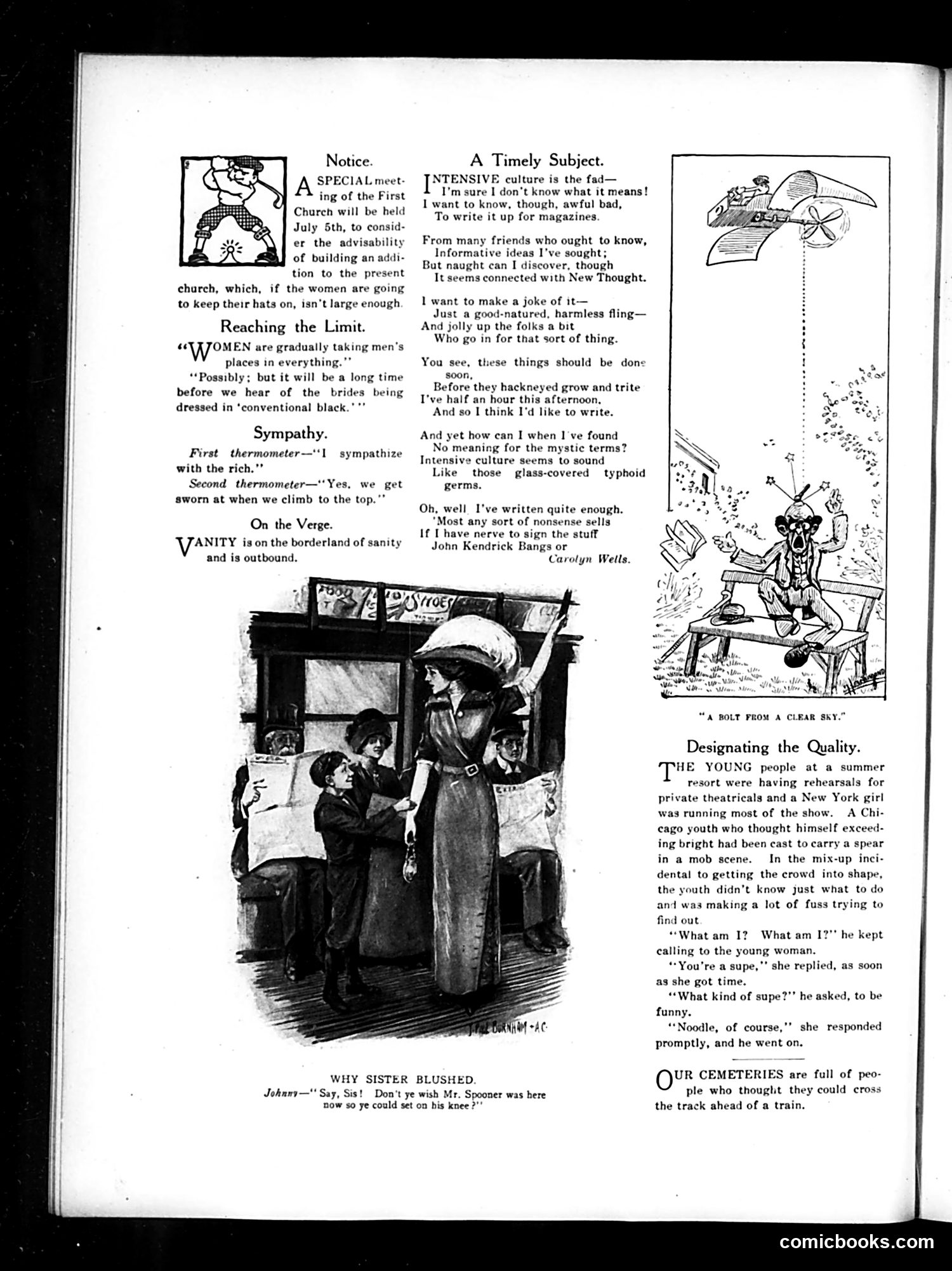
This page contains several brief satirical pieces mocking contemporary social trends: **"Reaching the Limit"** jokes about women's expanding roles in society, suggesting that if women keep wearing large hats to church, the building needs expansion—satirizing both women's fashion and their increasing public presence. **"A Timely Subject"** by Carolyn Wells parodies the era's fascination with "intensive culture" and "New Thought" (a popular spiritual movement). The author admits she doesn't understand these trendy concepts but will write about them anyway for magazine publication, mocking both superficial intellectualism and editorial standards. **"Designating the Quality"** depicts a theater rehearsal where a Chicago youth, cast as a "supe" (supernumerary/extra), repeatedly asks what his role is. When told he's a "supe," he asks what *kind*, and receives the retort "Noodle, of course"—a pun using "noodle" (slang for head/fool) to describe his minor part. Minor items mock women's fashion, thermometer/class anxiety, and reckless cemetery trespassers. The overall tone is genteel, conventional satire targeting pretension and social change.
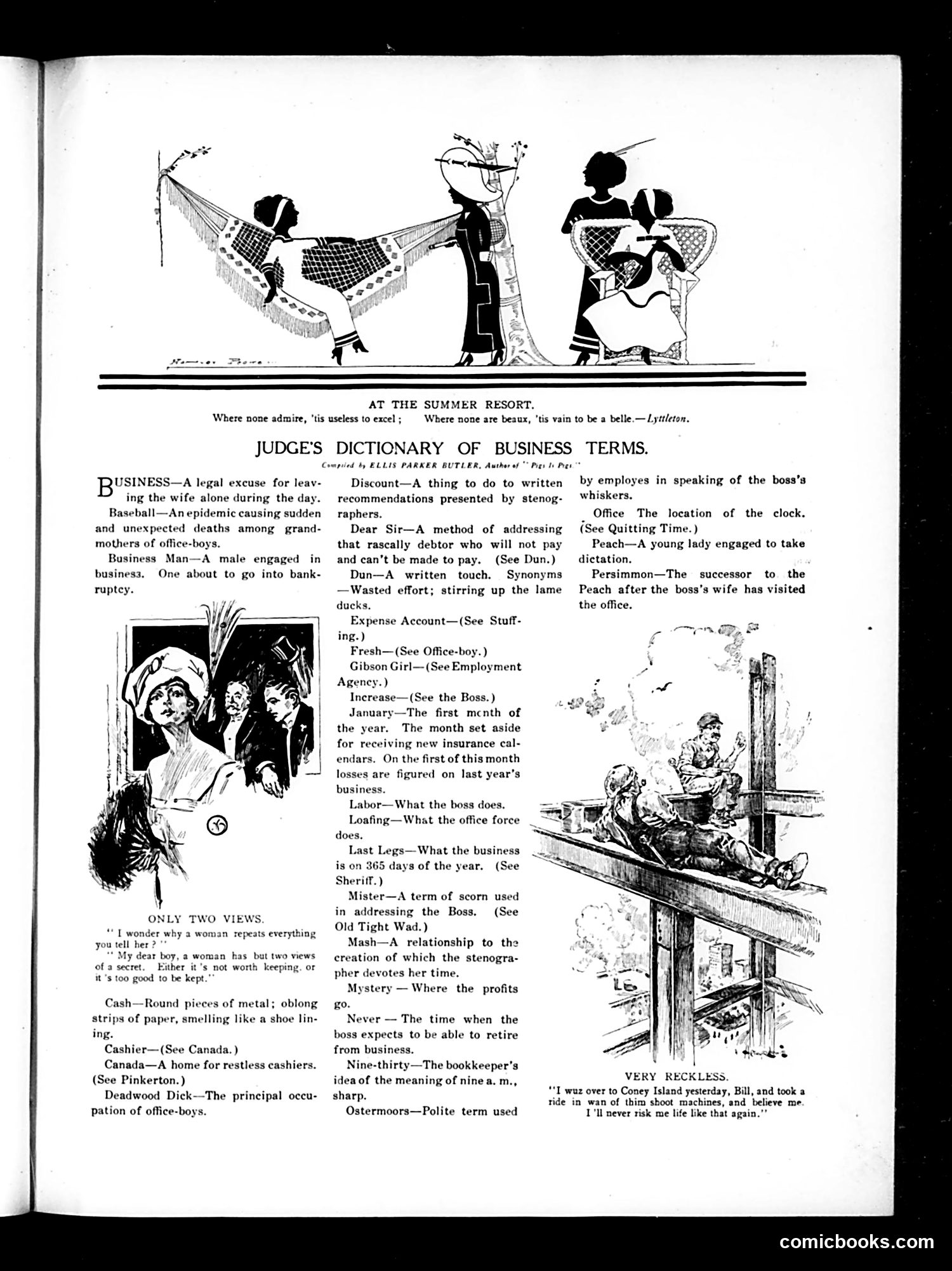
This page contains two distinct satirical pieces from Judge magazine: **"At the Summer Resort"** (top): A humorous illustration of women at leisure, with a Lydia epigraph about beauty and admiration. The cartoon mocks vanity and social pretension among wealthy summer visitors. **"Judge's Dictionary of Business Terms"** (main content): A mock dictionary compiled by Ellis Parker Butler that satirizes workplace hypocrisy and class relations. The definitions invert or expose uncomfortable truths: "Business" excuses husbands abandoning wives; "Labor" means what the boss does while "Loafing" is what workers do; "Mystery" is where profits vanish. The humor relies on readers recognizing the gap between official business language and actual office behavior—exploitative bosses, underpaid stenographers, incompetent timekeeping, and casual dishonesty. **"Very Reckless"** (bottom right): A brief comic about someone terrified by a Coney Island amusement ride, contrasting his fear of machines with workers' actual workplace dangers. The page satirizes American industrial capitalism and office culture circa early 1900s.
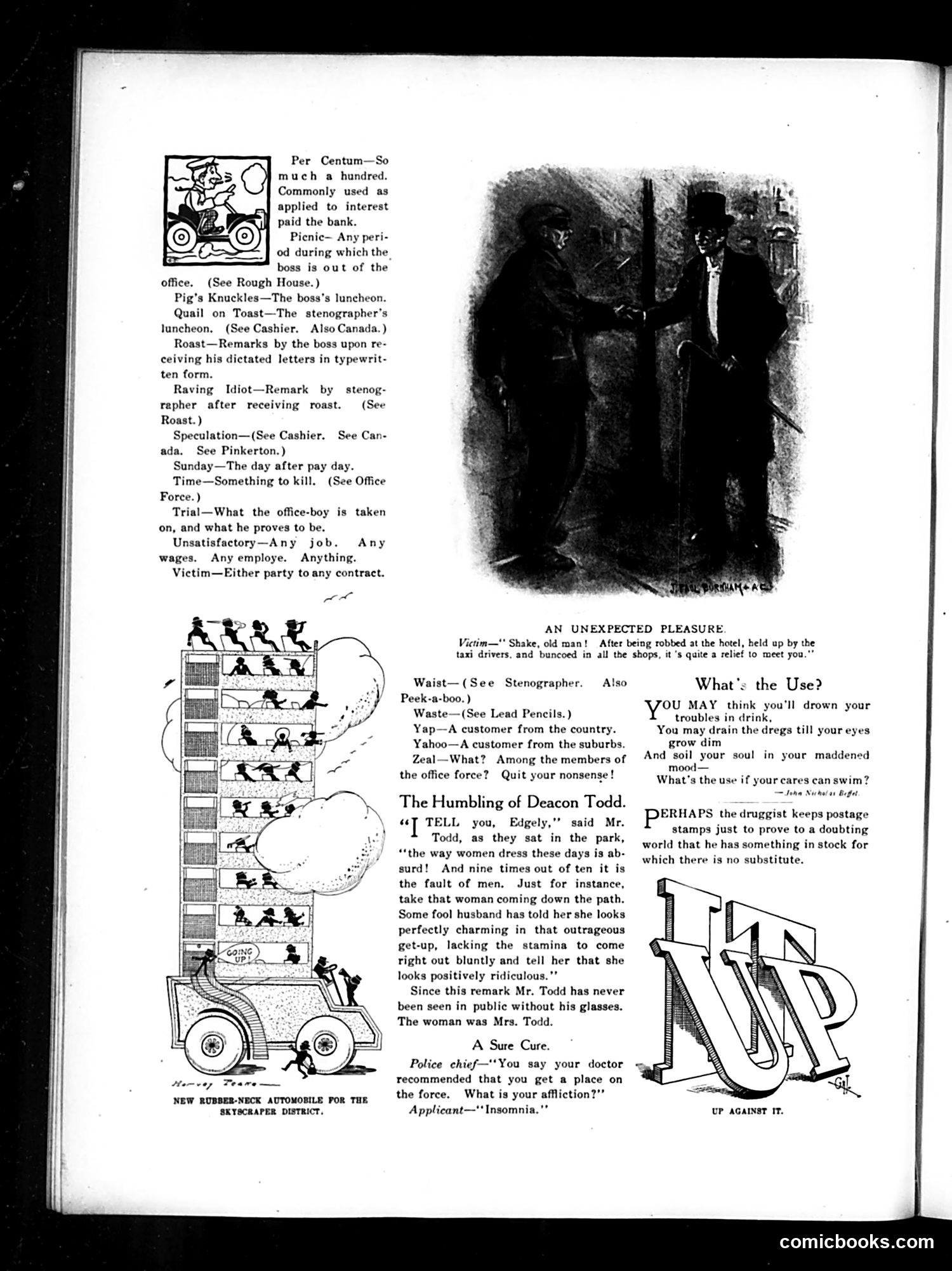
This page presents **office workplace satire** through a mock dictionary of terms and accompanying cartoons. ## The Glossary The left column humorously defines office jargon to mock workplace culture. Key terms ridicule: employees killing time ("Time"), bosses criticizing typed letters ("Roast"), stenographers' complaints ("Raving Idiot"), and the exploitative nature of employment ("Victim—Either party to any contract"). References to "Cashier," "Canada," and "Pinkerton" suggest corruption/embezzlement scandals of the era. ## The Cartoons **"New Rubber-Neck Automobile"**: A multi-story vehicle for skyscraper office workers—satirizing both urban density and workers' nosiness. **"Deacon Todd"**: A moralistic man criticizes women's fashion, unaware his own wife is the offender. The joke: his comeuppance when she's revealed. **"A Sure Cure"**: Dark humor—a doctor recommends police work to cure insomnia (implying danger/stress). **Overall**: Satirical commentary on early 20th-century office culture, class dynamics, and urban American life, presenting work as exploitative and social hypocrisy as rampant.
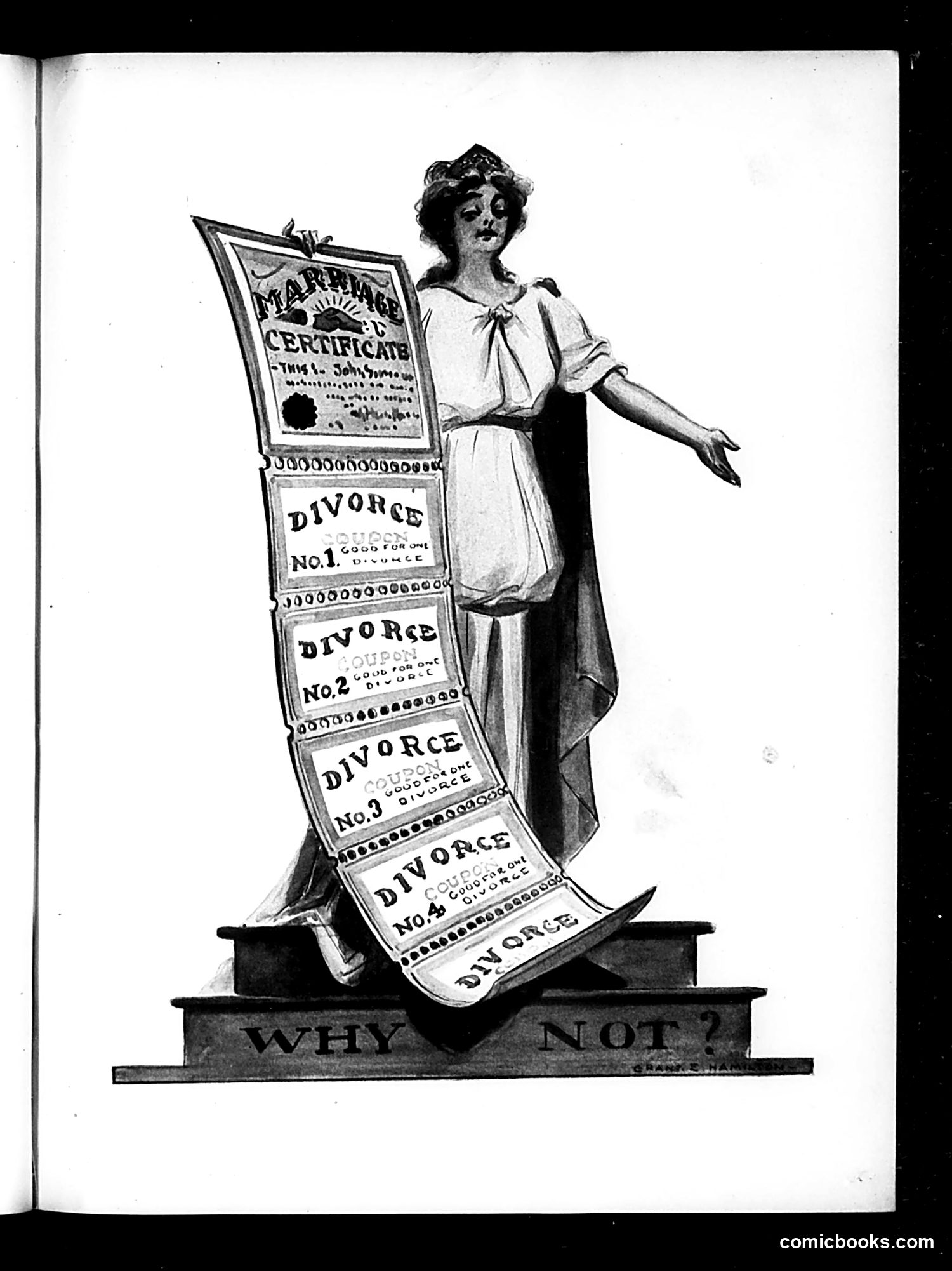
This Judge magazine cartoon satirizes easy divorce through a commodified, vending-machine aesthetic. A classical female figure stands beside a tall mechanical dispenser labeled "Marriage Certificate" at top, followed by numbered "Divorce" coupons (No. 1-5) that extend downward like a slot machine receipt. The caption "Why Not?" suggests cynical commentary on divorce accessibility—implying it had become as casual and transactional as purchasing goods from a machine. The classical female personification of justice or marriage contrasts sharply with the crude mechanization, highlighting the satire: what should be serious legal/moral matters has been reduced to frivolous consumer transactions. The cartoon likely critiques either recent liberalization of divorce laws or broader anxieties about changing marriage and social standards in early 20th-century America.
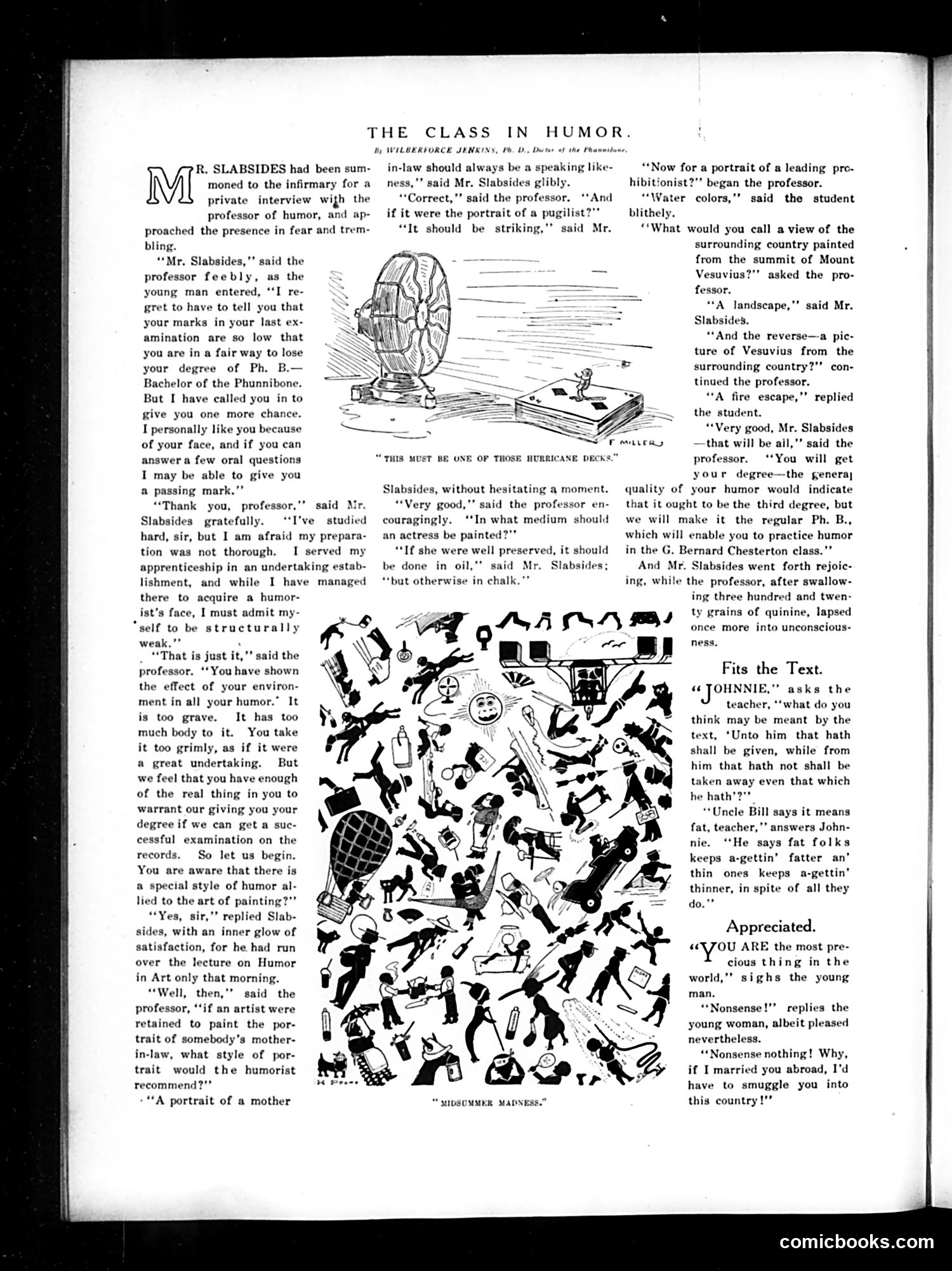
This satirical story mocks academic pretension and the teaching of humor as a formal discipline. Mr. Slabsides, a former undertaker with a naturally gloomy disposition, nearly fails his degree in "Phunnibone" (a pun on "funny bone"). The professor quizzes him on "humor in art"—asking what painting style suits various subjects: a mother-in-law should be "speaking likeness," a boxer "striking," an actress (if "well preserved") done in oil or "chalk" if not. A prohibitionist requires "water colors" (referencing alcohol). The joke satirizes how humor can be artificially systematized and taught through absurd rules. The accompanying illustrations show increasingly chaotic, surreal imagery labeled "Midsummer Madness," reinforcing the absurdity. The page also includes "Fits the Text," where a child hilariously misinterprets scripture about the rich getting richer—Uncle Bill says fat people keep getting fatter while thin people stay thin, applying economic inequality to body mass.
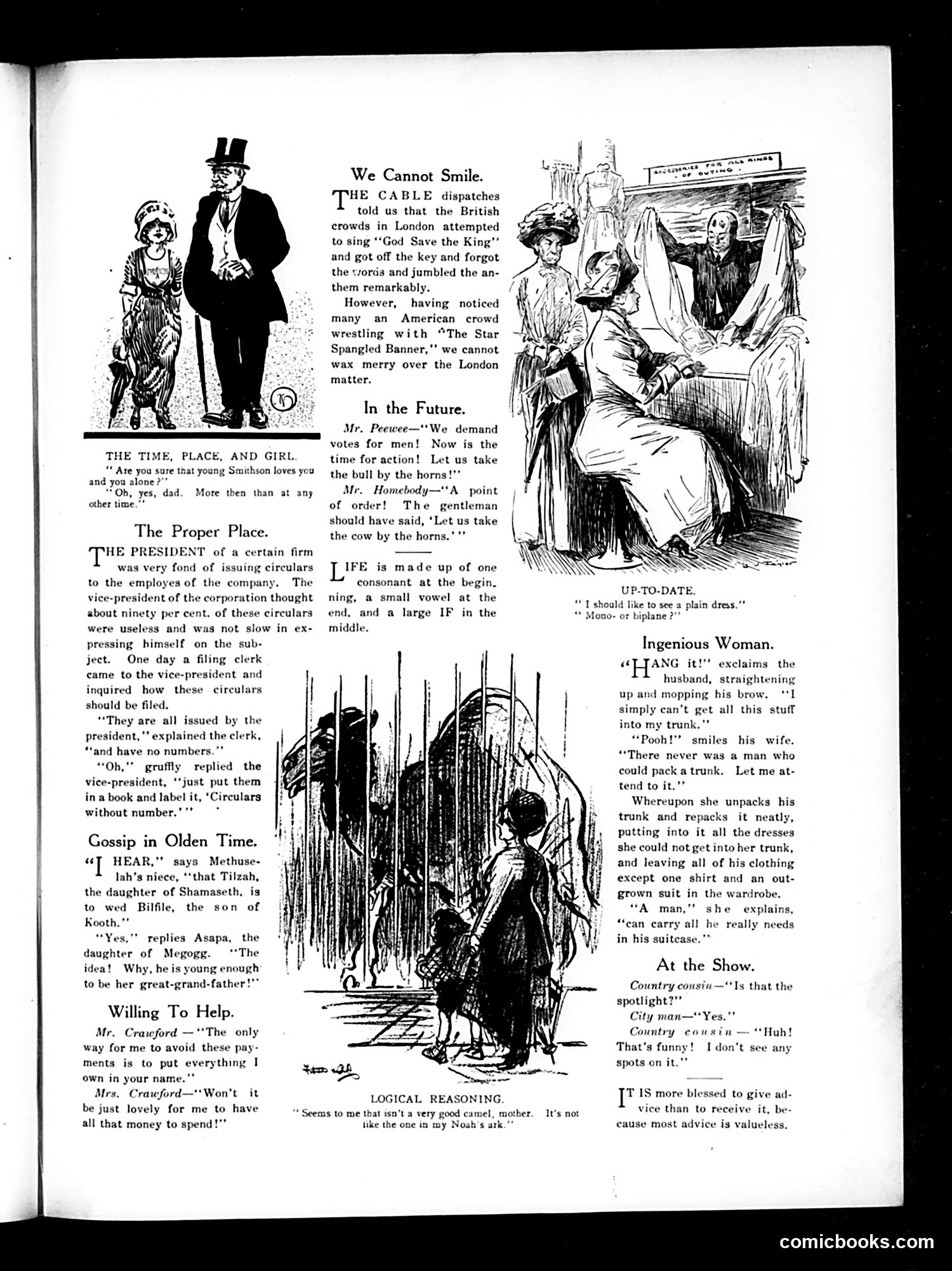
This page contains multiple brief satirical pieces typical of Judge's humor: **"We Cannot Smile"** critiques British crowds who botched the national anthem during a public singing. The joke: Americans shouldn't mock this since American crowds similarly struggle with "The Star-Spangled Banner"—a dig at American civic incompetence. **"The Proper Place"** mocks a verbose corporate president. The vice-president's suggestion to file useless circulars in a book labeled "Circulars without number" is bureaucratic wordplay satirizing office inefficiency. **"In the Future"** appears to reference early 20th-century women's suffrage activism, with "Mr. Peewee" demanding "votes for men" (possibly mocking male anxiety about women's rights). The humor relies on gendered role-reversal. **Other pieces** include domestic comedy ("Ingenious Woman" about packing trunks) and observational humor about modern life ("Up-to-Date" jokes about aviation/fashion terminology). The cartoons emphasize Judge's focus on American social commentary, workplace satire, and gender dynamics of the period.
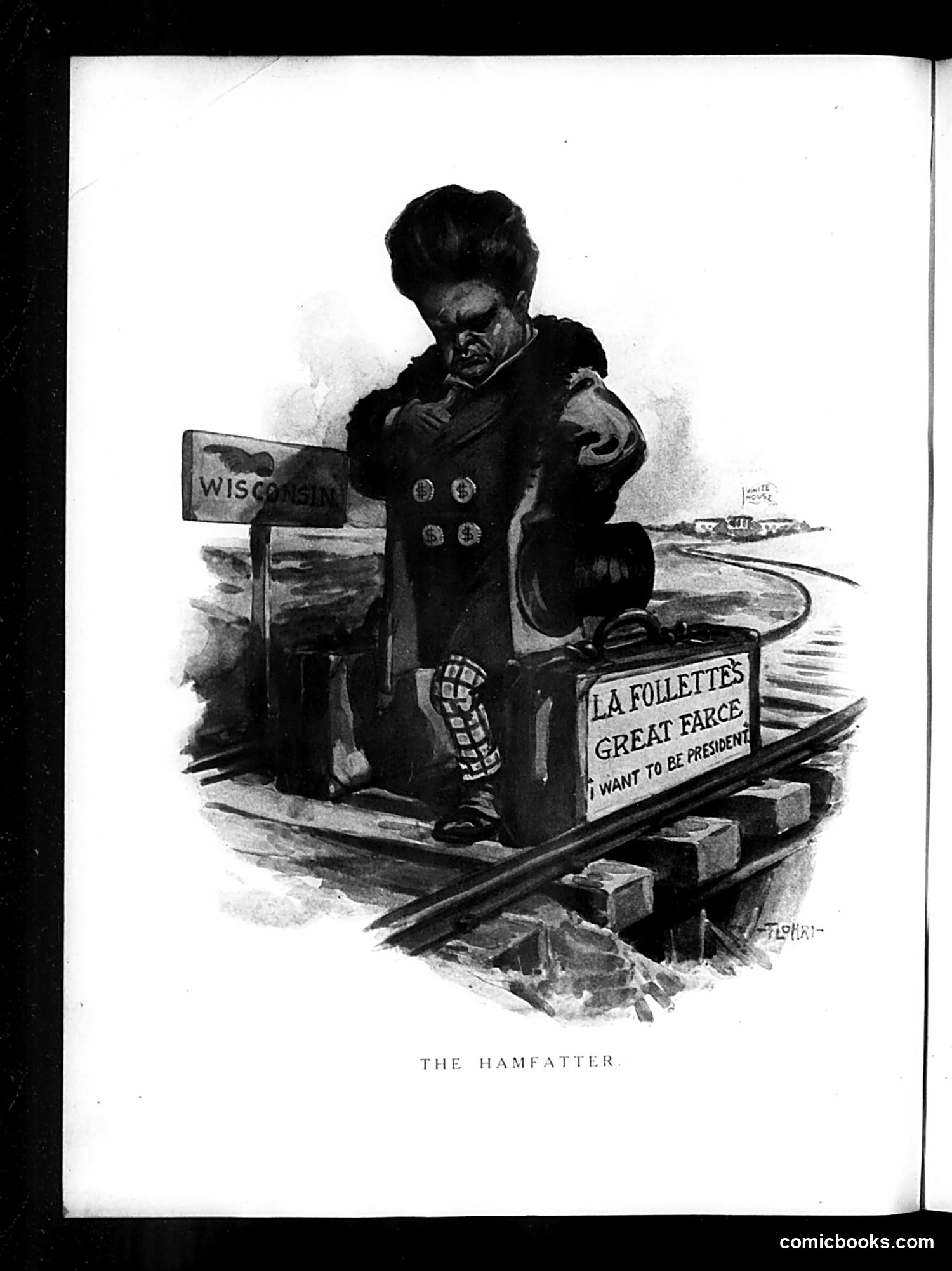
This political cartoon satirizes an incompetent performer—a "hamfatter" being theatrical slang for a bad actor. The caricatured figure wears a double-breasted coat and holds theatrical props while standing on railroad tracks marked "Wisconsin." The signs reference "La Follettes Great Farce" and "I Want to Be President," indicating this mocks Robert M. La Follette's presidential ambitions. The Wisconsin setting reinforces this. The cartoon suggests La Follette's political campaign is mere theatrical ham-acting—an incompetent performance. The railroad tracks and exaggerated caricature emphasize the derision. Judge magazine used such imagery to ridicule political figures deemed unqualified or absurd. The satire attacks both La Follette's credibility and his presidential aspirations as farcical nonsense.
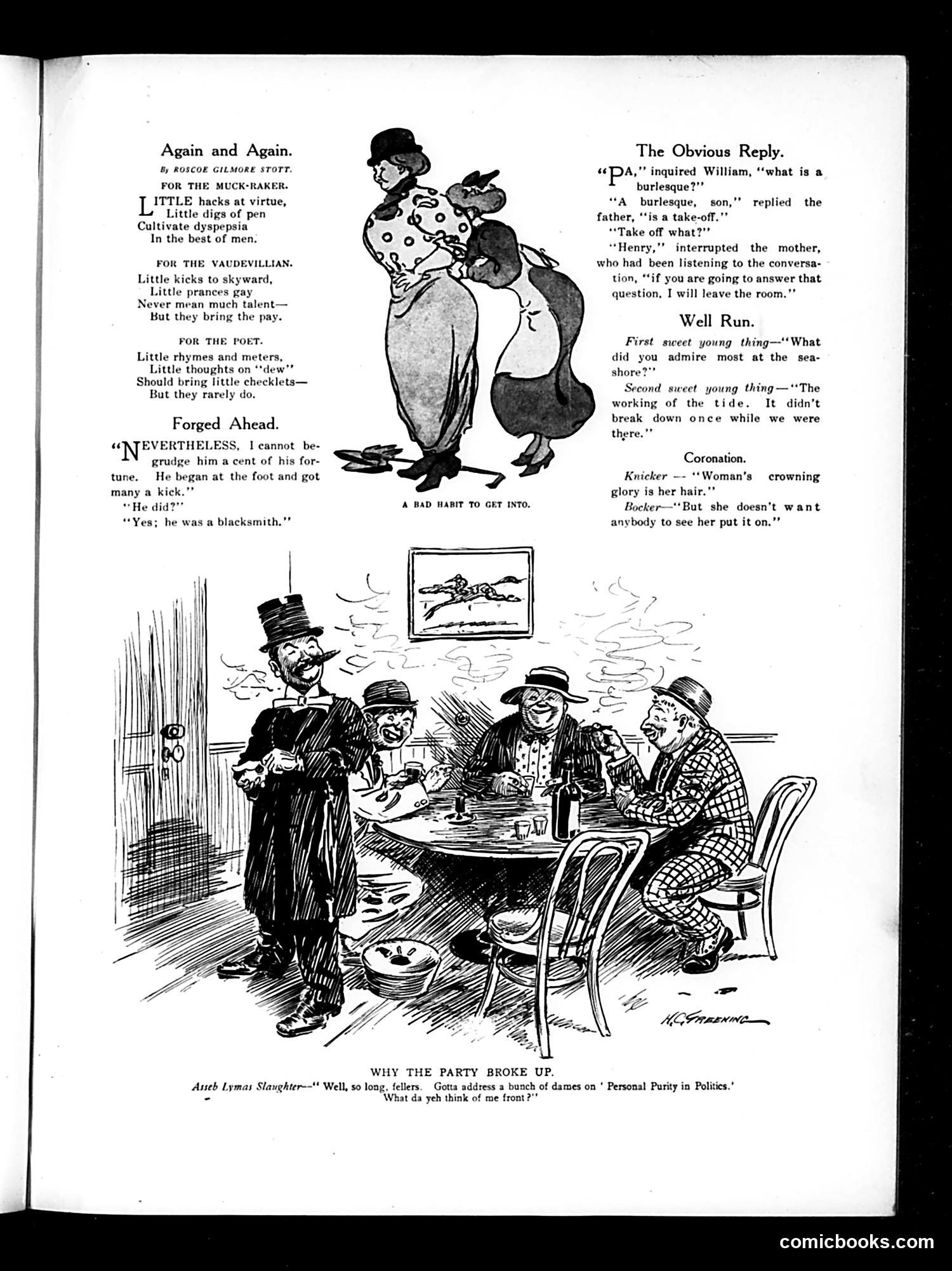
This page contains several short humor pieces and cartoons typical of early 20th-century satirical magazines. **"Again and Again"** by Roscoe Gilmore Stott mocks various professions—journalists ("muck-rakers"), vaudeville performers, and poets—for producing mediocre work that nonetheless succeeds financially. The satire critiques low-quality entertainment that pays well despite lacking merit. **The small jokes** ("The Obvious Reply," "Well Run," "Coronation") are domestic humor playing on double meanings and marital dynamics—standard fare for the era. **"Forged Ahead"** celebrates a blacksmith's self-made success, reflecting turn-of-century American idealization of working-class determination. **The main cartoon "Why the Party Broke Up"** shows a man named "Asseb Lymas Slaughter" (an anagram or fictional name) leaving a gathering, claiming he must address women about "Personal Purity in Politics." The irony is clear: his presence *broke up* the party, and his new lecture topic about virtue appears hypocritical. The satire targets political hypocrisy and moral posturing.
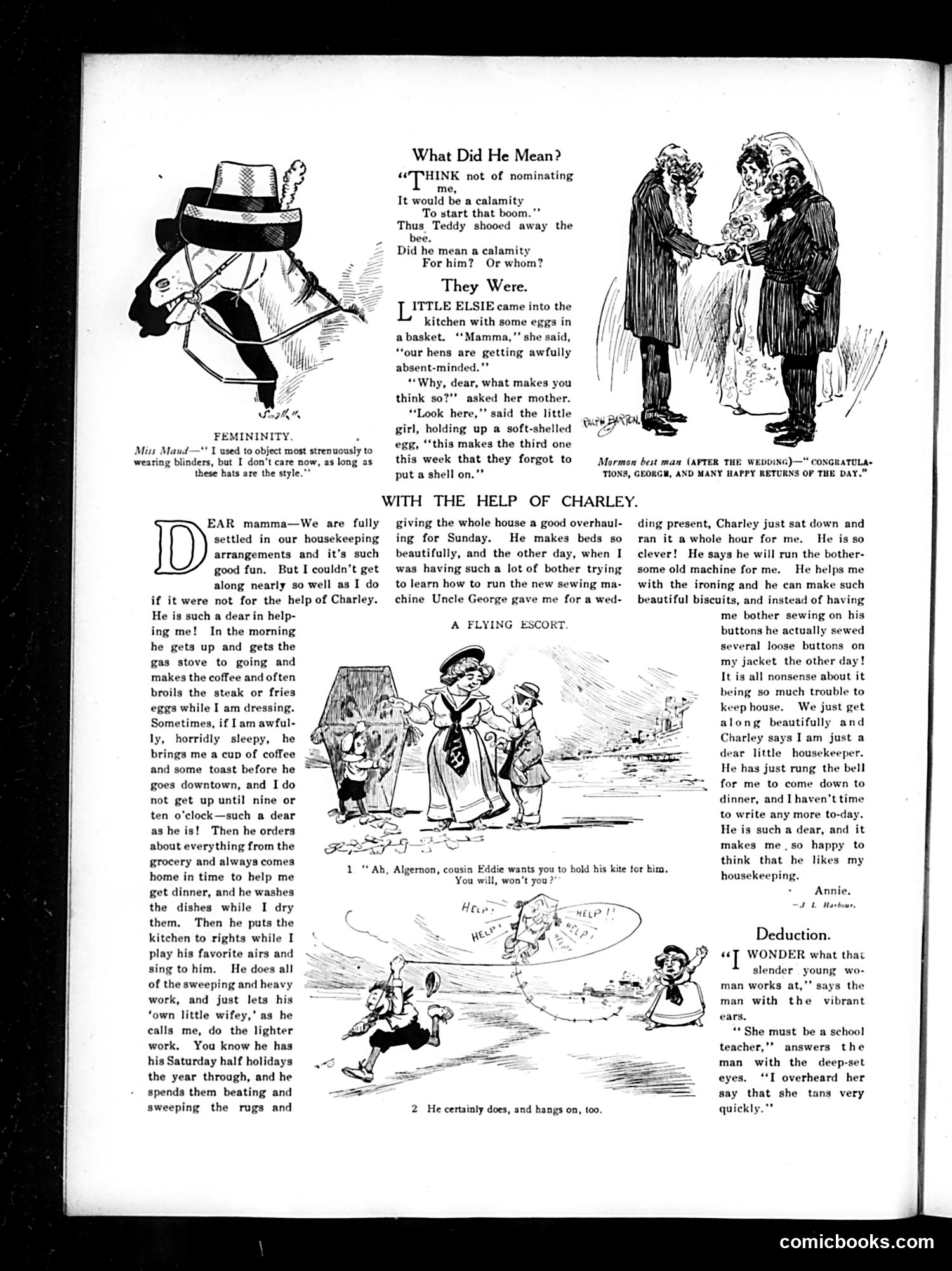
This page contains multiple satirical pieces typical of early 20th-century American humor: **"Femininity" (top left):** A horse wearing a hat jokes about fashion constraints—likely mocking Victorian women's restrictive dress codes and the absurdity of fashion trends. **"With the Help of Charley" (main text):** A wife's gushing letter praising her husband for doing all housework—cooking, cleaning, ironing, sewing—while she plays music and relaxes. The satire is obvious: this inverts traditional gender roles to mock either lazy wives or husbands foolish enough to enable them. Judge's readership would find this ridiculous role-reversal humorous. **"What Did He Mean?":** References Theodore Roosevelt ("Teddy") refusing a presidential nomination, questioning whether the "calamity" he mentions would harm him or the country—political commentary on his ambitions. **"A Flying Escort" and "Deduction":** Brief comic vignettes about kites and a woman's occupation, using wordplay and visual gags. The page satirizes contemporary social anxieties about changing gender roles and marriage dynamics.
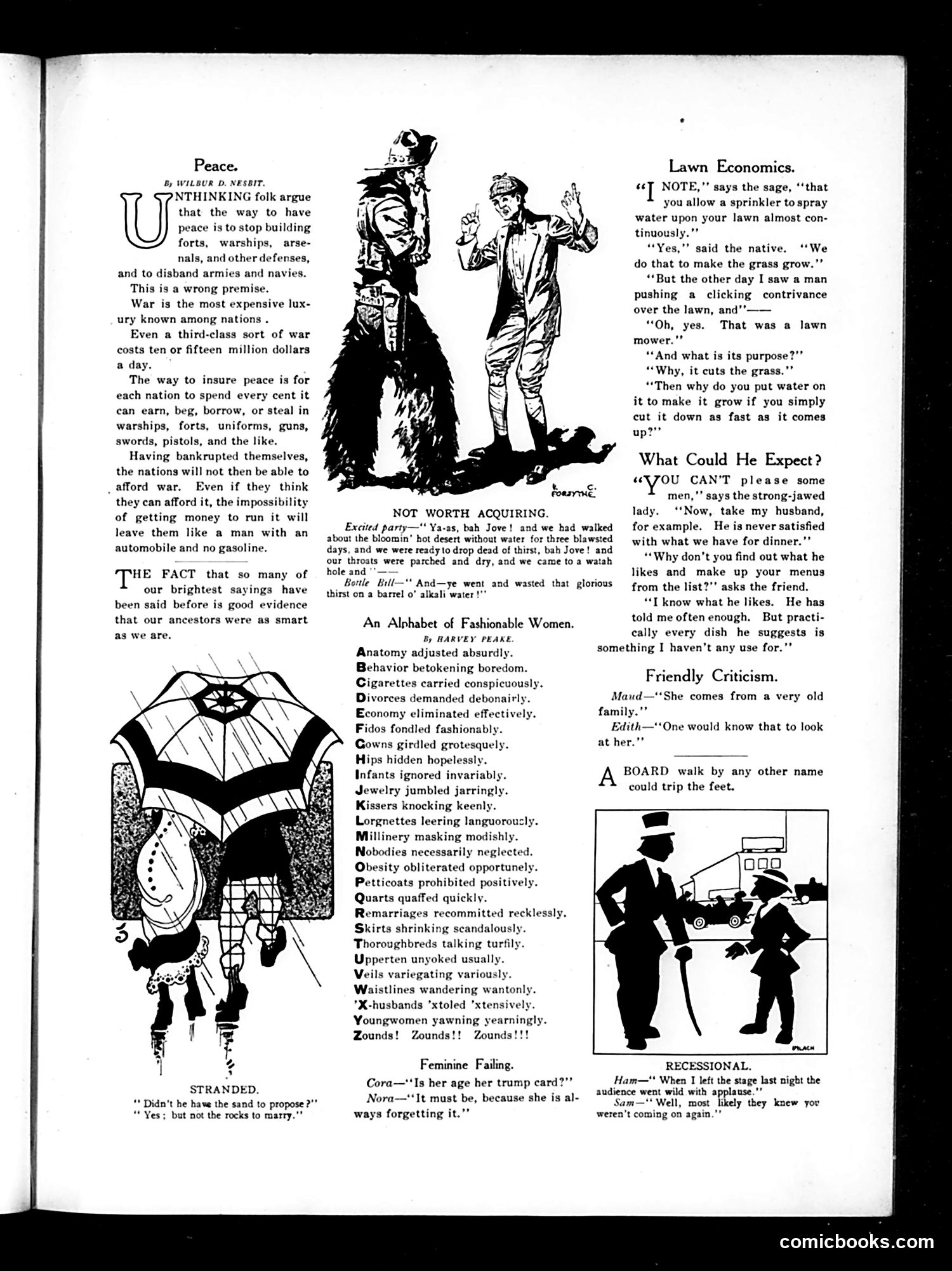
This Judge magazine page contains several satirical pieces mocking early 20th-century social conventions and absurdities: **"Peace"** argues ironically that nations should bankrupt themselves building weapons to prevent war—a critique of escalating military spending. **"Lawn Economics"** ridicules logical inconsistency: why spray water on grass if you're going to mow it down immediately? A pointed joke about pointless effort. **"An Alphabet of Fashionable Women"** sarcastically catalogs upper-class women's affectations—adjusted anatomy, conspicuous cigarette-smoking, shrinking skirts—reflecting anxiety about changing female behavior and fashion. **"What Could He Expect?"** mocks wives who claim to know their husbands' preferences but refuse to cook them, suggesting marital friction over domestic roles. The cartoons and shorter jokes similarly target vanity, pretension, and social hypocrisy among the wealthy. The overall tone is genteel mockery of contemporary manners and gender relations.
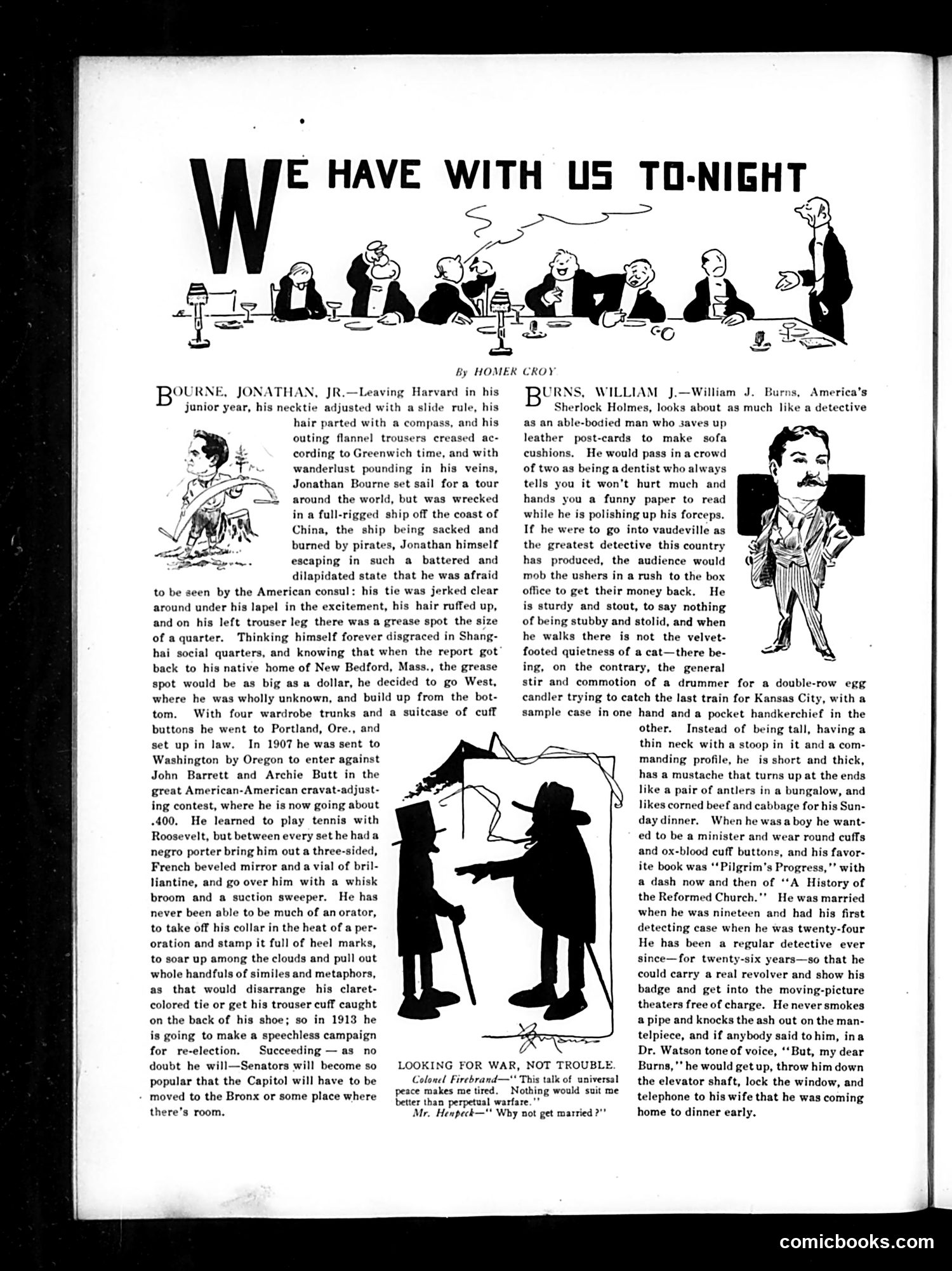
This page presents character sketches by Homer Croy satirizing prominent public figures of the era (circa 1913). **Jonathan Bourne Jr.** is mocked as an absurdly fastidious politician obsessed with grooming—his tie adjusted with a "slide rule," trousers creased "according to Greenwich time." The satire suggests his vanity and pretension make him unfit for serious oratory; he plans a "speechless campaign" because removing his collar might wrinkle his cravat. **William J. Burns**, described as "America's Sherlock Holmes," is lampooned for looking nothing like a detective—he resembles a dentist or traveling salesman rather than the sharp-featured, mysterious investigator the public imagines. The contrast between his unglamorous appearance and his famous reputation is the joke. The bottom cartoon mocks peace advocacy, with a Colonel promoting universal peace while Mr. Henpeck suggests marriage as preferable to war—implying domestic conflict surpasses international strife.
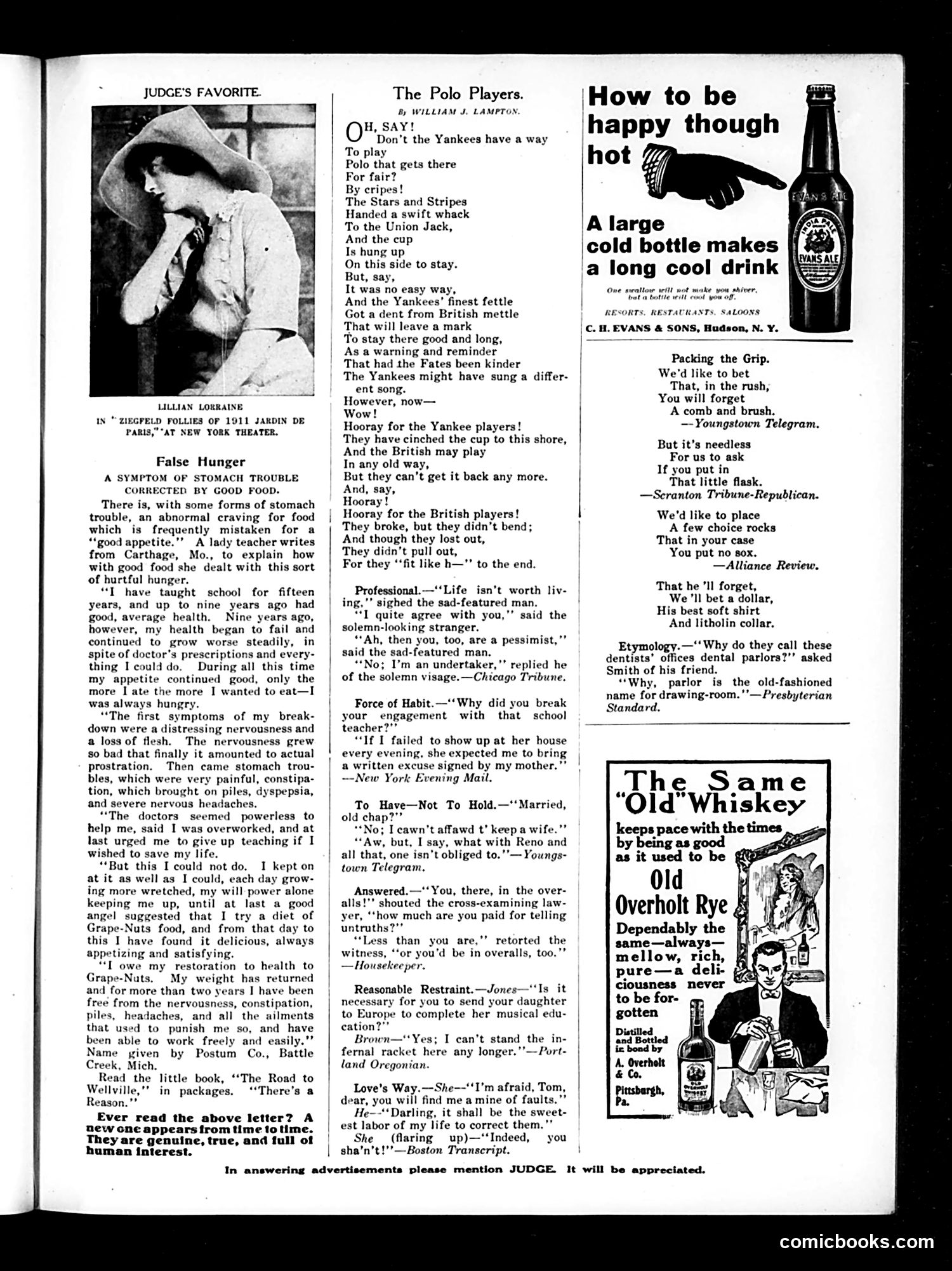
This page contains **Lillian Lorraine**, a Ziegfeld Follies performer, as the featured photo ("Judge's Favorite"), alongside several unrelated content sections. The main satirical poem, "The Polo Players" by William J. Lampton, celebrates **American victory in an international polo match**, likely the 1911 contest. The satire playfully mocks both nations—praising American triumph while acknowledging British sportsmanship ("fit like h—" to the end). The references to "Stars and Stripes" versus "Union Jack" and the cup staying "on this side" indicate nationalistic sporting pride typical of early 20th-century American magazines. The page also includes: a testimonial advertisement for Grape-Nuts cereal (disguised as health advice), and several brief joke sections lampooning undertakers, school teachers, and British divorce customs—typical Judge content mixing advertising with light social commentary. The overall tone reflects 1911 attitudes toward international competition and contemporary social conventions.
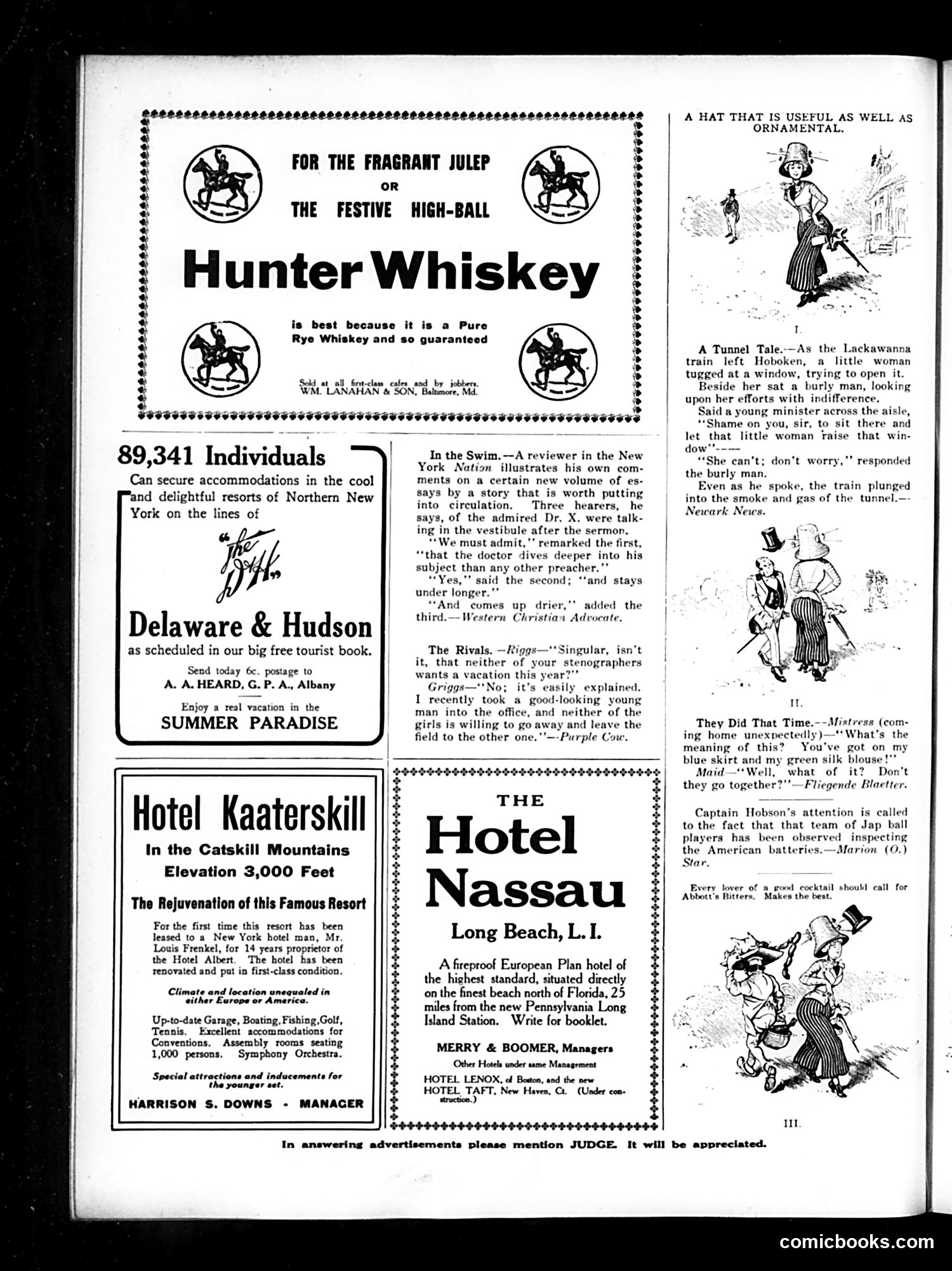
This page is primarily **advertising** with scattered humor pieces. The main content includes: **Advertisements:** Hotel promotions (Kaaterskill, Nassau), Delaware & Hudson railway, and Hunter Whiskey dominate the layout. **Humor Pieces:** The right side contains brief satirical anecdotes: - **"In the Swim"**: Mocks a preacher for being verbose but ultimately shallow—he "dives deeper" but "comes up drier" than other speakers. - **"The Rivals"**: A joke about stenographers reluctant to take vacations because they don't trust each other around the boss, suggesting workplace romantic tension. - **"A Tunnel Tale"**: A minister scolds a man for not helping a woman open a train window; the man dismisses her—then the train enters a tunnel anyway, proving the window wouldn't have helped. - **"They Did That Time"**: A maid accidentally wears her employer's clothes, humorously justifying the mismatch as coordinated. The page reflects early 20th-century American humor: workplace dynamics, gender relations, and everyday ironies.
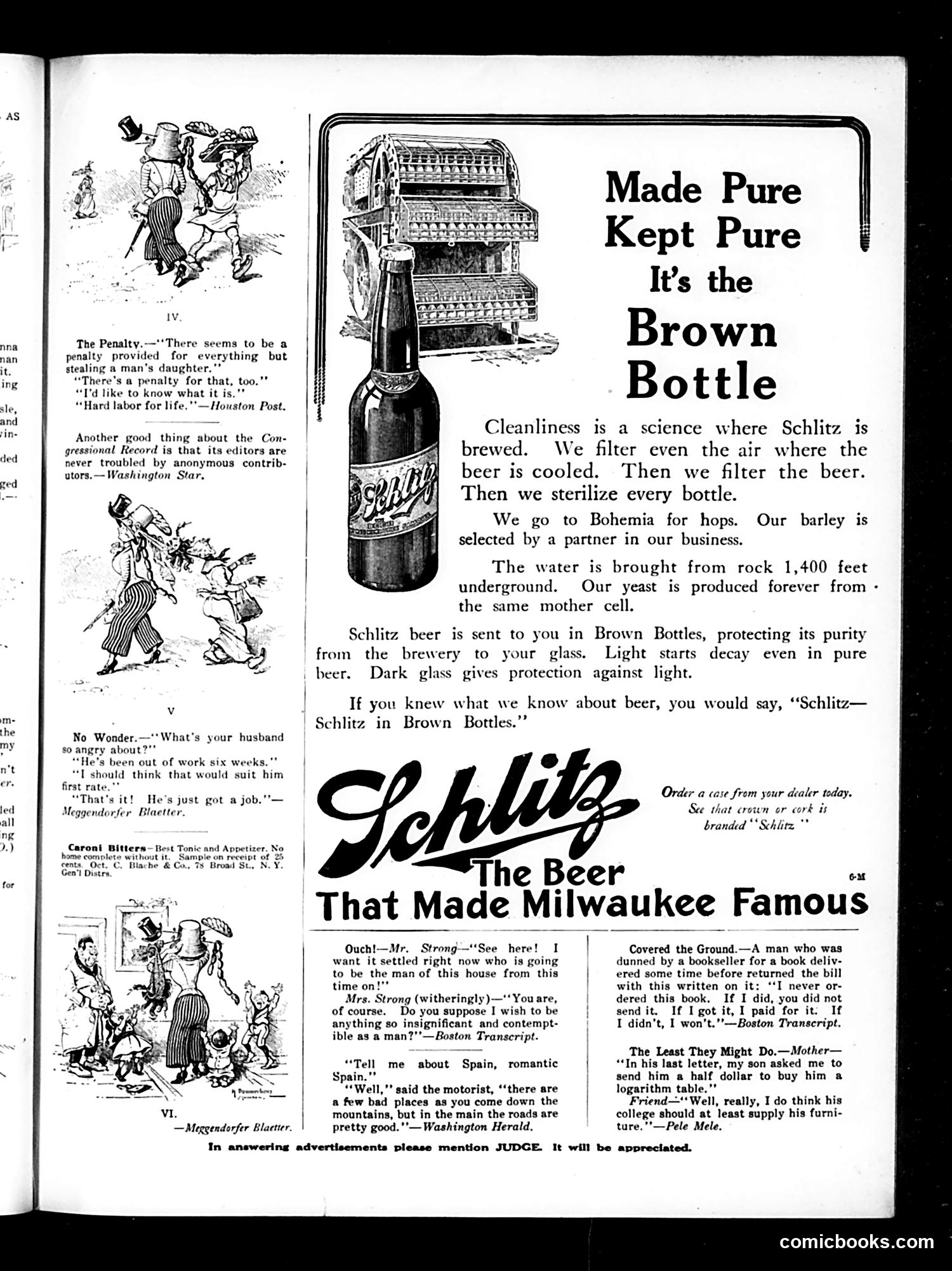
This page contains **brief joke items** (top left) and a **full-page Schlitz beer advertisement** (right side). The jokes are short, reprinted quips from other publications—typical filler for Judge. They mock domestic frustration (a man angry about getting a job after unemployment), marital power dynamics (a wife asserting her dominance), and bureaucratic absurdity (the Congressional Record needing no anonymous contributors because it's already ridiculous). The **Schlitz advertisement** emphasizes purity and scientific manufacturing—"made pure, kept pure"—reflecting early 20th-century consumer anxieties about food/beverage safety. It highlights Bohemian hops, underground water, sterilization, and crucially, the **brown bottle's protection against light decay**. This was marketing strategy: brown glass genuinely protected beer quality better than clear bottles, and Schlitz leveraged this technical advantage as a selling point. The tagline "The Beer That Made Milwaukee Famous" reinforces Milwaukee's status as America's beer capital.
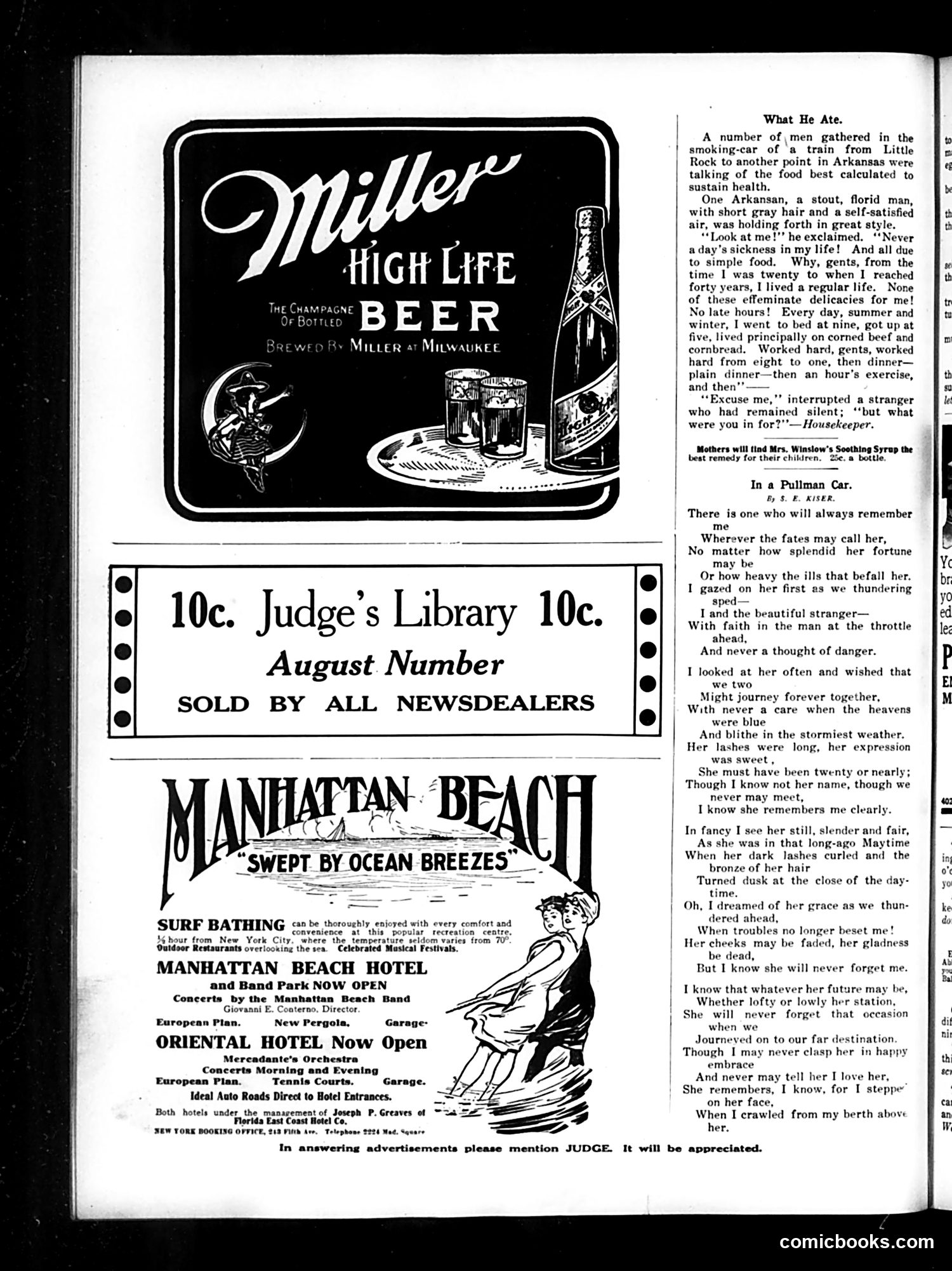
This page contains **primarily advertisements** with one humorous short story. The main comic content is "In a Pullman Car," a brief narrative joke by S.B. Kiser. A man on a train becomes romantically fixated on an attractive young woman passenger, composing sentimental poetry about their fateful meeting and imagining she'll remember him forever. The punchline reveals his delusion: he only "remembers" him because he **stepped on her face while climbing down from an upper berth**—a crude physical comedy ending that undercuts his romantic fantasy. The page is otherwise filled with period advertisements: Miller High Life beer ("The Champagne of Bottled Beers"), Judge's Library (10 cents), and Manhattan Beach resort hotels promoting leisure activities like surf bathing and concerts. The humor exploits the contrast between the narrator's inflated romantic sentimentality and the mundane, embarrassing reality—typical early-20th-century magazine comedy.
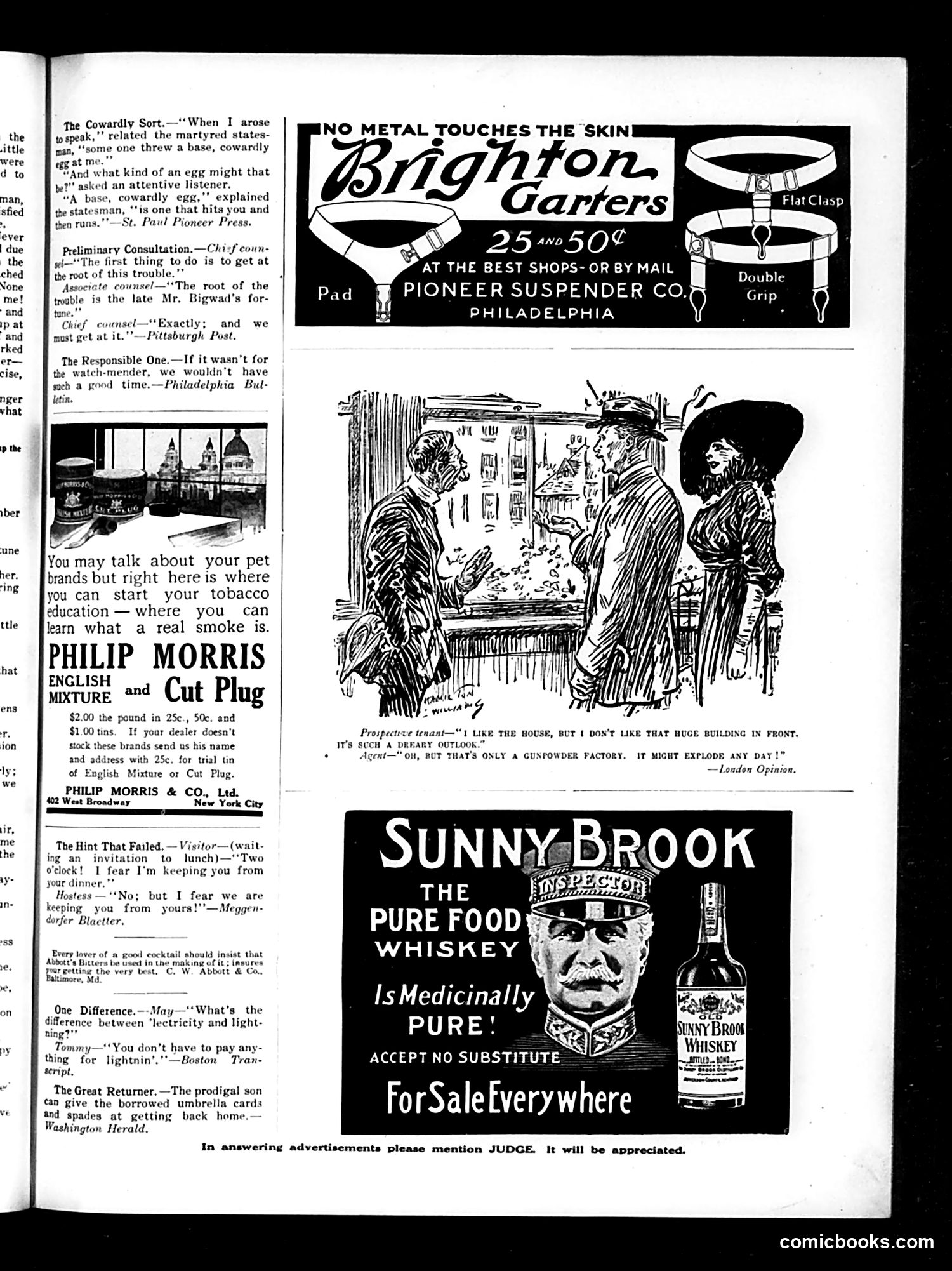
This page from *Judge* contains primarily **short humorous anecdotes and advertisements** rather than political cartoons. The text jokes ("The Cowardly Sort," "Preliminary Consultation," etc.) are brief, punny pieces typical of early 20th-century American humor magazines—wordplay about eggs thrown at speakers, lawyers discussing cases, and social situations. The **one illustration** shows a prospective tenant and real estate agent. The humor hinges on the agent casually mentioning the adjacent building is a gunpowder factory that "might explode any day"—absurd real estate logic presented deadpan. The **advertisements** promote period products: Brighton Garters (suspenders), Philip Morris tobacco, and Sunny Brook whiskey (marketed as "medicinally pure," reflecting Prohibition-era claims that spirits had medicinal value). The garter ad emphasizes "no metal touches the skin," a selling point for comfort. This page reflects early 1900s advertising culture and accessible, pun-based humor typical of *Judge*'s lighter content.
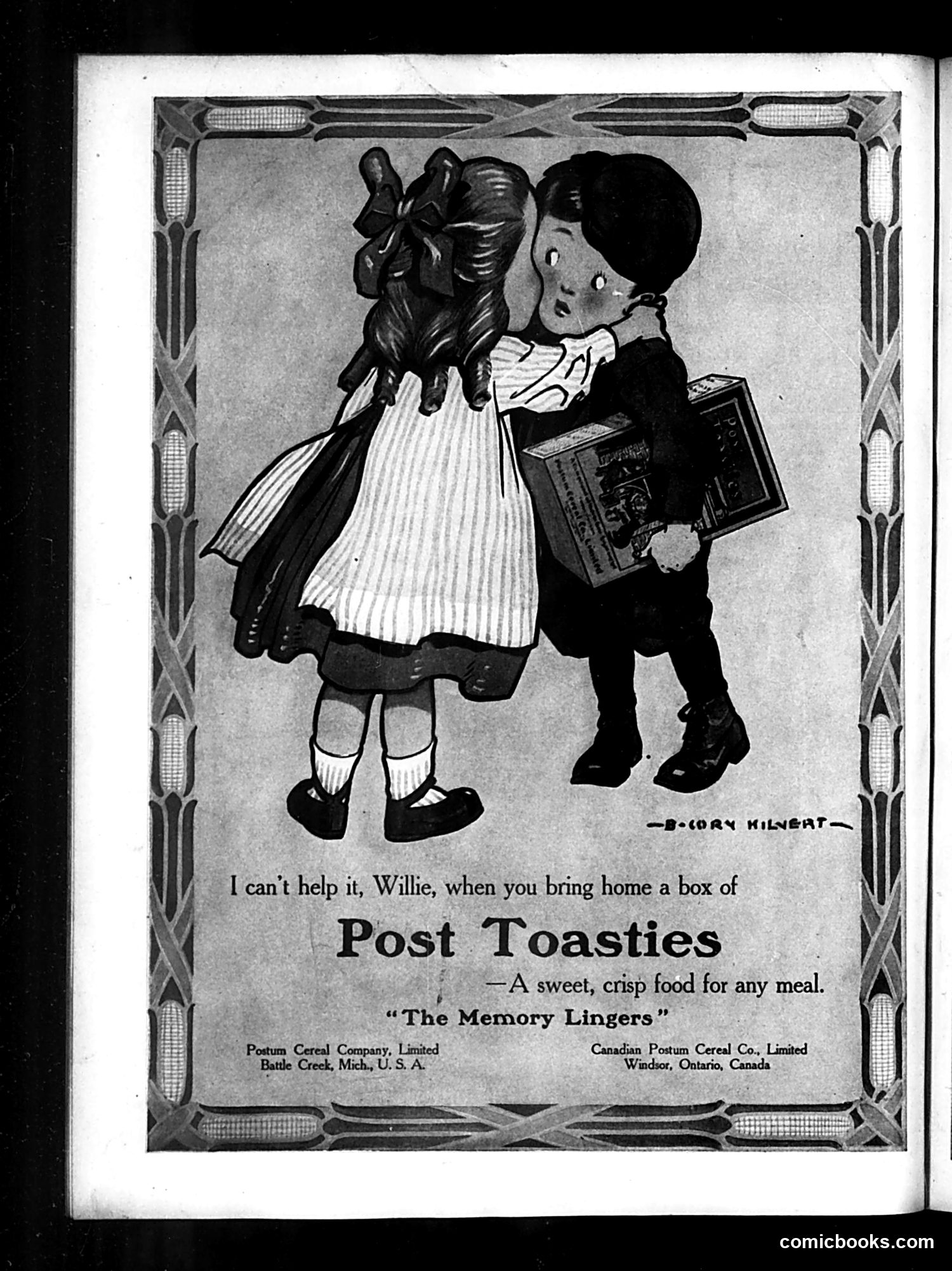
This is a **Post Toasties cereal advertisement** rather than political satire. The illustration by B. Cory Kilvert shows two children—a girl holding a doll and a boy clutching a box of Post Toasties cereal. The girl's caption, "I can't help it, Willie, when you bring home a box of Post Toasties," suggests the product's appeal is irresistible, even to those not initially seeking it. The tagline "The Memory Lingers" emphasizes the cereal's lasting impression. This is typical early-20th-century advertising rhetoric using domestic scenes and children to market breakfast foods. The decorative border frames the ad in Judge magazine's style. There is no political commentary—it's straightforward commercial promotion.