
Judge, 1911-07-29 · page 9 of 24
Judge — July 29, 1911 — page 9: what you’re looking at
What you’re looking at
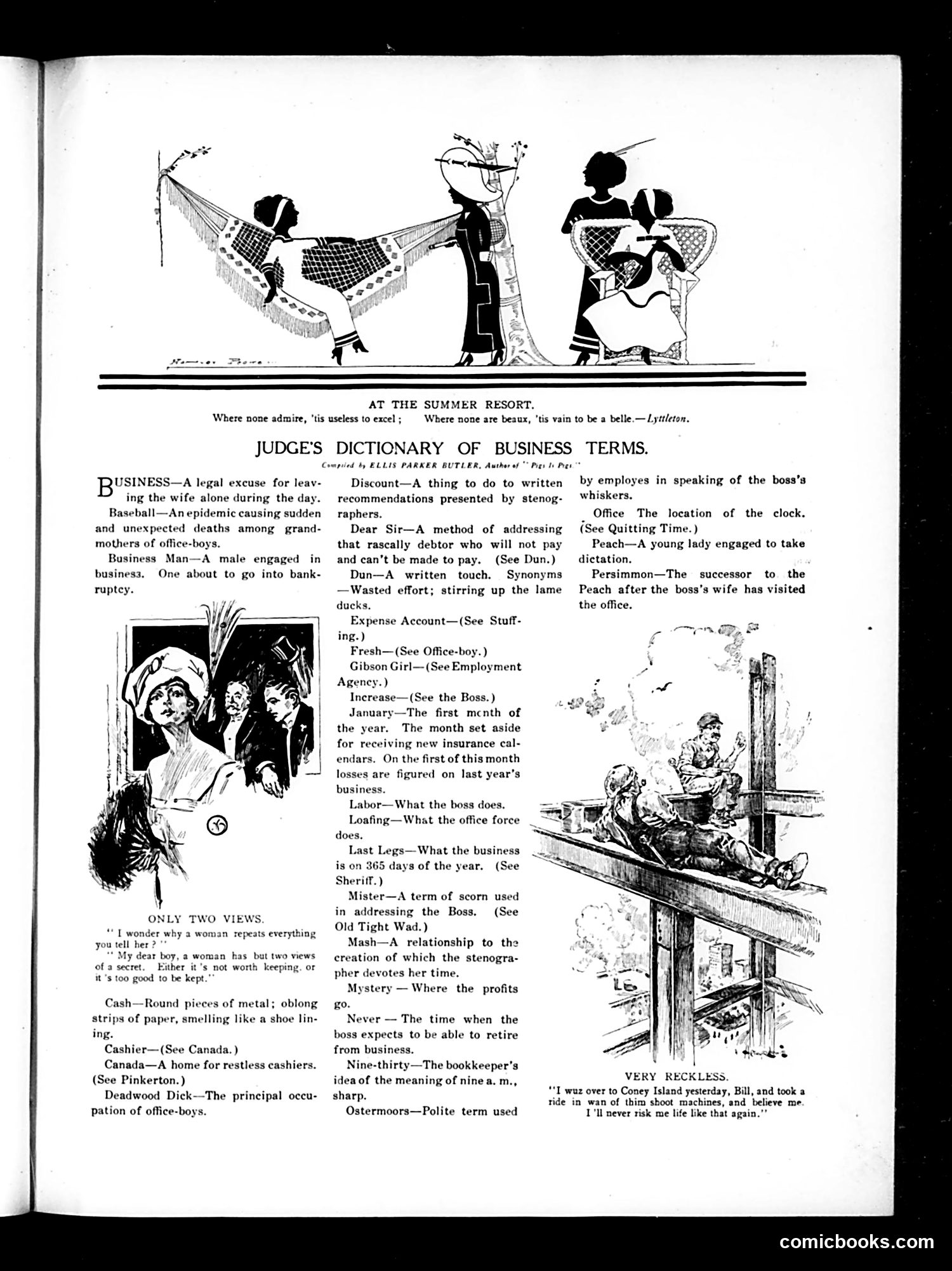
This page contains two distinct satirical pieces from Judge magazine: **"At the Summer Resort"** (top): A humorous illustration of women at leisure, with a Lydia epigraph about beauty and admiration. The cartoon mocks vanity and social pretension among wealthy summer visitors. **"Judge's Dictionary of Business Terms"** (main content): A mock dictionary compiled by Ellis Parker Butler that satirizes workplace hypocrisy and class relations. The definitions invert or expose uncomfortable truths: "Business" excuses husbands abandoning wives; "Labor" means what the boss does while "Loafing" is what workers do; "Mystery" is where profits vanish. The humor relies on readers recognizing the gap between official business language and actual office behavior—exploitative bosses, underpaid stenographers, incompetent timekeeping, and casual dishonesty. **"Very Reckless"** (bottom right): A brief comic about someone terrified by a Coney Island amusement ride, contrasting his fear of machines with workers' actual workplace dangers. The page satirizes American industrial capitalism and office culture circa early 1900s.
📄 Transcribed text from this page (OCR, searchable)
Machine-transcribed from the original scan — historical spelling and the odd misread are preserved.
Where none admire, ‘tis useless to excel ; AT THE SUMMER RESORT. Where none are beaux, ‘tis vain to be a belle.— Lyttleton. JUDGE'S DICTIONARY OF BUSINESS TERMS. USINESS—A legal excuse for leav- ing the wife alone during the day. Baseball—An epidemic causing sudden and unexpected deaths among grand- mothers of office-boys. Business Man—A male engaged in One about to go into bank- Wy business. ruptey. Za ONLY TWO VIEWS “ Lwonder why a woman repeats everything you tell her ? “* My dear boy, a woman has but two views of a secret. Either it’s not worth keeping. or it's too good to be kept.”” Cash—Round pieces of metal; oblong strips of paper, smelling like a shoe lin- ing. Cashier—(See Canada. ) Canada—A home for restless cashiers. (See Pinkerton.) Deadwood Dick—The principal occu- pation of office-boys. Compiled by ELLIS PARKER BUTLER, Author of ” Discount—A thing to do to written recommendations presented by stenog- raphers. Dear Sir—A method of addressing that rascally debtor who will not pay and can’t be made to pay. (See Dun.) Dun—A written touch. Synonyms —Wasted effort; stirring up the lame ducks. Expense Account—(See Stuff- ing.) Fresh—(See Office-boy.) Gibson Girl—(See Employment Agency.) Increase—(See the Boss.) January—The first mcnth of the year. The month set aside for receiving new insurance cal- endars. On the first of this month losses are figured on last year’s business. Labor—What the boss does. Loafing—What the office force does. Last Legs—What the business is on 365 days of the year. (See Sheriff.) Mister—A term of scorn used in addressing the Boss, (See Old Tight Wad.) Mash—A relationship to the creation of which the stenogra- pher devotes her time. Mystery — Where the profits go. Never — The time when the boss expects to be able to retire from business. Nine-thirty—The bookkeeper's idea of the meaning of nine a. m., sharp. Ostermoors—Polite term used Pas Pee by employes in speaking of the boss's whiskers, Office The location of the clock. (See Quitting Time.) Peach—A young lady engaged to take dictation. Persimmon—The successor to the Peach after the boss’s wife has visited the office. VERY RECKLESS. “*I wuz over to Coney Island yesterday, Bill, and took a ride in wan of thim shoot machines, and believe me. I'll never risk me life like that again." comicbooks.com