
Judge, 1911-07-29 · page 18 of 24
Judge — July 29, 1911 — page 18: what you’re looking at
What you’re looking at
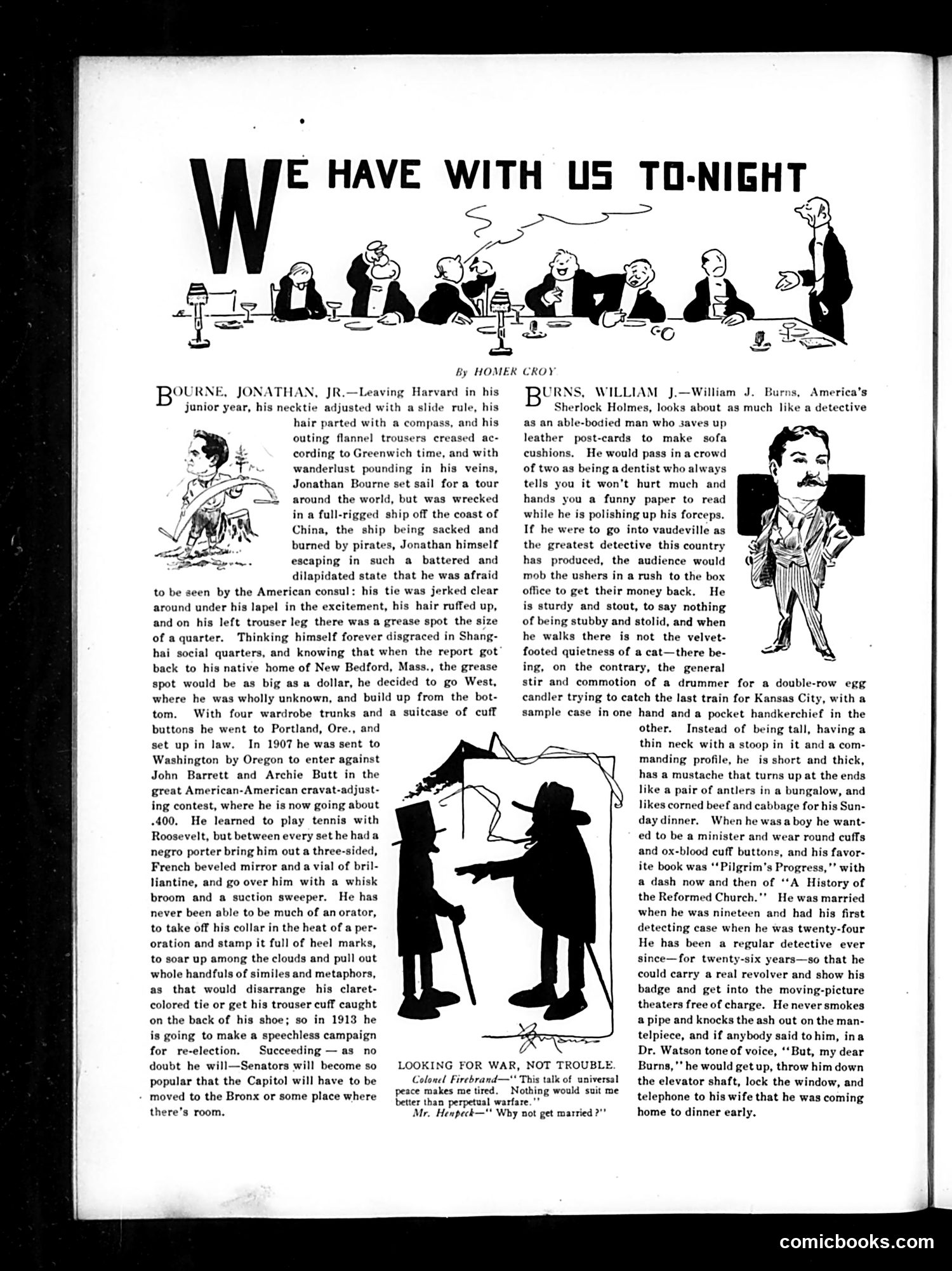
This page presents character sketches by Homer Croy satirizing prominent public figures of the era (circa 1913). **Jonathan Bourne Jr.** is mocked as an absurdly fastidious politician obsessed with grooming—his tie adjusted with a "slide rule," trousers creased "according to Greenwich time." The satire suggests his vanity and pretension make him unfit for serious oratory; he plans a "speechless campaign" because removing his collar might wrinkle his cravat. **William J. Burns**, described as "America's Sherlock Holmes," is lampooned for looking nothing like a detective—he resembles a dentist or traveling salesman rather than the sharp-featured, mysterious investigator the public imagines. The contrast between his unglamorous appearance and his famous reputation is the joke. The bottom cartoon mocks peace advocacy, with a Colonel promoting universal peace while Mr. Henpeck suggests marriage as preferable to war—implying domestic conflict surpasses international strife.
📄 Transcribed text from this page (OCR, searchable)
Machine-transcribed from the original scan — historical spelling and the odd misread are preserved.
at << By HOMER CROY OURNE, JONATHAN, JR.—Leaving Harvard in his junior year, his necktie adjusted with a slide rule, his hair parted with a compass, and his outing flannel trousers creased ac- cording to Greenwich time, and with wanderlust pounding in his veins, Jonathan Bourne set sail for a tour around the world, but was wrecked in a full-rigged ship off the coast of China, the ship being sacked and burned by pirates, Jonathan himself escaping in such a battered and dilapidated state that he was afraid to be seen by the American consul: his tie was jerked clear around under his lapel in the excitement, his hair ruffed up, and on his left trouser leg there was a grease spot the size of aquarter. Thinking himself forever disgraced in Shang- hai social quarters, and knowing that when the report got back to his native home of New Bedford, Mass., the grease spot would be as big as a dollar, he decided to go West, where he was wholly unknown, and build up from the bot- tom. With four wardrobe trunks and a suitcase of cuff buttons he went to Portland, Ore., and set up in law. In 1907 he was sent to Washington by Oregon to enter against John Barrett and Archie Butt in the great American-American cravat-adjust- ing contest, where he is now going about -400. He learned to play tennis with Roosevelt, but between every set he hada negro porter bring him out a three-sided, French beveled mirror and a vial of bril- liantine, and go over him with a whisk broom and a suction sweeper. He has never been able to be much of an orator, to take off his collar in the heat of a pe oration and stamp it full of heel marks, to soar up among the clouds and pull out whole handfuls of similes and metaphors, as that would disarrange his claret- colored tie or get his trouser cuff caught on the back of his shoe; so in 1913 he is going to make a speechless campaign for re-election. Succeeding — as no doubt he will—Senators will become so popular that the Capitol will have to be moved to the Bronx or some place where there’s room. AE ¥ 7 aa om» peace makes me tired. LOOKING FOR WAR, NOT TROUBLE. Colonel Firebrand—** This talk of universal better than perpetual warfare Mr. Henpeck—"" Why not get married 2" URNS, WILLIAM J.—William J. Burns, America’s Sherlock Holmes, looks about as much like a detective as an able-bodied man who saves up leather post-cards to make sofa cushions. He would pass in a crowd of two as being a dentist who always tells you it won't hurt much and hands you a funny paper to read while he is polishing up his forceps. If he were to go into vaudeville as the greatest detective this country has produced, the audience would mob the ushers in a rush to the box office to get their money back. He is sturdy and stout, to say nothing of being stubby and stolid, and when he walks there is not the velvet- footed quietness of a cat—there be- ing, on the contrary, the general stir and commotion of a drummer for a double-row egg candler trying to catch the last train for Kansas City, with a sample case in one hand and a pocket handkerchief in the other. Instead of being tall, having a thin neck with a stoop in it and a com- manding profile, he is short and thick, has a mustache that turns up at the ends like a pair of antlers in a bungalow, and likes corned beef and cabbage for his Sun- day dinner. When he was a boy he want- ed to be a minister and wear round cuffs and ox-blood cuff buttons, and his favor- ite book was ‘Pilgrim's Progress,"’ with a dash now and then of ‘‘A History of the Reformed Church."* He was married when he was nineteen and had his first detecting case when he was twenty-four He has been a regular detective ever since—for twen ix years—so that he could carry a real revolver and show his badge and get into the moving-picture theaters free of charge. He never smokes a pipe and knocks the ash out on the man- telpiece, and if anybody said tohim, ina Dr. Watson tone of voice, ‘‘But, my dear Burns,"’ he would get up, throw him down the elevator shaft, lock the window, and Nothing would suite telephone to his wife that he was coming home to dinner early. comicbooks.com