
Judge, 1911-07-29 · page 7 of 24
Judge — July 29, 1911 — page 7: what you’re looking at
What you’re looking at
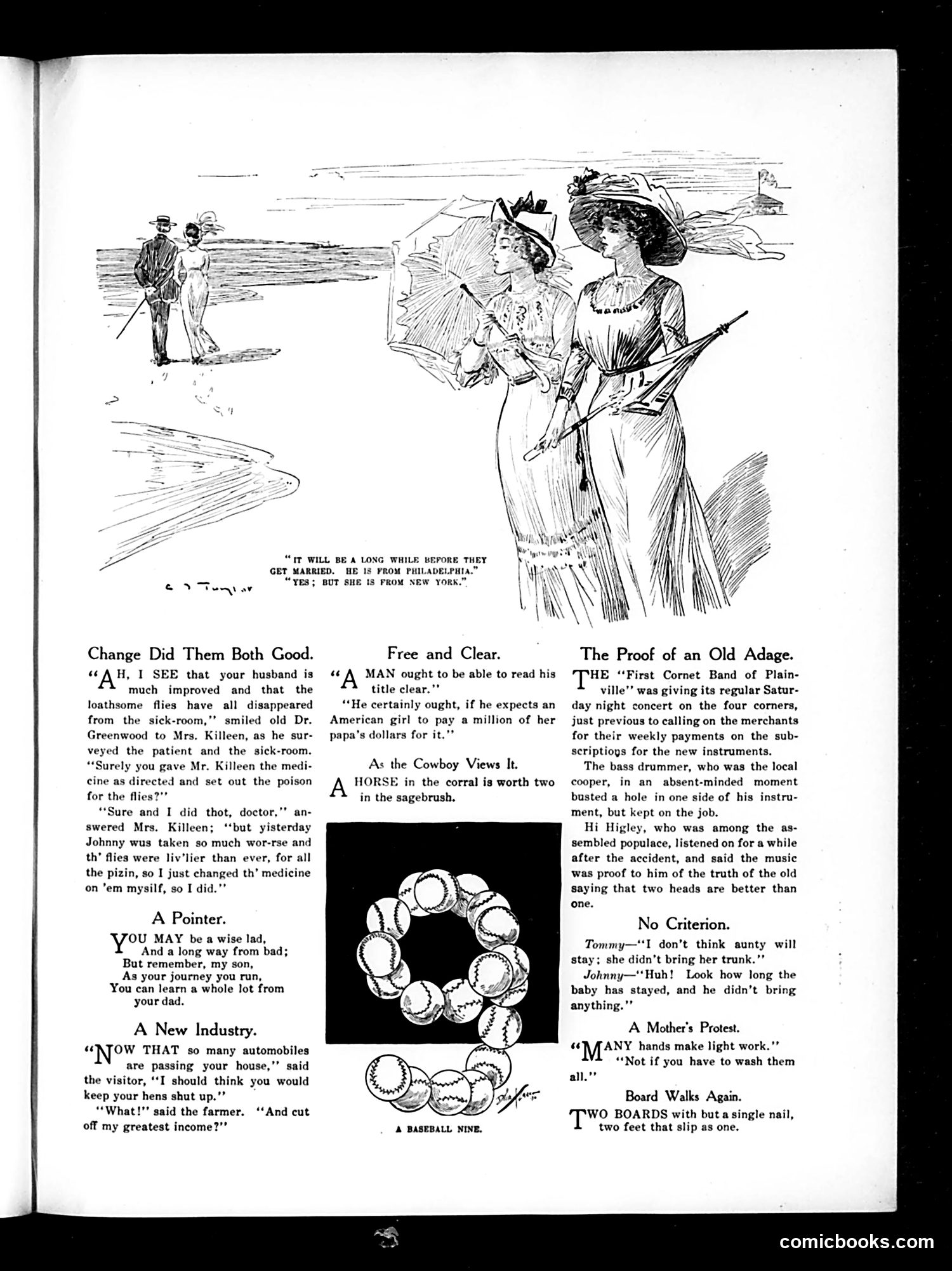
This page contains several short humorous pieces typical of early 20th-century American satire: **Main Cartoon (top):** Features two fashionable women with parasols on a beach discussing courtship delays. The joke plays on regional prejudice—one woman is from Philadelphia, the other from New York, implying their different origins complicate romance. **Short Pieces Below:** - "Change Did Them Both Good": An Irish immigrant woman (indicated by dialect) accidentally improves her husband's condition by changing his medicine herself, outwitting the doctor - "A New Industry": A farmer welcomes automobiles passing his house because he profits from killing hens (presumably hit by cars) for income - Several brief jokes about marriage, literacy, and rural life **Context:** The humor relies on ethnic stereotypes (Irish servants), class commentary (wealthy suitors, working farmers), and period-specific references (automobiles as novelty, cornet bands as community institutions). The satire targets social pretension, marital complications, and rural-urban differences characteristic of early 1900s American society.
📄 Transcribed text from this page (OCR, searchable)
Machine-transcribed from the original scan — historical spelling and the odd misread are preserved.
“IT WILL BE A LONG WHILE BEFORE THEY GET MARRIED. “YES; BUT SHE 1S FROM NE Teor Change Did Them Both Good. «¢ A H, I SEE that your husband is much improved and that the loathsome flies have all disappeared from the sick-room,"’ smiled old Dr. Greenwood to Mrs. Killeen, as he sur- veyed the patient and the sick-room. “Surely you gave Mr. Killeen the medi- cine as directed and set out the poison for the flies?’ “Sure and I did thot, doctor,’’ an- swered Mrs. Killeen; ‘‘but yisterday Johnny wus taken so much wor-rse and th’ flies were liv’lier than ever, for all the pizin, so I just changed th’ medicine on ’em mysilf, so I did.’" A Pointer. ‘OU MAY be a wise lad, And a long way from bad; But remember, my son, As your journey you run, You can learn a whole lot from your dad. A New Industry. “now THAT so many automobiles are passing your house,’’ said the visitor, ‘‘I should think you would keep your hens shut up.”” “*What!"’ said the farmer. off my greatest income?” “And cut HE “A DELPHIA.” York.” 18 FROM Pull Free and Clear. MAN ought to be able to read his title clear."’ “He certainly ought, if he expects an American girl to p: papa’ A! y a million of her 's dollars for it.”* As the Cowboy Views It. 1ORSE in the corral is worth two in the sagebrush. A BASEBALL NINE. The Proof of an Old Adage. HE ‘First Cornet Band of Plain- ville’? was giving its regular Satur- day night concert on the four corners, just previous to calling on the merchants for their weekly payments on the sub- scriptioys for the new instruments. The bass drummer, who was the local cooper, in an absent-minded moment busted a hole in one side of his instru- ment, but kept on the job. Hi Higley, who was among the as- sembled populace, listened on for a while after the accident, and said the music was proof to him of the truth of the old saying that two heads are better than one. No Criterion. Tommy—'I don’t think aunty will stay; she didn’t bring her trunk.’ Johnny—'Huh! Look how long the baby has stayed, and he didn’t bring anything.'’ A Mother's Protest. “MANY hands make light work.’’ “Not if you have to wash them all.’” Board Walks Again. ‘WO BOARDS with buta single nail, two feet that slip as one. comicbooks.com