
A complete issue · 24 pages · 1911
Judge — May 27, 1911
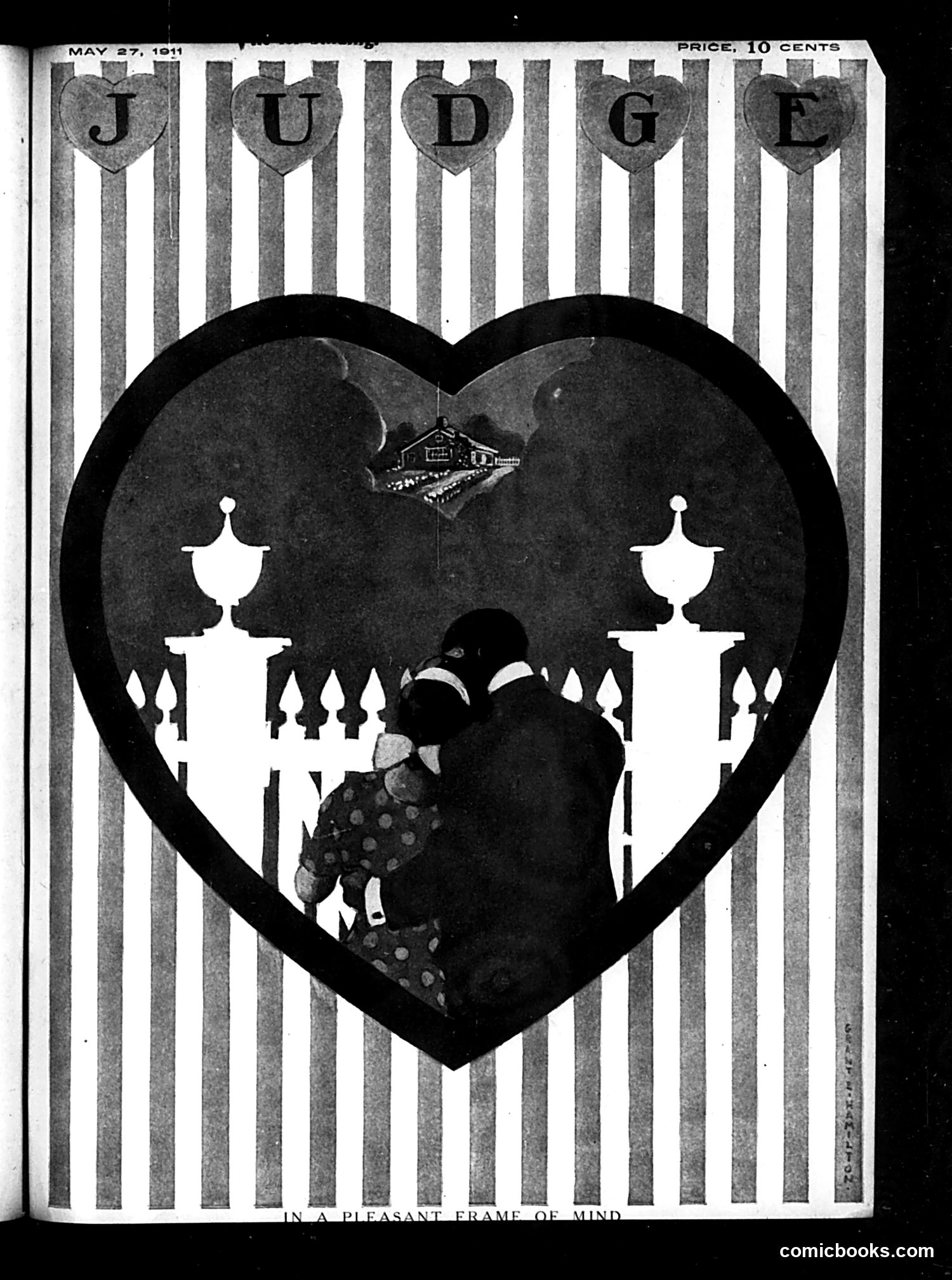
This cover illustration titled "In a Pleasant Frame of Mind" depicts a romantic scene framed within a large heart shape. Two figures (appearing to be a courting couple) are shown in silhouette against a pastoral background featuring a mansion and formal gardens with ornamental urns and hedges. The word "JUDGE" appears spelled across the top in heart-shaped cartouches against vertical stripes, establishing this as the magazine's masthead design. The satire appears to celebrate romantic love and courtship, using the elaborate formal estate setting to suggest wealth or social aspiration. The "pleasant frame of mind" subtitle suggests ironic commentary on the idealized nature of romantic sentiment—possibly poking fun at sentimental attitudes toward love or marriage among the affluent classes that Judge typically satirized.
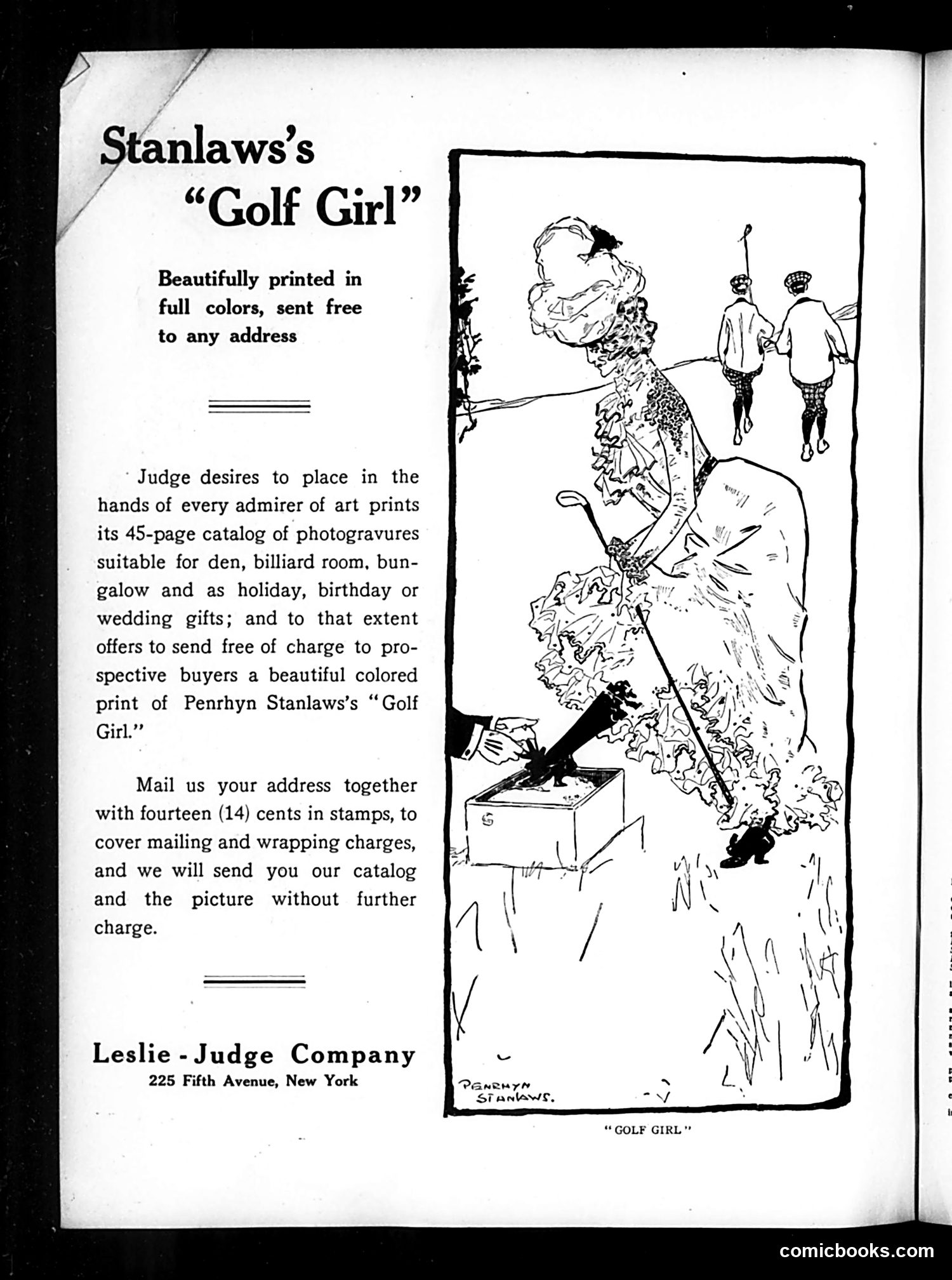
This page is primarily **advertising**, not satire. It promotes Penrhyn Stanlaw's "Golf Girl" print through the Leslie-Judge Company in New York. The illustration depicts a fashionably dressed woman on a golf course, swinging a club while two male golfers observe in the background. The woman wears an elaborate, decorative dress typical of early 20th-century fashion—the satire here is gentle social commentary about women's golf participation while maintaining impractical Victorian/Edwardian dress standards. The ad offers a free colored reproduction of this print to prospective buyers who send fourteen cents in stamps. The accompanying 45-page catalog featured prints suitable for home decoration as gifts. This represents typical Judge magazine cross-promotion and merchandising practices from the era.
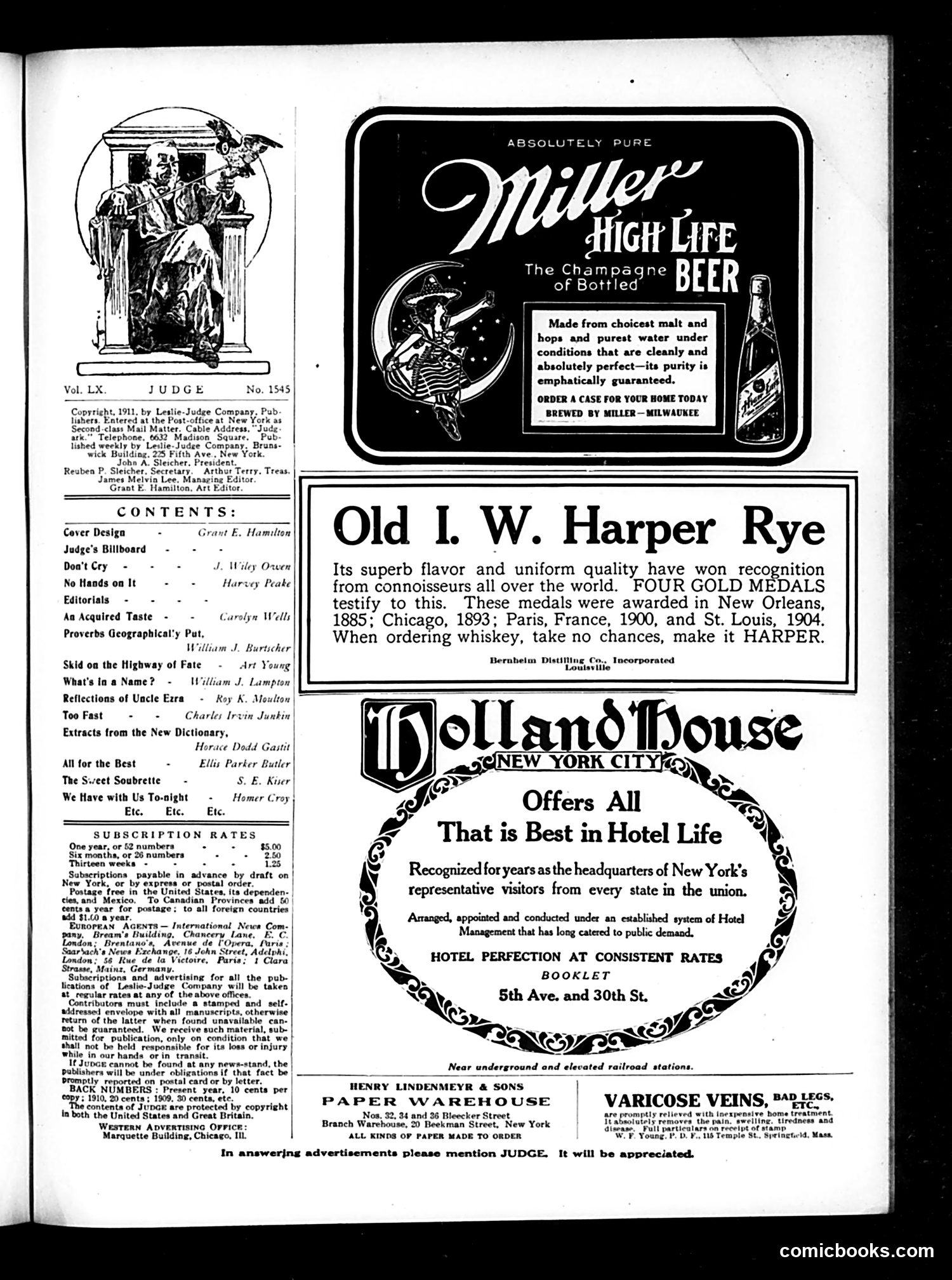
This page is primarily **advertising**, not editorial content or political satire. The dominant advertisements are for: 1. **Miller High Life Beer** - emphasizing purity and quality, promoting home orders by the case 2. **Old I.W. Harper Rye Whiskey** - highlighting four gold medals won at international expositions (1885-1904) 3. **Holland House Hotel** in New York City - promoting luxury accommodations The left sidebar shows a **Judge magazine masthead illustration** (artist Grant E. Hamilton) depicting a classical figure, which is the publication's recurring decorative element rather than topical satire. The page's contents listing indicates the issue includes editorial cartoons and humor pieces, but those aren't visible in this reproduction—we're viewing the back matter and advertising section of the magazine.
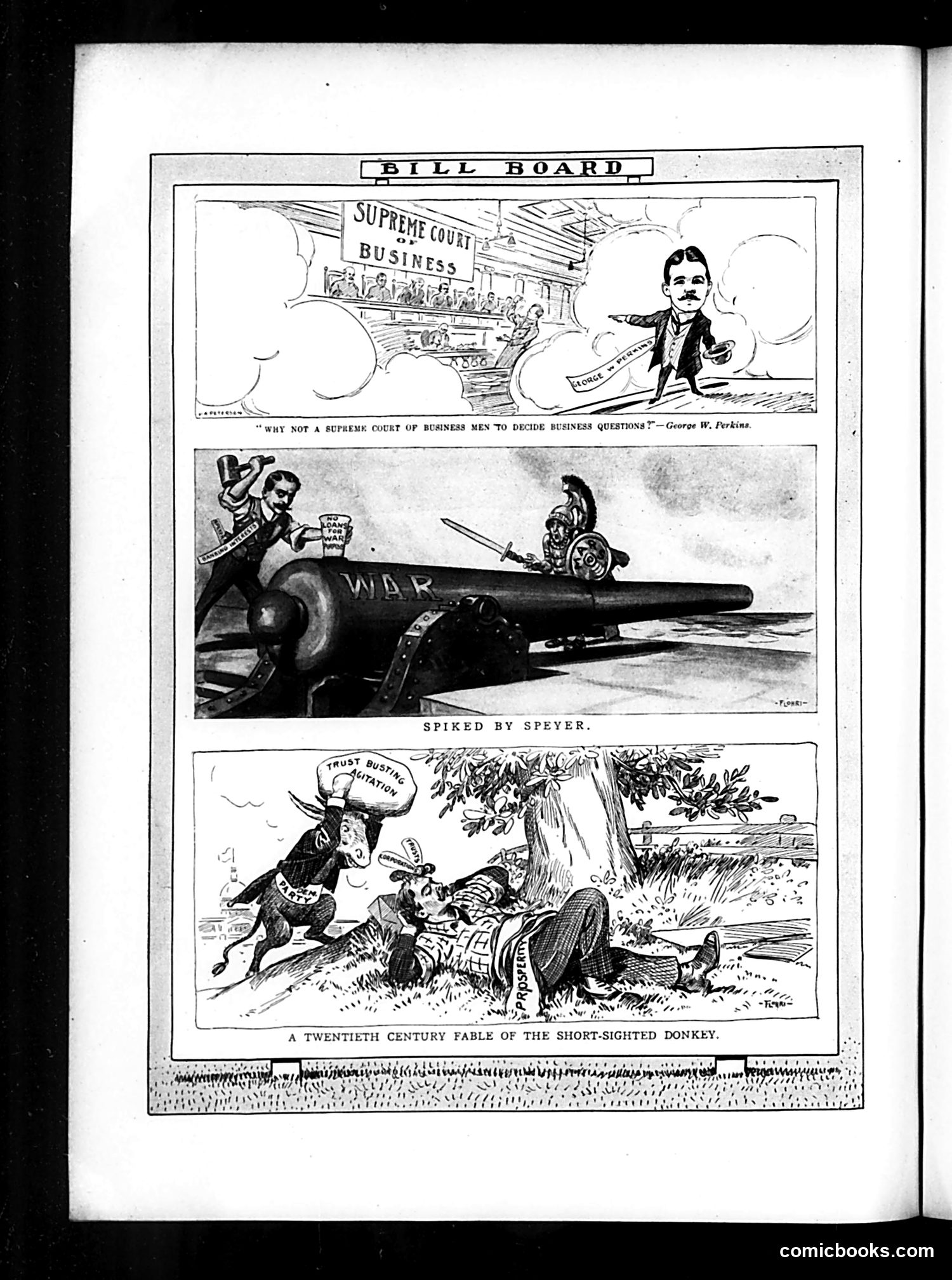
This page contains three satirical cartoons: **Top cartoon**: George W. Perkins proposes a "Supreme Court of Business Men" to decide business questions—mocking the idea that wealthy businessmen should have judicial power over commerce. **Middle cartoon**: Titled "Spiked by Speyer," depicts what appears to be a cannon labeled "War" being blocked or stopped. This likely references James Speyer, a prominent banker, in relation to WWI financing or armament debates. **Bottom cartoon**: "A Twentieth Century Fable of the Short-Sighted Donkey" shows a donkey refusing to see danger ahead (appears to reference "Trust Busting"), satirizing those who ignore obvious threats or consequences of their actions. All three cartoons critique business elites and their influence over government policy during the Progressive Era.
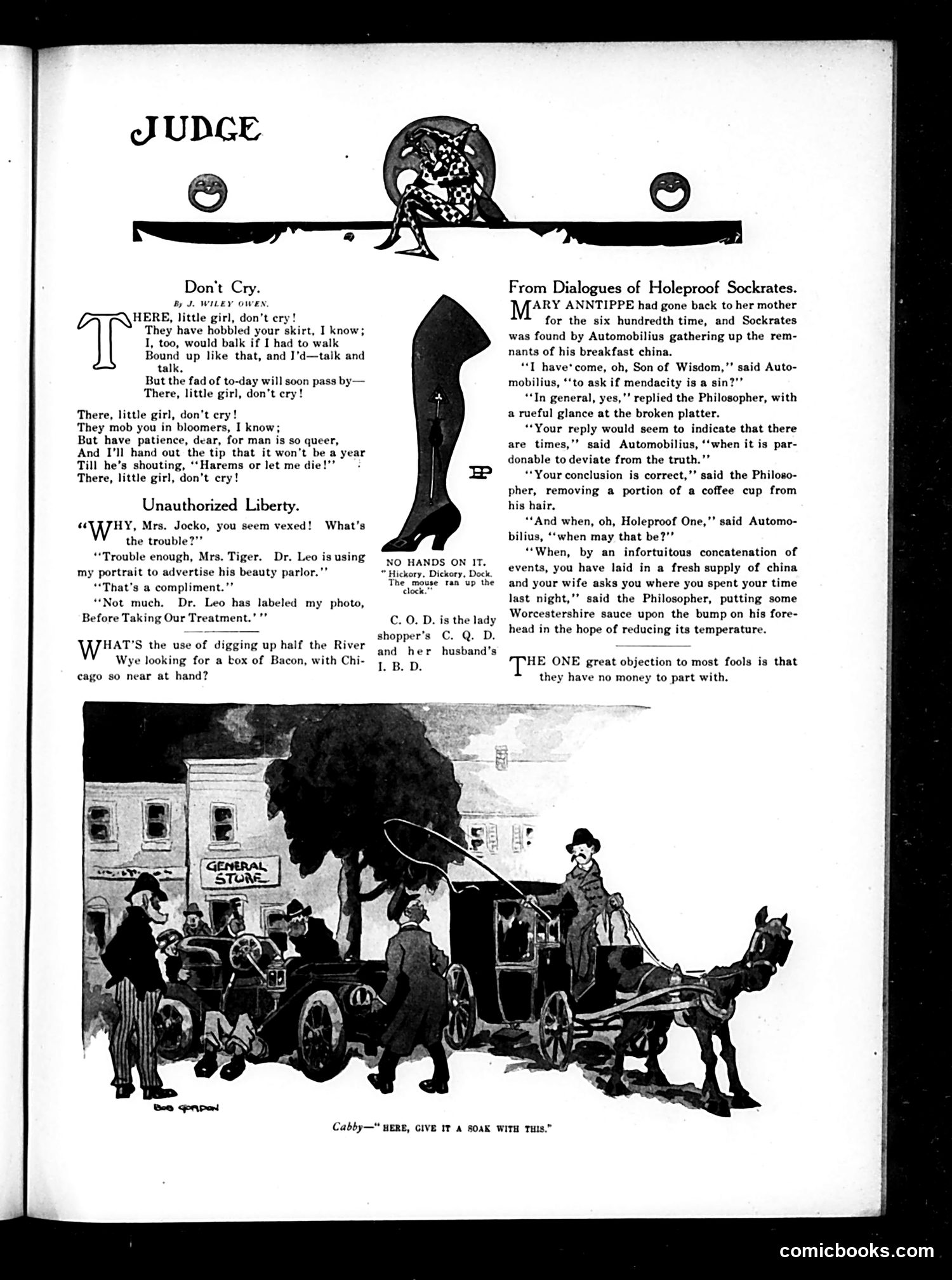
This page contains several satirical pieces typical of Judge magazine's humor: **"Don't Cry"** — A sentimental poem consoling a crying girl, using Victorian-era sympathy ("There, little girl, don't cry!"). **"Unauthorized Liberty"** — Satire about a man's photograph being used without permission to advertise beauty products, mocking both invasive advertising practices and vanity. **"What's the use..."** — A brief joke about inefficiency in river commerce. **"Dialogues of Holeproof Socrates"** — A philosophical dialogue seemingly advertising Holeproof hosiery (socks), presented as mock-Platonic wisdom. **Main cartoon** ("Cabby—'HERE, GIVE IT A SOAK WITH THIS'"): Shows a cabdriver offering ale to a horse at General Stone (appears to be a public monument), joking that drink improves the horse's stamina. The humor plays on anthropomorphizing animals and period drinking culture.
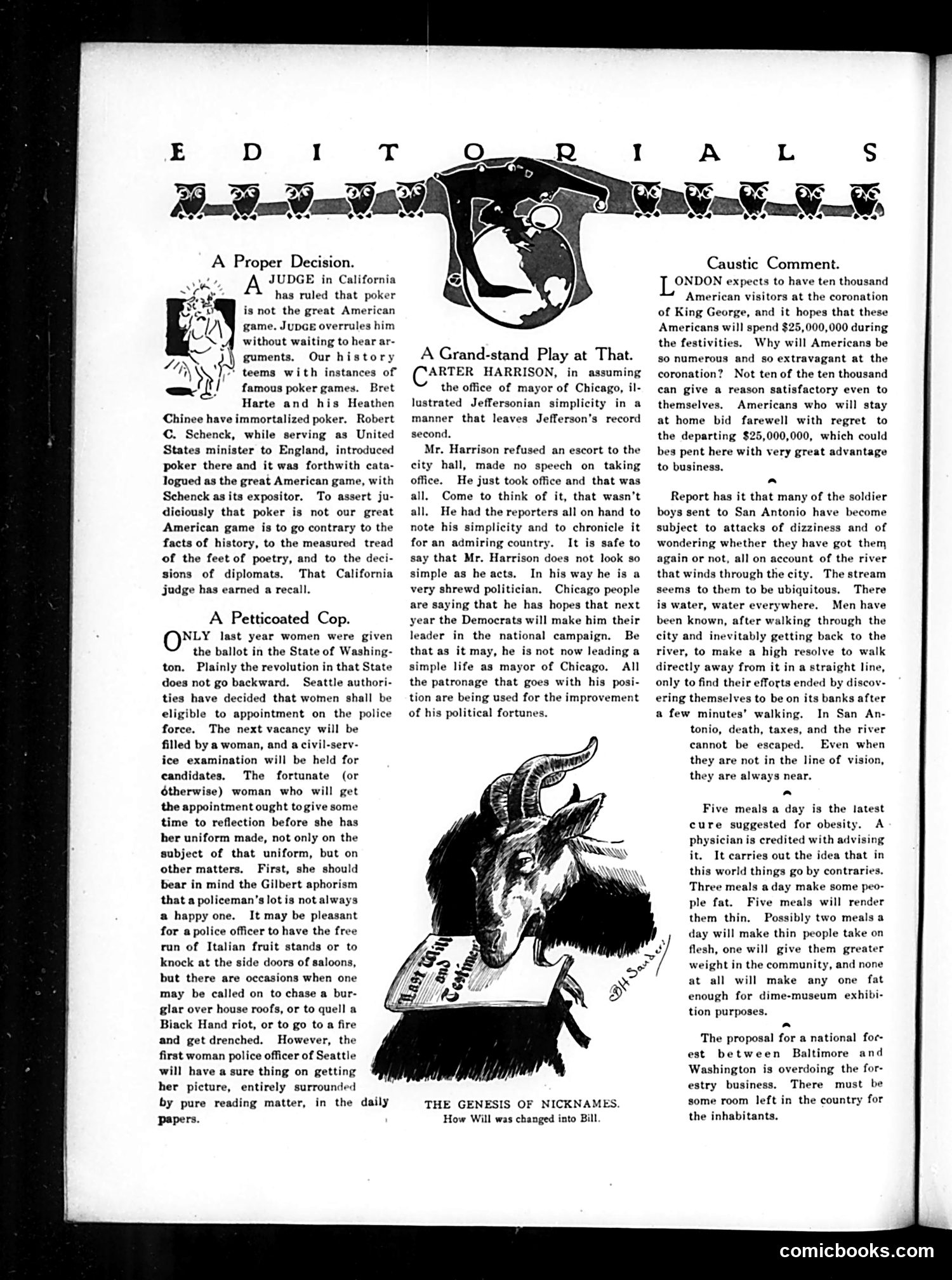
This page from *Judge* magazine contains three satirical pieces targeting American politics and social issues: **"A Proper Decision"** defends poker as authentically American, mocking a California judge's ruling otherwise. It references Robert Schenck, a U.S. minister who introduced poker to England, treating the game's cultural legitimacy seriously—satirical absurdism. **"A Petticoated Cop"** addresses Seattle's recent decision to allow women police officers (Washington granted women suffrage in 1910). Judge sardonically predicts the first female officer will gain publicity but face real dangers—a backhanded comment on women's capability and media sensationalism. **"A Grand-stand Play at That"** criticizes Carter Harrison (likely Chicago's newly-elected mayor) for ostentatiously refusing a ceremonial escort and making no speech—presenting himself as a humble Jeffersonian while secretly orchestrating media coverage and using patronage for political gain. The satire exposes his calculated performance of simplicity. The magazine's tone throughout is skeptical of American institutions and political theater.
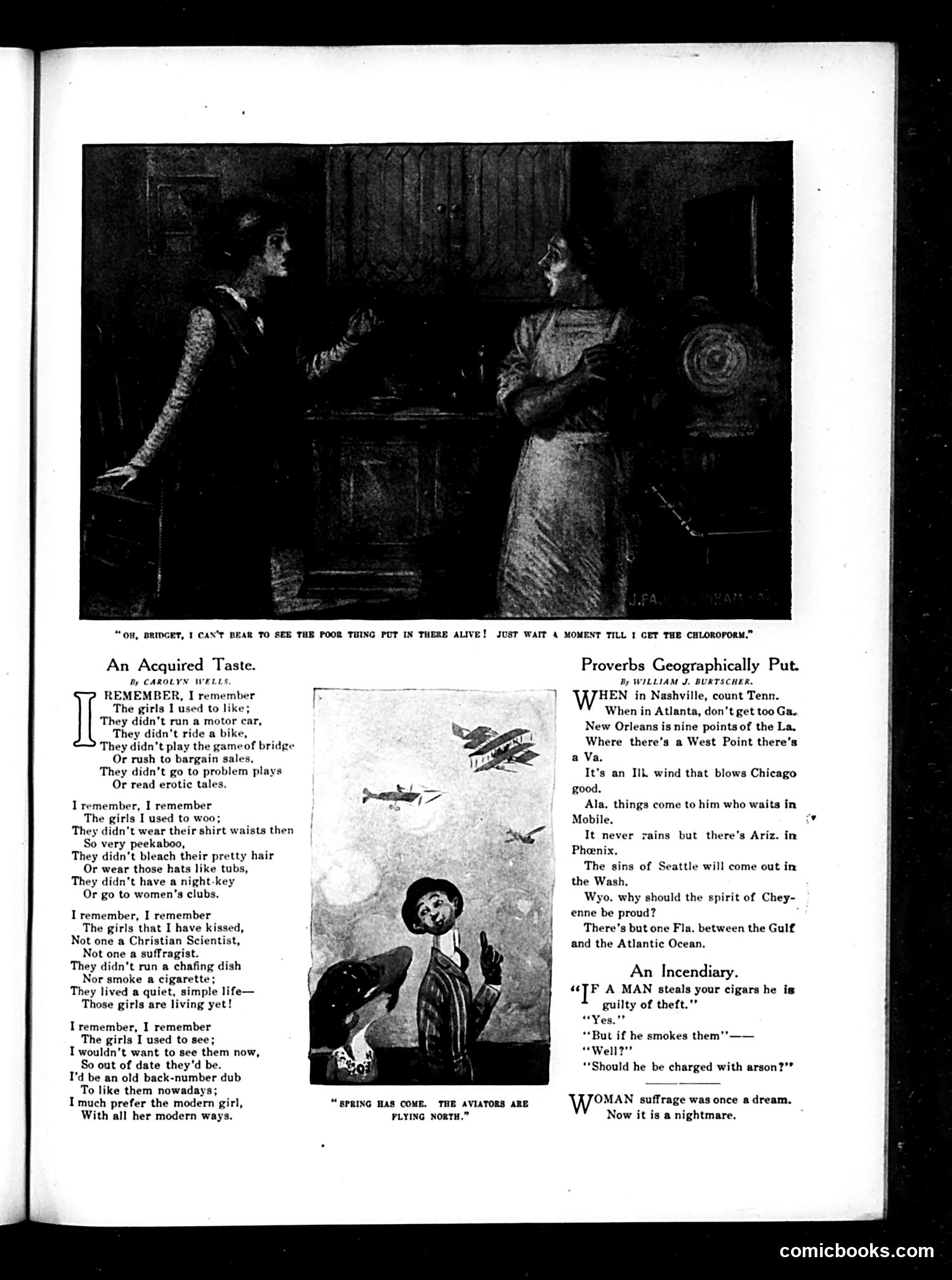
This page contains three distinct pieces of satire: **"An Acquired Taste"** mocks changing gender roles. The poem nostalgically contrasts "old-fashioned" women (modest, domestic, politically uninvolved) with modern women (driving cars, smoking, joining clubs, supporting suffrage). The joke's twist: the narrator claims to prefer modern women, though his lengthy complaints suggest otherwise. This reflects early 20th-century anxiety about women's independence. **"Proverbs Geographically Put"** is wordplay humor, creating puns by treating state abbreviations as homophones (Nashville = "count Tenn"; Arizona = "Ariz."). **The cartoon at top** shows a woman requesting chloroform before "the poor thing" enters "there alive"—likely depicting anxieties about women's suffrage or modern womanhood as something distressing requiring anesthesia. **"An Incendiary"** is a brief joke about legal definitions of theft versus arson when stolen cigars are smoked. The final line declares "Woman suffrage was once a dream. Now it is a nightmare"—expressing anti-suffrage sentiment, placing this page circa 1910s America.
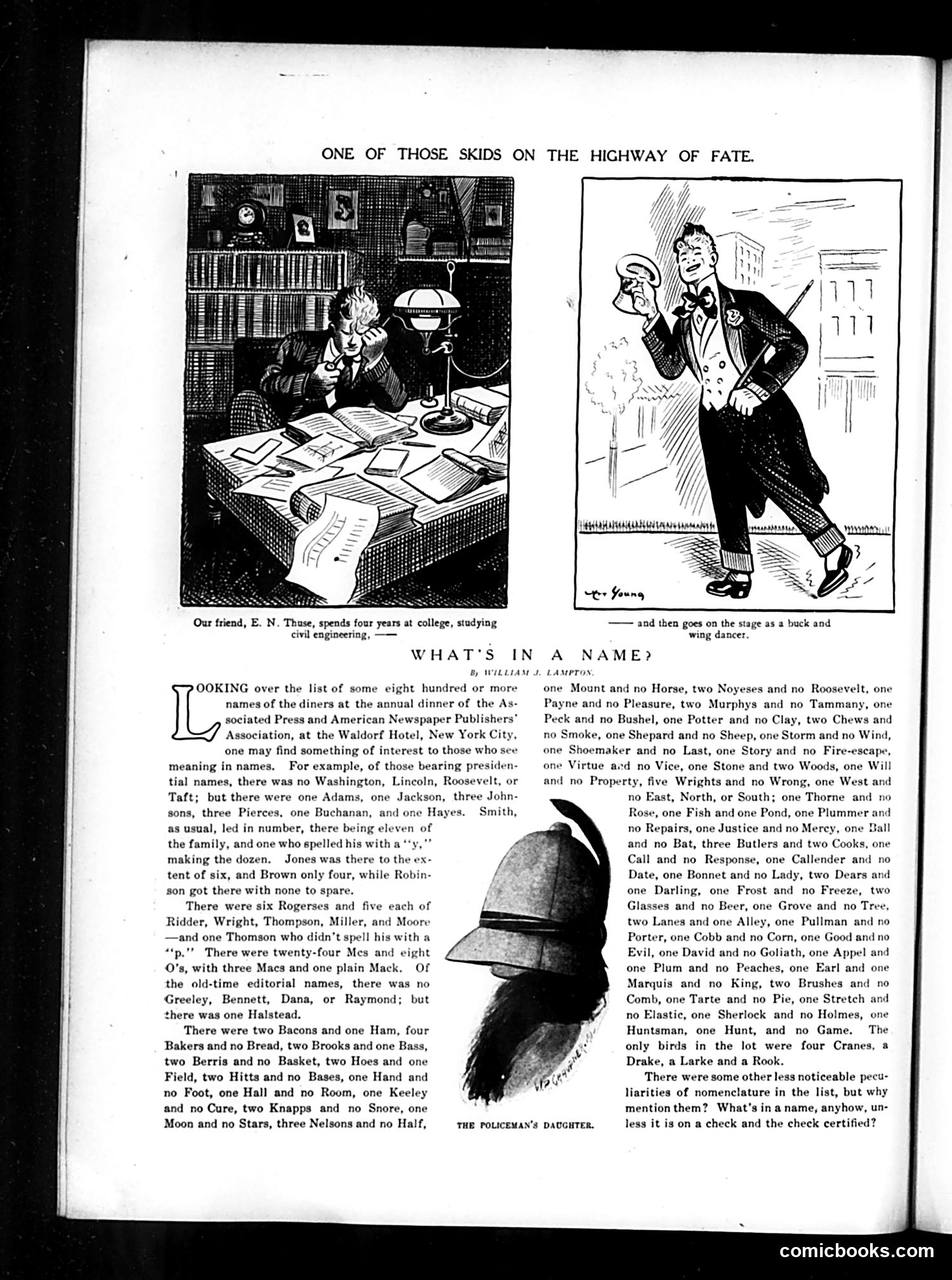
**Top Cartoon:** A two-panel satirical commentary on wasted potential. The left panel shows "E. N. Thuse" (a pun on "in this") studying civil engineering at college for four years. The right panel reveals he becomes a vaudeville performer ("buck and wing dancer"). The joke: his expensive education is irrelevant to his actual career choice—a commentary on poor life decisions or the disconnect between academic training and real employment. **Main Article:** A humorous essay analyzing the guest list from an Associated Press newspaper publishers' dinner at New York's Waldorf Hotel. The satire catalogs amusing coincidences in surnames: people named "Payne" with no "Pleasure," "Potter" with no "Clay," "Shoemaker" with no "Last." The author suggests names themselves have inherent meanings, then demonstrates the irony that these meaningful surnames often lack their logical complements. The concluding joke queries whether names matter except on bank checks—satirizing the pretentiousness of associating nomenclature with destiny or character.
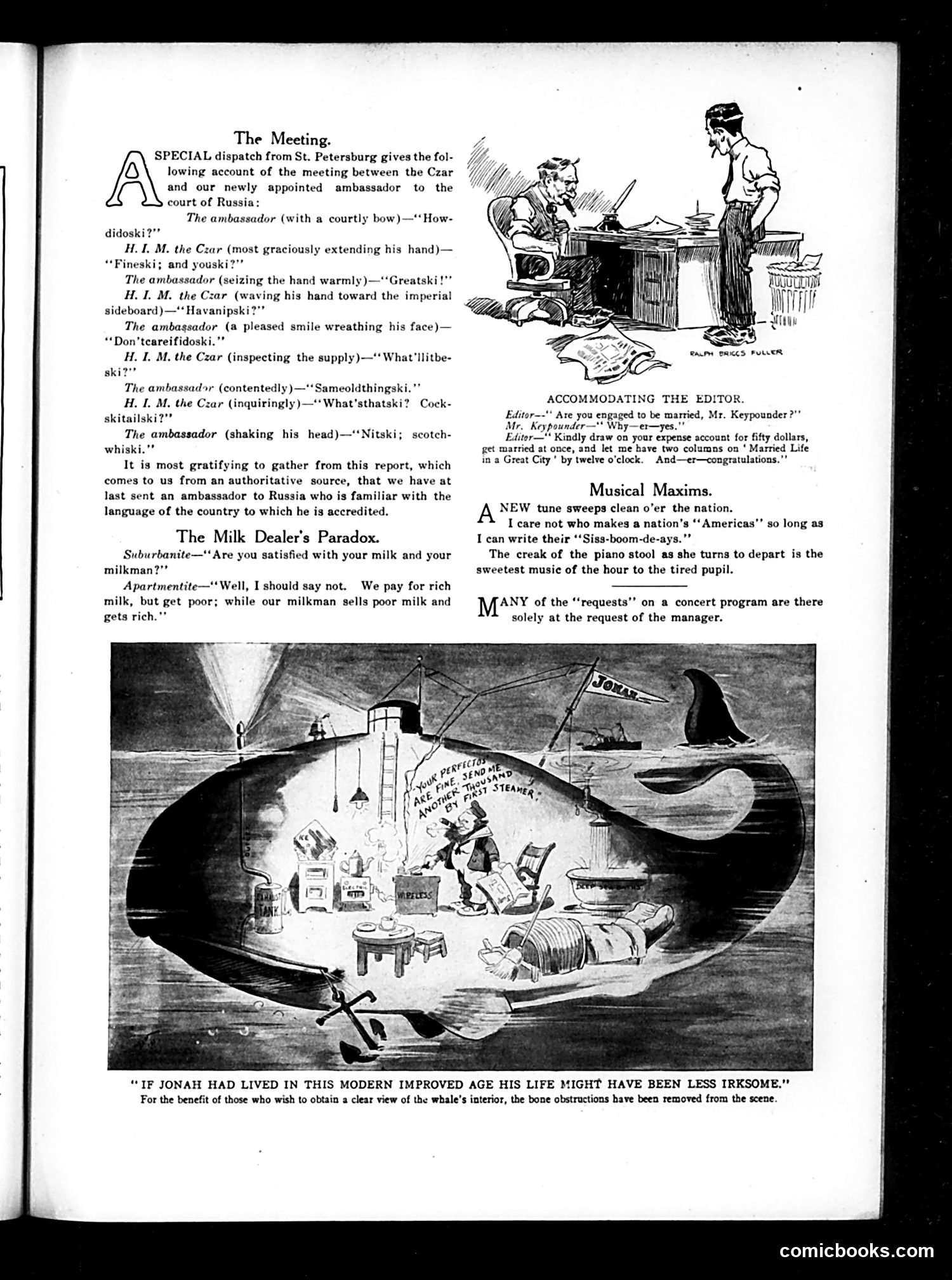
This page contains three satirical pieces: **"The Meeting"** mocks America's newly appointed ambassador to Russia by suggesting he communicates in broken Russian-English hybrid gibberish (adding "-ski" suffixes to English words). The joke implies either the ambassador's incompetence or absurd assumptions about Russian language/culture—though it humorously depicts him successfully conducting diplomatic business despite the nonsensical exchanges. **"The Milk Dealer's Paradox"** is a brief joke about urban commerce: wealthy apartment dwellers pay premium prices but receive inferior milk, while their milkman profits by adulterating it. **"Accommodating the Editor"** satirizes newspaper workplace culture, showing an editor cynically demanding his employee marry immediately to provide material ("two columns on 'Married Life'") for the publication—treating personal life as content. The large whale cartoon at bottom appears unrelated, illustrating Jonah's biblical story with modern comforts, suggesting modern life would have made hardship less burdensome.
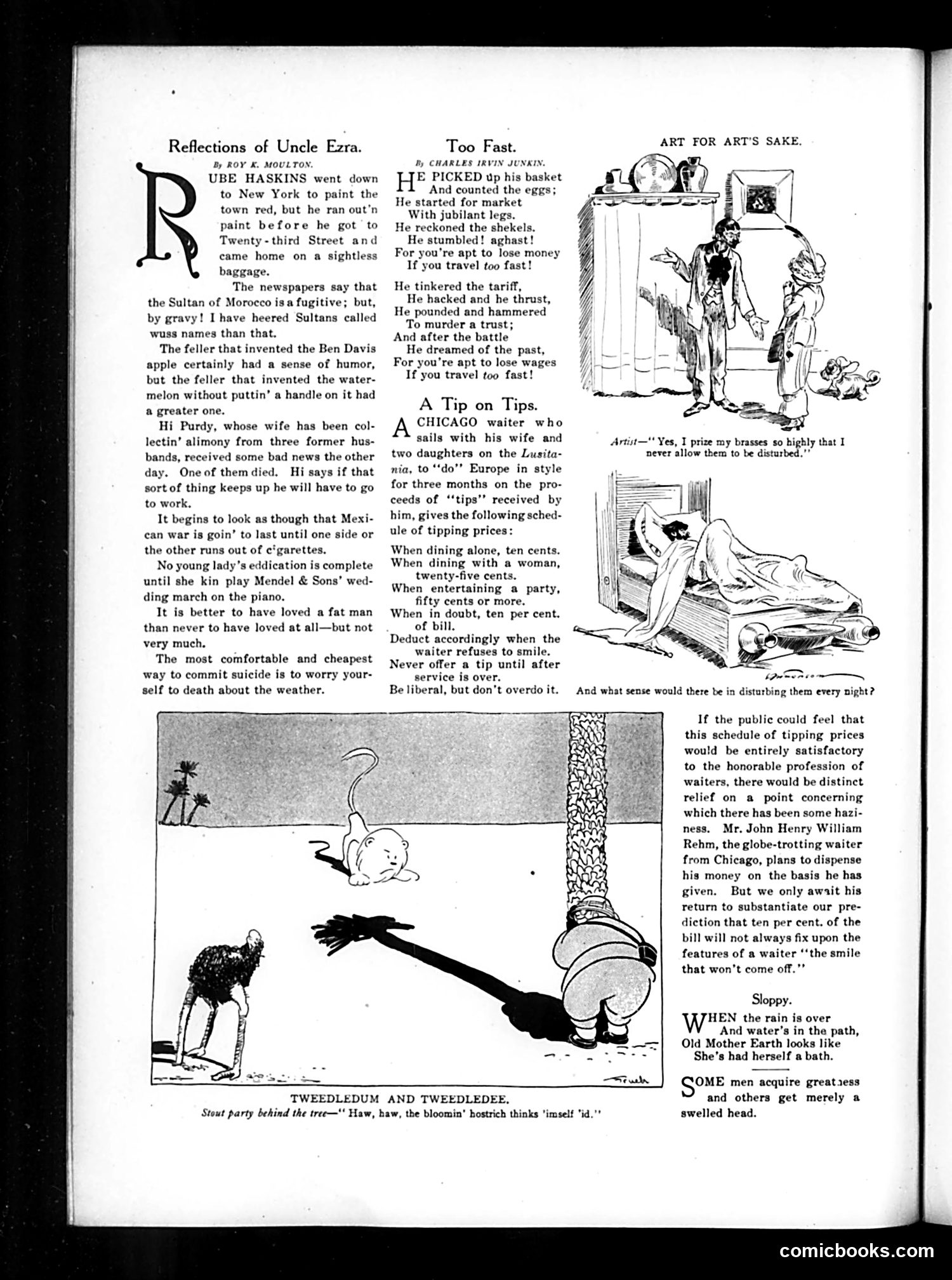
This page contains several satirical pieces typical of early 20th-century American humor: **"Reflections of Uncle Ezra"** presents rural folk wisdom poking fun at contemporary figures and events—the Sultan of Morocco's flight, the Mexican border conflict, and frivolous social trends like piano lessons. **"Too Fast"** uses an egg-seller's mishap as metaphor for political recklessness, likely referencing trust-busting efforts and tariff debates of the era. The moral: rushing toward goals causes financial loss. **"A Tip on Tips"** satirizes class anxieties around gratuities by publishing a Chicago waiter's precise tipping schedule for the *Lusitania* voyage. The satire mocks both the waiter's presumption that ten percent will always produce smiles and the broader uncertainty about proper tipping etiquette in changing times. **The cartoons** include domestic humor about cleaning brass fixtures and the aftermath of rain, offering gentle social observation rather than sharp political commentary.
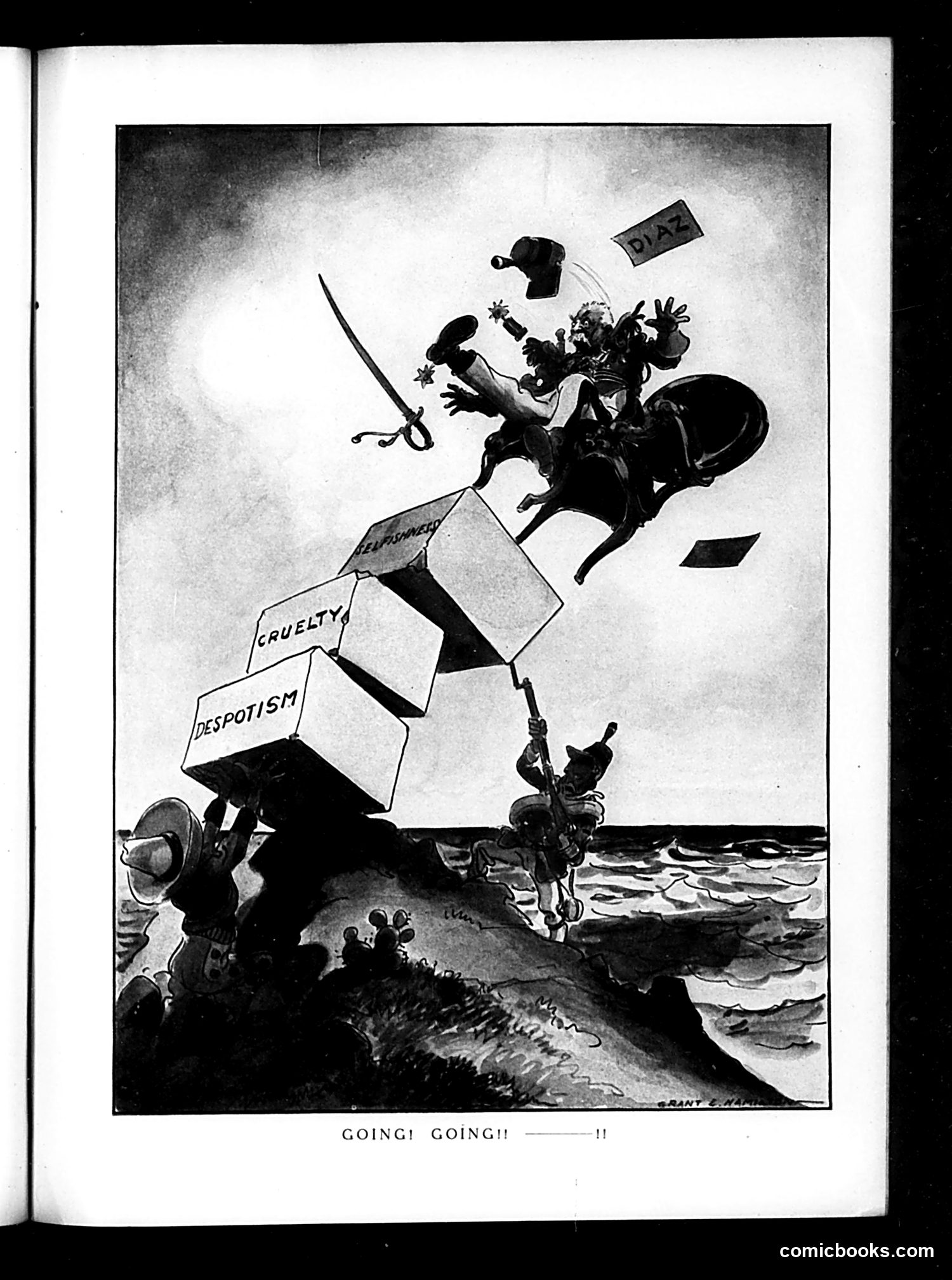
This satirical cartoon depicts a precarious tower of stacked boxes collapsing into the sea. The visible labels read "DESPOTISM" and "CRUELTY," with additional boxes above (partially visible). A figure rides atop the unstable structure while armed figures below attempt to stabilize or topple it. The caption "GOING! GOING!!" suggests an auction or imminent collapse. The cartoon likely comments on authoritarian regimes or oppressive systems tumbling down, possibly referencing contemporary early 20th-century political upheavals (revolutions, wars, or regime changes). The sea and figures below suggest struggle or resistance against these systems. Without a date visible, the specific historical event remains unclear, though the imagery aligns with Judge magazine's typical anti-despotism messaging.
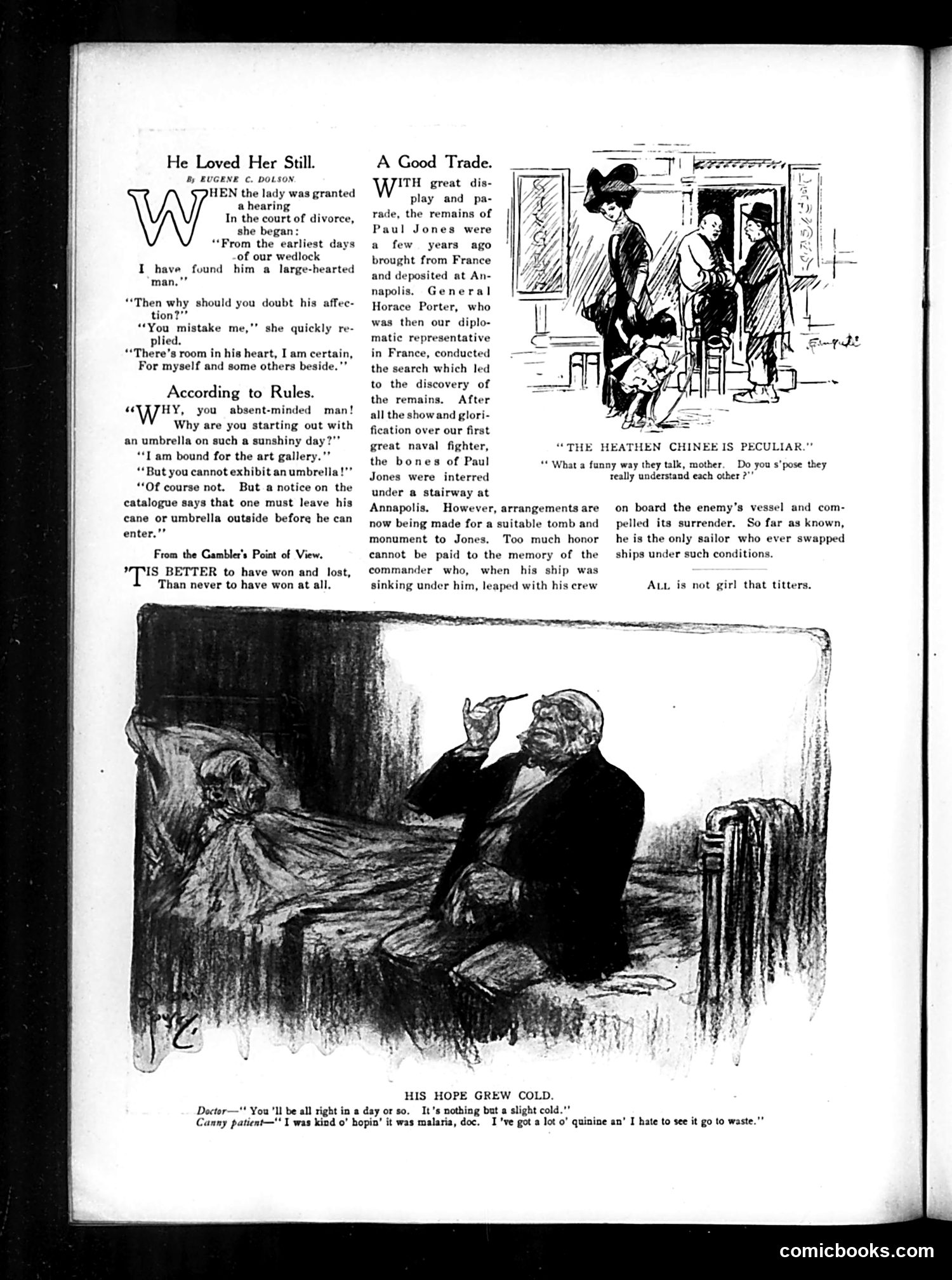
This page contains three satirical pieces: **"He Loved Her Still"** mocks a divorce proceeding where the wife praises her husband's "large heart"—then reveals she means he has room for her *and other women*, implying infidelity. **"According to Rules"** jokes about bureaucratic absurdity: a man brings an umbrella to an art gallery, explaining that the posted rules require leaving umbrellas outside, so he's following instructions by not entering. **"A Good Trade"** references the recent (historical) reburial of Revolutionary War naval hero John Paul Jones. The satire is that despite elaborate ceremonies honoring him, his bones were initially placed under a stairway at Annapolis—an undignified resting place. Now they're finally getting a proper monument. **"His Hope Grew Cold"** depicts a miserly patient telling his doctor he's disappointed it's only a cold, not malaria, because he has quinine he doesn't want to waste. The page also includes a brief joke about Chinese language barriers.
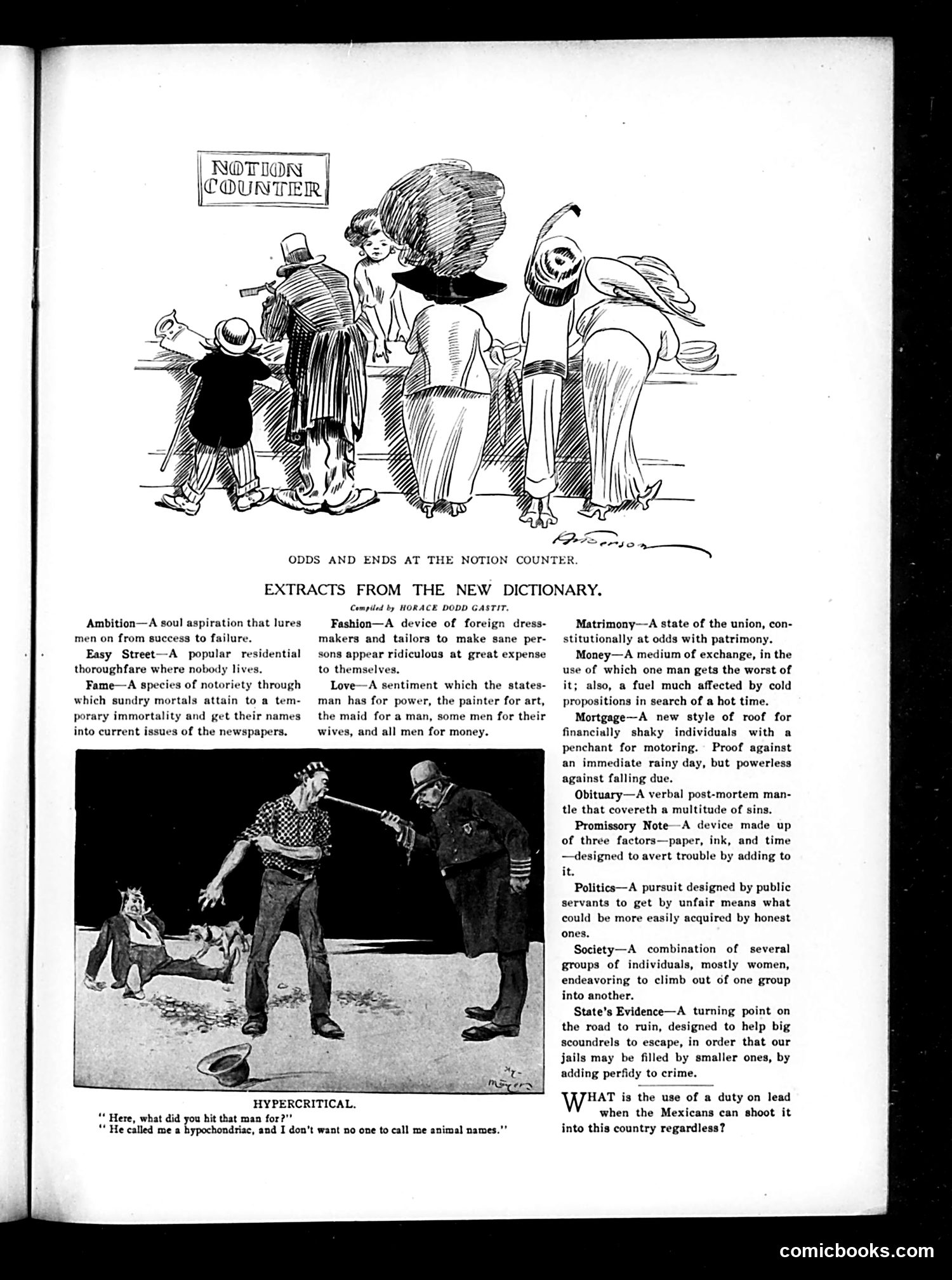
This page from *Judge* magazine features cynical, mock-dictionary definitions satirizing American social conventions. The top cartoon illustrates "Odds and Ends at the Notion Counter"—a play on the haberdashery section where women shopped for accessories. The central cartoon, "Hypercritical," shows a man beating another man, defending himself by claiming he objected to being called a "hypochondriac" because it's an "animal name"—the joke being the absurdity of this logic. The bulk of the page contains Horace Dodd Gastit's satirical dictionary entries mocking contemporary society: "Fashion" ridicules foreign dress designers; "Matrimony" jokes about marital financial conflict; "Politics" attacks public servants' corruption; "Society" mocks women's social climbing. The final item questions tariffs on Mexican lead imports—likely referencing debates over protectionist trade policy during this period. Overall, the page reflects *Judge's* cynical editorial voice, using humor to critique American materialism, social pretension, and political dishonesty.
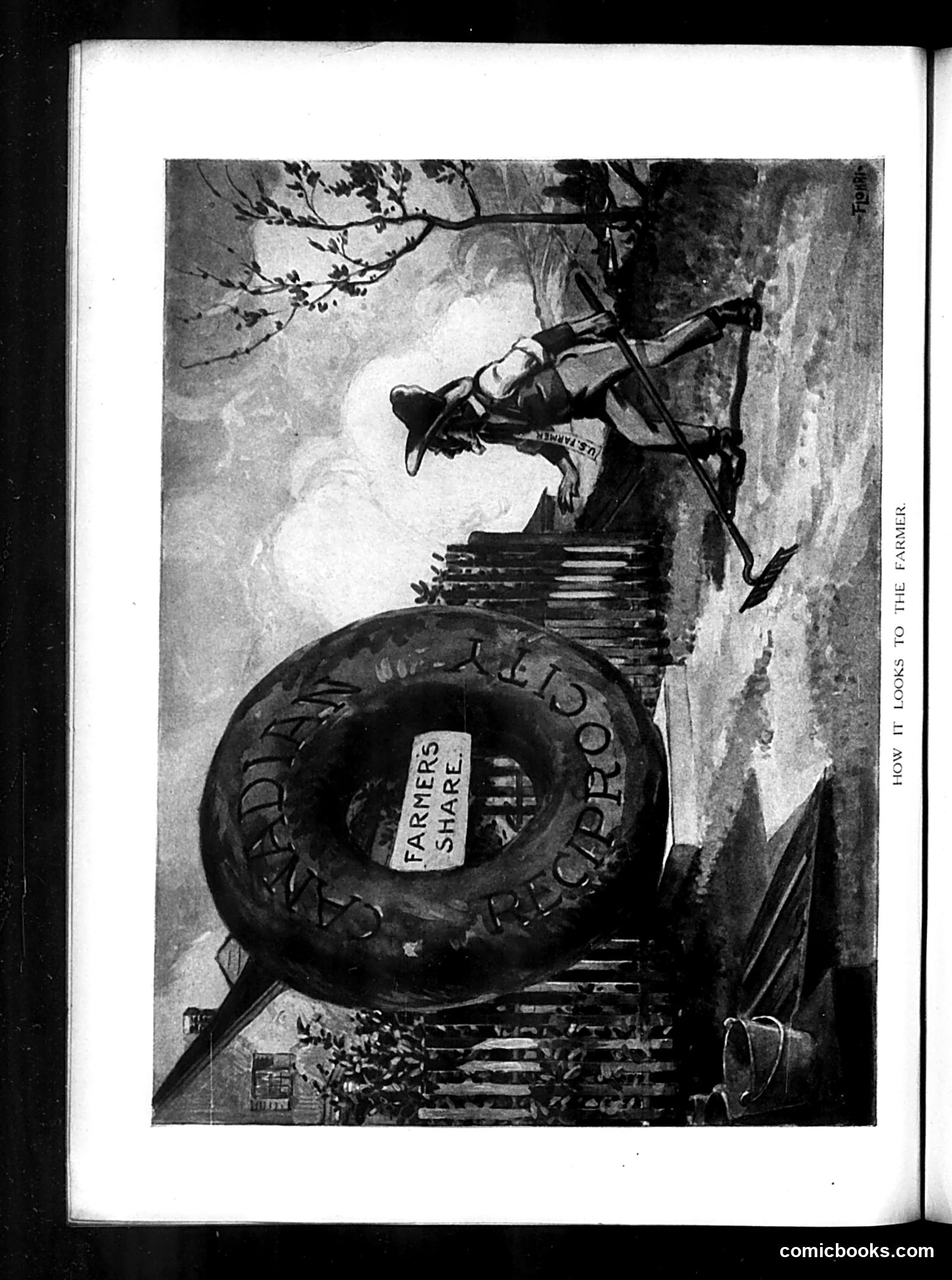
This page shows a photograph (not a cartoon) with the caption "HOW IT LOOKS TO THE FARMER." The image depicts a man relaxing on a large tire labeled "FARMERS SHARE," sitting beside what appears to be farm equipment or supplies. The satire critiques the disparity between farmers' actual economic conditions and their promised share of prosperity. The tire—a consumer good—contrasts with the farmer's modest surroundings, suggesting that while industrial/commercial sectors enjoy abundance, farmers receive only token benefits or false promises of wealth-sharing. This likely references early 20th-century agricultural discontent in America, when farmers felt economically disadvantaged compared to industrial interests, despite being told they'd benefit from national prosperity. The visual irony is the central point: the "share" farmers receive is hollow or insufficient.
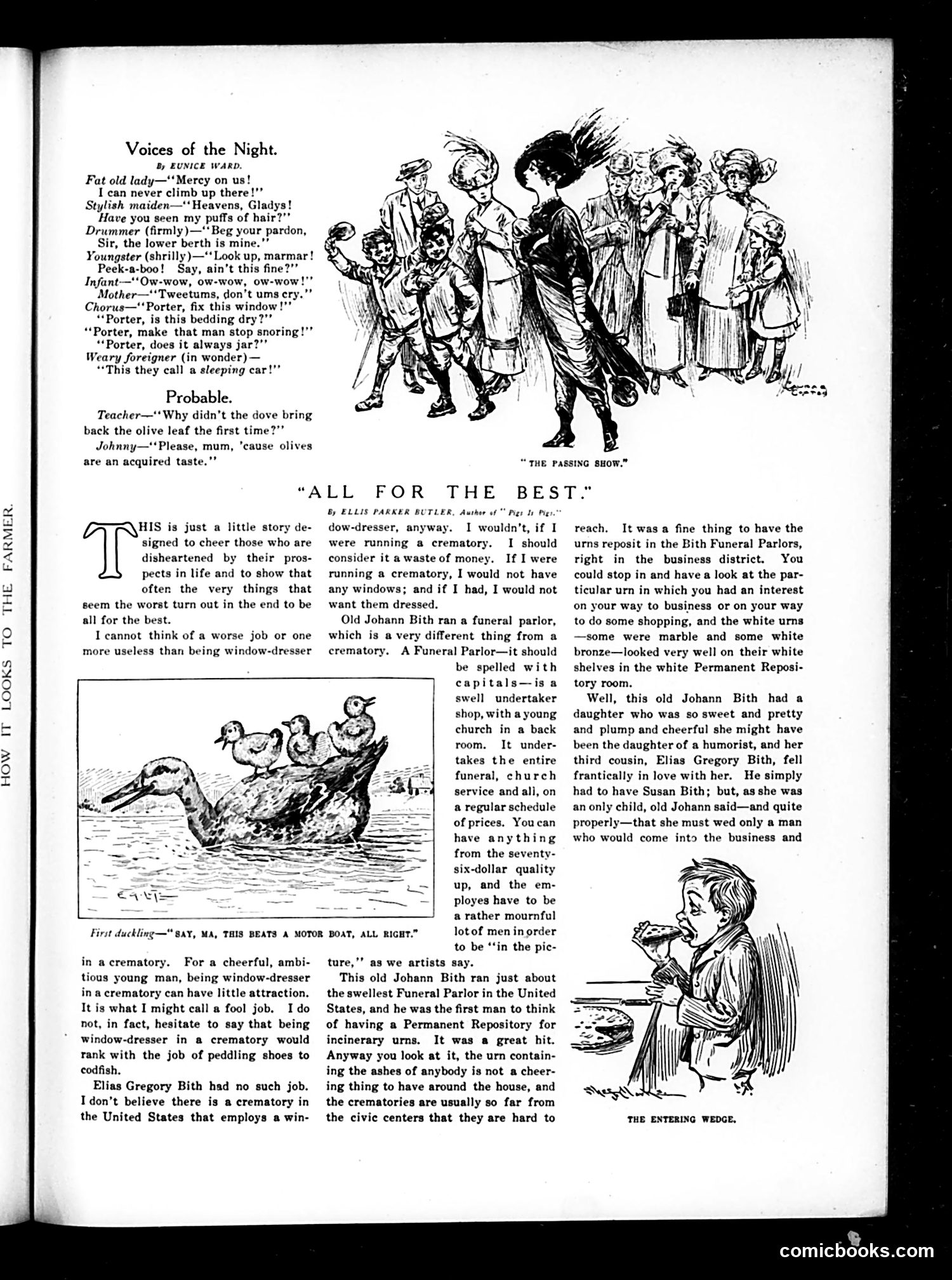
This page contains three distinct satirical pieces: **"Voices of the Night"** mocks the chaotic experience of train travel, with various passengers making competing demands on a porter—a common complaint about overcrowded sleeping cars of the era. **"Probable"** is a brief joke about a child misunderstanding the phrase "acquired taste" regarding olives, typical of children's humor sections. **"All for the Best"** is the main story by Ellis Parker Butler. It satirizes the funeral industry's commercialization by following Johann Bith, who innovatively created a "Permanent Repository" for cremation urns in his funeral parlor's downtown location—allowing grieving families convenient access while shopping. The satire lies in treating this morbid business venture as a entrepreneurial triumph. The story's opening mocks the notion that even useless jobs (like window-dressing for a crematory) somehow work out "for the best," setting up dark comic irony about profiting from death. The illustrations are period-appropriate sketches supporting these texts.
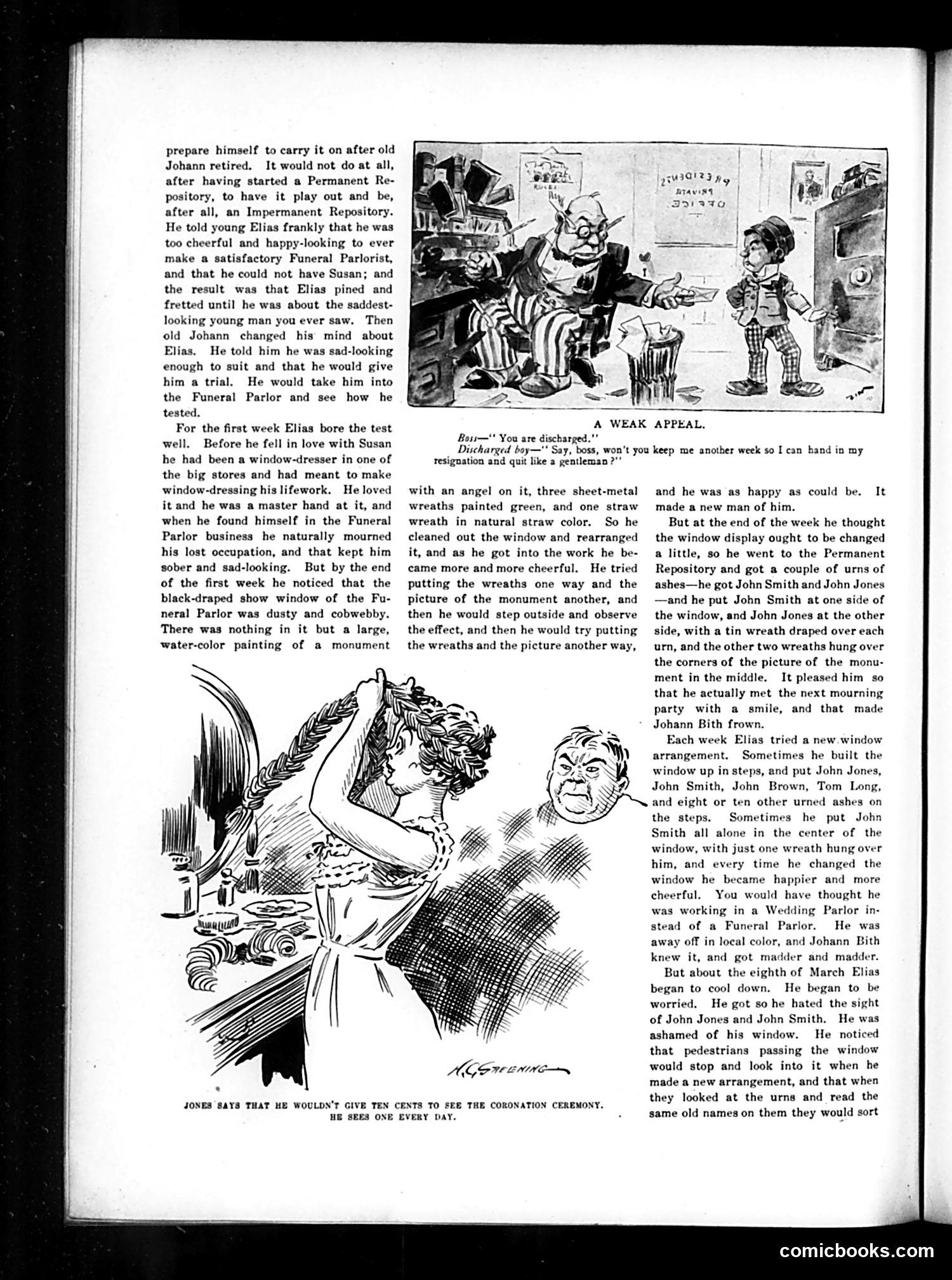
This page satirizes the absurdity of funeral parlor window-dressing as a profession. The story concerns Elias, a young man desperate to work at a funeral parlor to marry Susan. His employer, old Johann, initially rejects him for being too cheerful—funeral work requires a perpetually sad demeanor. Once Elias becomes sufficiently melancholic, Johann hires him. The satire intensifies when Elias, formerly a talented window-dresser, cannot help but apply his creative skills to the funeral parlor display. He arranges urns (containing ashes of "John Smith," "John Jones," etc.) and monuments with increasing artistic flair, becoming visibly happier. This horrifies Johann: the funeral business demands solemnity, not aesthetic joy. The cartoon's humor derives from the contradiction between professional expertise and professional atmosphere—Elias's competence undermines the gloomy pretense essential to funeral parlors. The bottom cartoon about "Jones" and the coronation reinforces the theme: viewing ceremonial death ritually has become mundane.
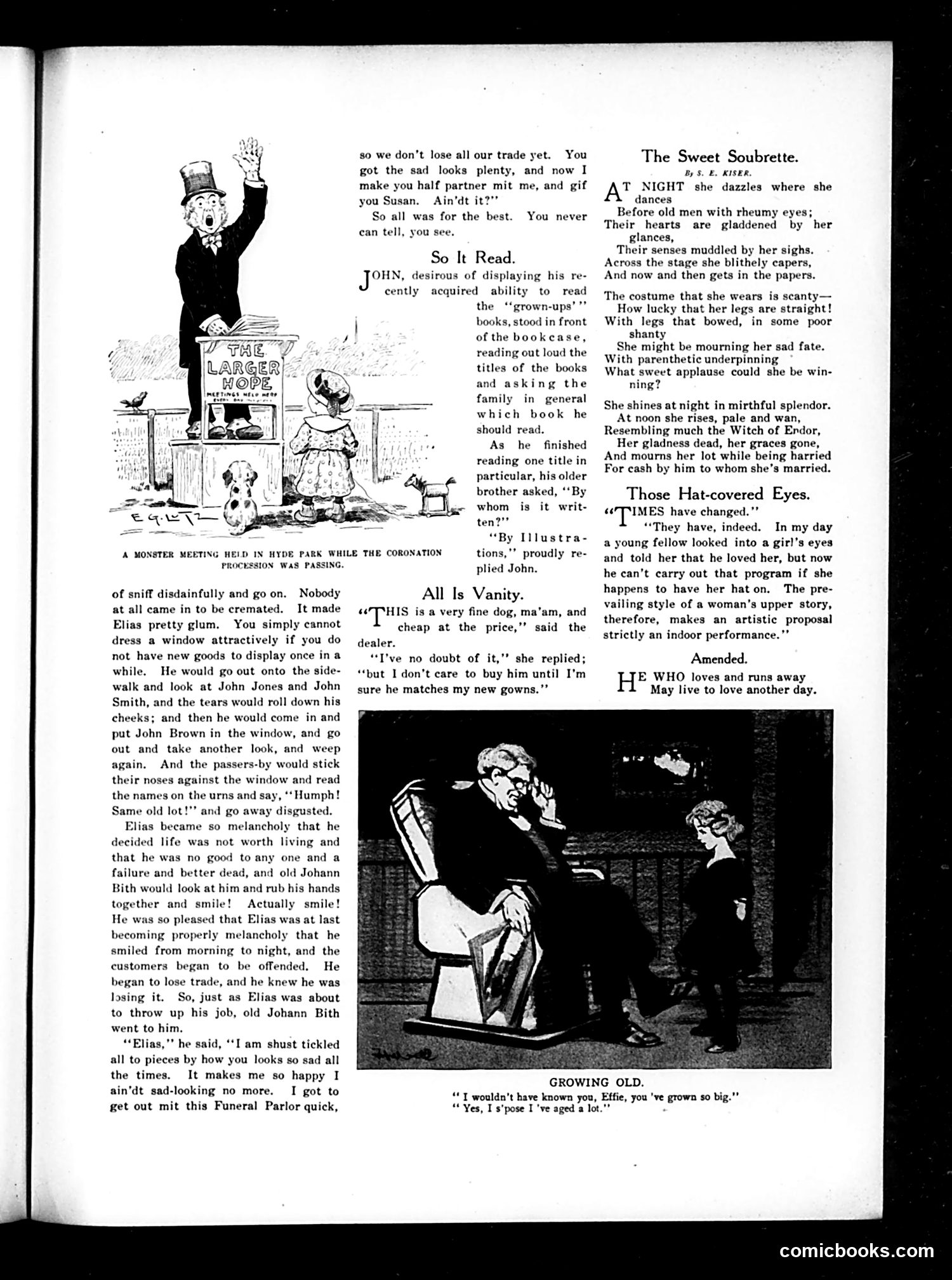
This page contains several satirical pieces typical of early 20th-century Judge humor: **"A Monster Meeting in Hyde Park"** (top cartoon): The illustration shows a funeral parlor owner displaying urns in a window display during what appears to be a major public event (the coronation procession). The satire mocks both the undertaker's gloomy business model and the irony of trying to drum up trade during a celebration. **"So It Read"**: A humorous anecdote about a child reading book titles aloud, misunderstanding that "By Illustrations" is a crediting phrase, not the author's name. Gentle satire on childhood misinterpretation. **"All Is Vanity"**: Social commentary on materialism—a woman refuses to buy a dog until it matches her new gowns, satirizing fashion obsession. **"The Sweet Soubrette" (poem)**: Cynical critique of stage dancers—glamorous at night in scanty costumes but exhausted and aging by day, trapped in unhappy marriages for financial survival. **"Those Hat-covered Eyes"**: Complaint about fashionable women's hats with large brims that obscure the eyes, making romantic gestures impractical. The page reflects period concerns: materialism, changing fashions, and women's roles in entertainment.
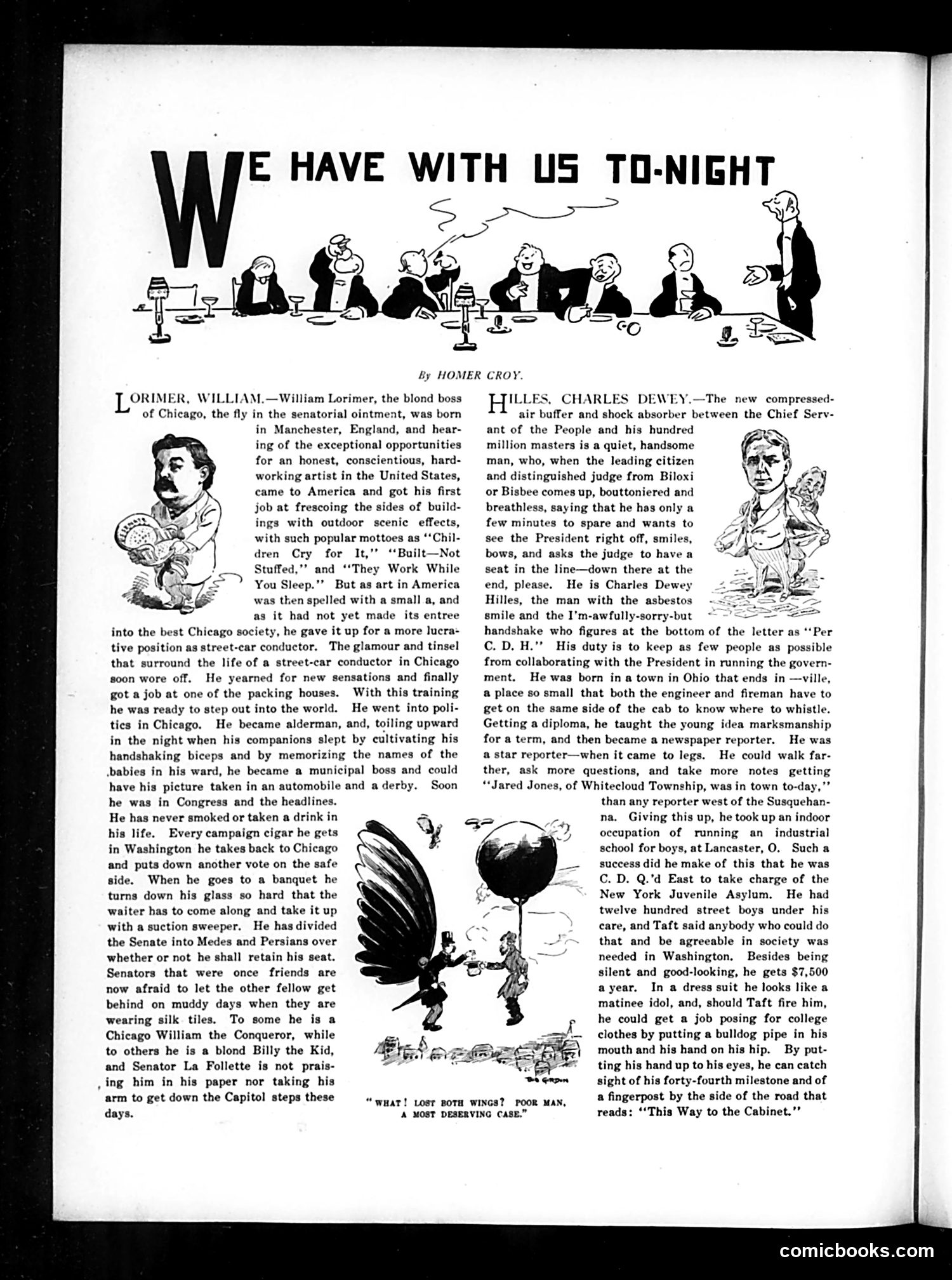
This page from Judge magazine presents satirical biographical sketches of two prominent political figures by Homer Croy. **William Lorimer** is the primary target—a Chicago political boss derided as "the fly in the senatorial ointment." The satire traces his opportunistic rise from manual laborer to alderman to congressman, mocking his cultivation of power through handshaking and voter manipulation. The piece suggests he's divisive even among senators, compared to both a conqueror and outlaw. **Charles Dewey Hilles** (President Taft's secretary) is portrayed as the presidential gatekeeper who shields the chief executive from public access. The satire mocks his humble origins and journalistic past, while his "asbestos smile" and ability to politely refuse petitioners makes him simultaneously indispensable and detested. Both sketches employ exaggerated biographical humor typical of early-20th-century political satire, highlighting how ambitious men navigate and exploit power structures. The cartoons above presumably satirize their respective roles in contemporary politics.
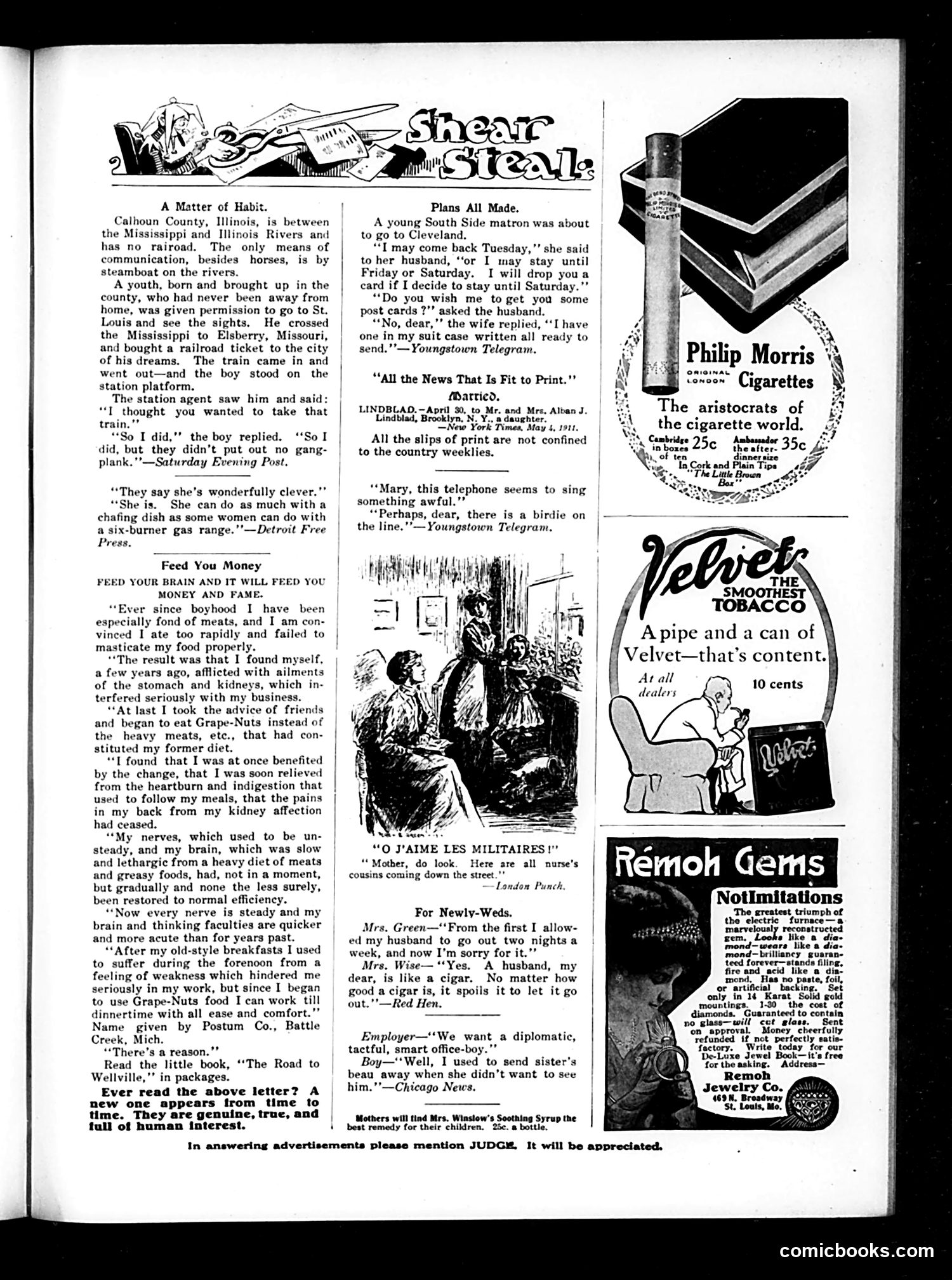
This is primarily a **humor and advertising page** from Judge (circa 1911, based on the New York Times marriage notice dated May 4, 1911). The content consists of several **short joke anecdotes** rather than political cartoons: - **"A Matter of Habit"**: Rural Illinois youth, unfamiliar with trains, waits on the platform expecting a "gangplank" (like a steamboat) instead of understanding how to board - **"Plans All Made"**: Wife pre-writes postcards to husband about her trip, satirizing lazy correspondence - **"All the News That Is Fit to Print"**: Mocks the *New York Times*'s motto by highlighting a typographical error in their own announcements - Various one-liners about women's cleverness, telephones, and newlywed dynamics **The advertisements** (Philip Morris cigarettes, Velvet tobacco, Remoh Gems, and Grape-Nuts) dominate the right side. The Grape-Nuts testimonial is a lengthy advertorial about digestive health—typical early 1900s marketing. The satire is **gentle, domestic, and class-conscious**—poking fun at rural simplicity, marital dynamics, and urban sophistication rather than addressing politics or major social issues.
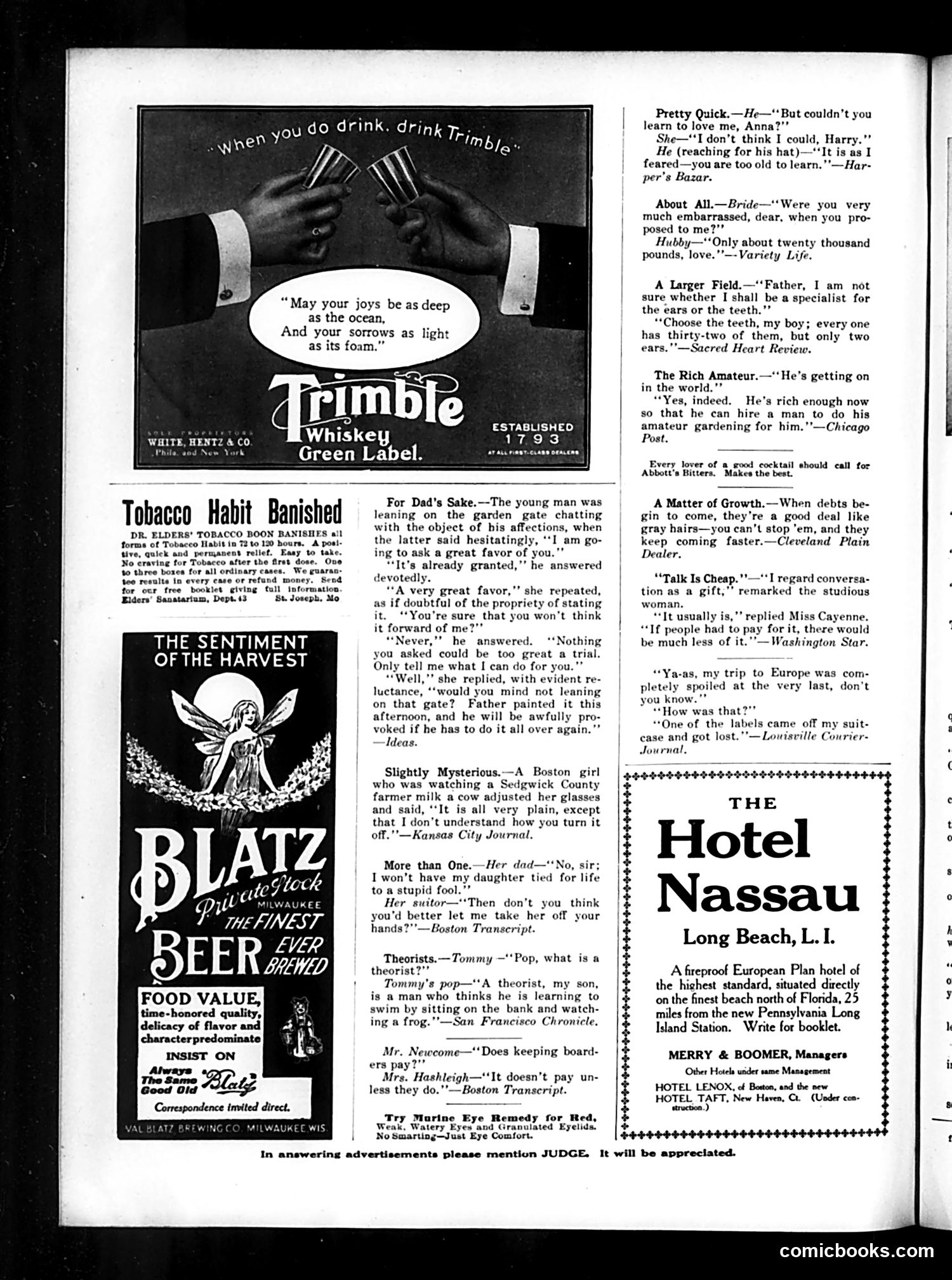
This page is primarily **advertising and humor anecdotes**, not political cartoons. **Main Advertisement:** A Trimble Whiskey ad (established 1793) features two hands toasting with the sentimental toast: "May your joys be as deep as the ocean, / And your sorrows as light as its foam." **Supporting Ads:** Include Blatz Beer (Milwaukee), a tobacco-cessation product, and Hotel Nassau on Long Island. **Humor Section:** The bulk of the page contains brief, lighthearted joke anecdotes typical of Judge's format—romantic misunderstandings, marital humor, and wordplay. Examples include a young man embarrassed about leaning on a freshly-painted gate, and a woman's concern about suitcase labels falling off during European travel. **Context for Modern Readers:** These jokes reflect early 20th-century social anxieties about courtship etiquette, marital finances, and leisure travel—essentially gentle satire of middle-class life rather than political commentary.
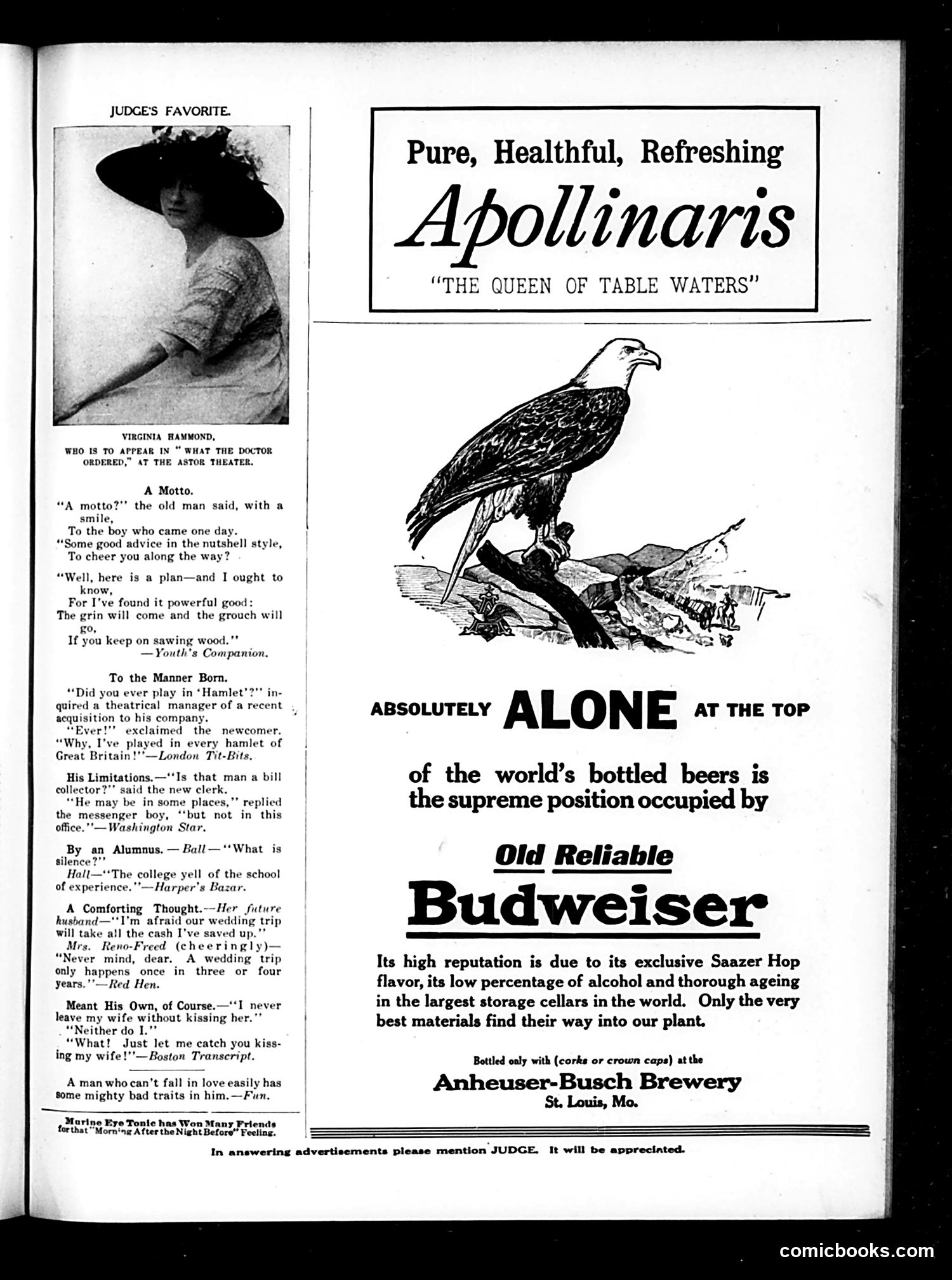
This page combines entertainment coverage with period advertisements. The top features **Virginia Hammond**, an actress appearing in "What the Doctor Ordered" at the Astor Theater—presented as "Judge's Favorite," a celebrity spotlight common to the era. Below are several brief humorous anecdotes and jokes typical of early 20th-century magazines, touching on themes like advice-giving, theatrical ambition, workplace dynamics, and marriage—mostly mild domestic humor. The substantial advertising occupies the right side: **Apollinaris** mineral water ("Queen of Table Waters") and **Budweiser beer** ("Old Reliable"), which claims supreme position among bottled beers. Both ads emphasize purity and quality—selling points reflecting contemporary consumer concerns about product safety and standards. The page reflects Judge's dual function: satirical commentary mixed with commercial advertisements that subsidized publication. The modest theatrical note and genteel humor suggest an audience of educated, middle-to-upper-class readers in an early 1900s American publication.
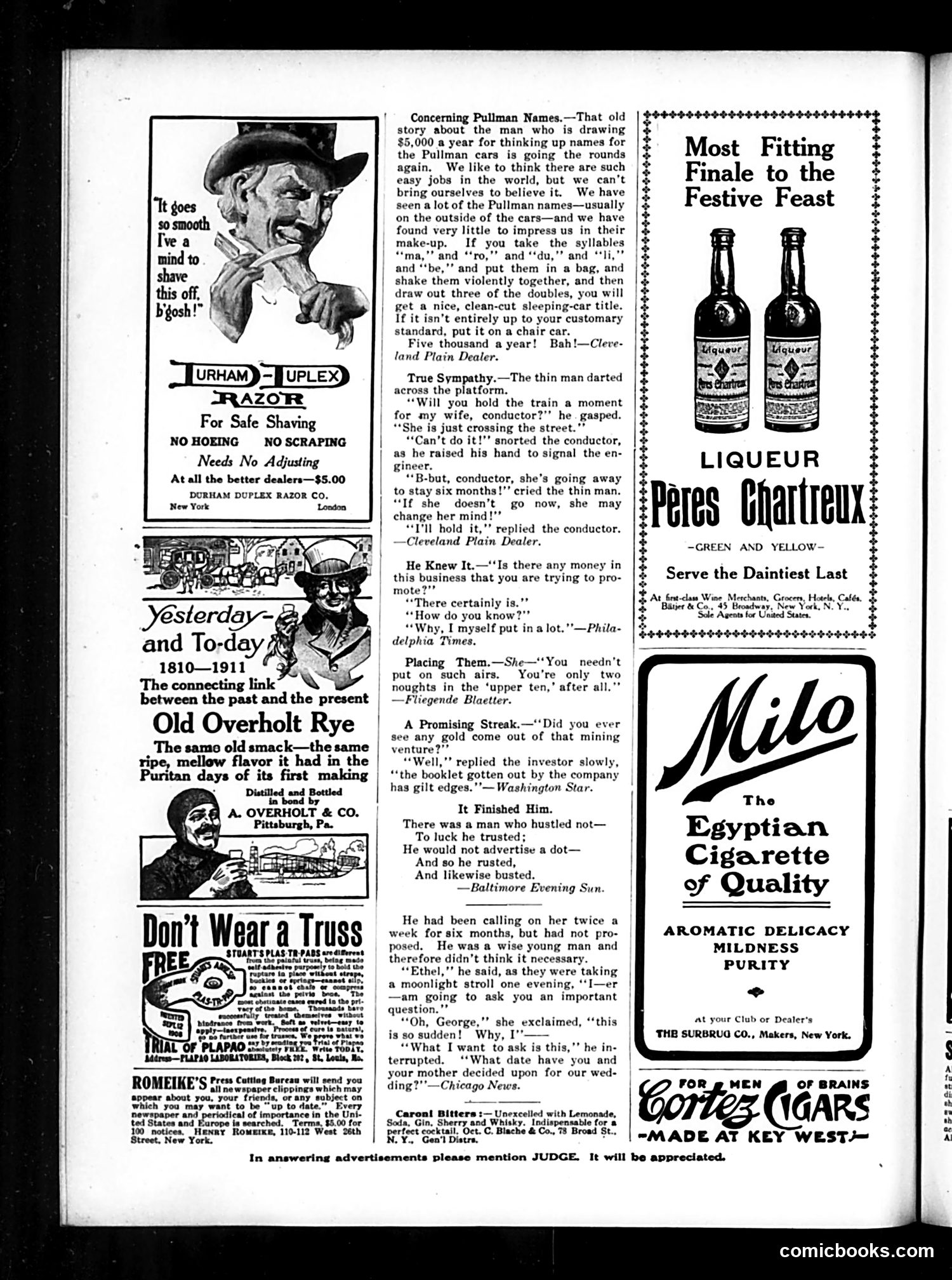
This page is primarily **advertising with interspersed humor items**—typical of Judge's format. The advertisements promote consumer products (razors, whiskey, cigars, liqueurs) alongside brief comedic anecdotes. The humor pieces are short, punchy jokes with no political content. They satirize everyday situations: a Pullman naming executive supposedly earning $5,000/year for uninspired car names; a conductor's sympathy when learning a wife is leaving for six months; an investor's mining venture that only produced "gilt edges" on promotional pamphlets; and a suitor's trick proposal question about wedding dates rather than marriage itself. The cartoons—a caricatured man promoting a razor, and illustrations for whiskey and rye—use exaggerated features typical of the era but contain no identifiable political figures or references. The page reflects early 1910s consumer culture and gentle domestic humor rather than political satire.
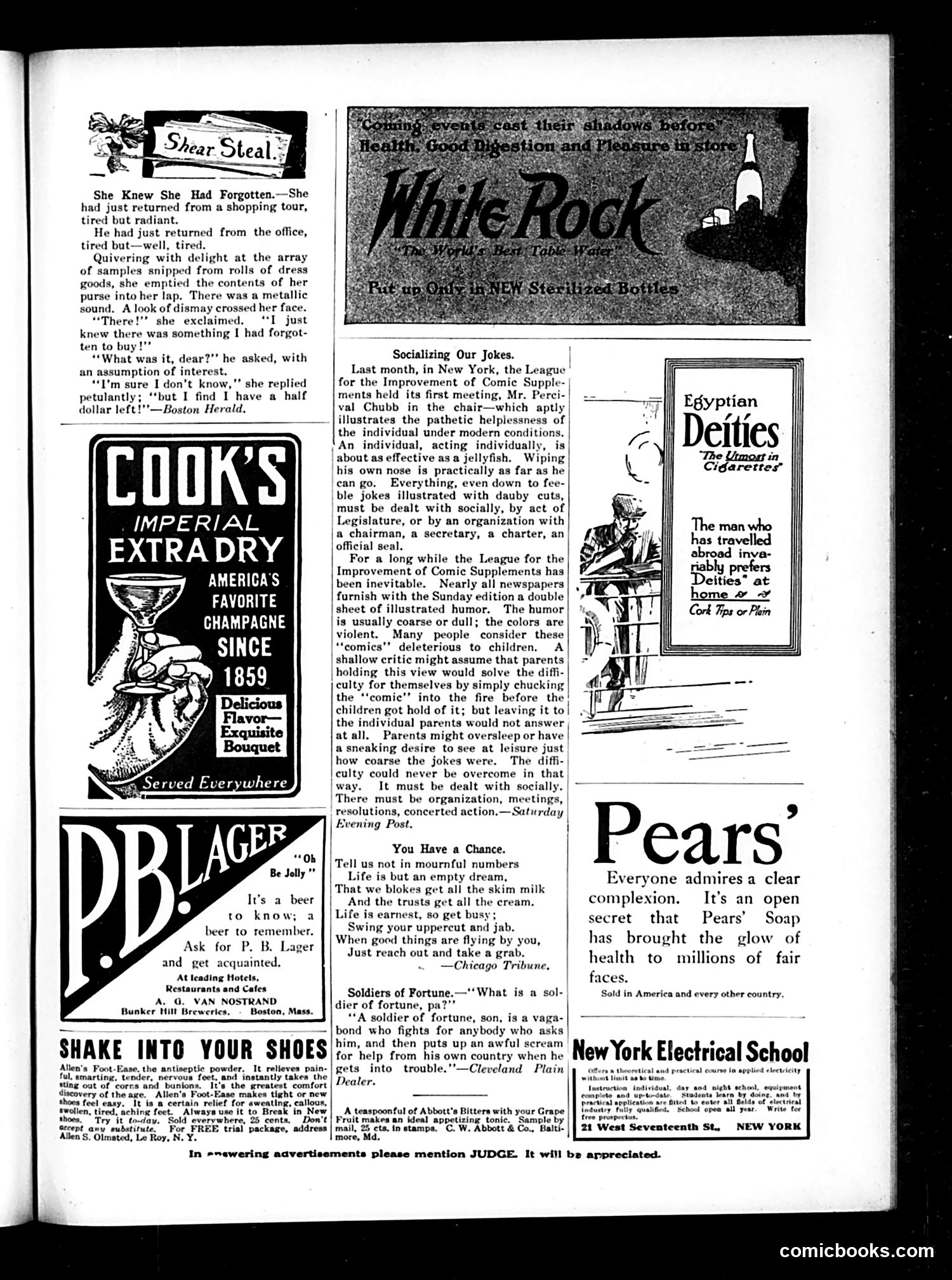
This page contains primarily **advertisements and humor pieces** rather than political cartoons. The main content includes: **"She Knew She Had Forgotten"** — A domestic humor piece about a wife returning from shopping so excited about her purchases that she's dismayed to discover she still has money left unspent. The joke relies on stereotypes about women's shopping habits and spending. **"Socializing Our Jokes"** — Editorial commentary satirizing the newly-formed League for the Improvement of Comic Supplements. The author mocks modern society's tendency to bureaucratize everything (forming committees, charters, official seals) even for minor issues like lowering the moral quality of newspaper comics. It critiques both the coarse humor in Sunday comics *and* the absurdity of solving social problems through formal organizations rather than individual parental responsibility. Other pieces include light jokes on soldiers of fortune and miscellaneous verse. The page is largely filled with period advertisements for champagne, beer, foot powder, and other products—typical of Judge's commercial revenue model.
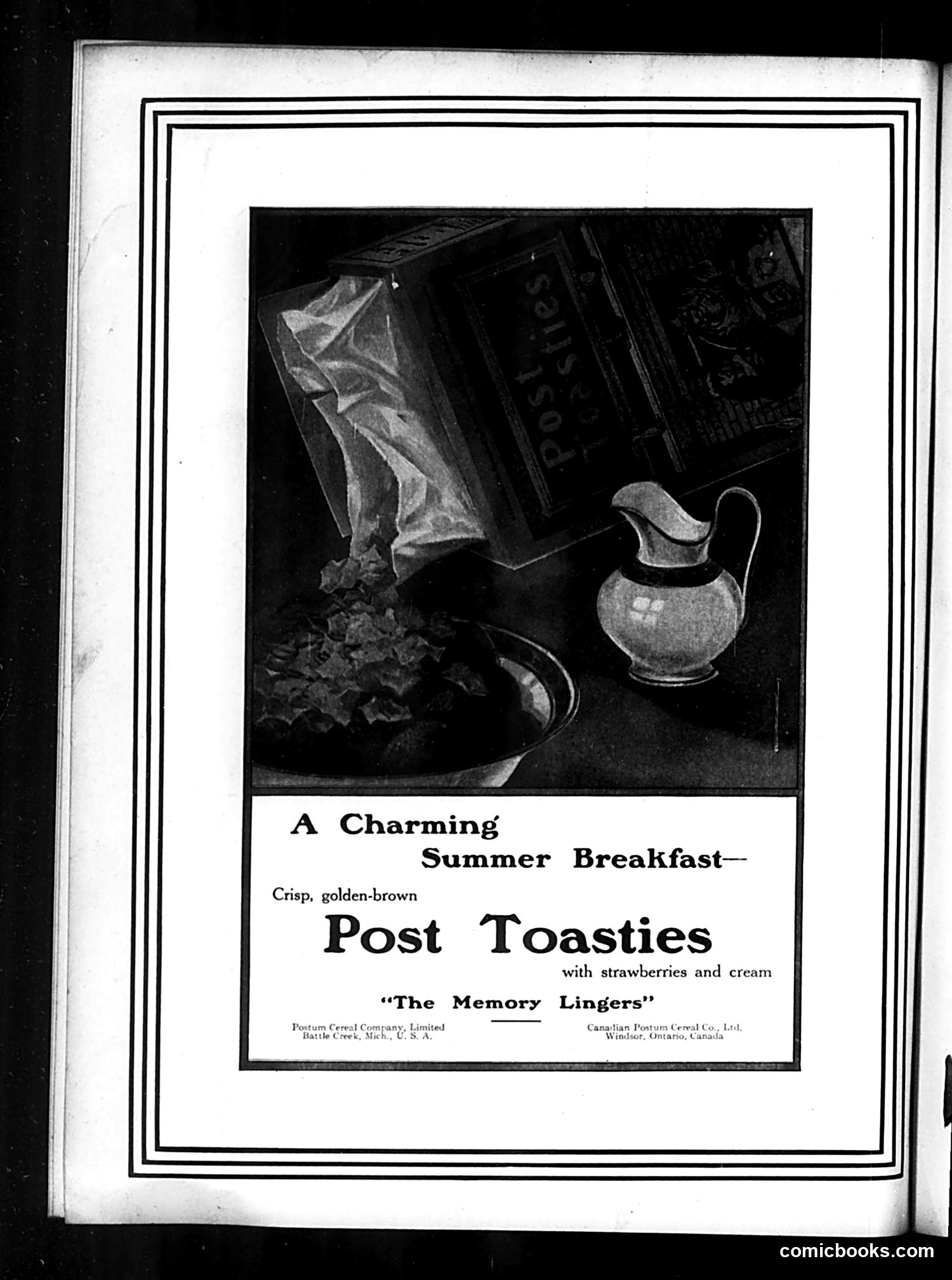
This is a **full-page advertisement**, not political satire or a cartoon. It advertises Post Toasties cereal, promoting a summer breakfast of the product with strawberries and cream. The image shows a cereal box being poured into a bowl, accompanied by a cream pitcher and what appears to be a serving plate. The tagline "The Memory Lingers" emphasizes the product's appeal and taste. The ad lists two company locations: Postum Cereal Company in Battle Creek, Michigan (U.S.A.) and Canadian Postum Cereal Co. in Windsor, Ontario. This reflects early 20th-century breakfast marketing, when cereal companies used sophisticated advertising in magazines like *Judge* to establish brand recognition and associate their products with pleasant, leisurely domestic scenes.