
Judge, 1911-05-27 · page 18 of 24
Judge — May 27, 1911 — page 18: what you’re looking at
What you’re looking at
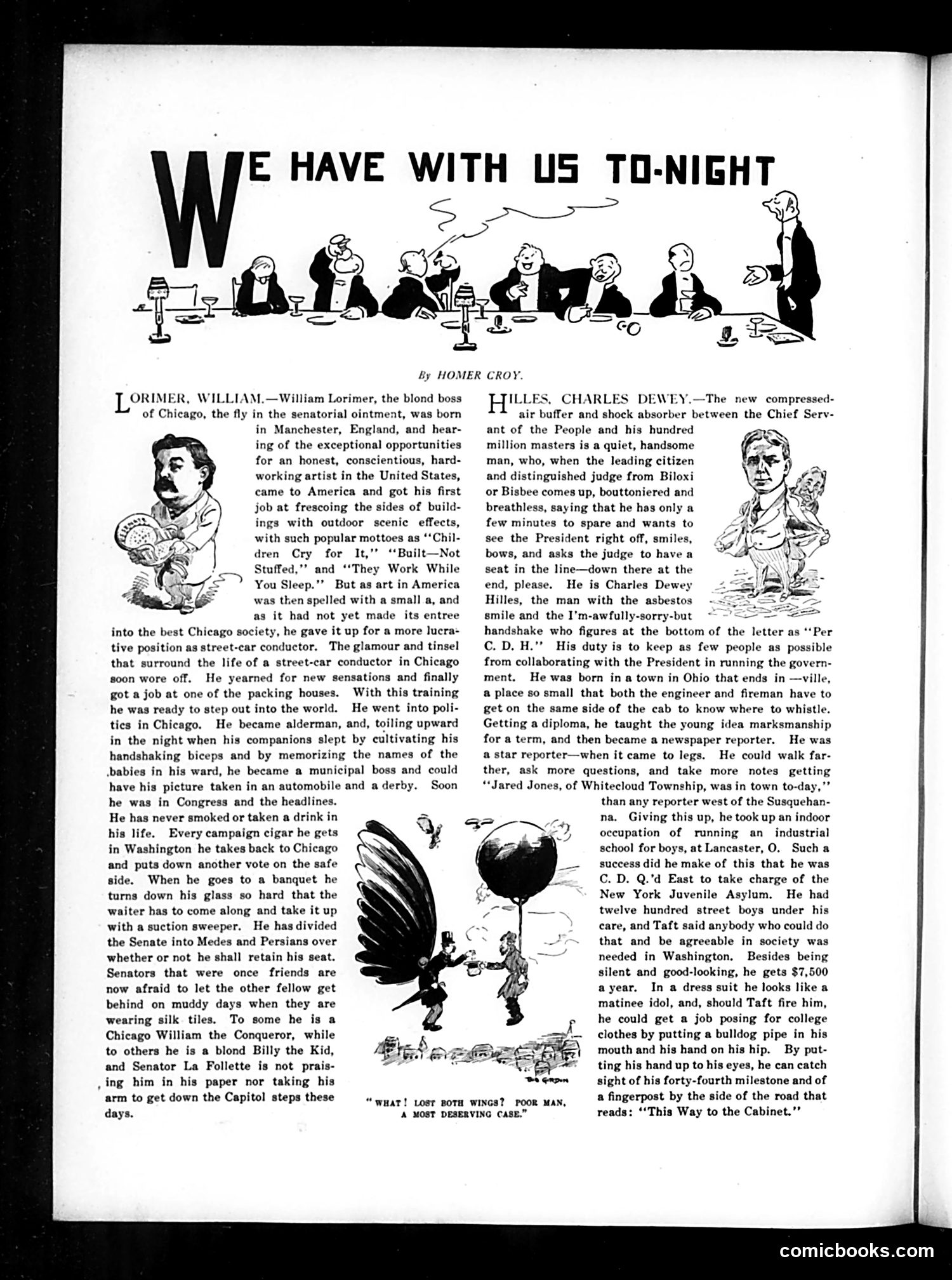
This page from Judge magazine presents satirical biographical sketches of two prominent political figures by Homer Croy. **William Lorimer** is the primary target—a Chicago political boss derided as "the fly in the senatorial ointment." The satire traces his opportunistic rise from manual laborer to alderman to congressman, mocking his cultivation of power through handshaking and voter manipulation. The piece suggests he's divisive even among senators, compared to both a conqueror and outlaw. **Charles Dewey Hilles** (President Taft's secretary) is portrayed as the presidential gatekeeper who shields the chief executive from public access. The satire mocks his humble origins and journalistic past, while his "asbestos smile" and ability to politely refuse petitioners makes him simultaneously indispensable and detested. Both sketches employ exaggerated biographical humor typical of early-20th-century political satire, highlighting how ambitious men navigate and exploit power structures. The cartoons above presumably satirize their respective roles in contemporary politics.
📄 Transcribed text from this page (OCR, searchable)
Machine-transcribed from the original scan — historical spelling and the odd misread are preserved.
E HAVE WITH US TO-NIGHT car By HOMER CROY. ORIMER, WILLIAM.—William Lorimer, the blond boss of Chicago, the fly in the senatorial ointment, was born in Manchester, England, and hear- ing of the exceptional opportunities for an honest, conscientious, hard- working artist in the United States, came to America and got his first job at frescoing the sides of build- ings with outdoor scenic effects, with such popular mottoes as ‘‘Chil- dren Cry for It,’’ ‘*Built—Not Stuffed,”” and ‘‘They Work While You Sleep.’’ But as art in America was then spelled with a small a, and as it had not yet made its entree into the best Chicago society, he gave it up for a more lucra- tive position as street-car conductor. The glamour and tinsel that surround the life of a street-car conductor in Chicago He yearned for new sensations and finally got a job at one of the packing houses. With this training he was ready to step out into the world. He went into poli- tics in Chicago. He became alderman, and, toiling upward in the night when his companions slept by cultivating his handshaking biceps and by memorizing the names of the .babies in his ward, he became a municipal boss and could have his picture taken in an automobile and aderby. Soon he was in Congress and the headlines. He has never smoked or taken a drink in his life. Every campaign cigar he gets in Washington he takes back to Chicago and puts down another vote on the safe side. When he goes to a banquet he turns down his glass so hard that the waiter has to come along and take it up with a suction sweeper. He has divided the Senate into Medes and Persians over whether or not he shall retain his seat. Senators that were once friends are now afraid to let the other fellow get behind on muddy days when they are wearing silk tiles. To some he is a Chicago William the Conqueror, while to others he is a blond Billy the Kid, and Senator La Follette is not prais- , ing him in his paper nor taking his arm to get down the Capitol steps these days. soon wore off. ILL CHARLES DEWEY.—The new compressed- air buffer and shock absorber between the Chief Serv- ant of the People and his hundred million masters is a quiet, handsome man, who, when the leading citizen and distinguished judge from Biloxi or Bisbee comes up, bouttoniered and breathless, saying that he has only a few minutes to spare and wants to see the President right off, smiles, bows, and asks the judge to have a seat in the line—down there at the end, please. He is Charles Dewey Hilles, the man with the asbestos smile and the I’m-awfully-sorry-but handshake who figures at the bottom of the letter as ‘‘Per C.D. H." His duty is to keep as few people as possible from collaborating with the President in running the govern- ment. He was born in a town in Ohio that ends in —ville, a place so small that both the engineer and fireman have to get on the same side of the cab to know where to whistle. Getting a diploma, he taught the young idea marksmanship for a term, and then became a newspaper reporter. He was a star reporter—when it came to legs. He could walk far- ther, ask more questions, and take more notes getting “Jared Jones, of Whitecloud Township, was in town to-day,”” than any reporter west of the Susquehan- na. Giving this up, he took up an indoor occupation of running an_ industrial school for boys, at Lancaster, O. Such a success did he make of this that he was C. D. Q.’d East to take charge of the New York Juvenile Asylum. He had twelve hundred street boys under his care, and Taft said anybody who could do that and be agreeable in society was needed in Washington. Besides being silent and good-looking, he gets $7,500 ayear. In a dress suit he looks like a matinee idol, and, should Taft fire him, he could get a job posing for college clothes by putting a bulldog pipe in his mouth and his hand on his hip. By put- ting his hand up to his eyes, he can catch sight of his forty-fourth milestone and of a fingerpost by the side of the road that reads: ‘‘This Way to the Cabinet.’’ ee _—_f. ace “wHaT! Lost BOTH WINGS? POOR MAN, A MOST DESERVING CASE.” comicbooks.com