
Judge, 1911-05-27 · page 16 of 24
Judge — May 27, 1911 — page 16: what you’re looking at
What you’re looking at
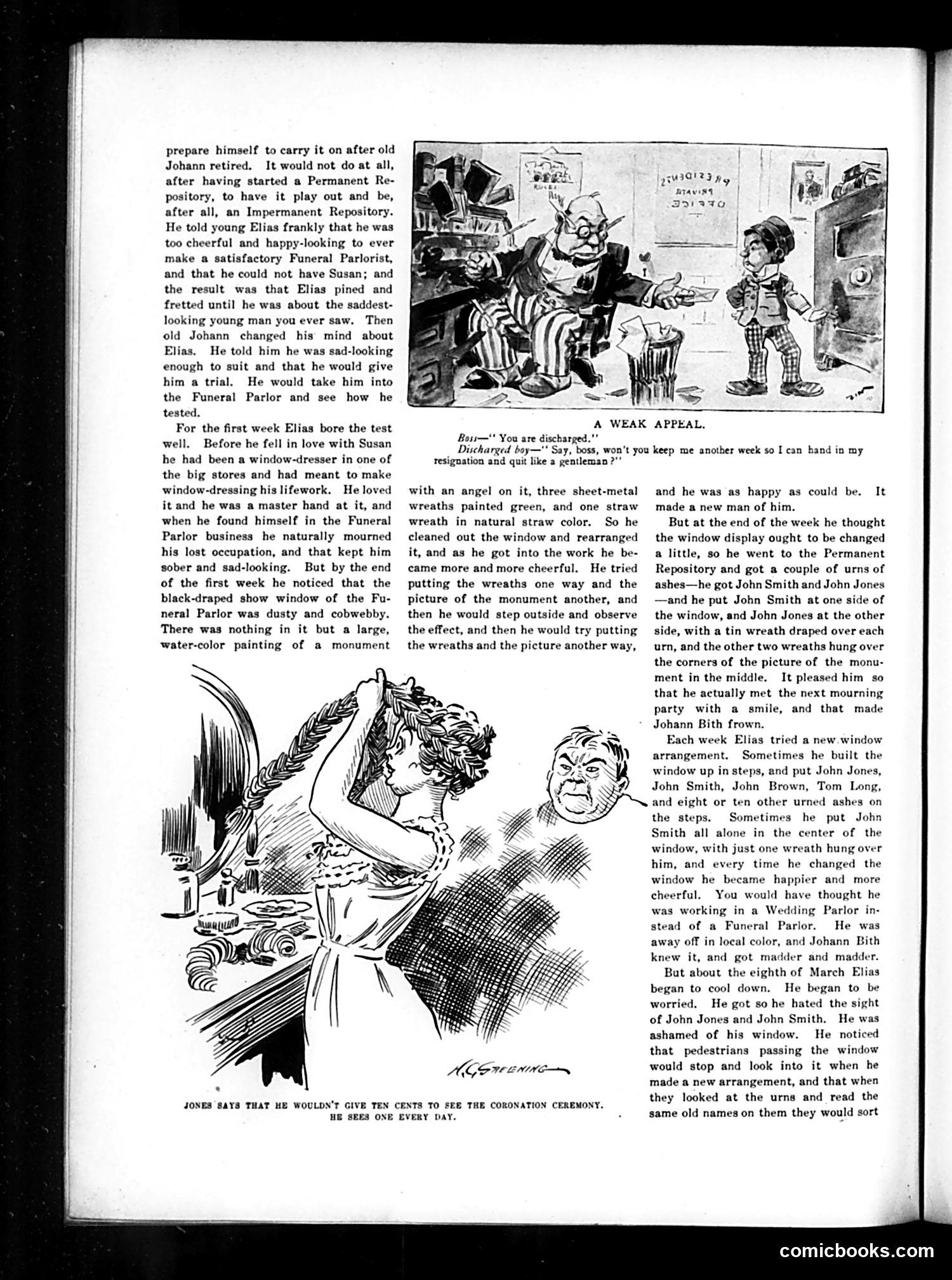
This page satirizes the absurdity of funeral parlor window-dressing as a profession. The story concerns Elias, a young man desperate to work at a funeral parlor to marry Susan. His employer, old Johann, initially rejects him for being too cheerful—funeral work requires a perpetually sad demeanor. Once Elias becomes sufficiently melancholic, Johann hires him. The satire intensifies when Elias, formerly a talented window-dresser, cannot help but apply his creative skills to the funeral parlor display. He arranges urns (containing ashes of "John Smith," "John Jones," etc.) and monuments with increasing artistic flair, becoming visibly happier. This horrifies Johann: the funeral business demands solemnity, not aesthetic joy. The cartoon's humor derives from the contradiction between professional expertise and professional atmosphere—Elias's competence undermines the gloomy pretense essential to funeral parlors. The bottom cartoon about "Jones" and the coronation reinforces the theme: viewing ceremonial death ritually has become mundane.
📄 Transcribed text from this page (OCR, searchable)
Machine-transcribed from the original scan — historical spelling and the odd misread are preserved.
prepare himself to carry it on after old Johann retired. It would not do at all, after having started a Permanent Re- pository, to have it play out and be, after all, an Impermanent Repository. He told young Elias frankly that he was too cheerful and happy-looking to ever make a satisfactory Funeral Parlorist, and that he could not have Susan; and the result was that Elias pined and fretted until he was about the saddest- looking young man you ever saw. Then old Johann changed his mind about Elias. He told him he was sad-looking enough to suit and that he would give him a trial. He would take him into the Funeral Parlor and see how he tested. For the first week Elias bore the test well. Before he fell in love with Susan he had been a window-dresser in one of the big stores and had meant to make window-dressing his lifework. He loved it and he was a master hand at it, and when he found himself in the Funeral Parlor business he naturally mourned his lost occupation, and that kept him sober and sad-looking. But by the end of the first week he noticed that the black-draped show window of the Fu- neral Parlor was dusty and cobwebby. There was nothing in it but a large, water-color painting of a monument A WEAK APPEAL. Boss—'* You are discharged.’ Discharged boy—'* Say, boss, won't you keep me another week so I can hand in my resignation and quit like a gentleman ?"’ with an angel on it, three sheet-metal wreaths painted green, and one straw wreath in natural straw color. So he cleaned out the window and rearranged it, and as he got into the work he be- came more and more cheerful. He tried putting the wreaths one way and the picture of the monument another, and then he would step outside and observe the effect, and then he would try putting the wreaths and the picture another way, AGEVENN ES JONES SAYS THAT HE WOULDN'T GIVE TEN CENTS TO SEE THE CORONATION CEREMONY. HE SEES ONE E) RY DAY. and he was as happy as could be. It made a new man of him. But at the end of the week he thought the window display ought to be changed a little, so he went to the Permanent Repository and got a couple of urns of ashes—he got John Smith and John Jones —and he put John Smith at one side of the window, and John Jones at the other side, with a tin wreath draped over each urn, and the other two wreaths hung over the corners of the picture of the monu- ment in the middle. It pleased him so that he actually met the next mourning party with a smile, and that made Johann Bith frown. Each week Elias tried a new window arrangement. Sometimes he built the window up in steps, and put John Jones, John Smith, John Brown, Tom Long, and eight or ten other urned ashes on the steps. Sometimes he put John Smith all alone in the center of the window, with just one wreath hung over him, and every time he changed the window he became happier and more cheerful. You would have thought he was working in a Wedding Parlor in- Parlor. He was away off in local color, and Johann Bith knew it, and got madder and madder. But about the eighth of March Elias began to cool down. He began to be He got so he hated the sight He was noticed stead of a Funeral worried. of John Jones and John Smith. ashamed of his window. He that pedestrians passing the window would stop and look into it when he made a new arrangement, and that when they looked at the urns and read the same old names on them they would sort comicbooks.com