
Judge, 1911-05-27 · page 13 of 24
Judge — May 27, 1911 — page 13: what you’re looking at
What you’re looking at
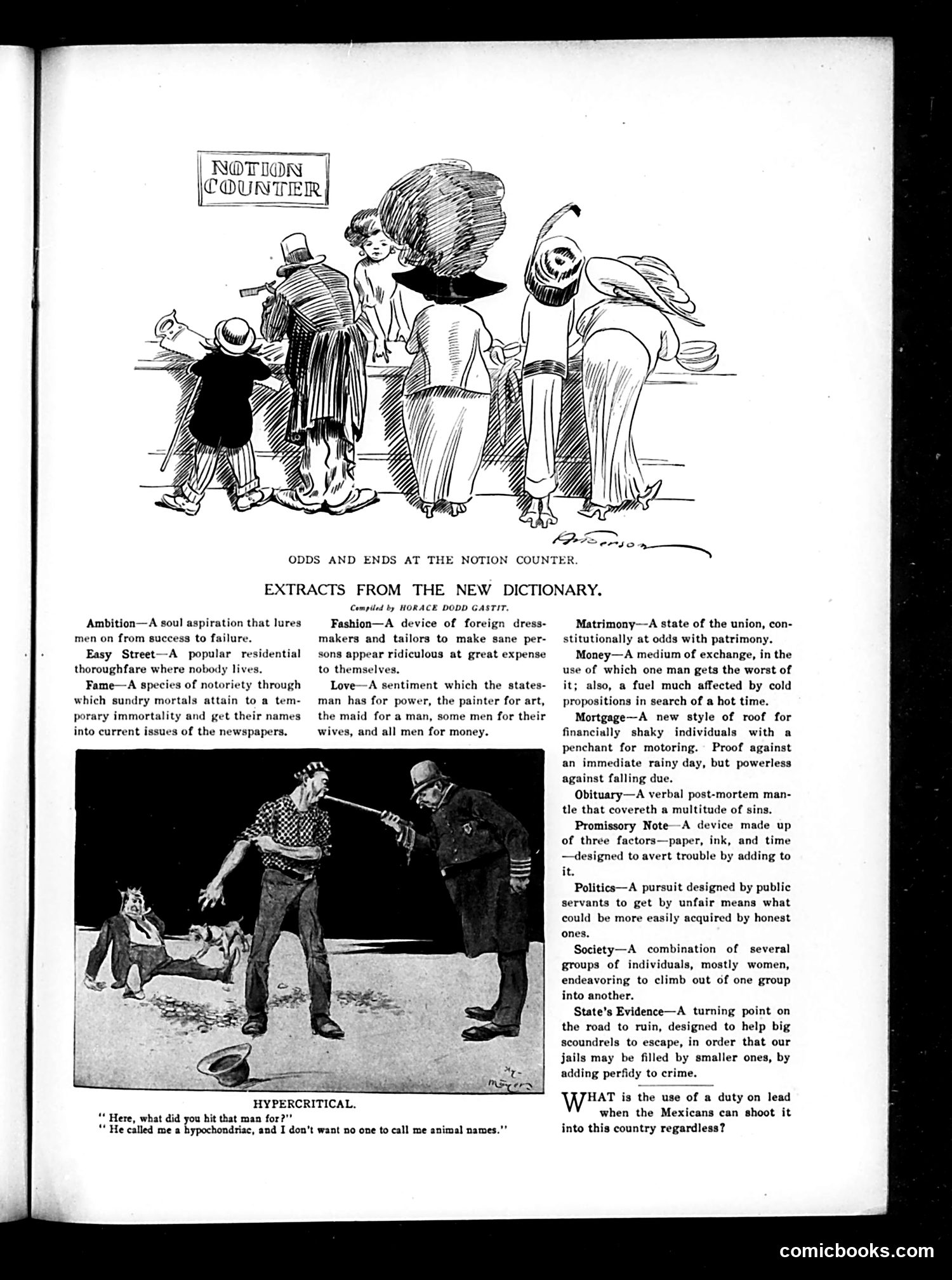
This page from *Judge* magazine features cynical, mock-dictionary definitions satirizing American social conventions. The top cartoon illustrates "Odds and Ends at the Notion Counter"—a play on the haberdashery section where women shopped for accessories. The central cartoon, "Hypercritical," shows a man beating another man, defending himself by claiming he objected to being called a "hypochondriac" because it's an "animal name"—the joke being the absurdity of this logic. The bulk of the page contains Horace Dodd Gastit's satirical dictionary entries mocking contemporary society: "Fashion" ridicules foreign dress designers; "Matrimony" jokes about marital financial conflict; "Politics" attacks public servants' corruption; "Society" mocks women's social climbing. The final item questions tariffs on Mexican lead imports—likely referencing debates over protectionist trade policy during this period. Overall, the page reflects *Judge's* cynical editorial voice, using humor to critique American materialism, social pretension, and political dishonesty.
📄 Transcribed text from this page (OCR, searchable)
Machine-transcribed from the original scan — historical spelling and the odd misread are preserved.
| NOTION |COUNTER| ODDS AND ENDS AT THE NOTION COUNTER. EXTRACTS FROM THE NEW DICTIONARY. Ambition—A soul aspiration that lures men on from success to failure. Easy Street—A popular residential thoroughfare where nobody lives. Fame—A species of notoriety through which sundry mortals attain to a tem- porary immortality and get their names into current issues of the newspapers. Compiled by HORACE DODD GASTIT. Fashion—A device of foreign dress- makers and tailors to make sane per- sons appear ridiculous at great expense to themselves. Love—A sentiment which the states- man has for power, the painter for art, the maid for a man, some men for their wives, and all men for money. HYPERCRITICAL. “* Here, what did you hit that man for?" ‘* He called me a hypochondriac, and I don’t want no one to call me animal names.’’ Matrimony—A state of the union, con- stitutionally at odds with patrimony. Money—A medium of exchange, in the use of which one man gets the worst of it; also, a fuel much affected by cold propositions in search of a hot time. Mortgage—A new style of roof for financially shaky individuals with a penchant for motoring. Proof against an immediate rainy day, but powerless against falling due. Obituary—A verbal post-mortem man- tle that covereth a multitude of sins. Promissory Note—-A device made up of three factors—paper, ink, and time —designed to avert trouble by adding to it. Politics—A pursuit designed by public servants to get by unfair means what could be more easily acquired by honest ones. Society—A combination of several groups of individuals, mostly women, endeavoring to climb out of one group into another. State’s Evidence—A turning point on the road to ruin, designed to help big scoundrels to escape, in order that our jails may be filled by smaller ones, by adding perfidy to crime. HAT is the use of a duty on lead when the Mexicans can shoot it into this country regardless? comicbooks.com