
A complete issue · 24 pages · 1911
Judge — May 20, 1911
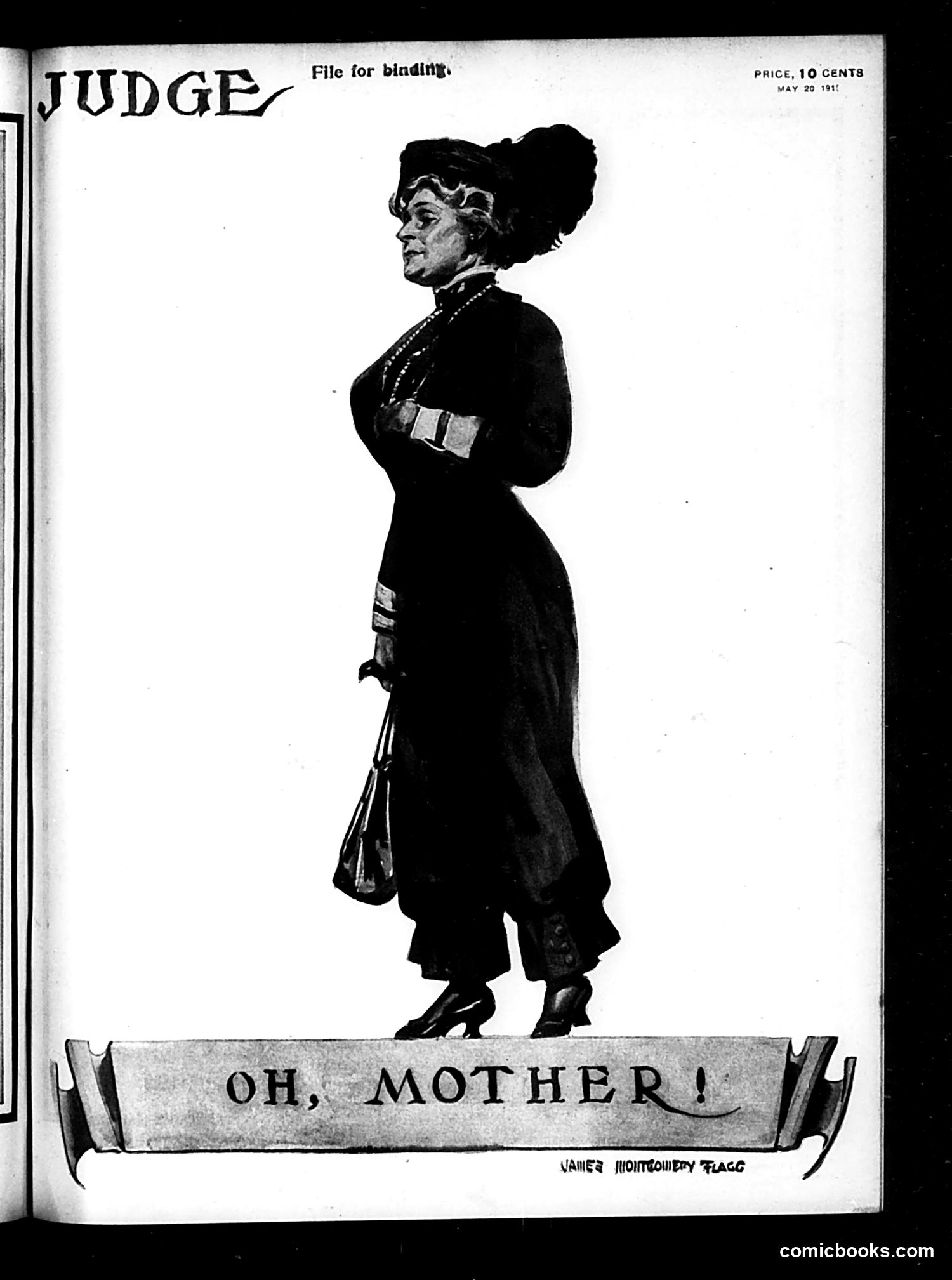
This cartoon by James Montgomery Flagg depicts an elegantly dressed woman in profile, carrying a purse and wearing fashionable early-1900s attire with a large feathered hat. The caption "Oh, Mother!" suggests satirical commentary on maternal figures or women's fashion and behavior. Given the 1911 date and Judge's satirical focus, this likely mocks contemporary women—possibly addressing evolving gender roles, fashion excess, or social pretensions of the era. The exaggerated silhouette and refined pose may parody wealthy or fashionable women. Without additional context identifying the specific figure or social issue referenced, the precise target remains unclear, though the tone appears gently mocking of women's vanity or social performance.
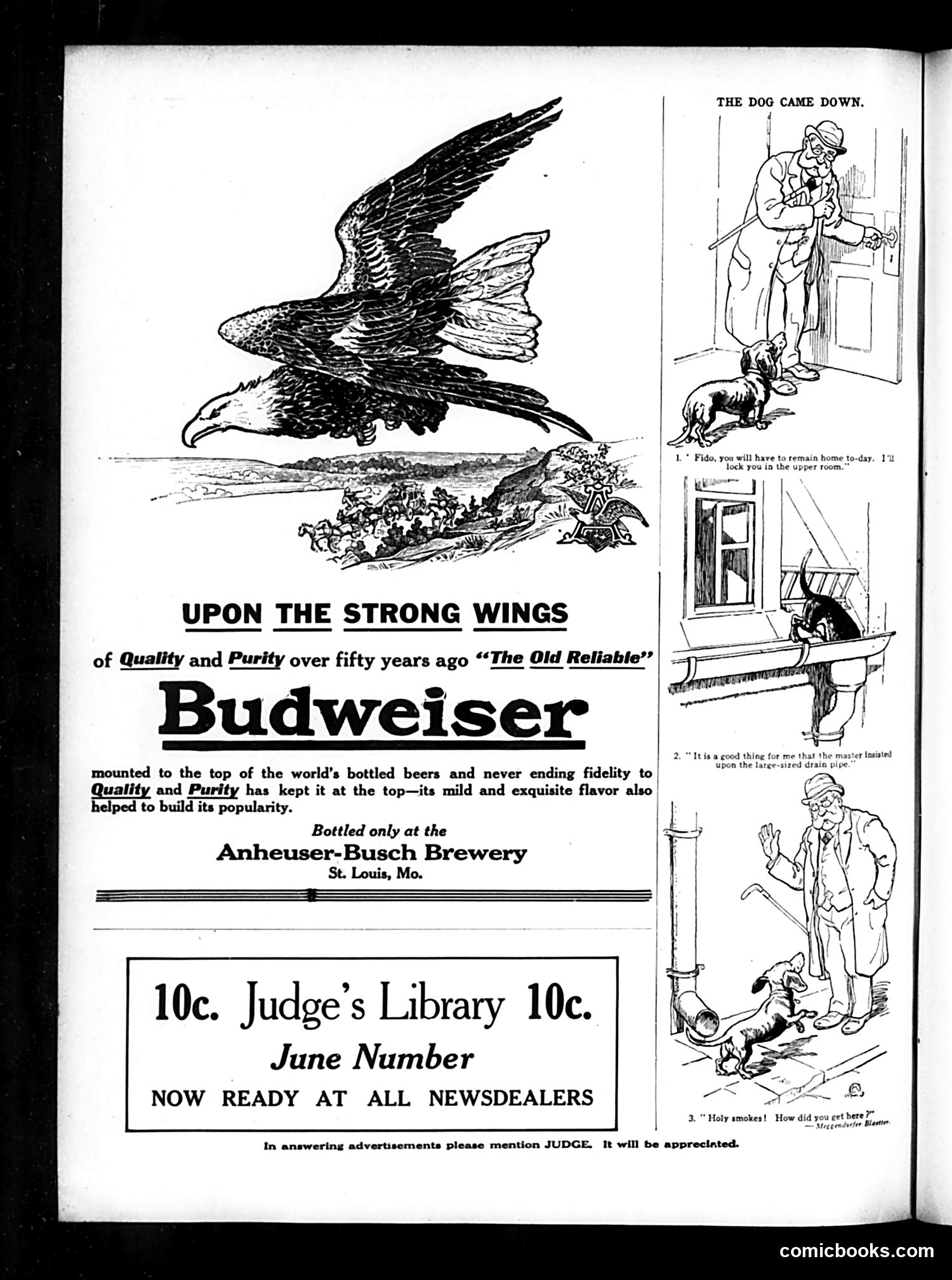
This page is primarily **advertising**, not satirical content. The dominant feature is a Budweiser beer advertisement featuring an eagle ("The Old Reliable") with text emphasizing the brand's fifty-year heritage of "Quality and Purity." On the right side is a small comic strip titled "The Dog Came Down," a domestic humor sequence showing a man discovering his dog has escaped through an upper window. The three panels depict the man's reaction and the dog's safe return—typical early-20th-century light family comedy with no political satire. The page also advertises Judge's "June Number" at ten cents. The content reflects early-1900s commercial publishing, mixing advertising with light entertainment rather than sharp political commentary.
This page is **primarily advertising** with minimal editorial content. The main cartoons are small: **Left side**: A classical allegorical figure (Justice or similar) seated under a columned structure—standard decorative masthead imagery for Judge magazine. **Content**: The page consists mainly of advertisements for Chiclets chewing gum and the Holland House hotel in New York City, plus subscription/publication information. The Chiclets ad emphasizes the product as refined chewing gum for "people of refinement," a marketing appeal typical of early 1900s luxury goods advertising. No identifiable political figures or specific satirical commentary appears on this particular page—it represents Judge's business side rather than its editorial satire function.
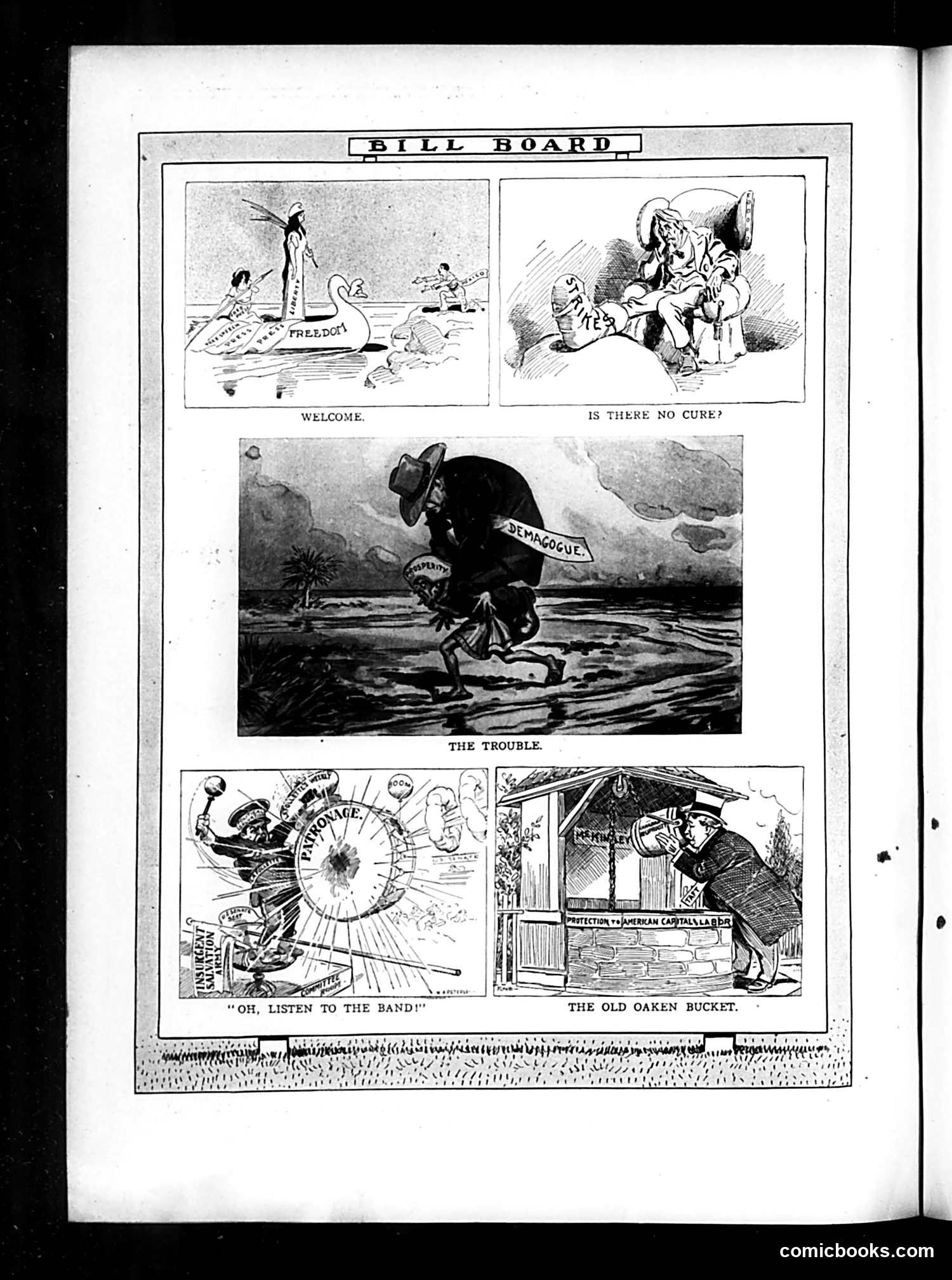
This page comprises five satirical cartoons addressing late 19th/early 20th-century American political issues: 1. **"Welcome"** and **"Is There No Cure?"** appear to reference immigration debates, showing figures arriving by ship and a doctor's inability to treat social problems. 2. **"The Trouble"** depicts a bloated figure labeled "Demagogue" and "Appetite," suggesting criticism of corrupt politicians exploiting public sentiment. 3. **"Oh, Listen to the Band!"** shows a spinning wheel of patronage/political appointments, satirizing how politicians distribute jobs and favors. 4. **"The Old Oaken Bucket"** references nostalgia versus present-day conditions, likely critiquing how politicians invoke the past while ignoring current problems. The cartoons collectively critique political corruption, demagoguery, and patronage systems of the era.
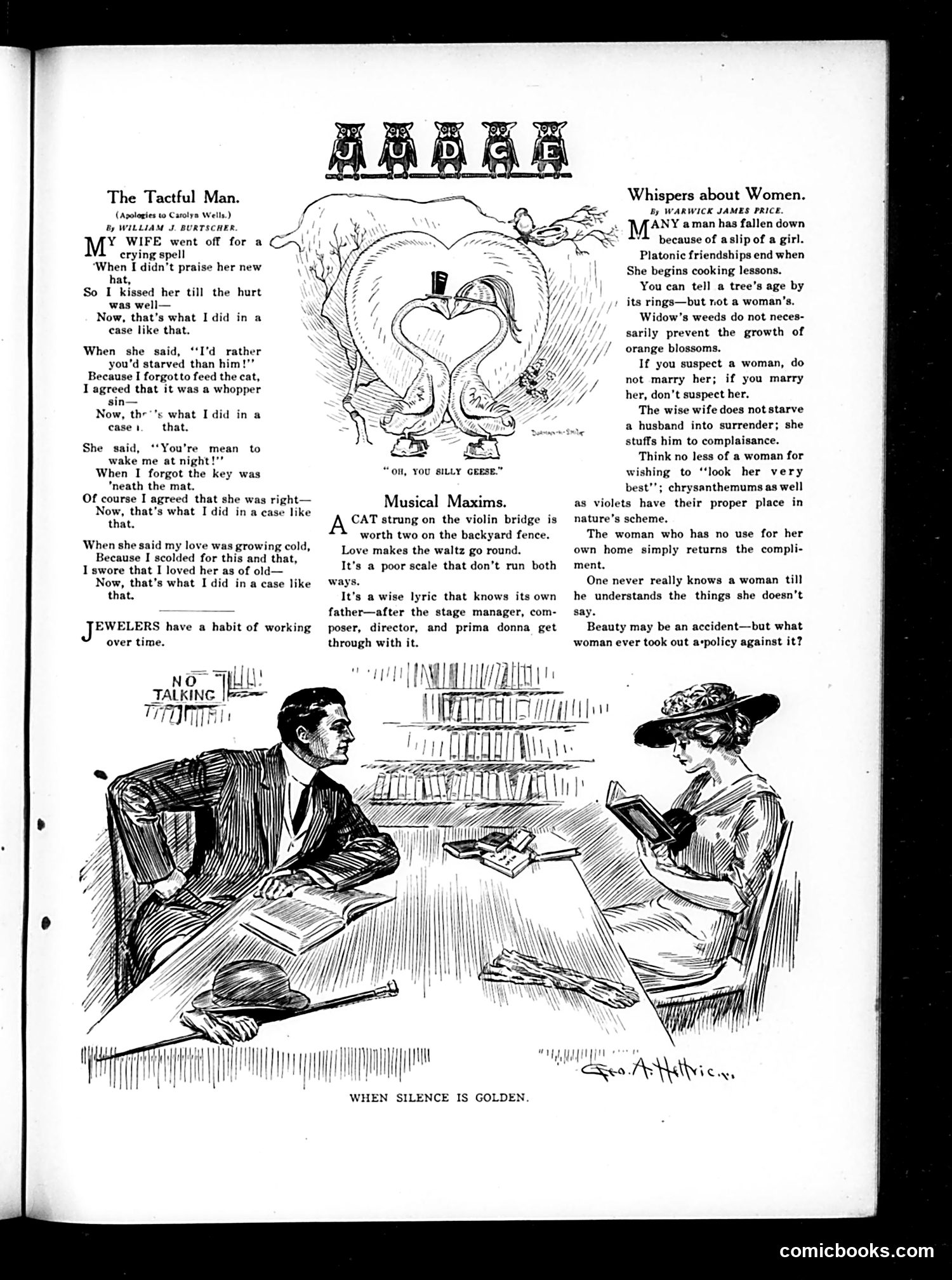
This page contains three pieces of early 20th-century social commentary: 1. **"The Tactful Man"** (left): A humorous poem by William J. Leutscher about diplomatic dishonesty in marriage—specifically how a husband tactfully lies to keep peace, using examples like pretending to like his wife's hat and claiming to love her more than an old mistress. 2. **"Whispers about Women"** (right): Cynical aphorisms by Harwick James Price about women's nature, relationships, and beauty. It's dismissive commentary typical of the era—suggesting women are unpredictable, that beauty isn't trustworthy, and that men shouldn't fully understand women. 3. **"When Silence is Golden"** (bottom): A sketch showing a man and woman in a library, apparently in tense silence—illustrating that sometimes not speaking is preferable, possibly suggesting marital discord or awkwardness. The page reflects period attitudes about gender relations and marriage through satire.
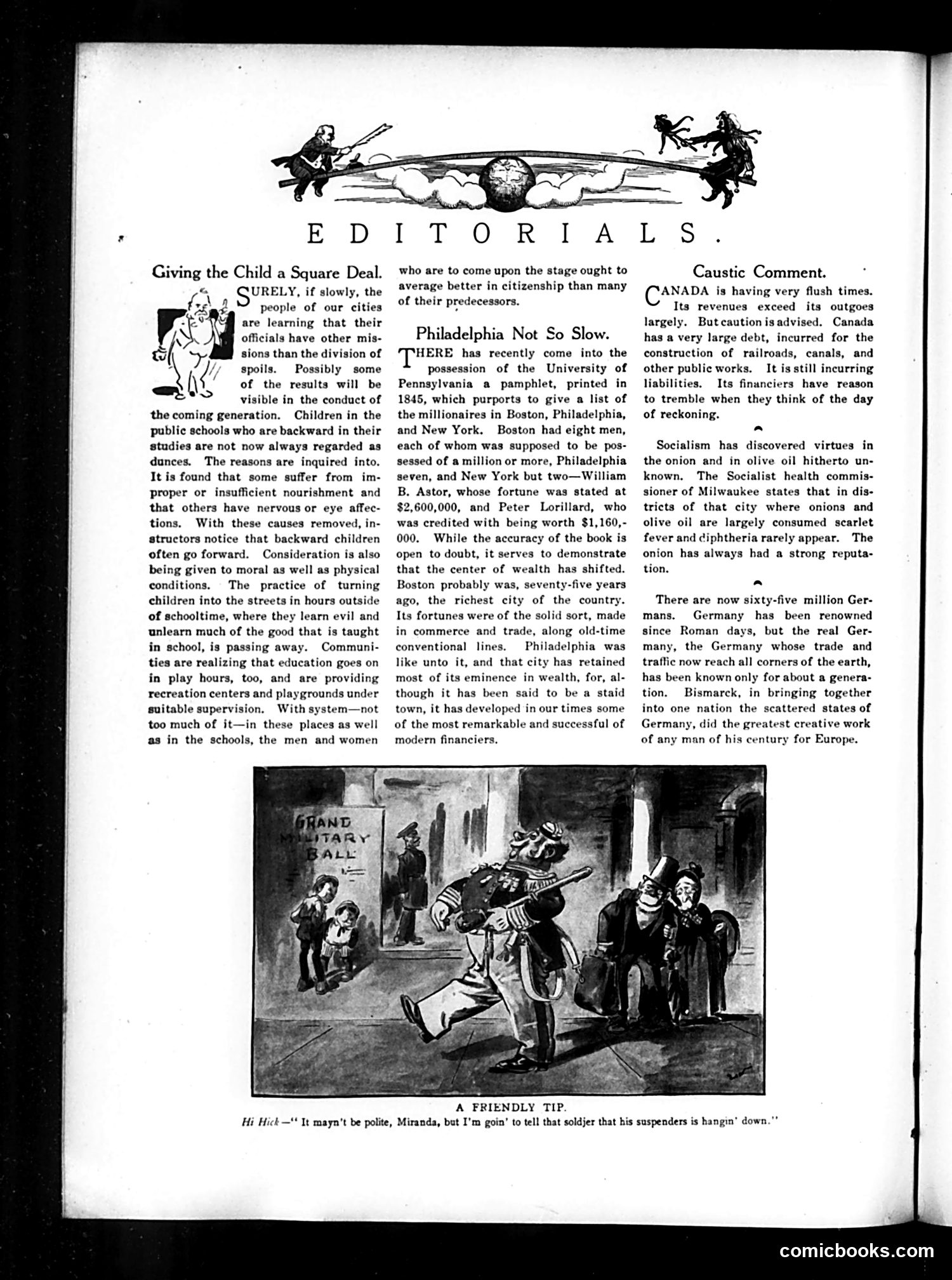
This Judge magazine page contains three distinct editorials plus one cartoon. **"Giving the Child a Square Deal"** praises progressive urban reforms: better nutrition and medical care for struggling schoolchildren, supervised playgrounds, and recognizing that education happens outside classroom hours. It reflects early-20th-century Progressive Era concern for child welfare. **"Philadelphia Not So Slow"** disputes the notion that Philadelphia has declined economically. Using an 1845 millionaire list showing Boston ahead, it argues Philadelphia has actually retained and grown its wealth through successful modern financiers—contrasting "solid" old commerce with new financial innovation. **"Caustic Comment"** warns Canada against overconfidence despite budget surpluses, citing accumulated railroad/canal debt. It also praises Milwaukee's Socialist health commissioner for noting onion and olive oil consumption correlates with fewer disease cases. The third item celebrates Bismarck's German unification as unprecedented creative statecraft. **The cartoon** ("A Friendly Tip") shows a rustic character warning a military officer that his suspenders are showing—gentle social satire about propriety and masculine dignity.
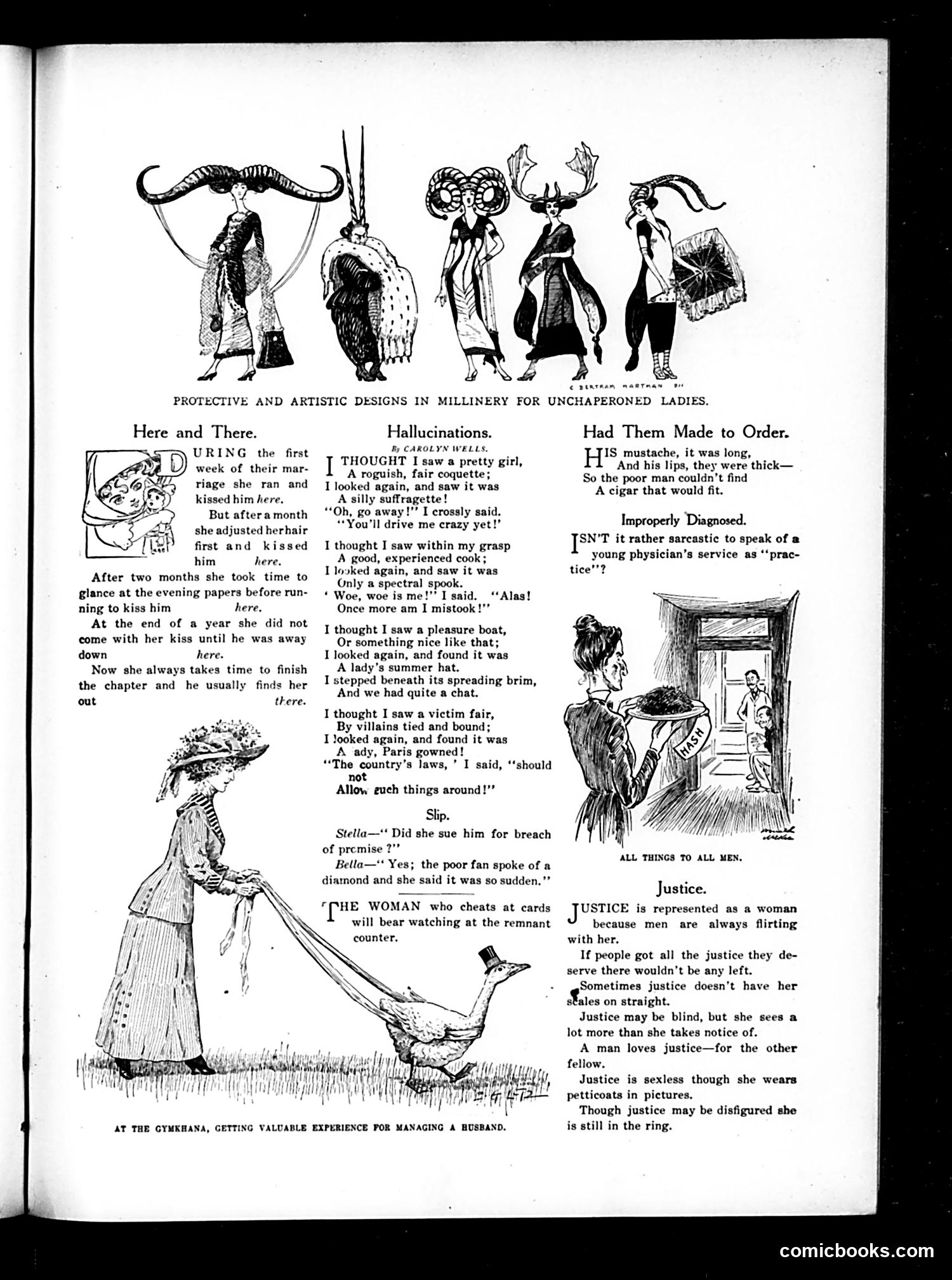
This satirical page from early-20th-century Judge contains multiple comic commentaries on gender and social relations: **"Here and There"** depicts a wife's declining affection over marriage's first year—a common trope mocking matrimonial disillusionment. She progresses from eagerly greeting her husband to ignoring him entirely, finishing her book instead. **"Hallucinations"** by Carolyn Wells mocks women's suffrage and changing female independence. The speaker mistakes a "suffragette" for a pretty girl and a "lady's summer hat" for a pleasure boat—suggesting absurdity in women's liberation and the era's enormous, impractical women's hats. **"At the Gymkhana"** shows a woman learning to "manage a husband" through sports, implying women need training to handle marriage. The remaining short pieces ("Had Them Made to Order," "Justice") offer mild domestic humor about mustaches and cynical observations about justice favoring the wealthy. Overall, the page reflects Belle Époque anxieties about changing gender roles, marriage stability, and women's emerging independence—treating these developments with condescending mockery typical of the period's satirical press.
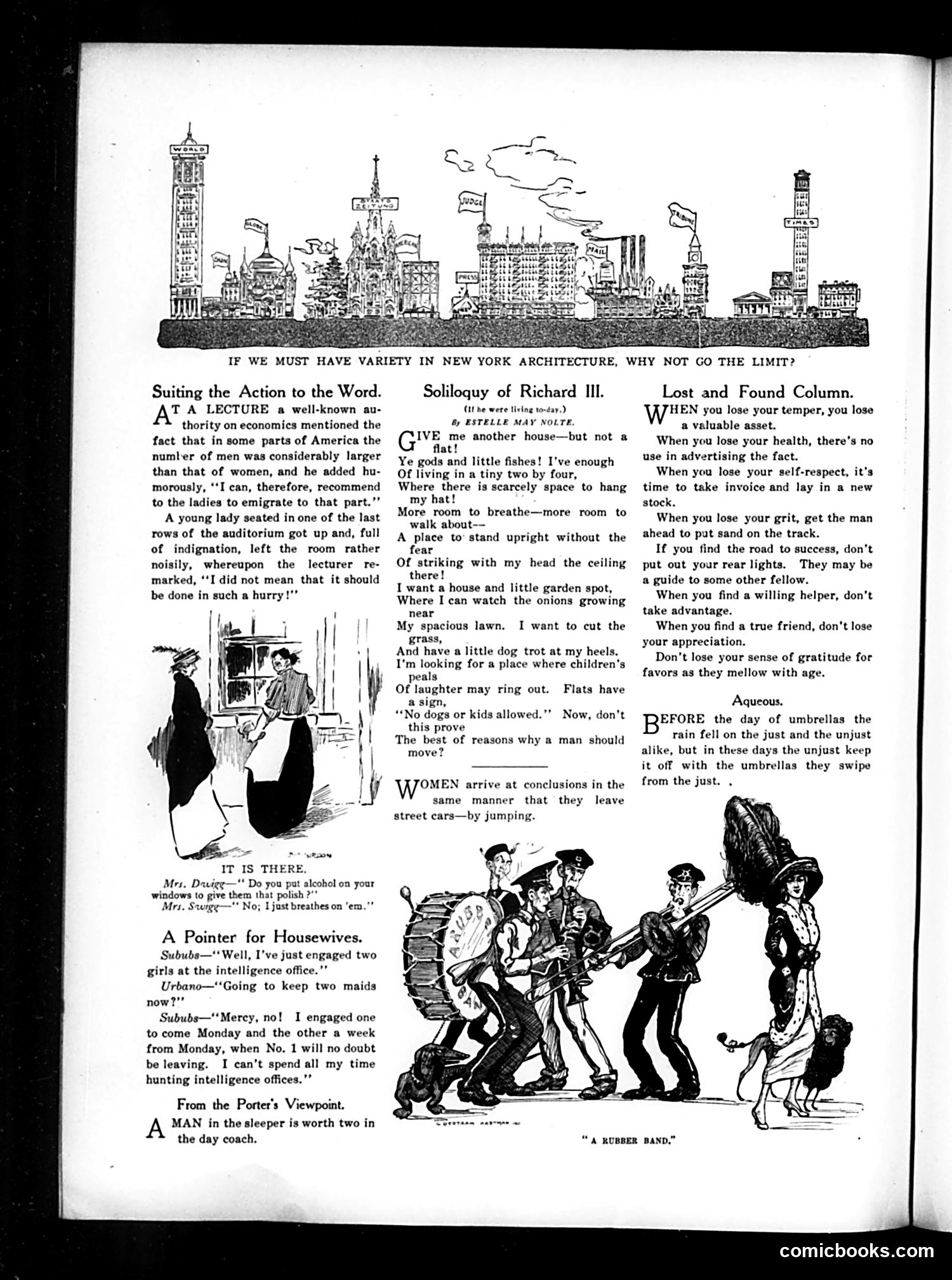
**Top Cartoon:** The architectural skyline satirizes New York's chaotic building boom—mocking the era's hodgepodge of styles by asking if architects should abandon restraint entirely. **"Suiting the Action to the Word":** An economics lecturer jokingly suggests women emigrate to regions with more men than women. A young woman immediately leaves the auditorium in protest—the humor lies in her taking his offhand comment as a literal suggestion. **"A Pointer for Housewives":** Suburban housewife satirizes the domestic servant crisis (likely post-WWI era) by deliberately staggering maids' start dates so she only employs one at a time, avoiding "wasting" money on overlapping help. **"Soliloquy of Richard III":** Uses Shakespeare's villain to lampoon 1920s apartment living—Richard complains about cramped city flats (no space, noise restrictions against children/dogs), yearning for a suburban house with lawn and garden. **"Lost and Found" & "Rubber Band":** Advice columns with cynical humor about life's losses and urban theft of umbrellas from "the just."
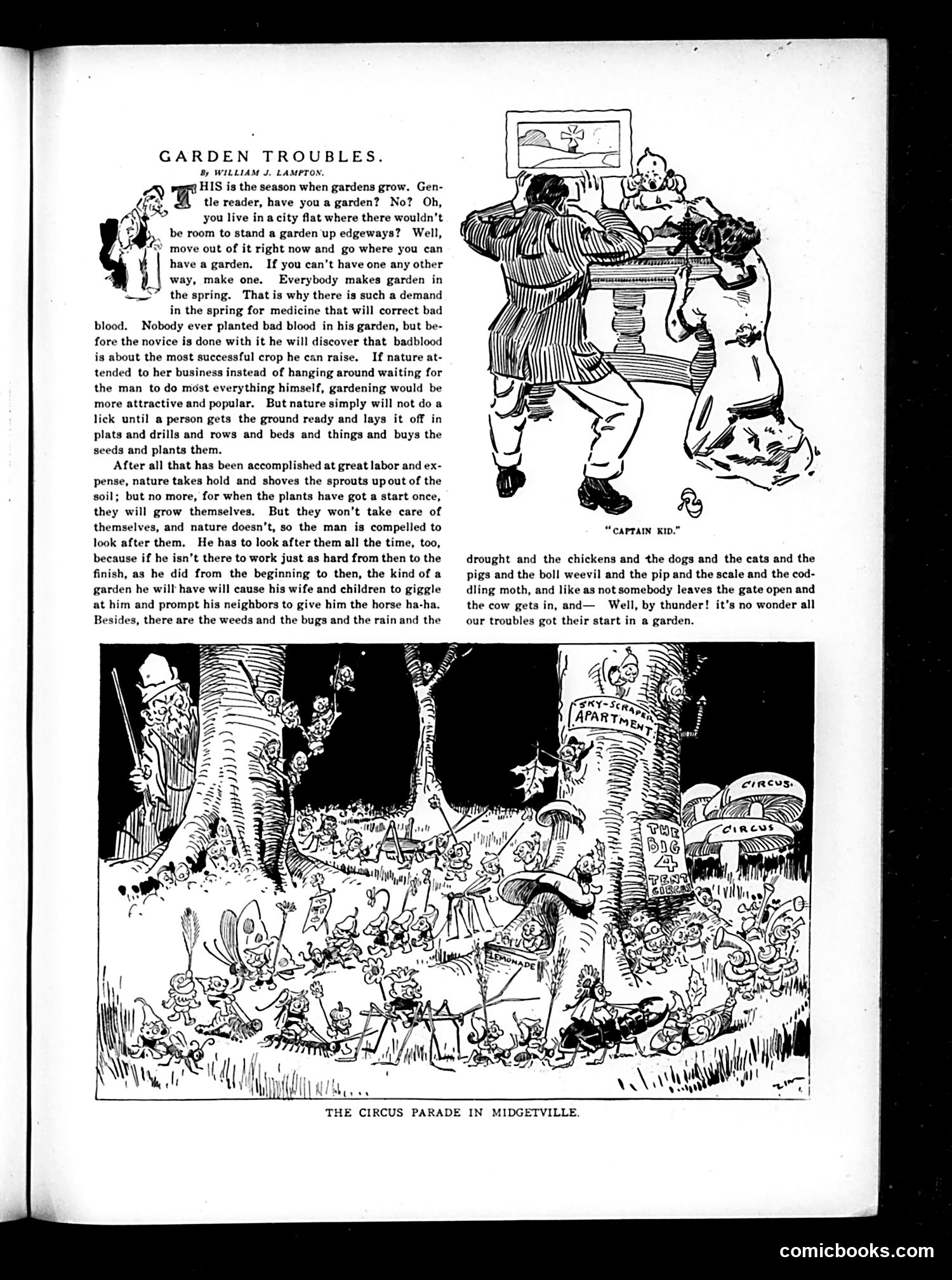
This page contains two distinct pieces. The main article by William J. Lampton humorously catalogs the frustrations of spring gardening through satirical exaggeration. The author ironically suggests everyone should garden, then systematically details why gardening is actually a disaster: it requires backbreaking labor, nature refuses to cooperate beyond sprouting, pests multiply (weeds, bugs, animals), weather interferes, and domestic chaos ensues. The final punchline—"it's no wonder all our troubles got their start in a garden"—references the biblical Garden of Eden, sardonically blaming humanity's original sin location for all modern problems. The accompanying illustrations are light comic supplements: "Captain Kid" depicts people at a desk (possibly a pun on Kidd the pirate), and "The Circus Parade in Midgetville" shows a whimsical miniature circus among giant trees—likely a fantastical scene for entertainment. The satire targets the romanticization of gardening as simple, therapeutic work when reality proves exhausting and futile.
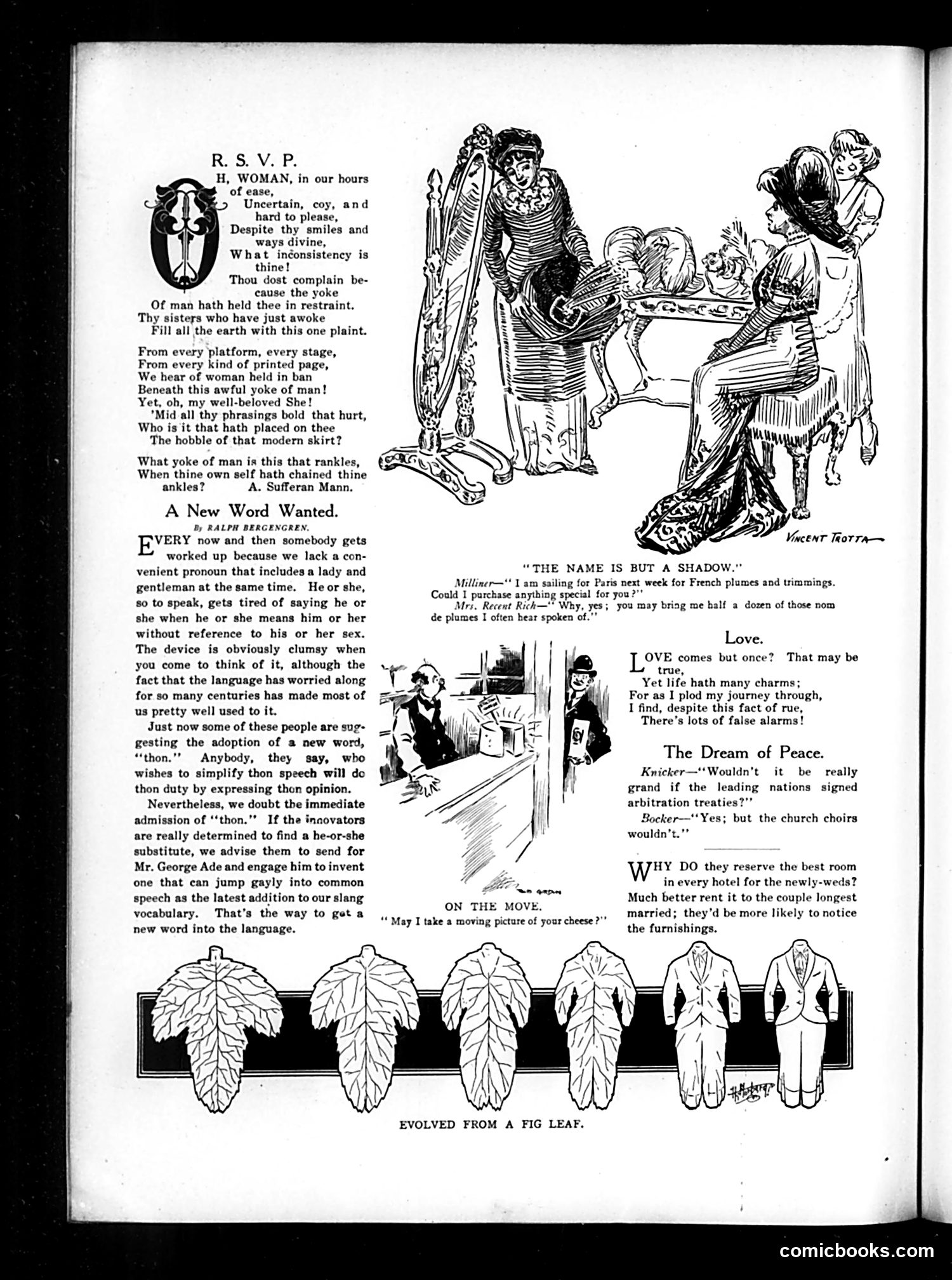
This page contains multiple satirical pieces typical of early 20th-century American humor: **"R.S.V.P." poem**: Mocks women's rights advocates by sarcastically noting women complain about male oppression while self-imposing restrictive fashion (the "hobble skirt"—a notoriously tight, leg-restricting garment). The satire suggests women are their own constraint. **"A New Word Wanted"**: Ridicules proposals for a gender-neutral pronoun ("thon") to replace "he or she," dismissing the effort as clumsy and suggesting only slang-creator George Ade could make such neologisms stick. **"The Name is But a Shadow"**: A pun joke where a wealthy woman confuses "nom de plumes" (pen names) with actual French feathers for her hat—satirizing nouveaux riches pretension. **"Evolved from a Fig Leaf"**: Shows progressive undressing from fig leaf to business suit, apparently commenting on social evolution. The overall tone reflects anti-feminist sentiment common in Judge magazine, mocking women's rights activism while using fashion and language as targets.
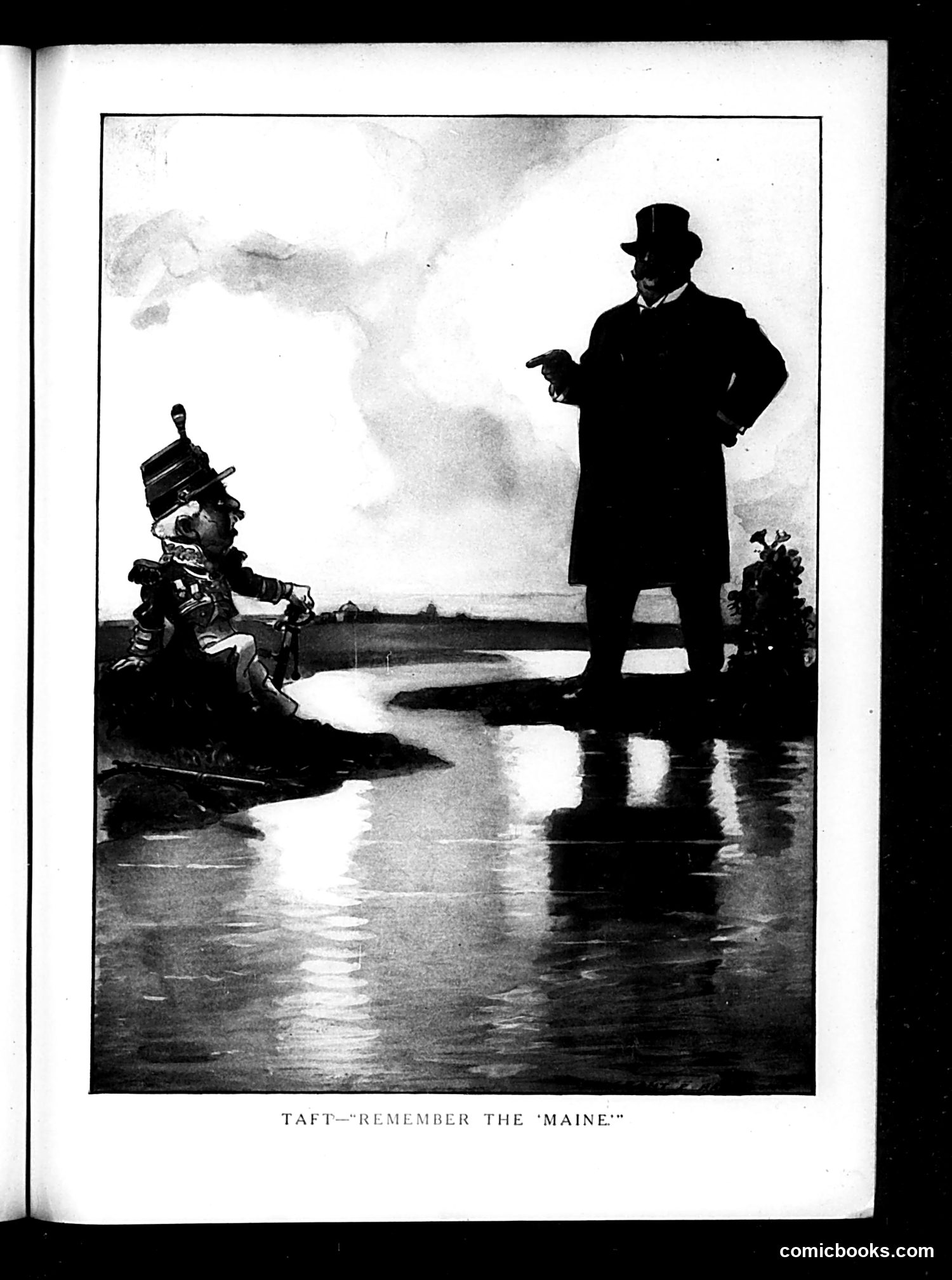
This cartoon references the USS Maine, a U.S. battleship that exploded in Havana harbor in 1898, killing 266 sailors. The incident became a rallying cry for American intervention in Cuba's independence war against Spain—"Remember the Maine" became a famous propaganda slogan. The tall figure in the bowler hat appears to be a political leader (likely President William McKinley or a similar authority figure) standing over what looks like a grave or memorial, with military figures flanking him. The silhouetted composition treats the Maine's loss as a somber, pivotal moment. The cartoon likely critiques how politicians exploited the tragedy to justify war, using it as emotional leverage to sway public opinion—a satirical commentary on using patriotic sentiment for political purposes.
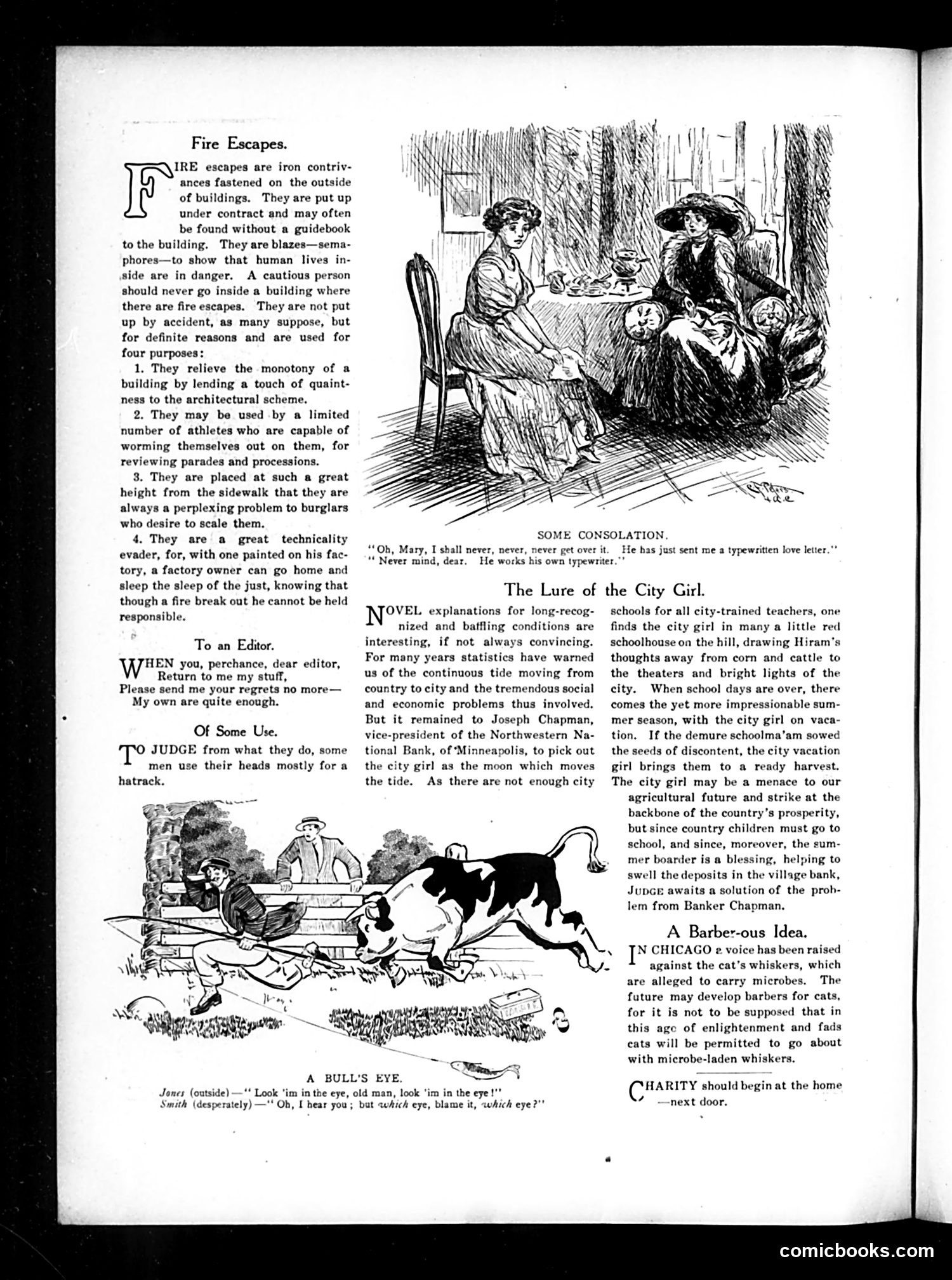
This page contains several brief satirical pieces typical of early 20th-century American humor: **"Fire Escapes"** sarcastically lists four "purposes" of fire escapes, the final being most cutting: that factory owners install them purely for legal protection—so they can sleep soundly knowing they cannot be held responsible if a fire breaks out. The joke critiques workplace safety negligence hidden behind compliance theater. **"The Lure of the City Girl"** discusses rural depopulation, blaming "city girls" who teach in country schools and vacation in towns, luring farm youth cityward. Banker Chapman apparently suggested this novel economic explanation. The satire mocks both rural anxiety about urbanization and the absurdity of blaming women for demographic shifts. **"A Barber-ous Idea"** jokes about a Chicago voice criticizing cats' whiskers as microbe-carriers, humorously predicting future cat-grooming services. The remaining items are brief gags about editors rejecting submissions, men using their heads as hatracks, and eye contact confusion. The overall tone is genteel mockery of contemporary social anxieties and bureaucratic absurdity.
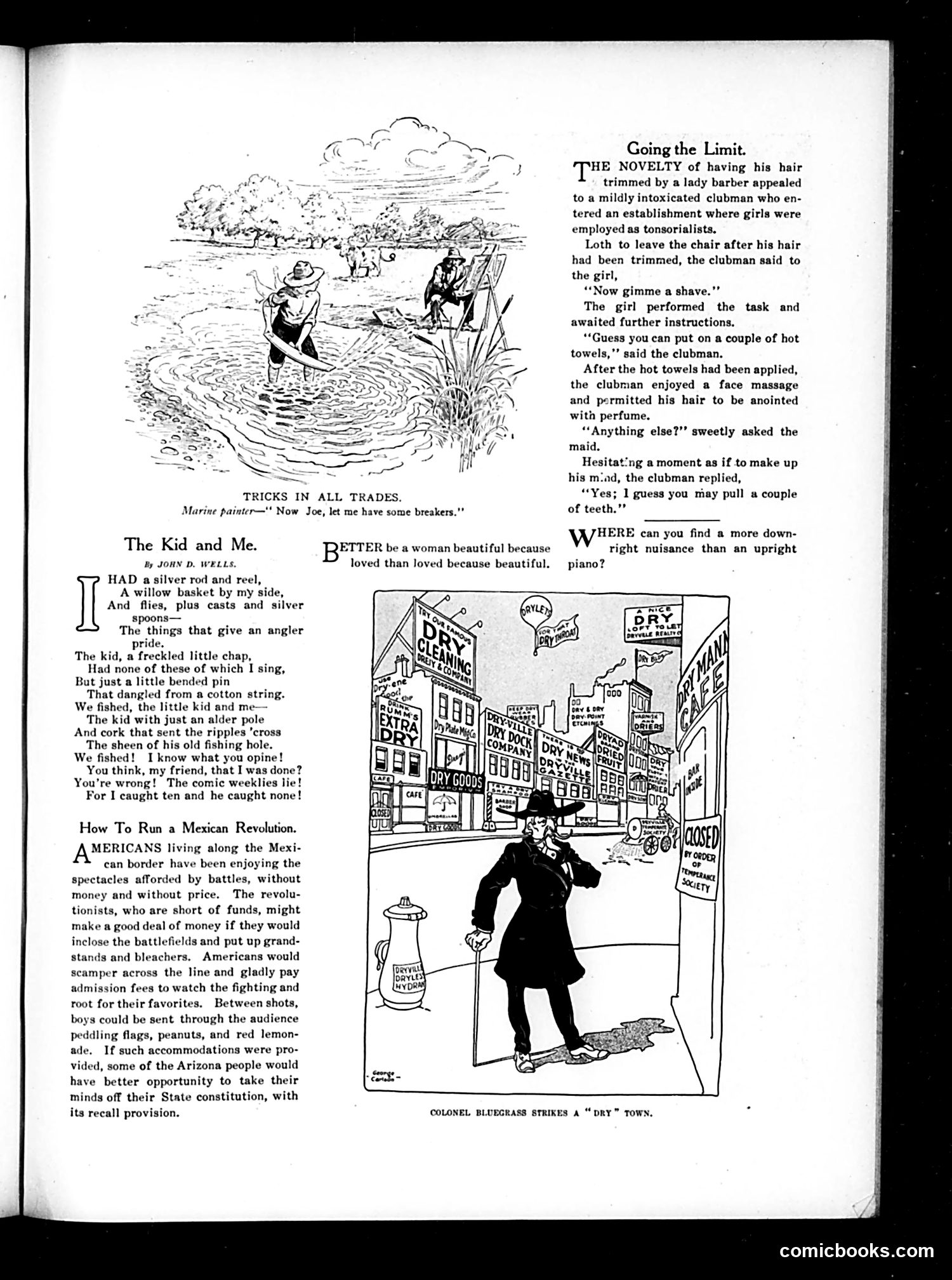
This Judge magazine page contains several satirical pieces: **"The Kid and Me"** mocks fishing story exaggeration—the narrator with expensive equipment loses to a boy with a bent pin and cotton string, subverting the expected outcome of such tales. **"How To Run a Mexican Revolution"** satirizes American spectacle-seeking and indifference during the Mexican Revolution (early 1900s border conflicts). The joke proposes treating battles as entertainment with admission fees and concessions, suggesting Americans care more about amusement than the actual suffering involved. The reference to Arizona's "recall provision" indicates contemporary political debate. **"Going the Limit"** depicts a drunk clubman at a female barber who keeps requesting additional services (shave, massage, cologne)—culminating in asking her to extract teeth. It satirizes intoxicated excess and the novelty/impropriety of women working in traditionally male grooming professions. **"Colonel Bluegrass Strikes a Dry Town"** (cartoon) shows a man confronting a prohibition-era ("dry") town, likely mocking resistance to alcohol bans. The page emphasizes American excess, class pretension, and changing social norms.
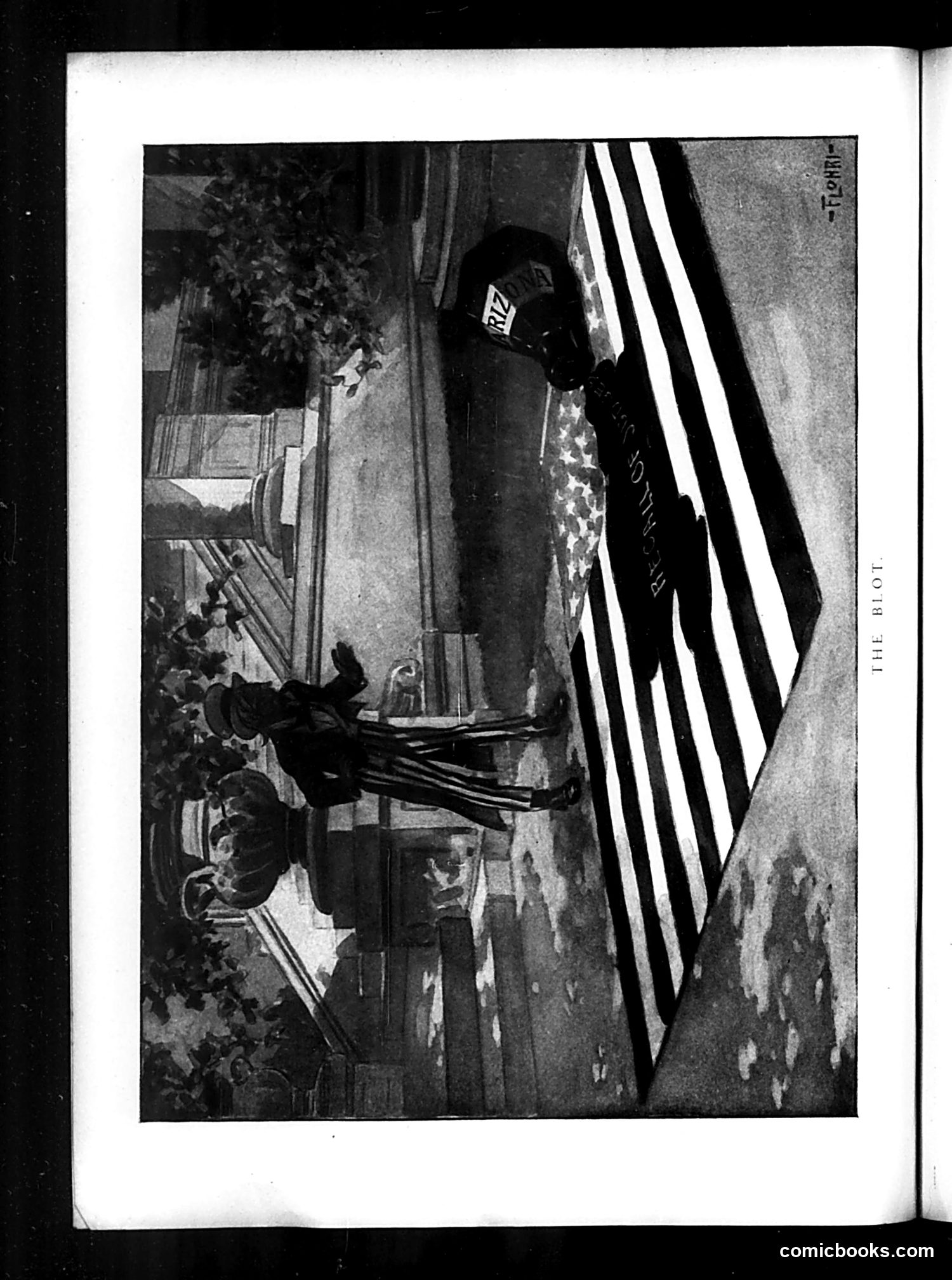
This page shows a black and white photograph rather than a drawn cartoon. The image depicts a figure in dark clothing standing next to an American flag. The caption reads "THE PLOT" (visible on the right margin). Without clearer context about which *Judge* issue this is from or additional OCR text explaining the caption, I cannot definitively identify the specific political or social reference. The title "THE PLOT" suggests this was meant to illustrate some contemporary scandal or conspiracy, but the photograph's subjects and the historical moment it references are unclear from the image alone. To provide accurate analysis, I would need either the publication date or accompanying article text explaining what "plot" is being referenced.
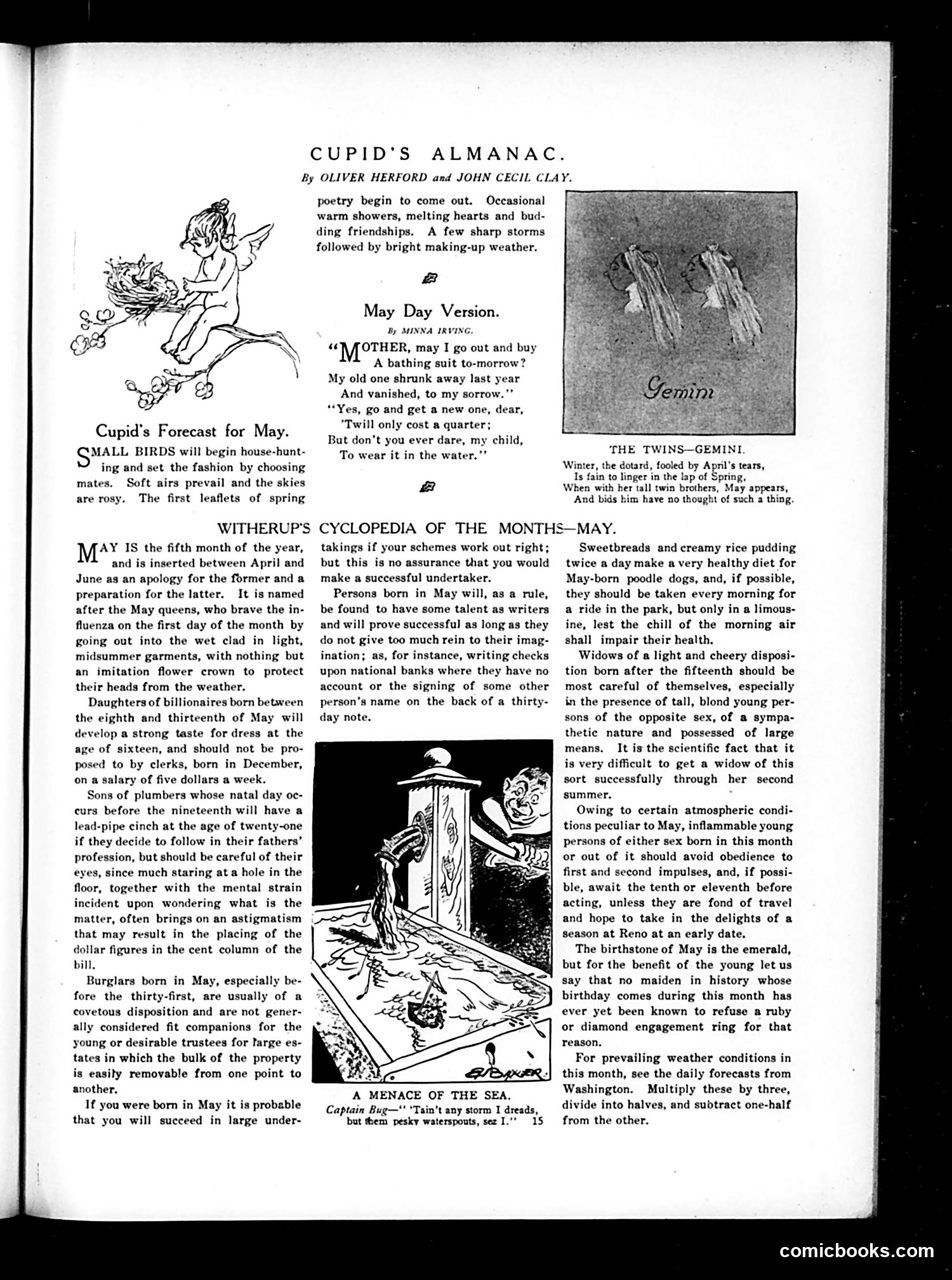
This is a humorous satirical piece parodying astrological almanacs and fortune-telling columns popular in the era. The page contains several interconnected jokes: **Main Content:** "Witherup's Cyclopedia of the Months—May" mocks absurd superstitions by offering ridiculous "scientific" predictions tied to birth dates. It warns that billionaires' daughters born mid-May will love dresses, plumbers' sons will succeed but develop eye strain from staring at holes in floors, and burglars born in May are untrustworthy—all presented as fact. **The Comedy:** The satire targets how people uncritically believed in astrology and pseudoscience. References to writing bad checks and forging signatures humorously suggest criminality as "predicted" traits. **Supporting Elements:** A "May Day Version" poem jokes about a child wanting to buy a bathing suit but being forbidden from actually wearing it in water. The cartoon "Menace of the Sea" features a captain fearing waterspouts—a pun on genuine nautical hazards. Overall, it's gentle mockery of fortune-telling culture and superstition through absurdist humor.
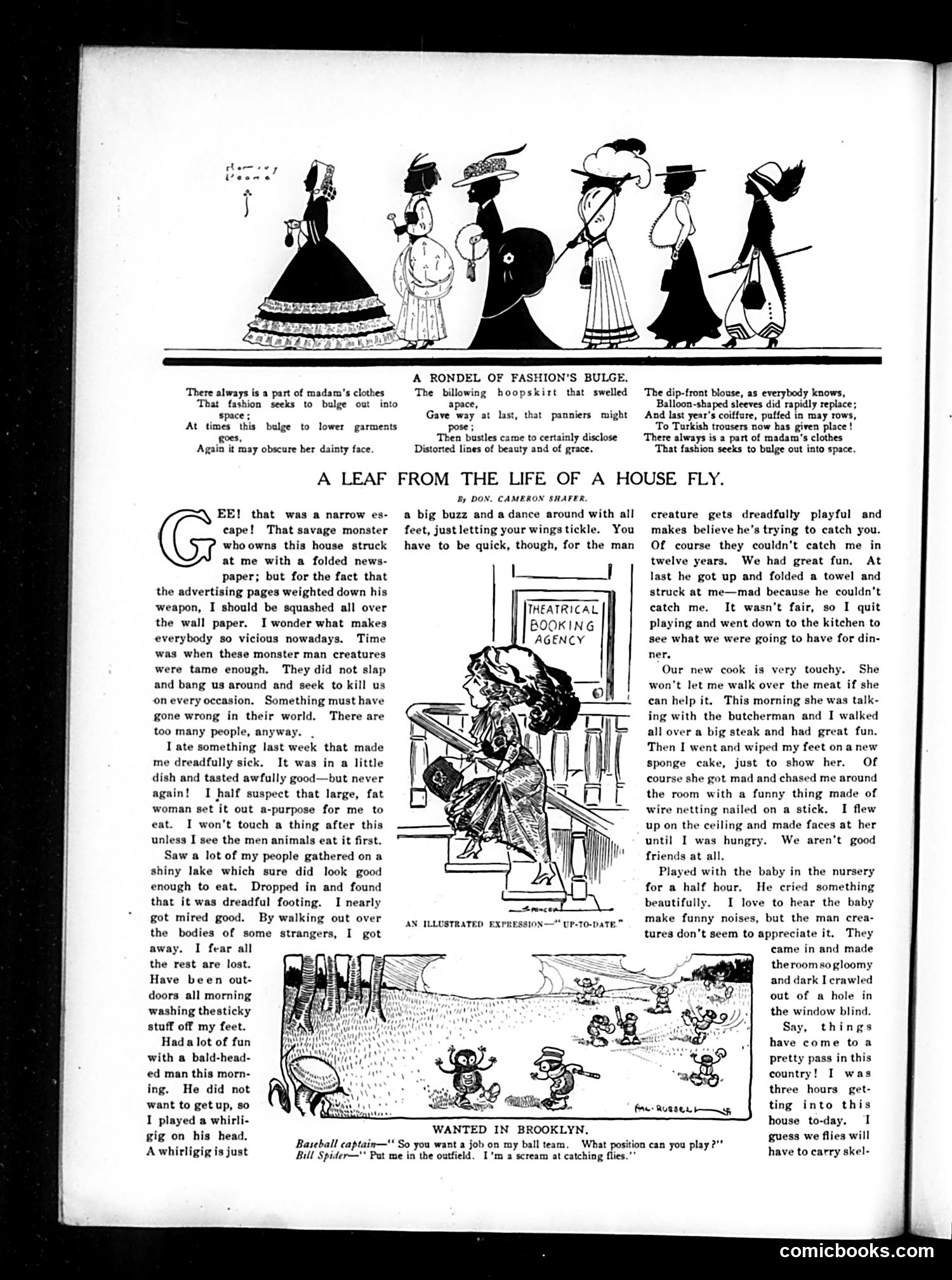
This Judge magazine page contains two satirical pieces: **"A Rondel of Fashion's Bulge"** (top) mocks women's fashion trends. The accompanying silhouettes show how different eras emphasized different bulging areas—hoopskirts, panniers, bustles, balloon sleeves—satirizing how fashion constantly reshapes the female body into awkward, exaggerated forms. The text notes fashion arbitrarily decides which body part should "bulge out into space." **"A Leaf from the Life of a House Fly"** is a first-person narrative from a fly's perspective, describing its domestic misadventures: nearly being swatted, causing mischief with a bald man, contaminating the cook's food, tormenting a baby. The humor derives from treating the fly's petty pranks and narrow escapes as dramatic adventures, while mocking human reactions to household pests. The baseball joke at bottom plays on "catching flies" (the sport) versus literally catching flies (the insect). Both pieces use anthropomorphism and exaggeration for humorous social commentary typical of Judge's satirical style.
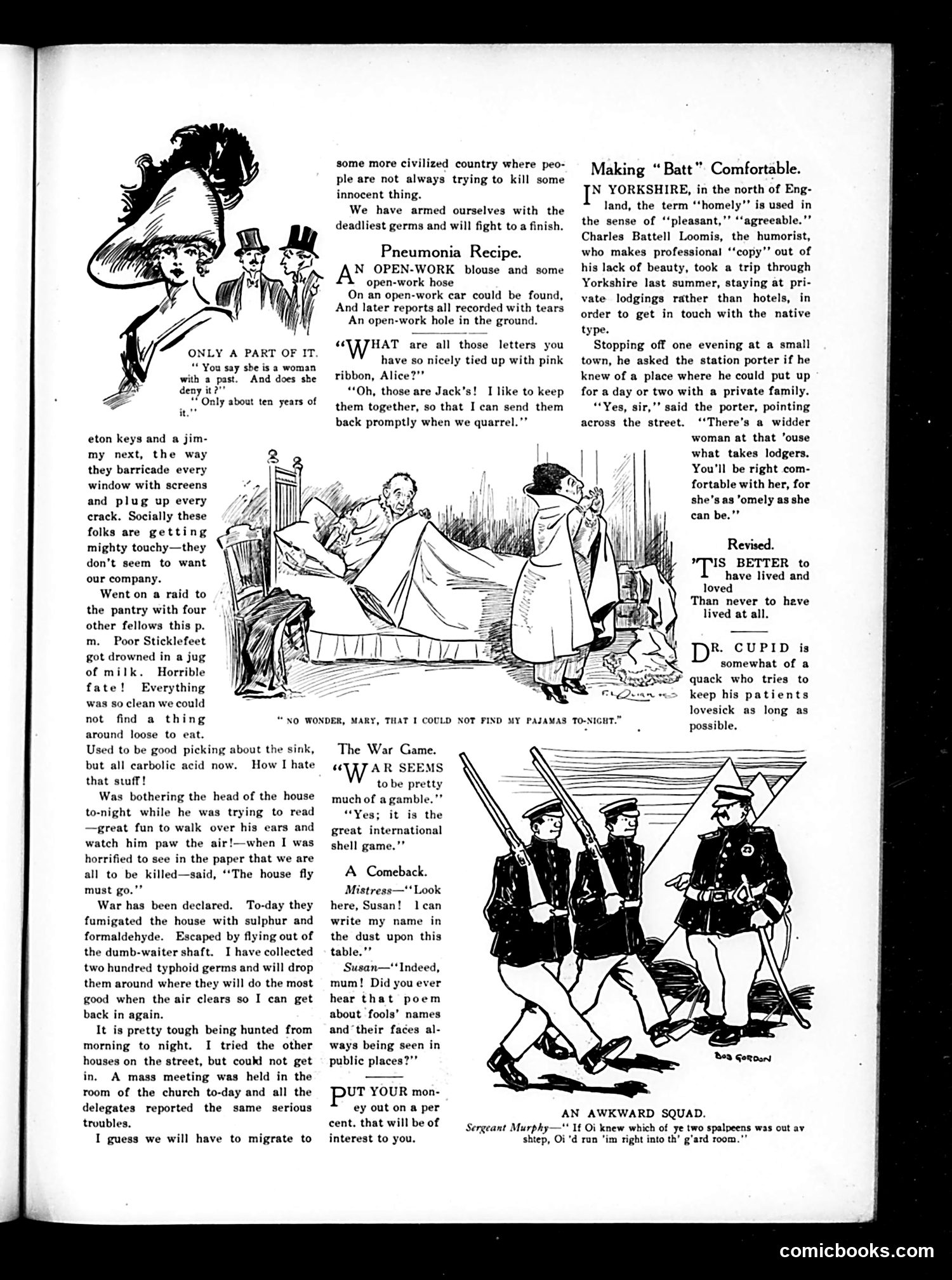
This page contains multiple satirical pieces typical of early 20th-century American humor: **"The War Game"** mocks World War I as mere gambling, comparing international conflict to a "shell game"—suggesting political leaders treat war as casually as a confidence trick. **The house fly monologue** personifies an insect declaring "war" after fumigation, satirizing human paranoia about disease and cleanliness while ironically having the fly boast of spreading typhoid germs—commentary on germ theory anxieties of the era. **"Making 'Batt' Comfortable"** features humorist Charles Battell Loomis visiting Yorkshire, where a landlady's regional dialect uses "homely" (meaning pleasant) to describe herself, creating a joke about linguistic differences between American and British English. **"An Awkward Squad"** shows military soldiers with an Irish sergeant unable to identify which soldier is out of step—mocking military incompetence and stereotyping Irish dialect. The cartoons and quips collectively ridicule war, social anxieties, linguistic confusion, and military inefficiency through exaggeration and wordplay.
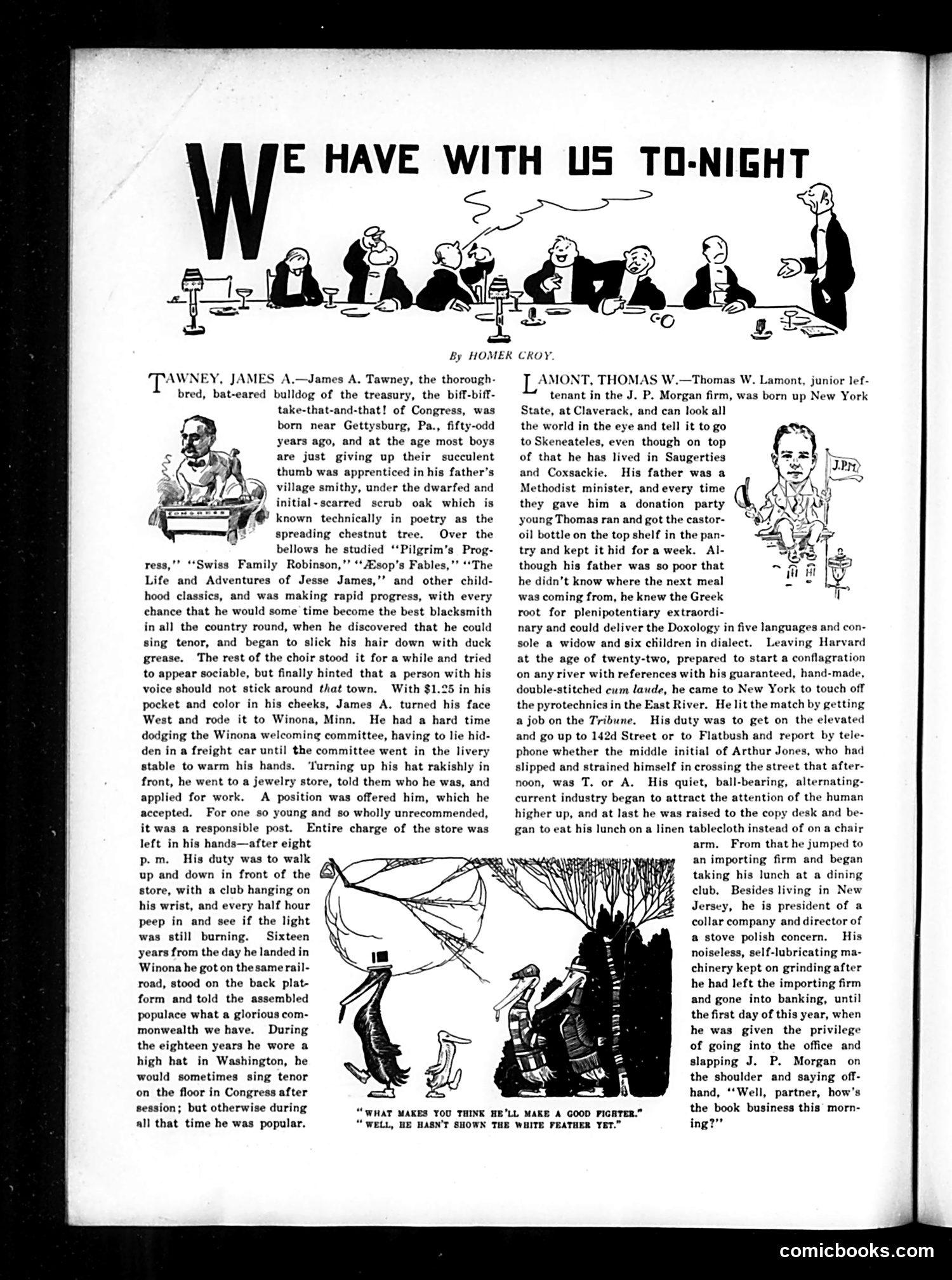
This page features satirical biographical sketches by Homer Croy of two prominent figures, likely from the early 1900s. **James A. Tawney** is portrayed as a self-made man—a former blacksmith's apprentice from Pennsylvania who became a powerful congressman ("bulldog of the treasury"). The satire mocks his humble origins and unlikely rise, particularly his failed singing career, presenting his success as improbable. **Thomas W. Lamont** is caricatured as a wealthy Manhattan banker (junior officer at J.P. Morgan) from upstate New York. The satire ridicules his privileged background masked as struggle—his Methodist minister father who was simultaneously impoverished yet erudite, able to deliver sermons in five languages. His entry into finance through the Tribune is presented as absurdly pointless busy-work. The bottom cartoon caption jokes about making "a good fighter"—the context suggests wartime (possibly WWI), with "hasn't shown the white feather" (cowardice) as the measure of manhood. The satire targets both self-made men and inherited privilege as worthy of mockery.
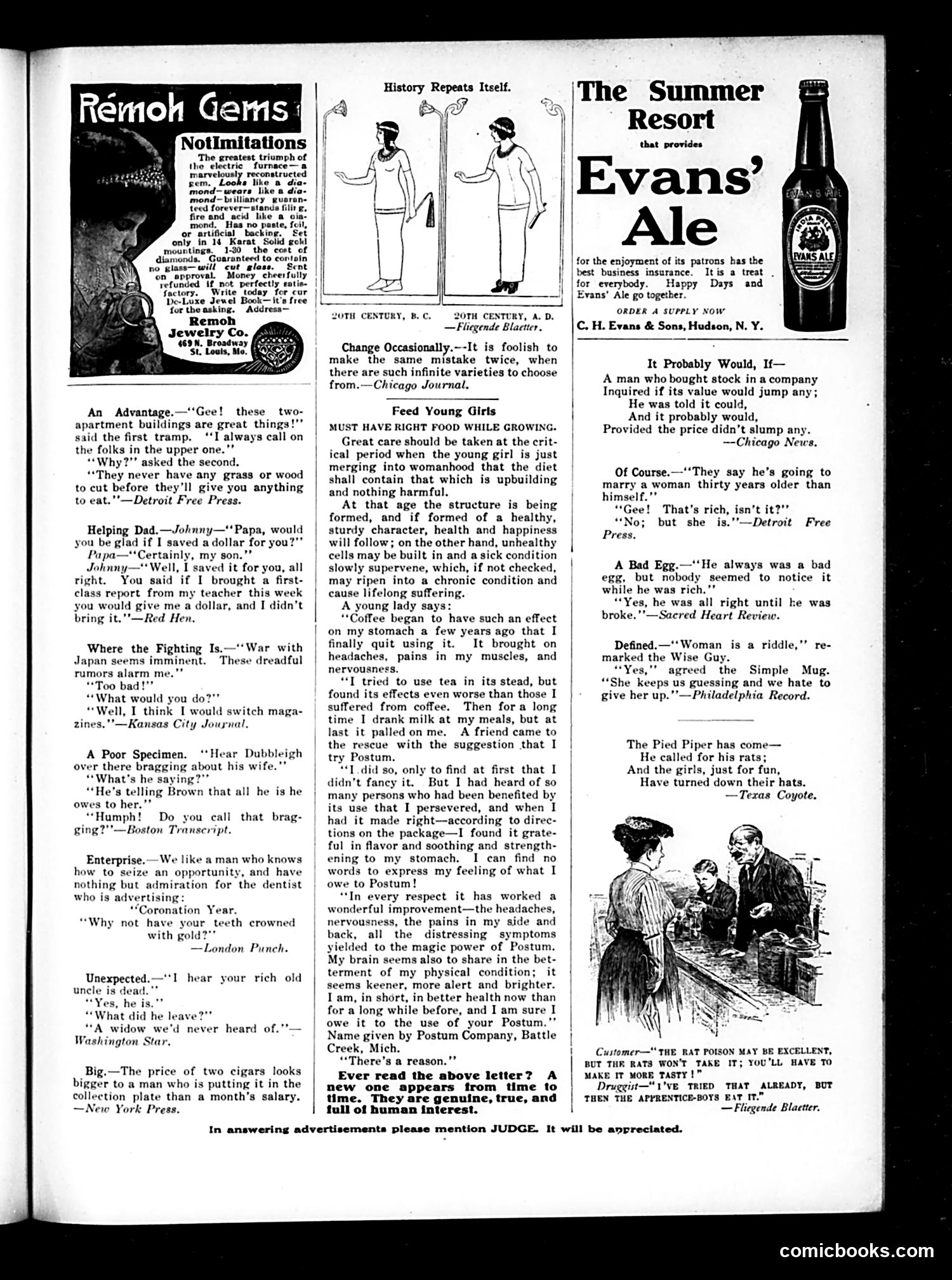
This page is primarily **advertising and humor columns** rather than political cartoons. The main content includes: **"History Repeats Itself"** cartoon shows two nearly identical figures from 20th century B.C. and A.D., satirizing human nature's unchanging folly across millennia—a common theme in satirical magazines. The page features **multiple short jokes** playing on domestic life, marriages, poverty, and social situations typical of early 20th-century American humor (tramps avoiding yard work, husbands crediting wives for their success, etc.). **Major advertising** dominates: Remoh Jewelry Company promotes synthetic gems as diamond alternatives, and Postum cereal advertises itself as a healthful coffee substitute through a testimonial letter from a young woman claiming it cured her headaches and nervousness. The **Postum ad reflects period anxieties** about women's health during adolescence and the era's promotion of patent medicines/commercial foods as cure-alls. The page illustrates Judge's typical blend of light social satire with commercial messaging.
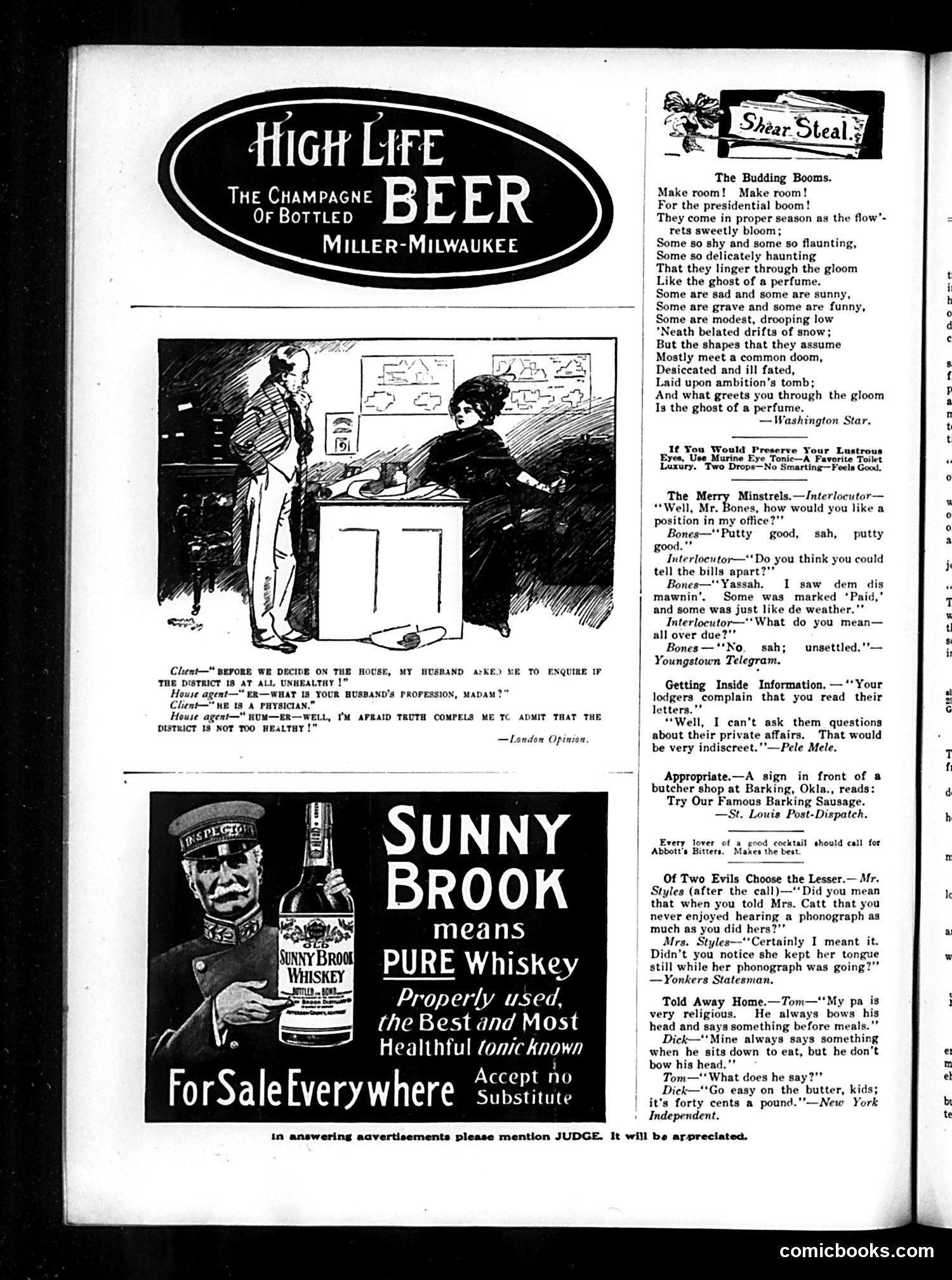
The main cartoon depicts a real estate agent confronting an awkward situation: a prospective buyer (a woman) asks if a neighborhood is healthy before purchasing. When she reveals her husband is a physician, the agent admits the district is actually *not* healthy—implying that a doctor would know better and wouldn't want to live there, or that the neighborhood's poor health would be good for a doctor's business. The joke hinges on the ironic conflict between the agent's sales pitch and professional honesty when dealing with someone who understands the area's actual conditions. The page is otherwise filled with period advertisements (High Life Beer, Sunny Brook Whiskey) and miscellaneous humor pieces typical of Judge magazine's satirical format—jokes about bills, phonographs, and family dinners that require no specific historical context to understand their basic comedic structure, though details of contemporary life they reference are now obscure.
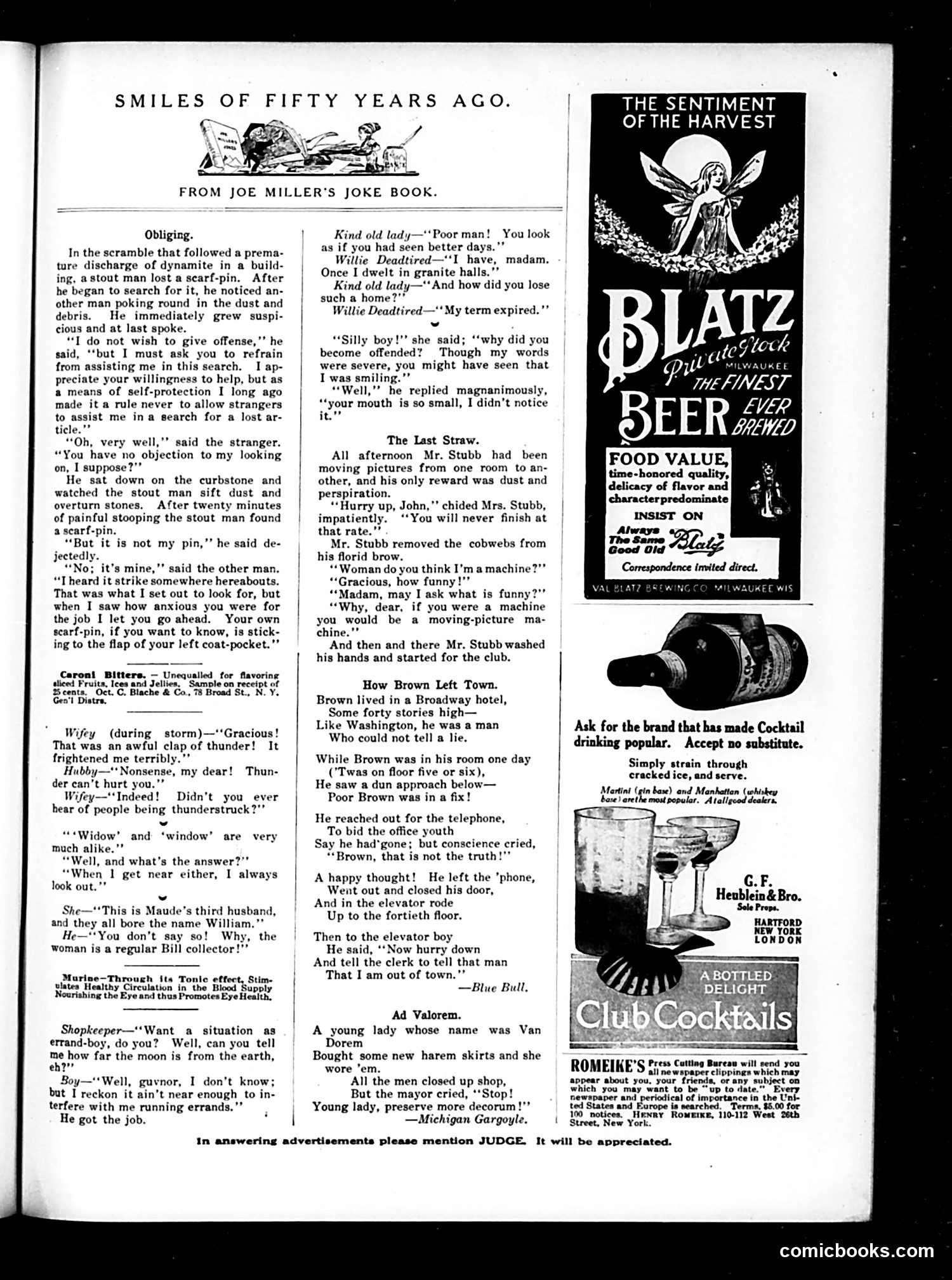
This page primarily contains **vintage jokes** reprinted from Joe Miller's 18th-century joke book, not original political satire. The humor relies on wordplay and situational comedy typical of that era. Notable jokes include: - A man searching for a lost pin, unknowingly helped by another searcher looking for his own - Puns on "widow" and "Bill collector" - A boy hired as errand-boy despite admitting ignorance of astronomy The page also features **period advertisements** for products like Carrol Bitters, Murine eye tonic, and Blatz beer—standard commercial content for Judge magazine. **No identifiable political figures or events** appear on this page. The satire is generic and timeless rather than topical. The content reflects early 20th-century humor sensibilities: gentle, pun-based, and focused on domestic situations rather than social commentary.
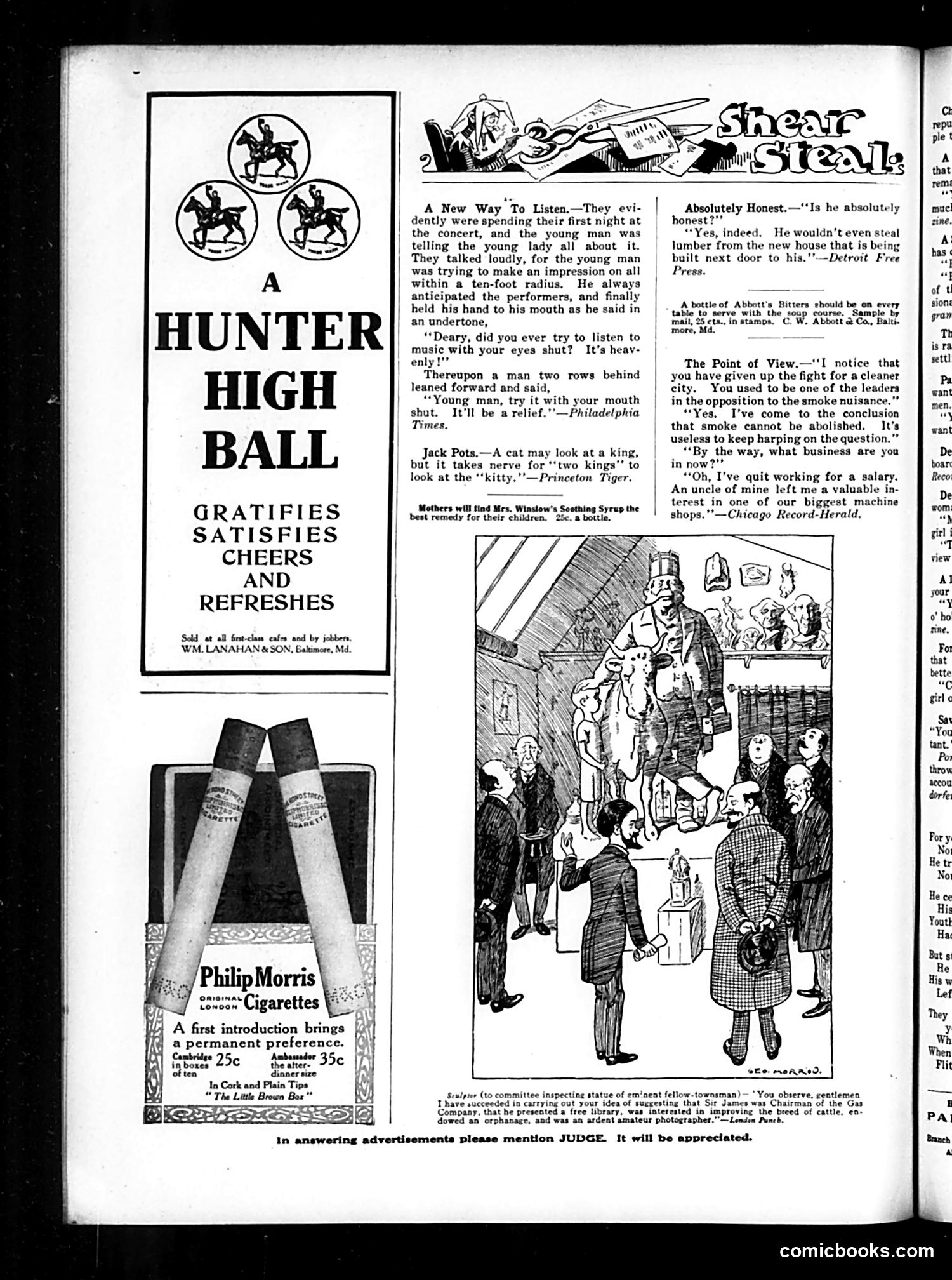
This page from *Judge* magazine contains several brief satirical anecdotes mocking social hypocrisy and annoying behavior: **"A New Way To Listen"** ridicules a young couple at a concert—the man loudly shows off to impress people nearby, then holds his hand to his mouth while speaking. A man behind suggests he try listening with his *mouth* shut instead, implying the young man is an obnoxious talker. **"The Point of View"** satirizes a man who abandoned civic activism. He previously fought pollution, but quit after his uncle's inheritance made him wealthy—revealing his reformism was performative, not principled. His silence on smoke now that he's rich exposes his selfish motivations. The page also includes period advertisements (Hunter High Ball liquor, Philip Morris cigarettes, patent medicines) and unrelated humorous quotes. The cartoons target pretension, self-interest masquerading as virtue, and social climbing—typical *Judge* magazine fare mocking American middle-class affectation.
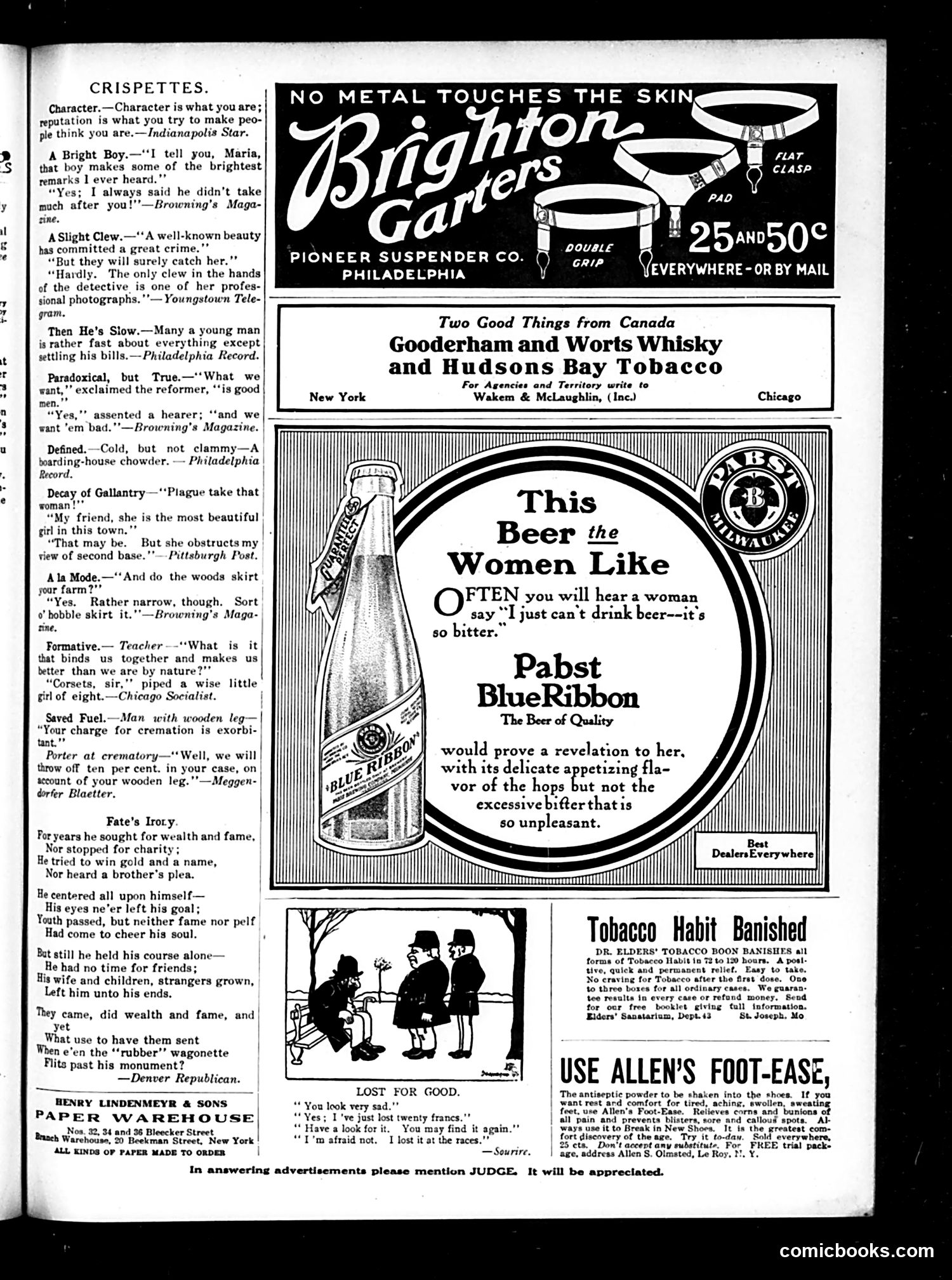
This page is primarily **advertisements and filler content** rather than political satire. The material consists of: **Short humorous definitions and quips** (top left) mocking various social types—vain women, slow young men, boarding-house food—typical Judge humor of the era. **Three major advertisements:** 1. **Brighton Garters** (top)—a suspender product with no metal touching skin 2. **Pabst Blue Ribbon beer** (center)—notably marketing to women by suggesting their complaint that beer is "too bitter" would be disproven by this gentler brew. This reflects early 1900s marketing attempting to expand beer consumption beyond traditional male audiences. 3. **Tobacco Habit Banished** and **Allen's Foot-Ease**—patent medicine ads typical of the period The **Pabst ad is most socially revealing**: it reflects attitudes about gender and consumption, implying women needed persuading to drink beer and that manufacturers should address female consumers' alleged preferences. No identified political figures or events appear on this page.
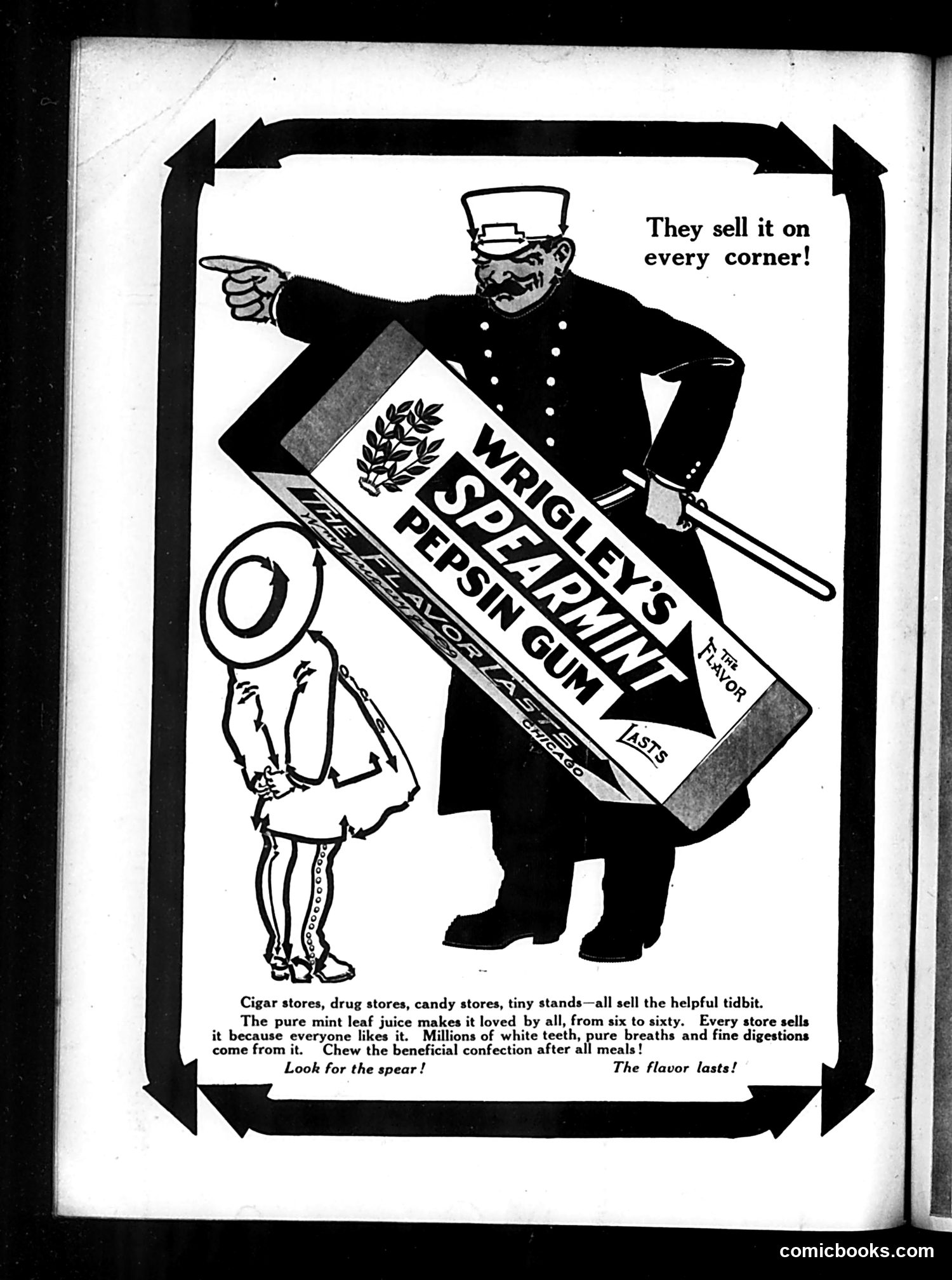
This is an advertisement for Wrigley's Spearmint Gum, not political satire. The uniformed figure (appearing to be a policeman or authority figure) enthusiastically promotes the product's ubiquitous availability and claimed health benefits—white teeth, fresh breath, and improved digestion. The small child figure represents the product's appeal across all ages ("from six to sixty"). The "spear" referenced is Wrigley's logo. This reflects early 20th-century advertising conventions that made exaggerated health claims for chewing gum, which was then marketed as a beneficial confection rather than mere candy. The imagery emphasizes the product's accessibility and universal popularity rather than making any political or social commentary.