
Judge, 1911-05-20 · page 18 of 24
Judge — May 20, 1911 — page 18: what you’re looking at
What you’re looking at
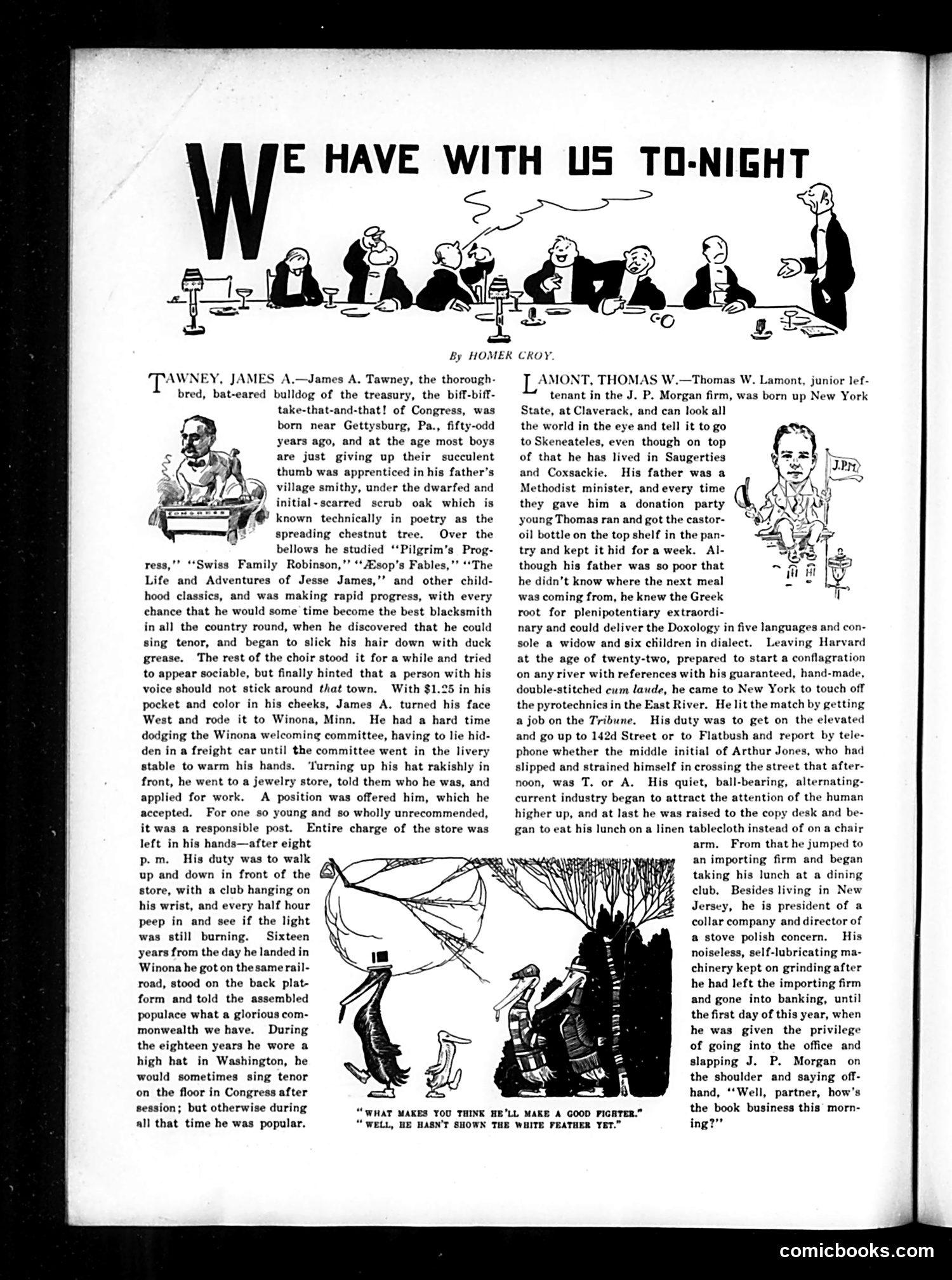
This page features satirical biographical sketches by Homer Croy of two prominent figures, likely from the early 1900s. **James A. Tawney** is portrayed as a self-made man—a former blacksmith's apprentice from Pennsylvania who became a powerful congressman ("bulldog of the treasury"). The satire mocks his humble origins and unlikely rise, particularly his failed singing career, presenting his success as improbable. **Thomas W. Lamont** is caricatured as a wealthy Manhattan banker (junior officer at J.P. Morgan) from upstate New York. The satire ridicules his privileged background masked as struggle—his Methodist minister father who was simultaneously impoverished yet erudite, able to deliver sermons in five languages. His entry into finance through the Tribune is presented as absurdly pointless busy-work. The bottom cartoon caption jokes about making "a good fighter"—the context suggests wartime (possibly WWI), with "hasn't shown the white feather" (cowardice) as the measure of manhood. The satire targets both self-made men and inherited privilege as worthy of mockery.
📄 Transcribed text from this page (OCR, searchable)
Machine-transcribed from the original scan — historical spelling and the odd misread are preserved.
E HAVE WITH US TO-NIGHT By HOMER CROY. ’, JAMES A.—James A. Tawney, the thorough- bred, bat-eared bulldog of the treasury, the biff-biff- take-that-and-that! of Congress, was born near Gettysburg, Pa., fifty-odd years ago, and at the age most boys are just giving up their succulent thumb was apprenticed in his father’s village smithy, under the dwarfed and | initial-scarred scrub oak which is known technically in poetry as the spreading chestnut tree. Over the bellows he studied ‘‘Pilgrim’s Prog- ress,’’ ‘‘Swiss Family Robinson,’’ ‘‘£sop’s Fables,’’ ‘‘The Life and Adventures of Jesse James,’’ and other child- hood classics, and was making rapid progress, with every chance that he would some time become the best blacksmith in all the country round, when he discovered that he could sing tenor, and began to slick his hair down with duck grease. The rest of the choir stood it for a while and tried to appear sociable, but finally hinted that a person with his voice should not stick around that town. With $1.25 in his pocket and color in his cheeks, James A. turned his face West and rode it to Winona, Minn. He had a hard time dodging the Winona welcoming committee, having to lie hid- den in a freight car until the committee went in the livery stable to warm his hands. ‘Turning up his hat rakishly in front, he went to a jewelry store, told them who he was, and applied for work. A position was offered him, which he accepted. For one so young and so wholly unrecommended, it was a responsible post. Entire charge of the store was left in his hands—after eight p.m. His duty was to walk up and down in front of the store, with a club hanging on his wrist, and every half hour peep in and see if the light was still burning. Sixteen years from the day he landed in Winona he got on thesame rail- road, stood on the back plat- form and told the assembled populace what a glorious com- monwealth we have. During the eighteen years he wore a high hat in Washington, he would sometimes sing tenor on the floor in Congress after session; but otherwise during all that time he was popular. “WHAT MAKES YOU THINK HE'LL MAKE A GOOD FIGATER.” “ WELL, HE HASN'T SHOWN THE WHITE FEATHER YET.” AMONT, THOMAS W.—Thomas W. Lamont, junior lef- tenant in the J. P. Morgan firm, was born up New York State, at Claverack, and can look all the world in the eye and tell it to go to Skeneateles, even though on top of that he has lived in Saugerties and Coxsackie. His father was a Methodist minister, andevery time they gave him a donation party young Thomas ran and got the castor- oil bottle on the top shelf in the pan- try and kept it hid for a week. Al- though his father was so poor that he didn’t know where the next meal was coming from, he knew the Greek root for plenipotentiary extraordi- nary and could deliver the Doxology in five languages and con- sole a widow and six children in dialect. Leaving Harvard at the age of twenty-two, prepared to start a conflagration on any river with references with his guaranteed, hand-made, double-stitched cum laude, he came to New York to touch off the pyrotechnics in the East River. He lit the match by getting a job on the Tribune. His duty was to get on the elevated and go up to 142d Street or to Flatbush and report by tele- phone whether the middle initial of Arthur Jones, who had slipped and strained himself in crossing the street that after- noon, was T. or A. His quiet, ball-bearing, alternating- current industry began to attract the attention of the human higher up, and at last he was raised to the copy desk and be- gan to eat his lunch ona linen tablecloth instead of on a chair arm. From that he jumped to an importing firm and began taking his lunch at a dining club. Besides living in New Jersey, he is president of a collar company and director of a stove polish concern. His noiseless, self-lubricating ma- chinery kept on grinding after he had left the importing firm and gone into banking, until the first day of this year, when he was given the privilege of going into the office and slapping J. P. Morgan on the shoulder and saying off- hand, ‘‘Well, partner, how's the book business this morn- ing?” comicbooks.com